



AI Accelerator Market Trends, Leading Companies, Company Revenue / Sales Performance, Subscriber Growth, Pricing Strategies, Cloud Adoption, Infrastructure Expansion, Competitive Landscape, and Industry Outlook
ICT industry specialist Gautam Mahajan estimates the AI accelerator market at USD 265.93 billion in 2026, with continued technology adoption expected to take the market to USD 1,215.98 billion by 2035 at a CAGR of 18.40%. Leading AI accelerator market providers such as NVIDIA, Broadcom, AMD,Marvell Technology are expanding their capabilities across segments including type, deployment, workload, region.
Source: https://www.precedenceresearch.com/ai-accelerator-market
 Get a Sample
 Report Description


AI Accelerator Market Trends, Share, and Growth Analysis 2035
The AI accelerator market is forecasted to expand from USD 265.93 billion in 2026 to USD 1,215.98 billion by 2035, growing at a CAGR of 18.40% from 2026 to 2035.
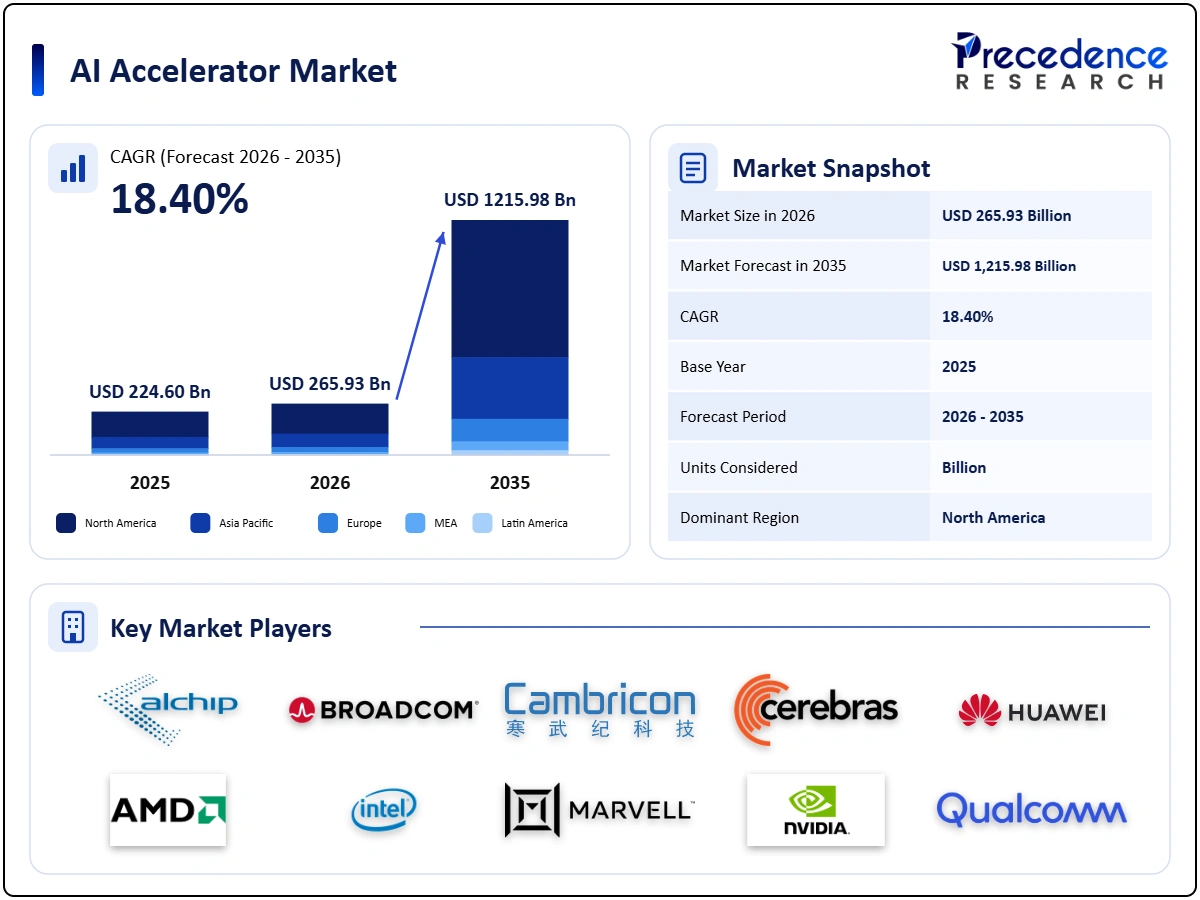 Key Takeaways
Market Size & Growth Outlook
- Market Size in 2025: USD 224.60 Billion
- Estimated Market Size in 2026: USD 265.93 Billion
- Projected Market Size by 2035: USD 1,215.98 Billion
- CAGR (2026-2035): 18.40%
Regional Market Spotlight
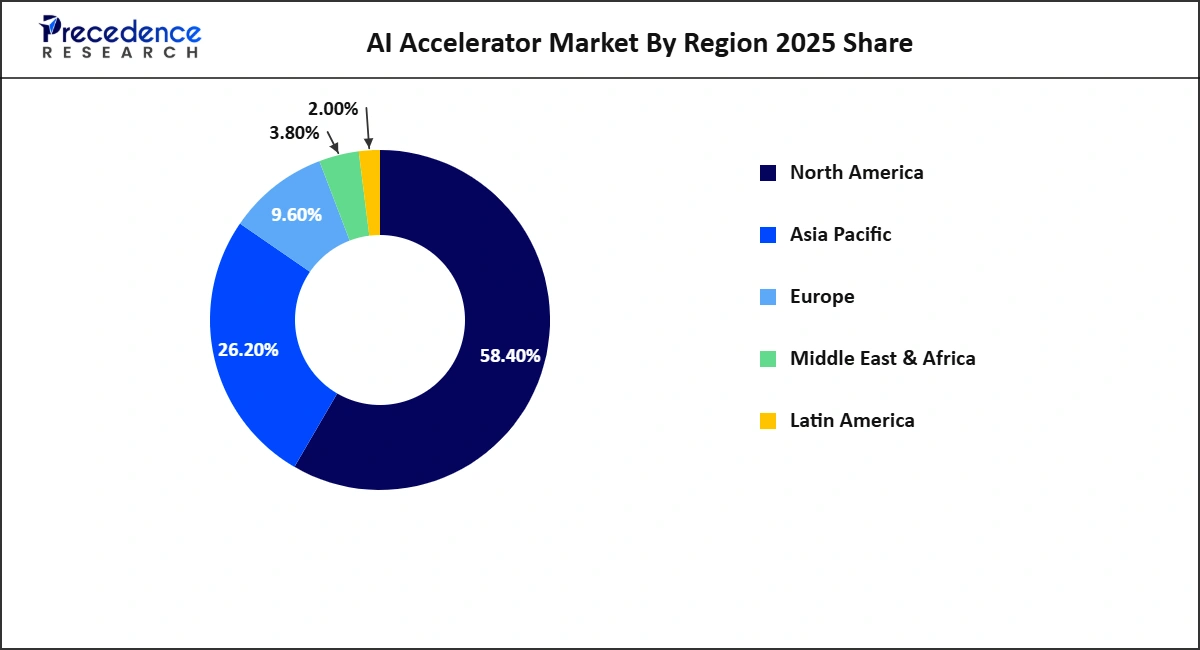
- North America led the market with a 58.40% share and was valued at USD 131.17 billion in 2025.
- Asia Pacific accounted for 26.20% (USD 58.85 billion) of the market share in 2025 and is projected to be the fastest-growing region, at a CAGR of 20.07% from 2026 to 2035.
- Europe captured a 9.60% share and generated USD 21.56 billion of revenue in 2025.
Segmental Spotlight
- By type, the GPU segment captured a share of 74.60% (USD 167.55 billion) in 2025.
- By deployment, Data Center accounted for an 89.40% share and reached USD 200.79 billion in 2025.
- By workload, the Training segment held 52.60% of the market share (USD 118.14 billion) in 2025.
AI Accelerator Market Size and Forecast, 2025-2035 (USD Billion)
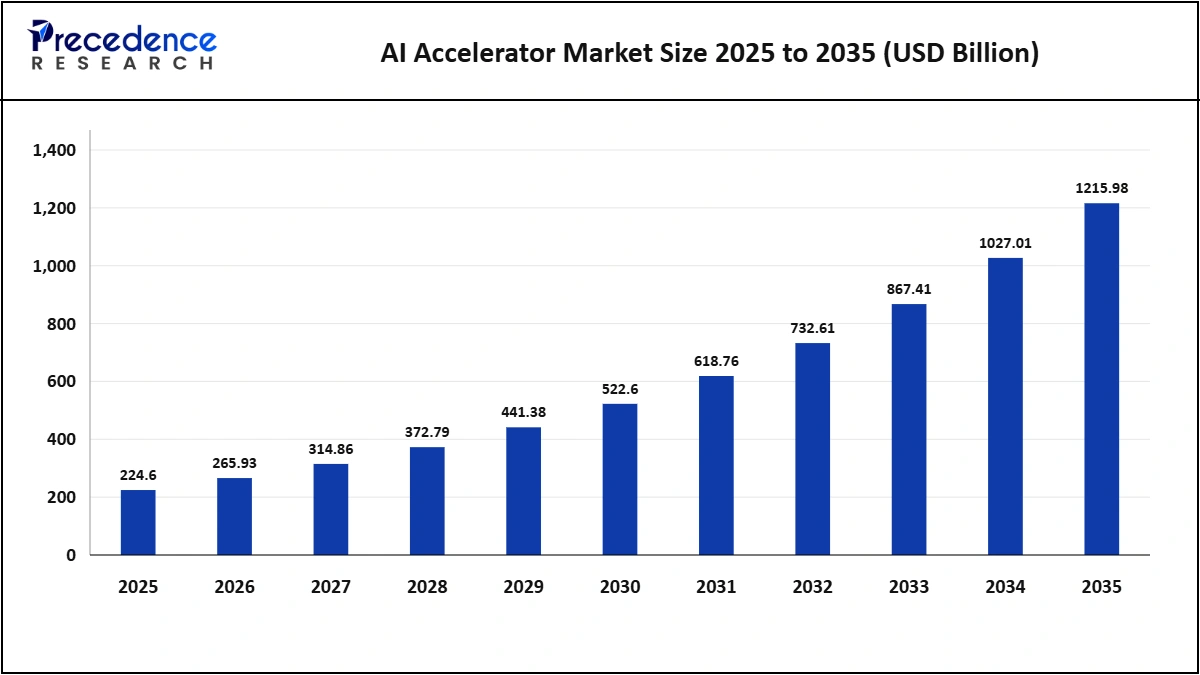
Note: 2025 is the base year; 2026-2035 values are forecasts.
Sources: Expert interviews, secondary sources, Precedence Research database, and Precedence Research analysts.
The global AI accelerator market is projected to grow from USD 224.60 billion in 2025 to USD 1,215.98 billion by 2035 because cloud providers, AI developers, enterprises, and governments are building data centers at unprecedented scale to train and serve generative AI models, and every new AI service needs accelerator capacity. The shift from training to large-scale inference, together with AI moving into PCs, phones, vehicles, and robots, broadens demand, lifting the market to USD 522.60 billion by 2030 and sustaining a CAGR of 18.40% from 2026 to 2035.
- Analyst View: The market is poised for strong growth, driven by expanding AI infrastructure investments, rising inference workloads, and the integration of AI across edge devices. Growing demand from cloud providers, enterprises, and governments is expected to accelerate the market expansion. The growth rate reflects continuing AI infrastructure investment, moderated by power availability, supply constraints, and falling cost per unit of compute.
Market Trends
- Annual GPU and accelerator product cycles.
- Hyperscale custom ASICs scale in volume.
- Rack-scale systems replace single servers.
- Inference overtakes training in compute demand.
- HBM and advanced packaging capacity limit supply.
- Sovereign AI programs add national demand.
Drivers, Restraints, and Opportunities
Driver
Generative AI model training and inference require large accelerator clusters. Cloud providers and AI developers are committing to multi-gigawatt data center build-outs. Reasoning and agentic models increase compute per query. Governments fund sovereign AI capacity. AI is spreading into PCs, phones, vehicles, and robots.
Restraint
Power availability and grid connections limit data center growth. Supply of HBM (High Bandwidth Memory) and advanced packaging is constrained. Export controls restrict sales to some markets. Accelerators are very expensive, and return on AI investment is uncertain. Rapid product cycles shorten asset lives.
Opportunity
Inference at scale creates demand for efficient, lower-cost accelerators. Custom silicon partnerships expand the market for design services. Edge AI in devices and vehicles opens new volume segments. Sovereign AI and emerging-market data centers add regional demand. Optical interconnect and liquid cooling enable larger systems.
Market Segmentation: 2025 Share and Value
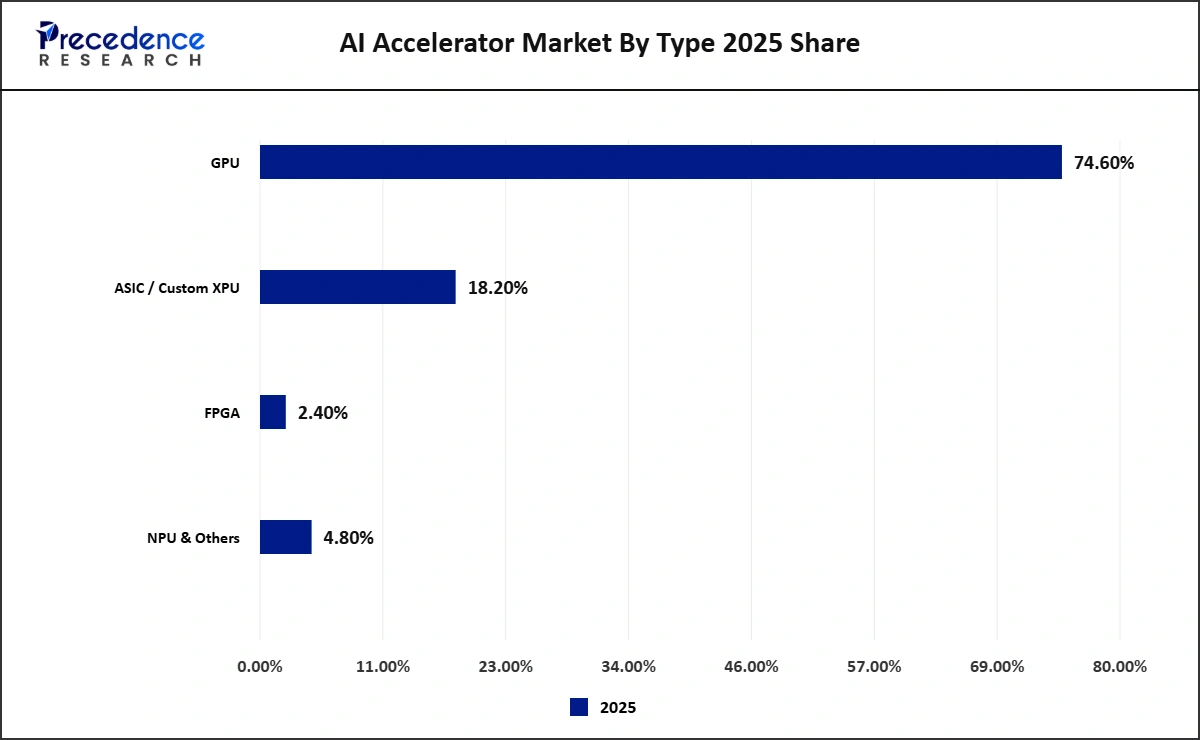
AI Accelerator Market By Type 2025 Share
Note: 2025 is the base year.
Sources: Expert interviews, secondary sources, Precedence Research database, and Precedence Research analysts.
By type, GPUs accounted for a 74.60% share (USD 167.55 billion) in 2025 because they combine high memory bandwidth, flexible programming through mature software ecosystems, and rack-scale systems that link dozens of GPUs into a single computer. ASIC / custom XPU, at 18.20% share and valued at USD 40.88 billion, is the fastest-growing type segment as hyperscalers deploy their own tensor processing units and training and inference chips, often co-designed with semiconductor partners, to lower cost per workload.
FPGAs accounted for a 2.40% share (USD 5.39 billion) and are used for low-latency inference and networking. NPUs and others accounted for a 4.80% share in 2025 (USD 10.78 billion), covering edge, PC, and embedded AI processors.
AI Accelerator Market By Deployment 2025 Share & Size
| Segments | 2025 Share | 2025 Market Value |
| Data Center | 89.40% | USD 200.79 billion |
| Edge & Devices | 6.20% | USD 13.93 billion |
| Automotive | 4.40% | USD 9.88 billion |
Note: 2025 is the base year.
Sources: Expert interviews, secondary sources, Precedence Research database, and Precedence Research analysts.
Data centers dominate with the largest share of 89.40%, reaching USD 200.79 billion in 2025 because large AI clusters for training and cloud inference absorb most accelerator spending. Edge & devices accounted for a 6.20% share (USD 13.93 billion), including AI PCs, smartphones, industrial systems, and robots, while the automotive segment held a 4.40% share and reached USD 9.88 billion in 2025, covering driver assistance and autonomous driving computers. Edge and automotive are growing as AI models move closer to users.
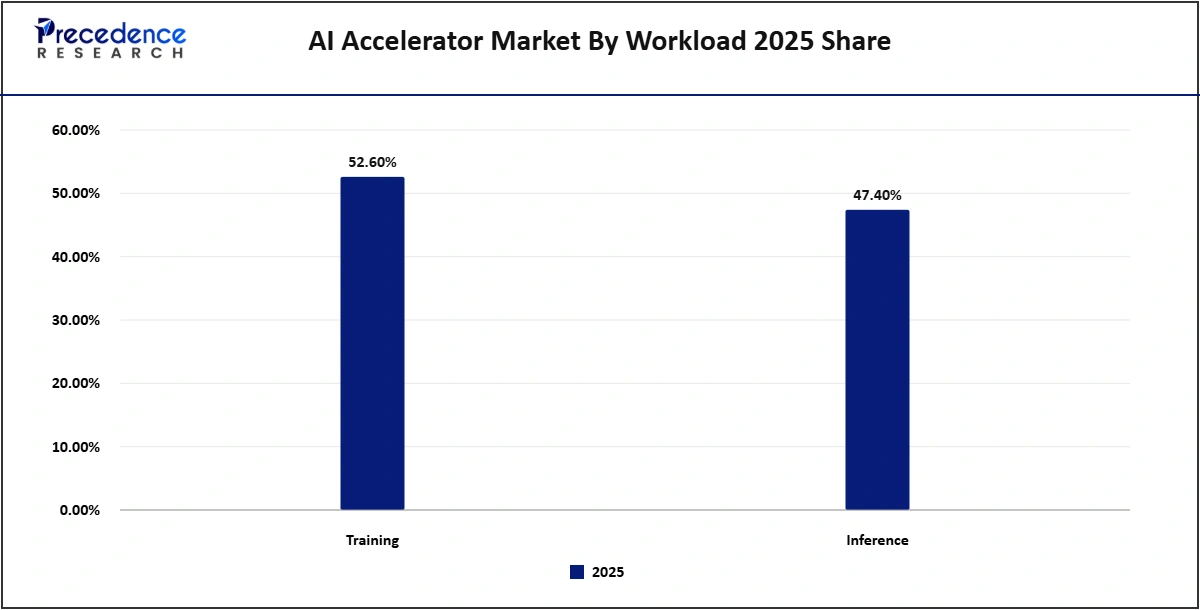
AI Accelerator Market By Workload 2025 Share
Note: 2025 is the base year.
Sources: Expert interviews, secondary sources, Precedence Research database, and Precedence Research analysts.
By workload, the training segment held the largest share of 52.60% and generated USD 118.14 billion in 2025 because frontier and foundation model developers continue to build larger clusters. Inference accounted for 47.40% (USD 106.46 billion) of the market share in 2025 and is the fastest-growing workload segment as chatbots, agents, search and enterprise applications serve billions of requests, and reasoning models use more compute per query.
- Analyst View: GPU is the leading AI accelerator type because of its flexibility, high performance, and established software ecosystem. Data centers dominate deployment, supported by growing demand for AI training and cloud-based inference, while edge devices and automotive applications expand as AI processing moves closer to end users. We expect custom ASICs, inference, and edge deployment to gain share over the forecast period.
Regional Analysis
AI Accelerator Market By Region 2025 Share
Note: 2025 is the base year.
Sources: Expert interviews, secondary sources, Precedence Research database, and Precedence Research analysts.
North America accounted for a 58.40% share and was valued at USD 131.17 billion in 2025 because the largest cloud providers, AI model developers, and neoclouds are building multi-gigawatt AI data centers in the United States. Asia Pacific, at 26.20% (USD 58.85 billion), is the fastest-growing region, supported by cloud and AI investment in China, Japan, South Korea, Taiwan, India, and Southeast Asia and by domestic accelerator development in China. Europe held 9.60% share (USD 21.56 billion) and is supported by sovereign AI and supercomputing programs. The Middle East & Africa, at 3.80% of the market share, reaching USD 8.53 billion in 2025, is supported by large AI campus projects in the Gulf, while Latin America held 2.00% share (USD 4.49 billion) in 2025.
North America dominated the market with 58.40% share (USD 131.17 billion) in 2025. Hyperscalers, OpenAI, Anthropic, xAI, and neocloud providers are deploying large numbers of accelerators per site. Most leading accelerator designers are based in the United States.
Asia Pacific accounted for a 26.20% share (USD 58.85 billion) in 2025 and is the fastest-growing region. China is scaling domestic accelerators from Huawei, Cambricon, and others under export controls, while Japan, South Korea, India, and Southeast Asia are expanding AI data centers and sovereign AI capacity.
Europe held a 9.60% share in 2025, reaching USD 21.56 billion in the base year. EU AI factories, national supercomputers, and telecom operators building AI clouds support the demand, although power costs and grid access constrain the market growth.
The Middle East & Africa accounted for a 3.80% share and was valued at USD 8.53 billion in revenue in 2025. Saudi Arabia and the UAE are building large AI campuses with U.S. technology partners.
The Latin America region held a 2.00% share (USD 4.49 billion) in 2025. Cloud region expansion in Brazil, Mexico, and Chile supported the market demand.
Analyst View: Regional shares were built from data center deployments, cloud capacity, and accelerator shipments by region. North America leads because of hyperscale AI investment. We expect Asia Pacific to have the highest growth premium because domestic accelerator programs and AI data center construction are expanding fastest in this region.
Competitive Landscape
Top Companies in the AI Accelerator Market, 2025
| Rank | Company Name | Market-Specific Revenue (USD Billion) | 2025 Share | Key Products / Business | Headquarters |
| 1 | NVIDIA | 158.00 | 70.35% | Blackwell and Rubin GPUs, rack-scale systems | United States |
| 2 | Broadcom | 13.50 | 6.01% | Custom AI accelerators (XPUs) | United States |
| 3 | Huawei (HiSilicon) | 7.80 | 3.47% | Ascend AI processors | China |
| 4 | AMD | 7.20 | 3.21% | Instinct MI300 and MI350 GPUs | United States |
| 5 | Marvell Technology | 1.60 | 0.71% | Custom AI ASICs | United States |
| 6 | Qualcomm | 1.20 | 0.53% | Cloud AI and edge NPUs | United States |
| 7 | Cambricon | 1.00 | 0.45% | Siyuan AI chips | China |
| 8 | Alchip Technologies | 1.00 | 0.45% | AI ASIC design and supply | Taiwan |
| 9 | Intel | 0.90 | 0.40% | Gaudi AI accelerators | United States |
| 10 | Cerebras Systems | 0.40 | 0.18% | Wafer-scale AI systems | United States |
Note: Company revenues and shares are 2025 estimates.
Sources: Company press releases, expert interviews, secondary sources, Precedence Research database, and Precedence Research analysts.
NVIDIA led the AI accelerator market with 70.35% share (USD 158.00 billion) of 2025 revenue, followed by Broadcom at 6.01% (USD 13.50 billion) and Huawei at 3.47% (USD 7.80 billion). NVIDIA leads through its GPU architectures, CUDA software ecosystem, and rack-scale systems that hyperscalers and AI developers deploy at massive scale. Broadcom designs custom accelerators for Google and other hyperscalers and AI developers, while Huawei supplies Ascend processors that are the main domestic alternative in China. AMD is growing with its Instinct GPUs, and Marvell Technology, Qualcomm, Cambricon, Alchip Technologies, Intel, and Cerebras Systems compete in custom silicon, edge and cloud inference, domestic Chinese markets, and wafer-scale systems.
The top 10 players accounted for 85.75% share and reached USD 192.60 billion of 2025 revenue, while the remaining 14.25% (USD 32.00 billion) was shared among startups, FPGA suppliers, edge AI chip makers, and automotive processor vendors. The AI accelerator market is highly concentrated, and competition centers on performance per watt, memory bandwidth, interconnect and rack-scale integration, software ecosystems, supply of advanced packaging and high-bandwidth memory, and total cost of ownership. Hyperscaler custom silicon and export controls are reshaping supplier positions.
Companies Ecosystem
The AI accelerator ecosystem links chip designers and custom silicon partners with foundries, memory and packaging suppliers, server and system builders, cloud providers and AI developers. Supply of advanced packaging and high-bandwidth memory is a key constraint.
| Ecosystem Stage | Role in the Market | Key Companies |
| Chip Designers | Design GPUs, custom ASICs, FPGAs, and NPUs | NVIDIA, AMD, Broadcom, Marvell, Huawei, Intel, Qualcomm, Cambricon |
| Foundry, Memory & Packaging | Manufacture chips, supply HBM and advanced packaging | TSMC, Samsung, SK hynix, Micron, ASE, Amkor |
| Systems & Servers | Build AI servers and racks | Foxconn, Quanta, Wistron, Dell, Supermicro, HPE |
| Cloud & Neocloud Providers | Deploy accelerators and sell AI compute | AWS, Microsoft, Google, Oracle, CoreWeave, Alibaba Cloud |
| End Users | Train and run AI models and applications | OpenAI, Anthropic, Meta, xAI, enterprises, governments |
Sources: Company press releases, expert interviews, secondary sources, Precedence Research database, and Precedence Research analysts.
Precedence Research Companies Quadrant
The Precedence Research Companies Quadrant positions key participants in the AI accelerator market by market strength, reflecting revenue scale, market share and geographic reach, and by innovation and growth strategy, reflecting product portfolio breadth, R&D intensity and partnerships. Positions reflect each company's estimated 2025 AI accelerator revenue and our assessment of its architecture roadmap, software ecosystem, and customer partnerships.
Sources: Company press releases, expert interviews, secondary sources, Precedence Research database, and Precedence Research analysts.
Leaders: NVIDIA, Broadcom, Huawei (HiSilicon), and AMD combine large AI accelerator revenue with strong roadmaps, software ecosystems, and hyperscaler partnerships.
Challengers: Marvell Technology and Intel have significant semiconductor scale and established customers but a smaller AI accelerator roadmap or customer base.
Innovators: Qualcomm and Cerebras Systems bring differentiated inference and wafer-scale architectures that are winning new customers.
Niche Players: Cambricon and Alchip Technologies serve domestic or design-service segments of the market.
Recent Developments
- January 2026: NVIDIA unveiled the Rubin AI computing platform, comprising six new chips, with AWS, Google Cloud, Microsoft Azure, and Oracle Cloud expected to be among the first cloud providers to deploy Rubin-based instances in 2026.
- December 2025: NVIDIA entered a non-exclusive licensing agreement with Groq for AI inference technology. While bringing Groq's founder, president, and other team members into NVIDIA to support the development and scaling of AI inference capabilities.
- December 2025: Broadcom reported fiscal 2025 AI semiconductor revenue of USD 20 billion and an AI backlog of USD 73 billion, driven by strong demand for custom AI accelerators and networking solutions.
- October 2025: OpenAI and Broadcom announced a strategic collaboration to deploy 10 gigawatts of custom AI accelerators designed by OpenAI. Integrated with Broadcom's networking technologies to support next-generation AI infrastructure.
- October 2025: AMD and OpenAI announced a partnership to deploy 6 gigawatts of AMD Instinct GPUs for next-generation AI infrastructure, starting with MI450 systems in the second half of 2026.
AI Accelerator Market Segments
By Type
- GPU
- ASIC / Custom XPU
- FPGA
- NPU & Others
By Deployment
- Data Center
- Edge & Devices
- Automotive
By Workload
- Training
- Inference
By Region
- North America (U.S., Canada, Mexico)
- Europe (Germany, U.K., France, Italy, Spain, Rest of Europe)
- Asia Pacific (China, Japan, India, South Korea, Taiwan, Rest of Asia Pacific)
- Latin America (Brazil, Argentina, Rest of Latin America)
- Middle East & Africa (GCC, South Africa, Rest of MEA)
Research Methodology
The AI accelerator market was defined as GPUs, custom ASICs, FPGAs, and NPUs designed for AI training and inference in data centers, edge devices, and vehicles, worldwide. The 2025 base year was built bottom-up from accelerator shipments by type and deployment and average selling prices, and checked top-down against the AI accelerator revenue disclosed by leading chip designers. Segment, regional and company values were allocated from accelerator types, deployments, workloads and regional demand. Key estimates were verified by cross-checking company disclosures, regulatory and industry data and published third-party estimates, and inputs that could not be reconciled were excluded. All segment, regional and company figures were reconciled to the same 2025 base year, and the 2026-2035 forecast, which applies a constant CAGR from the 2025 base, was recalculated and validated.
Analyst View: Overall Market
The AI accelerator market is the core of AI infrastructure spending and is growing rapidly as AI developers and cloud providers scale training and inference. Our estimate links demand to shipments, prices, and company disclosures, so the forecast follows AI capital spending and the transition to new accelerator generations. The main upside comes from inference growth and custom silicon, while the main risks are power constraints, export controls, and the sustainability of AI investment.
Sources and References
- “NVIDIA Kicks Off the Next Generation of AI With Rubin”. January 2026. Data center revenue and Rubin platform. (Source: nvidianews.nvidia.com)
- Groq and Nvidia Enter Non-Exclusive Inference Technology Licensing Agreement, December 2025. (Source: groq.com)
- Broadcom Inc. Announces Fourth Quarter and Fiscal Year 2025 Financial Results and Quarterly Dividend. (Source: investors.broadcom.com)
- OpenAI and Broadcom announce strategic collaboration, October 2025. (Source: openai.com)
- AMD and OpenAI announce strategic partnership, October 2025. https://openai.com/index/openai-amd-strategic-partnership
For inquiries regarding discounts, bulk purchases, or customization requests, please contact us at sales@precedenceresearch.com
Frequently Asked Questions





Ask For Sample
No cookie-cutter, only authentic analysis – take the 1st step to become a Precedence Research client
 Get a Sample




 sales@precedenceresearch.com
 Schedule a Meeting
