


AI Agents Market Size, Key Companies, Company Market Share, User Adoption, Technology Deployment, Revenue Growth, Competitive Positioning, and Demand Forecast
The global AI agents market is estimated at USD 11.55 billion in 2026 and is projected to reach USD 294.66 billion by 2035, growing at a 43.57% CAGR over 2026–2035. Growth comes from enterprise adoption of autonomous workflow execution, multi-agent orchestration, computer-use capabilities, coding agents, customer-service automation, and intelligent business-process management. Demand for productivity gains, workflow automation, enterprise data integration and agent-enabled decision-making is speeding up deployment across technology, financial services, healthcare, retail, manufacturing, and professional services. The report evaluates agent architectures, applications, deployment models, technology maturity, adoption patterns, competitive positioning, pricing economics and emerging opportunities.
Source: https://www.precedenceresearch.com/ai-agents-market
 Get a Sample
 Table Of Content


What is the AI Agents Market Size in 2026?
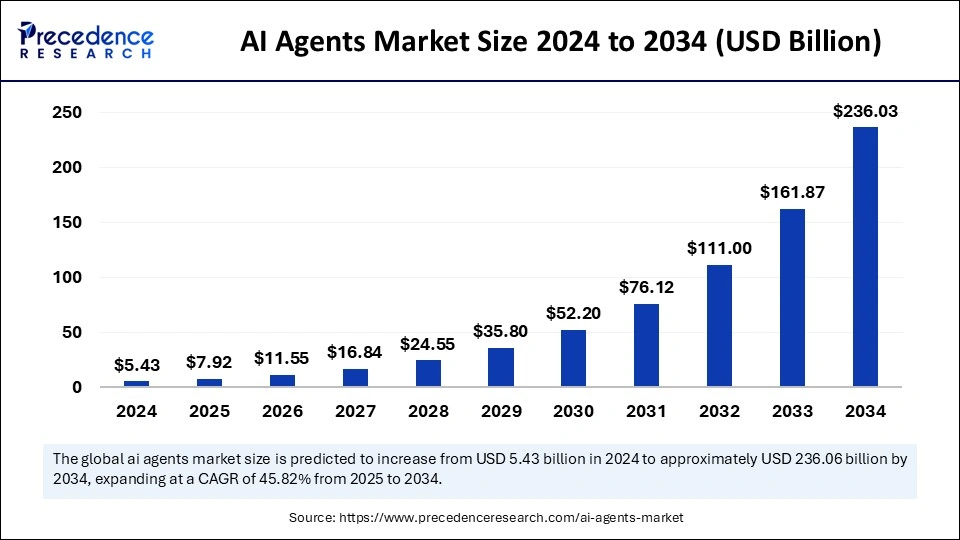
The global AI agents market size is predicted to increase from USD 11.55 billion in 2026 to approximately USD 294.66 billion by 2035, expanding at a CAGR of 43.57% from 2026 to 2035. The ongoing revolution in enterprises, with the emphasis over automation in large-scale industries is seen to promote the market s growth in the foreseen period.
Key Takeaways
- Enterprises are moving from AI assistants toward autonomous systems that can run multi-step workflows.
- Vertical AI agents are the fastest-growing offering category because they bring domain knowledge, specialized workflows, and a closer fit with enterprise use cases.
- North America is the largest regional market, backed by AI infrastructure, enterprise adoption, developer ecosystems and heavy technology investment.
- Asia Pacific is a high-growth region, driven by digital transformation and rising enterprise AI and automation investment.
- Multi-agent architectures let specialized agents divide tasks and coordinate workflows, which suits complex enterprise processes.
- Computer-use capabilities let agents work directly with applications, websites, and files, beyond conversation.
- Memory, tool calling, retrieval, observability and interoperability are becoming essential layers for reliable, persistent agents.
- Fully autonomous deployment remains limited because organizations are still working through security, governance, reliability, and permission issues.
- Pricing is moving beyond subscriptions toward usage-, API-, task- and outcome-based models.
- Advantage is shifting from standalone model quality to execution reliability, integration depth, workflow ownership, security, and deployment scale.
- The long-term opportunity depends on turning pilots into production deployments with measurable gains.
Overview
AI Agents Ready to Move Enterprise AI from Assistance to Autonomous Execution?
In a Gartner survey of 360 IT application leaders conducted in May and June 2026,75% said their organizations were piloting, deploying, or had already deployed some form of AI agent. Only 15% said they were considering, piloting, or deploying fully autonomous agents. (CIO Dive)
AI agents differ from conventional software because value moves from seats to task execution, workflow completion, and consumption. Revenue is increasingly tied to API calls, inference, completed tasks, usage, transactions and outcomes, not only per-user subscriptions. North America is the largest regional revenue pool, while Asia Pacific is among the fastest-growing regions as enterprise digitization, cloud adoption and AI infrastructure investment pick up.
The full analysis sizes the market by horizontal versus vertical agents, single-agent versus multi-agent architectures, agent role, deployment model, enterprise size, application, industry, and geography. It also examines the economics of agent-hours, task volumes, inference consumption, tool calls, autonomous actions, and agent-managed transactions.
Key Coverage
- North America as the largest regional market
- Vertical and industry-specific agents among the fastest-expanding segments
- Customer service, software development, IT operations, sales, and knowledge work as major application pools
- Increasing shift from seat-based software toward usage-, task-, and outcome-linked monetization
- Significant gap between AI-agent experimentation and fully autonomous production deployment
Segmentation Analysis
Which Agent Segments are Growing Fastest, and Why are Vertical Agents Gaining Ground?
The market is segmented by agent type, architecture, role, deployment, application, industry, customer size and geography. Horizontal agents hold a large share of demand today because they serve general productivity, research, knowledge work, and employee assistance. Vertical agents are growing quickly because enterprises want domain-specific controls, workflows, and access to proprietary data.
The highest-value applications include software development, customer service, IT operations, sales, marketing, finance, research, and supply-chain workflows. Coding and software-engineering agents stand out because they can work across repositories, terminals, testing environments and development tools, and do more than generate text.
The report quantifies revenue, adoption, CAGR, and contribution across single-agent and multi-agent systems, hosted and self-managed deployments, API/platform and application layers, and industry verticals including financial services, healthcare, technology, retail, manufacturing, and professional services.
Key Coverage
- Horizontal versus vertical agents
- Single-agent versus multi-agent architectures
- Productivity, coding, sales, customer service, and IT agents
- Cloud versus on-premise/private deployments
- Enterprise versus SMB adoption
- Industry-specific revenue pools
- Largest and fastest-growing application segments
Market Dynamics
Enterprises Want Completed Work, but Autonomy Brings New Cost and Risk
The demand driver is the move from AI-assisted activity to AI-executed workflows. Enterprise customers want systems that can retrieve information, reason over it, use tools, carry out transactions and return finished outputs with little intervention.
Autonomy also brings new costs and risks. Agents can need far more inference and tool execution than chat interactions, and long-running workflows open the door to prompt injection, excessive permissions, data leakage, wrong actions, and unpredictable execution paths. As a result, the workable commercial model is bounded autonomy with human approval gates, restricted automation.
Enterprise surveys point to strong interest. In a 2025 survey released by UiPath, 93% of IT executives at U.S. companies with USD 1 billion or more in revenue said they were extremely or very interested in agentic AI, and 37% said they were already using it in some form. The gap between interest and scaled deployment is one of the market's largest near-term opportunities.
Key Coverage
- Enterprise automation demand
- Productivity and labor-efficiency economics
- AI inference and execution costs
- Adoption barriers
- Security and governance requirements
- Human-in-the-loop deployment
- Multi-agent orchestration
- Agentic commerce and transaction execution
Pricing Analysis
How Should Agent Platforms Be Priced When Costs Vary with Every Task?
Agent pricing is fragmenting across per-seat subscriptions, API consumption, inference usage, task-based pricing, platform fees, workflow execution, and outcome-based models. Traditional enterprise software can charge hundreds of dollars per employee each year. Agent platforms add variable costs through model tokens, tool calls, browser or computer use, data retrieval, and execution time.
That creates a basic pricing problem. An agent that completes 500 tasks may create more economic value than a software seat, but it may also use far more compute. The full report models cost per task, cost per successful workflow, inference intensity, gross-margin potential, platform fees, human-review costs, and customer ROI.
Key Coverage
- Per-seat versus consumption pricing
- API and inference economics
- Cost per task/workflow
- Premium pricing for vertical agents
- Platform versus application monetization
- Gross-margin implications
- Outcome-based and transaction-linked models
- Regional and enterprise pricing differences
Demand-Supply & Infrastructure
Agents Need More Than Models, and Infrastructure Demand is Rising Fast
Demand is growing for model inference, orchestration, vector databases, enterprise data connectors, security controls, and execution environments. Agents need more than model access. They also need memory, identity, permissions, tool calling, observability, evaluation, sandboxing, and persistent state.
On the supply side, vendors are moving from model APIs to complete agent runtimes. Development platforms now offer web search, file search, computer use, code execution, memory, tracing, and multi-agent orchestration. Amazon Bedrock AgentCore's SDK passed 2 million downloads within five months of its July 2025 preview, according to AWS, which shows how fast developers are adopting infrastructure built to run production-grade agents. (Amazon)
The report maps how agent workloads relate to inference demand, infrastructure cost, deployment scale, and execution reliability.
Key Coverage
- Agent inference demand
- Model and API supply
- Runtime infrastructure
- Tool and connector ecosystem
- Compute intensity
- Latency and reliability
- Agent execution capacity
- Enterprise deployment economics
Value Chain & Supply Chain
Where in the Agent Value Chain is Value Concentrating?
The AI-agent value chain runs from foundation models to inference infrastructure, agent runtimes, orchestration, data and connectors, security and observability, vertical agents, enterprise workflows, and finally end users and transactions.
Value is concentrating around proprietary enterprise data, workflow integration, and control of execution environments. A model alone can be replaced. An agent embedded in finance, CRM, development, procurement, or customer-service workflows creates much higher switching costs.
The full report quantifies the economics of each layer, including model costs, orchestration fees, integration costs, deployment expenses and potential margin pools.
Key Coverage
- Agent technology stack
- Model-to-application economics
- Data and connector layer
- Orchestration and runtime
- Security and observability
- Distribution economics
- Margin pools and bottlenecks
Technology & Innovation
Which Technologies Will Turn AI Agents Into Autonomous Enterprise Systems?
AI agents are moving beyond prompt-based assistance toward systems that can plan, call tools, keep memory, use computers, and carry out multi-step tasks on their own. Multi-agent architectures matter here because specialized agents can split complex workflows between them, instead of relying on one general-purpose agent. Interoperability standards are central to this shift. Anthropic's Model Context Protocol (MCP) is widely used to connect agents to tools and data, with client support in products such as ChatGPT, Gemini, Microsoft Copilot, and Visual Studio Code. Google's Agent2Agent (A2A) protocol, announced in April 2025 with more than 50 technology partners, covers agent-to-agent coordination and is designed to complement MCP. (The New Stack) Developer interest is high. Monthly downloads of the MCP Python and TypeScript SDKs combined reached about 97 million by March 2026, up from roughly 2 million at launch in November 2024. (AI2Work)
The key shift is from model intelligence to execution capability. Better reasoning alone does not make an agent commercially valuable. The bigger opportunity appears when models can reliably reach enterprise data, call tools, keep context, operate software interfaces, and finish measurable workflows. Computer use, multi-agent orchestration, persistent memory, standard tool protocols and agent evaluation are likely to be the main differentiators. Competitive advantage may depend more on execution reliability, integration depth, security, and observability than on model performance alone.
This shift widens the addressable market from AI assistance to autonomous digital work. Coding, IT operations, customer service, research, sales operations, and knowledge management are areas where more capable agents can carry out several steps and do more than make recommendations. Greater autonomy also raises the risk of wrong actions, prompt injection, excessive permissions, data leakage, and unpredictable workflows. Evaluation, monitoring, identity, access controls and human approval are therefore essential for enterprise use. Vendors that pair autonomy with measurable reliability and governance are better placed to win recurring enterprise spending as production deployments grow.
The report assesses LLM-based agents and related technologies, including multi-agent architecture and memory frameworks, highlighting their level of development and adoption. It features technology maturity and adoption benchmarks, including product launches and partnerships, across experimental and enterprise-level technologies. The report also includes a technology database where users can filter and compare the different technologies according to key factors such as maturity and application.
Key Coverage
- LLM-based agents
- Multi-agent orchestration
- Computer-use agents
- Agent memory
- MCP and tool protocols
- Agent-to-agent interoperability
- Observability and evaluation
- Autonomous coding
- Agent security
Regulation & Sustainability
Governance is Becoming a Core Product Feature as Agents Gain Permission to Act
AI agents are exposed to an increasing number of regulatory constraints regarding general-purpose AI, transparency, data privacy, cybersecurity, autonomous decision-making, and high-risk applications. Under the proposed European AI Act, obligations regarding general-purpose AI models will apply from August 2025. Requirements for transparency of artificial intelligence systems engaged in interpersonal communication or content creation will become mandatory in selected cases from August 2026, with a transition period until.
December 2026 for labelling AI-generated content in systems already on the market. (Winston Taylor) High-risk obligations were postponed by the Digital Omnibus on AI, which entered into force in July 2026. They now apply from December 2027 for stand-alone high-risk systems and from August 2028 for AI built into regulated products. (Usercentrics)
The regulatory question is changing. It used to be whether an AI answer was accurate. It is now who is responsible when an AI system takes an action on its own. That creates demand for audit trails, permissions, human approval, model evaluation, incident reporting, and agent identity controls.
Key Coverage
- AI governance
- Privacy and data sovereignty
- Transparency requirements
- Cybersecurity
- Agent permissions
- Auditability
- Human oversight
- Liability and accountability
- Energy and inference efficiency
Customer & Application Analysis
Which Workflows Are Companies Handing to AI Agents First?
Enterprise demand is strongest where tasks are repetitive, digitally accessible, and measurable. Customer service, software engineering, IT support, research, sales operations, finance, and internal knowledge management are the core early adoption areas.
Buyers now judge agents on workflow completion rate, accuracy, latency, integration depth, security, explainability, auditability, and cost per completed task. Model benchmark scores are only part of the picture.
Key Coverage
- Customer-service automation
- Coding and software engineering
- IT operations
- Sales and marketing
- Finance and research
- Enterprise knowledge work
- Industry-specific agents
- ROI and task-completion economics
Competitive Landscape
Which Business Models Are Best Placed to Lead the AI Agents Market?
The AI agents market is organized around four competitive models. These are foundation-model and agent-platform providers, enterprise software platforms, automation specialists, and independent vertical or application specialists. The 23-company universe reflects this range and spans general-purpose AI, cloud infrastructure, enterprise workflows, RPA, coding, knowledge management, customer service, and vertical applications.
Competition is turning into an ecosystem contest and not only a model contest. Foundation-model providers lead on model capability, compute access, and developer reach.
Enterprise platforms hold installed customer relationships, proprietary workflow data and embedded business processes. Automation specialists bring process expertise and execution infrastructure, and vertical specialists compete through domain workflows and higher-value use cases. No single model dominates the whole agent stack, so leadership will likely go to those who control key layers such as models, infrastructure, orchestration, applications, data, and distribution.
Winners will need to turn intelligence into measurable workflow results. The strongest positions are likely where agents are built into high-frequency processes such as software development, customer service, IT operations, finance, HR, sales, and knowledge work.
The full report benchmarks competitors on market position, technology, application focus, enterprise reach, orchestration, strategic developments, partnerships, investment, and M&A. The same data is available as a company-level database that users can filter by company type, application, geography, technology capability, and enterprise focus.
Tentative Leading Company Universe
| Company | Headquarters | Market Position | Core Strength | Major Applications/Segments |
| Microsoft | U.S. | Enterprise platform leader | Copilot, cloud, productivity | Enterprise, coding, productivity |
| OpenAI | U.S. | Foundation-model/agent platform | Models, APIs, agent runtime | General-purpose, coding, productivity |
| U.S. | AI/cloud platform | Gemini, cloud agents | Enterprise, productivity, development | |
| Amazon Web Services | U.S. | Cloud agent infrastructure | Bedrock, agent infrastructure | Enterprise, developers |
| Anthropic | U.S. | Frontier-model/agent platform | Claude, coding, computer use | Enterprise, coding, knowledge work |
| Salesforce | U.S. | Enterprise application agents | Agentforce | CRM, service, sales |
| ServiceNow | U.S. | Workflow-agent platform | Enterprise workflow automation | IT, HR, customer service |
| IBM | U.S. | Enterprise AI | watsonx, orchestration | Regulated enterprise |
| Oracle | U.S. | Enterprise application AI | Database/cloud/application agents | ERP, finance, HR |
| SAP | Germany | Enterprise workflow AI | Business-process integration | ERP, finance, supply chain |
| UiPath | U.S. | Automation specialist | RPA + agentic automation | Operations, finance, IT |
| Automation Anywhere | U.S. | Intelligent automation | Agentic process automation | Enterprise operations |
| Appian | U.S. | Process automation | Workflow orchestration | Regulated industries |
| Pegasystems | U.S. | Decision/workflow automation | Customer and process automation | Financial services, service |
| Glean | U.S. | Enterprise knowledge agents | Enterprise search and knowledge | Knowledge work |
| Kore.ai | U.S. | Conversational/agent platform | Enterprise automation | Customer and employee service |
| Cognition | U.S. | Coding-agent specialist | Autonomous software engineering | Development |
| Sierra | U.S. | Customer-service agent specialist | Autonomous service | Customer experience |
| CrewAI | U.S. | Multi-agent platform | Agent orchestration | Enterprise/developer |
| LangChain | U.S. | Agent developer ecosystem | Frameworks/orchestration | Developers, enterprise |
| Replit | U.S. | AI development platform | Coding agents | Software development |
| Harvey | U.S. | Vertical agent specialist | Legal AI | Legal services |
| Decagon | U.S. | Customer-service specialist | AI customer agents | Customer support |
Market Share & Competitive Ranking
Revenue is Concentrated Among a Few Firms, but the Agent Layer is Fragmented
Overall, AI revenue is concentrated among a few large platforms, but the agent layer remains highly fragmented. Market-share analysis has to separate agent-specific revenue from wider cloud, software, and AI revenue. For diversified technology companies, only revenue from agent platforms, agent applications, or directly monetized agent features should count.
The report therefore gives estimated shares and avoids false precision. It covers Top 5, Top 10, and remaining-market concentration, along with company-level agent revenue proxies, customer adoption, and strategic exposure.
Key Coverage
- Estimated company revenue exposure
- Agent-specific revenue pools
- Top-5 and Top-10 concentration
- Share-gain/loss indicators
- Platform versus application exposure
- Horizontal versus vertical positioning
Competitive Benchmarking
Distribution, Data and Workflow Integration Now Matter as Much as Model Performance
Leading companies are benchmarked on agent capabilities, enterprise distribution, model access, developer ecosystem, workflow integration, security, observability, pricing, geographic reach, application breadth, and strategic investment.
Each player is different from the others. The foundation-model providers lead in technological know-how and have the largest developer ecosystems. Enterprise software platforms are able to store workflow data, which helps them in the distribution process. The automation vendors have expertise in process automation, and specialists compete on the basis of their vertical scope and speed of iteration.
Key Coverage
- Revenue and growth
- Agent product breadth
- Enterprise distribution
- Developer ecosystem
- Technology maturity
- Security/governance
- Workflow integration
- Geographic reach
Product Portfolio & Technology Benchmarking
How Do Broad Platforms Compare with Deep Vertical Specialists?
Portfolio analysis focuses on agents' degree of productivity, coding, customer service, sales, IT, finance, research, knowledge management, and industry-specific processes. It classifies companies according to the presence of horizontal, multi-industry platform solutions versus a concentration on high-value verticals.
Technology benchmarking, meanwhile, assesses the design of models, their use of tools, degree of computer interaction, memory and orchestration, multi-agent capacity, evaluations, safety, and interconnectivity.
Application & Geographic Competition
Owning the Enterprise Workflow is the Main Competitive Fight Across Applications and Regions
Application benchmarking identifies competitors in customer service, software engineering, IT operations, sales, marketing, finance, healthcare, legal, manufacturing, and supply-chain functions. For each function, the company that owns the enterprise workflow is the most formidable competitor.
North America, still the largest commercial market, is followed by Europe, which has the most regulatory and governance requirements, and Asia Pacific, which is the region of choice for developers, rapid digitalization, and emerging enterprise AI investment. The report analyzes regional revenue exposure, customer penetration, partnerships, localization, deployment requirements, and regulatory barriers.
Manufacturing/Capacity & Customer/Channel Benchmarking
What Decides How Far Agent Vendors Can Scale?
For AI agents, capacity means compute availability, inference throughput, model serving, cloud capacity, and execution environments. The report therefore benchmarks infrastructure commitments, model-serving scale, developer adoption, and agent runtime capabilities.
Customer and channel analysis covers direct enterprise sales, cloud marketplaces, developer distribution, system integrators, software ecosystems, and distribution built into existing business applications.
Strategic Developments
Agent Platforms Now Offer Full Execution Environments, Not Just Model APIs
Recent activity shows a shift from standalone chat interfaces to full agent ecosystems. Platform providers are adding computer use, coding, memory, tool protocols, observability, agent registries, and multi-agent orchestration.
Two launches show the pattern. Amazon Bedrock AgentCore became generally available in October 2025 as a platform for building, deploying, and managing production-scale agents. (AWS) At re:Invent in December 2025, AWS added Policy and Evaluations in preview and episodic memory for agents. (Amazon)
In May 2026, Microsoft made Agent 365 generally available, giving organizations a central registry in the Microsoft 365 admin center to see, govern, and secure their agents. (ITelio) Agents are also being built to work with existing enterprise software, so companies do not have to rebuild workflows from scratch.
The full report tracks product launches, platform integrations, partnerships, developer programs, enterprise contracts, and technology investments over the past 24 to 36 months.
M&A Landscape
Consolidation Speeding Up Around Agentic Automation and Workflow Execution?
M&A activity is targeting agentic automation, enterprise workflow technology, agent analytics, orchestration, and vertical applications. Several deals have reached multi-billion-dollar values.
alesforce signed an agreement in June 2026 to acquire Fin, formerly Intercom, for about USD 3.6 billion, and completed the deal in September 2026. (Salesforce) (Salesforce) ServiceNow announced its USD 2.85 billion acquisition of Moveworks in March 2025, and completed it in December 2025. (CIO) (PR Newswire) Workday agreed to buy Sana for USD 1.1 billion in September 2025. (CIO) These three deals alone add up to about USD 7.5 billion. At a smaller scale, Salesforce completed an acquisition of Spindle AI in November 2025, which strengthens its agentic analytics capabilities. (Salesforce)
The report analyzes the acquirer, target, transaction value, technology, customer base, geography, and strategic rationale, and identifies likely future consolidation themes.
Company Profiles
Detailed Intelligence on Top Market-Relevant Participants
The report profiles leading companies on financial exposure, agent revenue, product portfolio, applications, technology, customers, geography, partnerships, acquisitions, R&D, workforce, infrastructure, and strategic priorities.
For private specialists with limited financial disclosure, the analysis relies on funding, valuation where disclosed, customer traction, product deployment, technology capabilities and strategic relevance, and avoids inventing revenue estimates.
Company Strategic Positioning
Several Business Models Compete to Control the Agent Execution Layer
Participants are grouped as market leaders, technology leaders, platform leaders, automation specialists, application specialists, regional participants, and emerging challengers. The grouping rests on documented market presence, technology capabilities, distribution, customer relationships, product breadth and strategic activity.
Agent intelligence alone does not decide positioning. The analysis looks at how model capability, enterprise data, workflow integration, distribution, governance, and execution reliability work together.
Opportunity & White-Space Analysis
Where are the Biggest Untapped Opportunities Beyond Generic Assistants?
The biggest white spaces are in vertical industry agents, multi-agent workflow orchestration, agent security, agent identity, autonomous coding, procurement, finance operations, regulated workflows, and agent-managed commerce.
Opportunities are sized using market growth, adoption gaps, task volumes, enterprise spending, and penetration assumptions. The analysis pays close attention to workflows where human labor costs are still high, but processes are structured enough for controlled automation.
Industry Structure
Strong Supplier and Buyer Leverage Meet Real Integration Barriers
- Supplier power: High. Dependence on frontier-model and cloud infrastructure providers creates real concentration at the foundation layer.
- Buyer power: Medium-High. Large enterprises can use several models and platforms, but switching costs rise once agents are embedded in workflows.
- Threat of new entrants: Medium. Open-source frameworks lower development barriers, but distribution, compute, security, and enterprise integration remain hard to match.
- Threat of substitutes: Medium. SaaS, RPA, human labor, and conventional copilots remain relevant alternatives.
- Competitive rivalry: High. Hyperscalers, model developers, enterprise software providers, automation companies, and venture-backed specialists all compete.
PESTLE Analysis
What Outside Forces Will Shape the AI Agents Market?
The report covers political and regulatory trends in governing artificial intelligence, the economic environment that will determine enterprise IT expenditure and cost of compute, societal adoption of autonomous technologies, progress in the art of reasoning and tool use, legal liability and data privacy, and environmental impacts of rising inference workloads.
Market Attractiveness
High Growth Comes with Real Technology, Security and Monetization Uncertainty
Attractiveness varies widely by application. The best opportunities combine large labor pools, repetitive digital workflows, measurable outcomes, high software spending, and strong integration potential. Generic, low-value assistance is more exposed to commoditization, while specialized agents can build stronger differentiation through domain data and workflow integration.
The full report evaluates attractiveness by application, industry, geography, business model, and technology layer, using market size, growth, margins, barriers, customer economics, and competitive intensity.
Future Outlook
Could AI Agents Become the Execution Layer Across Enterprise Software by 2035?
The next phase will likely bring multi-agent collaboration, computer-use capabilities, persistent memory, standard agent interoperability, stronger security controls and more autonomous enterprise workflows. Pricing is expected to shift further toward consumption and outcomes, as customers can measure completed work and no longer need to count seats.
The report models base, upside, and downside scenarios through 2035. It also extends the strategic implications toward future, including technology architectures, application pools, geographic expansion, margin evolution, infrastructure requirements, competitive consolidation, and emerging profit pools.
Key Strategic Questions Addressed
- What is the current global AI agents market size, and how quickly is it expanding through 2035?
- How much of the market is generated by platforms, applications, vertical agents, and agent infrastructure?
- Which agent roles are creating the largest revenue pools?
- Which applications have the highest adoption and fastest growth?
- How quickly are enterprises moving from pilots to production deployments?
- What is the economic value of an autonomous task compared with a traditional software seat?
- How will inference and execution costs affect agent pricing and vendor margins?
- Which technologies, including multi-agent systems, computer use, memory, and interoperability, will reshape the market?
- What security, regulatory, and governance requirements could constrain autonomous deployment?
- Which companies control the most important layers of the agent technology stack?
- How concentrated is the market, and where are market shares shifting?
- Which companies have the strongest exposure to enterprise workflows, developer ecosystems, and proprietary data?
- Where is M&A accelerating across agent platforms, automation, and vertical applications?
- Which industries and geographies contain the largest underpenetrated agent opportunities?
AI Agents Market Segments
By Agent Type
- General-Purpose Agents
- Specialized Agents
- Vertical AI Agents
- Coding Agents
- Customer-Service Agents
- Autonomous Task Agents
By Architecture
- Single-Agent Systems
- Multi-Agent Systems
- Hierarchical Agent Systems
- Agentic Workflow Systems
By Role
- Personal Assistant
- Software Developer
- Customer-Service Agent
- IT Operations Agent
- Sales Agent
- Research Agent
- Knowledge Agent
- Finance Agent
- Marketing Agent
- Other Business Roles
By Deployment
- Cloud-Based
- On-Premises
- Hybrid
By Application
- Customer Service
- Software Development
- IT Operations
- Sales & Marketing
- Research & Knowledge Management
- Finance & Accounting
- Human Resources
- Supply Chain & Operations
- Other Applications
By Industry
- Technology & IT
- BFSI
- Healthcare
- Retail & E-commerce
- Manufacturing
- Telecommunications
- Media & Entertainment
- Professional Services
- Government & Public Sector
- Energy & Utilities
- Other Industries
By Customer Size
- Large Enterprises
- Medium-Sized Enterprises
- Small Enterprises
By Business Model
- Subscription-Based
- Usage-Based
- API-Based
- Task-Based
- Outcome-Based
By Technology
- LLM-Based Agents
- Retrieval-Augmented Agents
- Tool-Using Agents
- Computer-Use Agents
- Memory-Enabled Agents
- Multi-Agent Orchestration
By Region
- North America
- Europe
- Asia Pacific
- Latin America
- Middle East & Africa
For inquiries regarding discounts, bulk purchases, or customization requests, please contact us at sales@precedenceresearch.com
Frequently Asked Questions





Ask For Sample
No cookie-cutter, only authentic analysis – take the 1st step to become a Precedence Research client
 Get a Sample




 sales@precedenceresearch.com
 Schedule a Meeting