



AI Code Assistants Market Size, Key Companies, Company Product Portfolio, Digital Transformation, Technology Investment, Adoption Rates, Customer Acquisition, Company Market Share, and Market Outlook
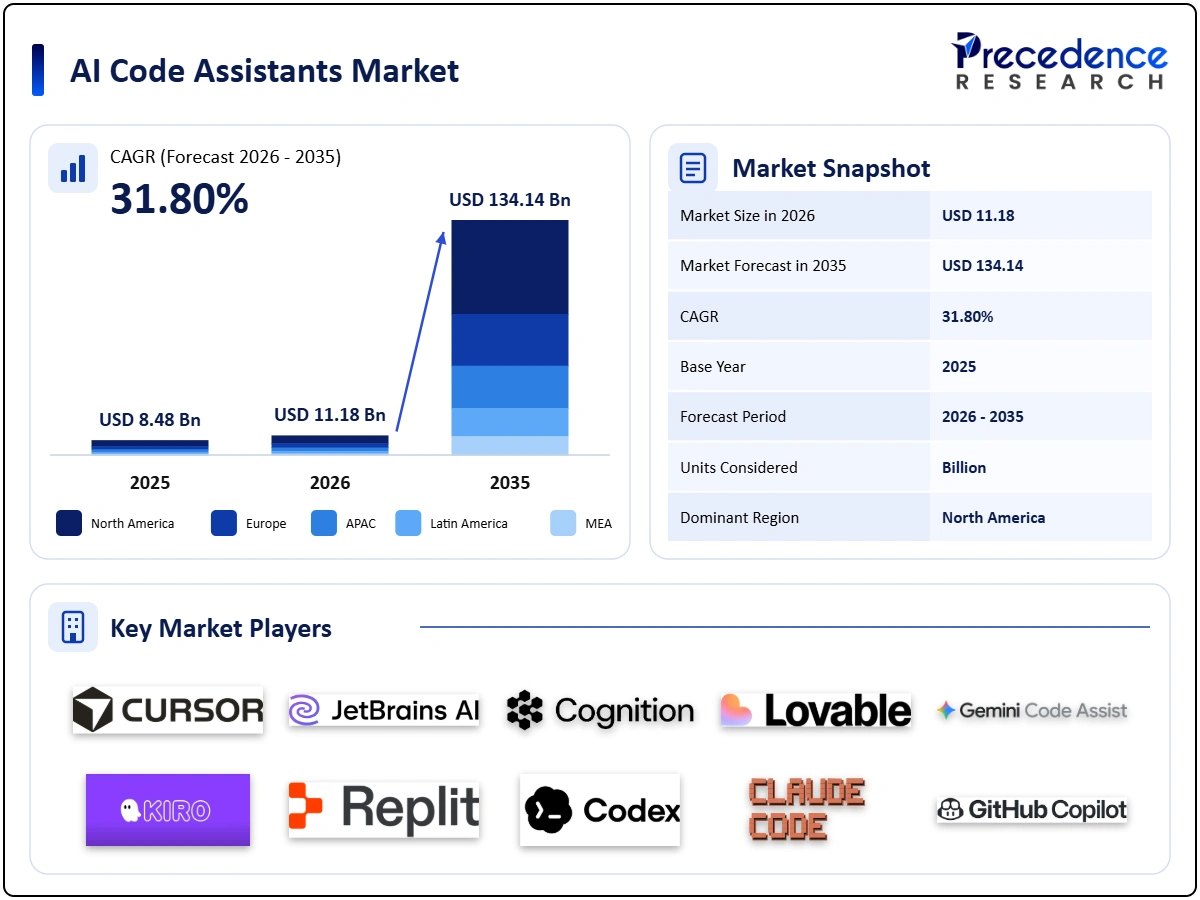
ICT industry specialist Gautam Mahajan estimates the AI code assistants market at USD 11.18 billion in 2026, with continued technology adoption expected to take the market to USD 134.14 billion by 2035 at a CAGR of 31.80%. Leading AI code assistants market providers such as GitHub Copilot, Cursor, Claude Code, Codex are expanding their capabilities across segments including type, deployment, end user and region.
Source: https://www.precedenceresearch.com/ai-code-assistants-market
 Get a Sample
 Report Description
Key Takeaways
Market Size & Growth Outlook
- Market Size in 2025: USD 8.48 Billion
- Estimated Market Size in 2026: USD 11.18 Billion
- Projected Market Size by 2035: USD 134.14 Billion
- CAGR (2026-2035): 31.80%
Regional Market Spotlight
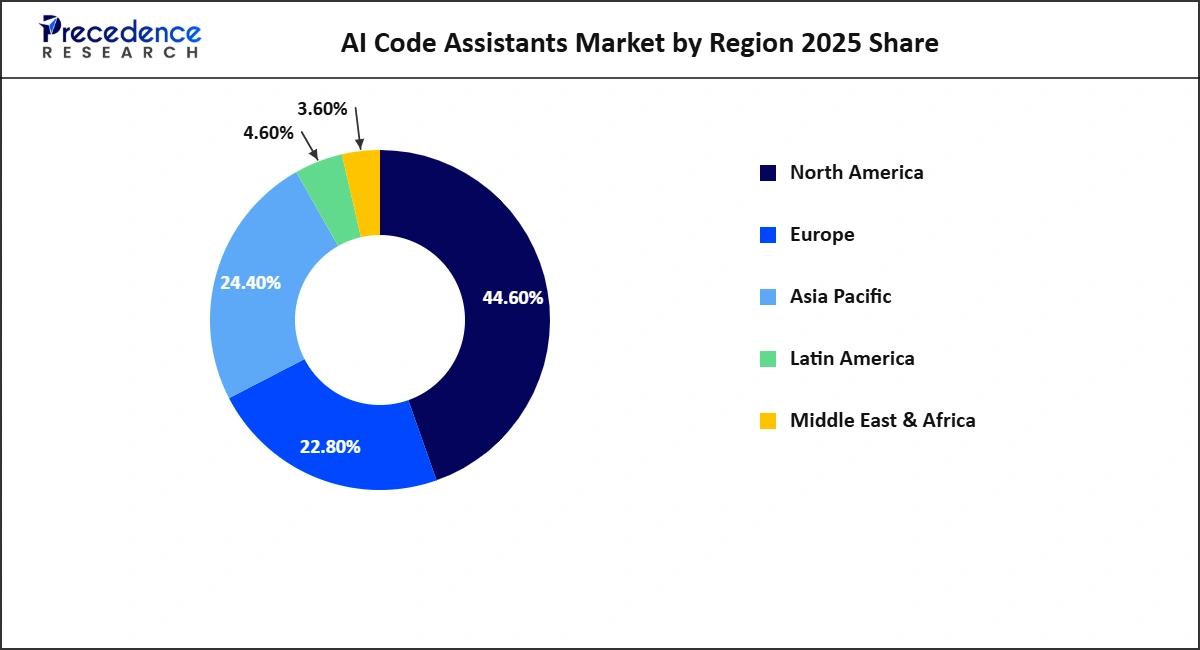
- North America led the market with a 44.60% share and was valued at USD 3.78 billion in 2025.
- Asia Pacific accounted for 24.40% of the market share and held USD 2.07 billion in 2025 and is projected to be the fastest-growing region, at a CAGR of 33.46% from 2026 to 2035.
- The Europe region held a 22.80% share and generated USD 1.93 billion in 2025.
Segmental Spotlight
- By type, Code Generation & Completion accounted for 46.80% market share, reaching USD 3.97 billion in 2025.
- By deployment, the Cloud segment captured 82.60% (USD 7.00 billion) of the market share in 2025.
- By end user, Large Enterprises held a 54.20% share and reached USD 4.60 billion in 2025.
AI Code Assistants Market Size and Forecast, 2025-2035 (USD Billion)
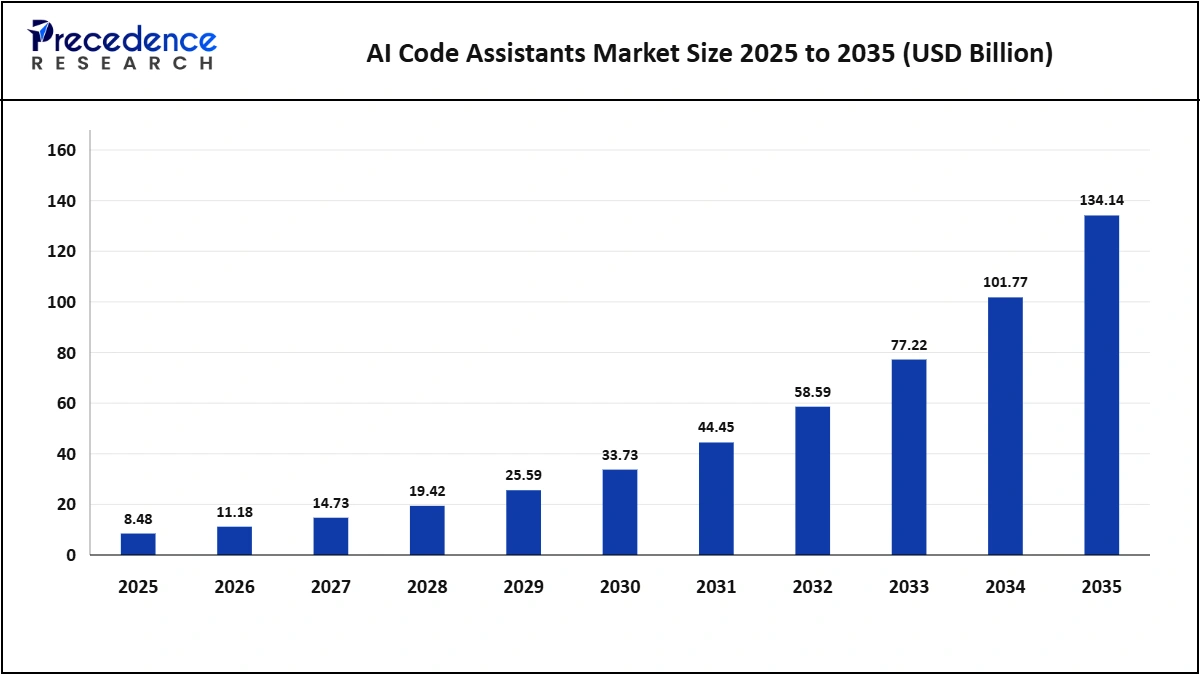
Note: 2025 is the base year; 2026-2035 values are forecasts.
Sources: Expert interviews, secondary sources, Precedence Research database, and Precedence Research analysts.
The AI code assistants market is projected to grow from USD 8.48 billion in 2025 to USD 134.14 billion by 2035 because most professional developers now use AI tools, enterprises are buying seats at scale to raise engineering productivity, and coding agents can complete larger tasks with each new model generation. In addition, the shift from seat-based assistants to usage-based autonomous agents and AI app builders for non-developers sharply raises per-user spending, lifting the market to USD 33.73 billion by 2030 and sustaining a 31.80% CAGR over the forecast period.
- Analyst View: The market is growing rapidly as developers and enterprises increasingly view AI as an essential part of software development. Increasing adoption of coding assistants, rising enterprise investments, and the emergence of autonomous AI agents are expanding the market's potential. Overall, continuous innovation and wider adoption across industries will remain key drivers of market growth.
Market Trends
- AI Agents are replacing traditional autocomplete tools as the main workflow.
- Usage-based pricing model gaining traction.
- AI model providers are expanding their offerings by selling coding assistant tools directly to users.
- Non-developers are increasingly using natural language prompts to build applications with minimal coding knowledge.
- Enterprises are adopting governance and security measures to manage AI-written code.
Market Dynamics
Driver
AI-coding tools are gaining traction as they help developers improve productivity and streamline software development processes. Continuous improvements in coding model capabilities are enabling these tools to handle increasingly complex tasks. Furthermore, enterprises are expanding adoption by purchasing tools at scale and deploying AI agents for software maintenance and legacy system modernization.
Restraint
AI-generated code can introduce bugs and security vulnerabilities. Intellectual property and licensing concerns affect adoption of such code. Price competition and falling model costs pressure revenue per task. Some enterprises restrict code from leaving their networks. Reliance on third-party models squeezes tool margins.
Opportunity
The growing capabilities of AI agents create opportunities to handle entire software and complex code migrations, while legacy code modernization presents significant potential for enterprise adoption. In addition, the increasing demand for automated code reviews, testing, and security solutions is opening new revenue streams. Private deployment options are also gaining importance among regulated industries that need greater control over their data and development processes.
AI Code Assistants Market Segmentation: 2025 Share and Value
AI Code Assistants Market By Type 2025 Share
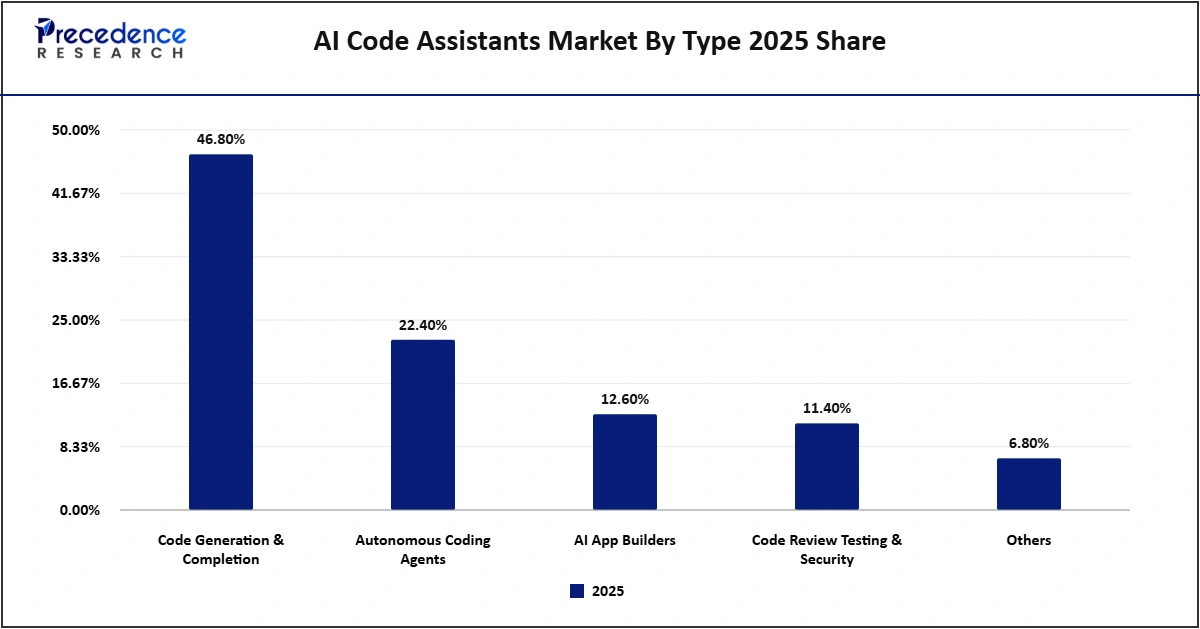
Note: 2025 is the base year.
Sources: Expert interviews, secondary sources, Precedence Research database, and Precedence Research analysts.
Code generation & completion accounted for a 46.80% share and reached USD 3.97 billion in 2025 because IDE assistants and AI-native editors that suggest, write, and explain code are used daily by millions of developers. Autonomous coding agents, at 22.40% share, reaching USD 1.90 billion, are the fastest-growing type as terminal and cloud agents complete features, fix bugs, and run tests with little supervision. AI app builders account for 12.60% market share and are valued at USD 1.07 billion, letting non-developers create web and mobile apps from prompts. Code review, testing & security held an 11.40% share (USD 0.97 billion), and others held 6.80% share (USD 0.58 billion) in 2025.
AI Code Assistants Market By Deployment 2025 Share & Size
| Segments | 2025 Share | 2025 Market Value |
| Cloud | 82.60% | USD 7.00 billion |
| On-Premises & Private Cloud | 17.40% | USD 1.48 billion |
Note: 2025 is the base year.
Sources: Expert interviews, secondary sources, Precedence Research database, and Precedence Research analysts.
Cloud deployment accounted for 82.60% share and generated USD 7.00 billion in 2025 because most tools run on hosted models and are sold as software-as-a-service. On-premises & private cloud account for 17.40% share and valued at USD 1.48 billion in 2025; growth is attributed because it is used by banks, governments, and companies that restrict source code from leaving their networks.
AI Code Assistants Market By End User 2025 Share
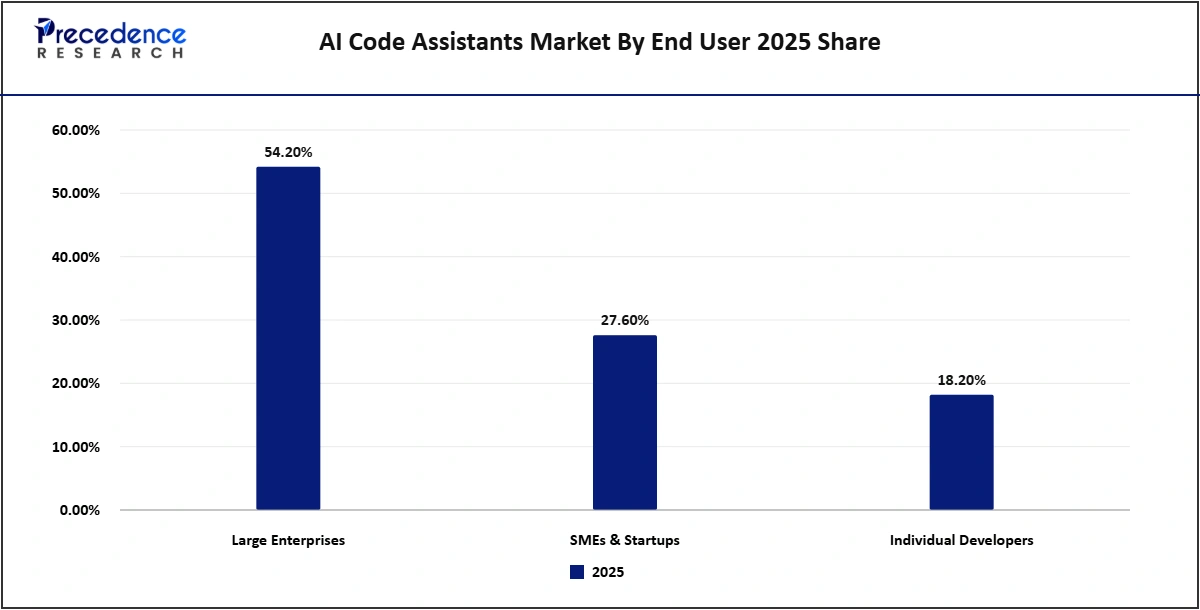
Note: 2025 is the base year.
Sources: Expert interviews, secondary sources, Precedence Research database, and Precedence Research analysts.
By end user, large enterprises dominate with a 54.20% share and reached USD 4.60 billion in 2025 because they buy assistants for developers and adopt agents for modernization and maintenance. SMEs & startups account for a 27.60% share (USD 2.34 billion), and individual developers held an 18.20% share (USD 1.54 billion) in 2025. Large enterprises are growing fastest due to mature security, governance, and administration features.
- Analyst View: The market is driven by the widespread adoption of AI-code generation and completion tools, while autonomous coding agents are gaining momentum as developers increasingly rely on them for complex tasks. Cloud deployment remains the preferred choice due to its flexibility and ease of access. Large enterprises lead adoption as they have greater resources to invest in AI tools and are increasingly using them to improve development efficiency, modernize legacy systems, and streamline maintenance.
Regional Analysis
AI Code Assistants Market by Region 2025 Share
Note: 2025 is the base year.
Sources: Expert interviews, secondary sources, Precedence Research database, and Precedence Research analysts.
North America region dominates with the largest share of 44.60% and generated USD 3.78 billion in 2025; growth is attributed to large technology companies and high developer salaries that justify tool spending. The companies GitHub, Cursor, Anthropic, OpenAI, Replit, and Cognition are headquartered in this region. Asia Pacific, at 24.40% share, reached USD 2.07 billion in 2025 and is the fastest-growing region, supported by India's large developer base and IT services firms, China's domestic coding assistants, and AI adoption in Japan, South Korea, and Southeast Asia. Europe captured a 22.80% share (USD 1.93 billion), growing through enterprise adoption and European vendors such as Lovable and JetBrains. Latin America, at 4.60% share (USD 0.39 billion), and the Middle East & Africa, at 3.60% share (USD 0.31 billion), are growing with outsourcing and startup activity.
North America reached 44.60% of the market share and was valued at USD 3.78 billion in 2025. Most leading coding tools and model providers are based in the United States. Enterprises are deploying agents across engineering teams.
Asia Pacific held 24.40% of the market share and reached USD 2.07 billion in 2025 and is projected to be the fastest-growing region. India's IT services companies are rolling out assistants to large numbers of engineers, and Chinese technology groups offer domestic tools.
Europe accounts for a 22.80% share (USD 1.93 billion) in 2025. Sweden-based Lovable and Czech-founded JetBrains are prominent vendors in the region. Data protection rules shape enterprise deployment.
Latin America captured a 4.60% share, generating USD 0.39 billion in 2025. Nearshore development firms in Brazil and Argentina adopt AI tools.
The Middle East & Africa accounted for a 3.60% share (USD 0.31 billion) in 2025. Gulf technology investment and growing developer communities support adoption.
Analyst View: Regional shares were built from developer populations, adoption rates, and spending in each region. North America leads the market because of the strong presence of leading technology companies, high developer spending, and widespread enterprise adoption. Asia Pacific is emerging as the fastest-growing region, growing by its expanding developer base, growing IT services industry, and increasing investments in AI-powered tools. Europe is witnessing steady growth through enterprise adoption, while Latin America and the Middle East & Africa are gradually gaining traction due to rising startup activity, outsourcing demand, and growing technology investments.
Competitive Landscape
Top Companies in the AI Code Assistants Market, 2025
| Rank | Company Name | Market-Specific Revenue (USD Billion) | 2025 Share | Key Products / Business | Headquarters |
| 1 | GitHub Copilot | 1.25 | 14.74% | Copilot assistant and coding agent | United States |
| 2 | Cursor | 0.62 | 7.31% | AI-native code editor and agents | United States |
| 3 | Claude Code | 0.55 | 6.49% | Agentic coding tool | United States |
| 4 | Codex | 0.30 | 3.54% | Cloud and local coding agent | United States |
| 5 | Replit | 0.21 | 2.48% | AI app building agent | United States |
| 6 | Amazon Q Developer & Kiro | 0.20 | 2.36% | Coding assistant and agentic IDE | United States |
| 7 | Gemini Code Assist | 0.16 | 1.89% | Coding assistant and CLI | United States |
| 8 | Lovable | 0.14 | 1.65% | AI app builder | Sweden |
| 9 | Cognition (Devin, Windsurf) | 0.14 | 1.65% | Autonomous engineer and AI IDE | United States |
| 10 | JetBrains AI | 0.10 | 1.18% | AI assistant and Junie agent | Czech Republic |
Note: Company revenues and shares are 2025 estimates.
Sources: Company press releases, expert interviews, secondary sources, Precedence Research database, and Precedence Research analysts.
GitHub Copilot led the AI code assistants market with a 14.74% share of the market and was valued at USD 1.25 billion in 2025 revenue, followed by Cursor at 7.31% (USD 0.62 billion) and Claude Code at 6.49% (USD 0.55 billion). GitHub Copilot leads through its integration with GitHub and Visual Studio Code and a large base of individual and enterprise users. Cursor has grown rapidly as an AI-native editor favored by professional developers, and Claude Code has become a leading agentic coding tool used from the terminal and IDEs. Codex, Replit, Amazon Q Developer and Kiro, Gemini Code Assist, Lovable, Cognition, and JetBrains AI compete through coding agents, app builders, cloud ecosystems, and IDE installed bases.
The top 10 players accounted for a 43.28% share and generated USD 3.67 billion of 2025 revenue, while the remaining 56.72% (USD 4.81 billion) was shared among code review and security tools, regional coding assistants, app builders, and enterprise implementation services. The market is evolving quickly, with competition increasingly driven by model performance, agent capabilities, reliability, codebase understanding, seamless IDE integration, security features, pricing strategies, and overall developer experience. Model providers increasingly compete directly with tool vendors that build on their models.
Companies Ecosystem
The AI code assistants ecosystem links foundation model providers and cloud infrastructure with coding tools, developer platforms, enterprise buyers, and individual developers. Model access and pricing strongly influence tool economics.
| Ecosystem Stage | Role in the Market | Key Companies |
| Foundation Models | Provide coding-capable language models | Anthropic, OpenAI, Google, Alibaba Qwen, Mistral |
| Coding Tools & Agents | Offer assistants, editors, agents, and app builders | GitHub, Cursor, Claude Code, Codex, Replit, Lovable, Cognition |
| Developer Platforms | Host code, CI/CD and IDEs that integrate AI | GitHub, GitLab, JetBrains, Atlassian, Vercel |
| Cloud & Infrastructure | Run models and development environments | Microsoft Azure, AWS, Google Cloud |
| End Users | Developers, enterprises and non-developer builders | Technology companies, banks, IT services firms, startups |
Sources: Company press releases, expert interviews, secondary sources, Precedence Research database, and Precedence Research analysts.
Precedence Research Companies Quadrant
The Precedence Research Companies Quadrant positions key participants in the AI code assistants market by market strength, reflecting revenue scale, market share and geographic reach, and by innovation and growth strategy, reflecting product portfolio breadth, R&D intensity and partnerships. Positions reflect each company's estimated 2025 AI coding revenue and our assessment of its agent capabilities, model access, and developer adoption.
Sources: Company press releases, expert interviews, secondary sources, Precedence Research database, and Precedence Research analysts.
Leaders: GitHub Copilot, Cursor, Claude Code, and Codex combine large paid user bases with fast-improving agents, strong model capabilities, and broad developer adoption.
Challengers: Amazon Q Developer & Kiro benefit from cloud ecosystem reach but have a smaller share of developer mindshare.
Innovators: Replit, Gemini Code Assist, and Lovable bring app builders, terminal agents, and new interfaces that are growing quickly.
Niche Players: Cognition (Devin, Windsurf) and JetBrains AI serve specific IDE users or autonomous engineering use cases.
Recent Developments
- June 2026: Cursor surpassed USD 4 billion in annualized revenue, with around 75% of its revenue run rate coming from business customers, reflecting strong enterprise adoption and growing demand for AI-powered coding solutions.
- February 2026: OpenAI launched the Codex desktop app for macOS, introducing multi-agent coding that allows developers to run multiple AI agents in parallel, manage complex coding tasks, and collaborate on long-running software development projects.
- December 2025: Anthropic acquired Bun, the JavaScript runtime and development toolkit, to strengthen Claude Code's infrastructure, performance, and reliability, as Claude Code reached an annualized revenue run rate of USD 1 billion.
- October 2025: GitHub introduced Agent HQ at its GitHub Universe conference, creating a unified platform that enables developers to access, manage, and orchestrate coding agents from multiple providers, including Anthropic, OpenAI, Google, Cognition, and xAI, directly within GitHub.
- July 2025: Cognition acquired Windsurf, combining the Windsurf AI IDE with its Devin autonomous software engineer. The acquisition aimed to combine AI-assisted coding with autonomous development capabilities and strengthen Cognition's position in the market.
AI Code Assistants Market Segments
By Type
- Code Generation & Completion
- Autonomous Coding Agents
- AI App Builders
- Code Review, Testing & Security
- Others
By Deployment
- Cloud
- On-Premises & Private Cloud
By End User
- Large Enterprises
- SMEs & Startups
- Individual Developers
By Region
- North America (U.S., Canada, Mexico)
- Europe (Germany, U.K., France, Italy, Spain, Rest of Europe)
- Asia Pacific (China, Japan, India, South Korea, Taiwan, Rest of Asia Pacific)
- Latin America (Brazil, Argentina, Rest of Latin America)
- Middle East & Africa (GCC, South Africa, Rest of MEA)
Research Methodology
The AI code assistants market was defined as AI-powered code completion and generation tools, AI-native editors, coding agents, AI app builders, and code review, testing, and security assistants, worldwide. The 2025 base year was built bottom-up from paid users by tool type, deployment, and region, and average subscription, seat, and usage spending, and checked top-down against the reported revenue and annualized run rates of leading coding tool vendors. Segment, regional, and company values were allocated from tool types, deployment models, end users, and regional demand. Key estimates were verified by cross-checking company disclosures, regulatory and industry data, and published third-party estimates, and inputs that could not be reconciled were excluded. All segment, regional, and company figures were reconciled to the same 2025 base year, and the 2026-2035 forecast, which applies a constant CAGR from the 2025 base, was recalculated and validated.
Analyst View: Overall Market
The AI code assistants market is one of the fastest-growing AI software segments and is shifting from autocomplete to autonomous agents. Our estimate links demand to paid users, spending, and enterprise licenses, so the forecast follows adoption of agents and app builders. The main growth comes from agentic workflows and enterprise modernization, while the main risks are price competition, code quality concerns, and dependence on model providers.
Sources and References
- Forbes. Cursor Hits $4 Billion Annualized Revenue, June 2026. (Source: forbes.com)
- OpenAI. Introducing the Codex app for macOS, February 2026. (Source: openai.com)
- Anthropic. Anthropic acquires Bun as Claude Code reaches $1B milestone, December 2025. (Source: anthropic.com)
- GitHub. Introducing Agent HQ: Any agent, any way you work, October 2025. (Source: github.blog)
- Cognition. Cognition's acquisition of Windsurf, July 2025. (Source: cognition.com)
For inquiries regarding discounts, bulk purchases, or customization requests, please contact us at sales@precedenceresearch.com
Frequently Asked Questions





Ask For Sample
No cookie-cutter, only authentic analysis – take the 1st step to become a Precedence Research client
 Get a Sample




 sales@precedenceresearch.com
 Schedule a Meeting
