



Automotive Predictive Analytics Market Size, Key Companies, Company Market Share, Vehicle Production Volume, Sales Performance, Export & Import Analysis, Technology Adoption, Competitive Positioning, and Demand Trends
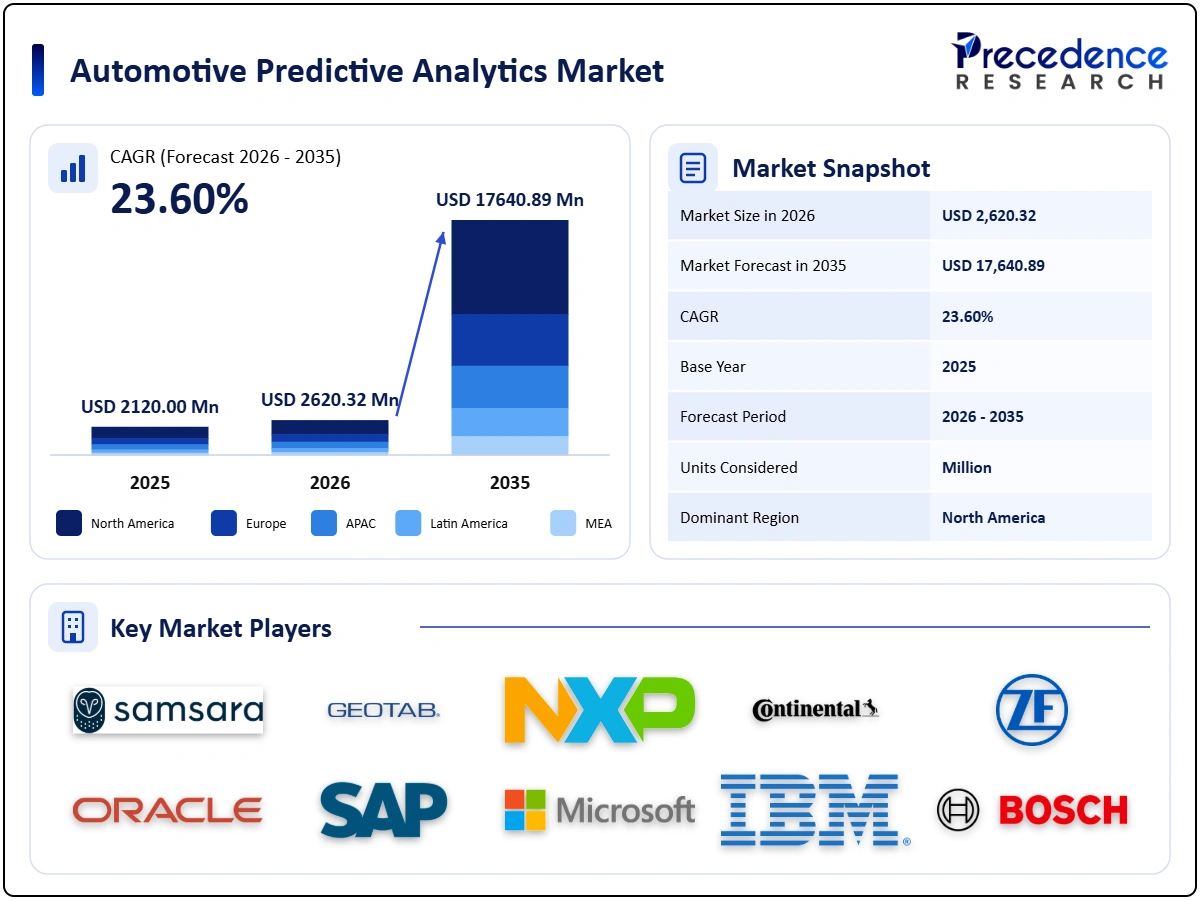
According to automotive sector expert, Laxmi Narayan notes that the automotive predictive analytics market stands at USD 2,620.32 million in 2026 and is expected to reach USD 17,640.89 million by 2035, growing at a CAGR of 23.60%. Leading automotive predictive analytics market companies such as Bosch, IBM, Microsoft,SAP are driving market development across segments including component, vehicle type, application, end user and region.
Source: https://www.precedenceresearch.com/automotive-predictive-analytics-market
 Get a Sample
 Report Description
Key Takeaways
Market Size & Growth Outlook
- Market size in 2025: USD 2,120.00 million
- Estimated market size in 2026: USD 2,620.32 million
- Projected market size by 2035: USD 17,640.89 million
- CAGR (2026-2035): 23.60%
Regional Market Spotlight
- North America led the market with a 34.20% (USD 725.04 million) share in 2025.
- Europe accounted for 29.60% (USD 627.52 million) of the market in 2025.
- Asia Pacific accounted for 27.80% (USD 589.36 million) of the market in 2025 and is projected to be the fastest-growing region, at a CAGR of 25.01% from 2025 to 2035.
Segmental Spotlight
- By component, Hardware accounted for 52.40% (USD 1,110.88 million) in 2025.
- By vehicle type, Passenger Cars accounted for 72.60% (USD 1,539.12 million) in 2025.
- By application, Predictive Maintenance accounted for 34.80% (USD 737.76 million) in 2025.
- By end user, OEMs accounted for 46.20% (USD 979.44 million) in 2025.
Automotive Predictive Analytics Market Size and Forecast, 2025-2035 (USD Million)
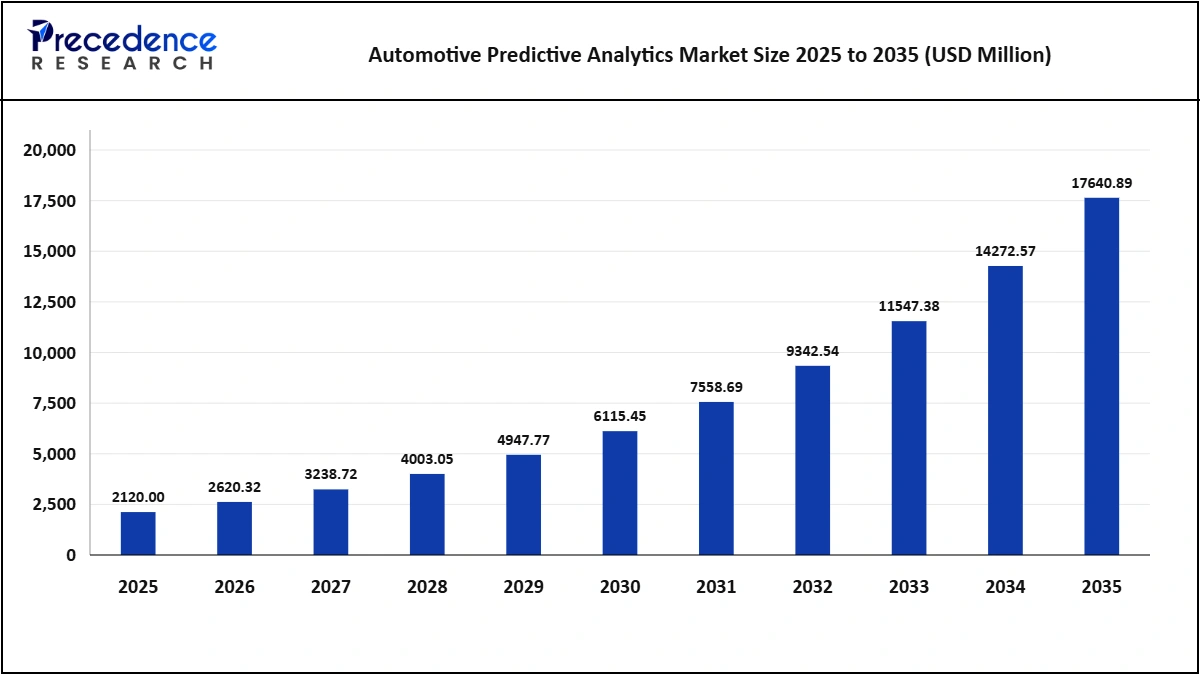
Note: 2025 is the base year; 2026–2035 values are forecasts.
Sources: Expert interviews, secondary sources, Precedence Research database and Precedence Research analysts.
The automotive predictive analytics market is projected to grow from USD 2,120.00 million in 2025 to USD 17,640.89 million by 2035 because connected vehicles generate continuous data that automakers, fleets, and insurers use to predict failures, reduce downtime and warranty costs, and price risk more accurately. Software-defined and electric vehicles, which need battery health and component monitoring, expand the data and use cases, lifting the market to USD 6,115.45 million by 2030 and sustaining a CAGR of 23.60% from 2026 to 2035.
- Analyst View: The estimate was built through predictive analytics based on components, types of vehicles, applications, end-users, and regions, multiplied by the average cost of hardware, software subscriptions, and services per vehicle or deployment. Adoption reflects connected car penetration, commercial fleet telematics, OEM data platform programs, and insurance telematics. The total was cross-checked against the automotive analytics revenue of leading technology suppliers and against published estimates, which places our base year slightly above the highest comparable figure. The growth rate is due to the high growth rate of connected and software-defined cars, subject to data privacy laws and integration costs.
Market Trends
- Software-defined vehicles stream more data.
- Battery health prediction for EVs.
- Virtual sensors are preferred over physical sensors.
- Digital twins support predictive maintenance.
- Usage-based insurance uses driving data.
- OEMs build in-house data platforms.
Drivers, Restraints and Opportunities
Driver
Connected vehicle penetration is rising quickly. Fleet downtime and maintenance cost reduction are essential. Warranty and recall costs pressure OEMs to predict failures. EV battery condition monitoring is necessary. Insurance companies determine prices based on drivers' activity.
Restraint
Data privacy laws restrict the use of the data. Integration with different vehicle architectures is difficult. Cybersecurity problems increase with connectivity. Smaller fleets do not have enough budget. Quality of data affects prediction quality.
Opportunity
Software-defined vehicles allow creating new predictive services. EV battery analytics support resale and second-life markets. Commercial fleets in emerging markets are adopting telematics. Aftermarket and dealer service can use predictions. Generative AI can help technicians understand diagnostics.
Market Segmentation: 2025 Share and Value
Automotive Predictive Analytics Market by Component 2025 Share
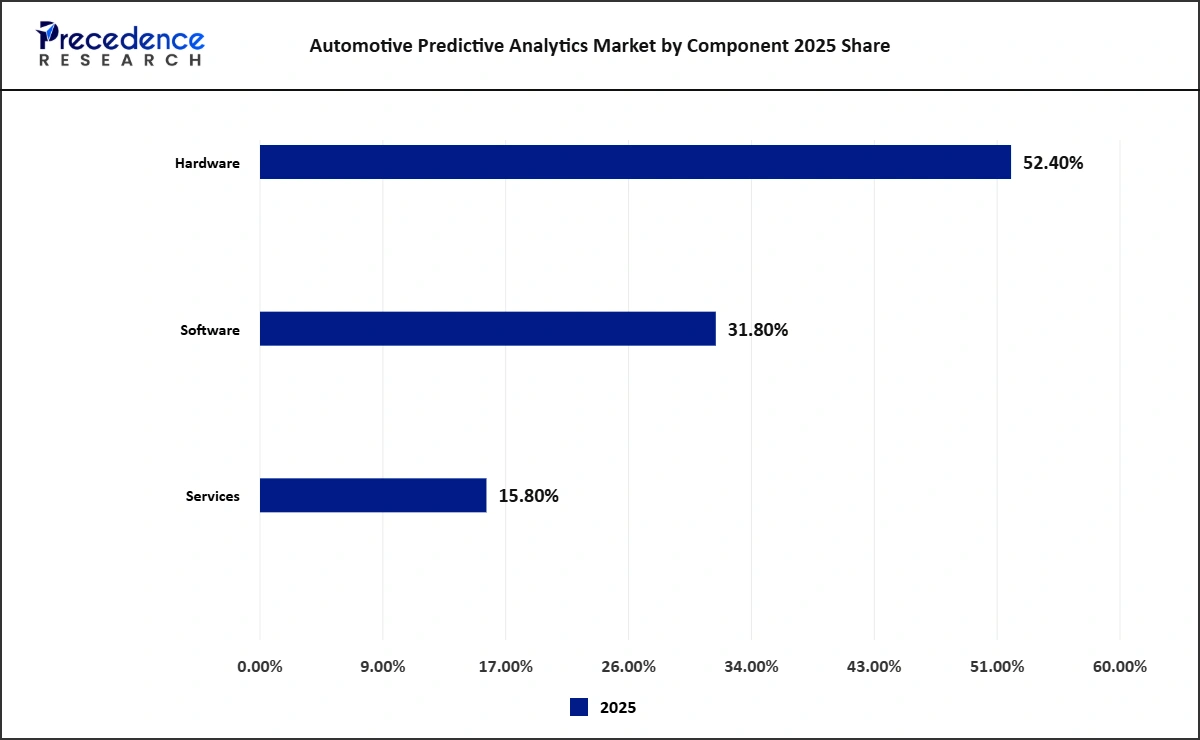
Note: 2025 is the base year.
Sources: Expert interviews, secondary sources, Precedence Research database and Precedence Research analysts.
Hardware accounted for 52.40% (USD 1,110.88 million) in 2025 because telematics units, sensors, and edge processors are required to capture and pre-process vehicle data. Software, at 31.80% (USD 674.16 million), is the fastest-growing component as cloud analytics platforms, digital twins, and AI models deliver predictions on a subscription basis. Services make up 15.80% (USD 334.96 million), including integration, data science, and managed analytics.
Automotive Predictive Analytics Market by Vehicle Type 2025 Share & Size
| Segments | 2025 Share | 2025 Market Value |
| Passenger Cars | 72.60% | USD 1,539.12 million |
| Commercial Vehicles | 27.40% | USD 580.88 million |
Note: 2025 is the base year.
Sources: Expert interviews, secondary sources, Precedence Research database and Precedence Research analysts.
Passenger cars accounted for 72.60% (USD 1,539.12 million) in 2025 because of their large volume and rising connected car penetration. Commercial vehicles account for 27.40% (USD 580.88 million) and use predictive analytics intensively to reduce downtime and maintenance costs for trucks, buses, and vans.
Automotive Predictive Analytics Market by Application 2025 Share
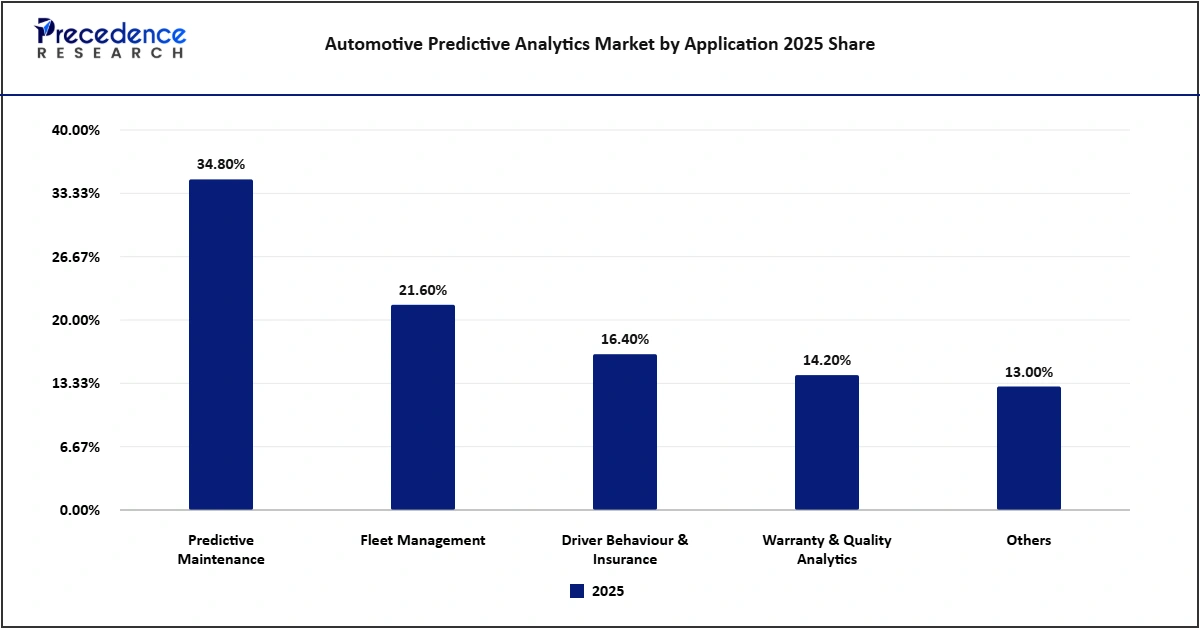
Note: 2025 is the base year.
Sources: Expert interviews, secondary sources, Precedence Research database and Precedence Research analysts.
Predictive maintenance accounted for 34.80% (USD 737.76 million) in 2025, since the prediction of component failure decreases breakdowns, repairs, and downtime. The percentage for fleet management was 21.60% (USD 457.92 million); driver behavior and insurance was 16.40% (USD 347.68 million); warranty and quality analytics were 14.20% (USD 301.04 million); while the rest was 13.00% (USD 275.60 million).
Automotive Predictive Analytics Market by End User 2025 Share & Size
| Segments | 2025 Share | 2025 Market Value |
| OEMs | 46.20% | USD 979.44 million |
| Fleet Operators | 28.40% | USD 602.08 million |
| Insurers | 13.60% | USD 288.32 million |
| Dealers & Others | 11.80% | USD 250.16 million |
Note: 2025 is the base year.
Sources: Expert interviews, secondary sources, Precedence Research database and Precedence Research analysts.
OEMs accounted for 46.20% (USD 979.44 million) in 2025 because automakers build vehicle data platforms to improve quality, reduce warranty costs, and offer connected services. Fleet operators account for 28.40% (USD 602.08 million); insurers for 13.60% (USD 288.32 million); and dealers and others for 11.80% (USD 250.16 million).
- Analyst View: Segment values were allocated by matching connected vehicles, fleet units, and spending to components, vehicle types, applications, and end users, using supplier revenue mixes. Hardware, passenger cars, predictive maintenance, and OEMs lead because of connected vehicle programs. Software, commercial vehicles, and battery analytics were considered to gain share.
Regional Analysis
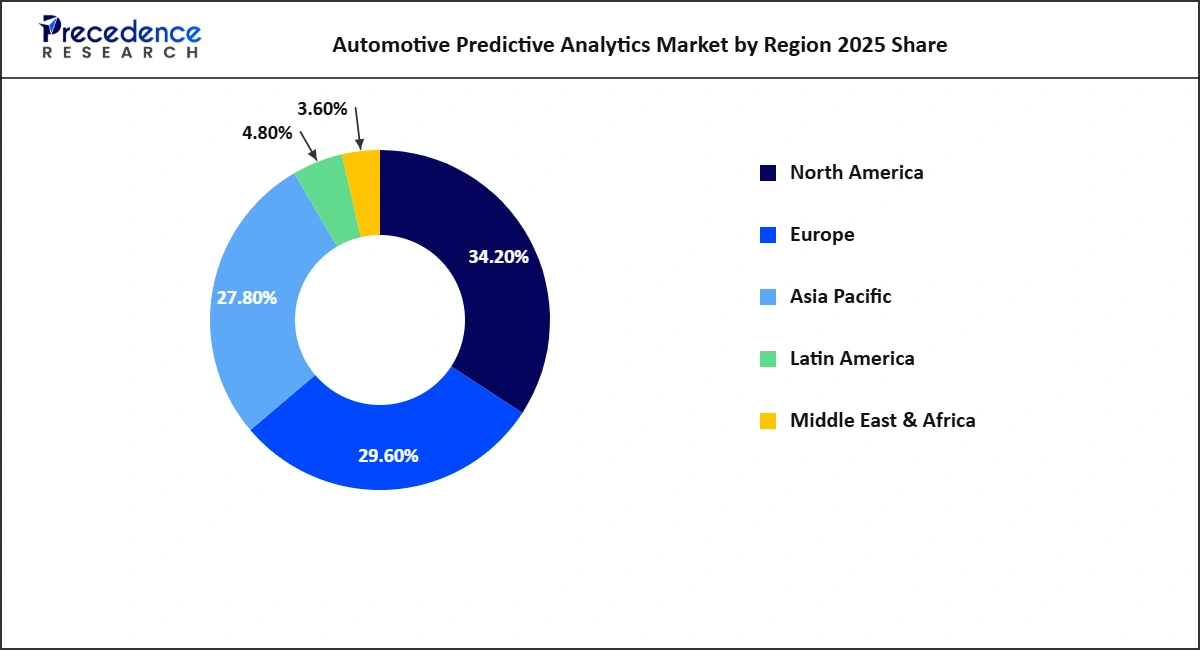
Automotive Predictive Analytics Market by Region 2025 Share
Note: 2025 is the base year.
Sources: Expert interviews, secondary sources, Precedence Research database and Precedence Research analysts.
North America accounted for 34.20% (USD 725.04 million) in 2025, supported by high connected vehicle penetration, large trucking fleets using telematics, and widespread usage-based insurance. Europe, at 29.60% (USD 627.52 million), is supported by data platforms of premium automakers, eCall-equipped vehicles, and fleet telematics. Asia Pacific, at 27.80% (USD 589.36 million), is the fastest-growing region, supported by China's connected and electric vehicle growth, India's commercial vehicle telematics, and Japanese and Korean automakers' data programs. Latin America, at 4.80% (USD 101.76 million), and the Middle East and Africa, at 3.60% (USD 76.32 million), are growing with fleet telematics.
North America accounted for 34.20% (USD 725.04 million) in 2025. Fleet telematics providers such as Samsara and Geotab serve large commercial fleets, and insurers use driving data for pricing.
Europe accounted for 29.60% (USD 627.52 million) in 2025. Automakers such as Volkswagen and Renault are expanding cloud data platforms and predictive maintenance programs. Data regulations of EU impact access to car data.
Asia Pacific accounted for 27.80% (USD 589.36 million) in 2025 and is the fastest-growing region. China's connected electric vehicles generate large data volumes, and Indian commercial vehicle makers are adding connected platforms.
Latin America accounted for 4.80% (USD 101.76 million) in 2025. Fleet telematics in Brazil and Mexico supports predictive maintenance.
The Middle East and Africa accounted for 3.60% (USD 76.32 million) in 2025. Logistics fleets in the Gulf and South Africa adopt telematics analytics.
Analyst View: Regional shares were derived using connected vehicles, fleets, and expenditures in each respective region. North America leads because of fleet telematics and insurance. We assign Asia Pacific the highest growth premium because connected and electric vehicle volumes are growing fastest there.
Competitive Landscape
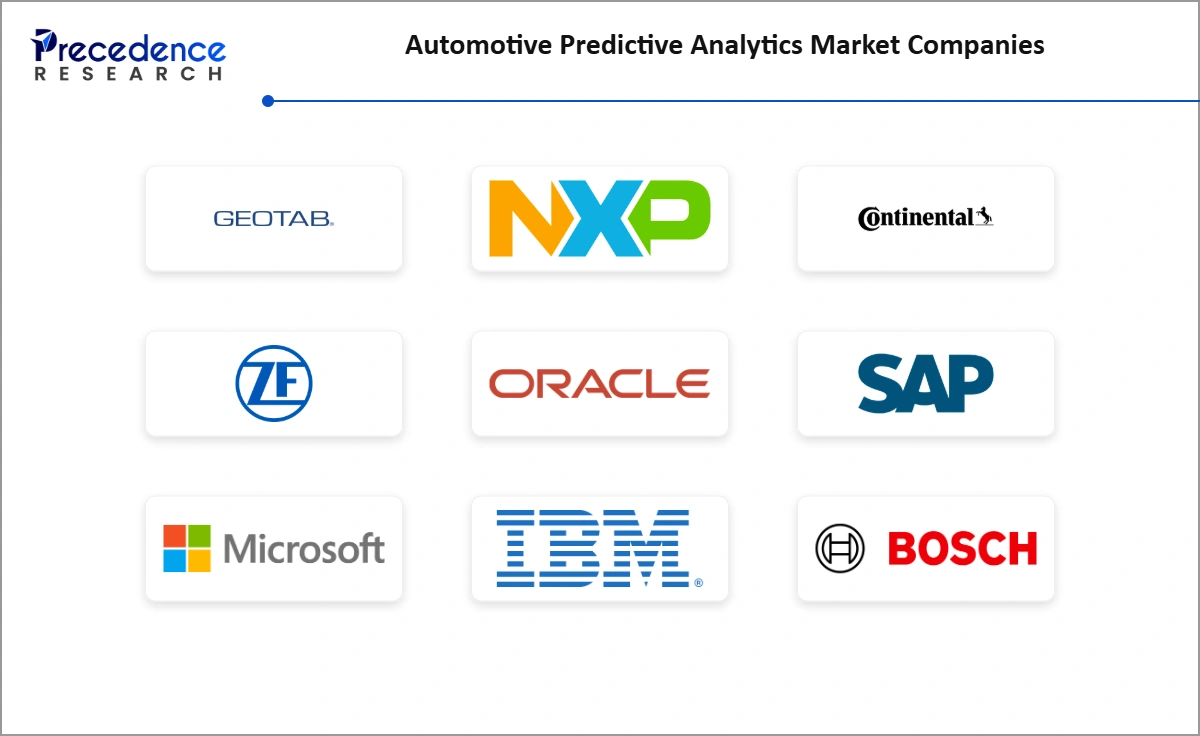
Top 10 Companies in the Automotive Predictive Analytics Market, 2025
| Rank | Company Name | Market-Specific Revenue (USD Million) | 2025 Share | Key Products / Business | Headquarters |
| 1 | Bosch | 236.00 | 11.13% | Vehicle data platforms and predictive diagnostics | Germany |
| 2 | IBM | 224.00 | 10.57% | Maximo and AI analytics for automotive | United States |
| 3 | Microsoft | 168.00 | 7.92% | Azure connected vehicle and AI services | United States |
| 4 | SAP | 142.00 | 6.70% | Vehicle insights and warranty analytics | Germany |
| 5 | Oracle | 118.00 | 5.57% | Cloud analytics and IoT for automotive | United States |
| 6 | ZF Friedrichshafen | 96.00 | 4.53% | Connected fleet and predictive maintenance | Germany |
| 7 | Continental | 82.00 | 3.87% | Telematics and fleet analytics | Germany |
| 8 | NXP Semiconductors | 64.00 | 3.02% | Vehicle processors and edge AI | Netherlands |
| 9 | Geotab | 58.00 | 2.74% | Fleet telematics and predictive analytics | Canada |
| 10 | Samsara | 52.00 | 2.45% | Connected operations and vehicle maintenance | United States |
Note: Company revenues and shares are 2025 estimates.
Sources: Company press releases, expert interviews, secondary sources, Precedence Research database and Precedence Research analysts.
Bosch led the automotive predictive analytics market with an estimated 11.13% (USD 236.00 million) of 2025 revenue, followed by IBM at 10.57% (USD 224.00 million) and Microsoft at 7.92% (USD 168.00 million). Bosch takes the lead through automotive hardware, diagnostics, and vehicle data platforms used by automobile manufacturers and fleets. IBM provides AI and asset management software for automotive maintenance and quality, and Microsoft supplies cloud and AI services for connected vehicle platforms. SAP, Oracle, ZF Friedrichshafen, Continental, NXP Semiconductors, Geotab and Samsara compete through enterprise warranty analytics, cloud platforms, fleet solutions, telematics hardware, and edge processors.
Top 10 firms constituted 58.49% (USD 1,240.00 million) of the total revenue for 2025, whereas the remaining 41.51% (USD 880.00 million) belonged to telematics vendors, analytical startups, data companies working with insurance firms, and software companies for the automotive industry. The automotive predictive analytics market is moderately fragmented, and competition centers on data access, model accuracy, integration with vehicle architectures and enterprise systems, cybersecurity, scalability and cost. Automakers increasingly build in-house data platforms with cloud partners.
Companies Ecosystem
The automotive predictive analytics ecosystem links chip and telematics hardware suppliers with automakers, cloud and analytics software providers, fleet and insurance users, and service networks.
| Ecosystem Stage | Role in the Market | Key Companies |
| Hardware & Chips | Supply telematics units, sensors, and edge processors | Bosch, Continental, NXP, Qualcomm, Infineon |
| Automakers & Tier-1s | Generate vehicle data and build data platforms | Volkswagen, Renault, Ford, GM, ZF, Bosch |
| Cloud & Analytics Software | Provide AI, digital twins, and analytics platforms | Microsoft, AWS, IBM, SAP, Oracle, PTC |
| Fleet & Telematics Providers | Deliver fleet analytics and maintenance tools | Samsara, Geotab, Trimble, Intangles |
| End Users | Use predictions for service, fleets, and insurance | OEMs, fleet operators, insurers, dealers |
Sources: Company press releases, expert interviews, secondary sources, Precedence Research database and Precedence Research analysts.
Precedence Research Companies Quadrant
The Precedence Research Companies Quadrant positions key participants in the automotive predictive analytics market by market strength (revenue scale, market share, and geographic reach) and by innovation and growth strategy (product portfolio breadth, R&D intensity, and partnerships). Positions reflect each company's estimated 2025 automotive predictive analytics revenue and our assessment of its AI capabilities, data access, and partnerships.
Sources: Company press releases, expert interviews, secondary sources, Precedence Research database and Precedence Research analysts.
Leaders: Bosch, IBM, and Microsoft have considerable automotive analytics revenues along with robust AI capabilities and vehicle data.
Challengers: SAP and Oracle have enterprise analytics positions but less automotive-specific innovation.
Innovators: ZF Friedrichshafen, NXP Semiconductors, Geotab, and Samsara bring fleet telematics, edge AI, and connected fleet solutions that are expanding rapidly.
Niche Players: Continental serves specific telematics hardware segments.
Recent Developments
- August 2025: Volkswagen Group announced a five-year expansion of its collaboration with AWS on its Digital Production Platform, supporting data-driven and predictive manufacturing.
- August 2025: Force Motors introduced iPulse, a connected vehicle platform with predictive analytics, as standard on its commercial vehicles.
Automotive Predictive Analytics Market Segments
By Component
- Hardware
- Software
- Services
By Vehicle Type
- Passenger Cars
- Commercial Vehicles
By Application
- Predictive Maintenance
- Fleet Management
- Driver Behavior & Insurance
- Warranty & Quality Analytics
- Others
By End User
- OEMs
- Fleet Operators
- Insurers
- Dealers & Others
By Region
- North America (U.S., Canada, Mexico)
- Europe (Germany, U.K., France, Italy, Spain, Rest of Europe)
- Asia Pacific (China, Japan, India, South Korea, Taiwan, Rest of Asia Pacific)
- Latin America (Brazil, Argentina, Rest of Latin America)
- Middle East & Africa (GCC, South Africa, Rest of MEA)
Research Methodology
The automotive predictive analytics market was defined as hardware, software, and services for predictive analytics using vehicle, driver, manufacturing, and service data, worldwide. The 2025 base year was built bottom-up from connected vehicles and fleet units using predictive analytics by component, vehicle type, application, end user, and region, and average spending, and checked top-down against the automotive analytics revenue of leading technology suppliers. Segment, regional and company values were allocated from components, vehicle types, applications, end users and regional demand. Key estimates were verified by cross-checking company disclosures, regulatory and industry data and published third-party estimates, and inputs that could not be reconciled were excluded. All segment, regional, and company figures were reconciled to the same 2025 base year, and the 2026-2035 forecast, which applies a constant CAGR from the 2025 base, was recalculated and validated.
Analyst View: Overall Market
The automotive predictive analytics market is growing rapidly as connected and software-defined vehicles turn data into maintenance, quality, and risk predictions. This estimation makes an association between demand and connectivity related to cars and fleets and investments, so the prediction will follow. The main upside comes from EV and software-defined vehicle data, while the main risks are data privacy rules and integration complexity.
Sources and References
- Amazon. "More efficient, smarter, more resilient: Volkswagen Group collaborates with AWS to help transform production for the age of AI". August 2025. Five-year extension of the Digital Production Platform collaboration. https://press.aboutamazon.com/aws/2025/8/more-efficient-smarter-more-resilient-volkswagen-group-collaborates-with-aws-to-help-transform-production-for-the-age-of-ai
For inquiries regarding discounts, bulk purchases, or customization requests, please contact us at sales@precedenceresearch.com
Frequently Asked Questions





Ask For Sample
No cookie-cutter, only authentic analysis – take the 1st step to become a Precedence Research client
 Get a Sample




 sales@precedenceresearch.com
 Schedule a Meeting
