



Autonomous Mobile Manipulator Robots (AMMR) Market Trends, Leading Companies, Company Revenue / Sales Performance, Manufacturing Capacity, Production Cost, Supply Chain Performance, Pricing Analysis, Competitive Landscape, and Industry Outlook
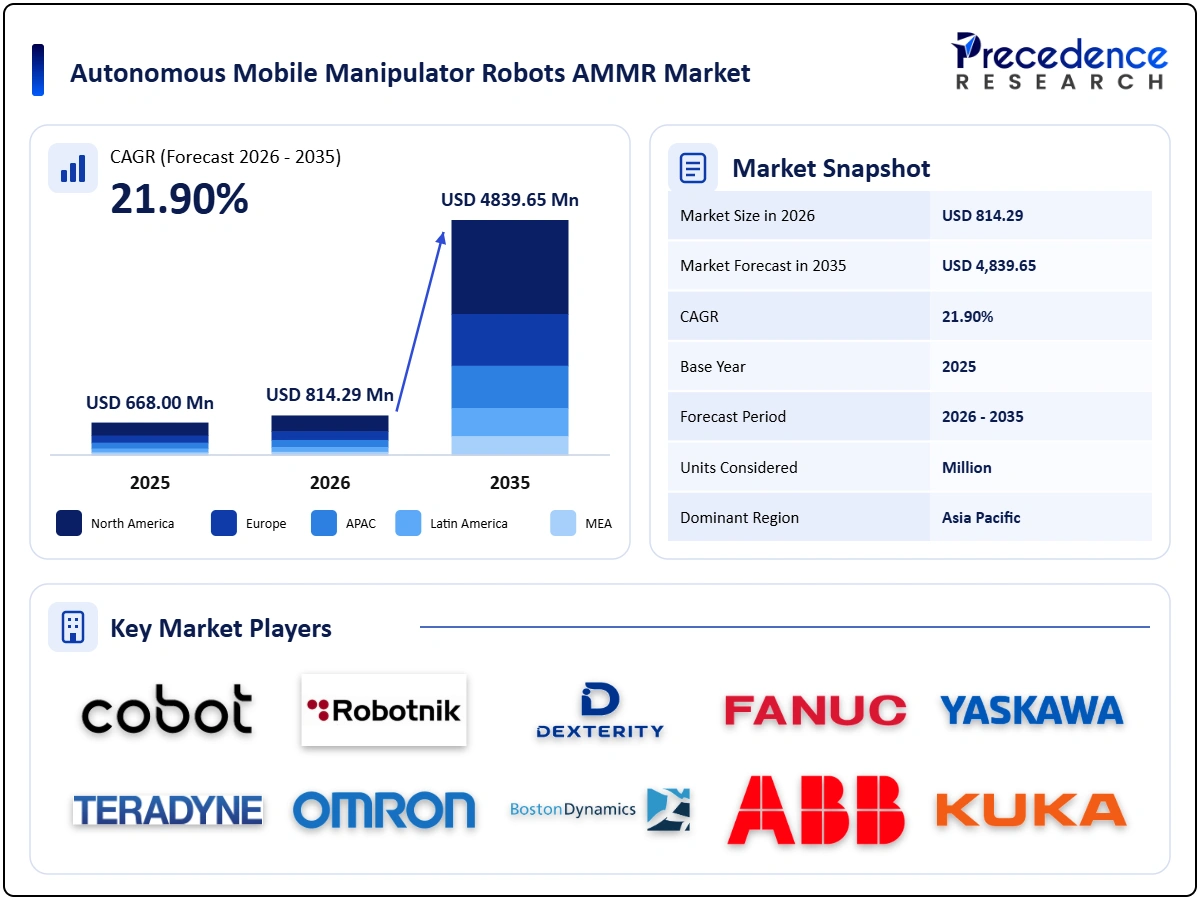
According to automotive sector expert, Laxmi Narayan notes that the autonomous mobile manipulator robots market stands at USD 814.29 million in 2026 and is expected to reach USD 4,839.65 million by 2035, growing at a CAGR of 21.90%. Leading autonomous mobile manipulator robots market companies such as KUKA, ABB, Boston Dynamics, OMRON are driving market development across segments including system type, payload, end use and region.
Source: https://www.precedenceresearch.com/autonomous-mobile-manipulator-robots-ammr-market
 Get a Sample
 Report Description
Key Takeaways
Market Size & Growth Outlook
- Market size in 2025: USD 668.00 million
- Estimated market size in 2026: USD 814.29 million
- Projected market size by 2035: USD 4,839.65 million
- CAGR (2026-2035): 21.90%
Regional Market Spotlight
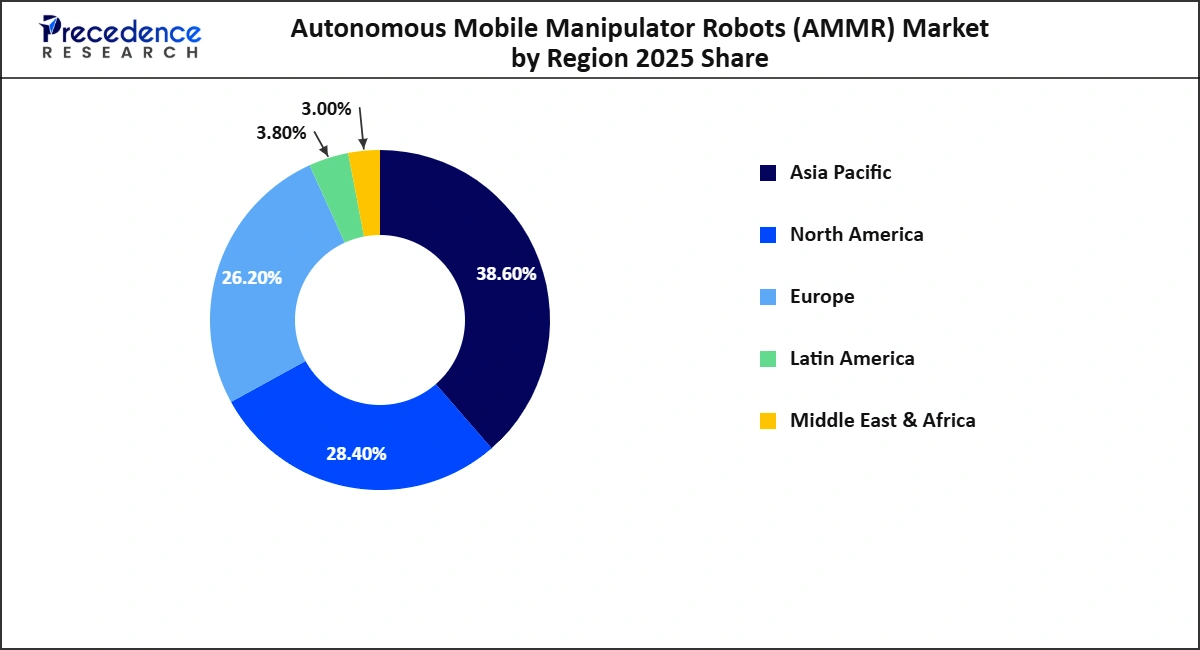
- Asia Pacific led the market with a 38.60% (USD 257.85 million) share in 2025 and is projected to be the fastest-growing region, at a CAGR of 22.80% from 2025 to 2035.
- North America accounted for 28.40% (USD 189.71 million) of the market in 2025.
- Europe accounted for 26.20% (USD 175.02 million) of the market in 2025.
Segmental Spotlight
- By system type, Differential accounted for 60.40% (USD 403.47 million) in 2025.
- By payload, Below 5 kg accounted for 32.40% (USD 216.43 million) in 2025.
- By end use, Automotive accounted for 26.80% (USD 179.02 million) in 2025.
Autonomous Mobile Manipulator Robots (AMMR) Market Size and Forecast, 2025-2035 (USD Million)
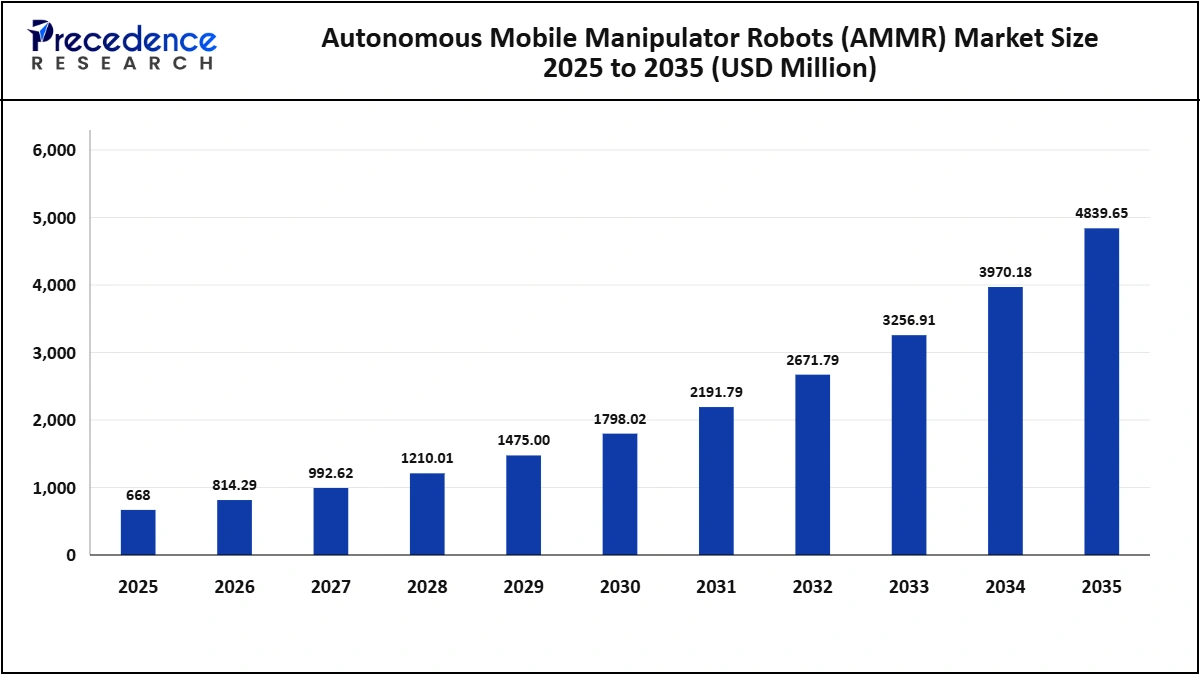
Note: 2025 is the base year; 2026-2035 values are forecasts.
Sources: Expert interviews, secondary sources, Precedence Research database and Precedence Research analysts.
The 21.90 is projected to grow from USD 668.00 million in 2025 to USD 4,839.65 million by 2035 because manufacturers and logistics operators face labor shortages and need flexible automation that can move between tasks, and AMMRs can tend machines, pick parts, and unload trucks without fixed robot cells. Perception and grasping utilizing AI, along with decreased prices of robots, expands application areas and raises the market up to USD 1,798.02 million by 2030, keeping a CAGR of 21.90% from 2026 to 2035.
- Analyst View: We built the estimate from AMMR unit shipments by system type, payload, end use, and region, multiplied by average system prices including mobile base, arm, gripper, vision, and software. Shipments represent automation investments in manufacturing and warehousing and pilot-to-fleet conversions. The total was cross-checked against the mobile manipulation revenue of leading robot makers and against published estimates, which places our base year slightly above the highest comparable figure. The growth is attributed to the high level of demand for automated solutions, which has been tempered by the cost of integration and high cost of systems.
Market Trends
- AI vision enables picking of varied items.
- The use of omnidirectional bases increases accuracy.
- Two-armed manipulators deal with bigger workloads.
- Truck unloading becomes a key use case.
- Fleet software coordinates AMMRs and AMRs.
- Embodied AI programs support development.
Drivers, Restraints and Opportunities
Driver
Labor shortages affect manufacturing and logistics. Flexible automation can be reallocated from one task to another. High-mix manufacturing requires flexible robots. AI enhances vision and manipulation. The reduced cost of cobots and AMRs reduces system cost.
Restraint
The high cost of systems and complexity in integration restrict market growth. Precision is also limited due to restrictions in accuracy positioning. Moving-arm systems take time to get safety-certified. Low return on investment is an uncertainty for low-volume manufacturers. Integrators are rare.
Opportunity
There is a huge demand in logistics for truck unloading and order picking. Laboratory and pharmaceutical automation need mobile handling. Robot-as-a-service models lower adoption barriers. Embodied AI can expand tasks. New manufacturing centers in India and Southeast Asia provide opportunity for expansion.
Market Segmentation: 2025 Share and Value
Autonomous Mobile Manipulator Robots (AMMR) Market by System Type 2025 Share
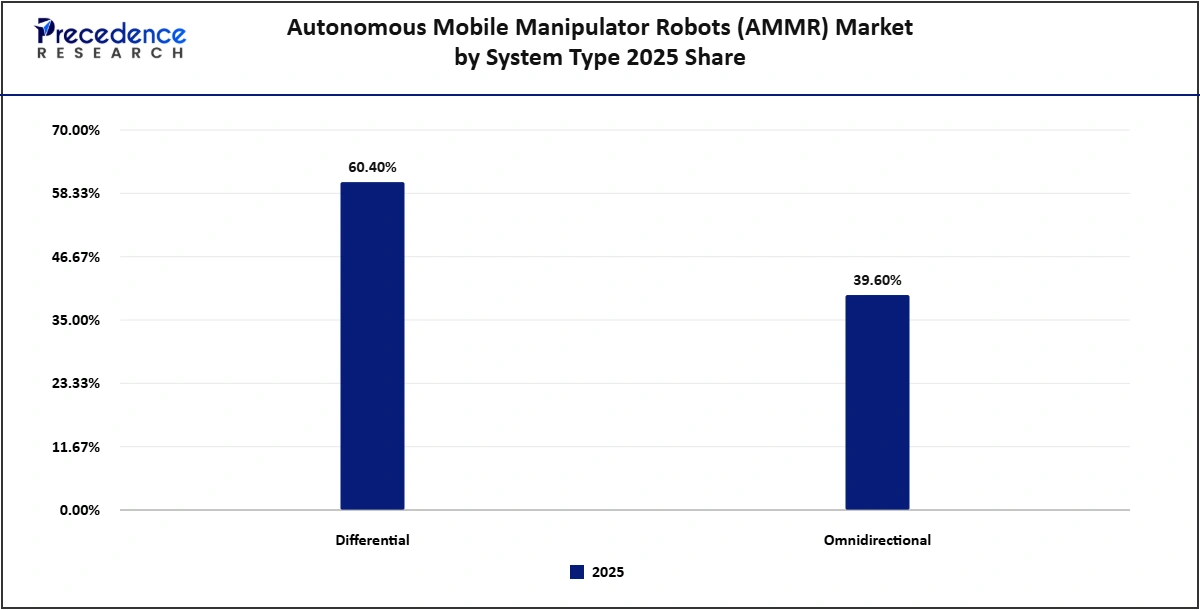
Note: 2025 is the base year.
Sources: Expert interviews, secondary sources, Precedence Research database and Precedence Research analysts.
Differential-drive systems accounted for 60.40% (USD 403.47 million) in 2025 because they are simpler, cheaper, and effective on smooth factory and warehouse floors.
Omnidirectional systems account for 39.60% (USD 264.53 million) and are the faster-growing type, as mecanum and swerve-drive bases position arms precisely in tight spaces.
Autonomous Mobile Manipulator Robots (AMMR) Market by Payload 2025 Share & Size
| Segments | 2025 Share | 2025 Market Value |
| Below 5 kg | 32.40% | USD 216.43 million |
| 5-10 kg | 24.60% | USD 164.33 million |
| 10-20 kg | 23.80% | USD 158.98 million |
| Above 20 kg | 19.20% | USD 128.26 million |
Note: 2025 is the base year.
Sources: Expert interviews, secondary sources, Precedence Research database and Precedence Research analysts.
Systems below 5 kg constituted 32.40% (USD 216.43 million) in 2025 because most electronic, laboratory, and machine tending applications handle light parts using collaborative robots. The 5–10 kg range accounts for 24.60% (USD 164.33 million); the 10–20 kg range for 23.80% (USD 158.98 million), the fastest-growing payload class as automotive and logistics uses expand; and above 20 kg for 19.20% (USD 128.26 million).
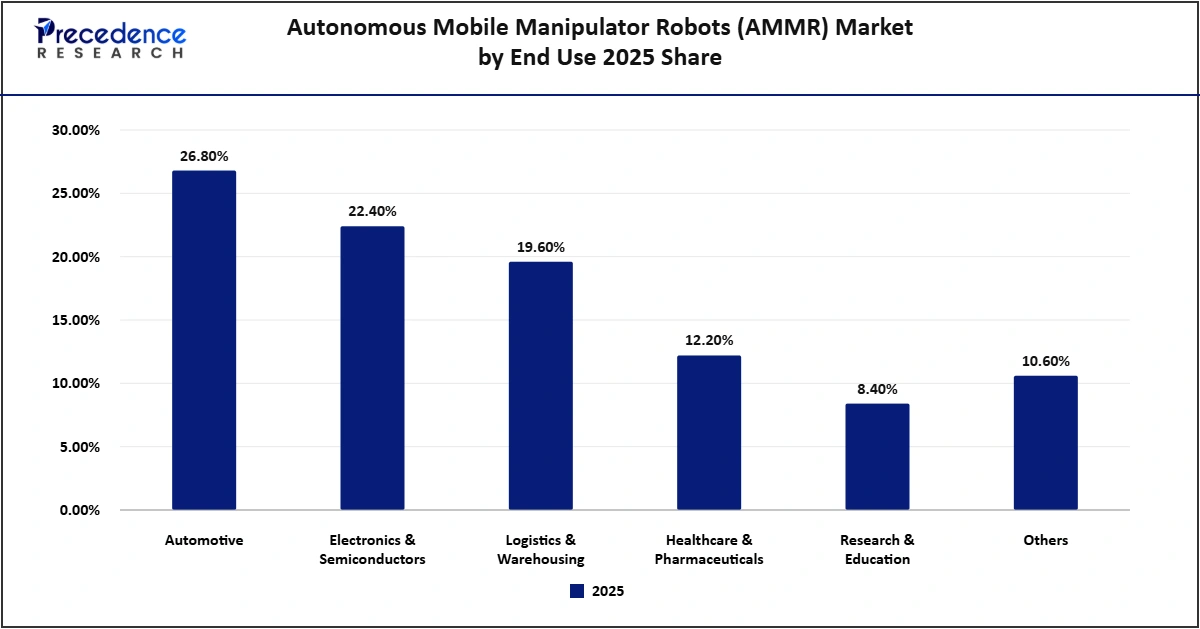
Note: 2025 is the base year.
Sources: Expert interviews, secondary sources, Precedence Research database and Precedence Research analysts.
Automotive accounted for 26.80% (USD 179.02 million) in 2025 because carmakers and suppliers use AMMRs for machine tending, kitting, and parts transfer. Electronics and semiconductors account for 22.40% (USD 149.63 million), logistics and warehousing for 19.60% (USD 130.93 million), the fastest-growing end use with truck unloading and picking; healthcare and pharmaceuticals for 12.20% (USD 81.50 million); research and education for 8.40% (USD 56.11 million); and others for 10.60% (USD 70.81 million).
- Analyst View: Allocation of segment values was done by linking shipments and prices to system types, payload categories, and applications through supplier information and project information. Differential systems, light payloads, and automotive lead because of early factory adoption. We believe omnidirectional systems, heavy payload applications, and logistics will be gaining ground.
Regional Analysis
Autonomous Mobile Manipulator Robots (AMMR) Market by Region 2025 Share
Note: 2025 is the base year.
Sources: Expert interviews, secondary sources, Precedence Research database and Precedence Research analysts.
Asia Pacific accounted for 38.60% (USD 257.85 million) in 2025, supported by electronics and automotive manufacturing in China, Japan, and South Korea, government robotics programs, and domestic robot makers. It is also the fastest-growing region. North America, at 28.40% (USD 189.71 million), is supported by warehouse and logistics automation and labor shortages, and Europe, at 26.20% (USD 175.02 million), by automotive and machinery manufacturing and robot makers such as KUKA, ABB, and Universal Robots. Latin America, at 3.80% (USD 25.38 million), and the Middle East and Africa, at 3.00% (USD 20.04 million), are early markets.
Asia Pacific accounted for 38.60% (USD 257.85 million) in 2025 and is the fastest-growing region. China is the largest robot market and is promoting embodied AI and mobile manipulation. Japan and South Korea face labor shortages.
North America accounted for 28.40% (USD 189.71 million) in 2025. Logistics companies deploy mobile manipulators for truck unloading and picking, and startups such as Dexterity and Collaborative Robotics are active.
Europe accounted for 26.20% (USD 175.02 million) in 2025. Automotive and machinery plants in Germany, Denmark, and Italy use AMMRs for machine tending.
Latin America accounted for 3.80% (USD 25.38 million) in 2025. Mexico and Brazil's automotive factories ensure early adoption.
The Middle East and Africa accounted for 3.00% (USD 20.04 million) in 2025. Logistics hubs and research institutions are early adopters.
Analyst View: Regional shares were built from shipments and prices in each region. Asia Pacific dominates due to the presence of manufacturing ecosystem and favorable robotics programs. We assign it the highest growth premium because electronics, automotive, and embodied AI investment are expanding fastest there.
Competitive Landscape
Top 10 Companies in the Autonomous Mobile Manipulator Robots (AMMR) Market, 2025
| Rank | Company Name | Market-Specific Revenue (USD Million) | 2025 Share | Key Products / Business | Headquarters |
| 1 | KUKA | 74.00 | 11.08% | KMR iiwa and mobile manipulators | Germany |
| 2 | ABB | 68.00 | 10.18% | Mobile manipulation with AMRs and cobots | Switzerland |
| 3 | Boston Dynamics | 62.00 | 9.28% | Stretch case-handling robot | United States |
| 4 | OMRON | 48.00 | 7.19% | MoMa mobile manipulators | Japan |
| 5 | Teradyne Robotics | 40.00 | 5.99% | Universal Robots arms on MiR platforms | United States |
| 6 | Yaskawa | 34.00 | 5.09% | Mobile manipulator solutions | Japan |
| 7 | FANUC | 30.00 | 4.49% | Cobots for mobile platforms | Japan |
| 8 | Dexterity | 22.00 | 3.29% | Mech truck-loading mobile manipulator | United States |
| 9 | Robotnik | 12.00 | 1.80% | RB-KAIROS and RB-ROBOUT mobile manipulators | Spain |
| 10 | Collaborative Robotics | 10.00 | 1.50% | Proxie warehouse mobile manipulator | United States |
Note: Company revenues and shares are 2025 estimates.
Sources: Company press releases, expert interviews, secondary sources, Precedence Research database and Precedence Research analysts.
KUKA led the autonomous mobile manipulator robots (AMMR) market with an estimated 11.08% (USD 74.00 million) of 2025 revenue, followed by ABB at 10.18% (USD 68.00 million) and Boston Dynamics at 9.28% (USD 62.00 million). KUKA leads through its mobile manipulator platforms used in automotive and electronics plants, backed by its parent Midea's presence in China. ABB combines its autonomous mobile robots and collaborative arms into mobile manipulation solutions, and Boston Dynamics sells its Stretch robot for truck unloading and case handling. OMRON, Teradyne Robotics, Yaskawa, FANUC, Dexterity, Robotnik and Collaborative Robotics compete through integrated mobile manipulators, cobot and AMR combinations, AI-based logistics robots and research platforms.
The leading 10 companies have captured around 59.88% (USD 400.00 million) of the 2025 market revenue share, while the balance of 40.12% (USD 268.00 million) belonged to other cobot providers, AMR manufacturers, system integrators, and robotics start-ups. The autonomous mobile manipulator robots (AMMR) market is moderately concentrated, and the competition is driven by positioning precision, payload capacity, vision and grasping based on AI, safety certification, easy programmability, fleet management software, and total cost. The integration of robot arms, bases, and grippers into some application-specific systems is greatly influenced by system integrators.
Companies Ecosystem
The AMMR ecosystem links component suppliers for arms, mobile bases, sensors, and grippers with robot makers, AI software developers, system integrators, and end users.
| Ecosystem Stage | Role in the Market | Key Companies |
| Components & Sensors | Supply arms, bases, lidar, cameras, grippers, and drives | Universal Robots, SICK, Robotiq, Schunk, NVIDIA |
| Robot Makers | Build integrated mobile manipulators | KUKA, ABB, OMRON, Yaskawa, Boston Dynamics, Robotnik |
| AI & Software | Provide navigation, perception, and grasp planning | NVIDIA Isaac, robot makers' software, AI startups |
| System Integrators | Design and deploy AMMR applications | Robotics integrators and automation engineering firms |
| End Users | Use AMMRs in factories, warehouses, and labs | Automakers, electronics makers, logistics firms, hospitals, laboratories |
Sources: Company press releases, expert interviews, secondary sources, Precedence Research database and Precedence Research analysts.
Precedence Research Companies Quadrant
The Precedence Research Companies Quadrant positions key participants in the autonomous mobile manipulator robots (AMMR) market by market strength, reflecting revenue scale, market share and geographic reach, and by innovation and growth strategy, reflecting product portfolio breadth, R&D intensity and partnerships. Positions reflect each company's estimated 2025 AMMR revenue and our assessment of its product portfolio, AI capabilities and partnerships.
Sources: Company press releases, expert interviews, secondary sources, Precedence Research database and Precedence Research analysts.
Leaders: KUKA, ABB, Boston Dynamics, and OMRON have high revenues from mobile manipulation and also incorporate platforms, artificial intelligence technology, and extensive sales networks.
Challengers: Teradyne Robotics has strong cobot and AMR businesses but relies on partners for integrated mobile manipulation.
Innovators: Dexterity, Robotnik, and Collaborative Robotics bring AI-driven logistics manipulators and research platforms that are winning new applications.
Niche Players: Yaskawa and FANUC offer arms and mobile solutions for specific industrial uses.
Recent Developments
- March 2025: Dexterity launched Mech, a dual-armed mobile manipulator for truck loading.
- March 2025: Robotnik introduced the RB-ROBOUT+, an omnidirectional mobile manipulator with a payload capacity of up to 35kg.
Autonomous Mobile Manipulator Robots AMMR Market Segments
By System Type
- Differential
- Omnidirectional
By Payload
- Below 5 kg
- 5-10 kg
- 10-20 kg
- Above 20 kg
By End Use
- Automotive
- Electronics & Semiconductors
- Logistics & Warehousing
- Healthcare & Pharmaceuticals
- Research & Education
- Others
By Region
- North America (U.S., Canada, Mexico)
- Europe (Germany, U.K., France, Italy, Spain, Rest of Europe)
- Asia Pacific (China, Japan, India, South Korea, Taiwan, Rest of Asia Pacific)
- Latin America (Brazil, Argentina, Rest of Latin America)
- Middle East & Africa (GCC, South Africa, Rest of MEA)
Research Methodology
The autonomous mobile manipulator robots (AMMR) market refers to robots combining autonomous mobile bases with robotic arms and grippers for industrial, logistics, healthcare, and research tasks worldwide. The 2025 base year was built bottom-up from AMMR shipments by system type, payload, end use, and region, and average system prices, and checked top-down against the mobile manipulation revenue of leading robot makers. Segment, regional, and company values were allocated from system types, payload classes, end uses, and regional demand. The information found in corporation filings, industry data, and third-party estimations were used to validate key inputs. Unverifiable inputs were dropped from the analysis. All segment, regional, and company figures were reconciled to the same 2025 base year, and the 2026-2035 forecast, which applies a constant CAGR from the 2025 base, was recalculated and validated.
Analyst View: Overall Market
The autonomous mobile manipulator robots (AMMR) market is small but growing quickly as manufacturers and logistics operators seek flexible automation. This estimation would be dependent on the forecasts that would be made depending on the amount of shipping that takes place and also the price, which is influenced by the investment in automation and capabilities in AI technology.
Sources and References
- Robotnik. "RB-ROBOUT+ mobile manipulator". 2025. Product information. https://robotnik.eu/
For inquiries regarding discounts, bulk purchases, or customization requests, please contact us at sales@precedenceresearch.com
Frequently Asked Questions





Ask For Sample
No cookie-cutter, only authentic analysis – take the 1st step to become a Precedence Research client
 Get a Sample




 sales@precedenceresearch.com
 Schedule a Meeting
