


Carbon Capture Materials Market Size, Key Companies, Company Production Capacity, Manufacturing Efficiency, Capacity Utilization, Raw Material Consumption, Cost Structure, Export Trends, Company Expansion Strategies, and Competitive Landscape
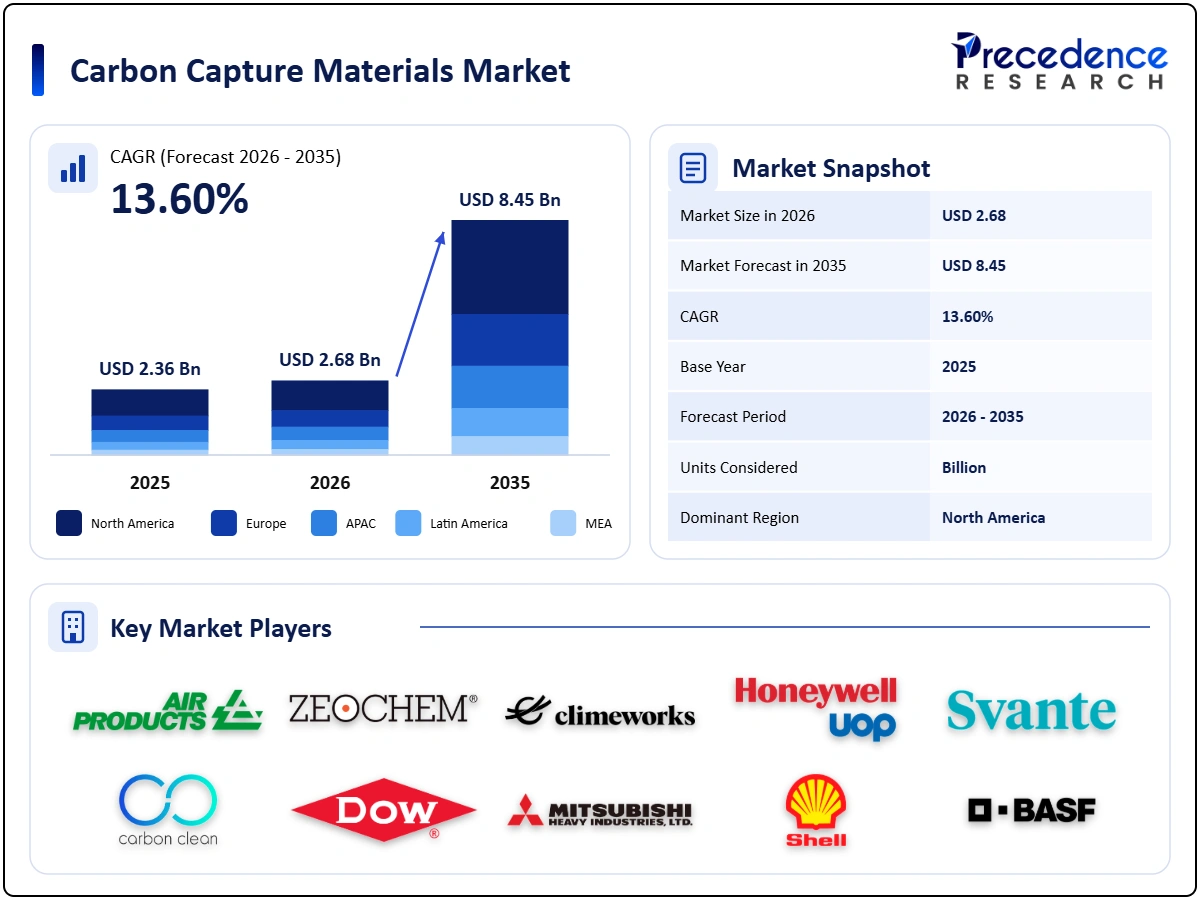
Vidyesh Swar, a Chemical and Materials Industry Expert, estimates the carbon capture materials market at USD 2.68 billion in 2026 to USD 8.45 billion by 2035, growing at a CAGR of 13.60%. Major carbon capture materials market companies such as BASF,Mitsubishi Heavy Industries, Dow, Carbon Clean are competing across key material and application segments, including Material Type, Capture Mechanism, Application and region.
Source: https://www.precedenceresearch.com/carbon-capture-materials-market
 Get a Sample
 Report Description
Carbon Capture Materials Market Trends, Share, and Growth Analysis 2035
The carbon capture materials market is forecasted to expand from USD 2.68 billion in 2026 to USD 8.45 billion by 2035, growing at a CAGR of 13.60% from 2026 to 2035.
Key Takeaways
Market Size & Growth Outlook
- Market size in 2025: USD 2.36 billion
- Estimated market size in 2026: USD 2.68 billion
- Projected market size by 2035: USD 8.45 billion
- CAGR (2026-2035): 13.60%
Regional Market Spotlight
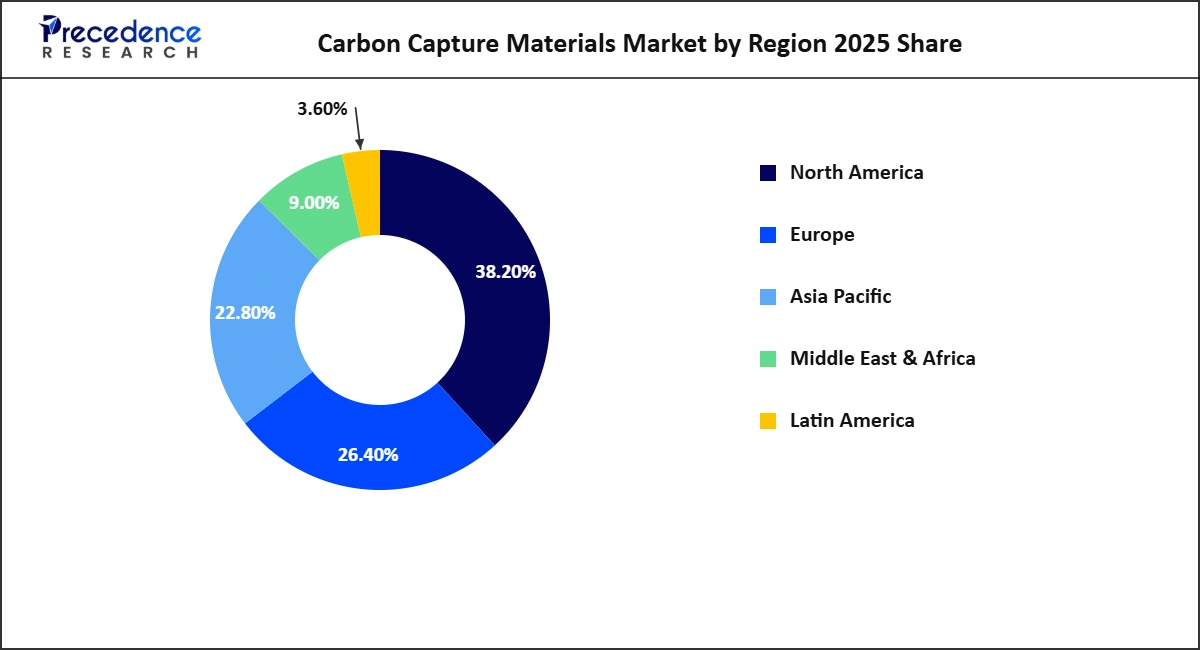
- North America dominated the market with a 38.20% (USD 0.90 billion) share in 2025.
- Europe held 26.40% (USD 0.62 billion) of market revenue in 2025.
- Asia Pacific accounted for a market share of 22.80% (USD 0.54 billion) in 2025 and is projected to grow at the fastest CAGR of 15.27% during the forecast period.
Segmental Spotlight
- By material type, Solvent-Based (Amine & Others) accounted for 58.40% (USD 1.38 billion) of revenue in 2025.
- The chemical absorption segment held a market share of 60.20% in the capture mechanism segment in 2025.
- By application, Natural Gas Processing & Hydrogen accounted for 30.40% (USD 0.72 billion) share in 2025.
Carbon Capture Materials Market Size and Forecast, 2025-2035 (USD Billion)
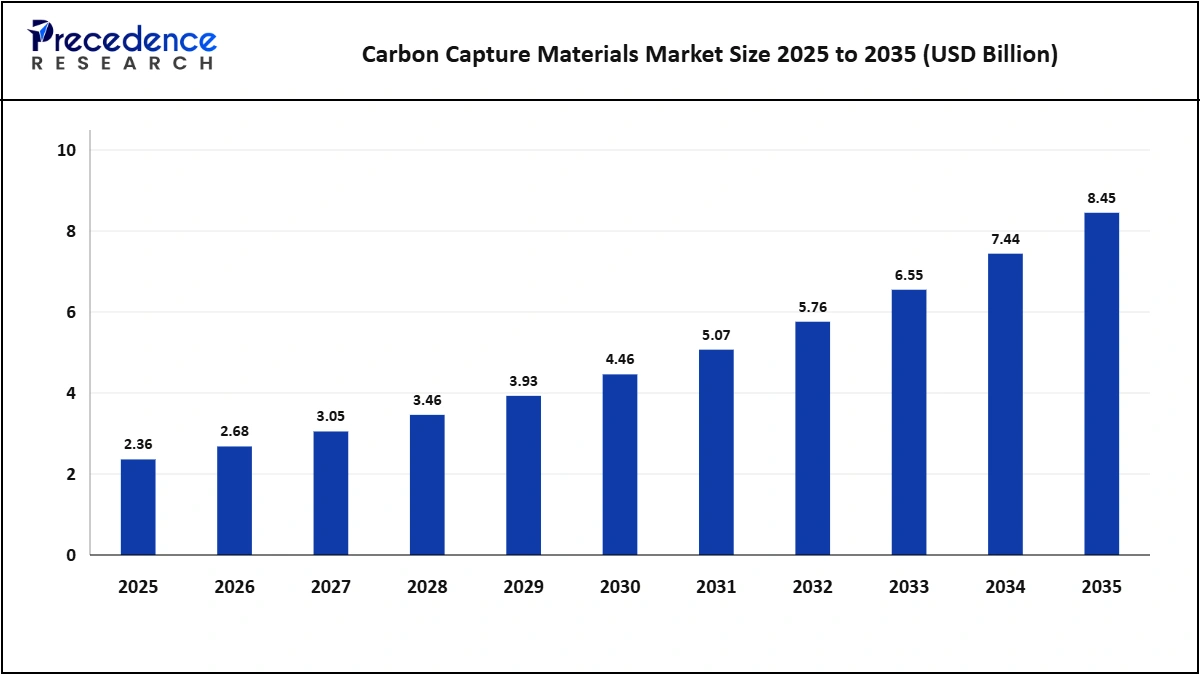
Note: 2025 is the base year; 2026–2035 values are forecasts.
Sources: Expert interviews, secondary sources, Precedence Research database and Precedence Research analysts.
The market is projected to expand from USD 2.36 billion in 2025 to USD 8.45 billion by 2035 due to the fact that every carbon capture plant needs solvents, sorbents or membranes to separate CO2, both for the first fill and for replacement as material degradation occurs. Direct air capture and new industrial projects add demand for advanced solid sorbents, propelling the market to USD 4.46 billion by 2030 and maintaining a CAGR of 13.60% during the forecast period.
- Analyst View: We built the estimate from operating and newly commissioned carbon capture capacity by technology and region, material inventory per ton of capture capacity, annual make-up and replacement rates, and mean solvent prices, sorbents, and membranes. Capacity highlights natural gas processing, ethanol, hydrogen, power, cement and steel projects and direct air capture facilities. The total was cross-checked against the carbon capture material revenue of chemical and technology suppliers and against published estimates, which places our base year slightly above the comparable materials-only figures; broader figures that include capture systems are not comparable. The growth rate reflects that projects are growing rapidly from a relatively small base, but policy delays and policy uncertainty negatively affect the growth rate.
Market Trends
- MOF sorbents are increasingly reaching industrial production.
- Low-energy amine solvents cause a reduction in capture costs.
- Direct air capture drives demand for solid sorbents.
- Cement and steel are emerging key capture markets.
- Filter manufacturing is being scaled in North America.
- Material manufacturers are partnering with technology licensors.
Drivers, Restraints and Opportunities
Driver
Governments and companies have set net-zero targets that need carbon capture in hard-to-abate sectors. Incentives such as the US 45Q tax credit and EU carbon pricing enhance project economics. Natural gas processing and blue hydrogen projects use capture as standard. Direct air capture projects are scaling with the help of public and private funding. Advanced materials assist in reducing capture energy and cost.
Restraint
Many capture projects often face steep costs and delays. Policy changes can potentially affect incentives and project pipelines. The degradation of amine solvents can create emissions that need to be controlled. Solid sorbent manufacturing is still scaling up. Lack of CO2 transport and storage infrastructure throttles the pace of deployment.
Opportunity
Cement, steel, and waste-to-energy capture projects can create significant material demand. Direct air capture has the potential to grow with carbon removal markets. MOFs and advanced sorbents will be useful to reduce the usage of energy. Material replacement cycles create repeating revenue. Emerging capture markets in Asia and the Middle East are important for market growth in upcoming years.
Market Segmentation 2025 Share and Value
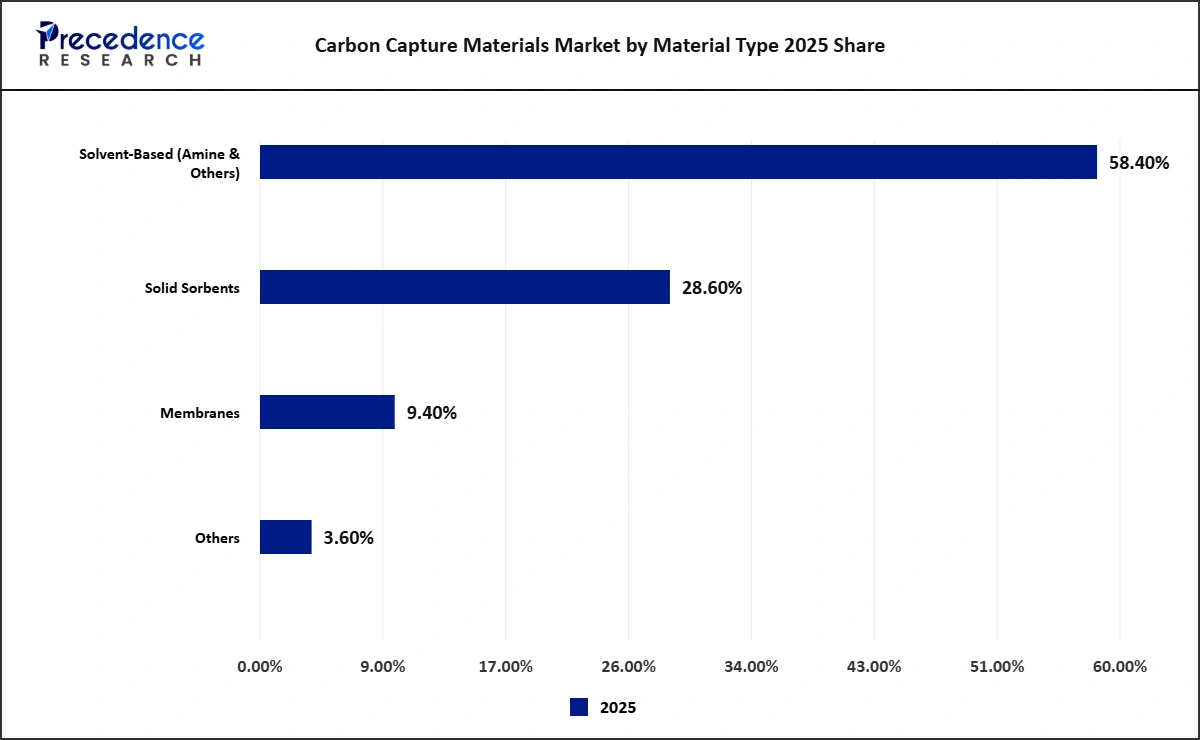
Carbon Capture Materials Market by Material Type 2025 Share
Note: 2025 is the base year.
Sources: Expert interviews, secondary sources, Precedence Research database and Precedence Research analysts.
Solvent-based materials accounted for 58.40% (USD 1.38 billion) share in 2025 due to the fact that most large-scale capture facilities in gas processing, hydrogen, power, and industry use amine absorption, which needs large solvent inventories and continuous make-up as solvents degrade. The market share of Advanced proprietary amines with lower regeneration energy is increasing. Solid sorbents held 28.60% (USD 0.67 billion) of revenue, and is expected to grow at the fastest rate in the material type segment because MOFs, zeolites, and amine- functionalized sorbents are used in rotary adsorption systems and direct air capture, and MOFs are now manufactured at industrial scale. Membranes held a market share of 9.40% (USD 0.22 billion) and others accounted for 3.60% (USD 0.08 billion).
Carbon Capture Materials Market by Capture Mechanism 2025 Share & Size
| Segments | 2025 Share | 2025 Market Value |
| Chemical Absorption | 60.20% | USD 1.42 billion |
| Physical Adsorption | 28.20% | USD 0.67 billion |
| Membrane Separation | 9.40% | USD 0.22 billion |
| Others | 2.20% | USD 0.05 billion |
Note: 2025 is the base year.
Sources: Expert interviews, secondary sources, Precedence Research database and Precedence Research analysts.
Chemical absorption accounted for 60.20% (USD 1.42 billion) of revenue in 2025, physical adsorption for 28.20% (USD 0.67 billion), membrane separation for 9.40% (USD 0.22 billion), and others for 2.20% (USD 0.05 billion). Physical adsorption is the fastest-growing mechanism as solid sorbent systems are increasingly progressing from pilot stage to commercial stage.
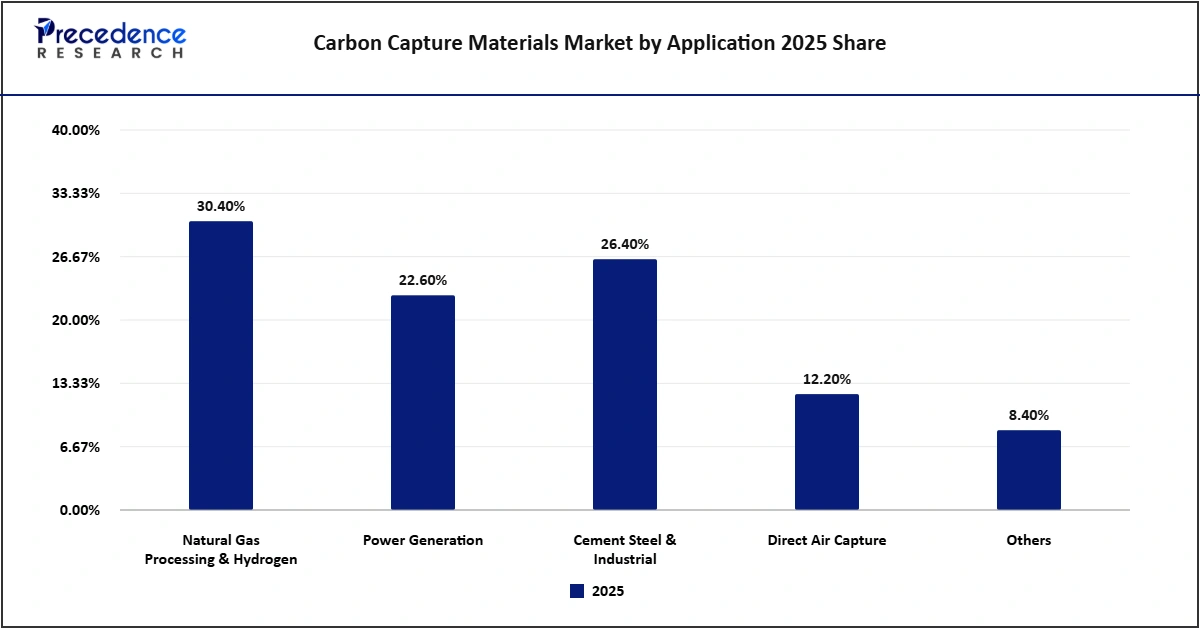
Carbon Capture Materials Market by Application 2025 Share
Note: 2025 is the base year.
Sources: Expert interviews, secondary sources, Precedence Research database and Precedence Research analysts.
The natural gas processing and hydrogen segment accounted for 30.40% (USD 0.72 billion) of market revenue in 2025 because CO2 removal is already the standard in gas treating and blue hydrogen projects. Cement, steel and industrial applications accounted for 26.40% (USD 0.62 billion) share, power generation for 22.60% (USD 0.53 billion), direct air capture for 12.20% (USD 0.29 billion) and others for 8.40% (USD 0.20 billion). Direct air capture is the fastest-growing application, followed by cement.
- Analyst View: Segment values were finalized by matching capture capacity, material inventories, replacement rates, and prices to material types, mechanisms and applications. The dominance of solvents is because of amine absorption plants, and gas processing leads because capture is established there. We expect solid sorbents, physical adsorption, direct air capture, and cement to gain share.
Regional Analysis
Carbon Capture Materials Market by Region 2025 Share
Note: 2025 is the base year.
Sources: Expert interviews, secondary sources, Precedence Research database and Precedence Research analysts.
North America accounted for 38.20% (USD 0.90 billion) of revenue in 2025, owing to the 45Q tax credit, ethanol and gas processing capture, direct air capture hubs and new sorbent and filter manufacturing in the U.S. and Canada. Europe held a market share of 26.40% (USD 0.62 billion), with important regional demand drivers being EU carbon pricing, North Sea storage projects and cement and waste-to-energy capture. Asia Pacific accounted for a 22.80% (USD 0.54 billion) share and is the fastest-growing region, owing to capture projects in China, Japan, South Korea and Australia and large industrial emitters. The Middle East and Africa, at 9.00% (USD 0.21 billion) of revenue, is supported by capture at gas and hydrogen facilities in Saudi Arabia, the UAE, and Qatar, and Latin America, at 3.60% (USD 0.08 billion), by projects in Brazil.
North America accounted for a market share of 38.20% (USD 0.90 billion) in 2025. Svante opened a commercial-scale carbon capture filter plant in British Columbia in 2025 with an annual capacity for filters capturing up to 10 million tons of CO2. US tax credits support ethanol, gas processing, and direct air capture projects. Several large amine capture projects are in the development stage.
Europe held 26.40% (USD 0.62 billion) of revenue in 2025. EU carbon pricing and storage projects in Norway, the Netherlands, and the United Kingdom support capture. BASF manufactures MOFs at industrial scale for carbon capture. Cement and waste-to-energy plants are increasingly adopting capture.
Asia Pacific accounted for 22.80% (USD 0.54 billion) of net market revenue in 2025 and is growing at the fastest rate. China operates capture demonstration projects in power and chemicals. Japan and South Korea support capture and storage collaborations. Australia has capture in gas processing.
The Middle East and Africa held 9.00% (USD 0.21 billion) of revenue in 2025. Saudi Arabia, the UAE, and Qatar capture CO2 at gas processing and industrial sites. Large hubs are planned for the future.
Latin America accounted for a 3.60% (USD 0.08 billion) share in 2025. Brazil reinjects CO2 from offshore gas production and is carrying out research related to capture in ethanol and industry.
Analyst View: Regional shares were built from capture capacity, material inventories and prices in each region. North America dominates due to tax credits and operating projects. We assign Asia Pacific the highest growth rate because industrial capture projects are expected to grow fastest in this region from a relatively lower base.
Top 10 Companies in the Carbon Capture Materials Market
| Rank | Company Name | Market-Specific Revenue (USD Billion) | 2025 Share | Key Products / Business | Headquarters |
| 1 | BASF | 0.24 | 10.17% | OASE gas treatment solvents and MOF sorbents | Germany |
| 2 | Shell (Cansolv) | 0.18 | 7.63% | CANSOLV CO2 capture solvents | United Kingdom |
| 3 | Mitsubishi Heavy Industries | 0.16 | 6.78% | KS-21 solvent and capture technology | Japan |
| 4 | Dow | 0.12 | 5.08% | Amine solvents for gas treating | United States |
| 5 | Carbon Clean | 0.08 | 3.39% | APBS-CDRMax solvent and modular capture | United Kingdom |
| 6 | Svante | 0.07 | 2.97% | MOF-based solid sorbent filters | Canada |
| 7 | Honeywell UOP | 0.06 | 2.54% | Adsorbents, membranes and capture solvents | United States |
| 8 | Climeworks | 0.05 | 2.12% | Direct air capture sorbents | Switzerland |
| 9 | Zeochem | 0.04 | 1.69% | Zeolite molecular sieves | Switzerland |
| 10 | Air Products | 0.04 | 1.69% | PRISM membranes | United States |
Note: Company revenues and shares are 2025 estimates.
Sources: Company press releases, expert interviews, secondary sources, Precedence Research database and Precedence Research analysts.
BASF dominated the market with 10.17% (USD 0.24 billion) of revenue in 2025, followed by Shell at 7.63% (USD 0.18 billion) share and Mitsubishi Heavy Industries at 6.78% (USD 0.16 billion). The leading position of BASF can be attributed to its OASE solvents, which are widely used in gas treating and CO2 capture, and it became the first company to manufacture MOFs at industrial scale, supplying Svante's CALF-20 sorbent under a commercial agreement. Shell's CANSOLV solvents and Mitsubishi Heavy Industries' KS-21 solvent find applications in many large post-combustion capture projects, supported by licensing and engineering packages.
Dow is an important supplier of amine solvents, Carbon Clean offers patented solvents and modular units, Svante produces MOF filters at its Redwood plant; Honeywell UOP, Zeochem and Air Products supply adsorbents and membranes, and Climeworks develops sorbents for direct air capture. The top 10 companies accounted for 44.07% (USD 1.04 billion) of share in the base year, while the remaining 55.93% (USD 1.32 billion) was held by sorbent start-ups, membrane developers and amine producers. The market is emerging and competitive, and competition revolves around capture capacity, regeneration energy, degradation resistance, cost per ton of CO2, scalability of manufacturing, and integration with capture technology licenses. Partnerships between material producers and technology developers are important for scaling of new sorbents and solvents.
Recent Developments
- May 2025: Svante completed commissioning of its Redwood carbon capture filter plant in Burnaby, British Columbia, a USD 145 million facility able to produce solid sorbent filters for up to 10 million tons of CO2 capture per year.
Carbon Capture Materials Market Segments
By Material Type
- Solvent-Based (Amine & Others)
- Solid Sorbents (MOFs, Zeolites, Amine-Silicas)
- Membranes
- Others
By Capture Mechanism
- Chemical Absorption
- Physical Adsorption
- Membrane Separation
- Others
By Application
- Natural Gas Processing & Hydrogen
- Power Generation
- Cement, Steel & Industrial
- Direct Air Capture
- Others
By Region
- North America (U.S., Canada, Mexico)
- Europe (Germany, U.K., France, Italy, Spain, Rest of Europe)
- Asia Pacific (China, Japan, India, South Korea, Taiwan, Rest of Asia Pacific)
- Latin America (Brazil, Argentina, Rest of Latin America)
- Middle East & Africa (GCC, South Africa, Rest of MEA)
Research Methodology
The market is defined as amine and other solvents, solid sorbents, membranes and related consumables for carbon dioxide capture, worldwide. The 2025 base year was built bottom-up from capture capacity by technology and region, material inventory and replacement rates and average prices, and checked top-down against the carbon capture material revenue of chemical and technology suppliers. Segment, regional and company values were allocated from material types, capture mechanisms, applications and regional demand. Key estimates were verified by cross-checking company disclosures, regulatory and industry data and published third-party estimates, and inputs that could not be reconciled were excluded. All segment, regional and company figures were reconciled to the same 2025 base year, and the 2026–2035 forecast, which applies a constant CAGR from the 2025 base, was recalculated and validated.
Analyst View: Overall Market
The market is growing swiftly from a small base as capture moves from gas processing into power, industry and direct air capture. Our estimate links demand to capture capacity, material inventories and prices, so the forecast follows project deployment, policy support and material innovation. The main upside comes from industrial capture and direct air capture, while the main risks are project delays and policy uncertainty.
Sources and References
- The Chemical Engineer. "BASF commercially produces metal-organic frameworks for CO2 capture in world first". 2023-11-03. BASF MOF production. https://www.thechemicalengineer.com/41954
- Pipeline & Gas Journal. "Svante opens first commercial carbon capture gigafactory in British Columbia". 2025-05-14. Svante Redwood plant. https://pgjonline.com/news/2025/may/svante-opens-first-commercial-carbon-capture-gigafactory-in-british-columbia
For inquiries regarding discounts, bulk purchases, or customization requests, please contact us at sales@precedenceresearch.com
Frequently Asked Questions





Ask For Sample
No cookie-cutter, only authentic analysis – take the 1st step to become a Precedence Research client
 Get a Sample




 sales@precedenceresearch.com
 Schedule a Meeting