



Clinical Oncology Next Generation Sequencing Market Size, Key Companies, Company Market Share, Patient Volume, Treatment Adoption Rates, Pricing Analysis, Regulatory Landscape, Competitive Positioning, and Demand Forecast
Payal Rabde, a Healthcare Industry Expert, highlights that the clinical oncology NGS market has reached USD 997.75 million in 2026 and is on track to reach USD 3,621.37 million by 2035, advancing at a CAGR of 15.40%. Key clinical oncology NGS market companies shaping the market include Illumina, Thermo Fisher Scientific, Roche, Agilent Technologies while major growth segments span workflow, technology, application, end use, region.
Source: https://www.precedenceresearch.com/clinical-oncology-ngs-market
 Get a Sample
 Report Description


Clinical Oncology NGS Market Size, Trends, Share, and Innovations 2035
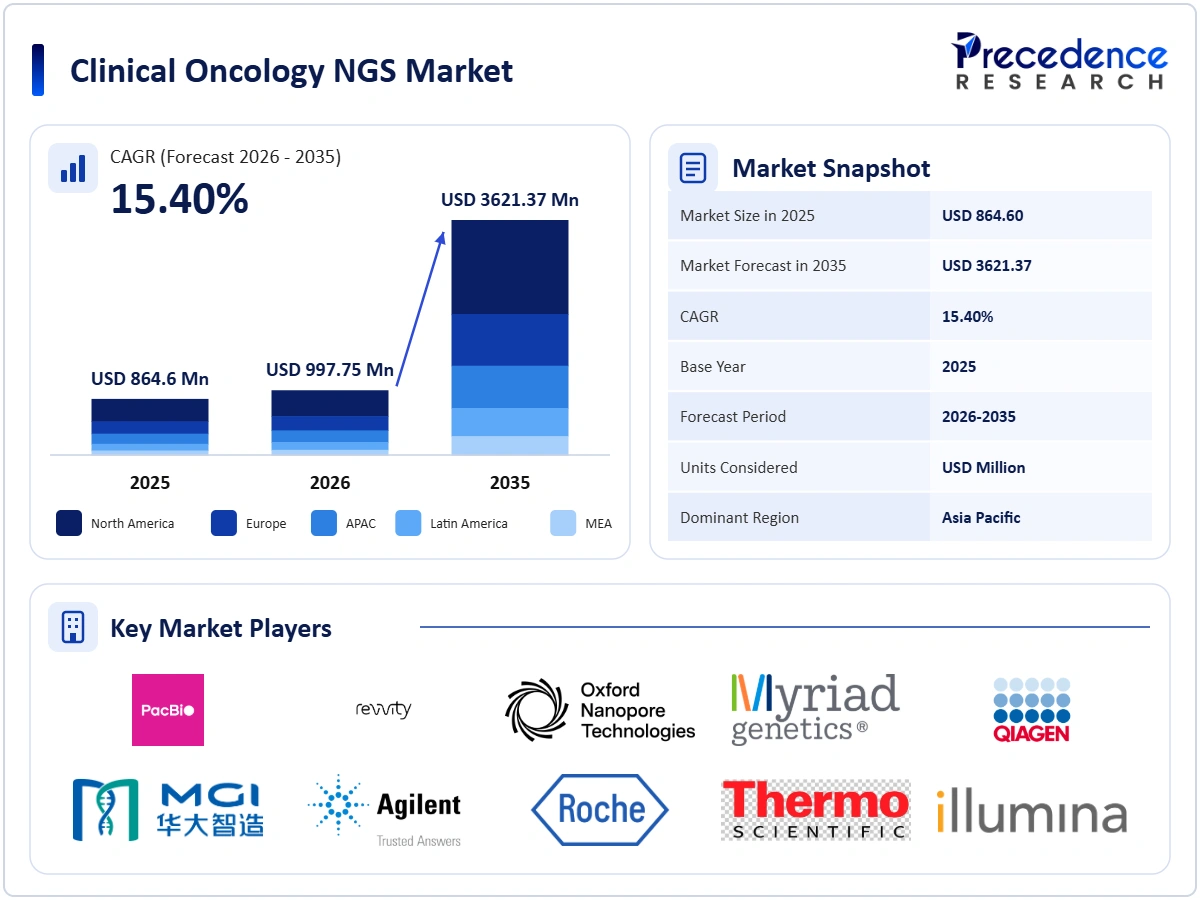
The clinical oncology NGS market is forecasted to expand from USD 997.75 million in 2026 to USD 3,621.37 million by 2035, growing at a CAGR of 15.40% from 2026 to 2035.
Key Takeaways
Market Size & Growth Outlook
- Market size in 2025: USD 864.60 million
- Estimated market size in 2026: USD 997.75 million
- Projected market size by 2035: USD 3,621.37 million
- CAGR (2026-2035): 15.40%
Regional Market Spotlight
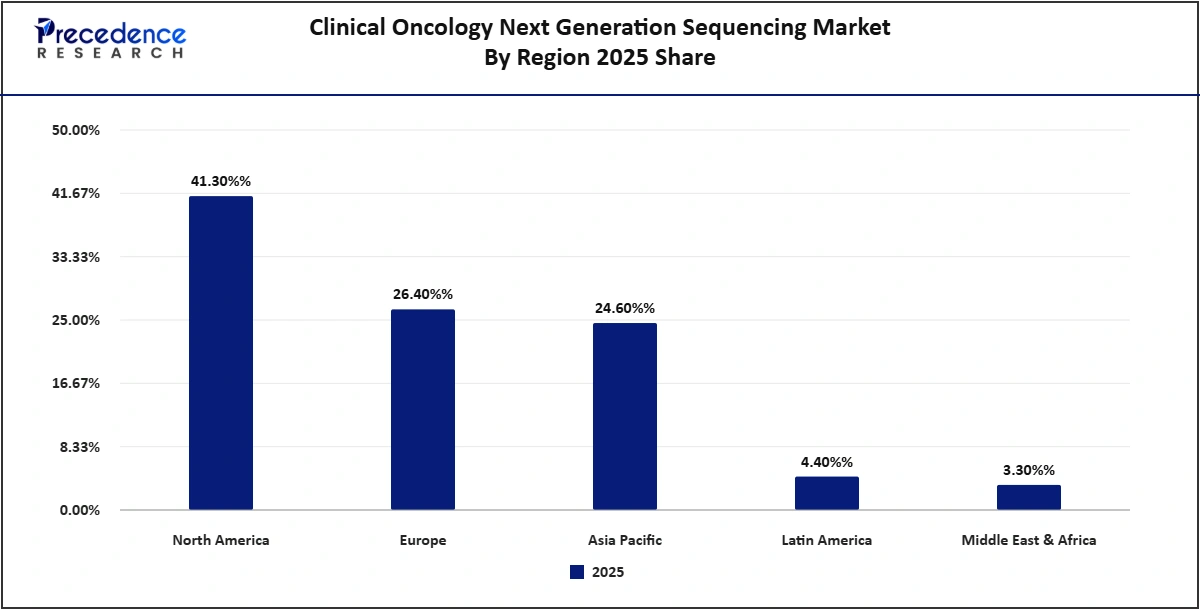
- North America led the market with a 41.30% (USD 357.08 million) share in 2025.
- Europe accounted for 26.40% (USD 228.25 million) of the market in 2025.
- Asia Pacific accounted for 24.60% (USD 212.69 million) of the market in 2025 and is projected to be the fastest-growing region, at a CAGR of 16.67% from 2025 to 2035.
Segmental Spotlight
- By workflow, Sequencing accounted for 45.80% (USD 395.99 million) in 2025.
- By technology, Targeted Sequencing & Resequencing accounted for 48.60% (USD 420.20 million) in 2025.
- By application, Screening accounted for 46.40% (USD 401.17 million) in 2025.
- By end use, Laboratories accounted for 57.40% (USD 496.28 million) in 2025.
Clinical Oncology Next Generation Sequencing Market Size and Forecast, 2025-2035 (USD Million)
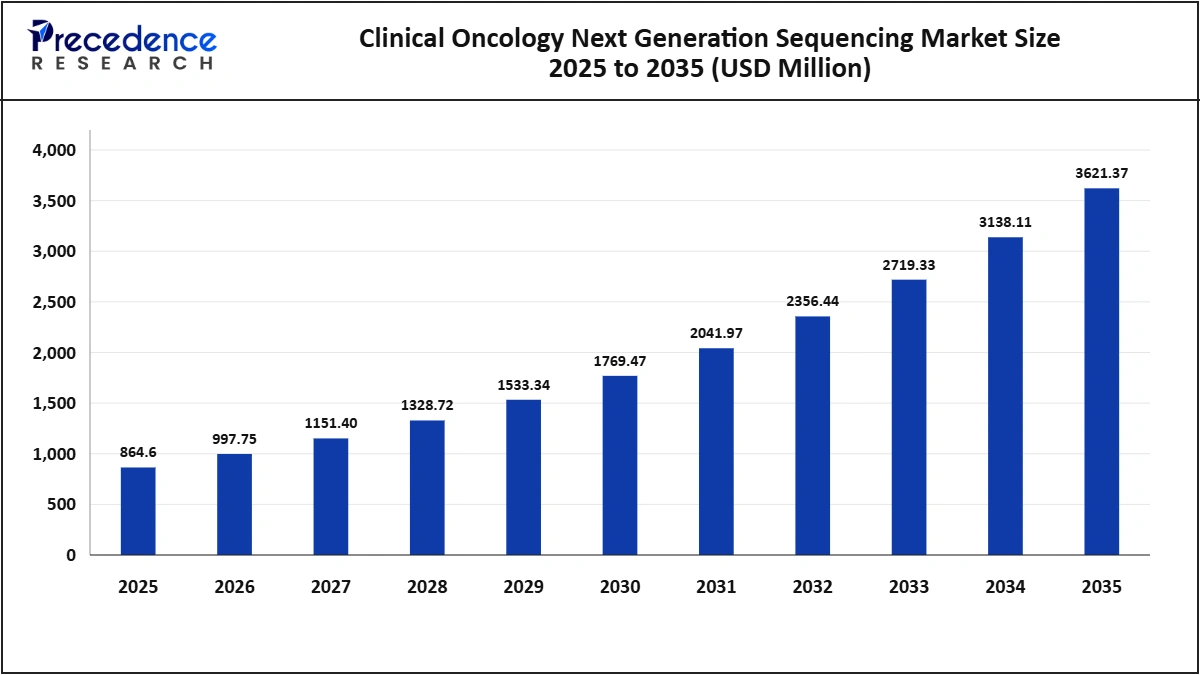
Note: 2025 is the base year; 2026–2035 values are forecasts.
Sources: Expert interviews, secondary sources, Precedence Research database and Precedence Research analysts.
The clinical oncology next generation sequencing market is projected to grow from USD 864.60 million in 2025 to USD 3,621.37 million by 2035 because hospital and reference laboratories run more oncology sequencing as FDA-approved kits and faster instruments make NGS easier to adopt. Companion diagnostic claims for new targeted therapies and coverage for profiling increase the number of patients tested, lifting the market to USD 1,769.47 million by 2030 and sustaining a CAGR of 15.40% from 2026 to 2035.
- Analyst View: We built the estimate from clinical oncology sequencing runs and samples by application, multiplied by the cost of pre-sequencing reagents, sequencing reagents and instrument use, and data analysis per sample, plus instrument placements in clinical laboratories. Samples include profiling tests, companion diagnostics, hereditary cancers, and liquid biopsy testing, and the percentage of those that are run in-house versus reference labs. The total was cross-checked against the clinical oncology revenue of leading sequencing and assay companies and against published estimates, which places our base year slightly above the comparable figures. Growth rate is dependent on fast implementation of NGS for clinical purposes, tempered by the reduction in cost per sample.
Market Trends
- FDA-approved NGS kits allow hospitals to test in-house.
- Benchtop sequencers deliver oncology results in one to two days.
- Whole genome sequencing is entering tumour-normal and MRD testing.
- Companion diagnostic claims are shifting to broad NGS panels.
- Lower-cost sequencers from China are widening access.
- Interpretation software is becoming central to clinical NGS.
Drivers, Restraints and Opportunities
Driver
The number of targeted therapies that require genomic testing keeps rising, and NGS can test many biomarkers in one run. Approval of NGS kits and diagnostics by FDA provides an approved alternative that will provide proper reimbursement. The faster and automated benchtop sequencing will provide the laboratory with the means to carry out the test in house. Broad genomics tests for various cancers are recommended. Liquid biopsy and minimal residual disease tests add new uses.
Restraint
Clinical NGS demands large capital investments, skilled personnel, and bioinformatics. Reimbursement varies from country to country and depending on the test. Tissue samples might not be sufficient for sequencing. Regulations for developing laboratory testing and in vitro diagnostic (IVD) kits increase cost and time. Cost per sample becomes lower.
Opportunity
Decentralized NGS kits can bring genomic testing to community hospitals worldwide. Whole genome sequencing and multi-omic tests can replace multiple separate assays. Minimal residual disease monitoring creates repeat testing over the course of treatment. Interpretation software and knowledge bases offer recurring revenue. Rapid growth in Asia Pacific offers large volume gains.
Market Segmentation: 2025 Share and Value
Clinical Oncology Next Generation Sequencing Market By Workflow 2025 Share
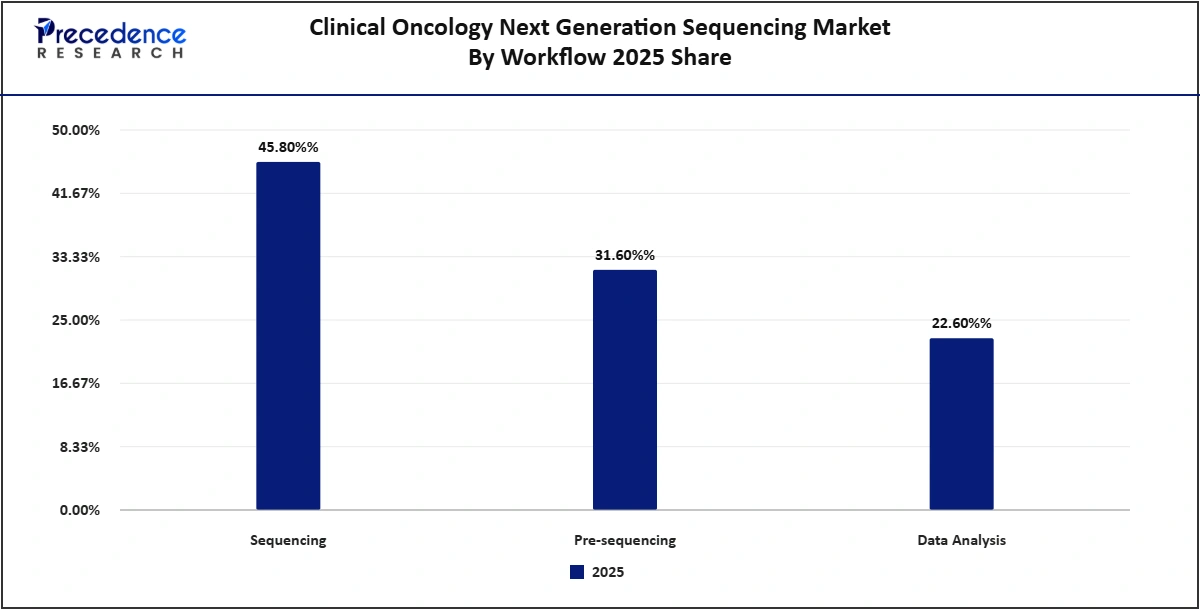
Note: 2025 is the base year.
Sources: Expert interviews, secondary sources, Precedence Research database and Precedence Research analysts.
Sequencing accounted for 45.80% (USD 395.99 million) in 2025 because flow cells, sequencing chemistry, and instrument time are the highest costs in each clinical run, and new benchtop systems have expanded clinical capacity. Pre-sequence processes at 31.60% (USD 273.21 million) include nucleic acid extraction, library preparation, and target enrichment, all of which require adherence to high-quality standards. Data analysis, at 22.60% (USD 195.40 million), is the fastest-growing step because variant calling, interpretation, and reporting software & knowledge bases are essential to turn sequence data into treatment decisions.
Clinical Oncology Next Generation Sequencing Market By Technology 2025 Share & Size
| Segments | 2025 Share | 2025 Market Value |
| Targeted Sequencing & Resequencing | 48.60% | USD 420.20 million |
| Whole Exome Sequencing | 22.40% | USD 193.67 million |
| Whole Genome Sequencing | 18.60% | USD 160.82 million |
| Others | 10.40% | USD 89.92 million |
Note: 2025 is the base year.
Sources: Expert interviews, secondary sources, Precedence Research database and Precedence Research analysts.
Targeted sequencing and resequencing accounted for 48.60% (USD 420.20 million) in 2025 because focused gene panels deliver deep coverage of actionable cancer genes at lower cost and are the basis of most FDA-approved oncology NGS tests. Whole exome sequencing, at 22.40% (USD 193.67 million), is used for broad profiling and hereditary testing. Whole genome sequencing, at 18.60% (USD 160.82 million), is the fastest-growing technology as costs fall and it is used for tumour-normal analysis and minimal residual disease tests; and other approaches, including RNA sequencing, account for 10.40% (USD 89.92 million).
Clinical Oncology Next Generation Sequencing Market By Application 2025 Share
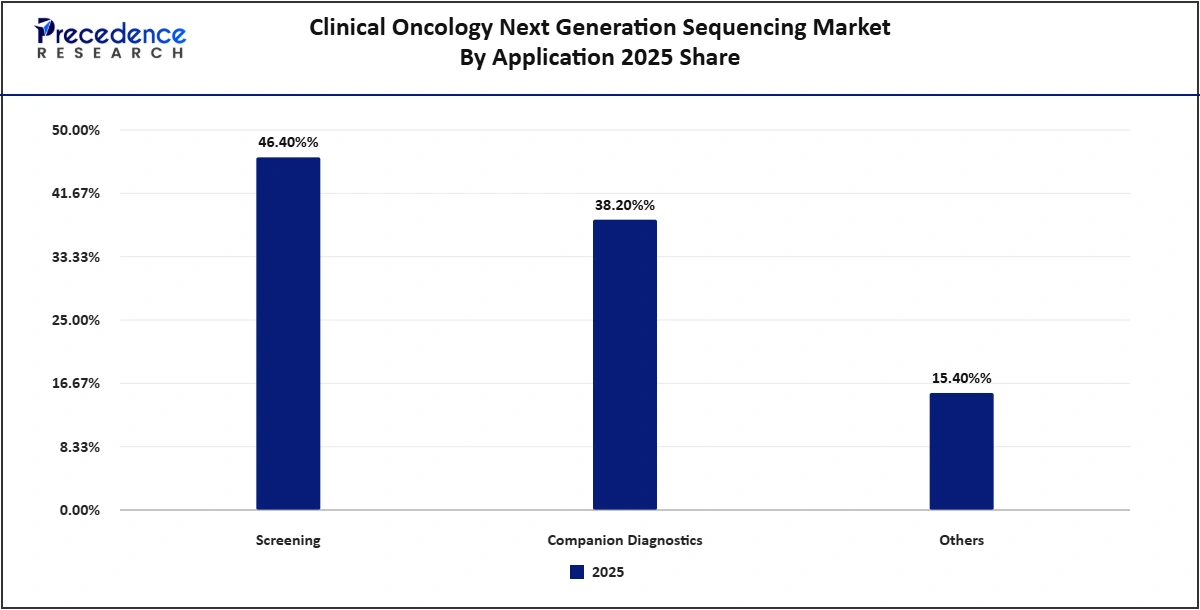
Note: 2025 is the base year.
Sources: Expert interviews, secondary sources, Precedence Research database and Precedence Research analysts.
Screening accounted for 46.40% (USD 401.17 million) in 2025, covering hereditary cancer risk testing, sporadic cancer screening, and early detection. Companion diagnostics, at 38.20% (USD 330.28 million), are the fastest-growing application because NGS panels are increasingly approved to select patients for targeted therapies, and other uses such as monitoring and research account for 15.40% (USD 133.15 million).
Clinical Oncology Next Generation Sequencing Market By End Use 2025 Share & Size
| Segments | 2025 Share | 2025 Market Value |
| Laboratories | 57.40% | USD 496.28 million |
| Hospitals | 30.20% | USD 261.11 million |
| Clinics | 12.40% | USD 107.21 million |
Note: 2025 is the base year.
Sources: Expert interviews, secondary sources, Precedence Research database and Precedence Research analysts.
Laboratories accounted for 57.40% (USD 496.28 million) in 2025, led by reference and specialty oncology laboratories that run large volumes of NGS tests. Hospitals, at 30.20% (USD 261.11 million), are the fastest-growing end user as FDA-approved kits and benchtop sequencers allow in-house testing, while clinics account for 12.40% (USD 107.21 million).
- Analyst View: Segment values were allocated by mapping clinical oncology samples by application and setting to workflow costs and sequencing technologies. Sequencing and targeted panels lead because they dominate clinical runs today. We expect data analysis, whole genome sequencing, companion diagnostics and hospital laboratories to gain share.
Regional Analysis
Note: 2025 is the base year.
Sources: Expert interviews, secondary sources, Precedence Research database and Precedence Research analysts.
North America accounted for 41.30% (USD 357.08 million) in 2025, growing on Medicare and commercial coverage for NGS profiling, many FDA-approved NGS assays and a dense network of oncology laboratories. U.S. hospitals deploy in-house kits to reduce turnaround time. Europe, at 26.40% (USD 228.25 million), is supported by national genomic medicine programs, such as England's Genomic Medicine Service, and growing reimbursement in Germany and France. Asia Pacific, at 24.60% (USD 212.69 million), is the fastest-growing region, supported by Japan's insurance coverage of comprehensive profiling, China's domestic sequencer makers, and expanding oncology testing in South Korea and India. Latin America, at 4.40% (USD 38.04 million), and the Middle East and Africa, at 3.30% (USD 28.53 million), are smaller markets where clinical NGS is mainly available in private laboratories and leading cancer centers.
North America accounted for 41.30% (USD 357.08 million) in 2025. Coverage for NGS testing and other FDA-approved tests motivates usage. Reference laboratories run large volumes. Hospitals are adopting in-house kits.
Europe accounted for 26.40% (USD 228.25 million) in 2025. National genomic programs support clinical sequencing. Reimbursement is growing in Germany and France. The EU IVD Regulation affects laboratory tests.
Asia Pacific accounted for 24.60% (USD 212.69 million) in 2025 and is the fastest-growing region. Japan covers comprehensive profiling. Chinese sequencer makers lower costs. South Korea and India are expanding oncology NGS.
Latin America accounted for 4.40% (USD 38.04 million) in 2025. Private laboratories in Brazil lead adoption. They prioritize sending samples to other laboratories for testing purposes.
The Middle East and Africa accounted for 3.30% (USD 28.53 million) in 2025. Gulf cancer centers are adopting NGS. Emerging economies like Africa and Egypt are making constant efforts to enhance access to NGS technology.
Analyst View: Regional shares were built from clinical oncology sequencing volumes, instrument placements, and prices in each region. North America leads because of high testing rates and reimbursement. We assign Asia Pacific the highest growth premium because national coverage and lower-cost local sequencing are expanding clinical NGS quickly.
Top 10 Companies in the Clinical Oncology Next Generation Sequencing Market
| Rank | Company Name | Market-Specific Revenue (USD Million) | 2025 Share | Key Products/Business | Headquarters |
| 1 | Illumina | 228.00 | 26.37% | NovaSeq, NextSeq and MiSeq Dx systems and TSO Comprehensive | United States |
| 2 | Thermo Fisher Scientific | 162.00 | 18.74% | Ion Torrent Genexus and Oncomine Dx assays | United States |
| 3 | Roche | 64.00 | 7.40% | AVENIO and sequencing technologies | Switzerland |
| 4 | Agilent Technologies | 48.00 | 5.55% | SureSelect target enrichment and analysis software | United States |
| 5 | MGI Tech | 38.00 | 4.40% | DNBSEQ sequencers | China |
| 6 | QIAGEN | 36.00 | 4.16% | QIAseq panels and clinical interpretation software | Netherlands |
| 7 | Myriad Genetics | 30.00 | 3.47% | Hereditary cancer NGS testing | United States |
| 8 | Oxford Nanopore Technologies | 22.00 | 2.54% | Long-read sequencing | United Kingdom |
| 9 | Revvity | 20.00 | 2.31% | NGS sample preparation | United States |
| 10 | Pacific Biosciences | 18.00 | 2.08% | Long-read sequencing systems | United States |
Note: Company revenues and shares are 2025 estimates.
Sources: Company press releases, expert interviews, secondary sources, Precedence Research database and Precedence Research analysts.
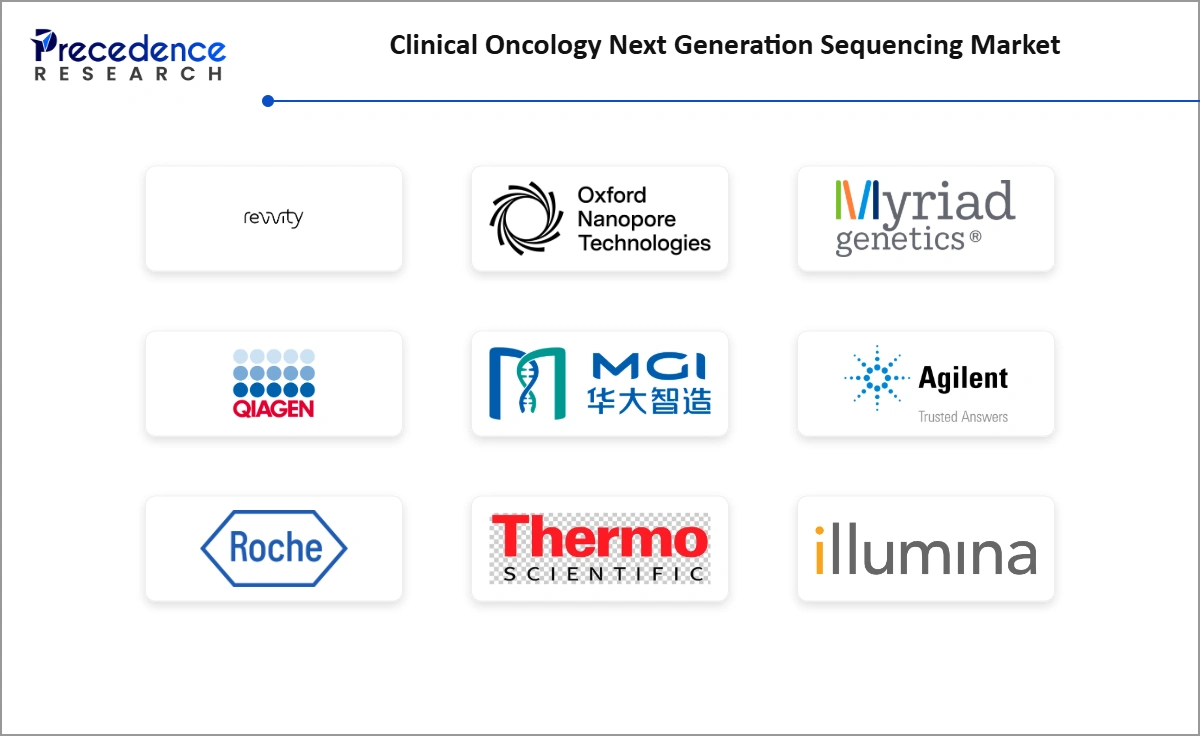
Illumina led the clinical oncology next generation sequencing market with an estimated 26.37% (USD 228.00 million) of 2025 revenue, followed by Thermo Fisher Scientific at 18.74% (USD 162.00 million) and Roche at 7.40% (USD 64.00 million). Illumina leads with the largest installed base of clinical sequencers and FDA-approved assays such as TruSight Oncology Comprehensive, which hospitals can run in-house. Thermo Fisher Scientific holds a strong position through Ion Torrent Genexus systems and Oncomine Dx tests, which deliver results in about a day and hold companion diagnostic claims. Roche, Agilent, and QIAGEN supply sequencing technologies, target enrichment, panels, and interpretation software; MGI Tech is expanding with lower-cost sequencers in China and other markets; and Myriad Genetics leads in hereditary cancer sequencing services. Top 10 firms made up an estimated 77.03% of revenue (USD 666.00 million), whereas the remaining 22.97% (USD 198.60 million) was divided between regional sequencing manufacturers, panel makers, bioinformatics suppliers, and clinical labs. The clinical oncology NGS market is concentrated among a few sequencing platform companies, and competition centers on regulatory approvals, turnaround time, cost per sample, ease of use in hospital laboratories, and data analysis tools. FDA-approved decentralized kits and software integration are increasingly important as hospitals conduct their own tests.
Recent Developments
- July 2025: The FDA approved Thermo Fisher Scientific's Oncomine Dx Express Test on the Genexus system as a companion diagnostic for Zegfrovy and for tumor profiling.
- May 2026: The FDA approved Guardant Health's Guardant360 Liquid CDx, an updated NGS liquid biopsy test covering more than 740 genes.
- May 2026: Tempus AI received FDA approval for a tumor-only indication of its 648-gene xT CDx NGS assay.
Market Segments
By Workflow
- Sequencing
- Pre-sequencing
- Data Analysis
By Technology
- Targeted Sequencing & Resequencing
- Whole Exome Sequencing
- Whole Genome Sequencing
- Others
By Application
- Screening
- Companion Diagnostics
- Others
By End Use
- Laboratories
- Hospitals
- Clinics
By Region
- North America (U.S., Canada, Mexico)
- Europe (Germany, U.K., France, Italy, Spain, Rest of Europe)
- Asia Pacific (China, Japan, India, South Korea, Taiwan, Rest of Asia Pacific)
- Latin America (Brazil, Argentina, Rest of Latin America)
- Middle East & Africa (GCC, South Africa, Rest of MEA)
Research Methodology
The clinical oncology next generation sequencing market refers to NGS instruments, pre-sequencing reagents, sequencing consumables, oncology panels, and data analysis software used in clinical cancer testing worldwide. The 2025 base year was built bottom-up from clinical oncology sequencing samples by application, workflow cost per sample, and instrument placements, and checked top-down against the clinical oncology revenue of leading sequencing and assay companies. Segment, regional, and company values were allocated from workflow steps, technologies, applications, end users, and regional sequencing activity. Key estimates were verified by cross-checking company disclosures, regulatory and industry data, and published third-party estimates, and inputs that could not be reconciled were excluded. All segment, regional, and company figures were reconciled to the same 2025 base year, and the 2026-2035 forecast, which applies a constant CAGR from the 2025 base, was recalculated and validated.
Analyst View Overall Market
The clinical oncology next generation sequencing market is growing quickly as approved kits, faster instruments, and companion diagnostic claims make sequencing a routine part of cancer care. The demand model is based on demand for the company's services in terms of clinical sequencing volume and workflow cost, so the forecast depends on implementation, reimbursement, and in-house hospital testing. Positive factors include decentralized kits, whole-genome sequencing, and MRD testing, while the negative factors include no reimbursement and lower pricing.
Sources and References
- Business Wire/Thermo Fisher. "Thermo Fisher's NGS assay receives FDA approval as a companion diagnostic for ZEGFROVY and for tumor profiling". 2025-07-02. Oncomine Dx Express Test approval. https://www.businesswire.com/news/home/20250702689193/en/Thermo-Fishers-NGS-Assay-Receives-FDA-Approval-as-a-Companion-Diagnostic-for-ZEGFROVY-and-for-Tumor-Profiling
- OncLive. "FDA approves TruSight Oncology Comprehensive assay as pan-tumor companion diagnostic". 2024-08. TSO Comprehensive approval. https://onclive.com/view/fda-approves-trusight-oncology-comprehensive-assay-as-pan-tumor-companion-diagnostic
- Tempus. "Tempus receives FDA approval for tumor-only xT CDx". 2026-05-29. xT CDx tumour-only approval. https://www.tempus.com/news/pr/tempus-receives-fda-approval-for-tumor-only-xt-cdx-enabling-migration-of-its-entire-dna-solid-tumor-portfolio/
- Patient Worthy. "Guardant Health secures FDA clearance for expanded liquid biopsy test". 2026-05-24. Guardant360 Liquid CDx approval. https://patientworthy.com/2026/05/24/guardant-health-secures-fda-clearance-for-expanded-liquid-biopsy-test/
For inquiries regarding discounts, bulk purchases, or customization requests, please contact us at sales@precedenceresearch.com
Frequently Asked Questions





Ask For Sample
No cookie-cutter, only authentic analysis – take the 1st step to become a Precedence Research client
 Get a Sample




 sales@precedenceresearch.com
 Schedule a Meeting
