



EPR Cable Market Size, Key Companies, Company Production Capacity, Electricity Generation, Capacity Utilization, Export & Import Analysis, Cost Structure, Competitive Landscape, and Market Outlook
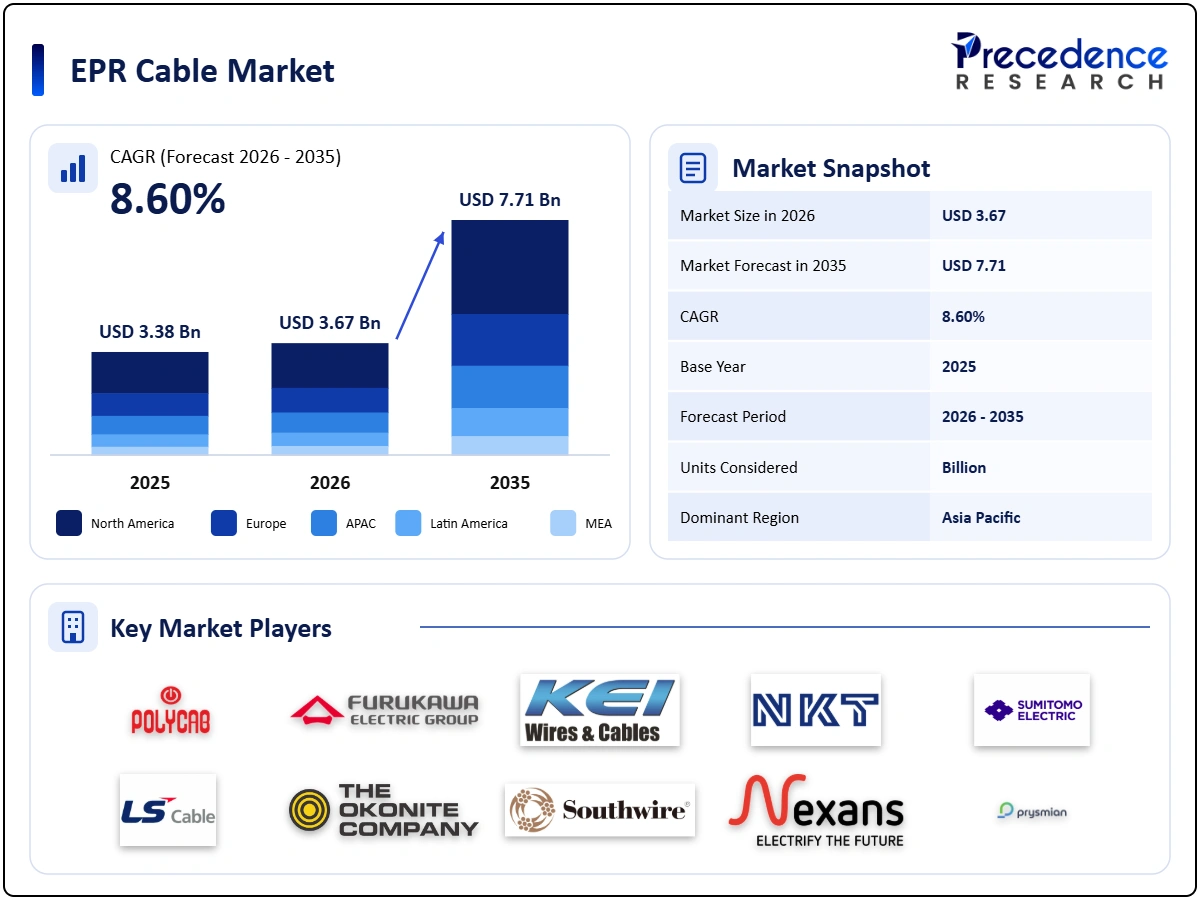
According to energy and power expert Laxmi Narayan, the EPR cable market has reached USD 3.67 billion in 2026 and is expected to grow to USD 7.71 billion by 2035, registering a CAGR of 8.60%. The EPR cable market companies such as Prysmian, Nexans, Southwire are playing a key role in market expansion, with major opportunities emerging across product type, conductor material, voltage type, end use and region segments.
Source: https://www.precedenceresearch.com/epr-cable-market
 Get a Sample
 Report Description

Key Takeaways
Market Size & Growth Outlook
- Market size in 2025: USD 3.38 billion
- Estimated market size in 2026: USD 3.67 billion
- Projected market size by 2035: USD 7.71 billion
- CAGR (2026-2035): 8.60%
Regional Market Spotlight
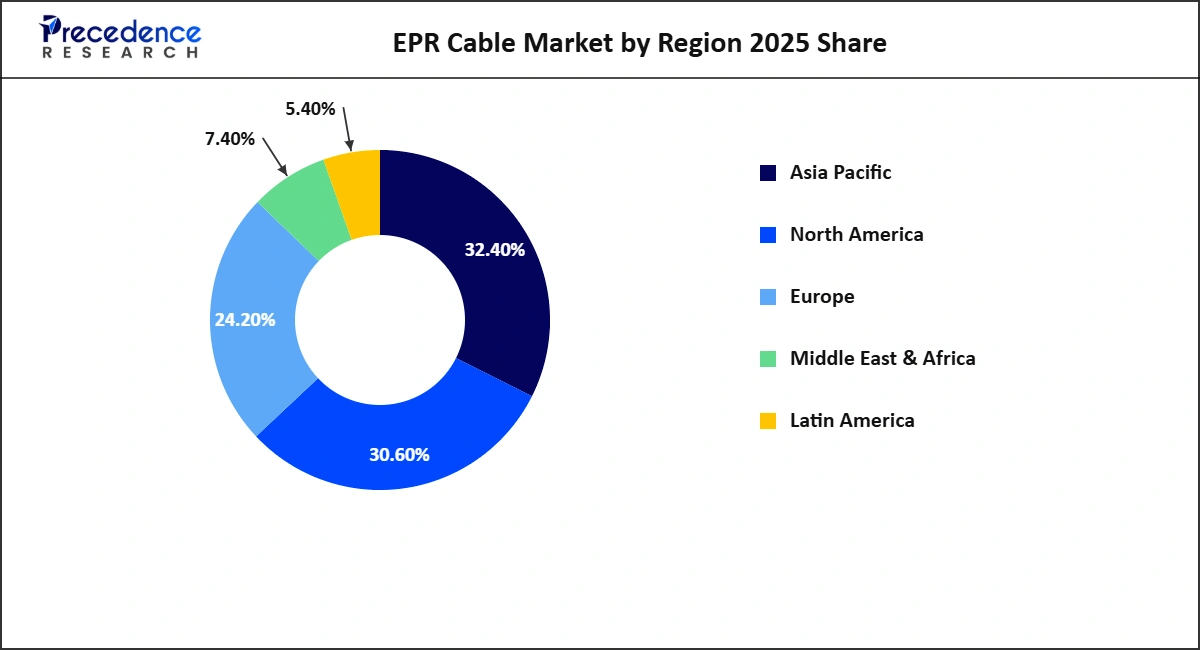
- Asia Pacific led the market in 2025 with a 32.40% share, worth USD 1.10 billion.
- North America accounted for 30.60% of the market, worth USD 1.03 billion, in 2025. It is expected to be the fastest-growing region, with a CAGR of 9.41% from 2025 to 2035.
- Europe held a 24.20% share of the market, worth USD 0.82 billion, in 2025.
Segmental Spotlight
- By product type, Multicore cables held a 56.40% share, worth USD 1.91 billion, in 2025.
- By conductor material, Copper accounted for 83.60%, worth USD 2.83 billion, in 2025.
- By voltage type, Medium Voltage (1–36 kV) held a 46.80% share, worth USD 1.58 billion, in 2025.
- By end use, Utilities accounted for 34.60%, worth USD 1.17 billion, in 2025.
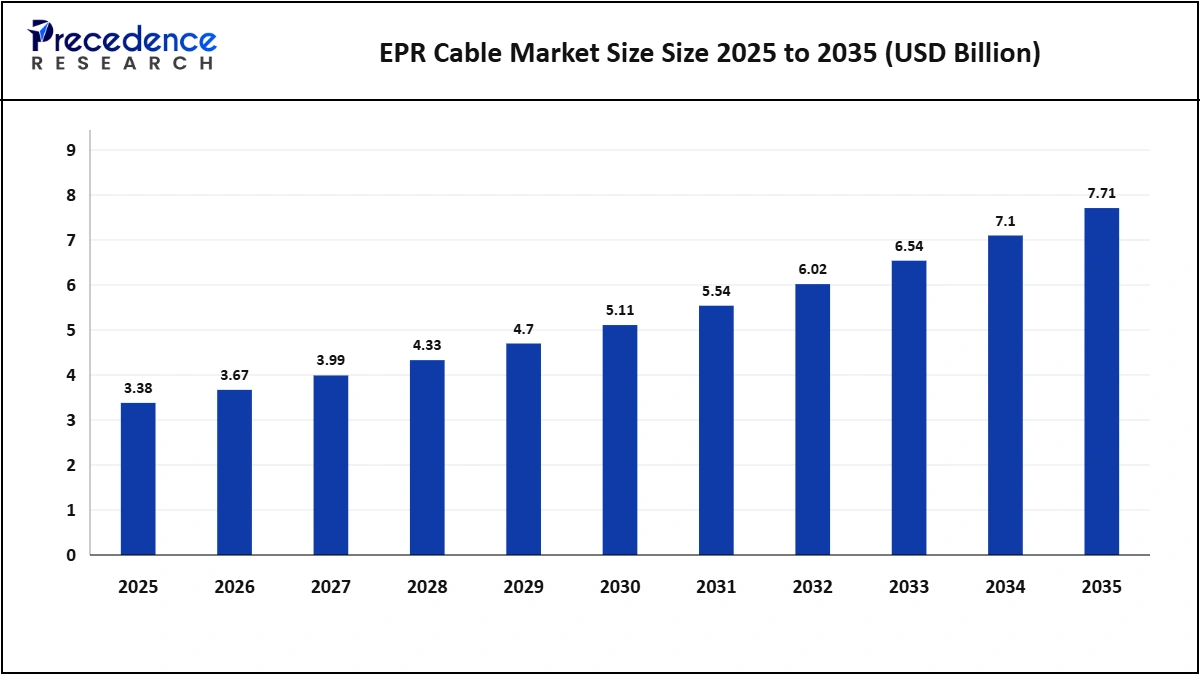
EPR Cable Market Size and Forecast, 2025-2035 (USD Billion)
Note: 2025 is the base year; 2026-2035 values are forecasts.
Sources: Expert interviews, secondary sources, Precedence Research database and Precedence Research analysts.
The EPR cable market is expected to grow from USD 3.38 billion in 2025 to USD 7.71 billion by 2035. This growth is mainly supported by demand from electricity utilities, industrial plants, mines, ships and renewable energy projects.
These industries use EPR-insulated cables because they are flexible, resist water-related damage and perform well at high conductor temperatures.
The growing use of underground power cables, data centre construction and renewable energy connections is also increasing demand for medium-voltage EPR cables. As a result, the market is expected to reach USD 5.11 billion by 2030 and grow at a CAGR of 8.60% from 2026 to 2035.
- Analyst View: We prepared the market estimate by looking at annual cable consumption across different voltage levels, applications and regions. We also considered the share of cables that use EPR or EPDM insulation and their average selling prices. Changes in copper and aluminium prices were also included in the estimate.
Demand estimates cover utility distribution networks, industrial plants, mining, marine and offshore projects, renewable energy and data centres.
We compared the total market estimate with the cable-related revenue of leading manufacturers and published market estimates. Based on this comparison, our base-year estimate is slightly higher than the comparable figures.
The expected growth is supported by investment in electricity grids and wider electrification. However, competition from cross-linked polyethylene insulation and changes in metal prices may affect market growth.
Market Trends
- Medium-voltage cable production capacity is increasing in North America.
- More underground power networks are increasing the use of EPR distribution cables.
- Data centre construction is creating demand for medium-voltage feeder cables.
- Renewable energy projects are increasing the use of EPR collection cables.
- Aluminium conductors are becoming more common in utility applications.
- Flexible EPR cables are supporting the growing electrification of mining operations.
Drivers, Restraints and Opportunities
Driver
Investment in grid upgrades and underground power networks is increasing demand for medium-voltage distribution cables. EPR insulation is preferred in many applications because it is flexible, resists moisture and water-tree damage, and performs well at high temperatures. Renewable energy projects need cables to connect and distribute generated power. Data centres also require large quantities of medium- and low-voltage cables. In addition, the growing use of electricity in industrial plants and mines is increasing demand for flexible cables.
Restraint
Cross-linked polyethylene (XLPE) insulation competes with EPR in many medium-voltage applications, often because of its lower cost. Changes in copper and aluminium prices can affect cable prices and project budgets. Long delivery times and limited manufacturing capacity can also delay projects. Raw material and insulation compound costs may change over time. Competition from lower-cost regional manufacturers can put pressure on company profit margins.
Opportunity
More utilities are installing underground cables to protect power networks from wildfires and severe storms. This creates opportunities for EPR cable manufacturers. Growth in offshore and onshore wind projects is also increasing demand for reliable medium-voltage cables. Data centre campuses can create large and repeat orders. Mining electrification and electric mining vehicles need strong and flexible cables. Manufacturers that build new local factories may also benefit from domestic manufacturing policies.
Market Segmentation: 2025 Share and Value
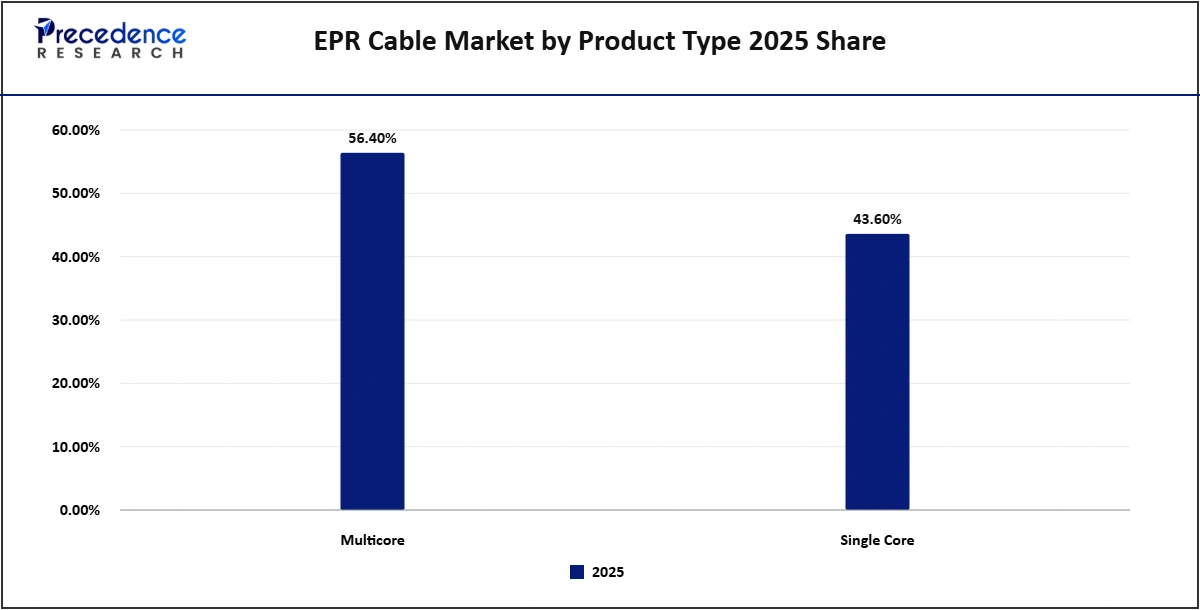
EPR Cable Market by Product Type 2025 Share
Note: 2025 is the base year.
Sources: Expert interviews, secondary sources, Precedence Research database and Precedence Research analysts.
Multicore cables held the largest product share in 2025, accounting for 56.40% or USD 1.91 billion. Factories, mines, ports and commercial facilities use these cables for power distribution, control circuits, motor connections and portable equipment.
Multicore EPR cables are useful in these applications because they are flexible and can resist surface damage. They also make installation easier in cable trays and moving cable systems, such as drag chains.
Single core cables accounted for 43.60% of the market, worth USD 1.47 billion. This is the faster-growing product type. These cables are used in medium-voltage utility networks, renewable energy collection systems and data centre power connections.
EPR Cable Market by Conductor Material 2025 Share & Size
| Segments | 2025 Share | 2025 Market Value |
| Copper | 83.60% | USD 2.83 billion |
| Aluminium | 16.40% | USD 0.55 billion |
Note: 2025 is the base year.
Sources: Expert interviews, secondary sources, Precedence Research database and Precedence Research analysts.
Copper accounted for 83.60% of the market, worth USD 2.83 billion, in 2025. Its good electrical conductivity and flexibility make it suitable for industrial, mining, marine and portable EPR cables.
Aluminium held a 16.40% share, worth USD 0.55 billion. It is the faster-growing conductor material in utility distribution and renewable energy collection systems, where lower weight and cost are important.
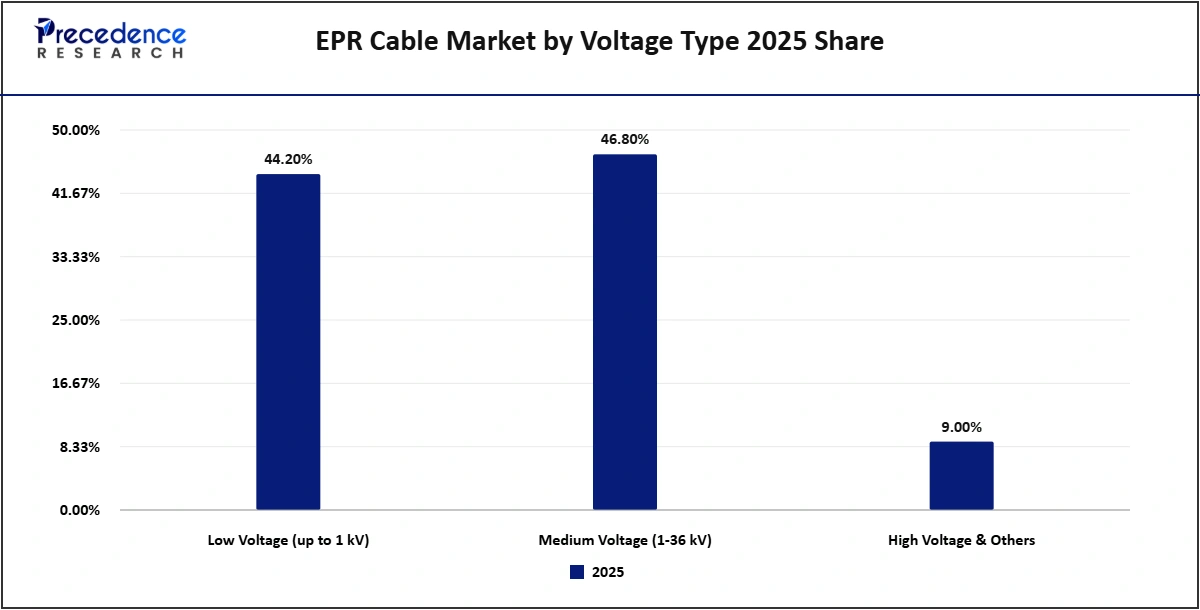
EPR Cable Market by Voltage Type 2025 Share
Note: 2025 is the base year.
Sources: Expert interviews, secondary sources, Precedence Research database and Precedence Research analysts.
Medium-voltage cables held the largest share in 2025, accounting for 46.80% or USD 1.58 billion. This is also the fastest-growing voltage segment.
EPR insulation is widely used in this category because it resists water-tree damage and performs well at high temperatures. These features make it suitable for underground electricity networks, wind and solar power collection systems and industrial power connections.
Low-voltage cables accounted for 44.20% of the market, worth USD 1.49 billion. High-voltage cables and other types held the remaining 9.00%, worth USD 0.30 billion.
EPR Cable Market by End Use 2025 Share & Size
| Segments | 2025 Share | 2025 Market Value |
| Utilities | 34.60% | USD 1.17 billion |
| Industrial & Manufacturing | 22.40% | USD 0.76 billion |
| Mining & Oil and Gas | 14.20% | USD 0.48 billion |
| Renewables & Data Centres | 16.20% | USD 0.55 billion |
| Marine, Transportation & Others | 12.60% | USD 0.43 billion |
Note: 2025 is the base year.
Sources: Expert interviews, secondary sources, Precedence Research database and Precedence Research analysts.
Utilities held the largest end-use share in 2025, accounting for 34.60% or USD 1.17 billion. Electricity distribution networks and underground cable projects use medium-voltage EPR cables, supporting demand from this segment.
Industrial and manufacturing applications accounted for 22.40%, worth USD 0.76 billion. Renewables and data centres held 16.20%, worth USD 0.55 billion. Mining and oil and gas accounted for 14.20%, worth USD 0.48 billion. Marine, transportation and other applications made up the remaining 12.60%, worth USD 0.43 billion.
Renewables and data centres are the fastest-growing end-use segment.
- Analyst View: We calculated the value of each segment by comparing cable consumption, EPR usage and cable prices across product types, conductor materials, voltage levels and end uses. We also used revenue information from cable manufacturers.
Multicore and medium-voltage cables currently lead because of strong demand from industrial users and utilities. We expect single core cables, medium-voltage cables, aluminium conductors and cables used in renewable energy and data centres to gain a larger market share over time.
Regional Analysis
EPR Cable Market by Region 2025 Share
Note: 2025 is the base year.
Sources: Expert interviews, secondary sources, Precedence Research database and Precedence Research analysts.
Asia Pacific held the largest share of the EPR cable market in 2025, accounting for 32.40% or USD 1.10 billion. Growth is supported by expanding electricity networks, industrial development, mining activities and large cable manufacturing centres in China, India, Japan and South Korea.
North America accounted for 30.60% of the market, worth USD 1.03 billion. It is expected to be the fastest-growing region because of electricity grid upgrades, underground cable projects, data centre construction, renewable energy connections and new medium-voltage cable production facilities.
Europe held a 24.20% share, worth USD 0.82 billion. Demand in the region is supported by offshore wind projects, electricity grid upgrades and industrial and marine applications.
The Middle East and Africa accounted for 7.40% of the market, worth USD 0.25 billion. Latin America held a 5.40% share, worth USD 0.18 billion. Demand in these regions is supported by oil and gas projects, mining, utility networks and renewable energy development.
Asia Pacific accounted for 32.40% of the market, worth USD 1.10 billion, in 2025 and remained the largest regional market. China and India are expanding their electricity transmission and distribution networks. Mining activities in Australia and Indonesia also use flexible EPR cables. Major cable manufacturers across the region supply both domestic and international markets.
North America held a 30.60% share, worth USD 1.03 billion, in 2025 and is expected to be the fastest-growing region. EPR insulation is widely used in medium-voltage distribution cables in the United States.
Prysmian is building a medium-voltage cable plant at Encore Wire's Texas campus, with production expected to begin in 2027. LS Cable & System USA also announced a USD 50 million investment to expand medium-voltage cable production in North Carolina in 2026. Growing data centre construction and electricity grid upgrades are creating additional demand.
Europe accounted for 24.20% of the market, worth USD 0.82 billion, in 2025. Offshore wind projects use medium-voltage cables to connect wind turbines, while onshore electricity networks are being upgraded. Marine and industrial customers also use EPR cables because of their flexibility and fire performance. Prysmian, Nexans and NKT are major suppliers in the region.
The Middle East and Africa held a 7.40% share, worth USD 0.25 billion, in 2025. Oil and gas projects, petrochemical facilities and utility networks are supporting demand in Gulf countries. Mining operations across Africa also use flexible trailing cables.
Latin America accounted for 5.40% of the market, worth USD 0.18 billion, in 2025. Mining activities in Chile and Peru, along with renewable energy projects in Brazil and Mexico, are supporting regional demand.
Analyst View: We calculated regional market shares by looking at cable consumption, EPR usage and prices in each region. Asia Pacific leads because of its high cable consumption, while North America has strong EPR use in medium-voltage distribution networks.
We expect North America to record the highest growth because investment in electricity grids, data centres and renewable energy projects is increasing. New cable manufacturing capacity in the region is also supporting this growth.
Competitive Landscape
Top 10 Companies in the EPR Cable Market, 2025
| Rank | Company Name | Market-Specific Revenue (USD Billion) | 2025 Share | Key Products / Business | Headquarters |
| 1 | Prysmian | 0.36 | 10.65% | EPR medium-voltage and industrial cables | Italy |
| 2 | Nexans | 0.24 | 7.10% | EPR power and industrial cables | France |
| 3 | Southwire | 0.22 | 6.51% | EPR medium-voltage and industrial cables | United States |
| 4 | The Okonite Company | 0.16 | 4.73% | Okoguard EPR cables | United States |
| 5 | LS Cable & System | 0.14 | 4.14% | Medium-voltage power cables | South Korea |
| 6 | Sumitomo Electric | 0.10 | 2.96% | Power and industrial cables | Japan |
| 7 | NKT | 0.08 | 2.37% | Medium-voltage and offshore cables | Denmark |
| 8 | KEI Industries | 0.06 | 1.78% | Industrial and power cables | India |
| 9 | Furukawa Electric | 0.05 | 1.48% | Power and specialty cables | Japan |
| 10 | Polycab India | 0.05 | 1.48% | Industrial and power cables | India |
Note: Company revenues and shares are 2025 estimates.
Sources: Company press releases, expert interviews, secondary sources, Precedence Research database and Precedence Research analysts.
Prysmian led the EPR cable market in 2025, with an estimated 10.65% share of revenue, worth USD 0.36 billion. Nexans ranked second with a 7.10% share, worth USD 0.24 billion, followed by Southwire with a 6.51% share, worth USD 0.22 billion.
Prysmian holds a leading position because it offers a wide range of EPR cables for electricity distribution, industrial operations, mining, oil and gas and marine applications. Its position in North America has also been strengthened by its acquisition of Encore Wire and the construction of a new medium-voltage cable plant in Texas.
Nexans and Southwire are also major suppliers of EPR power and industrial cables. Nexans has a strong position in Europe, while Southwire has a strong presence in North America.
The Okonite Company has a long history of producing EPR-insulated cables in the United States. LS Cable & System is increasing its medium-voltage cable manufacturing capacity in the US. Sumitomo Electric, NKT, KEI Industries, Furukawa Electric and Polycab also compete in different regional markets.
The top 10 companies accounted for an estimated 43.20% of market revenue in 2025, equal to USD 1.46 billion. The remaining 56.80%, or USD 1.92 billion, came from regional cable manufacturers, specialist mining and marine cable producers and customers of compound suppliers.
The EPR cable market is moderately concentrated among large international cable manufacturers and specialist producers. Companies mainly compete on insulation compound quality, resistance to water-tree damage, high-temperature performance, utility approvals, delivery times, local manufacturing and pricing.
New manufacturing investments in North America are becoming an important part of competition. Utilities and data centre developers want a reliable supply of cables, encouraging manufacturers to increase local production capacity.
Companies Ecosystem
The EPR cable market includes several connected groups. Polymer and metal suppliers provide the basic materials, while compound manufacturers prepare the insulation materials. Cable manufacturers use these materials to produce finished cables. Distributors and installers then supply and install the cables for utilities, industries and other customers.
The quality of insulation compounds and the ability to manufacture medium-voltage cables are important sources of value in this market. Long-term supply agreements with utilities and data centre companies also influence demand.
| Ecosystem Stage | Role in the Market | Key Companies |
| Raw Material Suppliers | Produce EPR and EPDM polymers, fillers, additives, copper and aluminium | Dow, ExxonMobil, ARLANXEO, Freeport-McMoRan, Rio Tinto |
| Compounders | Prepare EPR insulation and jacket compounds | Dow, Borealis, Hexpol, cable makers' in-house compounding |
| Cable Manufacturers | Draw conductors and add insulation, armour and outer jackets to produce cables | Prysmian, Nexans, Southwire, Okonite, LS Cable & System, NKT |
| Distributors & Installers | Store, supply, cut and install cables for utilities and contractors | Electrical distributors, EPC contractors, utility contractors |
| End Users | Use cables in utilities, industrial plants, mines, offshore operations, data centres and renewable energy projects | Utilities, data centre operators, mining companies, wind and solar developers |
Sources: Company press releases, expert interviews, secondary sources, Precedence Research database and Precedence Research analysts.
Precedence Research Companies Quadrant
The Precedence Research Companies Quadrant compares major companies in the EPR cable market based on their market position and growth plans.
Market strength is measured through factors such as company revenue, market share and geographic presence. Innovation and growth strategy are assessed by looking at product range, research and development activities and business partnerships.
Company positions are based on estimated 2025 EPR cable revenue and our assessment of their product ranges, manufacturing investments and partnerships.
Sources: Company press releases, expert interviews, secondary sources, Precedence Research database and Precedence Research analysts.
Leaders: Prysmian, Nexans, Southwire and LS Cable & System are leading companies in the market. They have strong EPR cable businesses, wide product ranges for utilities and industries, important product approvals and ongoing investments in manufacturing capacity across key regions.
Challengers: The Okonite Company and Sumitomo Electric have established market positions and strong product approvals. However, their product ranges or geographic presence are more focused.
Innovators: NKT and KEI Industries are expanding their manufacturing capacity and developing their offshore and specialty cable businesses. These efforts could help them gain market share in medium-voltage and renewable energy applications.
Niche Players: Furukawa Electric and Polycab India serve specific regional and specialty markets with focused product ranges.
Recent Developments
- June 2025: Prysmian started work on a USD 500 million expansion of Encore Wire's McKinney, Texas campus. The project includes a new medium-voltage cable facility, which is expected to begin production in 2027. (Source: na.prysmian.com)
- February 2026: LS Cable & System USA announced a USD 50 million investment in North Carolina to increase its medium-voltage power cable manufacturing capacity in the United States. (Source: businesswire.com)
EPR Cable Market Segments
By Product Type
- Multicore
- Single Core
By Conductor Material
- Copper
- Aluminium
By Voltage Type
- Low Voltage (up to 1 kV)
- Medium Voltage (1–36 kV)
- High Voltage & Others
By End Use
- Utilities
- Industrial & Manufacturing
- Mining & Oil and Gas
- Renewables & Data Centres
- Marine, Transportation & Others
By Region
- North America (U.S., Canada, Mexico)
- Europe (Germany, U.K., France, Italy, Spain, Rest of Europe)
- Asia Pacific (China, Japan, India, South Korea, Taiwan, Rest of Asia Pacific)
- Latin America (Brazil, Argentina, Rest of Latin America)
- Middle East & Africa (GCC, South Africa, Rest of MEA)
Research Methodology
The EPR cable market covers power, control, instrumentation and specialty cables that use EPR or EPDM insulation compounds. The study includes the global market.
We prepared the 2025 base-year estimate using a bottom-up approach. This involved calculating cable consumption by voltage level, application and region, along with the share of cables using EPR insulation and their average selling prices.
We then compared the total estimate with the cable-related revenue of leading manufacturers using a top-down approach.
Market values for different segments, regions and companies were calculated based on product types, conductor materials, voltage levels, end uses and regional demand.
We checked the main estimates against company disclosures, regulatory information, industry data and published third-party estimates. Any inputs that could not be matched or supported were excluded.
All segment, regional and company figures were aligned with the same 2025 base year. The 2026–2035 forecast was then calculated using a constant CAGR from the 2025 base year and checked again for consistency.
Analyst View: Overall Market
The EPR cable market is growing because of investment in electricity grids, wider electrification and the construction of data centres. Medium-voltage cables are expected to play an important role in this growth.
Our estimate connects market demand with cable consumption, EPR usage and cable prices. This means the forecast reflects investment in utility networks, renewable energy, industrial facilities and data centres.
The biggest growth opportunities come from underground power cable projects and data centre construction. However, competition from XLPE insulation and changes in metal prices remain important challenges for the market.
Sources and References
- IMPO. "Prysmian breaks ground on $500M Encore Wire expansion". 2025-06-18. Encore Wire MV plant. (Source: impomag.com)
- SMM. "Prysmian invests $1B in US expansion". 2026-08-31. Prysmian US investment. (Source: news.metal.com)
For inquiries regarding discounts, bulk purchases, or customization requests, please contact us at sales@precedenceresearch.com
Frequently Asked Questions





Ask For Sample
No cookie-cutter, only authentic analysis – take the 1st step to become a Precedence Research client
 Get a Sample




 sales@precedenceresearch.com
 Schedule a Meeting
