



Fertility Test Market Size, Key Companies, Company Product Portfolio, Hospital Procurement Trends, Manufacturing Capacity, Sales Performance, Regulatory Approvals, Company Market Share, and Forecast
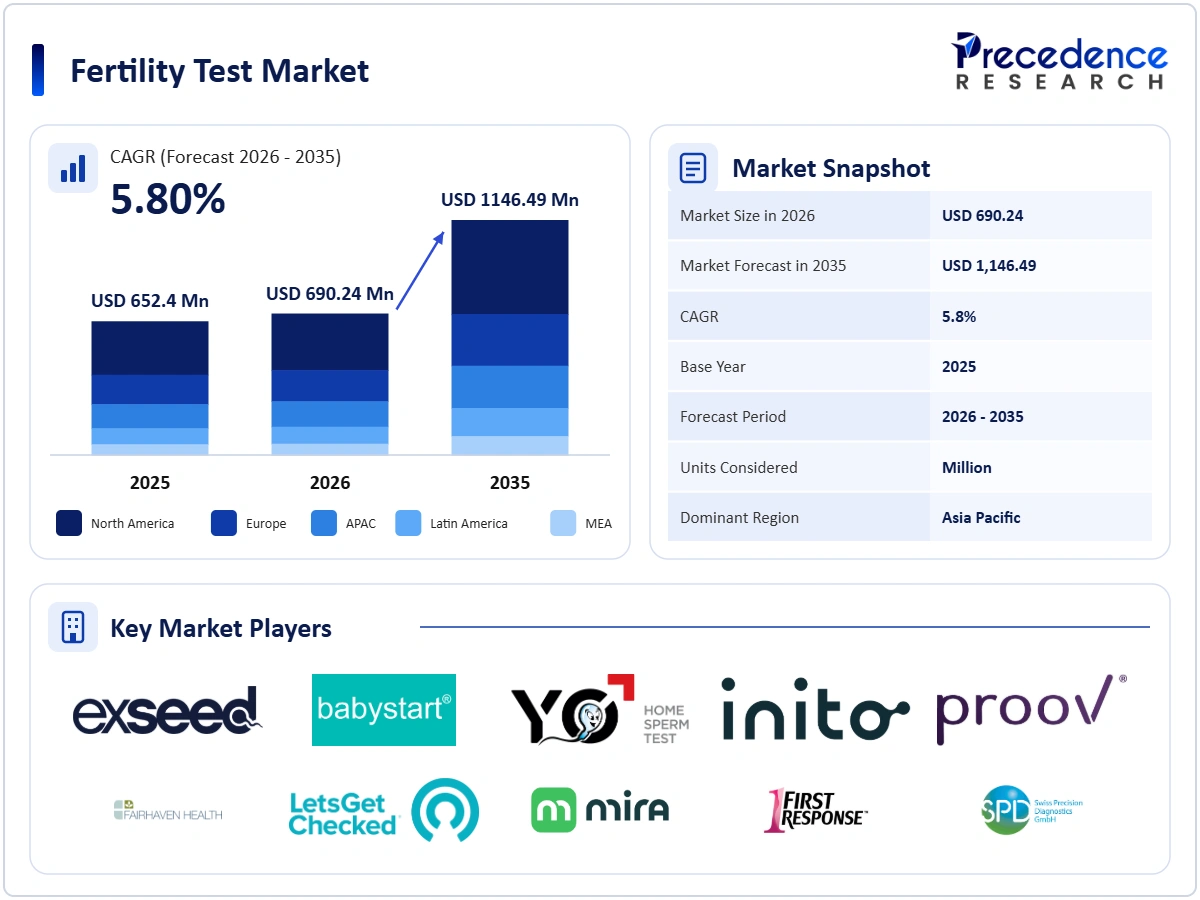
Payal Rabde, a Healthcare Industry Expert, highlights that the fertility test market has reached USD 690.24 million in 2026 and is on track to reach USD 1,146.49 million by 2035, advancing at a CAGR of 5.80%. Key fertility test market companies shaping the market include Mira, LetsGetChecked, Fairhaven Technologies while major growth segments span Product, mode of purchase, application, end user, region.
Source: https://www.precedenceresearch.com/fertility-test-market
 Get a Sample
 Report Description


Fertility Test Market Size, Demand, and Trends Analysis 2035
The fertility test market is forecasted to expand from USD 690.24 million in 2026 to USD 1,146.49 million by 2035, growing at a CAGR of 5.80% from 2026 to 2035.
Key Takeaways
Market Size & Growth Outlook
- Market size in 2025: USD 652.4 million
- Estimated market size in 2026: USD 690.24 million
- Projected market size by 2035: USD 1,146.49 million
- CAGR (2026-2035): 5.8%
Regional Market Spotlight
- North America led the market with a 38.6% (USD 251.83 million) share in 2025.
- Europe accounted for 27.4% (USD 178.76 million) of the market in 2025.
- Asia Pacific accounted for 24.8% (USD 161.80 million) of the market in 2025 and is projected to be the fastest-growing region, at a CAGR of 7.06% from 2025 to 2035.
Segmental Spotlight
- By product, Ovulation Prediction Kits accounted for 43.8% (USD 285.75 million) in 2025.
- By mode of purchase, OTC accounted for 68.7% (USD 448.20 million) in 2025.
- By application, Female Fertility Testing accounted for 83.7% (USD 546.06 million) in 2025.
- By end user, Home Care Settings accounted for 55.7% (USD 363.39 million) in 2025.
Fertility Test Market Size and Forecast, 2025-2035 (USD Million)
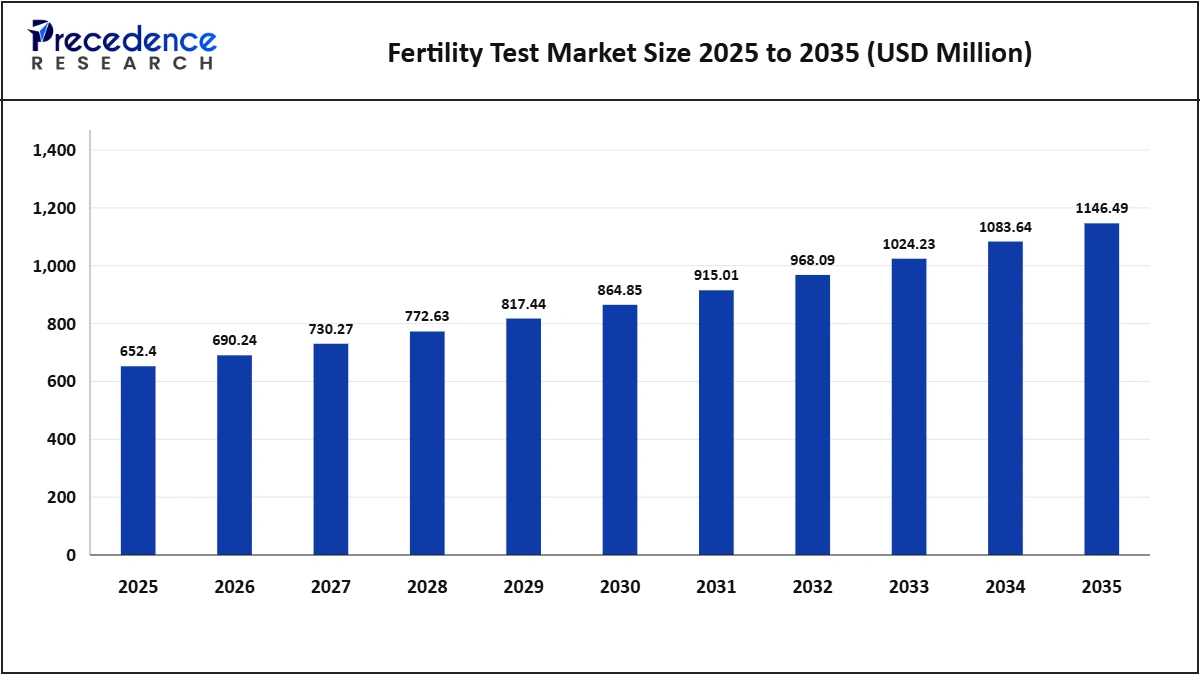
Note: 2025 is the base year; 2026-2035 values are forecasts.
Sources: Expert interviews, secondary sources, Precedence Research database and Precedence Research analysts.
The fertility test market is projected to grow from USD 652.40 million in 2025 to USD 1,146.49 million by 2035 because more people delay baby planning and use home tests to time conception, check ovulation, and assess fertility. Multi-hormone monitors with apps and at-home sperm tests add higher-value products, and these are lifting the market to USD 864.85 million by 2030 and sustaining a CAGR of 5.80% from 2026 to 2035.
- Analyst View: We built the estimate from the number of women and couples trying to conceive or monitoring fertility by region, multiplied by test usage per cycle and average prices for ovulation kits, monitors, hormone tests and male fertility tests, plus clinic-based fertility test sales. Usage reflects the share of people using home tests, the number of cycles tracked, and the growth of subscription monitor models. The total revenue was cross-checked against the fertility product revenue of leading consumer health and fertility technology companies and against published estimates, which places our base year slightly above the comparable figures. The growth rate reflects rising demand for connected monitors and male testing, moderated by low prices for basic ovulation strips.
Market Trends
- Multi-hormone monitors confirm ovulation as well as predict it.
- AI apps personalise fertile window predictions.
- At-home sperm tests are making male testing private and simple.
- Ovarian reserve and FSH tests support family planning decisions.
- Employer fertility benefits cover home testing products.
- Subscription models are growing for connected monitors.
Drivers, Restraints and Opportunities
Driver
The growing trend of delayed child planning raises concern about fertility and increases use of tests to time conception. Connected monitors that track several hormones give more detailed insights than basic strips. Awareness of male infertility is growing, and home sperm tests make testing easier. Employer fertility benefits and telehealth services support testing. Strong online and retail channels simplify purchasing products.
Restraint
Basic ovulation strips are low-priced commodities, which limits share growth. Home tests cannot diagnose many causes of infertility, so users may still need clinical evaluation. Accuracy varies from product to product. Some consumers find monitors expensive. Regulations and claims about fertility apps are under scrutiny.
Opportunity
Multi-hormone monitoring can extend to perimenopause and broader hormone health. Integration with telehealth and fertility clinics can link home testing to care. Male fertility testing remains under-penetrated. Low birth rates and pro-natal policies in Asia are predicted to open new avenues of growth in the upcoming years. AI-driven insights and subscriptions are estimated to create recurring revenue.
Market Segmentation: 2025 Share and Value
Fertility Test Market By Product 2025 Share
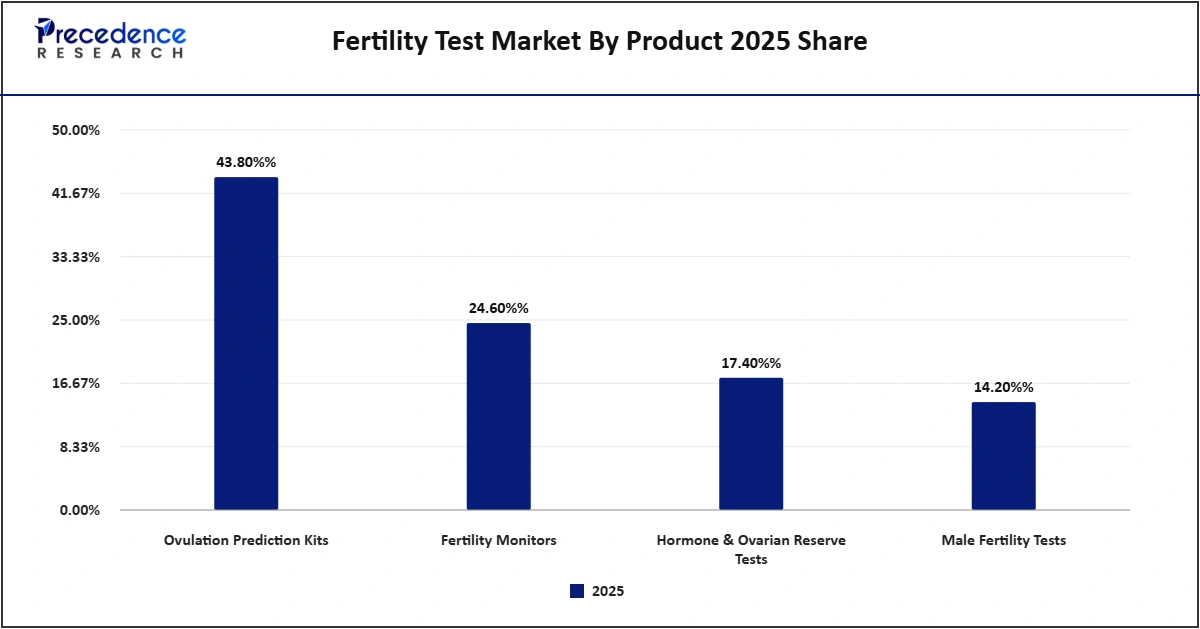
Note: 2025 is the base year.
Sources: Expert interviews, secondary sources, Precedence Research database and Precedence Research analysts.
Ovulation prediction kits accounted for 43.80% (USD 285.75 million) in 2025 because LH test strips and digital sticks are inexpensive, easy to use and sold in pharmacies, supermarkets and online. Fertility monitors, at 24.60% (USD 160.49 million), are the fastest-growing product, supported by devices that read several hormones such as LH, estrogen metabolites and PdG and use apps and AI to predict fertile days and confirm ovulation. Hormone and ovarian reserve tests account for 17.40% (USD 113.52 million), including AMH and FSH can support clinical assessment and fertility-treatment planning but should not be interpreted in isolation as definitive measures of an individual's ability to conceive naturally
Fertility Test Market By Mode of Purchase 2025 Share & Size
| Segments | 2025 Share | 2025 Market Value |
| OTC | 68.70% | USD 448.20 million |
| Prescription | 31.30% | USD 204.20 million |
Note: 2025 is the base year.
Sources: Expert interviews, secondary sources, Precedence Research database and Precedence Research analysts.
Over-the-counter products accounted for 68.70% (USD 448.20 million) in 2025 because most ovulation kits, monitors, and many hormone and sperm tests are bought directly by consumers through retail and online channels. Prescription products account for 31.30% (USD 204.20 million) and include laboratory-based hormone panels and tests ordered by fertility clinics and gynecologists.
Fertility Test Market By Application 2025 Share
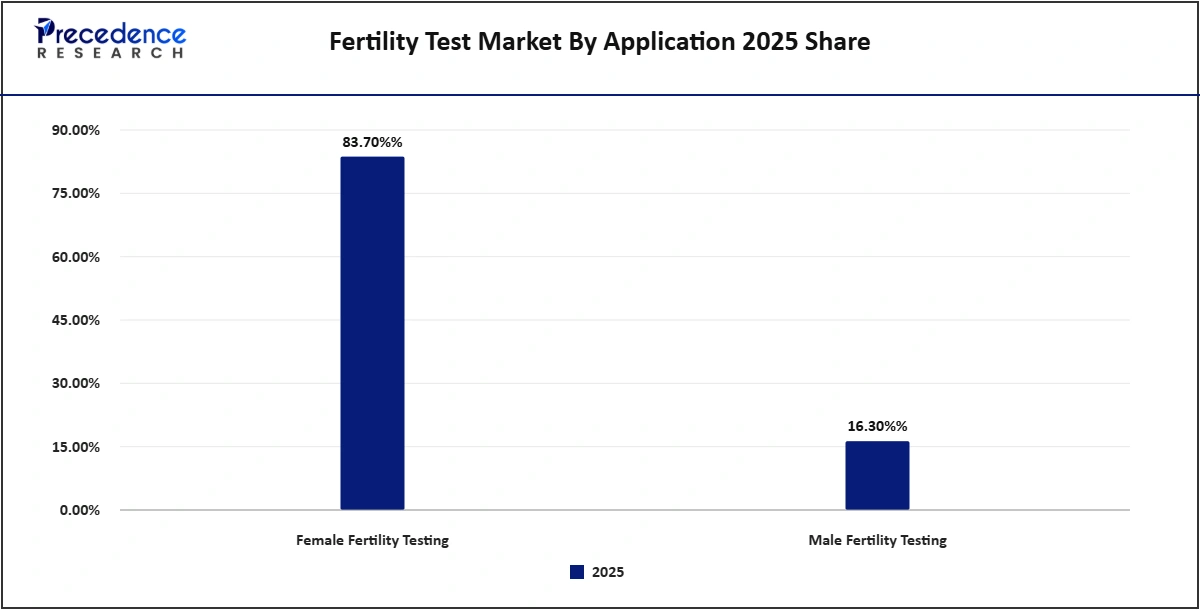
Note: 2025 is the base year.
Sources: Expert interviews, secondary sources, Precedence Research database and Precedence Research analysts.
Female fertility testing accounted for 83.70% (USD 546.06 million) in 2025 because ovulation tracking, hormone monitoring, and ovarian reserve tests make up most fertility test use. Male fertility testing, at 16.30% (USD 106.34 million), is the fastest-growing application as male factors contribute to many infertility cases and at-home sperm tests make testing easier and more private.
Fertility Test Market By End User 2025 Share & Size
| Segments | 2025 Share | 2025 Market Value |
| Home Care Settings | 55.70% | USD 363.39 million |
| Hospitals & Fertility Clinics | 32.40% | USD 211.38 million |
| Others | 11.90% | USD 77.64 million |
Note: 2025 is the base year.
Sources: Expert interviews, secondary sources, Precedence Research database and Precedence Research analysts.
Home care settings accounted for 55.70% (USD 363.39 million) in 2025 because most fertility tests are performed at home. Hospitals and fertility clinics accounted for 32.40% (USD 211.38 million). They use laboratory hormones and semen analysis before and during treatment. Other users, including pharmacies and telehealth programs, valued at 11.90% (USD 77.64 million).
- Analyst View: Segment values were allocated by matching users and testing frequency by product and channel to average prices. Ovulation kits lead because of their large user base, while monitors and hormone tests carry higher prices. We expect fertility monitors, male testing and home use to gain share as connected devices and direct-to-consumer services spread.
Regional Analysis
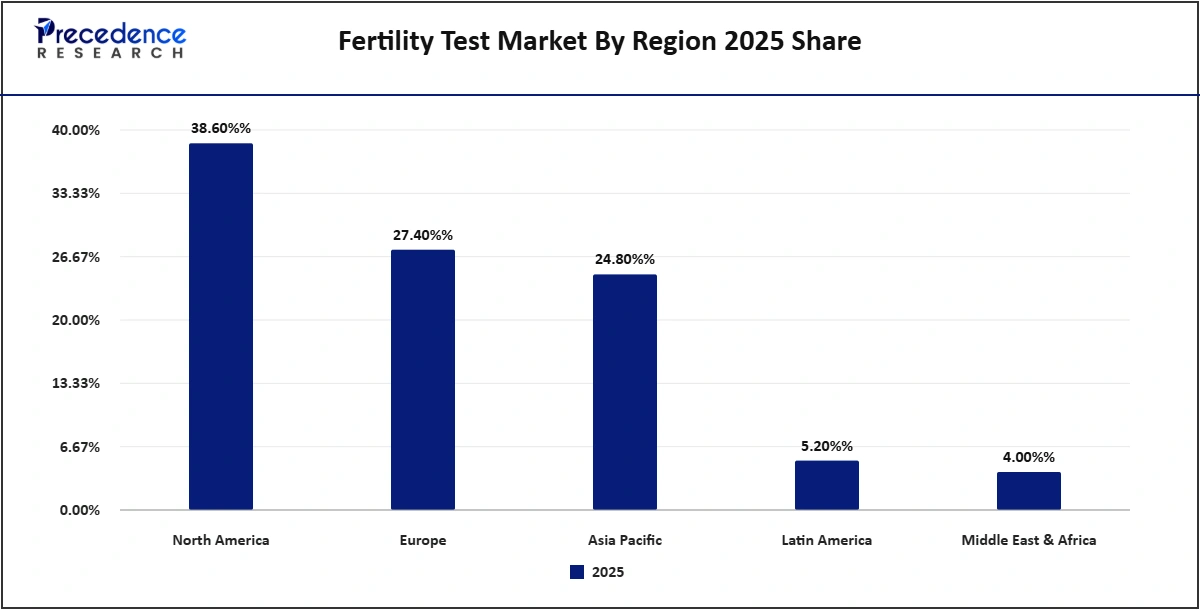
Fertility Test Market By Region 2025 Share
Note: 2025 is the base year.
Sources: Expert interviews, secondary sources, Precedence Research database and Precedence Research analysts.
North America accounted for 38.60% (USD 251.83 million) in 2025. This growth is attributed to high consumer spending, rising average age at first birth, employer fertility benefits, and many fertility technology brands sold online and in pharmacies. Direct-to-consumer male fertility tests and telehealth fertility services are expanding in the United States. Europe, at 27.40% (USD 178.76 million), is supported by strong pharmacy distribution of ovulation tests, older maternal age, and digital fertility apps in the UK, Germany, France, and the Nordic countries. Asia Pacific, at 24.80% (USD 161.80 million), is the fastest-growing region, supported by falling fertility rates and government pro-natal policies in China, Japan and South Korea, a large IVF sector and growing online sales of tests in India. Latin America, at 5.20% (USD 33.92 million), and the Middle East and Africa, at 4.00% (USD 26.10 million), are smaller markets where pharmacy distribution and private fertility clinics in Brazil, Mexico and the Gulf states support growth.
North America accounted for an estimated 38.6% of the global market in 2025, supported by consumer awareness, established retail and e-commerce channels, and product availability.
Europe accounted for 27.40% (USD 178.76 million) in 2025. Pharmacy distribution of ovulation tests across the region is strong. Also, digital fertility apps are widely used. Older maternal age supports demand.
Asia Pacific accounted for 24.80% (USD 161.80 million) in 2025 and is the fastest-growing region. Low birth rates have led to pro-natal policies in China, Japan, and South Korea. Online sales of fertility tests are growing in India. A large IVF sector adds to clinic testing.
Latin America accounted for 5.20% (USD 33.92 million) in 2025. Established pharmacy chains in Brazil and Mexico sell ovulation tests. Private fertility clinics are also expanding.
The Middle East and Africa accounted for 4.00% (USD 26.10 million) in 2025. Gulf countries have growing fertility clinic networks. Awareness of home testing among people is rising.
Analyst View: Regional shares were built from the number of people trying to conceive or monitor fertility, test usage, and prices in each region. North America leads because of high spending and product availability. We assign Asia Pacific the highest growth premium because fertility concerns and online test sales are rising fastest there.
Top 10 Companies in the Fertility Test Market
| Rank | Company Name | Market-Specific Revenue (USD Million) | 2025 Share | Key Products / Business | Headquarters |
| 1 | Swiss Precision Diagnostics (Clearblue) | 128.00 | 19.62% | Clearblue ovulation tests and fertility monitors | Switzerland |
| 2 | Church & Dwight (First Response) | 64.00 | 9.81% | First Response ovulation and pregnancy tests | United States |
| 3 | Mira | 22.00 | 3.37% | Mira multi-hormone fertility monitor | United States |
| 4 | LetsGetChecked | 20.00 | 3.07% | At-home fertility hormone tests | Ireland |
| 5 | Fairhaven Health | 18.00 | 2.76% | Fertility tests and supplements | United States |
| 6 | Proov | 14.00 | 2.15% | Proov PdG, FSH and LH tests | United States |
| 7 | Inito | 12.00 | 1.84% | AI-based multi-hormone fertility monitor | United States |
| 8 | Medical Electronic Systems (YO) | 10.00 | 1.53% | YO home sperm test | Israel |
| 9 | Babystart | 8.00 | 1.23% | Ovulation and fertility tests | United Kingdom |
| 10 | ExSeed Health | 6.00 | 0.92% | Home sperm testing kits | Denmark |
Note: Company revenues and shares are 2025 estimates.
Sources: Company press releases, expert interviews, secondary sources, Precedence Research database and Precedence Research analysts.
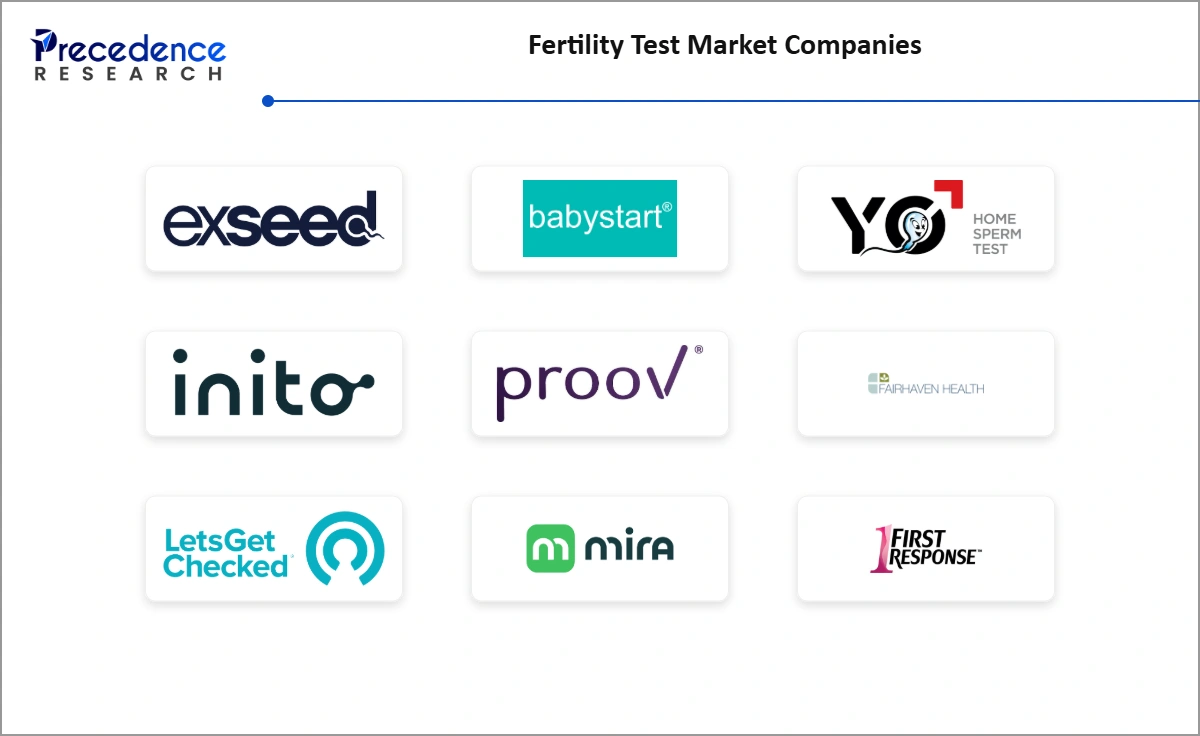
Clearblue led the fertility test market with an estimated 19.62% (USD 128.00 million) of 2025 revenue, followed by Church & Dwight at 9.81% (USD 64.00 million) and Mira at 3.37% (USD 22.00 million). Swiss Precision Diagnostics leads through the Clearblue brand, which offers digital ovulation tests and fertility monitors with wide pharmacy and online distribution. Church & Dwight holds a strong position with First Response ovulation and pregnancy tests sold in mass retail. Fertility technology companies such as Mira, Inito and Proov compete with multi-hormone monitors and tests that measure LH, estrogen metabolites, PdG and FSH and connect to apps. LetsGetChecked offers laboratory hormone tests by mail, and YO and ExSeed lead at-home sperm testing. The top 10 companies accounted for an estimated 46.29% (USD 302.00 million) of 2025 revenue, while the remaining 53.71% (USD 350.40 million) was shared among private-label ovulation test makers, regional brands, laboratory testing services and fertility app companies. The fertility test market is moderately fragmented, and competition prioritizes accuracy, the number of hormones measured, app experience, price, and retail and online reach. Low-cost private-label strips keep prices low for basic tests, while connected monitors and subscription models drive value growth for newer brands.
Recent Developments
- February 2025: Sonora Quest made an at-home male fertility test available through its consumer testing offering. The product provides information on selected sperm parameters; it should not be characterised as a comprehensive diagnosis of male infertility.
- December 2025: Inito announced a USD 29 million Series B funding round to support the development and expansion of its at-home diagnostic testing platform. The company's fertility-monitoring offering tracks multiple reproductive hormones, illustrating the market's shift toward more information-rich, digitally supported testing solutions.
Market Segments
By Product
- Ovulation Prediction Kits
- Fertility Monitors
- Hormone & Ovarian Reserve Tests
- Male Fertility Tests
By Mode of Purchase
- OTC
- Prescription
By Application
- Female Fertility Testing
- Male Fertility Testing
By End User
- Home Care Settings
- Hospitals & Fertility Clinics
- Others
By Region
- North America (U.S., Canada, Mexico)
- Europe (Germany, U.K., France, Italy, Spain, Rest of Europe)
- Asia Pacific (China, Japan, India, South Korea, Taiwan, Rest of Asia Pacific)
- Latin America (Brazil, Argentina, Rest of Latin America)
- Middle East & Africa (GCC, South Africa, Rest of MEA)
Research Methodology
The fertility test market was defined as ovulation prediction kits, fertility monitors, hormone and ovarian reserve tests and male fertility tests sold over the counter and through clinics worldwide. The 2025 base year was built bottom-up from people trying to conceive or monitoring fertility, test usage per cycle and average product prices, and checked top-down against the fertility product revenue of leading consumer health and fertility technology companies. Segment, regional and company values were allocated from products, modes of purchase, applications, end users and regional demand. Key estimates were verified by cross-checking company disclosures, regulatory and industry data and published third-party estimates, and inputs that could not be reconciled were excluded. All segment, regional and company figures were reconciled to the same 2025 base year, and the 2026-2035 forecast, which applies a constant CAGR from the 2025 base, was recalculated and validated.
Analyst View: Overall Market
The fertility test market is growing steadily as later parenthood and connected devices shift fertility tracking into the home. Our estimates connect demand to the number of people trying to conceive, testing frequency, and product prices, so the forecast follows demographic trends, product innovation, and channel growth. The main upside comes from multi-hormone monitors, male testing and Asia Pacific demand, while the main risks are commoditised ovulation strips and accuracy concerns.
Sources and References
- Fitt Insider. "At-home diagnostics reshape fertility care as Inito raises USD 29M". 2025-12-16. Inito funding. https://insider.fitt.co/at-home-diagnostics-reshape-fertility-care-inito-29m/
- KTAR. https://ktar.com/arizona-health-news/male-fertility-test-at-home?utm_source=chatgpt.com
- https://www.globenewswire.com/news-release/2022/08/02/2490462/0/en/Mira-Launches-Ovum-Wand-to-Predict-Menopause-and-Monitor-Fertility-Status-for-Women-Over-35.html
For inquiries regarding discounts, bulk purchases, or customization requests, please contact us at sales@precedenceresearch.com
Frequently Asked Questions





Ask For Sample
No cookie-cutter, only authentic analysis – take the 1st step to become a Precedence Research client
 Get a Sample




 sales@precedenceresearch.com
 Schedule a Meeting
