



Fire Resistant Cable Market Size, Key Companies, Company Production Capacity, Electricity Generation, Capacity Utilization, Export & Import Analysis, Cost Structure, Competitive Landscape, and Market Outlook
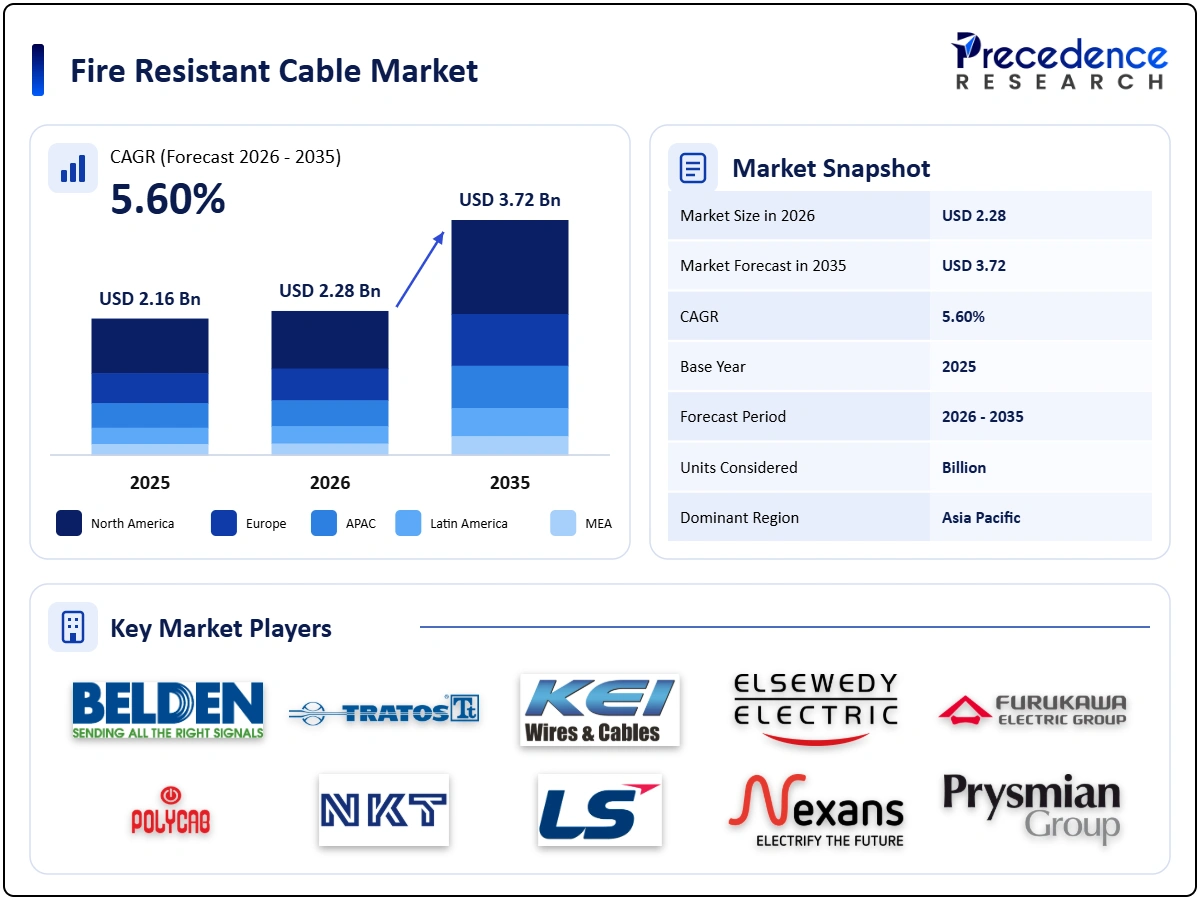
According to energy and power expert Laxmi Narayan, the fire resistant cable market has reached USD 2.28 billion in 2026 and is expected to grow to USD 3.72 billion by 2035, registering a CAGR of 5.60%. The fire resistant cable market companies such as Prysmian, LS Cable & System, Polycab India are playing a key role in market expansion, with major opportunities emerging across insulation material, voltage, end use segments.
Source: https://www.precedenceresearch.com/fire-resistant-cable-market
 Get a Sample
 Report Description
Key Takeaways
Market Size & Growth Outlook
- Market size in 2025: USD 2.16 billion
- Estimated market size in 2026: USD 2.28 billion
- Projected market size by 2035: USD 3.72 billion
- CAGR (2026-2035): 5.60%
Regional Market Spotlight
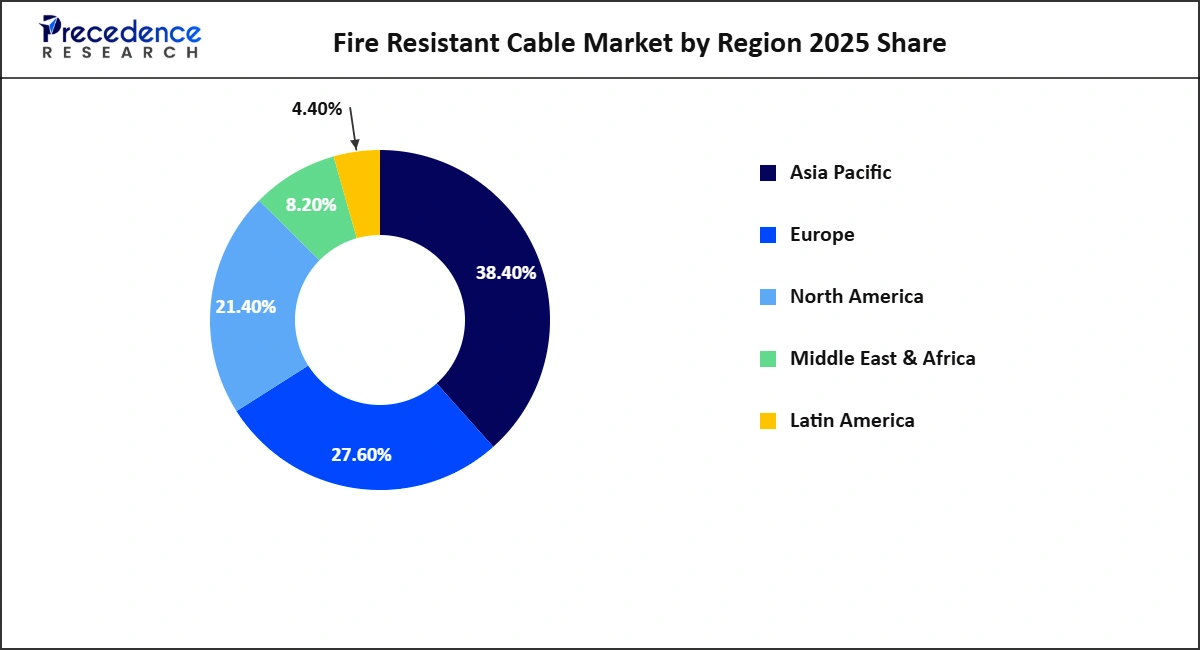
- Asia Pacific held the largest market share in 2025, at 38.40% (USD 0.83 billion). It is also expected to be the fastest-growing region, with a CAGR of 6.31% from 2025 to 2035.
- Europe accounted for 27.60% (USD 0.60 billion) of the market in 2025.
- North America accounted for 21.40% (USD 0.46 billion) of the market in 2025.
Segmental Spotlight
- By insulation material, LSZH & Silicone-Based cables held the largest share in 2025, at 38.60% (USD 0.83 billion).
- By voltage, Low Voltage (up to 1 kV) cables accounted for 72.40% (USD 1.56 billion) in 2025.
- By end use, Building & Construction held the largest share in 2025, at 44.60% (USD 0.96 billion).
Fire Resistant Cable Market Size and Forecast, 2025–2035 (USD Billion)
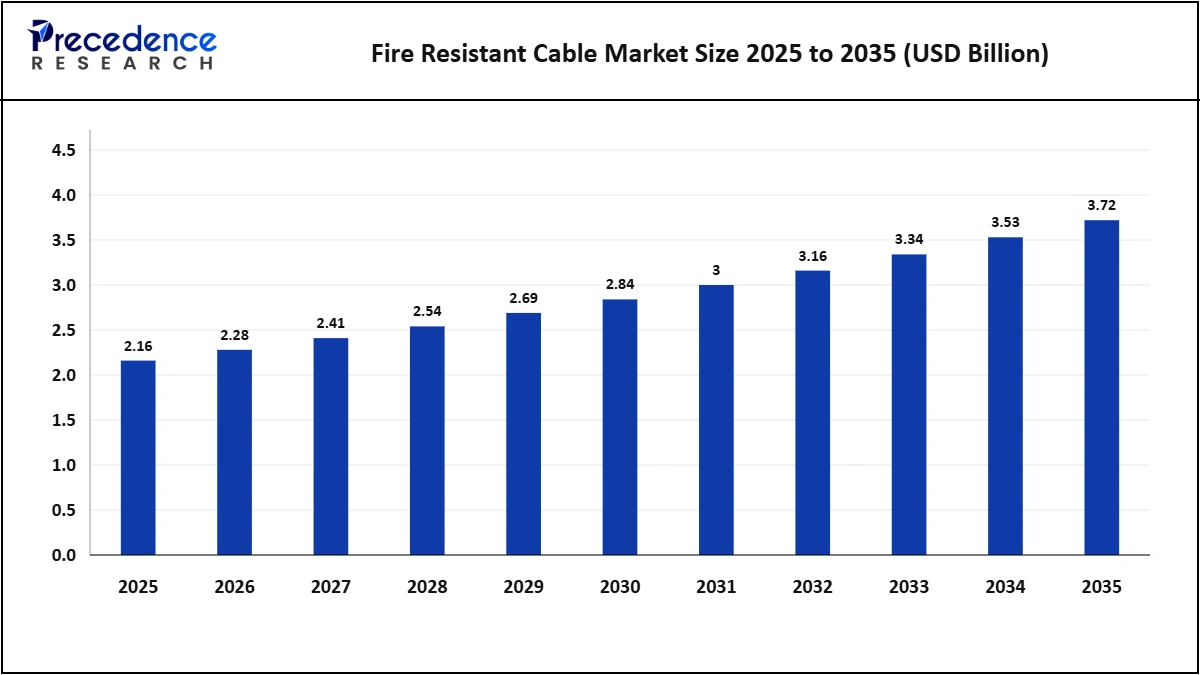
Note: 2025 is the base year; 2026-2035 values are forecasts.
Sources: Expert interviews, secondary sources, Precedence Research database and Precedence Research analysts.
The fire resistant cable market is expected to grow from USD 2.16 billion in 2025 to USD 3.72 billion by 2035. One of the main reasons for this growth is that building and infrastructure safety rules require important emergency systems to continue working during a fire.
Fire resistant cables help meet these safety requirements by keeping essential electrical circuits working for a specified period. Changes in safety codes, along with the growth of data centres and transport infrastructure, are creating more demand for certified fire-resistant cable systems.
As a result, the market is expected to reach USD 2.84 billion by 2030 and grow at a CAGR of 5.60% from 2026 to 2035.
- Analyst View: We prepared the market estimate by looking at construction and infrastructure projects that need emergency safety systems. We considered the amount of fire resistant cable used in different types of projects and the average prices of cables based on their insulation materials and fire ratings. We also included demand from industrial, marine and energy applications.
Demand mainly comes from high-rise and public buildings, tunnels, metro and railway systems, airports, data centres, oil and gas facilities and power plants.
We compared the total market estimate with the fire-performance cable revenue of leading manufacturers and other published market estimates. Based on this comparison, our base-year estimate is slightly higher than the comparable figures. The growth forecast reflects increasing construction activity and stricter fire safety rules, while also considering changes in metal prices and construction cycles.
Market Trends
- Fire safety rules are becoming stricter for emergency electrical systems.
- Ceramifiable silicone cables are being used as an alternative to concrete encasement.
- Halogen-free cable designs are becoming more common.
- Fire-resistant optical cables are helping protect important communication systems.
- Tested cable systems now include supports and conduits to improve overall fire protection.
- Growing data centre construction is increasing demand for fire-rated electrical circuits.
Drivers, Restraints and Opportunities
Driver
Fire safety rules require important electrical systems to keep working during a fire. The construction of high-rise buildings, hospitals, airports and public buildings is increasing demand for fire resistant cables. Tunnels, metro systems and railway projects also require cables that can maintain circuit integrity and produce less smoke. Data centres need reliable emergency power and communication systems. Updates to safety codes, such as the NEC 2026 requirements, are also increasing the need for better emergency feeder protection.
Restraint
Fire resistant cables are more expensive than standard cables. Changes in copper prices can also affect cable manufacturing costs and selling prices. Demand may change depending on construction activity and investment cycles. Getting the required certification can be costly, and certification rules differ between regions. In some markets, low-cost products without proper certification create strong competition for certified manufacturers.
Opportunity
Older buildings that need to meet modern fire safety rules can create new demand for fire resistant cables. Fire-resistant optical and data cables also have growth potential as important communication systems expand. Fully tested cable systems can attract higher prices because they offer complete fire protection solutions. Infrastructure projects in Asia, the Middle East and Africa provide further growth opportunities. Electric vehicle charging stations and battery storage facilities also need safer cable systems.
Market Segmentation: 2025 Share and Value
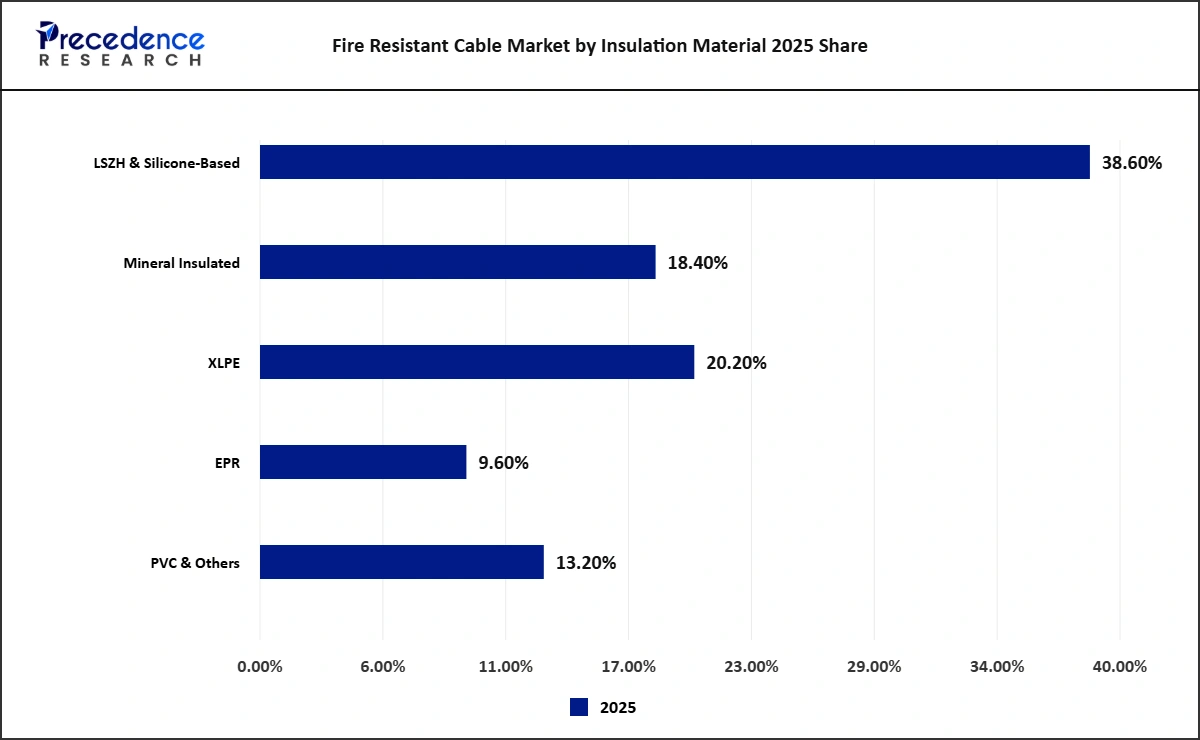
Fire Resistant Cable Market by Insulation Material 2025 Share
Note: 2025 is the base year.
Sources: Expert interviews, secondary sources, Precedence Research database and Precedence Research analysts.
LSZH and silicone-based cables held the largest share in 2025, accounting for 38.60% (USD 0.83 billion) of the market. This is mainly because these cables can help maintain electrical connections during a fire while also producing less smoke and fewer toxic gases.
These features are important in public buildings, tunnels and transport systems, where safety rules often require low-smoke and halogen-free cables. This segment is also growing quickly as more regions introduce stricter requirements for halogen-free cable designs.
XLPE fire resistant cables accounted for 20.20% (USD 0.44 billion) of the market. Mineral insulated cables held an 18.40% share (USD 0.40 billion) and are mainly used in applications where electrical circuits need to remain protected for a longer time during a fire.
EPR cables accounted for 9.60% (USD 0.21 billion), while PVC and other cable types held a 13.20% share (USD 0.29 billion).
Fire Resistant Cable Market by Voltage 2025 Share & Size
| Segments | 2025 Share | 2025 Market Value |
| Low Voltage (up to 1 kV) | 72.40% | USD 1.56 billion |
| Medium Voltage | 21.40% | USD 0.46 billion |
| High Voltage | 6.20% | USD 0.13 billion |
Note: 2025 is the base year.
Sources: Expert interviews, secondary sources, Precedence Research database and Precedence Research analysts.
Low voltage cables held the largest share in 2025, accounting for 72.40% (USD 1.56 billion) of the market. This is because most emergency lighting, fire alarm, control and building service systems operate at voltages below 1 kV.
Medium voltage cables accounted for 21.40% (USD 0.46 billion). They are mainly used in emergency power feeders, tunnels and industrial facilities. This is also the fastest-growing voltage segment.
High voltage cables accounted for the remaining 6.20% (USD 0.13 billion) of the market.
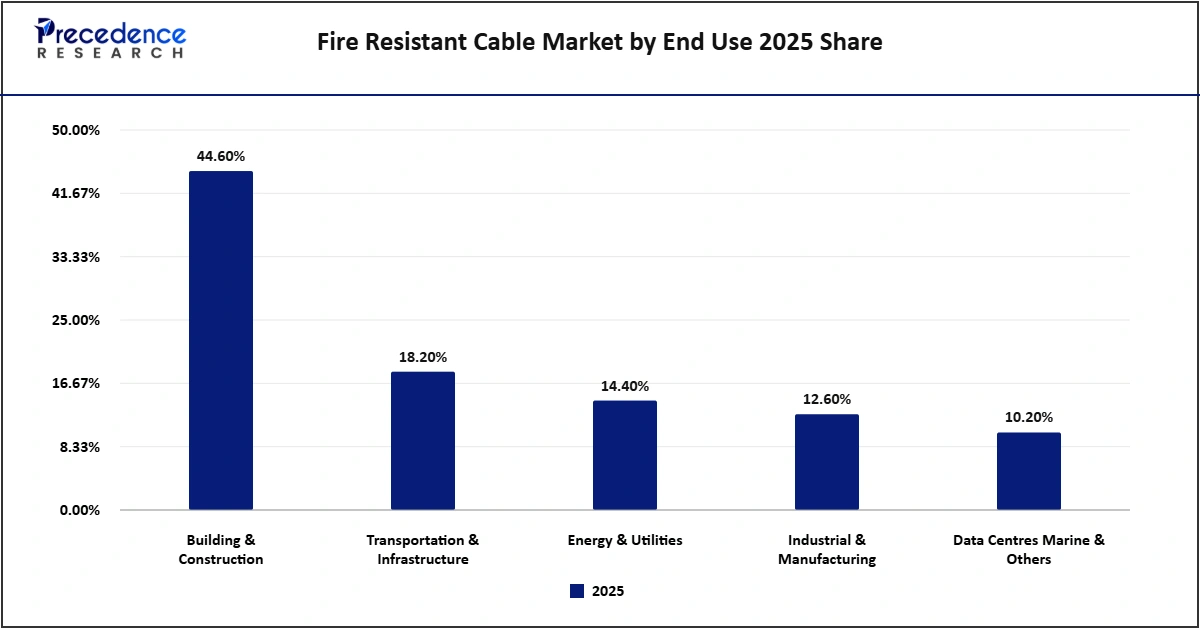
Fire Resistant Cable Market by End Use 2025 Share
Note: 2025 is the base year.
Sources: Expert interviews, secondary sources, Precedence Research database and Precedence Research analysts.
Building and construction accounted for the largest share in 2025, at 44.60% (USD 0.96 billion). This is mainly because high-rise buildings, commercial properties, hospitals and public buildings need reliable electrical systems for fire alarms, emergency lighting and other safety services.
Transportation and infrastructure accounted for 18.20% (USD 0.39 billion) of the market. Energy and utilities held a 14.40% share (USD 0.31 billion), while industrial and manufacturing applications accounted for 12.60% (USD 0.27 billion).
Data centres, marine applications and other uses together accounted for 10.20% (USD 0.22 billion). Data centres and transportation are among the fastest-growing areas of demand.
- Analyst View: We estimated the value of each segment by comparing the amount of cable used in different projects, the types of insulation materials selected and the average cable prices. We also considered manufacturer revenue across different product categories.
LSZH and silicone-based cables lead the market because of increasing fire safety requirements. We expect halogen-free cable designs, medium voltage cables and demand from data centres and transport projects to gain a larger market share in the coming years.
Regional Analysis
Fire Resistant Cable Market by Region 2025 Share
Note: 2025 is the base year.
Sources: Expert interviews, secondary sources, Precedence Research database and Precedence Research analysts.
Asia Pacific held the largest regional share in 2025, accounting for 38.40% (USD 0.83 billion) of the market. It is also the fastest-growing region. Demand is supported by high-rise construction, metro rail projects, airports and industrial developments in China, India and Southeast Asia, along with supply chains connected to the Middle East.
Europe accounted for 27.60% (USD 0.60 billion) of the market. Demand in the region is supported by the Construction Products Regulation, strict fire safety classifications and the development of tunnel and railway projects.
North America held a 21.40% share (USD 0.46 billion). Its market growth is supported by NEC and NFPA requirements, increasing data centre construction and healthcare infrastructure projects.
The Middle East and Africa accounted for 8.20% (USD 0.18 billion) of the market. Demand mainly comes from high-rise buildings, airports and oil and gas projects in the Gulf region. Latin America held a 4.40% share (USD 0.10 billion), supported by infrastructure and mining activities.
Asia Pacific accounted for 38.40% (USD 0.83 billion) of the market in 2025 and remains the largest and fastest-growing region. China and India are investing heavily in metro systems, airports and high-rise buildings, all of which require cables that can continue working during a fire. The growth of data centres in Southeast Asia is also creating additional demand. Local manufacturers in the region are competing strongly on price.
Europe accounted for 27.60% (USD 0.60 billion) of the market in 2025. The Construction Products Regulation sets fire performance requirements for cables used in buildings. Tunnel, railway and public building projects also require cables that can maintain circuit integrity during a fire. Prysmian and Nexans are among the major suppliers in this region.
North America held a 21.40% share (USD 0.46 billion) in 2025. The 2026 National Electrical Code increased concrete encasement requirements for emergency feeders. This is encouraging interest in UL 2196-listed fire-resistant cable systems as an alternative. Data centres and hospitals are also supporting demand.
The Middle East and Africa accounted for 8.20% (USD 0.18 billion) of the market in 2025. High-rise buildings, airports and stadiums in the Gulf region require fire-rated cables. Oil and gas facilities are also adding to market demand.
Latin America held a 4.40% share (USD 0.10 billion) in 2025. Infrastructure, metro and mining projects in Brazil, Mexico and Chile are supporting the use of fire resistant cables.
Analyst View: We estimated regional market shares by looking at construction and infrastructure activity, cable requirements and average prices in each region. Asia Pacific leads because of its large construction industry and growing infrastructure investment. We expect the region to maintain the highest growth rate because urban development and high-rise construction are expanding quickly.
Competitive Landscape
Top 10 Companies in the Fire Resistant Cable Market, 2025
| Rank | Company Name | Market-Specific Revenue (USD Billion) | 2025 Share | Key Products / Business | Headquarters |
| 1 | Prysmian | 0.21 | 9.72% | FP and Lifeline fire-resistive cables | Italy |
| 2 | Nexans | 0.15 | 6.94% | ALSECURE fire safety cables | France |
| 3 | LS Cable & System | 0.09 | 4.17% | Fire-resistant power and control cables | South Korea |
| 4 | NKT | 0.06 | 2.78% | Fire-resistant building cables | Denmark |
| 5 | Polycab India | 0.06 | 2.78% | Fire survival cables | India |
| 6 | Furukawa Electric | 0.05 | 2.31% | Fire-resistant cables | Japan |
| 7 | Elsewedy Electric | 0.05 | 2.31% | Fire-resistant power cables | Egypt |
| 8 | KEI Industries | 0.04 | 1.85% | Fire survival cables | India |
| 9 | Tratos | 0.03 | 1.39% | Fire-resistant specialty cables | Italy |
| 10 | Belden | 0.03 | 1.39% | Fire-rated signal and data cables | United States |
Note: Company revenues and shares are 2025 estimates.
Sources: Company press releases, expert interviews, secondary sources, Precedence Research database and Precedence Research analysts.
Prysmian led the fire resistant cable market in 2025, with an estimated market share of 9.72% and revenue of USD 0.21 billion. Nexans ranked second with a 6.94% share and USD 0.15 billion in revenue. LS Cable & System ranked third, with a 4.17% share and USD 0.09 billion in revenue.
Prysmian has a strong market position through its fire-performance cable products. These include FP cables in Europe and Lifeline ceramifiable silicone cables in North America. Its Lifeline systems are UL 2196-listed for two-hour circuit integrity and are promoted as an alternative to the thicker concrete encasement required under the 2026 NEC.
Nexans offers its ALSECURE fire safety cable range, which is designed to maintain circuit integrity for up to two hours. LS Cable & System supplies fire-resistant power and control cables in Asia and other markets.
Other important companies include NKT, Polycab, Furukawa Electric, Elsewedy Electric, KEI Industries, Tratos and Belden. These companies compete in different areas, including building construction, infrastructure, industrial applications and communication systems.
The top 10 companies together accounted for an estimated 35.65% (USD 0.77 billion) of market revenue in 2025. The remaining 64.35% (USD 1.39 billion) was shared by regional cable manufacturers, specialised mineral insulated cable suppliers and private-label brands sold by installers.
The fire resistant cable market has a moderate level of concentration, with major global cable manufacturers holding strong positions through certified products and complete cable systems.
Competition mainly depends on fire testing certifications, how long a cable can maintain circuit integrity during a fire, smoke and toxic gas performance, ease of installation and product pricing. Complete tested systems that include cable supports and conduits are becoming more important because safety rules increasingly require the entire system to meet fire performance standards.
Companies Ecosystem
The fire resistant cable market includes raw material suppliers, cable manufacturers, testing organisations, distributors, electrical contractors and final users. Each group plays an important role in producing, testing, supplying and installing fire resistant cables.
Certification is especially important in this market because customers need to know that cables can meet the required fire safety standards. A growing part of the market's value comes from complete, tested cable systems used in important emergency circuits.
| Ecosystem Stage | Role in the Market | Key Companies |
| Raw Material Suppliers | Supply copper, silicone rubber, mica tape, LSZH and XLPE compounds and mineral insulation | Dow, Wacker, Momentive, Borealis, copper producers |
| Cable Manufacturers | Design and produce fire resistant power, control, signal and optical cables | Prysmian, Nexans, LS Cable & System, NKT, Polycab, Elsewedy Electric |
| Testing & Certification Bodies | Test and certify circuit integrity and fire performance | UL, BASEC, LPCB, national testing institutes |
| Distributors & Contractors | Supply and install cables in buildings and infrastructure projects | Electrical distributors, fire protection and electrical contractors |
| End Users | Use cables in buildings, tunnels, transport systems, data centres and industrial facilities | Developers, transit authorities, data centre operators, utilities |
Sources: Company press releases, expert interviews, secondary sources, Precedence Research database and Precedence Research analysts.
Precedence Research Companies Quadrant
The Precedence Research Companies Quadrant shows the position of major companies in the fire resistant cable market based on their market strength, innovation and growth plans.
Market strength is measured through factors such as company revenue, market share and presence across different regions. Innovation and growth strategy are assessed by looking at product range, research and development activities and business partnerships.
The positions are based on each company's estimated fire resistant cable revenue in 2025, along with our assessment of its certified products, product development activities and distribution partnerships.
Sources: Company press releases, expert interviews, secondary sources, Precedence Research database and Precedence Research analysts.
Leaders: Prysmian, Nexans and LS Cable & System are leading companies in the market. They have strong fire-performance cable sales, a wide range of certified products, complete system solutions and a strong presence across different regions.
Challengers: NKT, Furukawa Electric and Elsewedy Electric have strong positions in their regional markets and offer certified cable products. However, their innovation activities or geographic presence are more limited.
Innovators: Polycab India and KEI Industries are expanding their certified fire survival cable product ranges and increasing their production capacity in fast-growing markets.
Niche Players: Tratos and Belden mainly focus on specialised cable products, communication applications and selected regional fire-rated cable markets.
Recent Developments
- November 2025: Prysmian highlighted its UL 2196-listed Lifeline fire-resistant cable systems as an alternative to the five-inch concrete encasement required for emergency feeders under the 2026 National Electrical Code. (Source: na.prysmian.com)
- June 2026: Prysmian presented its complete Lifeline fire-resistant cable system at the 2026 NFPA Conference and Expo. The system also included a UL flame-listed fire-resistant optical fibre cable. (Source: na.prysmian.com)
Fire Resistant Cable Market Segments
By Insulation Material
- LSZH & Silicone-Based
- Mineral Insulated
- XLPE
- EPR
- PVC & Others
By Voltage
- Low Voltage (up to 1 kV)
- Medium Voltage
- High Voltage
By End Use
- Building & Construction
- Transportation & Infrastructure
- Energy & Utilities
- Industrial & Manufacturing
- Data Centres, Marine & Others
By Region
- North America (U.S., Canada, Mexico)
- Europe (Germany, U.K., France, Italy, Spain, Rest of Europe)
- Asia Pacific (China, Japan, India, South Korea, Taiwan, Rest of Asia Pacific)
- Latin America (Brazil, Argentina, Rest of Latin America)
- Middle East & Africa (GCC, South Africa, Rest of MEA)
Research Methodology
The fire resistant cable market includes power, control, signal, data and optical cables that are specially designed to maintain electrical connections for a certain period during a fire. The market covers these products across the world.
The 2025 market estimate was prepared using a bottom-up approach. We first looked at construction and infrastructure projects that require emergency safety circuits. We then estimated the amount of cable needed for each type of project and the average selling prices of different cable products.
The total market estimate was also checked using a top-down approach by comparing it with the fire-performance cable revenue of leading manufacturers.
Market values for different segments, regions and companies were calculated based on insulation materials, voltage categories, end-use applications and regional demand.
Important estimates were checked against company disclosures, government regulations, industry information and published third-party market estimates. Figures that could not be properly matched or confirmed were excluded.
All segment, regional and company figures were aligned with the same 2025 base year. The market forecast for 2026–2035 was then calculated using a constant CAGR from the 2025 base year and checked for consistency.
Analyst View: Overall Market
The fire resistant cable market is mainly driven by fire safety rules and investment in construction and infrastructure. Demand is increasing as more buildings and infrastructure projects require cables that can continue working during a fire. Halogen-free and silicone-based cable systems are also gaining popularity.
Our market estimate connects demand with project activity, cable requirements and average prices. This means the forecast reflects construction activity, changes in fire safety rules and infrastructure spending.
The biggest growth opportunities come from stricter safety requirements and the increasing number of data centres. However, changes in construction activity and metal prices remain the main risks for the market.
Sources and References
- Prysmian. "Prysmian's Lifeline products: smart solutions amid updated 2026 NEC standards". 2025-11-18. NEC 2026 and Lifeline. (Source: na.prysmian.com)
- Prysmian. "Prysmian to showcase complete Lifeline cable system at the 2026 NFPA Conference and Expo". 2026-06-22. NFPA 2026. (Source: na.prysmian.com)
For inquiries regarding discounts, bulk purchases, or customization requests, please contact us at sales@precedenceresearch.com
Frequently Asked Questions





Ask For Sample
No cookie-cutter, only authentic analysis – take the 1st step to become a Precedence Research client
 Get a Sample




 sales@precedenceresearch.com
 Schedule a Meeting
