



Fire Resistant Lubricants Market Trends, Leading Companies, Company Revenue / Sales Performance, Plant Utilization, Production Volume, Pricing Dynamics, Supply Chain Performance, Competitive Landscape, and Industry Growth
Vidyesh Swar, a Chemical and Materials Industry Expert, estimates the fire resistant lubricants market at USD 6.61 billion in 2026, with the market projected to reach USD 6.21 billion by 2035 at a CAGR of 5.20%. Major fire resistant lubricants market companies such as Quaker Houghton, FUCHS, Shell, ExxonMobil are competing across key material and application segments, including type, end use, region.
Source: https://www.precedenceresearch.com/fire-resistant-lubricants-market
 Get a Sample
 Report Description


Fire Resistant Lubricants Market Size, Share and Forecast 2026-2035
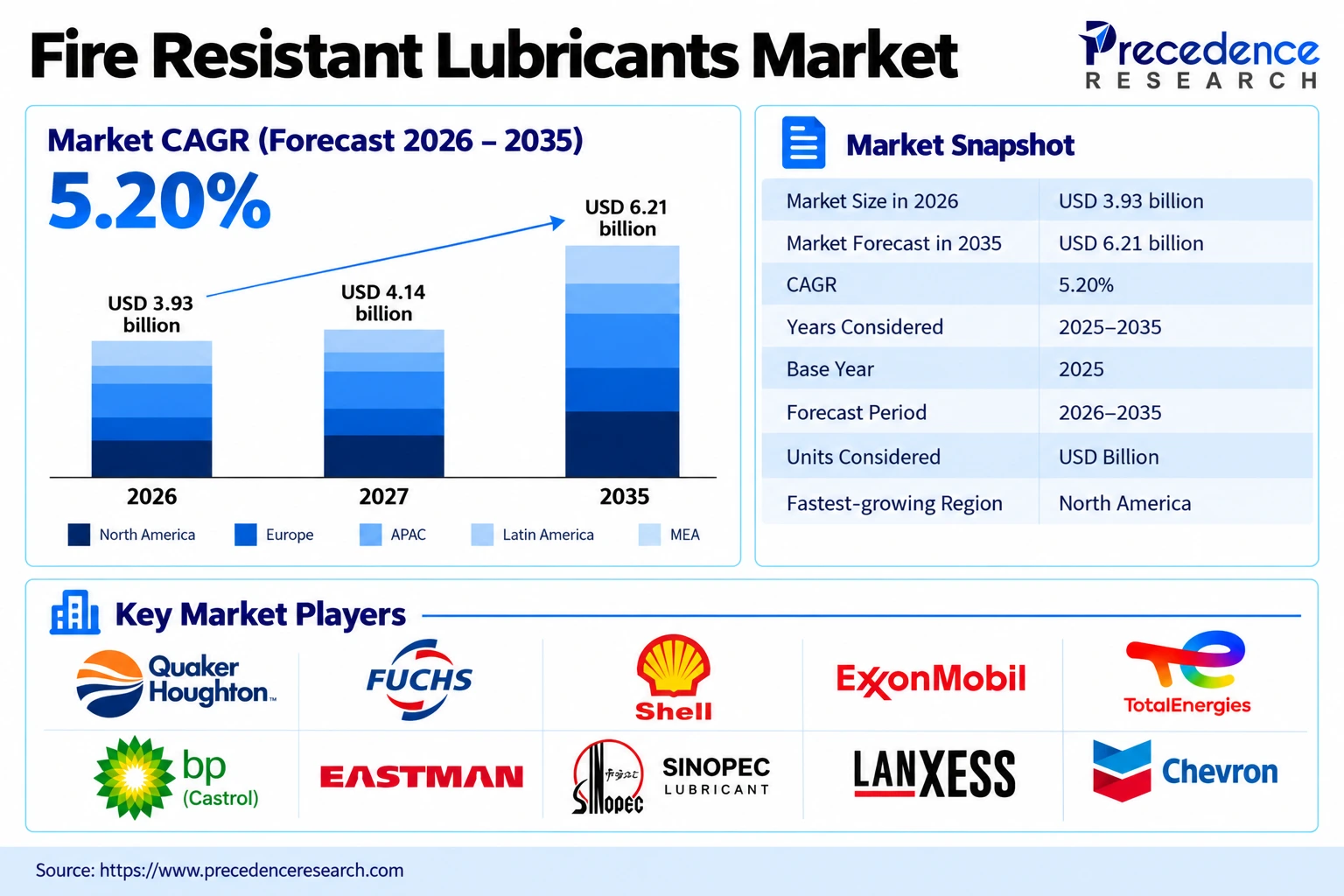
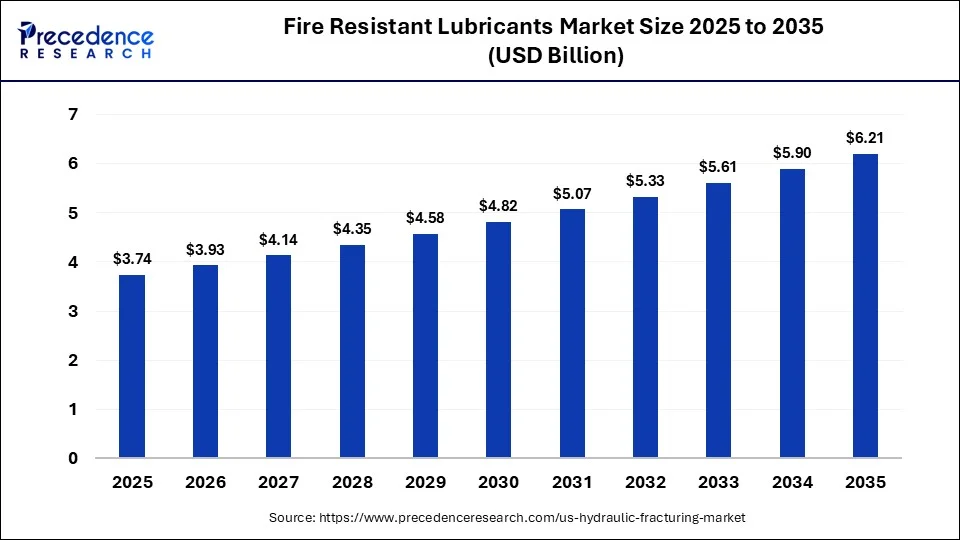
The fire resistant lubricants market is estimated at USD 3.93 billion in 2026 and is forecasted to reach USD 6.21 billion by 2035, growing at a CAGR of 5.20% during the forecast period from 2026 to 2035.
In 2025, which is considered to be the base year, the market has been valued at USD 3.74 billion. It includes hydraulic fluids and lubricants that have resistance to ignition as well as limiting the spread of fire. Fluids such as high water content fluids (HFA), water in oil emulsions (HFB), water glycol fluids (HFC), anhydrous synthetic ester and other water-free fluids (HFDU), and phosphate esters (HFDR) are a few among many.
Key Takeaways
Market Size & Growth Outlook
- Market size in 2026: USD 3.93 billion
- Estimated market size in 2027: USD 4.14 billion
- Projected market size by 2036: USD 6.21 billion
- CAGR (2026-2035): 5.20%
Regional Market Spotlight
- Asia Pacific led the market with a 39.60% (USD 1.48 billion) share in 2025.
- North America accounted for 24.80% (USD 0.93 billion) of the market in 2025 and is projected to be the fastest-growing region, at a CAGR of 5.95% from 2026 to 2035.
- Europe accounted for 22.40% (USD 0.84 billion) of the market in 2025.
Segmental Spotlight
- By type, HFC (Water-Glycol) accounted for 36.80% (USD 1.38 billion) in 2026.
- By end use, Metal Processing accounted for 28.40% (USD 1.06 billion) in 2025.
Fire Resistant Lubricants Market Size and Forecast, 2025-2035 (USD Billion)
In 2025, HFC water glycol was the leading type, which constituted 36.80% of market size, owing to its excellent fire-resistant and lubricating properties at relatively affordable prices in the steel industry, die casting, and mining applications. In 2025, Asia Pacific held the largest regional revenue share of 39.60%, backed by the demand from steel manufacturing, coal and metal mining, and electricity generation sectors in countries such as China, India, and Australia. The factors that influence this market include regulatory safety guidelines for workers working in proximity to hot metal, replacing mineral oils with water-based systems, and green fluids. Lubricant makers are acquiring niche fire-resistant fluid lines and partnering with hydraulic equipment makers to qualify new water-based fluids.
Note: 2025 is the base year; 2026-2035 values are forecasts.
Sources: Expert interviews, secondary sources, Precedence Research database, and Precedence Research analysts.
The fire resistant lubricants market is projected to grow from USD 3.74 billion in 2025 to USD 6.21 billion by 2035 because steel mills, die casters, mines and power plants replace mineral oil hydraulics near ignition sources with fluids that resist fire. Stricter safety, insurance, and environmental rules favor biodegradable and mineral-oil-free fire-resistant fluids, lifting the market to USD 4.82 billion by 2030 and sustaining a CAGR of 5.20% from 2026 to 2035.
- Analyst View: We built the estimate from the installed base of hydraulic systems in high-fire-risk industries, multiplied by fluid fill volumes, replacement and top-up rates, and average prices for each fire-resistant fluid type. The installed base reflects steel, aluminium, and die casting capacity, underground mining equipment, turbine control systems, and aircraft fleets. The total was cross-checked against the industrial and aviation fluid sales of leading lubricant and specialty chemical companies and against published estimates, which places our base year slightly above the comparable figures. The growth rate reflects steady industrial activity and a shift to higher-value synthetic and water-free fluids.
Market Trends
- Synthetic ester HFDU fluids are replacing mineral oils in high-risk areas.
- Mineral-oil-free and low-VOC fluids are gaining in Europe.
- Hydraulic equipment makers are qualifying water-based fluids.
- Lubricant makers are acquiring niche fire-resistant fluid lines.
- Underground mining is upgrading to safer hydraulic fluids.
- Biodegradable fluids are used in tunnelling and marine work.
Drivers, Restraints and Opportunities
Driver
Worker safety rules and insurance requirements push steel mills, die casters, mines and power plants to replace mineral oil near ignition sources. Fire-resistant fluids reduce the risk of costly fires and downtime. Environmental rules favor biodegradable and low-VOC fluids.
Restraint
Fire-resistant fluids cost more than mineral oil and may need system changes, seals, and closer monitoring. Water-containing fluids have lower pressure and temperature limits. Industrial slowdowns in steel and mining reduce demand.
Opportunity
Synthetic ester fluids can serve high-pressure systems that need both fire resistance and biodegradability. Partnerships with hydraulic equipment makers can speed approvals of new fluids. Mining growth for battery metals in Latin America, Africa, and Australia offers new demand.
Market Segmentation: 2025 Share and Value
Fire Resistant Lubricants Market By Type 2025 Share & Size
Sources: Expert interviews, secondary sources, Precedence Research database and Precedence Research analysts.
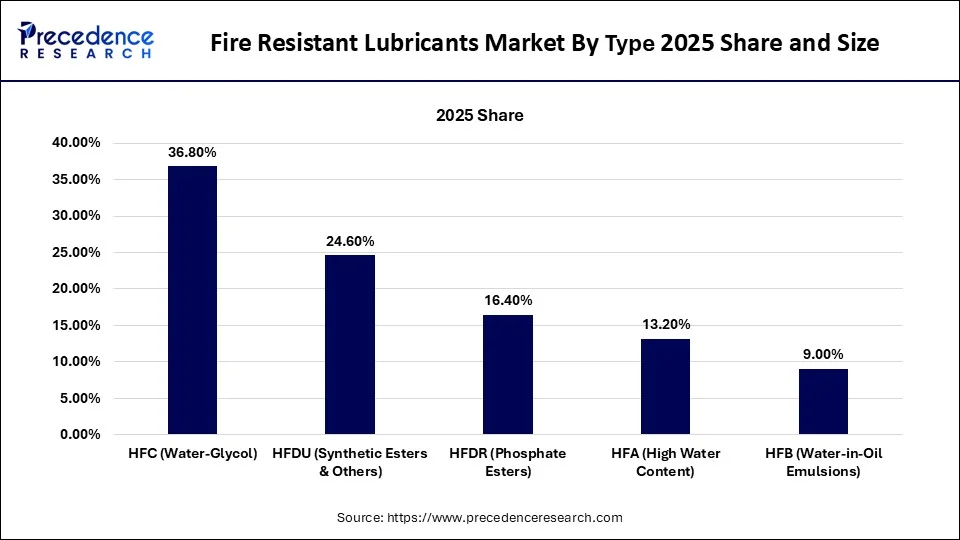
HFC water-glycol fluids accounted for 36.80% (USD 1.38 billion) in 2025 because their water content gives strong fire resistance while glycols provide lubrication for steel, die casting, and mining hydraulics. HFDU fluids, at 24.60% (USD 0.92 billion), are the fastest-growing type because synthetic esters are water-free, biodegradable, and suit high-pressure systems, while HFDR phosphate esters, at 16.40% (USD 0.61 billion), serve turbine controls and aircraft hydraulics. HFA fluids account for 13.20% (USD 0.49 billion), mainly in underground mining roof supports, and HFB emulsions for 9.00% (USD 0.34 billion).
Fire Resistant Lubricants Market by End Use 2025 Share & Size
| Segments | 2025 Share | 2025 Market Value |
| Metal Processing | 28.40% | USD 1.06 billion |
| Mining | 24.60% | USD 0.92 billion |
| Power Generation | 13.80% | USD 0.52 billion |
| Construction | 11.20% | USD 0.42 billion |
| Aerospace | 9.60% | USD 0.36 billion |
| Marine | 6.40% | USD 0.24 billion |
| Others | 6.00% | USD 0.22 billion |
Note: 2025 is the base year.
Sources: Expert interviews, secondary sources, Precedence Research database and Precedence Research analysts.
Metal processing accounted for 28.40% (USD 1.06 billion) in 2025, led by steel mills, aluminum plants, and die casting near molten metal. Mining, at 24.60% (USD 0.92 billion), uses fire resistant fluids in underground equipment and longwall supports, power generation accounts for 13.80% (USD 0.52 billion) through turbine control fluids, construction for 11.20% (USD 0.42 billion), aerospace for 9.60% (USD 0.36 billion) and marine for 6.40% (USD 0.24 billion), while other industries account for 6.00% (USD 0.22 billion).
- Analyst View: Segment values were allocated by mapping the installed base of high-risk hydraulic systems by industry to fluid type, volume, and price. HFC fluids lead because they are widely used in steel and mining at moderate cost. We expect HFDU synthetic esters to gain share as users seek water-free, biodegradable fluids with high performance.
Regional Analysis
Fire Resistant Lubricants Market by Region 2025 Share & Size
Note: 2025 is the base year.
Sources: Expert interviews, secondary sources, Precedence Research database and Precedence Research analysts.
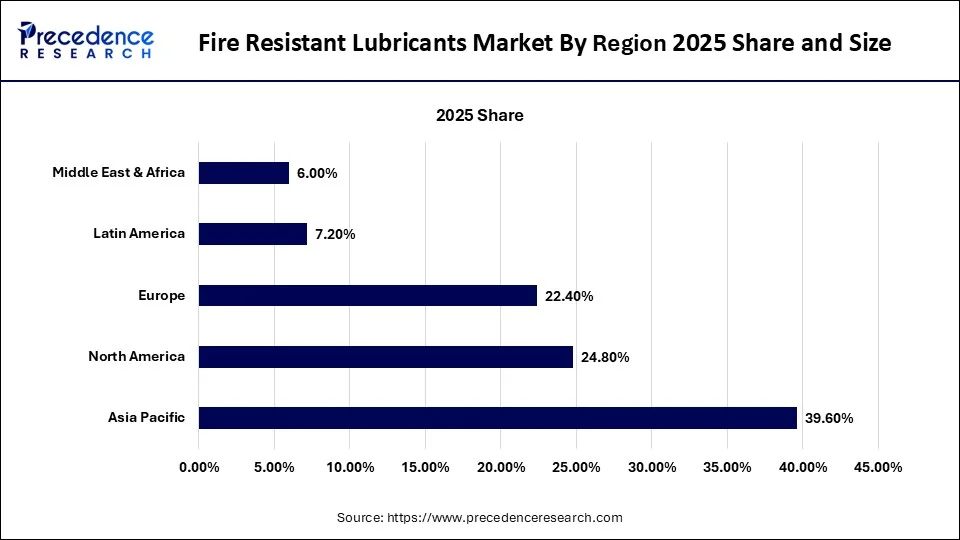
Asia Pacific accounted for 39.60% (USD 1.48 billion) in 2025, growing on steel production, mining and power generation in China, India and Australia. North America, at 24.80% (USD 0.93 billion), is the fastest-growing region, supported by mining, aerospace, metal processing, and strict workplace safety rules, while Europe, at 22.40% (USD 0.84 billion), grows with steel, tunnelling, and the shift to biodegradable, mineral-oil-free fluids. Latin America, at 7.20% (USD 0.27 billion), grows with mining in Chile, Peru, and Brazil, and the Middle East and Africa, at 6.00% (USD 0.22 billion), with mining in Africa and metals and power projects in the Gulf.
Asia Pacific accounted for 39.60% (USD 1.48 billion) in 2025. Steel, mining and power in China, India and Australia drive demand.
North America held 24.80% (USD 0.93 billion) of market share in 2025 and is the fastest-growing region. Growth is supported by mining, aerospace and safety rules.
Europe accounted for 22.40% (USD 0.84 billion) in 2025. Steel, tunnelling and biodegradable fluids support demand.
Latin America accounted for 7.20% (USD 0.27 billion) in 2025. Mining in Chile and Peru supports demand.
The Middle East and Africa accounted for 6.00% (USD 0.22 billion) in 2025. African mining and Gulf metals projects support demand.
Analyst View: Regional shares were built from the installed base of high-risk hydraulic systems in each region, weighted by fluid type and price. Asia Pacific leads because it has the largest steel and mining industries. We assign North America the highest growth premium because aerospace, mining, and safety-driven upgrades to higher-value fluids are growing there.
Top 10 Companies in the Fire Resistant Lubricants Market
| Rank | Company Name | Market-Specific Revenue (USD Billion) | 2025 Share | Key Products / Business | Headquarters |
| 1 | Quaker Houghton | 0.42 | 11.23% | QUINTOLUBRIC and HOUGHTO-SAFE fire resistant fluids | United States |
| 2 | FUCHS | 0.34 | 9.09% | PLANTOSAFE and RENOSAFE fire resistant fluids | Germany |
| 3 | Shell | 0.3 | 8.02% | Fire resistant hydraulic fluids | United Kingdom |
| 4 | ExxonMobil | 0.26 | 6.95% | Mobil Pyrotec fire resistant fluids | United States |
| 5 | TotalEnergies | 0.24 | 6.42% | Hydransafe fire resistant fluids | France |
| 6 | BP (Castrol) | 0.2 | 5.35% | Castrol fire resistant hydraulic fluids | United Kingdom |
| 7 | Eastman | 0.18 | 4.81% | Skydrol phosphate ester aviation hydraulic fluids | United States |
| 8 | Sinopec Lubricant | 0.14 | 3.74% | Fire resistant hydraulic fluids | China |
| 9 | LANXESS | 0.12 | 3.21% | Phosphate ester fire resistant fluids | Germany |
| 10 | Chevron | 0.1 | 2.67% | Fire resistant hydraulic fluids | United States |
Note: Company revenues and shares are 2025 estimates.
Sources: Company press releases, expert interviews, secondary sources, Precedence Research database and Precedence Research analysts.
Quaker Houghton led the fire resistant lubricants market with an estimated 11.23% (USD 0.42 billion) of 2025 revenue, followed by FUCHS at 9.09% (USD 0.34 billion) and Shell at 8.02% (USD 0.30 billion). Quaker Houghton dominates the market by supplying a variety of water glycol and synthetic ester fluids to the steel and mining industries; FUCHS supplies fire-resistant fluids to the mining and metalworking industries; and Shell delivers industrial fluids throughout the world. The total sales generated by the top 10 players were estimated at 61.50% (USD 2.30 billion), whereas the remaining 38.50% (USD 1.44 billion) belonged to the rest of the firms. The fire resistant lubricants market is moderately concentrated, and competition centers on fire resistance ratings, equipment maker approvals, lubrication performance, biodegradability, and technical service.
Recent Developments
- October 2026: Lubrication Engineers, Inc. announced the acquisition of BioBlend Renewable Resources, LLC to access its comprehensive portfolio of bio-based and hybrid lubricants for mining, marine, drilling, and industrial customers.
- January 2025: TotalEnergies Lubrifiants acquired the Corsave HFA and Lubesave HFC-E fire-resistant hydraulic fluid lines from Germany's Fluid Competence for steel, mining and tunnelling uses.
Market Segments
By Type
- HFC (Water-Glycol)
- HFDU (Synthetic Esters & Others)
- HFDR (Phosphate Esters)
- HFA (High Water Content)
- HFB (Water-in-Oil Emulsions)
By End Use
- Metal Processing
- Mining
- Power Generation
- Construction
- Aerospace
- Marine
- Others
By Region
- North America (U.S., Canada, Mexico)
- Europe (Germany, U.K., France, Italy, Spain, Rest of Europe)
- Asia Pacific (China, Japan, India, South Korea, Taiwan, Rest of Asia Pacific)
- Latin America (Brazil, Argentina, Rest of Latin America)
- Middle East & Africa (GCC, South Africa, Rest of MEA)
Research Methodology
The fire resistant lubricants market was defined as fire resistant hydraulic fluids and lubricants, including HFA, HFB, HFC, HFDU, and HFDR types, used in industry and aviation worldwide. The 2025 base year was built bottom-up from the installed base of high-risk hydraulic systems, fluid volumes, replacement rates, and fluid prices, and checked top-down against the industrial and aviation fluid sales of leading lubricant and specialty chemical companies. Segment, regional and company values were allocated from fluid types, end-use industries and regional industrial activity. Key estimates were verified by cross-checking company disclosures, regulatory and industry data, and published third-party estimates, and excluded inputs that could not be reconciled. All segment, regional, and company figures were reconciled to the same 2025 base year, and the 2026-2035 forecast, which applies a constant CAGR from the 2025 base, was recalculated and validated.
Analyst View Overall Market
The fire resistant lubricants market is a steady, safety-driven segment of industrial lubricants, with value shifting toward synthetic and water-free fluids. Our estimate links demand to the installed base of high-risk hydraulic systems, fluid volumes, and prices, so the forecast follows industrial activity and safety regulation. The main upside comes from synthetic ester fluids and mining growth, while the main risks are cost sensitivity and industrial slowdowns.
Sources and References
- TotalEnergies Lubricants. "TotalEnergies Lubrifiants acquires low-VOC emission fire resistant hydraulic fluids". 2025-01-29. Acquisition of Fluid Competence fluid lines. https://lubricants.totalenergies.com/news-press-releases/totalenergies-lubrifiants-acquires-low-voc-volatil-organic-compounds-emission
- Powertrain International. "Bosch Rexroth and TotalEnergies collaborate on water-based hydraulic fluids". 2023-12-19. Fire resistant water-based fluid development. https://www.powertraininternationalweb.com/sustainability/bosch-rexroth-totalenergies
- Quaker Houghton. "Best-in-class water-free fire-resistant hydraulic fluids". Undated. QUINTOLUBRIC product information. https://info.quakerhoughton.com/fire-resistant-hydraulic-fluids/.
For inquiries regarding discounts, bulk purchases, or customization requests, please contact us at sales@precedenceresearch.com
Frequently Asked Questions





Ask For Sample
No cookie-cutter, only authentic analysis – take the 1st step to become a Precedence Research client
 Get a Sample




 sales@precedenceresearch.com
 Schedule a Meeting
