



Food Grade Lubricants Market Size, Key Companies, Company Production Capacity, Manufacturing Efficiency, Capacity Utilization, Raw Material Consumption, Cost Structure, Export Trends, Company Expansion Strategies, and Competitive Landscape
Vidyesh Swar, a Chemical and Materials Industry Expert, estimates the food grade lubricants market at USD 455.17 million in 2026, with the market projected to reach USD 782.16 million by 2035 by 2035 at a CAGR of 6.20%. Major food grade lubricants market companies such as FUCHS, Klüber Lubrication, ExxonMobil, Petro-Canada Lubricants are competing across key material and application segments, base oil, product type, form, end use, egion.
Source: https://www.precedenceresearch.com/food-grade-lubricants-market
 Get a Sample
 Report Description


Food Grade Lubricants Market Size, Share and Forecast 2026-2035
The food grade lubricants market is estimated at USD 455.17 million in 2026 and is projected to reach USD 782.16 million by 2035, expanding at a CAGR of 6.20% from 2026 to 2035.
The market covers oils and greases registered for use in food, beverage, pharmaceutical, cosmetic, and animal feed processing. Some common examples of food grade lubricants include NSF H1 lubricants for incidental food contact, H2 lubricants for areas with no food contact, and H3 soluble oils, based on white mineral oils, synthetic fluids, and bio-based oils.
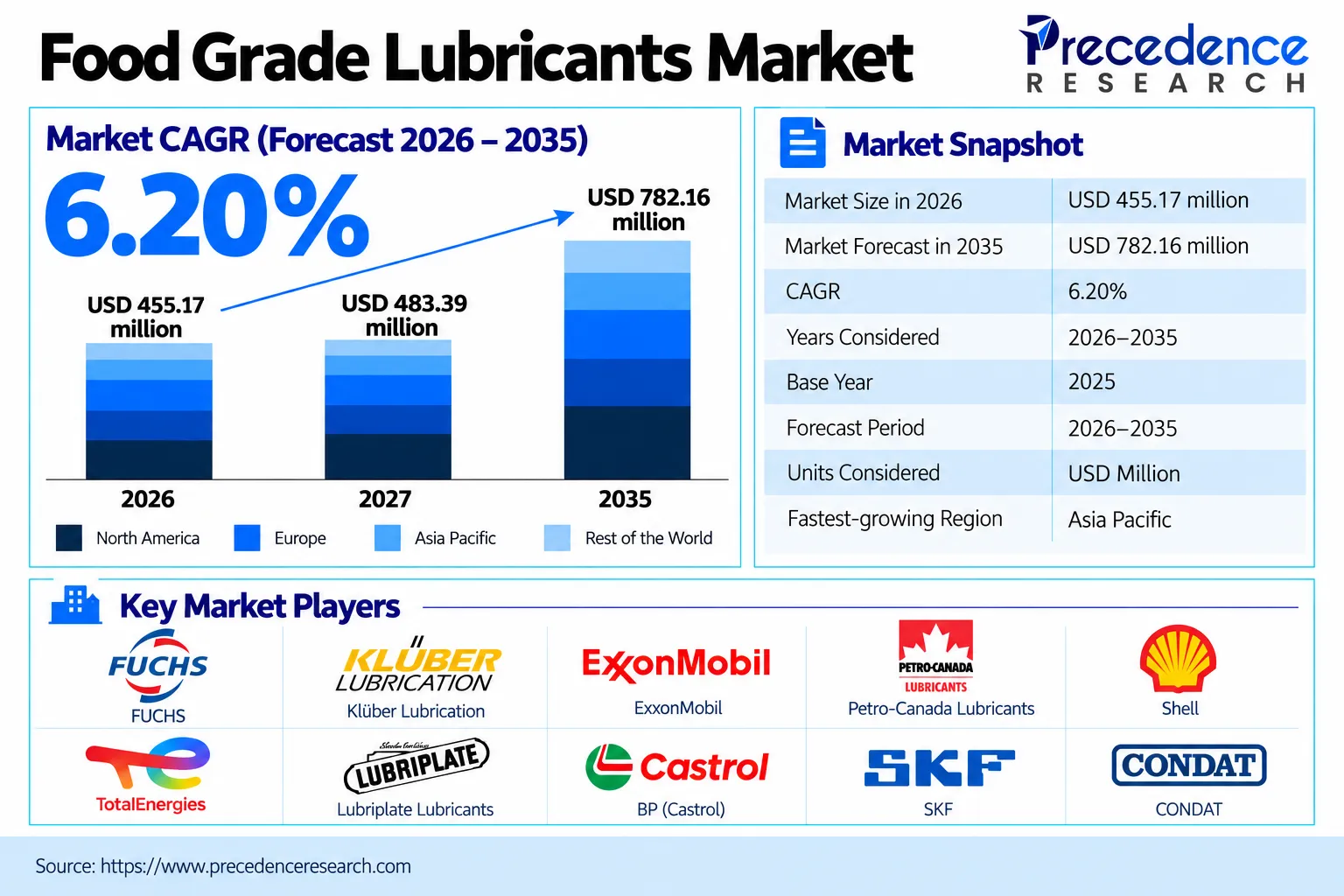 Key Takeaways
Market Size & Growth Outlook
- Market size in 2026: USD 6.61 million
- Estimated market size in 2027: USD 483.39 million
- Projected market size by 2036: USD 782.16 million
- CAGR (2026-2035): 6.20%
Regional Market Spotlight
- North America led the market with a 34.60% (USD 148.30 million) share in 2025.
- Europe accounted for 28.40% (USD 121.72 million) of the market in 2025.
- Asia Pacific accounted for 26.20% (USD 112.29 million) of the market in 2025 and is projected to be the fastest-growing region, at a CAGR of 7.42% from 2026 to 2035.
Segmental Spotlight
- By base oil, Mineral (White Oil) accounted for 44.60% (USD 191.16 million) in 2025.
- By product type, H1 accounted for 72.40% (USD 310.31 million) in 2025.
- By form, Oils accounted for 78.40% (USD 336.02 million) in 2025.
- By end use, Food accounted for 46.20% (USD 198.01 million) in 2025.
Food Grade Lubricants Market Size and Forecast, 2026-2035 (USD Million)
Lubricants with the H1 grade were the dominant products in terms of market share, occupying 72.40% of the market in 2026, as customers demanded H1-grade products due to safety regulations and audits. North America accounted for 34.60% of revenue in 2026, supported by a large processed food and beverage industry and strict food safety rules. Demand is driven by food safety regulations and audit standards, automation of processing and packaging lines, growth of packaged food, beverages, and pharmaceuticals in Asia, and the shift to synthetic H1 oils that last longer. Lubricant makers are launching new H1 greases and fluids that work across refrigerated and high-temperature zones.
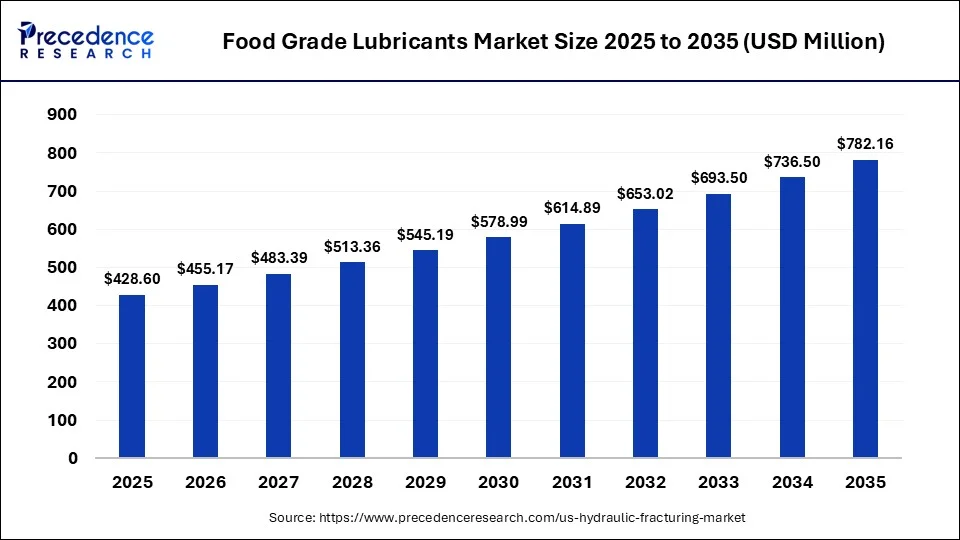
Note: 2025 is the base year; 2026-2035 values are forecasts.
Sources: Expert interviews, secondary sources, Precedence Research database and Precedence Research analysts.
The food grade lubricants market is projected to grow from USD 455.17 million in 2026 to USD 782.16 million by 2035 because food, beverage, and pharmaceutical plants run more automated equipment and replace conventional lubricants with H1 products to meet food safety audits. Synthetic H1 greases, which offer extended durability and multi-zone greases, bring additional value to each plant and take the market size to USD 578.99 million by 2030 while maintaining a CAGR of 6.20% during 2026 to 2035.
- Analyst View: We built the estimate from the number and size of food, beverage, pharmaceutical, and cosmetic processing plants by region, multiplied by lubricant consumption per plant, the share of food grade lubricants, and average prices for H1, H2, and H3 oils and greases. Consumption reflects equipment types such as conveyors, gearboxes, compressors, hydraulics and bearings, and the share of food grade products reflects food safety rules and audit practices. The total was cross-checked against the food grade lubricant sales of leading lubricant companies and against published estimates, which places our base year slightly above comparable figures. Growth is shown through consistent growth in the processing industry, increased H1 and synthetic material use.
Market Trends
- Plants are moving to H1 lubricants across whole facilities.
- Synthetic H1 oils are extending service intervals.
- Multi-zone greases simplify lubrication across temperature areas.
- Kosher and Halal certification is expected for food grade products.
- Bio-based food grade lubricants are gaining interest.
- Equipment makers are approving specific food grade fluids.
Drivers, Restraints and Opportunities
Driver
Food safety laws and audit standards push plants to use H1 lubricants to avoid contamination. Automation of processing and packaging lines increases the number of lubricated points. An increase in packaged foods, drinks, and medicines, particularly in Asia, helps drive demand.
Restraint
Food grade lubricants cost more than conventional lubricants, which slows adoption in price-sensitive markets. Some H1 products have lower performance limits than industrial lubricants. Awareness and enforcement of food grade use vary by country.
Opportunity
Both synthetic and multi-zone H1 products can substitute for various lubricants and save time. The pharmaceutical and cosmetic industry gives better value demand. Fast-growing food processing in Asia, Latin America, and the Middle East offers volume growth.
Market Segmentation: 2025 Share and Value
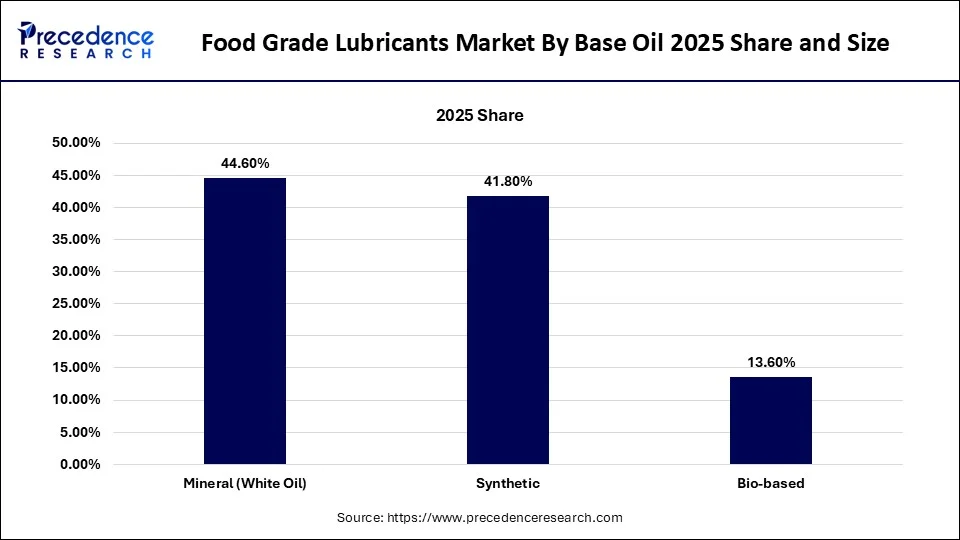
Food Grade Lubricants Market by Base Oil 2026 Share & Size
Sources: Expert interviews, secondary sources, Precedence Research database and Precedence Research analysts.
White mineral oils were responsible for 44.60% (USD 191.16 million) due to their economy and registration for H1 in 2025. Synthetic oils have been the fastest-growing base oil category with 41.80% (USD 179.15 million) as PAOs and other synthetic fluids offer longer lifetimes, operate over a wider range of temperatures, and minimize changeouts. Bio-based lubricants made up 13.60% (USD 58.29 million) of the market.
Food Grade Lubricants Market By Product Type 2025 Share & Size
| Segments | 2025 Share | 2025 Market Value |
| H1 | 72.40% | USD 310.31 million |
| H2 | 18.60% | USD 79.72 million |
| H3 & Others | 9.00% | USD 38.57 million |
Note: 2026 is the base year.
Sources: Expert interviews, secondary sources, Precedence Research database and Precedence Research analysts.
H1 lubricants accounted for 72.40% (USD 310.31 million) in 2025 and are the fastest-growing product type because plants are moving to H1 products throughout facilities to simplify audits and remove contamination risk. H2 lubricants, at 18.60% (USD 79.72 million), are used where there is no chance of food contact, and H3 soluble oils and other products account for 9.00% (USD 38.57 million).
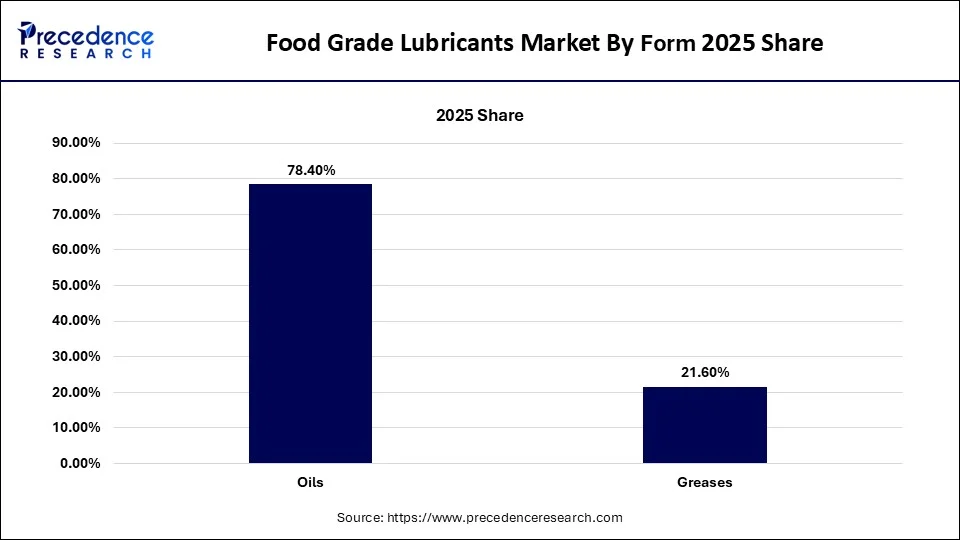
Food Grade Lubricants Market by Form 2025 Share & Size
Sources: Expert interviews, secondary sources, Precedence Research database and Precedence Research analysts.
Oils accounted for 78.40% (USD 336.02 million) in 2025, used in gearboxes, hydraulics, compressors, chains and vacuum pumps. Greases account for 21.60% (USD 92.58 million) and are used in bearings, mixers and conveyors, including new multi-zone greases that work in both cold and hot areas.
Food Grade Lubricants Market by End Use 2025 Share & Size
| Segments | 2025 Share | 2025 Market Value |
| Food | 46.20% | USD 198.01 million |
| Beverages | 22.40% | USD 96.01 million |
| Pharmaceuticals | 16.80% | USD 72.00 million |
| Cosmetics | 6.20% | USD 26.57 million |
| Others | 8.40% | USD 36.00 million |
Note: 2025 is the base year.
Sources: Expert interviews, secondary sources, Precedence Research database and Precedence Research analysts.
The food processing sector constituted 46.20% (USD 198.01 million), including meat, dairy, bakery products, and packaged foods. Beverages, at 22.40% (USD 96.01 million), include bottling and brewing; pharmaceuticals, at 16.80% (USD 72.00 million), are a fast-growing user with strict contamination rules; cosmetics account for 6.20% (USD 26.57 million); and other uses such as animal feed and packaging account for 8.40% (USD 36.00 million).
- Analyst View: Segment values were allocated by matching processing plant lubricant use by industry to base oil, product type and form, using average prices. H1 lubricants lead because food safety programs favor them across whole plants. We expect synthetic H1 lubricants and pharmaceutical uses to gain share.
Regional Analysis
Food Grade Lubricants Market by Region 2025 Share & Size
Sources: Expert interviews, secondary sources, Precedence Research database and Precedence Research analysts.
North America accounted for 34.60% (USD 148.30 million) in 2025, growing on a large processed food, beverage and pharmaceutical industry and strict food safety audits. Europe, at 28.40% (USD 121.72 million), is supported by food safety rules, a large dairy, bakery and beverage sector and demand for bio lubricants, while Asia Pacific, at 26.20% (USD 112.29 million), is the fastest-growing region as packaged food, beverage and pharmaceutical production expands in China, India and Southeast Asia. Latin America, at 6.20% (USD 26.57 million), grows with meat and beverage processing in Brazil and Mexico, and the Middle East and Africa, at 4.60% (USD 19.72 million), with food processing investment in the Gulf.
North America accounted for 34.60% (USD 148.30 million) in 2025. Processed food and strict food safety audits drive demand.
Europe accounted for 28.40% (USD 121.72 million) in 2025. Food safety rules and bio-based lubricants support demand.
Asia Pacific accounted for 26.20% (USD 112.29 million) in 2025 and is the fastest-growing region. Packaged food and pharmaceutical growth drive demand.
Latin America accounted for 6.20% (USD 26.57 million) in 2025. Meat and beverage processing support growth.
The Middle East and Africa accounted for 4.60% (USD 19.72 million) in 2025. Gulf food processing investment supports demand.
- Analyst View: Regional shares were built from processing plant capacity and lubricant use in each region, weighted by food grade adoption and price. The North American region is ahead due to its large processing industry and proper auditing process. We assign Asia Pacific the highest growth premium because packaged food and pharmaceutical production and food safety standards are growing quickly there.
Top 10 Companies in the Food Grade Lubricants Market
| Rank | Company Name | Market-Specific Revenue (USD Million) | 2025 Share | Key Products / Business | Headquarters |
| 1 | FUCHS | 44 | 10.27% | CASSIDA food grade oils and greases | Germany |
| 2 | Klüber Lubrication | 40 | 9.33% | Klübersynth and Klüberfood H1 lubricants | Germany |
| 3 | ExxonMobil | 34 | 7.93% | Mobil SHC Cibus food grade lubricants | United States |
| 4 | Petro-Canada Lubricants | 30 | 7.00% | PURITY FG food grade lubricants | Canada |
| 5 | Shell | 22 | 5.13% | Food grade lubricants | United Kingdom |
| 6 | TotalEnergies | 20 | 4.67% | Nevastane food grade lubricants | France |
| 7 | Lubriplate Lubricants | 16 | 3.73% | Food grade lubricants | United States |
| 8 | BP (Castrol) | 14 | 3.27% | Castrol Optileb food grade lubricants | United Kingdom |
| 9 | SKF | 10 | 2.33% | Food grade greases | Sweden |
| 10 | CONDAT | 8 | 1.87% | Food grade lubricants | France |
Note: Company revenues and shares are 2025 estimates.
Sources: Company press releases, expert interviews, secondary sources, Precedence Research database and Precedence Research analysts.
FUCHS led the food grade lubricants market with an estimated 10.27% (USD 44.00 million) of 2025 revenue, followed by Klüber Lubrication at 9.33% (USD 40.00 million) and ExxonMobil at 7.93% (USD 34.00 million). FUCHS leads through its CASSIDA food grade range, Klüber Lubrication through specialty H1 lubricants for food and pharmaceutical plants, and ExxonMobil through its Mobil SHC Cibus synthetic food grade line. The top 10 companies accounted for an estimated 55.53% (USD 238.00 million) of 2025 revenue, while the remaining 44.47% (USD 190.60 million) was shared among regional lubricant blenders, specialty food grade lubricant makers, and equipment makers' branded lubricants. The food grade lubricants market is moderately concentrated, and competition centers on NSF registrations, equipment maker approvals, temperature range, service life, and technical support for food safety audits.
Recent Developments
- June 2026: FUCHS launched the CASSIDA FM GREASE CSC EP Series, an NSF H1-registered calcium sulfonate complex grease for food and beverage plants that works from -20°C to steam-exposed equipment.
- October 2026: Interflon became the first lubricant manufacturer in the world to achieve NSF International's 538 mineral oil aromatic hydrocarbon (MOAH)-free certification.
Market Segments
By Base Oil
- Mineral (White Oil)
- Synthetic
- Bio-based
By Product Type
- H1
- H2
- H3 & Others
By Form
- Oils
- Greases
By End Use
- Food
- Beverages
- Pharmaceuticals
- Cosmetics
- Others
By Region
- North America (U.S., Canada, Mexico)
- Europe (Germany, U.K., France, Italy, Spain, Rest of Europe)
- Asia Pacific (China, Japan, India, South Korea, Taiwan, Rest of Asia Pacific)
- Latin America (Brazil, Argentina, Rest of Latin America)
- Middle East & Africa (GCC, South Africa, Rest of MEA)
Research Methodology
The food grade lubricants market was defined as NSF H1, H2, H3, and other food grade oils and greases used in food, beverage, pharmaceutical, cosmetic, and related processing worldwide. The 2025 base year was built bottom-up from processing plant capacity, lubricant consumption per plant, food grade share and prices, and checked top-down against the food grade lubricant sales of leading lubricant companies. Segment, regional and company values were allocated from base oils, product types, forms, end uses and regional processing capacity. Critical estimates were confirmed through comparison with company disclosures, industry data, and third-party estimates, and inputs that could not be reconciled were disregarded. All segment, regional and company figures were reconciled to the same 2025 base year, and the 2026-2035 forecast, which applies a constant CAGR from the 2025 base, was recalculated and validated.
Analyst View: Overall Market
The food grade lubricants market grows with food, beverage, and pharmaceutical processing and with the spread of H1 products across plants. As our estimation depends on plant capacity, lubrication consumption, and food-grade adoption, the forecast will depend on the growth of processing activity and food safety standards. In terms of opportunities, it will be the growth of Asian processing and synthetic H1. Threats will consist of price sensitivity and uneven enforcement.
Sources and References
- Canadian Occupational Safety. "FUCHS Lubricants launches food-grade grease for processing facilities". 2026-06-29. CASSIDA FM GREASE CSC EP launch. https://www.thesafetymag.com/ca/products/facility-safety/fuchs-lubricants-launches-food-grade-grease-for-processing-facilities/547653
- The National Provisioner. "Petro-Canada Lubricants launches PURITY FG with SynFX". 2016-07-04. Food grade lubricant line. https://www.provisioneronline.com/articles/103500-petro-canada-lubricants-launches-purity-fg-with-synfx
- Petro-Canada Lubricants. "Petro-Canada Lubricants awarded Husky approval for PURITY FG Synthetic Fluid 46". 2018-05-30. Food grade hydraulic fluid approval. https://petrocanadalubricants.com/en-us/knowledge-centre/newsreleases/petro-canada-lubricants-awarded-husky-approval-purity-fg-synthetic-fluid-46
- FUCHS. "FUCHS successfully completes the acquisition of the LUBCON Group". 2024-07-26. Specialty lubricant acquisition. https://www.fuchs.com/us/en/company/news/press-releases/view/6136-FUCHS-successfully-completes-the-acquisition-of-the-LUBCON-Group-a-manufacturer-of-high-performance-specialty-lubricants-news-with-additional-features
For inquiries regarding discounts, bulk purchases, or customization requests, please contact us at sales@precedenceresearch.com
Frequently Asked Questions





Ask For Sample
No cookie-cutter, only authentic analysis – take the 1st step to become a Precedence Research client
 Get a Sample




 sales@precedenceresearch.com
 Schedule a Meeting
