


Glass Substrate Market Trends, Leading Companies, Company Revenue / Sales Performance, Manufacturing Yield, Fab Capacity, Export & Import Dynamics, Supply Chain Analysis, Competitive Landscape, and Growth Forecast
According to semiconductor and electronics Laxmi Narayan specialist ,the glass substrate market is valued at USD 7.91 billion in 2026 and is forecast to reach USD 11.66 billion by 2035, reflecting a CAGR of 4.40%. Leading glass substrate market companies, including Corning Incorporated, AGC Inc., Nippon Electric Glass Co., Ltd. , are strengthening their presence across key segments such as material, application, end-use, region.
Source: https://www.precedenceresearch.com/glass-substrate-market
 Get a Sample
 Report Description


Glass Substrate Market Size, Share and Forecast 2026-2035
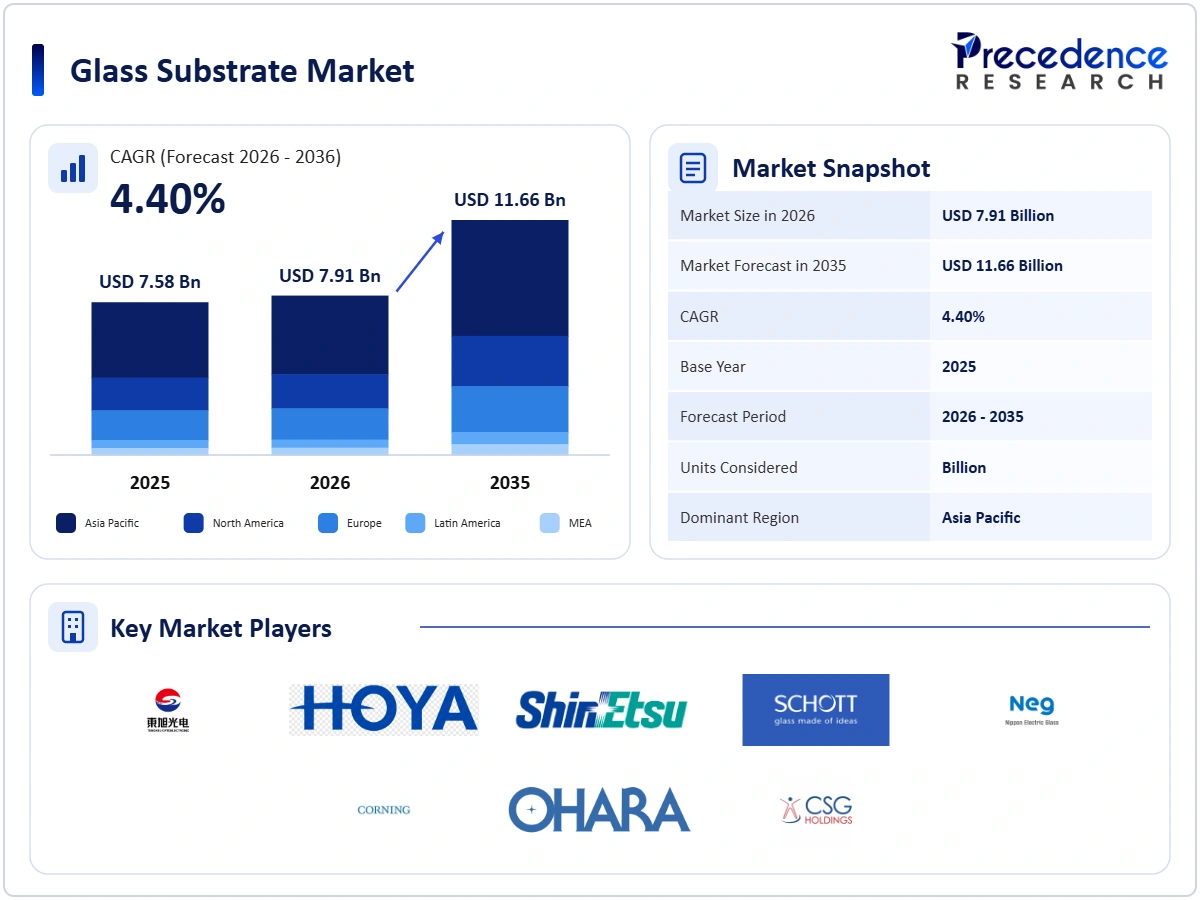
The glass substrate market is estimated at USD 7.91 billion in 2026 and is projected to reach USD 11.66 billion by 2035, expanding at a CAGR of 4.40% from 2026 to 2035.
Key Takeaways
Market Size & Growth Outlook
- Market size in 2025: USD 7.58 billion
- Estimated market size in 2026: USD 7.91 billion
- Projected market size by 2035: USD 11.66 billion
- CAGR (2026-2035): 4.40%
Regional Market Spotlight
- Asia Pacific led the market with a 49.30% share of USD 3.74 billion in 2025 and is projected to be the fastest-growing region, at a CAGR of 5.14% from 2025 to 2035.
- North America accounted for 21.40% with USD 1.62 billion of the market in 2025.
- Europe accounted for 19.60% with USD 1.49 billion of the market in 2025.
Segmental Spotlight
- By material, Borosilicate accounted for 45.10% with USD 3.42 billion in 2025.
- By application, Display Panels accounted for 45.80% with USD 3.47 billion in 2025.
- By end use, Consumer Electronics accounted for 37.40% with USD 2.83 billion in 2025.
Glass Substrate Market Size and Forecast, 2025-2035 (USD Billion)
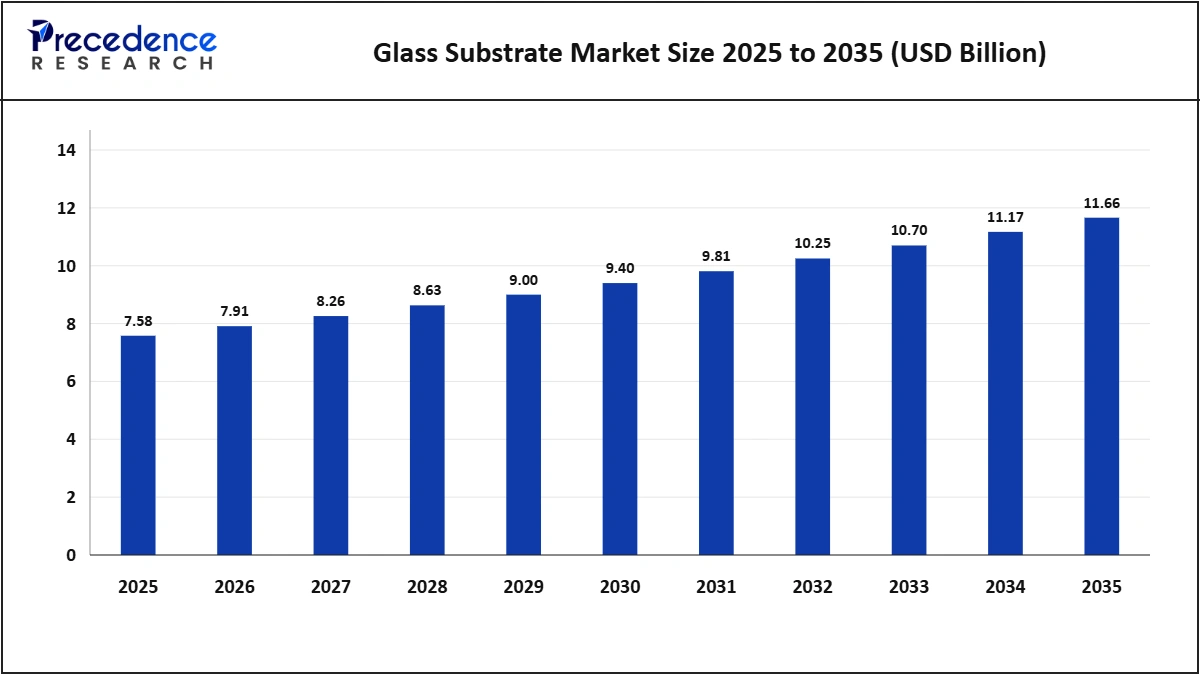
The glass substrate market was valued at USD 7.58 billion in 2025, the base year. The glass substrate market covers the thin, flat glass sheets and wafers used as base materials for display panels, semiconductor packaging and wafer processing, optics, photonics, sensors, and solar cells. Borosilicate glass accounted for the largest material share in 2025, at 45.10%, because of its low thermal expansion, chemical durability, and processability.
Asia Pacific accounted for 49.30% of revenue in 2025, anchored by display panel and semiconductor production in China, Japan, South Korea, and Taiwan. Demand is driven by display panels, advanced semiconductor packaging, automotive sensors, and photonics. Glass-core substrates for AI chip packaging are moving from pilot lines toward qualification, led by Absolics, Samsung Electro-Mechanics, and Intel.
Sources: Expert interviews, secondary sources, Precedence Research database, and Precedence Research analysts.
The glass substrate market is projected to grow from USD 7.58 billion in 2025 to USD 11.66 billion by 2035 because display panels, semiconductor packaging, photonics, and automotive sensors all rely on flat, stable, and highly pure glass as a base material. Glass carriers and early glass-core substrates for AI chip packaging add a higher-value layer on top of mature display demand, lifting the market to USD 9.40 billion by 2030 and sustaining a CAGR of 4.40% from 2026 to 2035.
- Analyst View: We built the glass substrate estimate from the demand side, multiplying display panel area, semiconductor wafer and panel-level packaging volumes, optical and sensor component output and solar module production by glass area per unit and average price per square metre for each glass type. The result was cross-checked against the glass substrate revenues of leading producers such as Corning, AGC, Nippon Electric Glass, SCHOTT and HOYA and against published estimates.
The growth rate reflects slow growth in mature display glass combined with faster growth in semiconductor and photonics substrates, where prices per square metre are far higher. Glass-core packaging is treated as an upside that ramps late in the forecast, because the first commercial products have slipped and are now targeted for 2026 to 2027 and beyond.
Market Trends
- Glass-core substrates are being developed to replace organic cores in large AI chip packages.
- Through-glass-via technology is enabling glass interposers and panel-level packaging.
- Fused silica demand is rising with photomasks, photonics, and optical interconnects.
- Display glass makers are shifting capacity toward higher-value OLED and specialty substrates.
- Automotive lidar, camera, and display modules are increasing demand for precision glass.
- Chinese producers are expanding display and solar glass capacity.
Drivers, Restraints and Opportunities
Driver
AI chip packaging, display panels, and photonics all need flat, thermally stable, and highly pure glass. Glass offers better dimensional stability and finer interconnect pitch than organic substrates for large packages. As packages grow, glass carriers and glass cores move from research into qualification, adding a high-value layer to mature display demand.
Restraint
Glass is brittle, and early glass-core production lines have suffered breakage and yield problems. Commercial timelines have slipped, and packaging houses need long reliability tests before adopting new materials. Mature display glass demand also grows slowly and faces price pressure from Chinese suppliers.
Opportunity
Glass-core substrates for AI accelerators and data center chips could open a large new market once yields improve. Photonics, AR optics, and automotive sensors add demand for high-purity and specialty glass. Suppliers that combine glass forming, through-glass-via drilling, and metallization can capture premium packaging business.
Market Segmentation: 2025 Share and Value
Glass Substrate Market by Material 2025 Share & Size
Sources: Expert interviews, secondary sources, Precedence Research database, and Precedence Research analysts.
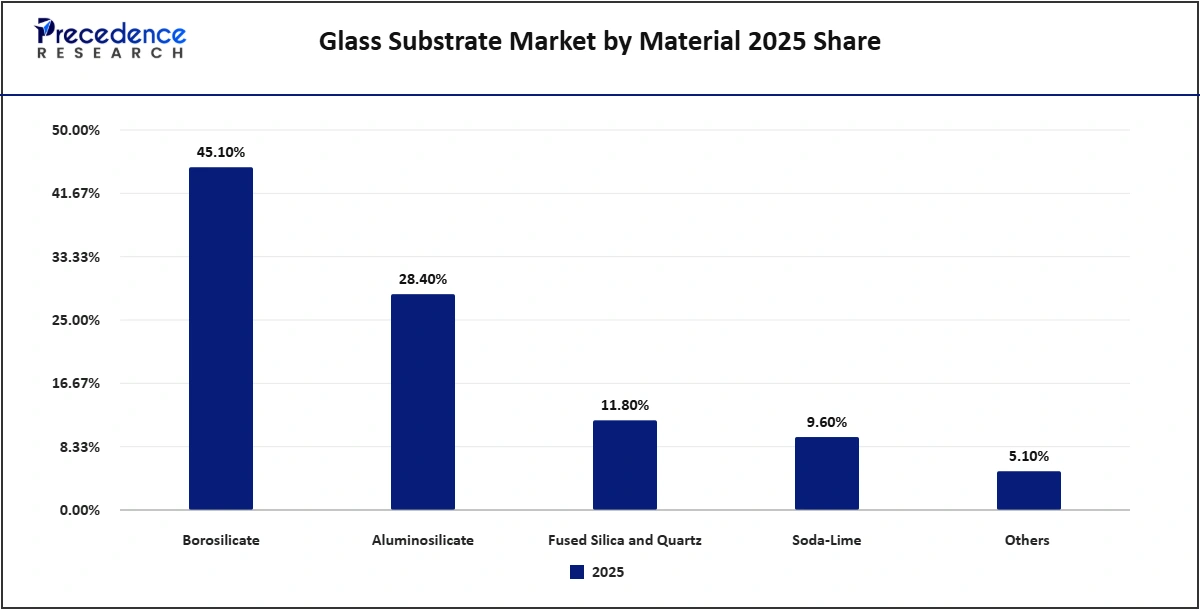
Borosilicate glass accounted for 45.10% with USD 3.42 billion in 2025 because its low thermal expansion and chemical durability suit display, semiconductor carrier, and laboratory applications. Aluminosilicate glass, at 28.40% with USD 2.15 billion, grows with high-strength display and cover substrates, while fused silica and quartz, at 11.80% with USD 0.89 billion, are gaining share in photomasks, photonics, and semiconductor processing that need extreme purity. Soda-lime glass, at 9.60% with USD 0.73 billion, serves lower-cost solar and touch applications, and other glass types account for 5.10% with USD 0.39 billion.
Glass Substrate Market by Application 2025 Share & Size
| Segments | 2025 Share | 2025 Market Value |
| Display Panels | 45.80% | USD 3.47 billion |
| Semiconductor Packaging & Wafer Processing | 18.60% | USD 1.41 billion |
| Optics & Photonics | 12.40% | USD 0.94 billion |
| Solar Cells | 9.20% | USD 0.70 billion |
| Automotive & Sensors | 7.30% | USD 0.55 billion |
| Others | 6.70% | USD 0.51 billion |
Note: 2025 is the base year.
Sources: Expert interviews, secondary sources, Precedence Research database, and Precedence Research analysts.
Display panels accounted for 45.80% with USD 3.47 billion in 2025, supported by LCD and OLED production for TVs, monitors, laptops and phones. Semiconductor packaging and wafer processing, at 18.60% with USD 1.41 billion, grows as glass carriers, interposers and glass-core substrates move toward AI chip packaging, while optics and photonics, at 12.40% with USD 0.94 billion, expand with optical communications and AR devices. Solar cells account for 9.20% with USD 0.70 billion, automotive and sensor applications for 7.30% with USD 0.55 billion, and other uses for 6.70% with USD 0.51 billion.
Glass Substrate Market by End Use 2025 Share & Size
| Segments | 2025 Share | 2025 Market Value |
| Consumer Electronics | 37.40% | USD 2.83 billion |
| Semiconductors | 21.60% | USD 1.64 billion |
| Automotive | 12.80% | USD 0.97 billion |
| Energy | 10.20% | USD 0.77 billion |
| Aerospace, Defense & Others | 9.30% | USD 0.70 billion |
| Healthcare & Life Sciences | 8.70% | USD 0.66 billion |
Note: 2025 is the base year.
Sources: Expert interviews, secondary sources, Precedence Research database, and Precedence Research analysts.
Consumer electronics accounted for 37.40% with USD 2.83 billion in 2025 because displays and touch panels remain the largest outlet for glass substrates. Semiconductors, at 21.60% with USD 1.64 billion, are the main growth engine as packaging moves to larger panels and finer interconnects, while automotive, at 12.80% with USD 0.97 billion, grows with in-vehicle displays and lidar and camera modules
Energy accounts for 10.20% with USD 0.77 billion, aerospace, defense and others for 9.30% with USD 0.70 billion, and healthcare and life sciences for 8.70% with USD 0.66 billion, where glass slides, microfluidics and diagnostic chips are used.
- Analyst View: Segment values were allocated by mapping each application to the glass types it uses and weighting by area and price. Display panels lead on revenue because of their large area, even though prices per square metre are modest, while semiconductor and photonics substrates carry much higher prices that lift their revenue weight relative to area. We expect semiconductor packaging and fused silica to gain share as AI chip packaging and optical interconnects grow, with glass-core substrates adding to this shift once qualification is complete.
Regional Analysis
Glass Substrate Market by Region 2025 Share & Size
Sources: Expert interviews, secondary sources, Precedence Research database, and Precedence Research analysts.
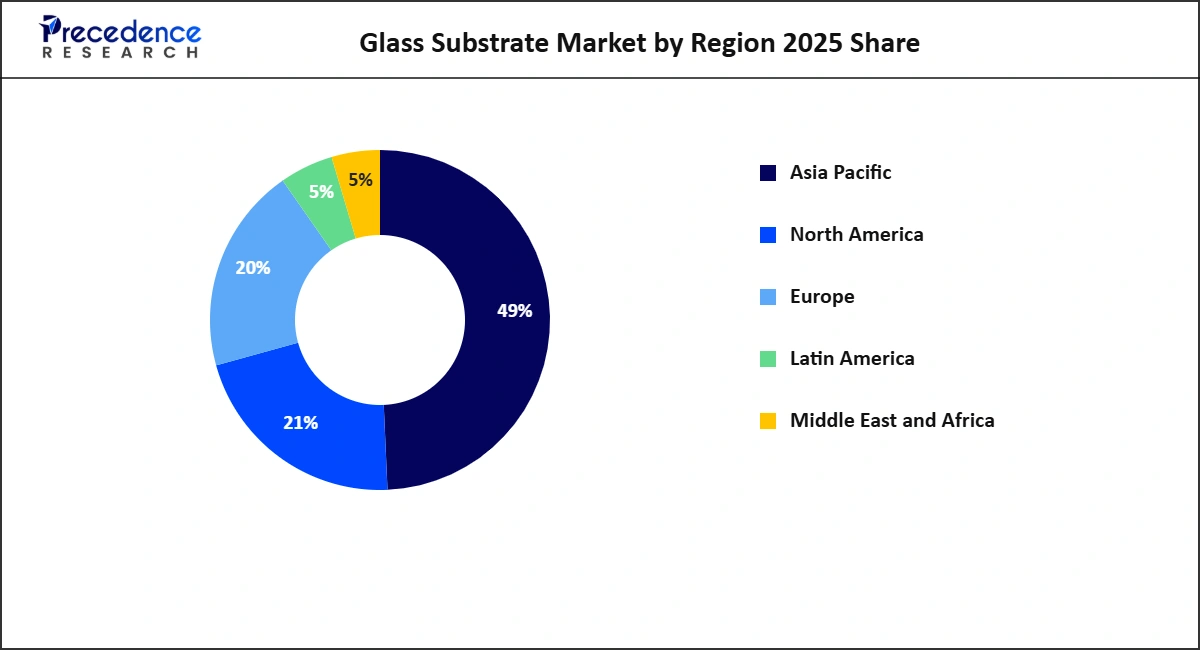
Asia Pacific accounted for 49.30% with USD 3.74 billion in 2025, growing on display panel, semiconductor and solar production in China, Japan, South Korea and Taiwan. North America, at 21.40% with USD 1.62 billion, grows with semiconductor packaging investment and photonics, including the first dedicated glass-core substrate plant in Georgia, while Europe, at 19.60% with USD 1.49 billion, expands on specialty glass, automotive and photonics demand. Latin America, at 5.10% with USD 0.39 billion, and the Middle East & Africa, at 4.60% (USD 0.35 billion), remain smaller markets tied to electronics assembly and solar installations.
Asia Pacific accounted for 49.30% with USD 3.74 billion in 2025 and is the fastest-growing region. China leads in display panels and solar, while Japan, South Korea and Taiwan lead in specialty glass and semiconductor packaging.
North America accounted for 21.40% with USD 1.62 billion in 2025. Semiconductor packaging investment, photonics, and defense optics drive demand, along with Absolics' glass substrate plant in Georgia.
Europe accounted for 19.60% with USD 1.49 billion in 2025. Germany's specialty glass industry, automotive sensors, and photonics support demand.
Latin America accounted for 5.10% with USD 0.39 billion in 2025. Electronics assembly in Mexico and solar projects in Brazil and Chile drive demand.
The Middle East & Africa accounted for 4.60% with USD 0.35 billion in 2025. Large solar projects in the Gulf are the main source of demand.
- Analyst View: Regional shares follow where glass substrates are consumed, measured through display, semiconductor, solar and optics production and adjusted for trade flows. Asia Pacific carries the largest weight because most panel, solar and semiconductor packaging capacity is located there. We assign Asia Pacific the highest growth premium because new semiconductor packaging and glass-core pilot lines are concentrated in South Korea, Japan, Taiwan and China, while North America's growth depends on how quickly US glass-core capacity reaches volume production.
Top 10 Companies in the Glass Substrate Market
| Rank | Company Name | Market-Specific Revenue (USD Billion) | 2025 Share | Key Products / Business | Headquarters |
| 1 | Corning Incorporated | 1.62 | 21.37% | Display glass, Willow glass and precision glass substrates | United States |
| 2 | AGC Inc. | 0.96 | 12.66% | Display glass and glass substrates for semiconductors | Japan |
| 3 | Nippon Electric Glass Co., Ltd. | 0.74 | 9.76% | Display glass and glass substrates for packaging | Japan |
| 4 | SCHOTT AG | 0.52 | 6.86% | Borosilicate and specialty glass wafers and substrates | Germany |
| 5 | HOYA Corporation | 0.38 | 5.01% | Photomask blanks and glass substrates for optics | Japan |
| 6 | Shin-Etsu Chemical Co., Ltd. | 0.31 | 4.09% | Synthetic quartz substrates for photomasks | Japan |
| 7 | Tunghsu Optoelectronic Technology Co., Ltd. | 0.28 | 3.69% | Display glass substrates | China |
| 8 | Irico Group New Energy Co., Ltd. | 0.19 | 2.51% | Display and solar glass substrates | China |
| 9 | CSG Holding Co., Ltd. | 0.16 | 2.11% | Display and specialty glass | China |
| 10 | Ohara Inc. | 0.12 | 1.58% | Optical and specialty glass substrates | Japan |
Note: Company revenues and shares are 2025 estimates.
Sources: Company press releases, expert interviews, secondary sources, Precedence Research database and Precedence Research analysts.
Corning led the glass substrate market with an estimated 21.37% with USD 1.62 billion of 2025 revenue, followed by AGC at 12.66% with USD 0.96 billion and Nippon Electric Glass at 9.76% with USD 0.74 billion. Corning leads through its fusion-drawn display and precision glass, AGC through display glass and semiconductor substrates, and Nippon Electric Glass through display glass and glass for packaging
The top 10 companies accounted for an estimated 69.66% with USD 5.28 billion of 2025 revenue, while the remaining 30.34% with USD 2.30 billion was shared among Chinese display glass producers, specialty glass makers, and new glass-core substrate entrants. Competition is moving toward semiconductor glass, where Absolics, Samsung Electro-Mechanics, Dai Nippon Printing and Intel are developing glass-core substrates for AI packages.
Recent Developments
- In August 2026, Absolics reported mass-production samples produced in early 2026 and targeted mass production by the end of 2026, after missing its original 2024 target.
- In July 2026, Samsung Electro-Mechanics formalized its GLASEM joint venture with Dongwoo Fine-Chem, valued at â‚©482.1 billion, targeting first glass substrate production at Pyeongtaek in the second half of 2027.
- In March 2026, SKC reportedly planned to put more than â‚©600 billion of a â‚©1 trillion capital increase into its glass substrate subsidiary Absolics, which built a dedicated glass substrate plant in Georgia, US.
- In January 2026, Intel showed a thick-core glass substrate with two embedded EMIB bridge dies at NEPCON Japan.
- In December 2025, Dai Nippon Printing began phased operation of a through-glass-via glass core substrate pilot line.
Market Segments
By Material
- Borosilicate
- Aluminosilicate
- Fused Silica & Quartz
- Soda-Lime
- Others
By Application
- Display Panels
- Semiconductor Packaging & Wafer Processing
- Optics & Photonics
- Solar Cells
- Automotive & Sensors
- Others
By End-User
- Consumer Electronics
- Semiconductors
- Automotive
- Energy
- Aerospace, Defense & Others
- Healthcare & Life Sciences
By Region
- North America
- U.S.
- Canada
- Mexico
- Europe
- Germany
- U.K.
- France
- Ital
- Spain
- Rest of Europe
- Asia Pacific
- China
- Japan
- India
- South Korea
- Taiwan
- Rest of Asia Pacific
- Latin America
- Brazil
- Mexico
- Rest of Latin America
- Middle East & Africa
- GCC
- South Africa
- Rest of MEA
Research Methodology
The glass substrate market was defined as flat glass sheets, panels and wafers used as base materials for display panels, semiconductor packaging and wafer processing, optics, photonics, sensors and solar cells, counted at glass-producer level. The 2025 base year was built bottom-up from display, semiconductor, optics and solar production volumes, glass area per unit and average price per square metre, and checked top-down against the glass substrate revenues of leading producers. Segment, regional and company values were allocated from application production data, regional manufacturing footprints and producer portfolios.
Key estimates were verified by cross-checking company disclosures, regulatory and industry data and published third-party estimates, and inputs that could not be reconciled were excluded. All segment, regional and company figures were reconciled to the same 2025 base year, and the 2026-2035 forecast, which applies a constant CAGR from the 2025 base, was recalculated and validated.
Analyst View Overall Market
The glass substrate market combines a large, mature display business with a smaller but faster-growing semiconductor and photonics business. Our estimate is built from glass area by application and price per square metre, so the forecast reflects both slow display growth and rising high-value packaging demand. Glass-core substrates are the main upside, but their timing remains uncertain after repeated delays. The key risks are display cycle weakness, glass-core yield problems, and price competition from Chinese producers.
Sources and References
- Tom's Hardware. "Glass substrate roadmaps examined: Absolics in final qualification". 2026-08-27. Absolics, Intel and Samsung glass-core substrate timelines. https://tomshardware.com/tech-industry/manufacturing/glass-substrate-roadmap-examined
- TrendForce News. "SKC reportedly channels over half of â‚©1T capital increase into Absolics". 2026-03-03. SKC investment in Absolics and competitor glass substrate plans. https://www.trendforce.com/news/2026/03/03/news-skc-reportedly-channels-over-half-of-%E2%82%A91T-capital-increase-into-absolics-to-fast-track-glass-substrates/
- Corning Incorporated (SEC EDGAR). "Form 10-K, fiscal year 2025". 2026. Display and specialty materials businesses. https://www.sec.gov/Archives/edgar/data/24741/000002474126000124/glw-20251231.htm
- 36Kr. "Glass substrates for chip packaging industry analysis". 2026. Glass-core substrate supply chain developments. https://eu.36kr.com/en/p/3636277088814085
For inquiries regarding discounts, bulk purchases, or customization requests, please contact us at sales@precedenceresearch.com
Frequently Asked Questions





Ask For Sample
No cookie-cutter, only authentic analysis – take the 1st step to become a Precedence Research client
 Get a Sample




 sales@precedenceresearch.com
 Schedule a Meeting