



Hydrogen Sulfide Scavengers Market Trends, Leading Companies, Company Revenue / Sales Performance, Plant Utilization, Production Volume, Pricing Dynamics, Supply Chain Performance, Competitive Landscape, and Industry Growth
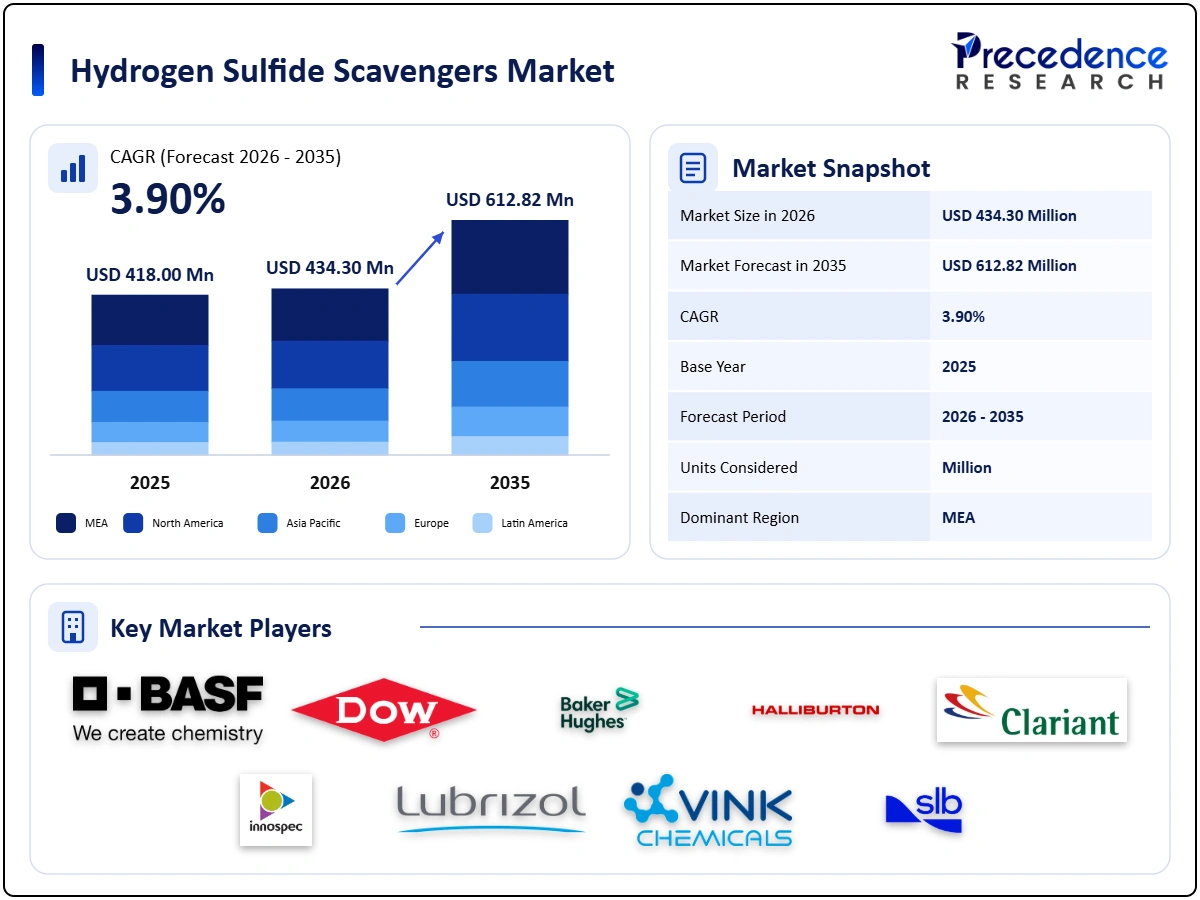
Vidyesh Swar, a Chemical and Materials Industry Expert, estimates the hydrogen sulfide scavengers market at USD 434.30 million in 2026 to USD 612.82 million by 2035, growing at a CAGR of 3.90%. Major hydrogen sulfide scavengers market companies such as Baker Hughes, Clariant, Halliburton are competing across key material and application segments, including type, chemistry, application and region.
Source: https://www.precedenceresearch.com/hydrogen-sulfide-scavengers-market
 Get a Sample
 Report Description


Hydrogen Sulfide Scavengers Market Size, Demand, and Trends Analysis 2035
The hydrogen sulfide scavengers market is forecasted to expand from USD 434.30 million in 2026 to USD 612.82 million by 2035, growing at a CAGR of 3.90% from 2026 to 2035.
Key Takeaways
Market Size & Growth Outlook
- Market size in 2025: USD 418.00 million
- Estimated market size in 2026: USD 434.30 million
- Projected market size by 2035: USD 612.82 million
- CAGR (2026-2035): 3.90%
Regional Market Spotlight
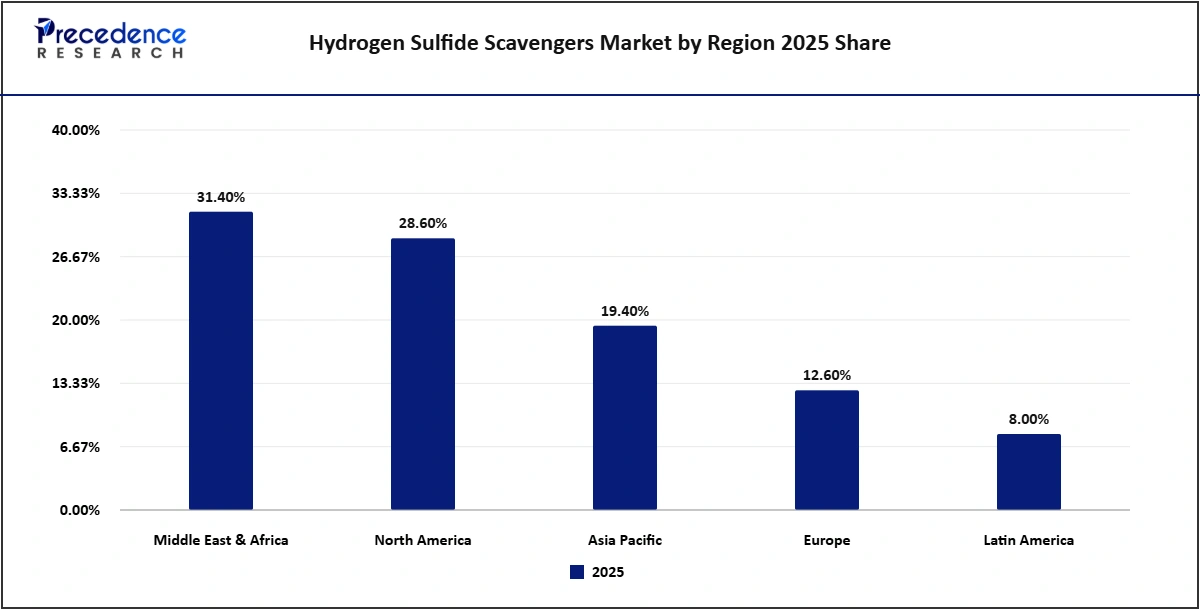
- Middle East & Africa led the market with a 31.40% (USD 131.25 million) share in 2025 and is projected to be the fastest-growing region, at a CAGR of 4.58% from 2025 to 2035.
- North America accounted for 28.60% (USD 119.55 million) of the market in 2025.
- Asia Pacific accounted for 19.40% (USD 81.09 million) of the market in 2025.
Segmental Spotlight
- By type, Water-Soluble accounted for 52.80% (USD 220.70 million) in 2025.
- By chemistry, Triazine accounted for 54.60% (USD 228.23 million) in 2025.
- By application, Crude Oil accounted for 44.20% (USD 184.76 million) in 2025.
Hydrogen Sulfide Scavengers Market Size and Forecast, 2025-2035 (USD Million)
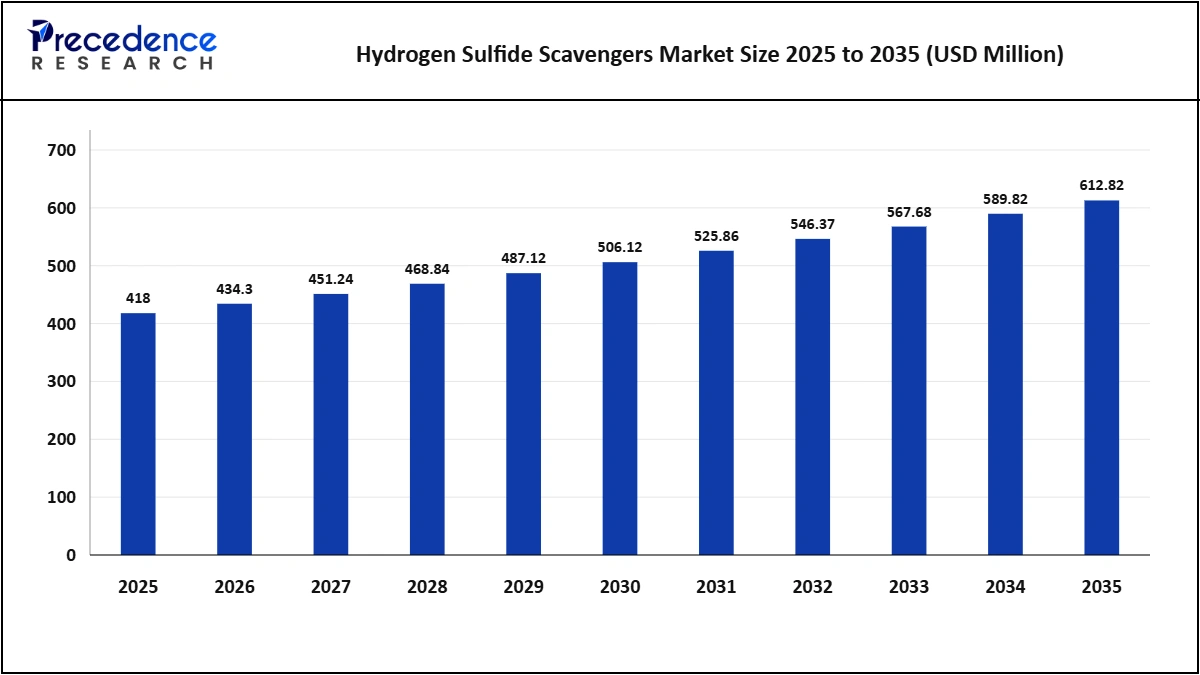
Note: 2025 is the base year; 2026–2035 values are forecasts.
Sources: Expert interviews, secondary sources, Precedence Research database and Precedence Research analysts.
The hydrogen sulfide scavengers market is projected to grow from USD 418.00 million in 2025 to USD 612.82 million by 2035 because H2S is toxic, corrosive, and limits the value of oil and gas, so producers, pipelines, and refiners must remove it to meet safety and quality specifications. Sour gas development and the usage of scale-free chemistry help drive value, driving the market towards USD 506.12 million by 2030 while maintaining a CAGR of 3.90% from 2026 to 2035.
- Analyst View: We built the estimate from H2S scavenger consumption volumes by chemistry, application and region, based on sour oil and gas production, H2S concentrations, treatment rates and gas processing volumes, multiplied by average product prices, plus solid scavenger media. Demand reflects upstream and midstream treatment, refinery and storage use, geothermal, biogas and wastewater applications. We cross-checked the total against the production chemicals revenue of leading oilfield chemical suppliers and published estimates, which places our base year slightly above comparable figures. Growth rate is influenced by growth in production of sour gas and non-triazine usage, taking into account the cycle of oil prices.
Market Trends
- Non-triazine scavengers reduce scale and solids.
- Oil-soluble products treat crude in storage and export.
- Oilfield chemicals consolidate.
- Digital surveillance fine-tunes scavenger dosage.
- Geothermal and biogas use grows.
- Sour gas projects expand in the Middle East.
Drivers, Restraints and Opportunities
Driver
Sour oil and gas production requires H2S removal for safety and quality. H2S is monitored by pipelines, terminals, and purchasers with tight H2S specifications for oil and gas. H2S concentration is increasing in some older and shale reservoirs. Poisonous gas control is required by safety laws. Wastewater, biogas, and geothermal uses create new demands.
Restraint
The cost of chemical treatments during production is impacted by fluctuations in oil prices. Triazines may create scale and solids formation. Large sour gas plants often use amine treating units instead of scavengers. There may be environmental constraints on the use of certain chemicals. Competition will affect pricing of commodity triazines.
Opportunity
Non-triazine and environmentally improved chemistries can command premiums. Oil-soluble scavengers for export of crude can be increased with stricter specifications. H2S analysis can optimize the addition process, generating revenue from services. Geothermal and renewable natural gas expansion offers new markets. Sour gas development in the Middle East and Central Asia increases demand.
Market Segmentation: 2025 Share and Value
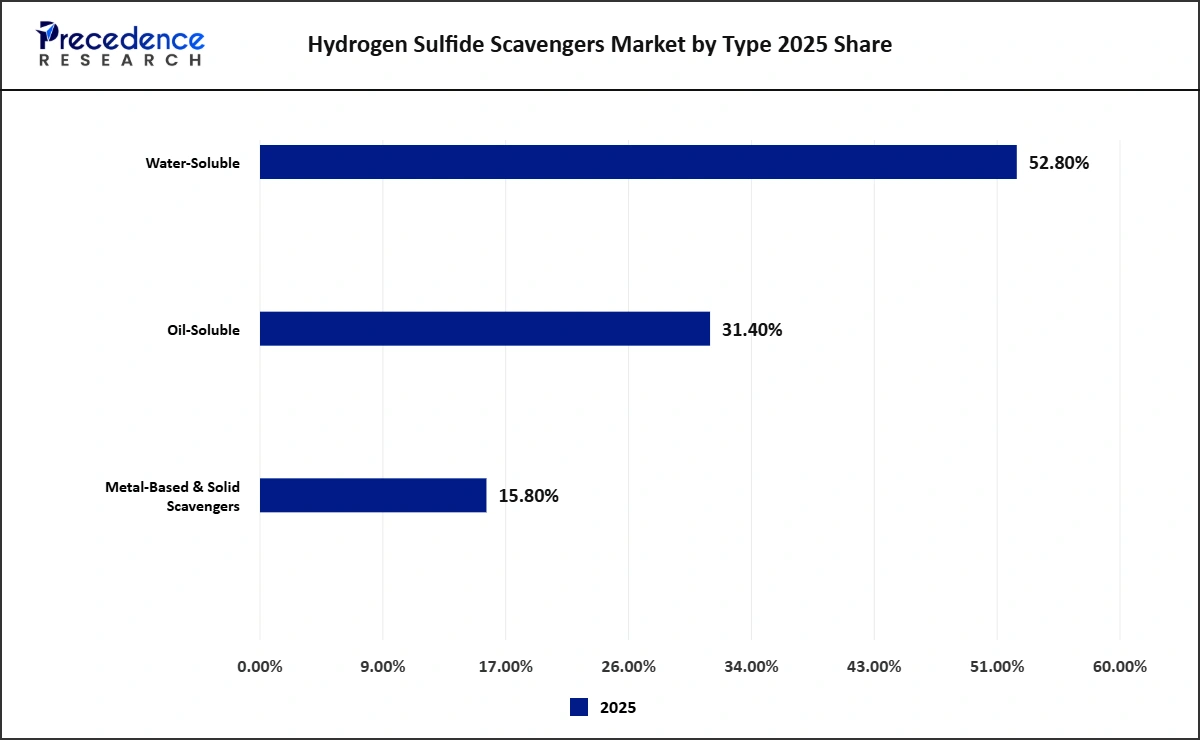
Hydrogen Sulfide Scavengers Market by Type 2025 Share
Note: 2025 is the base year.
Sources: Expert interviews, secondary sources, Precedence Research database and Precedence Research analysts.
Water-soluble scavengers accounted for 52.80% (USD 220.70 million) in 2025 because they are injected directly into gas streams, multiphase lines, and contact towers. They react quickly with H2S and are relatively inexpensive, making them the default choice for upstream and midstream treatment. Oil-soluble scavengers, at 31.40% (USD 131.25 million), are used to treat crude oil, fuel oil and asphalt in storage and transport, where they must disperse in hydrocarbons, and are the fastest-growing type as crude H2S specifications tighten. Metal-based and solid scavengers account for 15.80% (USD 66.04 million) and serve low-flow gas, vapor, and biogas applications.
Hydrogen Sulfide Scavengers Market By Chemistry 2025 Share & Size
| Segments | 2025 Share | 2025 Market Value |
| Triazine | 54.60% | USD 228.23 million |
| Non-Triazine Amine & Aldehyde | 22.40% | USD 93.63 million |
| Nitrite | 9.80% | USD 40.96 million |
| Iron Sponge & Others | 13.20% | USD 55.18 million |
Note: 2025 is the base year.
Sources: Expert interviews, secondary sources, Precedence Research database and Precedence Research analysts.
Triazine accounted for 54.60% (USD 228.23 million) in 2025 because MEA-triazine is the most widely used and cost-effective H2S scavenger. Non-triazine amine and aldehyde chemistries, at 22.40% (USD 93.63 million), are the fastest-growing chemistries because they reduce the scale and solids that triazine reaction products can cause and can lower the carbon footprint. Nitrite accounts for 9.80% (USD 40.96 million), and iron sponge and others for 13.20% (USD 55.18 million).
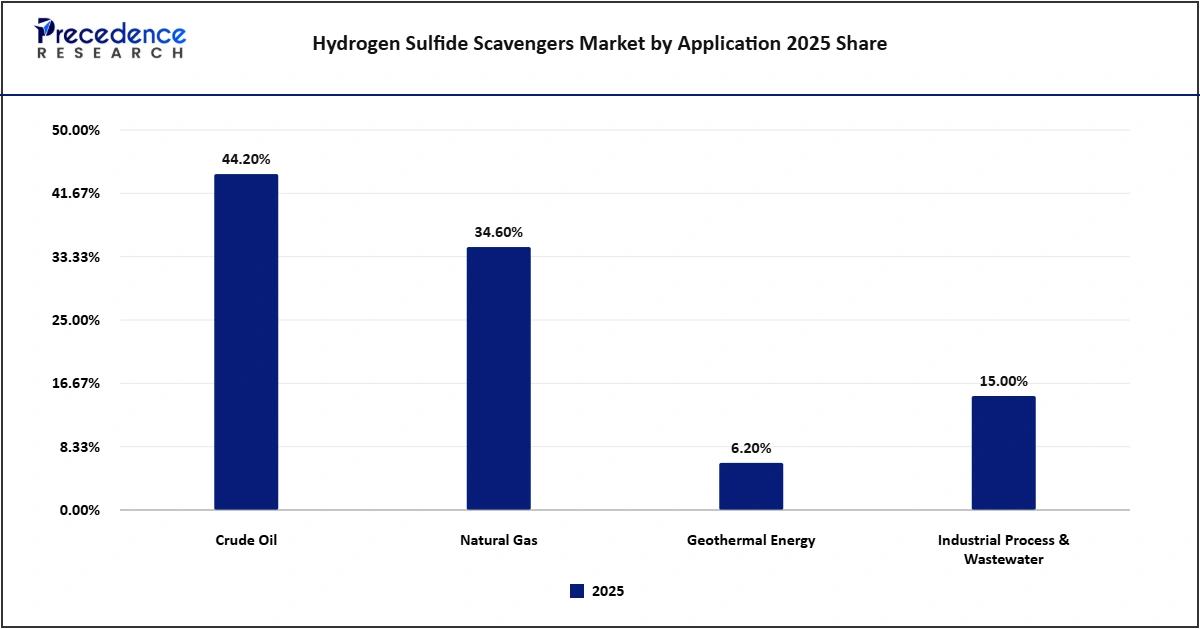
Hydrogen Sulfide Scavengers Market by Application 2025 Share
Note: 2025 is the base year.
Sources: Expert interviews, secondary sources, Precedence Research database and Precedence Research analysts.
Crude oil accounted for 44.20% (USD 184.76 million) in 2025 because sour crude must be treated to meet transport, storage, and export specifications. Natural gas accounts for 34.60% (USD 144.63 million), geothermal energy for 6.20% (USD 25.92 million) and industrial process and wastewater for 15.00% (USD 62.70 million). Geothermal and biogas applications are growing fastest from small bases.
- Analyst View: Values of the segments have been apportioned based on matching of treatment volume and cost to the respective type, chemistry, and application. Water-soluble triazine leads because of its cost and wide use. We expect oil-soluble and non-triazine products and geothermal and biogas uses to gain share.
Regional Analysis
Hydrogen Sulfide Scavengers Market by Region 2025 Share
Note: 2025 is the base year.
Sources: Expert interviews, secondary sources, Precedence Research database and Precedence Research analysts.
The Middle East and Africa accounted for 31.40% (USD 131.25 million) in 2025, the largest share and the fastest growth, because large sour oil and gas fields in Saudi Arabia, Kuwait, the UAE, Qatar, and Iraq require extensive H2S treatment, and new sour gas developments are underway. North America, at 28.60% (USD 119.55 million), is supported by sour production in the Permian Basin and other shale plays, crude H2S limits for pipelines and storage, and a large oilfield chemicals industry. Asia Pacific, at 19.40% (USD 81.09 million), is supported by gas production, refining and geothermal energy in Indonesia and the Philippines. Europe, at 12.60% (USD 52.67 million), is supported by North Sea production, refining and biogas, and Latin America, at 8.00% (USD 33.44 million), by oil production in Brazil, Mexico, and Venezuela.
The Middle East and Africa accounted for 31.40% (USD 131.25 million) in 2025 and is the largest and fastest-growing region. Many fields produce sour crude and gas with high H2S levels. Sour gas projects in Saudi Arabia, the UAE, and Qatar require extensive treatment. National oil companies use large volumes of scavengers.
North America accounted for 28.60% (USD 119.55 million) in 2025. H2S levels have increased in parts of the Permian Basin. H2S levels for crude are controlled by pipelines and terminals. Oilfield chemical suppliers, now including SLB with ChampionX, serve producers.
Asia Pacific accounted for 19.40% (USD 81.09 million) in 2025. Gas production in Southeast Asia and refining in China and India use scavengers. Geothermal plants in Indonesia and the Philippines treat H2S.
Europe accounted for 12.60% (USD 52.67 million) in 2025. North Sea operators use non-triazine scavengers to reduce scaling and environmental impact. Biogas producers remove H2S before gas upgrading.
Latin America accounted for 8.00% (USD 33.44 million) in 2025. Offshore production in Brazil and onshore fields in Mexico and Venezuela use scavengers. The evolving price cycles of oil affect demand.
Analyst View: Regional shares were built from sour oil and gas production, H2S levels, treatment rates and prices in each region. The Middle East and Africa lead because of sour field concentration. We assign the Middle East and Africa the highest growth premium because sour gas development is expanding fastest there.
Top 10 Companies in the Hydrogen Sulfide Scavengers Market
| Rank | Company Name | Market-Specific Revenue (USD Million) | 2025 Share | Key Products/Business | Headquarters |
| 1 | SLB (incl. ChampionX) | 92.00 | 22.01% | Production chemicals and H2S scavengers | United States |
| 2 | Baker Hughes | 62.00 | 14.83% | H2S scavengers and production chemicals | United States |
| 3 | Clariant | 34.00 | 8.13% | SCAVINATOR and oil services chemicals | Switzerland |
| 4 | Halliburton | 28.00 | 6.70% | Multi-Chem production chemicals | United States |
| 5 | Dow | 20.00 | 4.78% | Amine and specialty chemicals | United States |
| 6 | BASF | 16.00 | 3.83% | Oilfield and gas treating chemicals | Germany |
| 7 | Innospec | 14.00 | 3.35% | Oilfield chemicals | United States |
| 8 | Lubrizol | 10.00 | 2.39% | Oilfield performance chemicals | United States |
| 9 | Vink Chemicals | 6.00 | 1.44% | Triazine scavengers | Germany |
| 10 | Merichem Technologies | 6.00 | 1.44% | Gas treating solutions | United States |
Note: Company revenues and shares are 2025 estimates.
Sources: Company press releases, expert interviews, secondary sources, Precedence Research database and Precedence Research analysts.
SLB led the hydrogen sulfide scavengers market with an estimated 22.01% (USD 92.00 million) of 2025 revenue, followed by Baker Hughes at 14.83% (USD 62.00 million) and Clariant at 8.13% (USD 34.00 million). SLB leads after completing its USD 7.8 billion acquisition of ChampionX in July 2025, combining ChampionX's large production chemicals business, including H2S scavengers and treatment programs, with SLB's global oilfield reach and non-triazine scavenger technology. Baker Hughes supplies H2S scavengers and production chemical services, and Clariant offers non-triazine scavengers such as SCAVINATOR and broad oil services chemicals. Halliburton's Multi-Chem, Dow, BASF, Innospec, Lubrizol, Vink Chemicals and Merichem compete in scavenger chemistries, raw materials and gas treating solutions, alongside regional chemical companies.
The top 10 companies were responsible for approximately 68.90% (USD 288.00 million) of the 2025 sales, while the rest 31.10% (USD 130.00 million) came from regional oilfield chemical firms, triazine manufacturers, and gas treating service providers. The hydrogen sulfide scavengers market is moderately concentrated among oilfield chemical service companies, and competition centers on scavenging efficiency, reduced scaling and solids, safety, environmental profile, treatment cost, and field service. Non-triazine chemistry and digital chemical management are the distinguishing factors, and consolidation will raise the bar for top players.
Recent Developments
- May 2025: ICC, a subsidiary of SMC Global, launched AvanScav 1450, a triazine-free, amine-free and nitrogen-free H2S scavenger with neutral pH designed to reduce scaling in upstream and downstream applications.
- July 2025: SLB completed its USD 7.8 billion acquisition of ChampionX, adding ChampionX's production chemicals business, including H2S scavengers, to its portfolio.
Hydrogen Sulfide Scavengers Market Segments
By Type
- Water-Soluble
- Oil-Soluble
- Metal-Based & Solid Scavengers
By Chemistry
- Triazine
- Non-Triazine Amine & Aldehyde
- Nitrite
- Iron Sponge & Others
By Application
- Crude Oil
- Natural Gas
- Geothermal Energy
- Industrial Process & Wastewater
By Region
- North America (U.S., Canada, Mexico)
- Europe (Germany, U.K., France, Italy, Spain, Rest of Europe)
- Asia Pacific (China, Japan, India, South Korea, Taiwan, Rest of Asia Pacific)
- Latin America (Brazil, Argentina, Rest of Latin America)
- Middle East & Africa (GCC, South Africa, Rest of MEA)
Research Methodology
The hydrogen sulfide scavengers market was defined as water-soluble, oil-soluble, metal-based, and solid H2S scavengers for oil, gas, geothermal, and industrial applications, worldwide. The 2025 base year was built bottom-up from scavenger volumes by chemistry, application, and region based on sour production and treatment rates, and average prices, and checked top-down against the production chemicals revenue of leading oilfield chemical suppliers. Segment, regional, and company values were allocated from types, chemistries, applications, and regional demand. Key figures were validated through cross-referencing of disclosures from the firm, regulatory data, industry data, and published third-party estimates; figures that could not be reconciled were excluded. All segment, regional, and company figures were reconciled to the same 2025 base year, and the 2026-2035 forecast, which applies a constant CAGR from the 2025 base, was recalculated and validated.
Analyst View: Overall Market
The hydrogen sulfide scavengers market is a steady, production-linked market supported by sour oil and gas development and safety requirements. Our estimate relates to the connection between demand and sour production, treatment volumes, and prices. Thus, the forecast is affected by oil and gas operations, H2S content, and changes in chemical formulas. Key positive factors include non-triazine solutions and Middle Eastern sour gas. The major threat is the cycle of oil prices.
Sources and References
- Mining Stock Education. "ICC, a subsidiary of SMC Global, launches AvanScav 1450". 2025-05-07. AvanScav 1450 launch. https://www.miningstockeducation.com/2025/05/icc-a-subsidiary-of-smc-global-launches-avanscav-1450-a-safer-smarter-solution-for-h%e2%82%82s-removal/
- World Oil. "SLB completes $7.8 billion ChampionX acquisition". 2025-07-16. ChampionX acquisition. https://worldoil.com/news/2025/7/16/slb-completes-7-8-billion-championx-acquisition/
- SLB. "Non-triazine H2S scavenger case study". Undated. Non-triazine scavenger performance. https://www.slb.com/resource-library/case-study-with-navigation/production-chemicals/h2s-scavenger-north-sea-cs
For inquiries regarding discounts, bulk purchases, or customization requests, please contact us at sales@precedenceresearch.com
Frequently Asked Questions





Ask For Sample
No cookie-cutter, only authentic analysis – take the 1st step to become a Precedence Research client
 Get a Sample




 sales@precedenceresearch.com
 Schedule a Meeting
