



Immersion Cooling Fluids Market Trends, Leading Companies, Company Revenue / Sales Performance, Plant Utilization, Production Volume, Pricing Dynamics, Supply Chain Performance, Competitive Landscape, and Industry Growth
Vidyesh Swar a Chemical and Materials Industry Expert, estimates the Immersion Cooling Fluids market at USD 2.74 billion in 2026, with the market projected to reach USD 5.75 billion by 2035 at a CAGR of 8.60%. Major Immersion Cooling Fluids market companies such as ExxonMobil, Shell, Cargill are competing across key material and application segments, including fluid type, application, technology, and region,.
Source: https://www.precedenceresearch.com/immersion-cooling-fluids-market
 Get a Sample
 Report Description


Immersion Cooling Fluids Market Size, Share and Forecast 2026-2035
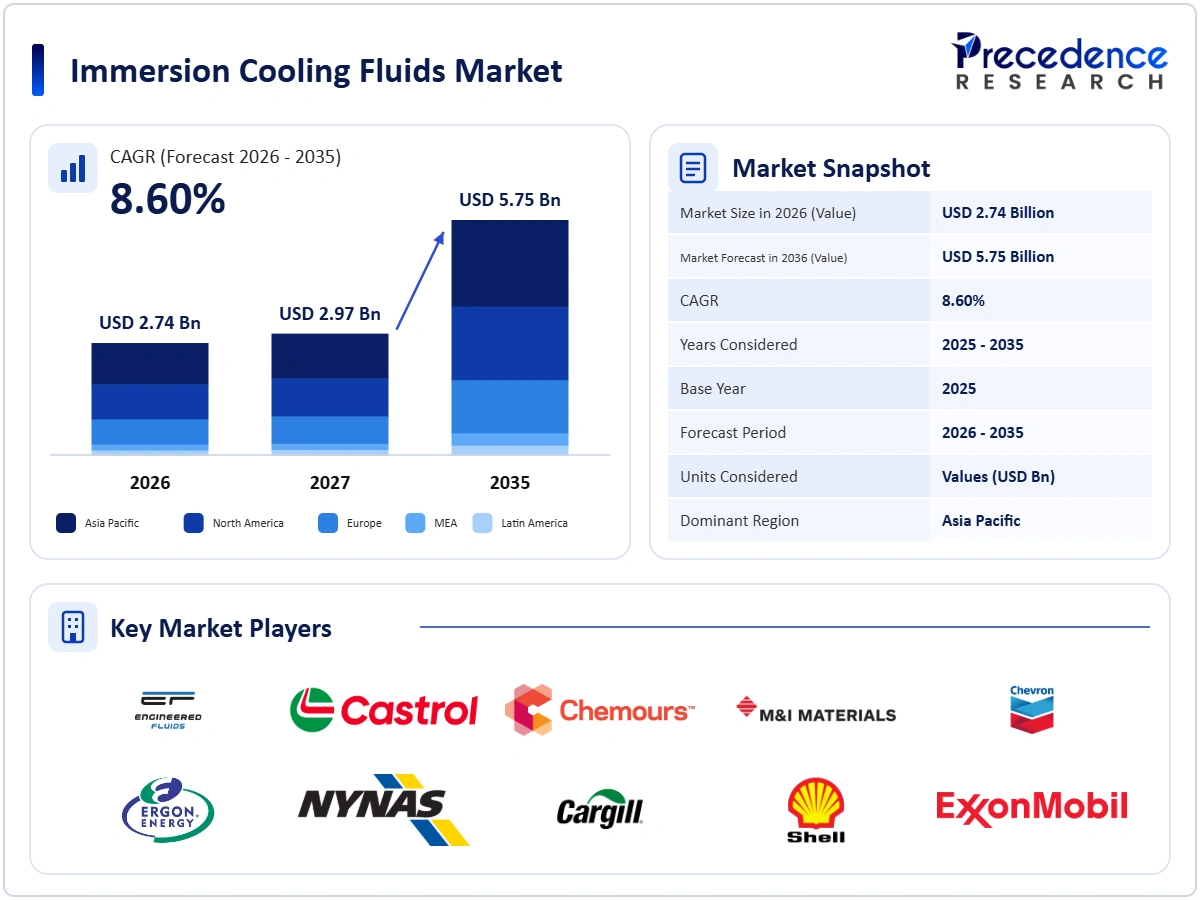
The immersion cooling fluids market is estimated at USD 2.74 billion in 2026 and is projected to reach USD 5.75 billion by 2035, expanding at a CAGR of 8.60% from 2026 to 2035.
Key Takeaways
Market Size & Growth Outlook
- Market size in 2025: USD 2.52 billion
- Estimated market size in 2026: USD 2.74 billion
- Projected market size by 2035: USD 5.75 billion
- CAGR (2026-2035): 8.60%
Regional Market Spotlight
- Asia Pacific led the market with a 36.80% (USD 0.93 billion) share in 2025 and is projected to be the fastest-growing region, at a CAGR of 9.22% from 2025 to 2035.
- North America accounted for 31.40% (USD 0.79 billion) of the market in 2025.
- Europe accounted for 22.60% (USD 0.57 billion) of the market in 2025.
Segmental Spotlight
- By application, Transformers & Power Equipment accounted for 56.00% (USD 1.41 billion) in 2025.
- By fluid type, Mineral & Hydrocarbon Oils accounted for 44.60% (USD 1.12 billion) in 2025.
- By technology, Single-phase accounted for 84.20% (USD 2.12 billion) in 2025.
Immersion Cooling Fluids Market Size and Forecast, 2025-2035 (USD Billion)
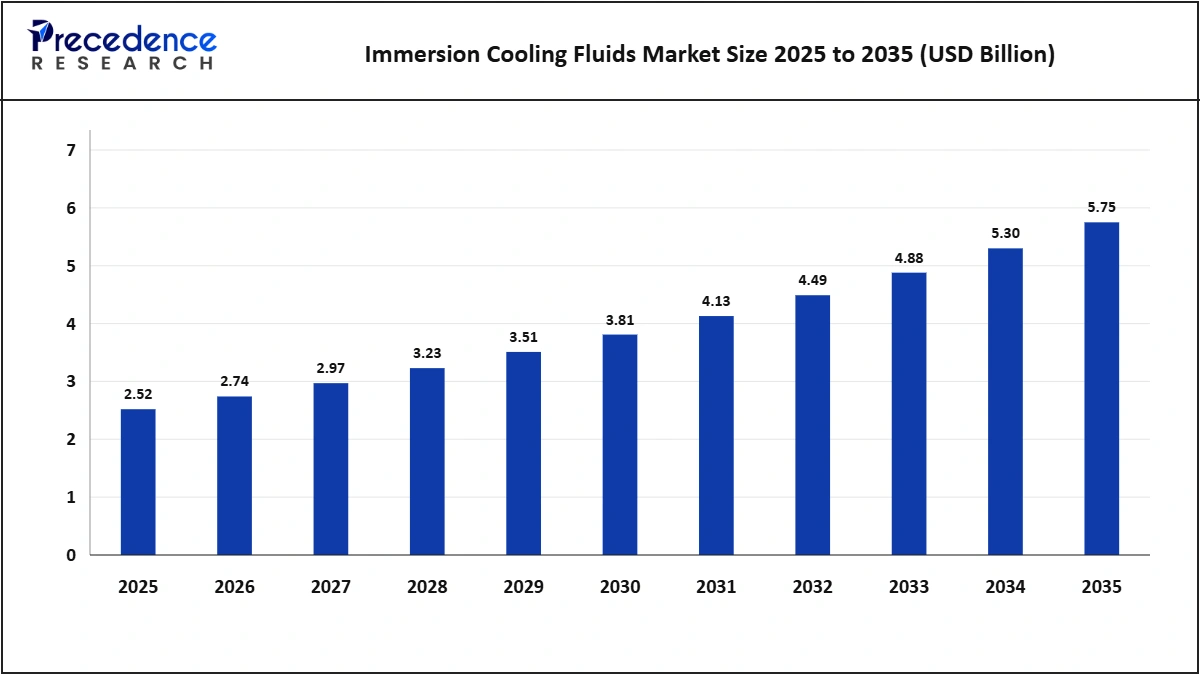
The immersion cooling fluids market was valued at USD 2.52 billion in 2025, the base year. The immersion cooling fluids market includes dielectric fluids, including mineral and hydrocarbon oils, synthetic hydrocarbons and esters, natural esters, and fluorinated fluids, used to cool equipment through direct immersion in transformers and power equipment, data centres, cryptocurrency mining, electric vehicle batteries, power electronics, and other industrial applications.
Transformers and power equipment accounted for the largest application share in 2025, at 56.00%, because oil-immersed transformers need large fluid volumes for cooling and insulation. Asia Pacific accounted for 36.80% of revenue in 2025, supported by grid expansion i
China and India and fast-growing data centre capacity. Grid investment and renewable energy connections, AI data centres moving to immersion cooling, research on immersion-cooled battery packs, and the shift away from PFAS-based fluids are driving demand. Fluid suppliers are launching new synthetic, bio-based and low-global-warming-potential fluids and partnering with equipment makers.
Sources: Expert interviews, secondary sources, Precedence Research database and Precedence Research analysts.
The immersion cooling fluids market is projected to grow from USD 2.52 billion in 2025 to USD 5.75 billion by 2035 because utilities add and replace transformers to connect renewable power and new load, while data centres and miners adopt immersion cooling for high-density hardware. Ester and synthetic fluids gain share because of their fire safety, biodegradability and long life, lifting the market to USD 3.81 billion by 2030 and sustaining a CAGR of 8.60% from 2026 to 2035.
- Analyst View: We built the estimate from the volume of dielectric fluid needed in each application: new and replacement transformer installations, immersion-cooled data centre and mining capacity, battery and power electronics applications and industrial equipment, multiplied by average fluid prices for each chemistry. Transformer demand was linked to grid investment and the installed base requiring refills, and data centre and mining demand to immersion-cooled capacity and fluid volume per megawatt. The total was cross-checked against the fluid sales of leading oil, chemical and ester producers and against published estimates, which places our base year slightly above the comparable figures. The growth rate combines steady transformer demand with much faster growth in data centre and battery uses, so the overall rate rises as these newer applications gain share.
Market Trends
- Natural and synthetic esters are replacing mineral oil in fire-sensitive transformers.
- AI data centres are adopting immersion cooling for high-density racks.
- PFAS-free fluids are replacing older fluorinated two-phase fluids.
- Immersion-cooled battery packs are being tested for fast-charging EVs.
- Gas-to-liquids fluids are gaining approvals in transformers and data centres.
- Fluid suppliers are partnering with tank, server and transformer makers.
Drivers, Restraints and Opportunities
Driver
Utilities are expanding and upgrading grids to connect renewable power and serve new data centre and electrification load, which increases transformer fluid demand. AI and high-performance computing are pushing data centres toward immersion cooling. Electric vehicles and fast chargers create new uses for dielectric fluids in battery and power electronics cooling.
Restraint
Mineral oil prices follow crude oil and can be volatile. Ester and synthetic fluids cost more than mineral oil, which slows switching in price-sensitive markets. Restrictions on PFAS chemicals limit the use of some fluorinated fluids, and immersion cooling in data centres competes with direct-to-chip cooling.
Opportunity
Natural ester fluids can win share in urban and offshore transformers where fire safety matters. New low-global-warming-potential two-phase fluids can serve the densest AI clusters. Immersion cooling for EV batteries, chargers and energy storage offers a large new market as fast charging spreads.
Market Segmentation: 2025 Share and Value
Immersion Cooling Fluids Market by Application 2025 Share & Size
Sources: Expert interviews, secondary sources, Precedence Research database and Precedence Research analysts.
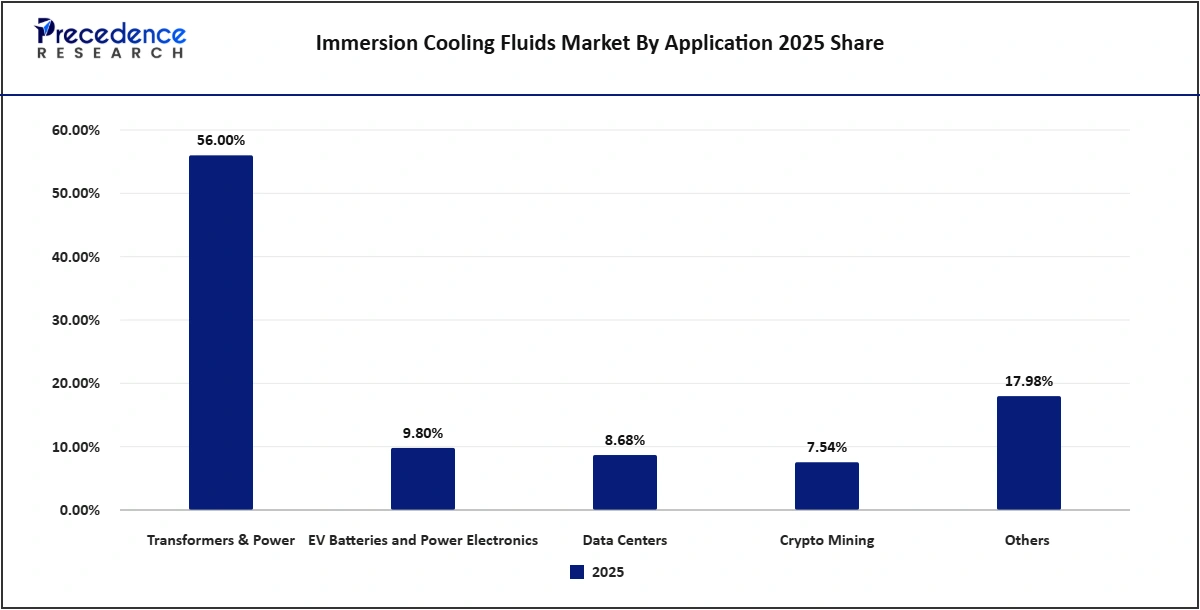
Transformers and power equipment accounted for 56.00% (USD 1.41 billion) in 2025 because utilities and industrial users fill large transformers with dielectric fluid for both cooling and insulation, and grid expansion and replacement keep demand steady. EV batteries and power electronics, at 9.80% (USD 0.25 billion), include immersion-cooled battery packs, chargers and drives under development and in early use. Data centres, at 8.68% (USD 0.22 billion), are the fastest-growing application as AI racks move to immersion, crypto mining accounts for 7.54% (USD 0.19 billion) and other uses such as industrial motors and electronics testing account for 17.98% (USD 0.45 billion).
Immersion Cooling Fluids Market by Fluid Type 2025 Share & Size
| Segments | 2025 Share | 2025 Market Value |
| Mineral & Hydrocarbon Oils | 44.60% | USD 1.12 billion |
| Synthetic Fluids (PAO, GTL, Synthetic Esters) | 30.80% | USD 0.78 billion |
| Natural Esters | 15.20% | USD 0.38 billion |
| Fluorinated Fluids | 9.40% | USD 0.24 billion |
Note: 2025 is the base year.
Sources: Expert interviews, secondary sources, Precedence Research database and Precedence Research analysts.
Mineral and hydrocarbon oils accounted for 44.60% (USD 1.12 billion) in 2025 because they remain the standard low-cost fluid for transformers. Synthetic fluids, at 30.80% (USD 0.78 billion), are used in data centres, mining and specialised equipment for their thermal performance and long life, while natural esters, at 15.20% (USD 0.38 billion), grow fastest in transformers because of their fire safety and biodegradability. Fluorinated fluids account for 9.40% (USD 0.24 billion), mainly in two-phase cooling.
Immersion Cooling Fluids Market by Technology 2025 Share & Size
| Segments | 2025 Share | 2025 Market Value |
| Single-phase | 84.20% | USD 2.12 billion |
| Two-phase | 15.80% | USD 0.40 billion |
Note: 2025 is the base year.
Sources: Expert interviews, secondary sources, Precedence Research database and Precedence Research analysts.
Single-phase immersion accounted for 84.20% (USD 2.12 billion) in 2025 because transformers, most data centre tanks and mining systems use fluids that stay liquid. Two-phase immersion accounts for 15.80% (USD 0.40 billion) and serves the densest computing applications, where boiling fluids offer very high heat removal.
- Analyst View: Segment values were allocated by matching each application's fluid volume to chemistry and technology, using price per litre for each fluid type. Transformers lead because of their very large fluid volumes, while data centre and two-phase fluids carry higher prices. We expect data centres, EV uses and natural and synthetic esters to gain share, while mineral oils lose share gradually.
Regional Analysis
Immersion Cooling Fluids Market by Region 2025 Share & Size
Sources: Expert interviews, secondary sources, Precedence Research database and Precedence Research analysts.
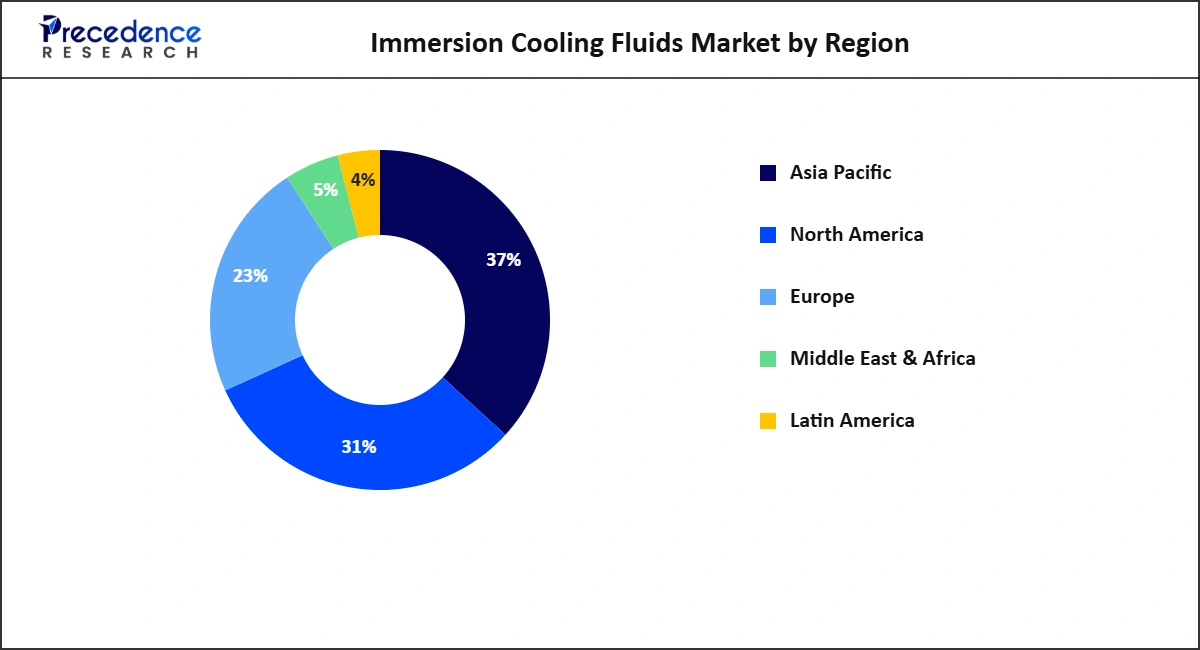
Asia Pacific accounted for 36.80% (USD 0.93 billion) in 2025 and is the fastest-growing region, supported by grid expansion in China and India, transformer manufacturing and rising data centre capacity. North America, at 31.40% (USD 0.79 billion), grows on grid upgrades, AI data centre construction and early immersion adoption, while Europe, at 22.60% (USD 0.57 billion), is supported by renewable connections, ester fluid adoption and energy-efficiency rules for data centres. The Middle East and Africa, at 5.20% (USD 0.13 billion), grows with power and data centre projects in hot climates, and Latin America, at 4.00% (USD 0.10 billion), with grid investment in Brazil and Mexico.
Asia Pacific accounted for 36.80% (USD 0.93 billion) in 2025 and is the fastest-growing region. Grid expansion in China and India and new data centres drive demand.
North America accounted for 31.40% (USD 0.79 billion) in 2025. Grid upgrades and AI data centre growth support demand.
Europe accounted for 22.60% (USD 0.57 billion) in 2025. Renewable grid connections and ester fluid adoption support growth.
The Middle East and Africa accounted for 5.20% (USD 0.13 billion) in 2025. Power and data centre projects in the Gulf support demand.
Latin America accounted for 4.00% (USD 0.10 billion) in 2025. Grid investment in Brazil and Mexico supports demand.
- Analyst View: Regional shares were built from transformer installations, immersion-cooled computing capacity and industrial demand in each region, weighted by fluid prices. Asia Pacific leads because it has the largest grid build-out and transformer production. We assig
Asia Pacific the highest growth premium because grid and data centre investment there continue to grow fastest.
Top 10 Companies in the Immersion Cooling Fluids Market
| Rank | Company Name | Market-Specific Revenue (USD Billion) | 2025 Share | Key Products / Business | Headquarters |
| 1 | ExxonMobil | 0.20 | 7.94% | Transformer oils and data centre immersion fluids | United States |
| 2 | Shell | 0.18 | 7.14% | GTL-based transformer oils and immersion cooling fluids | United Kingdom |
| 3 | Cargill | 0.16 | 6.35% | FR3 natural ester and plant-based immersion fluids | United States |
| 4 | Nynas | 0.14 | 5.56% | Naphthenic transformer oils | Sweden |
| 5 | Ergon | 0.11 | 4.37% | Naphthenic base oils and transformer fluids | United States |
| 6 | Chevron | 0.08 | 3.17% | Transformer oils and dielectric fluids | United States |
| 7 | M&I Materials | 0.07 | 2.78% | MIDEL synthetic and natural ester fluids | United Kingdom |
| 8 | Chemours | 0.06 | 2.38% | Opteon two-phase immersion cooling fluid | United States |
| 9 | Castrol | 0.05 | 1.98% | Castrol ON immersion cooling and EV fluids | United Kingdom |
| 10 | Engineered Fluids | 0.03 | 1.19% | ElectroCool dielectric coolants | United States |
Note: Company revenues and shares are 2025 estimates.
Sources: Company press releases, expert interviews, secondary sources, Precedence Research database and Precedence Research analysts.
ExxonMobil led the immersion cooling fluids market with an estimated 7.94% (USD 0.20 billion) of 2025 revenue, followed by Shell at 7.14% (USD 0.18 billion) and Cargill at 6.35% (USD 0.16 billion). ExxonMobil and Shell lead through broad transformer oil and immersion fluid portfolios, while Cargill leads in natural ester fluids used in fire-safe transformers and plant-based immersion cooling. The top 10 companies accounted for an estimated 42.86% (USD 1.08 billion) of 2025 revenue, while the remaining 57.14% (USD 1.44 billion) was shared among regional transformer oil refiners, specialty ester producers and smaller immersion fluid suppliers. The immersion cooling fluids market is moderately fragmented, and competition centres on dielectric strength, thermal performance, fire safety, biodegradability and equipment approvals, as oil majors, ester specialists and chemical companies compete across applications.
Recent Developments
- December 2022: 3M announced it would exit PFAS manufacturing by the end of 2025, including its Novec fluids used in two-phase immersion cooling, opening space for alternative fluids.
- May 2025: Chemours and Navin Fluorine agreed to manufacture Chemours' Opteon two-phase immersion cooling fluid, with Navin providing capacity from 2026.
- October 2025: LG Electronics, SK Enmove and Green Revolution Cooling signed an agreement to develop immersion cooling for AI data centres, with SK Enmove supplying immersion fluids.
- April 2026: Keppel and Shell announced a six-month pilot of immersion cooling using Shell's gas-to-liquids fluid at one of Keppel's operating data centres.
Market Segments
By Application
- Transformers & Power Equipment
- EV Batteries & Power Electronics
- Data Centers
- Crypto Mining
- Others
By Fluid Type
- Mineral & Hydrocarbon Oils
- Synthetic Fluids (PAO, GTL, Synthetic Esters)
- Natural Esters
- Fluorinated Fluids
By Technology
- Single-phase
- Two-phase
By Region
- North America (U.S., Canada, Mexico)
- Europe (Germany, U.K., France, Italy, Spain, Rest of Europe)
- Asia Pacific (China, Japan, India, South Korea, Taiwan, Rest of Asia Pacific)
- Latin America (Brazil, Argentina, Rest of Latin America)
- Middle East & Africa (GCC, South Africa, Rest of MEA)
Research Methodology
The immersion cooling fluids market was defined as dielectric fluids used for immersion cooling and insulation in transformers, power equipment, data centres, cryptocurrency mining, EV batteries, power electronics and other equipment worldwide, counted at fluid-supplier level. The 2025 base year was built bottom-up from fluid volumes for transformer installations and refills, immersion-cooled computing capacity, battery and power electronics uses and industrial equipment, multiplied by fluid prices, and checked top-down against the fluid sales of leading oil, chemical and ester producers. Segment, regional and company values were allocated from applications, fluid chemistries, technologies and regional grid and computing capacity. Key estimates were verified by cross-checking company disclosures, regulatory and industry data and published third-party estimates, and inputs that could not be reconciled were excluded. All segment, regional and company figures were reconciled to the same 2025 base year, and the 2026–2035 forecast, which applies a constant CAGR from the 2025 base, was recalculated and validated.
Analyst View: Overall Market
The immersion cooling fluids market rests on a large transformer base, with faster growth coming from data centres, mining and electric vehicles. Our estimate links demand to fluid volumes in each application and to chemistry-specific prices, so the forecast follows grid investment and the spread of immersion cooling in computing and mobility. The main upside comes from AI data centres and ester fluids, while the main risks are oil price volatility, chemical regulation and competing cooling technologies.
Sources and References
- Journal of Petroleum Technology. "Keppel and Shell turn to immersion cooling to tackle data center heat". 2026-04-24. Immersion cooling pilot with Shell GTL fluid. https://jpt.spe.org/keppel-and-shell-turn-to-immersion-cooling-to-tackle-data-center-heat
- LG Electronics. "LG, SK Enmove and GRC sign MOU to advance liquid immersion cooling solutions for AI data centers". 2025-10-28. Immersion cooling partnership including fluids. https://www.lg.com/global/newsroom/news/eco-solution/lg-sk-enmove-and-grc-sign-mou-to-advance-liquid-immersion-cooling-solutions-for-ai-data-centers/
- Chemours (via TipRanks). "Chemours, Navin Fluorine agree to manufacture new liquid cooling product". 2025-05. Opteon two-phase immersion fluid manufacturing. https://www.tipranks.com/news/the-fly/chemours-navin-fluorine-agree-to-manufacture-new-liquid-cooling-product
- DatacenterDynamics. "ExxonMobil launches data center immersion cooling fluids". Undated. ExxonMobil immersion fluid portfolio. https://datacenterdynamics.com/en/news/exxonmobil-launches-data-center-immersion-cooling-fluids
For inquiries regarding discounts, bulk purchases, or customization requests, please contact us at sales@precedenceresearch.com
Frequently Asked Questions





Ask For Sample
No cookie-cutter, only authentic analysis – take the 1st step to become a Precedence Research client
 Get a Sample




 sales@precedenceresearch.com
 Schedule a Meeting
