



Latex Agglutination Test Kits Market Size, Key Companies, Company Market Share, Patient Volume, Treatment Adoption Rates, Pricing Analysis, Regulatory Landscape, Competitive Positioning, and Demand Forecast
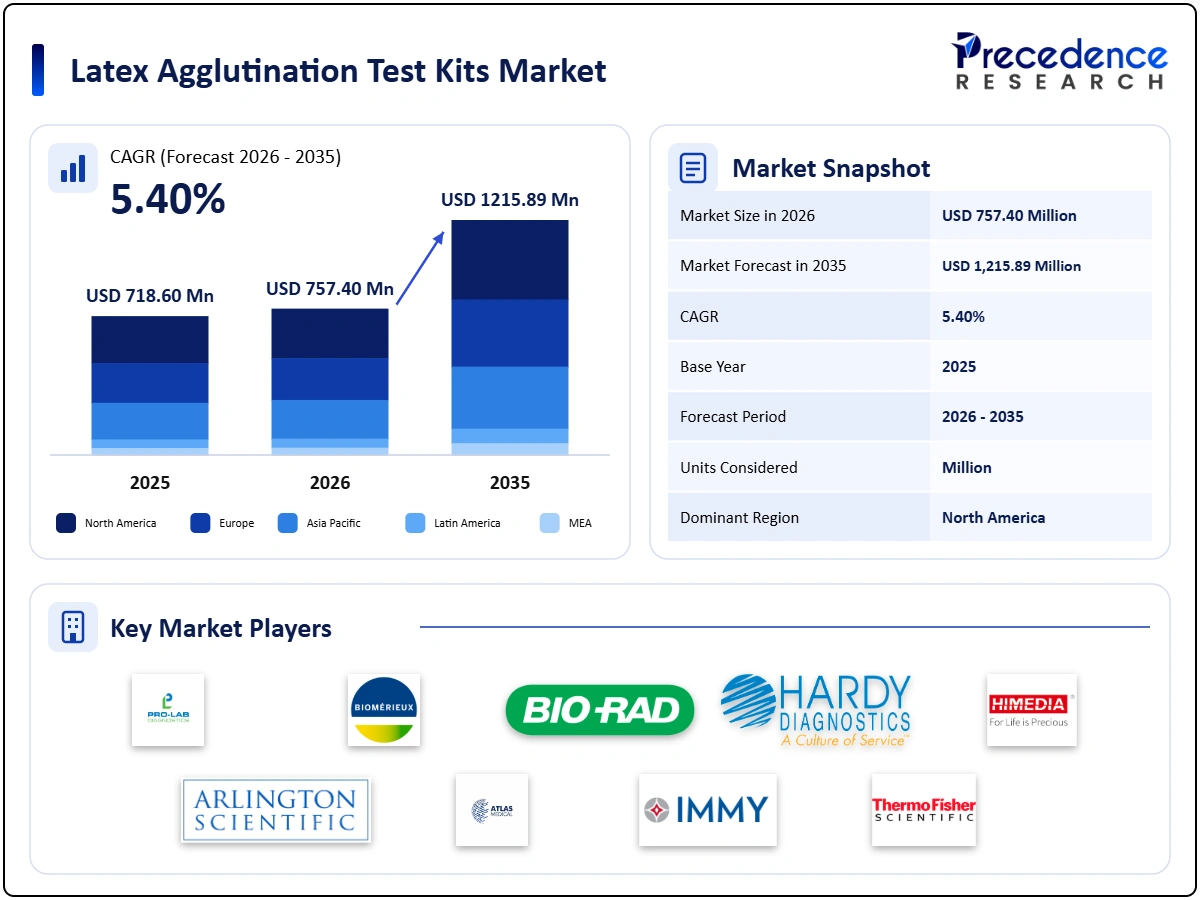
Payal Rabde, a Healthcare Industry Expert, highlights that the latex agglutination test kits market has reached USD 757.40 million in 2026 to USD 1,215.89 million by 2035, growing at a CAGR of 5.40%. Key latex agglutination test kits market companies shaping the market include Thermo Fisher Scientific, bioMérieux, Bio-Rad Laboratories, Pro-Lab Diagnostics, while major growth segments span test type, application, sample type, end user and region.
Source: https://www.precedenceresearch.com/latex-agglutination-test-kits-market
 Get a Sample
 Report Description


Latex Agglutination Test Kits Market Growth, Innovations, and Market Size Forecast 2035
The latex agglutination test kits market is forecasted to expand from USD 757.40 million in 2026 to USD 1,215.89 million by 2035, growing at a CAGR of 5.40% from 2026 to 2035.
Key Takeaways
Market Size & Growth Outlook
- Market size in 2025: USD 718.60 million
- Estimated market size in 2026: USD 757.40 million
- Projected market size by 2035: USD 1,215.89 million
- CAGR (2026-2035): 5.40%
Regional Market Spotlight
- North America led the market with a 33.80% (USD 242.89 million) share in 2025.
- Europe accounted for 28.60% (USD 205.52 million) of the market in 2025.
- Asia Pacific accounted for 26.40% (USD 189.71 million) of the market in 2025 and is projected to be the fastest-growing region, at a CAGR of 6.61% from 2025 to 2035.
Segmental Spotlight
- By test type, Antigen Testing accounted for 74.60% (USD 536.08 million) in 2025.
- By application, Streptococcal Infections accounted for 32.40% (USD 232.83 million) in 2025.
- By sample type, Blood & Serum accounted for 54.20% (USD 389.48 million) in 2025.
- By end user, Hospital Laboratories accounted for 46.20% (USD 331.99 million) in 2025.
Latex Agglutination Test Kits Market Size and Forecast, 2025-2035 (USD Million)
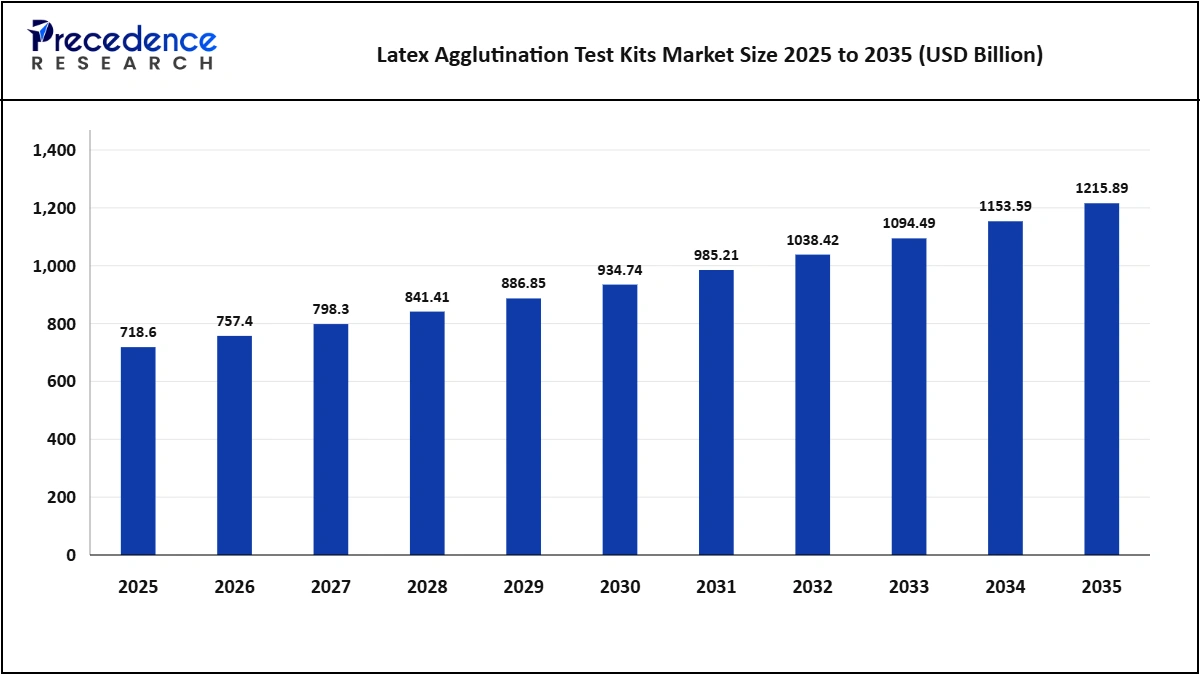
Note: 2025 is the base year; 2026-2035 values are forecasts.
Sources: Expert interviews, secondary sources, Precedence Research database and Precedence Research analysts.
The latex agglutination test kits market is projected to grow from USD 718.60 million in 2025 to USD 1,215.89 million by 2035 because microbiology laboratories continue to use latex tests to group streptococci, confirm staphylococci, and detect meningitis and fungal antigens quickly and cheaply. The demand from Asia, Africa, and Latin America, where cost-effective rapid tests are favored, would help in the rise in the market to USD 934.74 million in 2030 at a CAGR of 5.40% between 2026 and 2035.
- Analyst View: We built the estimate from latex agglutination test volumes by application and region, based on microbiology culture volumes, meningitis and cryptococcal testing, and rheumatoid factor and CRP screening, multiplied by average kit prices per test. Volumes reflect laboratory workflows that use latex tests for identification and confirmation and the share of testing that has shifted to molecular and automated immunoassays. The total was cross-checked against the microbiology reagent revenue of leading suppliers and against published estimates, which places our base year slightly above the comparable figures. The growth rate shows steady demand from developing markets, which is moderated by the adoption of new techniques in established laboratories.
Market Trends
- Latex tests remain standard for streptococcal grouping.
- Cryptococcal antigen screening supports HIV care in Africa.
- Molecular and immunoassay methods replace some latex uses.
- Better microparticles produce sharper reactions.
- Emerging markets prefer low-cost rapid tests.
- Latex serology moves to automated turbidimetry in large laboratories.
Drivers, Restraints and Opportunities
Driver
Latex tests are inexpensive, fast, and need little equipment, which makes them practical for routine identification and screening. Microbiology laboratories still use them to group streptococci and confirm staphylococci from cultures. Cryptococcal and meningitis antigen tests allow for quick diagnosis in severe infections. Laboratories in developing countries use low-cost rapid tests. Such factors ensure consistent demand despite advancements in technology.
Restraint
Molecular tests and automated immunoassays offer higher sensitivity and are replacing latex tests in many developed market laboratories. Visual reading can be subjective at times. When compared to contemporary testing methods, several latex-based procedures are less sensitive, especially when it comes to direct antigen detection. Storage issues are sometimes difficult to solve in some geographical areas. Price competition is strong in a mature market.
Opportunity
Expanding laboratory networks in Asia, Africa, and Latin America offer volume growth. Cryptococcal antigen screening programs can expand with HIV care. Improved particle technologies can increase sensitivity and readability. Supplier relationships can be strengthened with latex kits that come with identifying systems and culture media. Veterinary and food microbiology offer additional uses.
Market Segmentation: 2025 Share and Value
Latex Agglutination Test Kits Market By Test Type 2025 Share
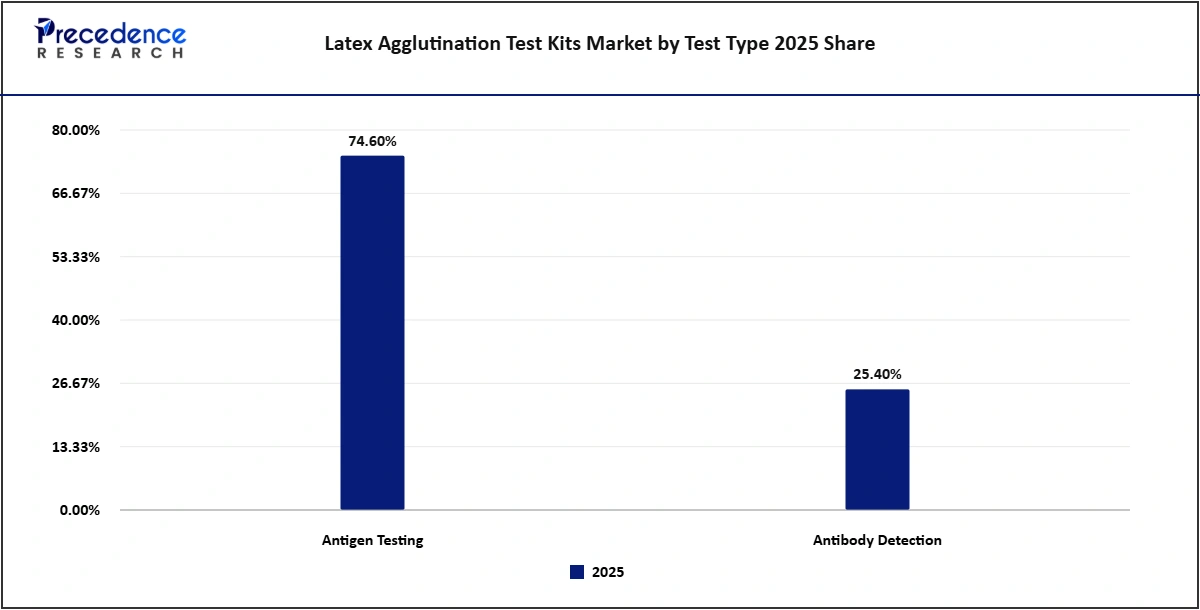
Note: 2025 is the base year.
Sources: Expert interviews, secondary sources, Precedence Research database and Precedence Research analysts.
Antigen testing accounted for 74.60% (USD 536.08 million) in 2025 because latex reagents coated with antibodies are used to detect and identify bacterial and fungal antigens in cultures and samples, including streptococcal grouping, Staphylococcus aureus confirmation, and meningitis and cryptococcal antigen tests. These tests give results in minutes with little equipment. Antibody detection, at 25.40% (USD 182.52 million), uses antigen-coated latex to detect antibodies or markers such as rheumatoid factor, anti-streptolysin O, and C-reactive protein in serum, and remains common in smaller laboratories.
Latex Agglutination Test Kits Market By Application 2025 Share & Size
| Segments | 2025 Share | 2025 Market Value |
| Streptococcal Infections | 32.40% | USD 232.83 million |
| Inflammation & Autoimmune Markers | 21.60% | USD 155.22 million |
| Meningitis & Bacterial Antigens | 14.80% | USD 106.35 million |
| Staphylococcal Infections | 12.20% | USD 87.67 million |
| Others | 10.60% | USD 76.17 million |
| Fungal Infections | 8.40% | USD 60.36 million |
Note: 2025 is the base year.
Sources: Expert interviews, secondary sources, Precedence Research database and Precedence Research analysts.
Streptococcal infections accounted for 32.40% (USD 232.83 million) in 2025 because latex grouping kits are a standard method for identifying beta-hemolytic streptococci from cultures. Inflammation and autoimmune markers such as rheumatoid factor, CRP, and ASO account for 21.60% (USD 155.22 million); meningitis and other bacterial antigen tests for 14.80% (USD 106.35 million); staphylococcal identification for 12.20% (USD 87.67 million); and other applications for 10.60% (USD 76.17 million). Fungal infections, at 8.40% (USD 60.36 million), are led by cryptococcal antigen tests used in HIV care, and are the fastest-growing application in low- and middle-income countries.
Latex Agglutination Test Kits Market by Sample Type 2025 Share
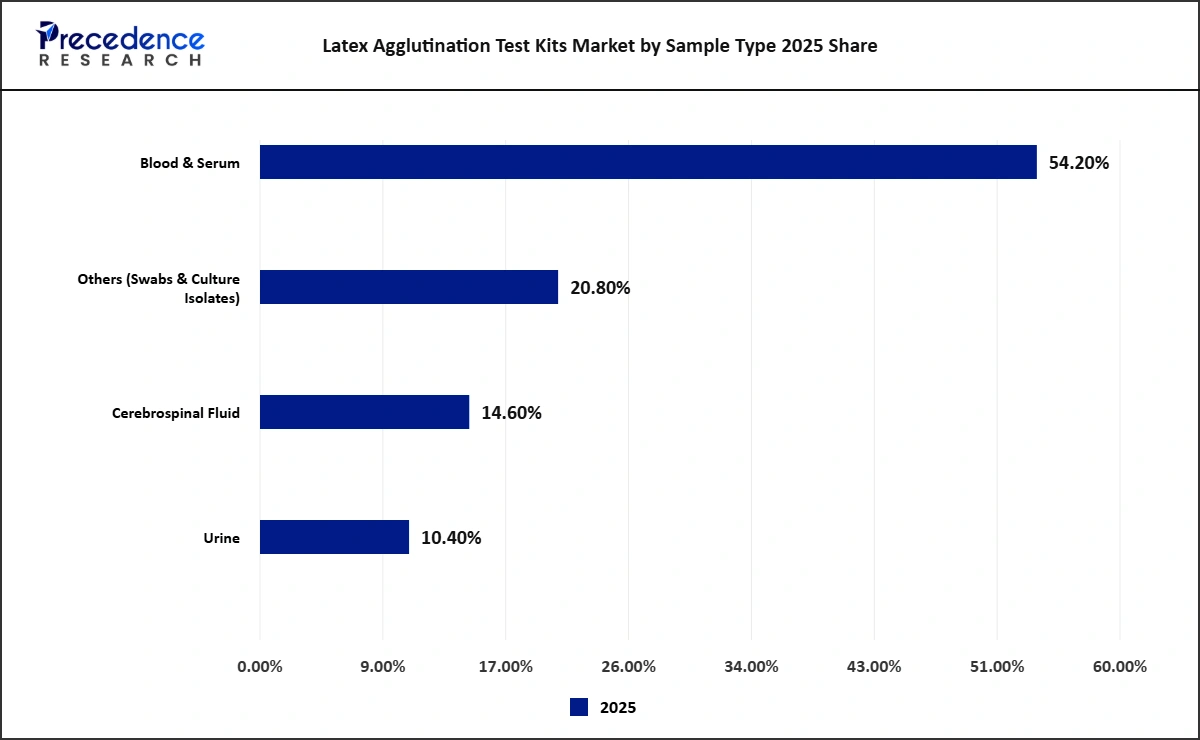
Note: 2025 is the base year.
Sources: Expert interviews, secondary sources, Precedence Research database and Precedence Research analysts.
Blood and serum accounted for 54.20% (USD 389.48 million) in 2025 because antibody and inflammatory marker tests and many antigen tests use serum. Swabs and culture isolates account for 20.80% (USD 149.47 million), mainly for bacterial identification; cerebrospinal fluid accounts for 14.60% (USD 104.92 million) for meningitis and cryptococcal testing; and urine accounts for 10.40% (USD 74.73 million).
Latex Agglutination Test Kits Market by End User 2025 Share
| Segments | 2025 Share | 2025 Market Value |
| Hospital Laboratories | 46.20% | USD 331.99 million |
| Independent Clinical Laboratories | 34.80% | USD 250.07 million |
| Others | 9.60% | USD 68.99 million |
| Academic & Research Institutes | 9.40% | USD 67.55 million |
Note: 2025 is the base year.
Sources: Expert interviews, secondary sources, Precedence Research database and Precedence Research analysts.
Hospital laboratories accounted for 46.20% (USD 331.99 million) in 2025 because they handle most urgent microbiology identification and meningitis testing. Independent clinical laboratories account for 34.80% (USD 250.07 million); other users, such as public health and veterinary laboratories, account for 9.60% (USD 68.99 million); and academic and research institutes account for 9.40% (USD 67.55 million).
- Analyst View: Segment values were allocated by matching test volumes by application and sample type to test types and settings, using average kit prices. Antigen testing and streptococcal grouping lead because they are routine steps in microbiology laboratories. We expect fungal antigen testing and use in emerging markets to gain share, while autoimmune and inflammation tests shift gradually to automated immunoassays analyzers in developed markets.
Regional Analysis
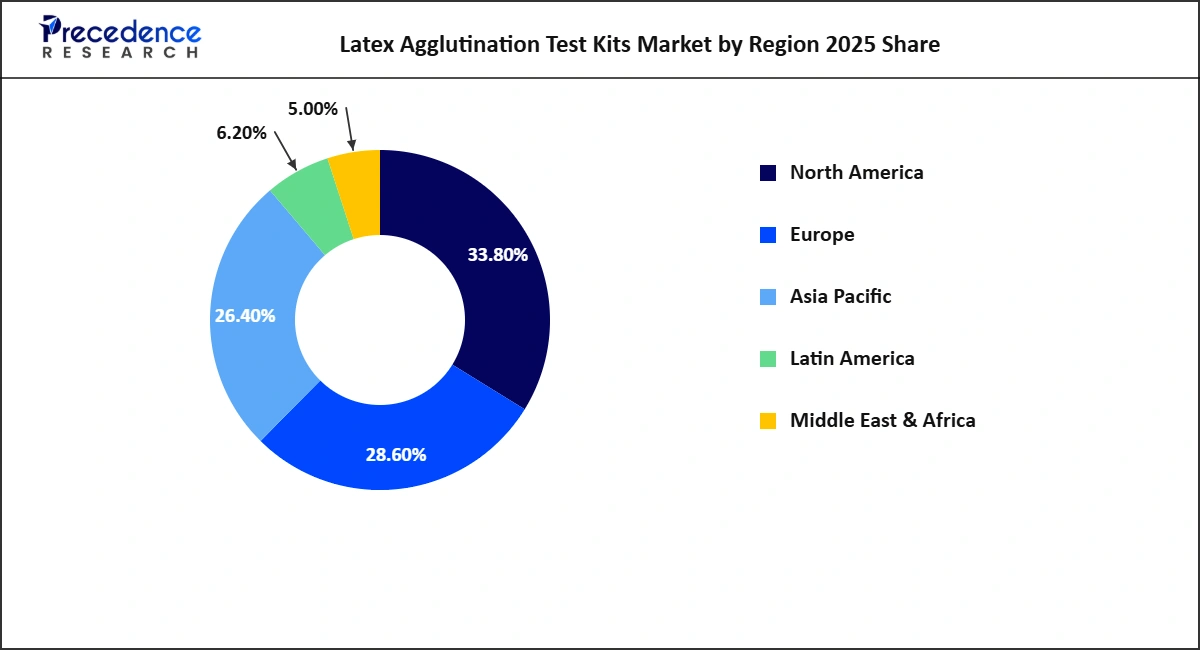
Latex Agglutination Test Kits Market By Region 2025 Share
Note: 2025 is the base year.
Sources: Expert interviews, secondary sources, Precedence Research database and Precedence Research analysts.
North America accounted for 33.80% (USD 242.89 million) in 2025, growing on large hospital and reference microbiology laboratories that use latex tests for bacterial identification and confirmation. Europe, at 28.60% (USD 205.52 million), is supported by established microbiology practice and suppliers in the UK, France, Germany and Italy, although molecular methods are replacing some uses. Asia Pacific, at 26.40% (USD 189.71 million), is the fastest-growing region, supported by expanding hospital laboratories in China and India and preference for low-cost rapid tests in Southeast Asia. Latin America, at 6.20% (USD 44.55 million), and the Middle East and Africa, at 5.00% (USD 35.93 million), rely heavily on latex tests where molecular capacity is limited, and cryptococcal antigen screening in HIV programs supports demand in Africa.
North America accounted for 33.80% (USD 242.89 million) in 2025. Large microbiology laboratories use latex grouping and confirmation tests. Molecular tests are replacing some uses. Demand remains steady.
Europe accounted for 28.60% (USD 205.52 million) in 2025. Established microbiology suppliers are based in the region. Hospital laboratories use latex tests in culture workflows. Growth is modest.
Asia Pacific accounted for 26.40% (USD 189.71 million) in 2025 and is the fastest-growing region. Hospital laboratory expansion in China and India drives demand. Low-cost rapid tests are preferred in many settings. Infectious disease burden supports testing.
Latin America accounted for 6.20% (USD 44.55 million) in 2025. Latex tests are widely used where molecular testing is limited. Brazil and Mexico lead demand.
The Middle East and Africa accounted for 5.00% (USD 35.93 million) in 2025. Cryptococcal antigen screening in HIV care supports demand. Low-cost tests suit resource-limited laboratories.
Analyst View: Regional shares were built from microbiology and serology test volumes, the share using latex methods, and kit prices in each region. North America leads because of its large laboratory base. Asia Pacific gets the top score for growth premium since laboratory capacity has grown and rapid tests continue to be favored there.
Top 10 Companies in the Latex Agglutination Test Kits Market
| Rank | Company Name | Market-Specific Revenue (USD Million) | 2025 Share | Key Products/Business | Headquarters |
| 1 | Thermo Fisher Scientific | 118.00 | 16.42% | Oxoid and Wellcogen latex agglutination kits | United States |
| 2 | bioMérieux | 62.00 | 8.63% | Slidex latex agglutination kits | France |
| 3 | Bio-Rad Laboratories | 48.00 | 6.68% | Pastorex latex agglutination kits | United States |
| 4 | Pro-Lab Diagnostics | 18.00 | 2.50% | Prolex latex grouping and identification kits | Canada |
| 5 | Atlas Medical | 16.00 | 2.23% | Latex serology kits for RF, CRP and ASO | Germany |
| 6 | Hardy Diagnostics | 14.00 | 1.95% | Microbiology latex tests | United States |
| 7 | IMMY | 14.00 | 1.95% | Cryptococcal antigen latex tests | United States |
| 8 | HiMedia Laboratories | 12.00 | 1.67% | Latex identification kits | India |
| 9 | Arlington Scientific | 10.00 | 1.39% | Latex serology kits | United States |
| 10 | Liofilchem | 8.00 | 1.11% | Microbiology latex kits | Italy |
Note: Company revenues and shares are 2025 estimates.
Sources: Company press releases, expert interviews, secondary sources, Precedence Research database and Precedence Research analysts.
Thermo Fisher Scientific led the latex agglutination test kits market with an estimated 16.42% (USD 118.00 million) of 2025 revenue, followed by bioMérieux at 8.63% (USD 62.00 million) and Bio-Rad Laboratories at 6.68% (USD 48.00 million). Thermo Fisher Scientific leads through its Oxoid and Wellcogen ranges of latex tests for streptococcal grouping, staphylococcal confirmation, and meningitis antigens, supported by a broad microbiology portfolio and global distribution. bioMérieux and Bio-Rad hold strong positions with Slidex and Pastorex kits widely used in European and international laboratories. Specialist suppliers such as Pro-Lab Diagnostics, Hardy Diagnostics, HiMedia and Liofilchem offer identification kits for microbiology laboratories; IMMY leads cryptococcal antigen testing; and Atlas Medical and Arlington Scientific focus on serology kits for rheumatoid factor, CRP and ASO.
The top 10 companies accounted for an estimated 44.53% (USD 320.00 million) of 2025 revenue, while the remaining 55.47% (USD 398.60 million) was shared among regional kit makers, distributors and private-label suppliers. There is moderate fragmentation in the latex agglutination test kits market, and the competitive elements include reliability, ease of reading, shelf life, cost, and market coverage. Because the technology is mature, suppliers compete mainly on quality, breadth of kit range, and cost, especially in tenders in emerging markets.
Latex Agglutination Test Kits Market Segments
By Test Type
- Antigen Testing
- Antibody Detection
By Application
- Streptococcal Infections
- Inflammation & Autoimmune Markers
- Meningitis & Bacterial Antigens
- Staphylococcal Infections
- Others
- Fungal Infections
By Sample Type
- Blood & Serum
- Others (Swabs & Culture Isolates)
- Cerebrospinal Fluid
- Urine
By End User
- Hospital Laboratories
- Independent Clinical Laboratories
- Others
- Academic & Research Institutes
By Region
- North America (U.S., Canada, Mexico)
- Europe (Germany, U.K., France, Italy, Spain, Rest of Europe)
- Asia Pacific (China, Japan, India, South Korea, Taiwan, Rest of Asia Pacific)
- Latin America (Brazil, Argentina, Rest of Latin America)
- Middle East & Africa (GCC, South Africa, Rest of MEA)
Research Methodology
The latex agglutination test kits market was defined as latex agglutination antigen and antibody test kits used in clinical microbiology, serology, and related testing worldwide. The 2025 base year was built bottom-up from latex test volumes by application and region and average kit prices per test, and checked top-down against the microbiology reagent revenue of leading suppliers. Segment, regional, and company values were allocated from test types, applications, sample types, end users, and regional laboratory activity. Key estimates were verified by cross-checking company disclosures, regulatory and industry data and published third-party estimates, and inputs that could not be reconciled were excluded. All segment, regional, and company figures were reconciled to the same 2025 base year, and the 2026-2035 forecast, which applies a constant CAGR from the 2025 base, was recalculated and validated.
Analyst View: Overall Market
The latex agglutination test kits market is mature but stable, supported by routine microbiology use and demand in emerging markets. The estimated model is dependent on demand that is related to the number of tests done, percentage of tests being done through latex testing, and kit price. The main upside comes from emerging market laboratories and fungal antigen testing, while the main risk is replacement by molecular and automated methods.
Sources and References
- Pathology in Practice. "Carboxylate-modified microparticles enhance latex agglutination testing". 2007-06-14. Pro-Lab latex reagent technology. https://pathologyinpractice.com/story/16148/carboxylate-modified-microparticles-enhance-latex-agglutination-testing
- Thermo Fisher Scientific. "Wellcogen Strep B rapid latex agglutination test". Undated. Latex test product. https://www.thermofisher.com/order/catalog/product/R30858701
For inquiries regarding discounts, bulk purchases, or customization requests, please contact us at sales@precedenceresearch.com
Frequently Asked Questions





Ask For Sample
No cookie-cutter, only authentic analysis – take the 1st step to become a Precedence Research client
 Get a Sample




 sales@precedenceresearch.com
 Schedule a Meeting
