



LTCC and HTCC Market Size, Key Companies, Company Market Share, Chip Production Volume, Wafer Capacity, Technology Adoption, Pricing Trends, Competitive Positioning, and Demand Analysis
According to semiconductor and electronics specialist Laxmi Narayan, the LTCC and HTCC market is valued at USD 4,870.69 million in 2026 to USD 7,953.64 million by 2035, growing at a CAGR of 6.29% . Leading LTCC and HTCC market companies, including Kyocera Corporation, TDK Corporation, Niterra Co., Ltd., are strengthening their presence across key segments such as technology, product, application, region.
Source: https://www.precedenceresearch.com/ltcc-htcc-market
 Get a Sample
 Report Description


LTCC HTCC Market Size, Share, Trends, and Growth Forecast 2035
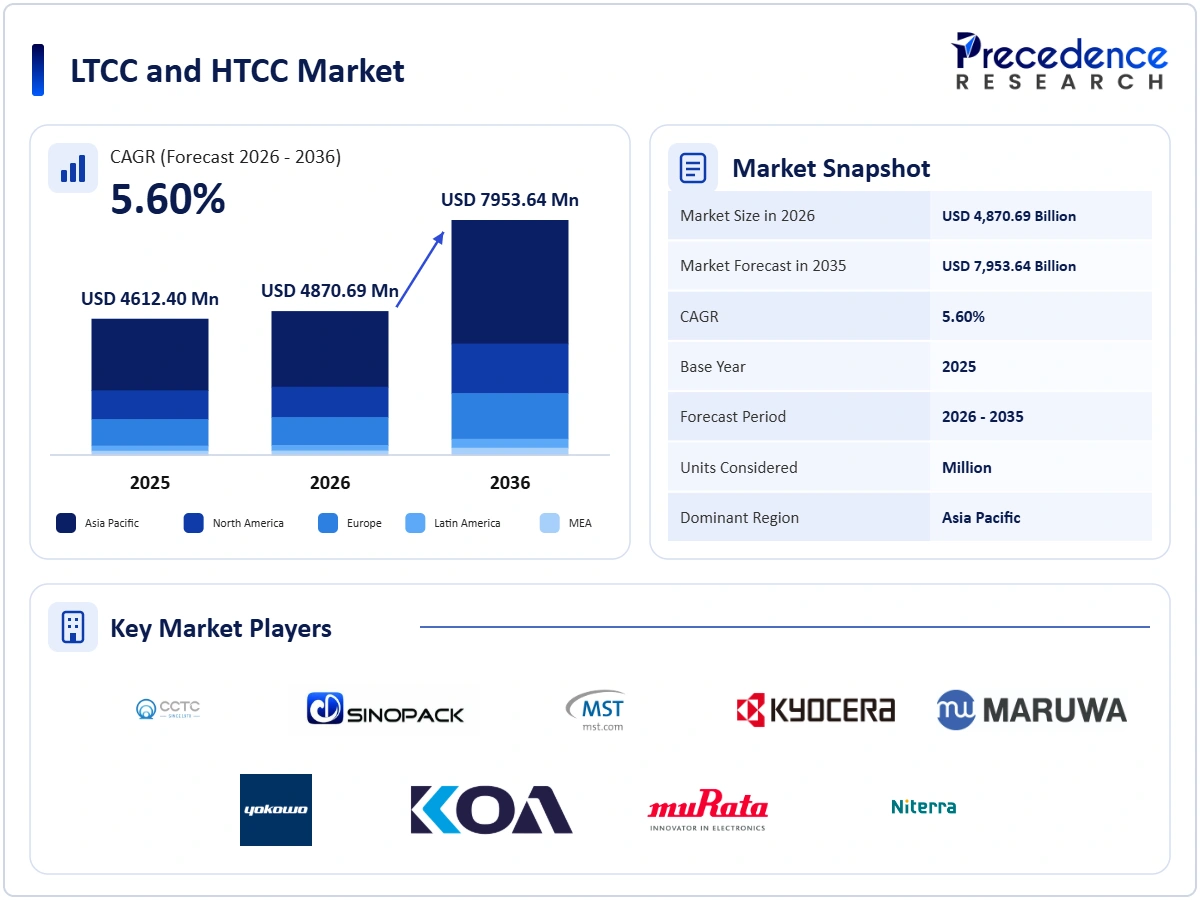
The LTCC and HTCC market is forecasted to expand from USD 4,870.69 million in 2026 to USD 7,953.64 million by 2035, growing at a CAGR of 6.29% from 2026 to 2035.
 Key Takeaways
Market Size & Growth Outlook
- LTCC and HTCC Market Size in 2025: USD 4,612.40 million
- Estimated Market Size in 2026: USD 4,870.69 million
- Projected Market Size by 2035: USD 7,953.64 million
- CAGR over the forecast (2026-2035) period: 5.60%
Regional Market Spotlight
- Asia Pacific: The region led the market in 2025, accounting for 52.60% of total revenue, equivalent to USD 2,426.12 million. It is projected to record the fastest growth, with a CAGR of 6.29% from 2026 to 2035.
- North America: The region accounted for 21.10% of the market in 2025, with revenue reaching USD 973.22 million.
- Europe: Europe represented 19.40% of the market in 2025, generating revenue of USD 894.81 million.
Segmental Spotlight
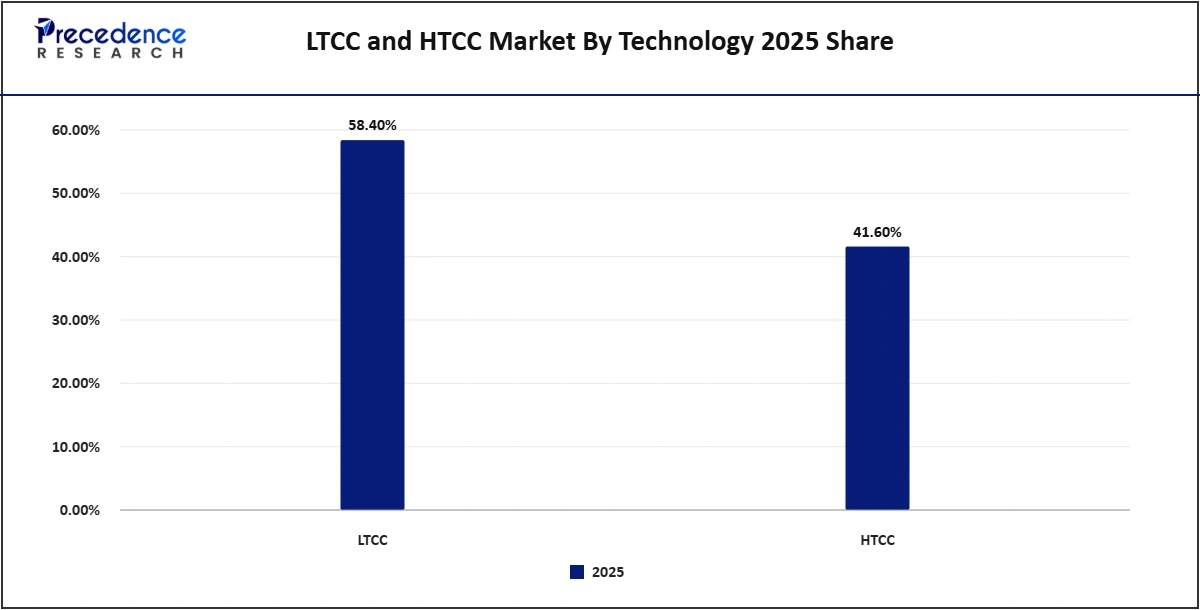
- By technology, the low-temperature co-fired ceramic (LTCC) segment dominated the market in 2025, accounting for 58.40% of total revenue, equivalent to USD 2,693.64 million.
- By product, packages and housings represented the largest product share in 2025, accounting for 37.20% of the market, valued at USD 1,715.81 million.
- By application, communications and RF applications, including 5G, mmWave, and Wi-Fi, accounted for 31.60% of the market in 2025, generating USD 1,457.52 million in revenue.
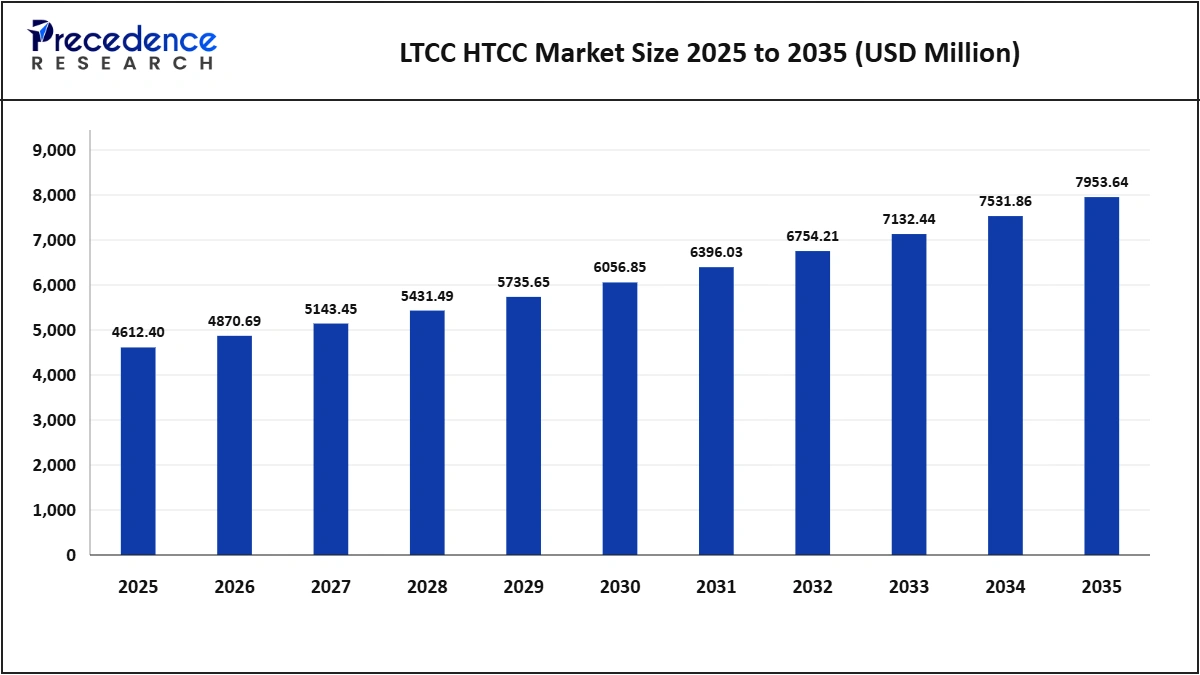
LTCC and HTCC Market Size and Forecast, 2025-2035 (USD Million)
Note: 2025 is the base year; 2026-2035 values are forecasts.
Sources: Expert interviews, secondary sources, Precedence Research database, and Precedence Research analysts.
The LTCC and HTCC market is expected to grow from USD 4,612.40 million in 2025 to USD 7,953.64 million by 2035, driven by increasing demand for multilayer ceramic components in 5G radio systems, automotive radar, electronic control units, optical transceivers, and hermetic sensor packages. These components integrate electrical interconnections and passive elements while ensuring reliable sealing. Rising demand from defence, space, and medical electronics further supports market growth. The market is projected to reach USD 6,056.85 million by 2030, expanding at a CAGR of 5.60% from 2026 to 2035.
- Analyst View: The LTCC and HTCC estimate is based on end-device output, estimating the co-fired content and value per RF module, radar module, control unit, sensor package, and optoelectronic package. The results were cross-checked against relevant revenues from leading manufacturers such as Kyocera, Murata, and TDK, as well as available published market estimates. The growth rate reflects steady growth in communications and consumer devices, faster growth in automotive radar, electrification and optical packaging, and a high-value defense and space layer.
Market Trends
- Antenna-in-package and mmWave modules are increasing LTCC layer counts and precision.
- Automotive radar and electric powertrains are lifting demand for reliable co-fired substrates.
- Optical transceivers for AI data centers are driving demand for HTCC and LTCC packages.
- Chinese producers are expanding co-fired ceramic capacity to localize supply.
- Aluminum nitride HTCC is gaining use in high-power and laser packages.
- Low-loss LTCC materials are being developed for 6G and higher-frequency bands.
Drivers, Restraints, and Opportunities
Driver
5G and mmWave radios, automotive radar, and power electronics all need compact, reliable components that integrate wiring and passives. Co-fired ceramics offer low signal loss, good thermal performance, and hermetic sealing that organic boards cannot match. As vehicles, base stations, and data centers add more high-frequency and harsh-environment electronics, co-fired ceramic content rises.
Restraint
Co-fired ceramic production requires precise material control, long firing cycles, and expensive tooling. Organic substrates and system-in-package solutions compete in cost-sensitive RF and consumer applications. Price pressure from new Chinese capacity also squeezes margins on standard packages and substrates.
Opportunity
Optical transceivers for AI data centers, satellite communications and 6G research open new high-value applications. Automotive electrification and radar create long-term programs with strict reliability requirements. Suppliers that offer low-loss materials, aluminum nitride packages, and fine-pitch multilayer structures can capture premium demand.
Market Segmentation: 2025 Share and Value
LTCC and HTCC Market By Technology 2025 Share & Size
Note: 2025 is the base year.
Sources: Expert interviews, secondary sources, Precedence Research database, and Precedence Research analysts.
LTCC dominated the market in 2025, accounting for 58.40% of revenue, equivalent to USD 2,693.64 million. Its lower firing temperature supports the use of silver and gold conductors and embedded passive components, making it suitable for multilayer RF modules, filters, and antenna-in-package designs.
HTCC accounted for the remaining 41.60%, valued at USD 1,918.76 million. It uses tungsten or molybdenum conductors with alumina or aluminum nitride substrates and serves hermetic packages, power devices, and sensors designed for harsh environments. Both technologies are expanding across key applications, with LTCC adoption increasing in high-frequency communications and radar, while HTCC demand is rising in optoelectronic and power packaging.
LTCC and HTCC Market By Product 2025 Share & Size
| Segments | 2025 Share | 2025 Market Value |
| Packages & Housings | 37.20% | USD 1,715.81 million |
| Substrates | 34.80% | USD 1,605.12 million |
| Modules & Integrated Components | 28.00% | USD 1,291.47 million |
Note: 2025 is the base year.
Sources: Expert interviews, secondary sources, Precedence Research database, and Precedence Research analysts.
Packages and housings represented the largest product segment in 2025, accounting for 37.20% of the market, valued at USD 1,715.81 million. Demand is supported by the use of hermetic ceramic packages in sensors, laser diodes, crystal oscillators, and image sensors. Substrates accounted for 34.80% of the market, generating USD 1,605.12 million, and serve as multilayer circuit carriers in automotive, industrial, and medical electronics. Modules and integrated components held the remaining 28.00% share, valued at USD 1,291.47 million. This segment includes RF front-end modules, filters, and baluns that combine multiple functions within a single ceramic package. Demand for integrated modules is increasing as electronic devices require greater functionality in smaller form factors.
LTCC and HTCC Market by Application 2025 Share & Size
| Segments | 2025 Share | 2025 Market Value |
| Communications & RF (5G, mmWave, Wi-Fi) | 31.60% | USD 1,457.52 million |
| Automotive Electronics & Radar | 24.80% | USD 1,143.88 million |
| Industrial & Sensors | 14.70% | USD 678.02 million |
| Consumer Electronics | 11.30% | USD 521.20 million |
| Aerospace & Defense | 10.20% | USD 470.46 million |
| Medical | 7.40% | USD 341.32 million |
Note: 2025 is the base year.
Sources: Expert interviews, secondary sources, Precedence Research database, and Precedence Research analysts.
Communications and RF applications, including 5G, mmWave, and Wi-Fi, accounted for the largest application share in 2025, reaching USD 1,457.52 million, or 31.60% of the market. Growth is driven by rising demand for 5G handsets, mmWave infrastructure, and Wi-Fi modules.
Automotive electronics and radar represented 24.80% of the market, valued at USD 1,143.88 million, and are the fastest-growing application segment as vehicles incorporate more radar sensors, electric powertrain controls, and battery management systems. Industrial and sensor applications accounted for 14.70%, generating USD 678.02 million. Consumer electronics represented 11.30% of the market, valued at USD 521.20 million, while aerospace and defence accounted for 10.20%, or USD 470.46 million. Medical devices contributed the remaining 7.40%, equivalent to USD 341.32 million, supported by the need for reliable hermetic packaging.
- Analyst View: Segment values were allocated by mapping each end device to the co-fired technology and product type it uses and weighting by ceramic value per unit. LTCC leads because RF modules and filters ship in high volumes, while HTCC carries higher value per package in hermetic and power applications. We expect automotive radar, optical transceiver packages and defense electronics to gain share as vehicles and data centers need more high-frequency and hermetic components.
Regional Analysis
LTCC and HTCC Market By Region 2025 Share & Size
Note: 2025 is the base year.
Sources: Expert interviews, secondary sources, Precedence Research database, and Precedence Research analysts.
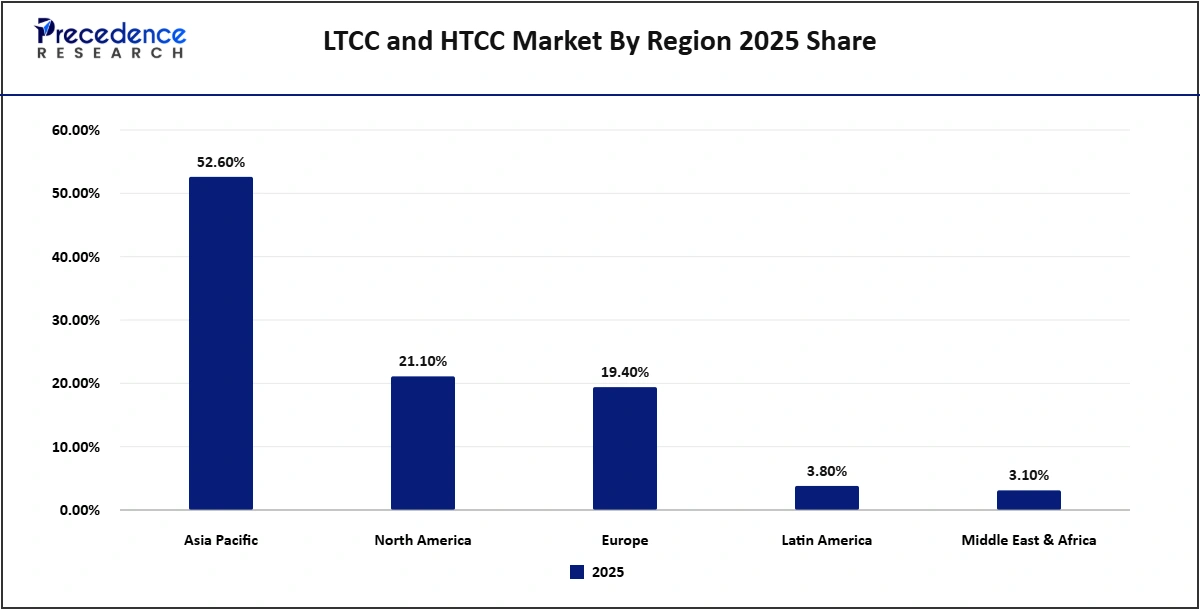
Asia Pacific accounted for 52.60% (USD 2,426.12 million) of the market share in 2025, growing on component and module production in Japan, China, South Korea, and Taiwan. North America, at 21.10% share and USD 973.22 million, grows with defense, aerospace, medical, and data center optical demand, while Europe, at 19.40% (USD 894.81 million), expands on automotive radar, industrial sensors, and space programs. Latin America captured a 3.80% share (USD 175.27 million), and the Middle East & Africa, at a 3.10% share (USD 142.98 million), remain small markets tied mainly to electronics assembly and defense procurement.
Asia Pacific: Asia Pacific accounted for 52.60% of the LTCC and HTCC market in 2025, generating USD 2,426.12 million in revenue. The region is projected to record the fastest growth, supported by established manufacturers in Japan and expanding domestic co-fired ceramic production in China for communications and automotive electronics.
North America: North America represented 21.10% of the market in 2025, with revenue reaching USD 973.22 million. Demand is driven by defence and space electronics, medical devices, and optical packaging for data centres.
Europe: Europe accounted for 19.40% of the market in 2025, valued at USD 894.81 million. Automotive radar and electronics suppliers in Germany, industrial sensor manufacturers, and space programs support regional demand.
Latin America: Latin America held a 3.80% market share in 2025, generating USD 175.27 million in revenue. Automotive manufacturing and electronics assembly in Brazil drive demand.
Middle East and Africa: The region accounted for 3.10% of the market in 2025, valued at USD 142.98 million. Demand is supported by defence electronics and telecommunications infrastructure projects.
Analyst View: Regional shares where co-fired ceramic components are consumed, measured through RF modules, automotive electronics, sensor and defense production, and adjusted for trade. Asia Pacific carries the largest weight because most module and component assembly happens there. We project Asia Pacific to have the highest growth premium because Chinese manufacturers are adding capacity to localize supply, while North America and Europe grow mainly through defense, space, automotive radar, and optical packaging programs.
Top 10 Market Players in the LTCC and HTCC Market
| Rank | Company Name | Market-Specific Revenue (USD Million) | 2025 Share | Key Products / Business | Headquarters |
| 1 | Kyocera Corporation | 1,012.60 | 21.95% | HTCC packages, LTCC substrates and modules | Japan |
| 2 | Murata Manufacturing Co., Ltd. | 684.30 | 14.84% | LTCC RF modules, filters and multilayer substrates | Japan |
| 3 | TDK Corporation | 312.80 | 6.78% | LTCC RF components and modules | Japan |
| 4 | Niterra Co., Ltd. | 286.40 | 6.21% | HTCC ceramic packages | Japan |
| 5 | MARUWA Co., Ltd. | 204.70 | 4.44% | Ceramic substrates and HTCC components | Japan |
| 6 | Hebei Sinopack Electronic Technology Co., Ltd. | 168.20 | 3.65% | HTCC packages for communications and defense | China |
| 7 | Chaozhou Three-Circle (Group) Co., Ltd. | 152.60 | 3.31% | Ceramic packages and substrates | China |
| 8 | Yokowo Co., Ltd. | 96.40 | 2.09% | LTCC substrates and fine-pitch components | Japan |
| 9 | KOA Corporation | 78.30 | 1.70% | LTCC substrates | Japan |
| 10 | Micro Systems Technologies | 64.20 | 1.39% | LTCC and thin-film circuits for medical and industrial electronics | Switzerland |
Note: Company revenues and shares are 2025 estimates.
Sources: Company press releases, expert interviews, secondary sources, Precedence Research database, and Precedence Research analysts.
Kyocera Corporation led the LTCC and HTCC market in 2025, accounting for an estimated 21.95% of revenue, equivalent to USD 1,012.60 million. Murata Manufacturing Co., Ltd. ranked second with a 14.84% share, valued at USD 684.30 million, followed by TDK Corporation with 6.78%, or USD 312.80 million. Kyocera maintains its leading position through its broad portfolio of HTCC packages and LTCC substrates. Murata specialises in LTCC RF modules and filters for smartphones and communications equipment, while TDK focuses on LTCC RF components.
The top 10 companies accounted for an estimated 66.35% of market revenue in 2025, totalling USD 3,060.50 million. The remaining 33.65%, valued at USD 1,551.90 million, came from Chinese co-fired ceramic manufacturers, defence-focused specialists, and smaller substrate producers. Competition is intensifying as Chinese manufacturers expand production capacity, while established Japanese suppliers focus on high-frequency communications, automotive electronics, and semiconductor packaging applications that require tight manufacturing tolerances and high reliability.
Recent Developments
- June 2026: Murata introduced a soft-termination automotive multilayer ceramic capacitor for powertrain and safety equipment, reflecting continued investment in co-fired ceramic components for vehicles.
- July 2026: Kyocera Corporation announced that its new Nagasaki Isahaya Plant in Japan would open on September 1, 2026, with a planned investment of around ¥68 billion through March 2029. The facility will manufacture fine ceramic components for semiconductor manufacturing equipment and semiconductor packages.
LTCC HTCC Market Segments
By Technology
- LTCC
- HTCC
By Product
- Packages & Housings
- Substrates
- Modules & Integrated Components
By Application
- Communications & RF (5G, mmWave, Wi-Fi)
- Automotive Electronics & Radar
- Industrial & Sensors
- Consumer Electronics
- Aerospace & Defense
- Medical
By Region
- North America (U.S., Canada, Mexico)
- Europe (Germany, U.K., France, Italy, Spain, Rest of Europe)
- Asia Pacific (China, Japan, India, South Korea, Taiwan, Rest of Asia Pacific)
- Latin America (Brazil, Rest of Latin America)
- Middle East & Africa (GCC, South Africa, Rest of MEA)
Research Methodology
The LTCC and HTCC market was defined as low-temperature and high-temperature co-fired ceramic substrates, packages, housings, and integrated modules used in electronics, counted at the manufacturer level. The 2025 base year was built bottom-up from end-device production volumes and co-fired ceramic content and value per device, and checked top-down against the co-fired ceramic revenues of leading producers. Segment, regional, and company values were allocated from device production data, regional manufacturing footprints and producer portfolios. Key estimates were verified by cross-checking company disclosures, regulatory and industry data, and published third-party estimates, and inputs that could not be reconciled were excluded. All segment, regional, and company figures were reconciled to the same 2025 base year, and the 2026-2035 forecast, which applies a constant CAGR from the 2025 base, was recalculated and validated.
Analyst View: Overall Market
Co-fired ceramics remain the material of choice wherever electronics need high frequency, hermetic sealing, or harsh-environment reliability. Our estimate links demand to the production of RF modules, automotive electronics, sensor and optoelectronic packages and defense systems, so the forecast follows these end markets rather than general electronics output. Automotive radar, optical packaging and space electronics provide the strongest growth, while consumer RF modules provide volume. The main risks are competition from organic substrates, consumer electronics cycles, and price pressure from new capacity.
Sources and References
- Dempa Publications (AEI). "KYOCERA to open Nagasaki Isahaya Plant". 02-07-2026. ¥68 billion plant for fine ceramic components and semiconductor packages. (Source: aei.dempa.net)
- Murata Manufacturing (Business Wire). "Murata introduces soft-termination automotive MLCC". 04-06-2026. Automotive co-fired ceramic component launch. (Source: murata.com)
- Chaozhou Three-Circle (Group) Co., Ltd. (CNINFO). "Company financial summary". 2025. Operating revenue and ceramic package business description. (Source: static.cninfo.com.cn)
For inquiries regarding discounts, bulk purchases, or customization requests, please contact us at sales@precedenceresearch.com
Frequently Asked Questions





Ask For Sample
No cookie-cutter, only authentic analysis – take the 1st step to become a Precedence Research client
 Get a Sample




 sales@precedenceresearch.com
 Schedule a Meeting
