



Lyme Disease Testing Market Trends, Leading Companies, Company Revenue / Sales Performance, Procedure Volume, Healthcare Spending, Technology Adoption, Reimbursement Analysis, Competitive Landscape, and Growth Outlook
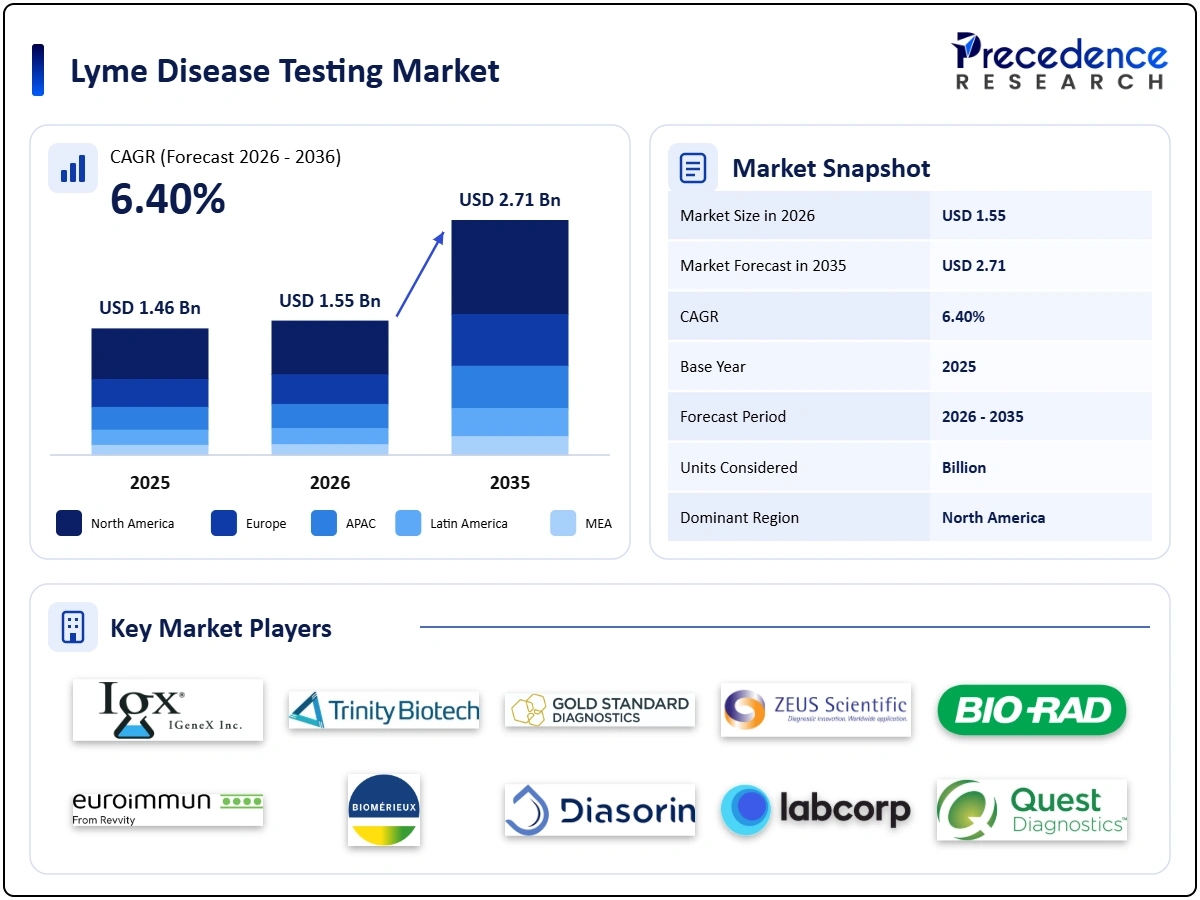
Payal Rabde, a Healthcare Industry Expert, highlights that the lyme disease testing market has reached USD 1.55 billion in 2026 to USD 2.71 billion by 2035, growing at a CAGR of 6.40%. Key Lyme disease testing market companies shaping the market include Quest Diagnostics, Labcorp, DiaSorin, bioMérieux, while major growth segments span technology, sample type, patient type, end use and region.
Source: https://www.precedenceresearch.com/lyme-disease-testing-market
 Get a Sample
 Report Description


Lyme Disease Testing Market Trends, Share, and Growth Analysis 2035
The Lyme disease testing market is forecasted to expand from USD 1.55 billion in 2026 to USD 2.71 billion by 2035, growing at a CAGR of 6.40% from 2026 to 2035.
Key Takeaways
Market Size & Growth Outlook
- Market size in 2025: USD 1.46 billion
- Estimated market size in 2026: USD 1.55 billion
- Projected market size by 2035: USD 2.71 billion
- CAGR (2026-2035): 6.40%
Regional Market Spotlight
- North America led the market with a 52.60% (USD 0.77 billion) share in 2025.
- Europe accounted for 34.40% (USD 0.50 billion) of the market in 2025 and is projected to be the fastest-growing region, at a CAGR of 7.23% from 2025 to 2035.
- Asia Pacific accounted for 8.60% (USD 0.13 billion) of the market in 2025.
Segmental Spotlight
- By technology, Serological Tests accounted for 72.40% (USD 1.06 billion) in 2025.
- By sample type, Blood accounted for 68.40% (USD 1.00 billion) in 2025.
- By patient type, Adults accounted for 76.40% (USD 1.12 billion) in 2025.
- By end use, Diagnostic Laboratories accounted for 54.40% (USD 0.79 billion) in 2025.
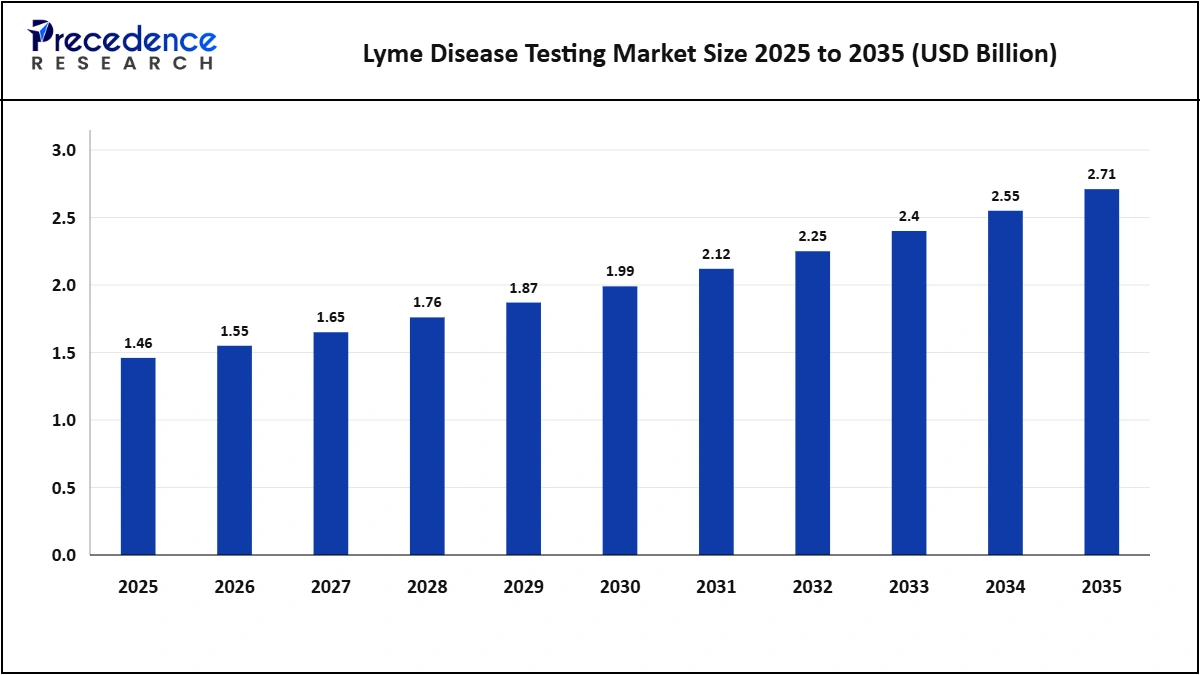
Lyme Disease Testing Market Size and Forecast, 2025-2035 (USD Billion)
Note: 2025 is the base year; 2026–2035 values are forecasts.
Sources: Expert interviews, secondary sources, Precedence Research database and Precedence Research analysts.
The Lyme disease testing market is projected to grow from USD 1.46 billion in 2025 to USD 2.71 billion by 2035 because tick-borne infections are rising in North America and Europe, and laboratories run large volumes of antibody tests for patients with suspected Lyme disease. Modified two-tier serology, molecular testing for complicated cases, and new early detection tests add value, lifting the market to USD 1.99 billion by 2030 and sustaining a CAGR of 6.40% from 2026 to 2035.
- Analyst View: We built the estimate from Lyme disease test volumes by method and region, based on reported and estimated cases, the much larger number of patients tested to rule out infection and repeat and confirmatory testing, multiplied by average test prices. Test volumes reflect published estimates of millions of Lyme tests performed each year in the United States and high testing in endemic European countries. The total was cross-checked against the infectious disease serology revenue of leading diagnostics and laboratory companies, so that the estimate stays consistent with the number of tests actually performed rather than broader published figures. Growing incidence and a broader geographic distribution are responsible for the rising rate, which is moderated by pressure on serology prices and the possible long-term effects of vaccination.
Market Trends
- Modified two-tier testing simplifies laboratory workflows.
- Tests for direct detection seek to confirm infection prior to antibody development.
- Tick ranges are expanding with climate change.
- Multiplex panels test for several tick-borne infections.
- Skin-fluid molecular tests are in development.
- A Lyme vaccine may change long-term testing demand.
Drivers, Restraints and Opportunities
Driver
Lyme disease cases are rising and spreading to new areas as tick ranges expand with warmer climates. Numerous patients undergo testing, and very few are diagnosed since the symptoms are non-specific and need to be checked for possible infections. Modified two-tier testing makes laboratory testing faster and easier to interpret. Awareness programs promote the idea of testing after tick bites. Early testing programs can solve the problems in the existing serology tests.
Restraints
Antibody tests do not detect early infections, limiting the clinical applications of the test in the first few weeks. Testing may not provide reliable results and may even be contentious when dealing with individuals who show symptoms persistently. Cost pressure exists in high-volume serology. Vaccines may decrease infections. The disease is region-specific; thus, low global demand.
Opportunity
Direct detection molecular and antigen tests can improve early diagnosis. Multiplex tick-borne disease panels can raise test value. Point-of-care tests can serve primary care and urgent care in endemic areas. Growing incidence in Europe and Canada offers volume growth. Additional testing requirements for vaccine trials and surveillance increase demand.
Market Segmentation: 2025 Share and Value
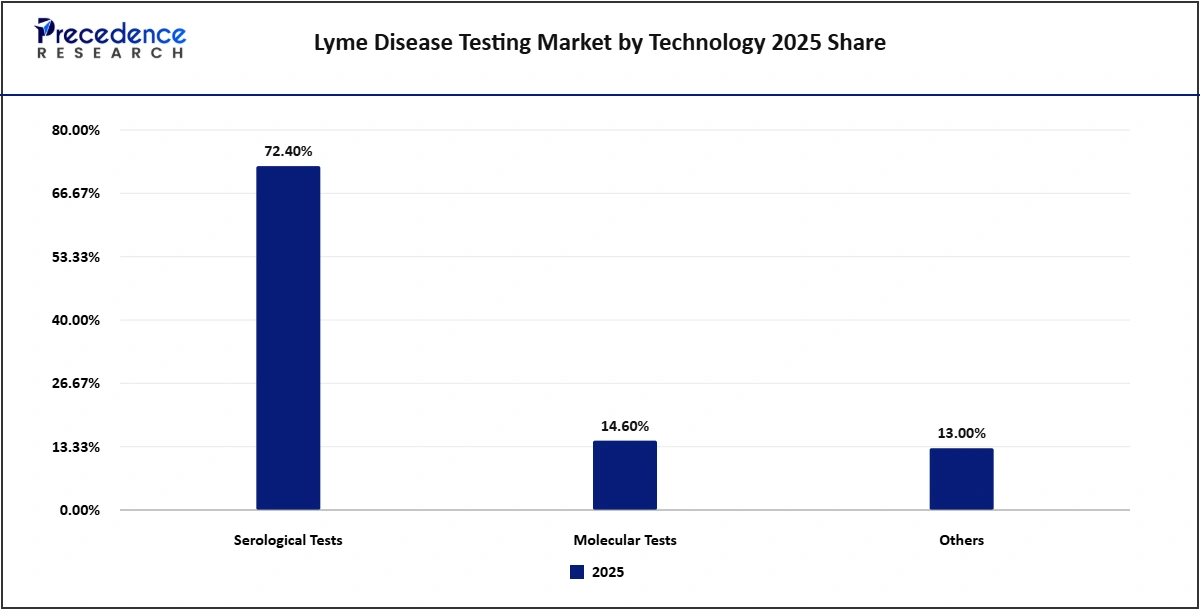
Lyme Disease Testing Market by Technology 2025 Share
Note: 2025 is the base year.
Sources: Expert interviews, secondary sources, Precedence Research database and Precedence Research analysts.
Serological tests had a market share of 72.40% (USD 1.06 billion) in 2025, since the protocol suggested the use of an EIA for the determination of antibodies, which is followed by immunoblotting or a second EIA, and the modified two-tier test approved by the FDA allows laboratories to use 2 EIAs. Serologic assays function better a few weeks after infection.
Molecular tests, at 14.60% (USD 0.21 billion), are used on synovial fluid, cerebrospinal fluid, and skin samples in complicated cases, and are the fastest-growing technology as new tests aim to detect Borrelia directly in early infection. Other tests, including culture, antigen, and T-cell-based assays, account for 13.00% (USD 0.19 billion).
Lyme Disease Testing Market by Sample Type 2025 Share & Size
| Segments | 2025 Share | 2025 Market Value |
| Blood | 68.40% | USD 1.00 billion |
| Others | 15.80% | USD 0.23 billion |
| Cerebrospinal Fluid | 9.60% | USD 0.14 billion |
| Synovial Fluid | 6.20% | USD 0.09 billion |
Note: 2025 is the base year.
Sources: Expert interviews, secondary sources, Precedence Research database and Precedence Research analysts.
Blood accounted for 68.40% (USD 1.00 billion) in 2025 because serum is used for antibody testing in almost all patients. Other samples, including skin and interstitial fluid and urine, account for 15.80% (USD 0.23 billion) and are the focus of new early detection tests; cerebrospinal fluid accounts for 9.60% (USD 0.14 billion) and is used for suspected neuroborreliosis; and synovial fluid accounts for 6.20% (USD 0.09 billion) for Lyme arthritis.
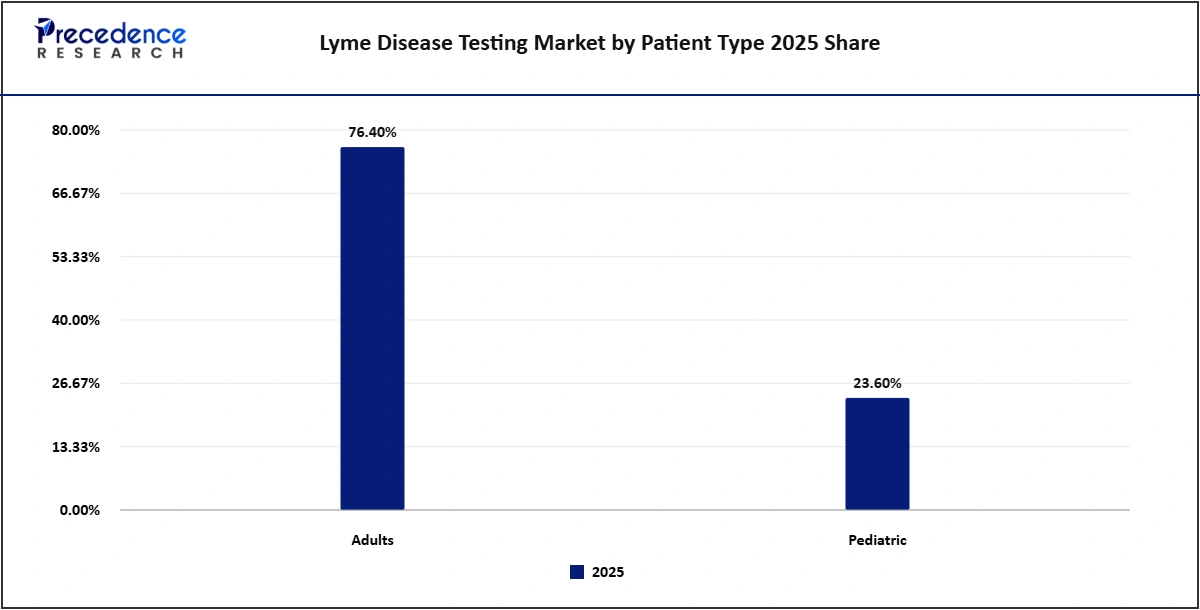
Lyme Disease Testing Market by Patient Type 2025 Share
Note: 2025 is the base year.
Sources: Expert interviews, secondary sources, Precedence Research database and Precedence Research analysts.
Adults accounted for 76.40% (USD 1.12 billion) in 2025 because most tested patients are adults with outdoor exposure. Pediatric patients account for 23.60% (USD 0.34 billion), with children aged 5 to 14 among the groups with the highest incidence.
Lyme Disease Testing Market by End Use 2025 Share & Size
| Segments | 2025 Share | 2025 Market Value |
| Diagnostic Laboratories | 54.40% | USD 0.79 billion |
| Hospitals | 36.20% | USD 0.53 billion |
| Others | 9.40% | USD 0.14 billion |
Note: 2025 is the base year.
Sources: Expert interviews, secondary sources, Precedence Research database and Precedence Research analysts.
Diagnostic laboratories accounted for 54.40% (USD 0.79 billion) in 2025 because most Lyme serology is sent to reference and specialty laboratories. Hospitals account for 36.20% (USD 0.53 billion), especially for complicated cases needing CSF or synovial fluid testing, and other users, including public health laboratories, account for 9.40% (USD 0.14 billion).
- Analyst View: Segment values were allocated by matching Lyme test volumes by method, sample, and setting to average prices. Serology and blood samples lead because antibody testing is the standard diagnostic approach. We expect molecular and other early detection tests to gain share as new direct-detection tests reach the market.
Regional Analysis
Lyme Disease Testing Market by Region 2025 Share
Note: 2025 is the base year.
Sources: Expert interviews, secondary sources, Precedence Research database and Precedence Research analysts.
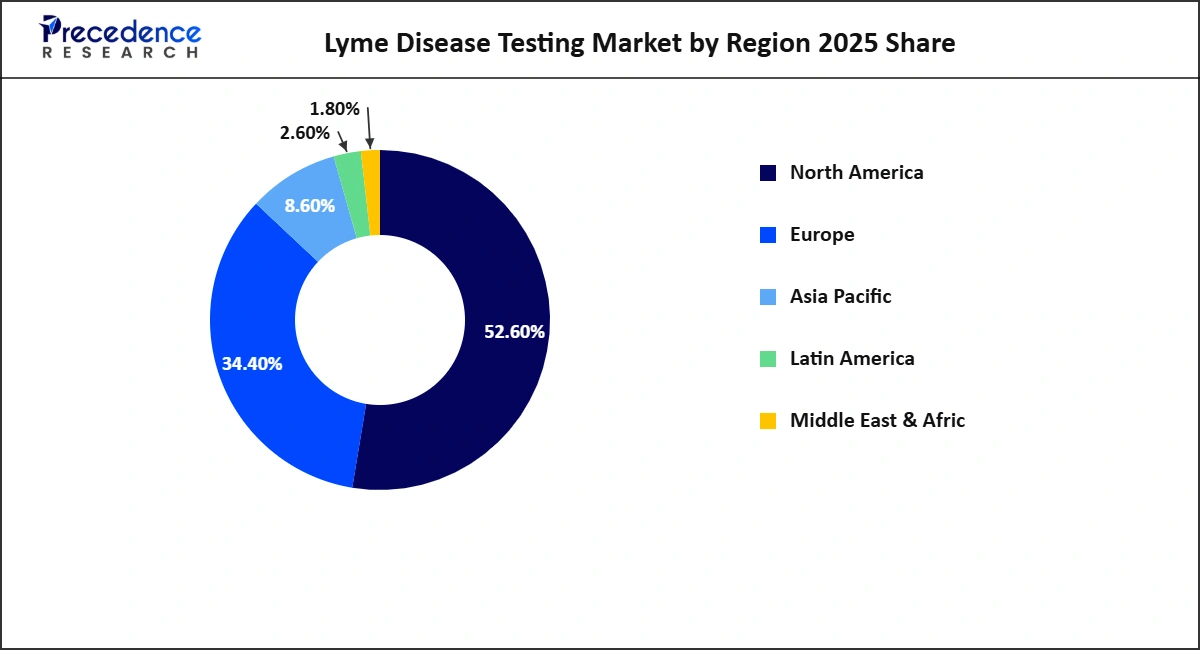
North America accounted for 52.60% (USD 0.77 billion) in 2025, growing on high Lyme disease incidence in the north-eastern, mid-Atlantic and upper mid-western U.S., expansion of tick ranges into Canada and new U.S. states and large reference laboratory testing volumes. Europe, at 34.40% (USD 0.50 billion), is the fastest-growing region, supported by rising cases in Germany, the Nordic countries, the Netherlands, Austria, and Central and Eastern Europe, where the disease is a major tick-borne infection. Asia Pacific, at 8.60% (USD 0.13 billion), is a smaller market with Lyme disease reported in parts of China, Japan, and Russia's Far East. Latin America, at 2.60% (USD 0.04 billion), and the Middle East and Africa, at 1.80% (USD 0.03 billion), have limited Lyme disease burden and testing.
North America accounted for 52.60% (USD 0.77 billion) in 2025. High incidence in endemic U.S. states drives testing. Tick ranges are expanding into Canada. Reference laboratories run most tests.
Europe accounted for 34.40% (USD 0.50 billion) in 2025 and is the fastest-growing region. Cases are rising in Germany, the Nordics, and Central Europe. Laboratories use two-tier serology.
Asia Pacific accounted for 8.60% (USD 0.13 billion) in 2025. Lyme disease occurs in parts of China and Japan. Testing volumes are modest.
Latin America accounted for 2.60% (USD 0.04 billion) in 2025. Lyme disease burden is limited. Testing is mainly for travellers and research.
The Middle East and Africa accounted for 1.80% (USD 0.03 billion) in 2025. Testing is limited. Demand comes mainly from travel-related cases.
Analyst View: Regional shares were built from Lyme disease incidence, testing rates, and test prices in each region. North America leads because of high incidence and large testing volumes. We assign Europe the highest growth premium because cases are rising across several European countries.
Top 10 Companies in the Lyme Disease Testing Market
| Rank | Company Name | Market-Specific Revenue (USD Billion) | 2025 Share | Key Products / Business | Headquarters |
| 1 | Quest Diagnostics | 0.16 | 10.96% | Lyme disease reference testing | United States |
| 2 | Labcorp | 0.14 | 9.59% | Lyme disease reference testing | United States |
| 3 | DiaSorin | 0.12 | 8.22% | LIAISON Lyme immunoassays | Italy |
| 4 | bioMérieux | 0.08 | 5.48% | VIDAS Lyme immunoassays | France |
| 5 | Euroimmun | 0.07 | 4.79% | Lyme ELISA and immunoblot tests | Germany |
| 6 | Bio-Rad Laboratories | 0.07 | 4.79% | Lyme serology tests | United States |
| 7 | ZEUS Scientific | 0.06 | 4.11% | ELISA Borrelia tests for modified two-tier testing | United States |
| 8 | Gold Standard Diagnostics | 0.06 | 4.11% | Lyme ELISA and immunoblot tests | United States |
| 9 | Trinity Biotech | 0.03 | 2.05% | Lyme serology tests | Ireland |
| 10 | IGeneX | 0.03 | 2.05% | Specialty tick-borne disease testing | United States |
Note: Company revenues and shares are 2025 estimates.
Sources: Company press releases, expert interviews, secondary sources, Precedence Research database and Precedence Research analysts.
Quest Diagnostics led the Lyme disease testing market with an estimated 10.96% (USD 0.16 billion) of 2025 revenue, followed by Labcorp at 9.59% (USD 0.14 billion) and DiaSorin at 8.22% (USD 0.12 billion). Quest Diagnostics and Labcorp lead by running large volumes of Lyme serology and molecular tests in their U.S. reference laboratory networks. DiaSorin holds a strong position in Lyme immunoassays on its LIAISON analyzers, which are widely used in Europe and North America. bioMérieux, Euroimmun, Bio-Rad, ZEUS Scientific, Gold Standard Diagnostics and Trinity Biotech supply EIA and immunoblot kits, with ZEUS's assays cleared for modified two-tier testing, while IGeneX and new entrants focus on specialty and early detection testing.
Top 10 firms had 56.16% share (USD 0.82 billion) of 2025 revenue, whereas the remaining 43.84% (USD 0.64 billion) was divided between laboratories, kits manufacturers, and new ventures engaged in designing direct testing kits. The Lyme disease testing market is moderately concentrated, and competition centers on test sensitivity in early infection, specificity, ease of interpretation, automation, and turnaround time. Testing that is able to identify infection before the development of antibodies would overcome one of the biggest clinical gaps.
Recent Developments
- February 2026: En Carta Diagnostics received FDA Breakthrough Device designation for its EC Pocket Lyme test, which detects Borrelia in skin interstitial fluid in people with signs of a tick bite.
- March 2026: Pfizer and Valneva reported Phase 3 VALOR results of their PF-07307405 (LB6V), a vaccine candidate, showing about 73% efficacy for their Lyme disease vaccine candidate and said they plan to seek regulatory approval.
Lyme Disease Testing Market Segments
By Technology
- Serological Tests
- Molecular Tests
- Others
By Sample Type
- Blood
- Others
- Cerebrospinal Fluid
- Synovial Fluid
By Patient Type
- Adults
- Pediatric
By End Use
- Diagnostic Laboratories
- Hospitals
- Others
By Region
- North America (U.S., Canada, Mexico)
- Europe (Germany, U.K., France, Italy, Spain, Rest of Europe)
- Asia Pacific (China, Japan, India, South Korea, Taiwan, Rest of Asia Pacific)
- Latin America (Brazil, Argentina, Rest of Latin America)
- Middle East & Africa (GCC, South Africa, Rest of MEA)
Research Methodology
The Lyme disease testing market refers to serological, molecular, and other tests used to diagnose Lyme disease and Borrelia infection worldwide. The 2025 base year was built bottom-up from Lyme disease test volumes by method and region, testing rates and average test prices, and checked top-down against the infectious disease serology revenue of leading diagnostics and laboratory companies. Segment, regional, and company values were allocated from technologies, sample types, patient types, end uses, and regional incidence. Key estimates were verified by cross-checking company disclosures, regulatory, and industry data and published third-party estimates, and inputs that could not be reconciled were excluded. All segment, regional, and company figures were reconciled to the same 2025 base year, and the 2026-2035 forecast, which applies a constant CAGR from the 2025 base, was recalculated and validated.
Analyst View: Overall Market
The Lyme disease testing market is driven by rising tick-borne infections in North America and Europe, with serology dominating and new direct detection tests emerging. This estimate is based on demand in relation to test volumes, methods, and pricing; therefore, the forecast will be in line with the incidence rate, testing processes, and adoption of new tests. The strengths are early diagnosis tests and geographic expansion, whereas the weakness is serology pricing and vaccination impact.
Sources and References
- PharmaTimes. "En Carta Diagnostics' EC Pocket Lyme test receives FDA Breakthrough Device Designation". 2026-02-02. Early-detection Lyme test. https://pharmatimes.com/news/en-carta-diagnostics-ec-pocket-lyme-test-receives-fda-breakthrough-device-designation/
- Indian Pharma Post. "Pfizer and Valneva report promising Phase 3 Lyme disease vaccine results". 2026-03-24. VALOR Phase 3 results. https://www.indianpharmapost.com/clinical-trials/lite/pfizer-and-valneva-report-promising-phase-3-lyme-disease-vaccine-results-19448
- Medical Dialogues. "FDA clears Lyme disease tests with new indications". 2019-07-29. Modified two-tier testing clearance. https://speciality.medicaldialogues.in/fda-clears-lymes-disease-tests-with-new-indications-to-facilitate-diagnosis
For inquiries regarding discounts, bulk purchases, or customization requests, please contact us at sales@precedenceresearch.com
Frequently Asked Questions





Ask For Sample
No cookie-cutter, only authentic analysis – take the 1st step to become a Precedence Research client
 Get a Sample




 sales@precedenceresearch.com
 Schedule a Meeting
