



Marine Lubricants Market Trends, Leading Companies, Company Revenue / Sales Performance, Plant Utilization, Production Volume, Pricing Dynamics, Supply Chain Performance, Competitive Landscape, and Industry Growth
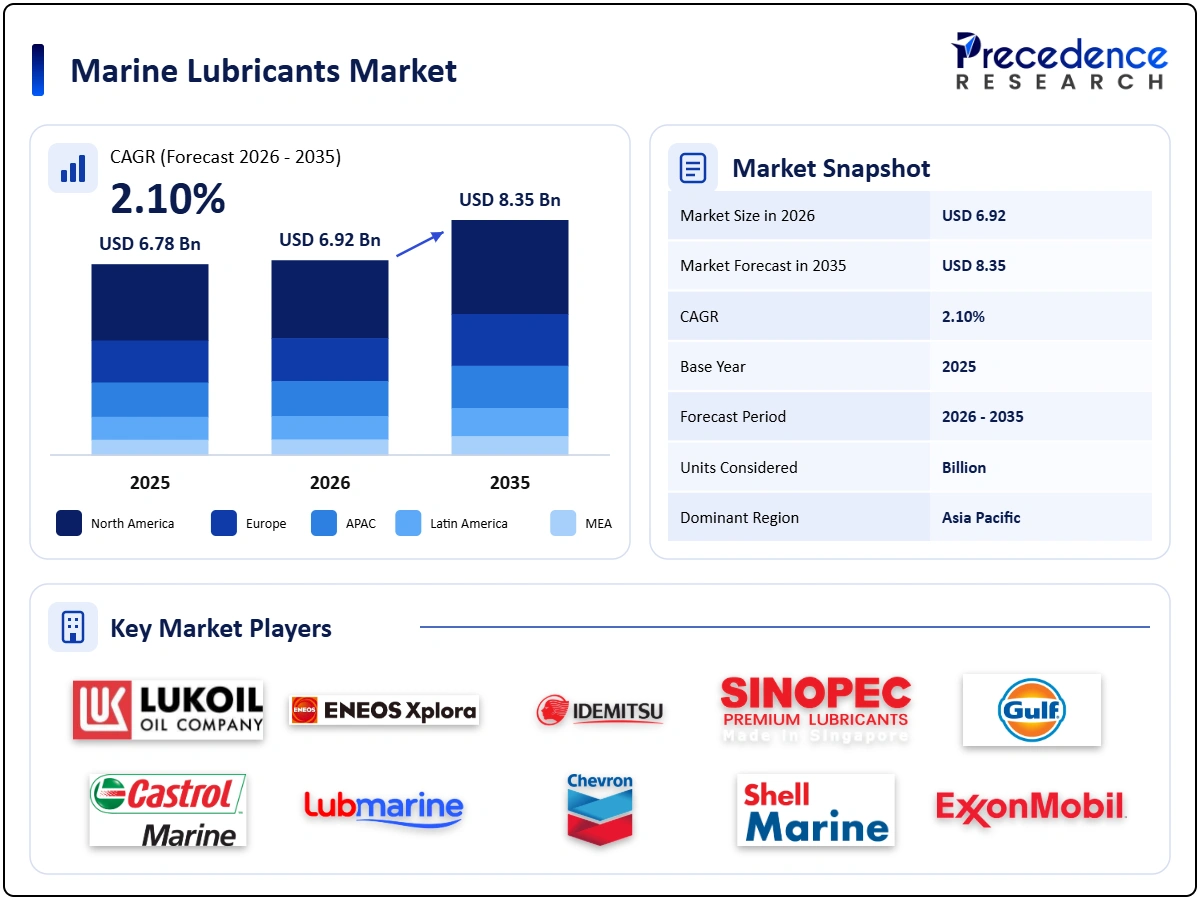
Vidyesh Swar, a Chemical and Materials Industry Expert, estimates the marine lubricants market at USD 6.92 billion in 2026, with the market projected to reach USD 8.35 billion by 2035 at a CAGR of 2.10%. Major marine lubricants market companies such as Shell Marine, ExxonMobil Marine, Chevron Marine Lubricants are competing across key material and application segments, including product type, base oil, ship Type and region.
Source: https://www.precedenceresearch.com/marine-lubricants-market
 Get a Sample
 Report Description
Key Takeaways
Market Size & Growth Outlook
- Market size in 2025: USD 6.78 billion
- Estimated market size in 2026: USD 6.92 billion
- Projected market size by 2035: USD 8.35 billion
- CAGR (2026-2035): 2.10%
Regional Market Spotlight
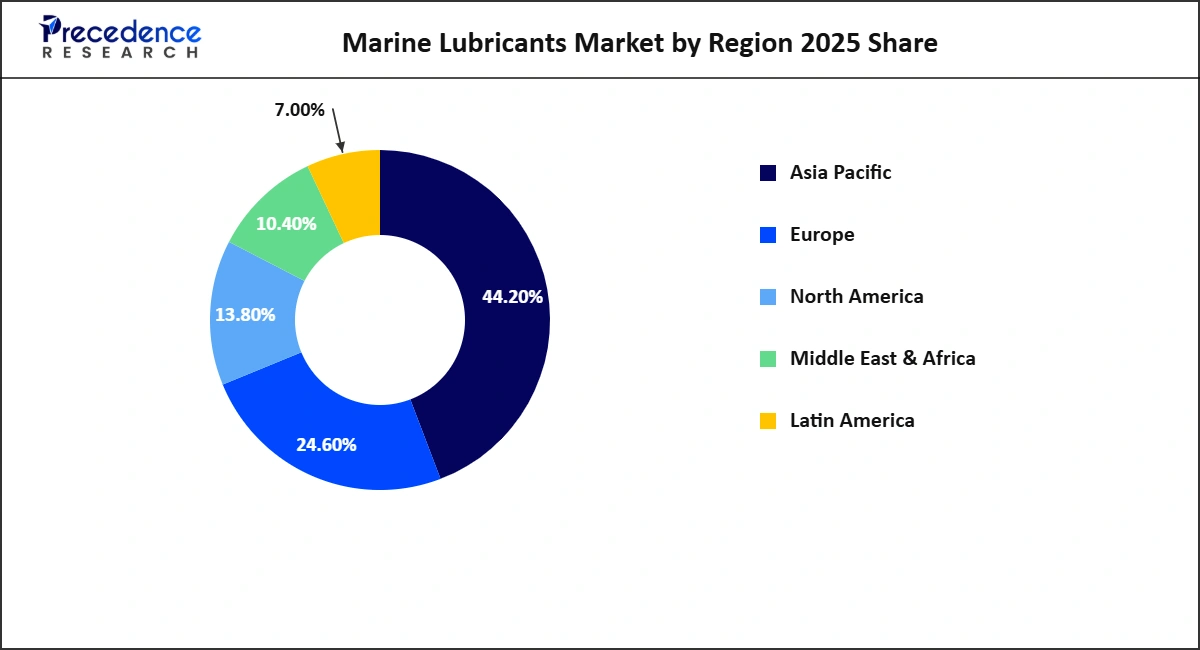
- Asia Pacific dominated the market with a 44.20% (USD 3.00 billion) share in 2025 and is forecasted to grow at the highest CAGR of 2.54% during the forecast period.
- Europe accounted for 24.60% (USD 1.67 billion) of revenue in 2025.
- North America held a market share of 13.80% (USD 0.94 billion) of the market in 2025.
Segmental Spotlight
- Engine oils accounted for 68.40% (USD 4.64 billion) of market share in the product type segment in 2025.
- By base oil, mineral oil held 78.60% (USD 5.33 billion) of revenue in 2025.
- By ship type, bulk Carriers accounted for a market share of 28.40% (USD 1.93 billion) in 2025.
Marine Lubricants Market Size and Forecast, 2025-2035 (USD Billion)
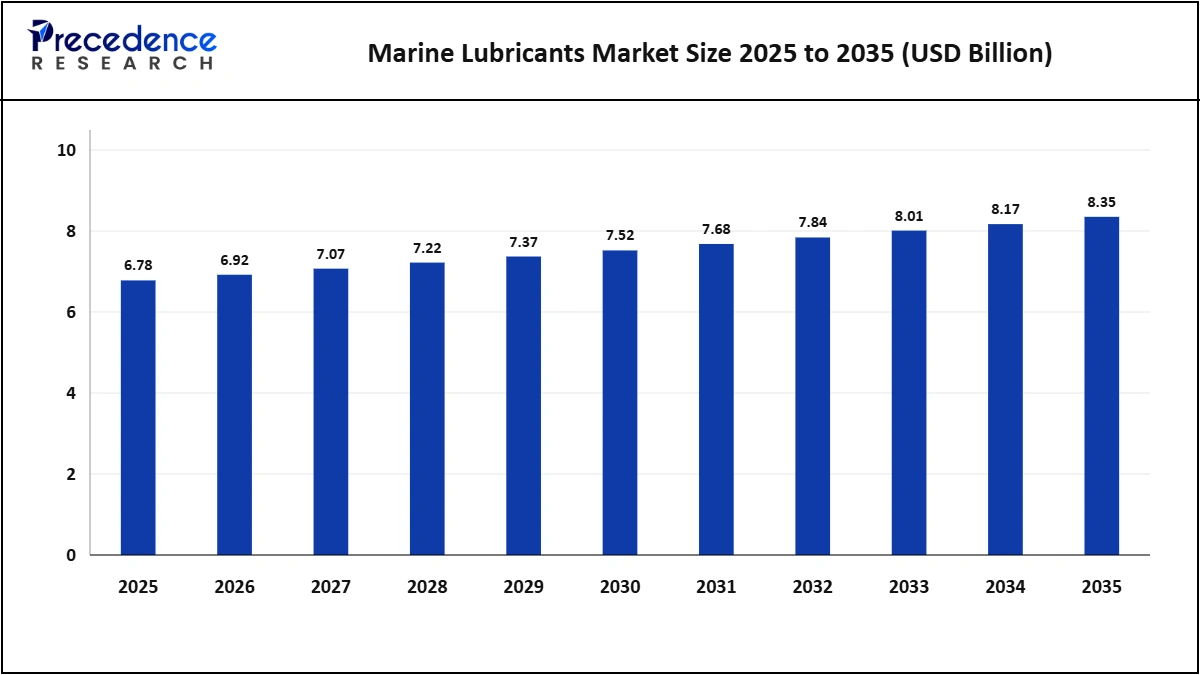
Note: 2025 is the base year; 2026-2035 values are forecasts.
Sources: Expert interviews, secondary sources, Precedence Research database and Precedence Research analysts.
The market is projected to expand from USD 6.78 billion in 2025 to USD 8.35 billion by the end of the forecast period, because every ocean-going ship consumes cylinder, system, and auxiliary engine oils continuously, so lubricant demand is tightly linked to fleet size, engine hours, and fuel choices. New fuels and environmental rules need higher-value specialized lubricants, lifting the market to USD 7.52 billion by 2030 and sustaining a CAGR of 2.10% from 2026 to 2035.
- Analyst View: We built the estimate from the world merchant fleet by ship type and engine type, mean lubricant consumption per vessel and operating day, and average lubricant prices by product, plus the demand for offshore, fishing, naval and inland vessels. Consumption reflects cylinder oil feed rates, system oil top-ups, trunk piston oil use and auxiliary equipment lubrication. The total was cross-checked against the marine lubricant revenue of major suppliers and against published estimates, which places our base year slightly above the comparable figures. The growth rate reflects fleet growth and higher-value lubricants. The demand for marine lubricants is being throttled by lower feed rates and fuel efficiency improvements.
Market Trends
- Fuel-economy engine oils support decarbonization.
- Lubricants are developed for methanol, ammonia and LNG engines.
- Cylinder oil BN is matched to low-sulfur fuels.
- Environmentally acceptable lubricants are being increasingly adopted.
- Digital oil analysis is being used to optimize feed rates.
- Asian supply hubs dominate deliveries.
Drivers, Restraints and Opportunities
Driver
Seaborne trade and the global merchant fleet are growing continuously. Every vessel needs a continuous supply of cylinder, system, and auxiliary engine oils. New fuels such as LNG, methanol and ammonia need specialized lubricants. Environmental regulations drive adoption of biodegradable lubricants in oil-to-sea interfaces. Fuel-saving lubricants assist shipowners in meeting efficiency and carbon intensity targets.
Restraint
Improved engine layouts and digital monitoring reduce cylinder oil feed rates. Slow steaming and trade disruptions can potentially lower engine running hours. There is a significant price competition among suppliers under fleet contracts. Fluctuations in base oil and additive prices put pressure on margins. Geopolitical disruptions affect shipping routes and port supply.
Opportunity
Lubricants for ammonia, methanol, and hydrogen-fueled engines create new product categories. Fuel-economy oils can support compliance with IMO carbon intensity regulations. Environmentally acceptable lubricants will be best positioned to secure adoption under increasingly stringent regulations. Condition monitoring and digital services can add value. New ship deliveries from Asian yards create initial fill demand.
Market Segmentation 2025 Share and Value
Marine Lubricants Market by Product Type 2025 Share
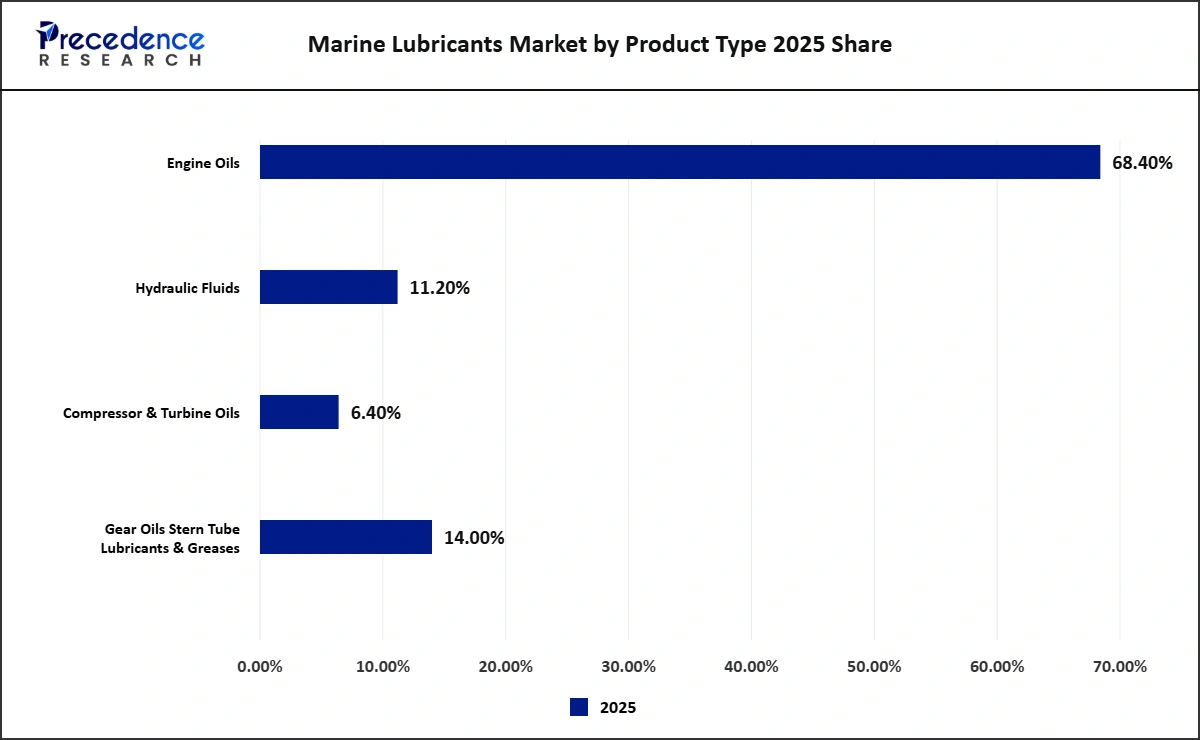
Note: 2025 is the base year.
Sources: Expert interviews, secondary sources, Precedence Research database and Precedence Research analysts.
The engine oils segment accounted for a 68.40% (USD 4.64 billion) share in 2025 because two-stroke main engines consume cylinder oil continuously, and four-stroke auxiliary and medium-speed engines use system and trunk piston oils that need regular top-ups and changes. Cylinder oil base numbers must match fuel sulfur content, so the shift to low-sulfur fuels and LNG has changed product mixes. Hydraulic fluids held 11.20% (USD 0.76 billion) of revenue, and serve deck machinery, steering and cranes. Compressor and turbine oils accounted for 6.40% (USD 0.43 billion), and gear oils, stern tube lubricants and greases account for 14.00% (USD 0.95 billion), with environmentally acceptable stern tube lubricants growing at the fastest rate under US and other regulations.
Marine Lubricants Market by Base Oil 2025 Share & Size
| Segments | 2025 Share | 2025 Market Value |
| Mineral Oil | 78.60% | USD 5.33 billion |
| Synthetic Oil | 14.20% | USD 0.96 billion |
| Bio-Based Oil | 7.20% | USD 0.49 billion |
Note: 2025 is the base year.
Sources: Expert interviews, secondary sources, Precedence Research database and Precedence Research analysts.
Mineral oil accounted for 78.60% (USD 5.33 billion) of revenue in 2025 because most marine engine oils use mineral base stocks for cost reasons. Synthetic oil held a market share of 14.20% (USD 0.96 billion), is used in compressors, gears, and demanding hydraulics applications, and bio-based oil, at 7.20% (USD 0.49 billion), is the fastest-growing base oil because environmentally acceptable lubricants are needed for oil-to-sea interfaces in many waters.
Marine Lubricants Market by Ship Type 2025 Share
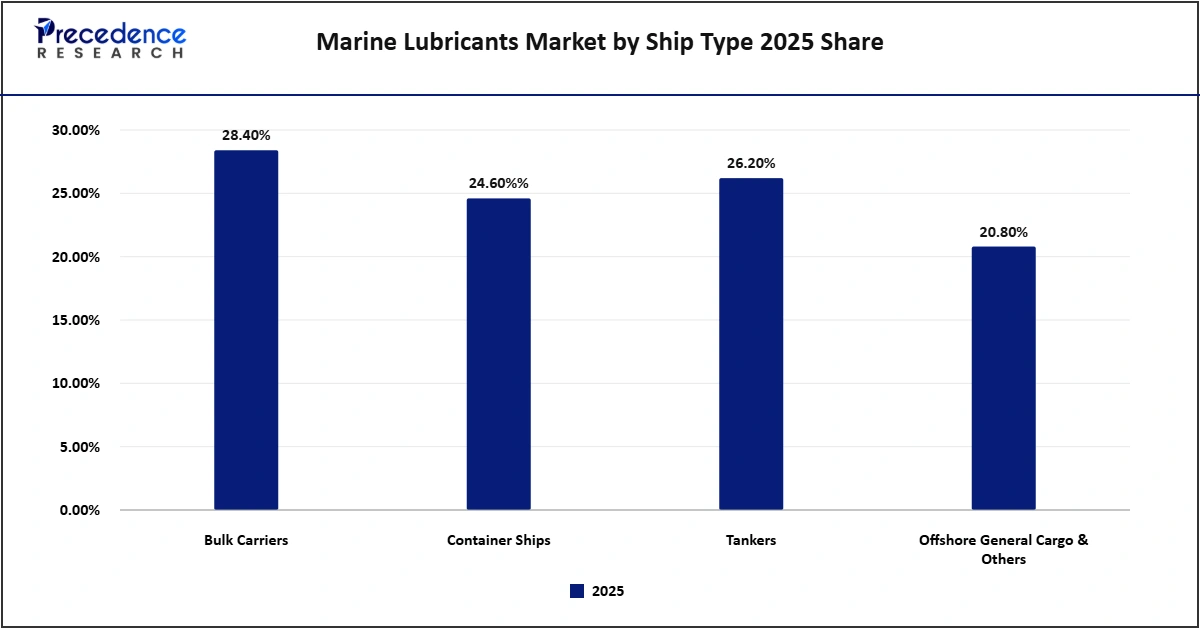
Note: 2025 is the base year.
Sources: Expert interviews, secondary sources, Precedence Research database and Precedence Research analysts.
Bulk carriers held a 28.40% (USD 1.93 billion) share in 2025, tankers accounted for 26.20% (USD 1.78 billion), container ships for 24.60% (USD 1.67 billion), and offshore, general cargo, and other vessels for 20.80% (USD 1.41 billion). Container ships are the fastest-growing ship type as new large vessels with dual-fuel engines are being increasingly adopted.
- Analyst View: Segment values were allocated by matching fleet, engine, and consumption data to products, base oils, and ship types, using supplier revenue mixes. Engine oils lead because of continuous cylinder and system oil use. We expect the market share of bio-based lubricants, container ships, and lubricants for new fuels to increase.
Regional Analysis
Marine Lubricants Market by Region 2025 Share
Note: 2025 is the base year.
Sources: Expert interviews, secondary sources, Precedence Research database and Precedence Research analysts.
Asia Pacific accounted for the largest market share of 44.20% (USD 3.00 billion) in 2025, and is growing at the fastest rate, owing to the fact that Singapore is the world's largest bunkering and marine lubricant supply hub, China, South Korea and Japan build most new ships, and the region's ports handle the largest share of global container and bulk trade.
Europe held 24.60% (USD 1.67 billion) of revenue, with the regional market ecosystem benefiting from major ports such as Rotterdam and Antwerp, large ship-owning groups and strict environmental rules. North America held a market share of 13.80% (USD 0.94 billion) and is supported by port calls, US environmental regulations for vessel lubricants, and naval and offshore demand. The Middle East and Africa, at 10.40% (USD 0.71 billion), is supported by hubs such as Fujairah, and Latin America, at 7.00% (USD 0.47 billion), is supported by ports in Brazil and Panama.
Asia Pacific dominated the market with 44.20% (USD 3.00 billion) of revenue in 2025 and is growing at the fastest rate. Singapore supplies massive volumes of marine lubricants to ships calling at the port. Chinese, Korean, and Japanese shipyards fill new vessels with initial lubricants. Trade growth in Asia drives fleet activity.
Europe accounted for a 24.60% (USD 1.67 billion) share in 2025. Rotterdam and Antwerp are major lubricant supply ports. European shipowners are early adopters of LNG, methanol and other alternative-fuel engines. EU environmental rules fuel demand for environmentally acceptable lubricants.
North America held a market share of 13.80% (USD 0.94 billion) in 2025. US rules require environmentally acceptable lubricants in oil-to-sea interfaces for many vessels. Offshore and naval vessels add demand. Houston and other Gulf Coast ports are some of the important supply points.
The Middle East and Africa accounted for 10.40% (USD 0.71 billion) of revenue in 2025. Fujairah is a major bunkering and supply hub. Offshore oil and gas activity adds demand for vessel lubricants.
Latin America held a 7.00% (USD 0.47 billion) share in 2025. Brazilian offshore support vessels and ports, and the Panama Canal route, drive regional market demand.
Analyst View: Regional shares were built from supply port volumes, fleet activity, and prices in each region. Asia Pacific leads because of Singapore's supply hub role and shipbuilding. We assign Asia Pacific the highest growth rate because trade and fleet activity are expanding fastest there.
Top 10 Companies in the Marine Lubricants Market
| Rank | Company Name | Market-Specific Revenue (USD Billion) | 2025 Share | Key Products / Business | Headquarters |
| 1 | Shell Marine | 1.24 | 18.29% | Alexia cylinder oils and Argina trunk piston oils | United Kingdom |
| 2 | ExxonMobil Marine | 1.02 | 15.04% | Mobilgard cylinder and engine oils | United States |
| 3 | Chevron Marine Lubricants | 0.86 | 12.68% | Taro cylinder oils and Delo marine oils | United States |
| 4 | TotalEnergies Lubmarine | 0.82 | 12.09% | Talusia cylinder oils and Aurelia trunk piston oils | France |
| 5 | Castrol Marine | 0.52 | 7.67% | Cyltech and TLX marine oils | United Kingdom |
| 6 | Gulf Oil Marine | 0.34 | 5.01% | GulfSea marine lubricants | United Kingdom |
| 7 | Sinopec Lubricant | 0.32 | 4.72% | Great Wall marine oils | China |
| 8 | Idemitsu Kosan | 0.22 | 3.24% | Daphne marine oils | Japan |
| 9 | ENEOS | 0.20 | 2.95% | Marine engine oils | Japan |
| 10 | LUKOIL Marine Lubricants | 0.16 | 2.36% | Navigo marine oils | Russia |
Note: Company revenues and shares are 2025 estimates.
Sources: Company press releases, expert interviews, secondary sources, Precedence Research database and Precedence Research analysts.
Shell dominated the market with 18.29% (USD 1.24 billion) of revenue in 2025, followed by ExxonMobil at 15.04% (USD 1.02 billion) and Chevron at 12.68% (USD 0.86 billion). Shell Marine leads with its Alexia cylinder oils and Argina trunk piston oils, supplied at hundreds of ports across the world and approved by major engine makers for conventional, LNG and dual-fuel engines. ExxonMobil Marine and Chevron Marine Lubricants are close competitors with Mobilgard and Taro ranges, broad port coverage and technical services such as used oil analysis and cylinder condition monitoring.
TotalEnergies Lubmarine introduced its Aurelia FE fuel-economy trunk piston oil in September 2026, while Castrol, Gulf Oil Marine, Sinopec, Idemitsu, ENEOS and LUKOIL compete through regional strengths and fleet supply contracts. The top 10 companies held an 84.07% (USD 5.70 billion) share in 2025, while the remaining 15.93% (USD 1.08 billion) was shared among regional marine lubricant suppliers, national oil company lubricant arms and specialty environmentally acceptable lubricant manufacturers. The market is concentrated among a few global suppliers, owing to the fact that shipowners need consistent products and technical support at ports across the globe. Competition revolves around engine manufacturer approvals, port availability, products matched to new fuels, condition monitoring services, environmentally acceptable lubricants, and price under fleet supply contracts.
Recent Developments
- March 2025: TotalEnergies Lubmarine reported that an experimental fuel-economy trunk piston engine oil completed year-long sea trials, reducing the consumption of fuel by about 4% depending on operating conditions, and was open for engine manufacturer approvals.
- September 2026: TotalEnergies Lubmarine unveiled Aurelia FE, a fuel-economy trunk piston engine oil for four-stroke medium-speed marine engines, with laboratory tests demonstrating about 1.5% lower fuel consumption as compared to the IMO E3 cycle.
Marine Lubricants Market Segments
By Product Type
- Engine Oils
- Hydraulic Fluids
- Compressor & Turbine Oils
- Gear Oils, Stern Tube Lubricants & Greases
By Base Oil
- Mineral Oil
- Synthetic Oil
- Bio-Based Oil
By Ship Type
- Bulk Carriers
- Container Ships
- Tankers
- Offshore, General Cargo & Others
By Region
- North America (U.S., Canada, Mexico)
- Europe (Germany, U.K., France, Italy, Spain, Rest of Europe)
- Asia Pacific (China, Japan, India, South Korea, Taiwan, Rest of Asia Pacific)
- Latin America (Brazil, Argentina, Rest of Latin America)
- Middle East & Africa (GCC, South Africa, Rest of MEA)
Research Methodology
The market is defined as marine cylinder, system and trunk piston oils, hydraulic, compressor, turbine and gear oils, stern tube lubricants and greases, across the world. The 2025 base year was built bottom-up from fleet by ship and engine type, lubricant consumption per vessel and average prices, and checked top-down against the marine lubricant revenue of major suppliers. Segment, regional and company values were allocated from product types, base oils, ship types and regional demand. Key estimates were verified by cross-checking company disclosures, regulatory and industry data and published third-party estimates, and inputs that could not be reconciled were excluded. All segment, regional and company figures were reconciled to the same 2025 base year, and the 2026–2035 forecast, which applies a constant CAGR from the 2025 base, was recalculated and validated.
Analyst View: Overall Market
The market has a well-established ecosystem and exhibits a gradual growth rate tied to fleet size and engine operation, with value shifts driven by new fuels, efficiency and environmental rules. Our estimate connects demand to fleet, consumption, and price data, so the forecast follows trade, fleet renewal, and fuel transitions. The market benefits from the use of lubricants for new fuels and fuel-economy oils, while the main risks are lower feed rates and trade disruptions.
Sources and References
- Riviera Maritime Media. "Lubricant breakthroughs cut fuel consumption". 2025-03-21. Fuel-economy trunk piston oil trials. https://www.rivieramm.com/news-content-hub/lubricant-breakthroughs-cut-fuel-consumption-84276
- Hydrocarbon Processing. "TotalEnergies Lubmarine launches Aurelia FE". 2026-09. Aurelia FE launch. https://hydrocarbonprocessing.com/news/2026/09/totalenergies-lubmarine-launches-aurelia-fe-an-innovative-fuel-economy-lubricant-for-4-stroke-medium-speed-marine-engines/
For inquiries regarding discounts, bulk purchases, or customization requests, please contact us at sales@precedenceresearch.com
Frequently Asked Questions
Tags





Ask For Sample
No cookie-cutter, only authentic analysis – take the 1st step to become a Precedence Research client
 Get a Sample




 sales@precedenceresearch.com
 Schedule a Meeting
