



Molecular Diagnostics Pharmacogenomics Market Trends, Leading Companies, Company Revenue / Sales Performance, Procedure Volume, Healthcare Spending, Technology Adoption, Reimbursement Analysis, Competitive Landscape, and Growth Outlook
Payal Rabde, a Healthcare Industry Expert, highlights that the molecular diagnostics pharmacogenomics market has reached USD 8.44 billion by 2026 to USD 21.25 billion by 2035, growing at a CAGR of 10.80%. Key molecular diagnostics pharmacogenomics market companies shaping the market include Thermo Fisher Scientific, Illumina, Roche, QIAGEN, while major growth segments span offering, technology, application, end user and region.
Source: https://www.precedenceresearch.com/molecular-diagnostics-pharmacogenomics-market
 Get a Sample
 Report Description


Molecular Diagnostics Pharmacogenomics Market Trends, Share, and Growth Analysis 2035
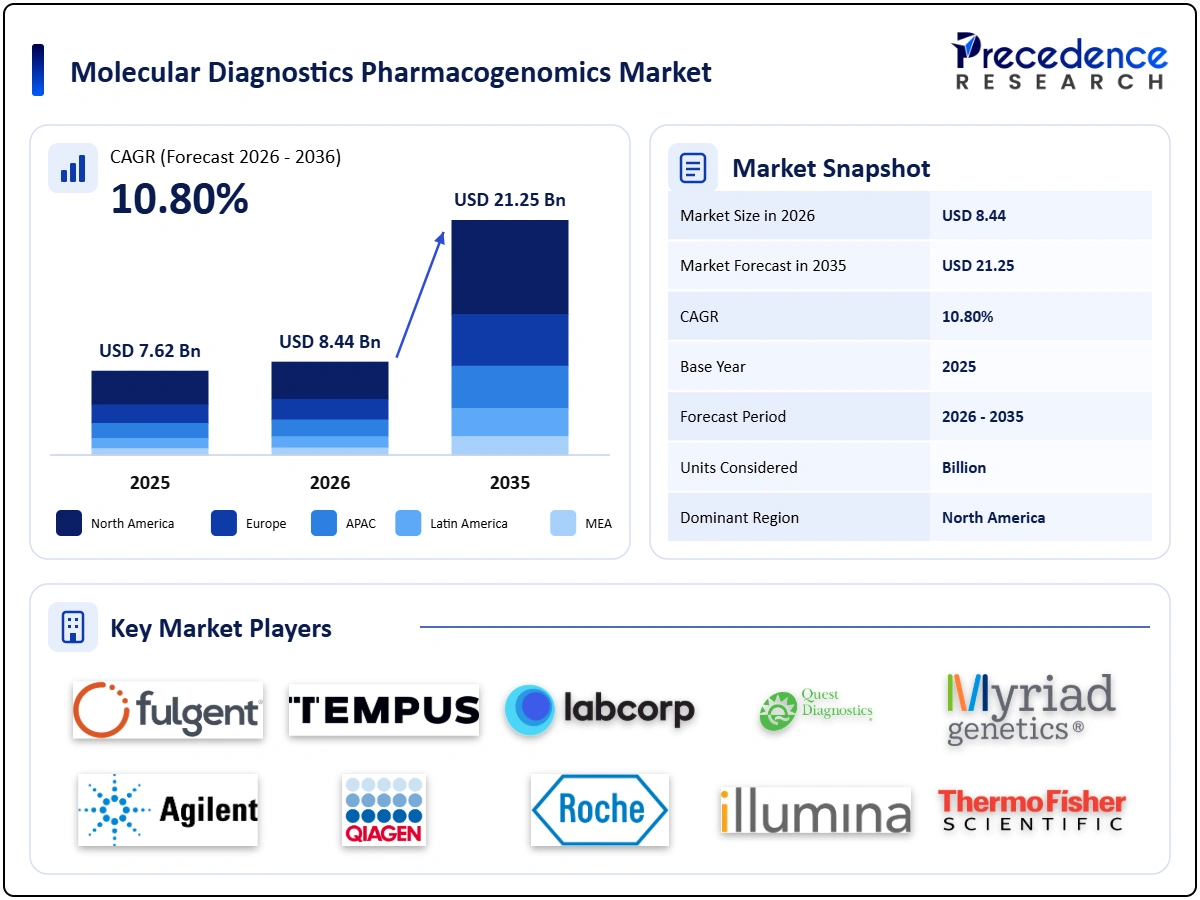
The molecular diagnostics pharmacogenomics market is forecasted to expand from USD 8.44 billion by 2026 to USD 21.25 billion by 2035, growing at a CAGR of 10.80% from 2026 to 2035.
 Key Takeaways
Market Size & Growth Outlook
- Market Size in 2025: USD 7.62 billion
- Expected Market Size in 2026: USD 8.44 billion
- Projected Market Size by 2035: USD 21.25 billion
- CAGR (2026-2035): 10.80%
Regional Market Spotlight
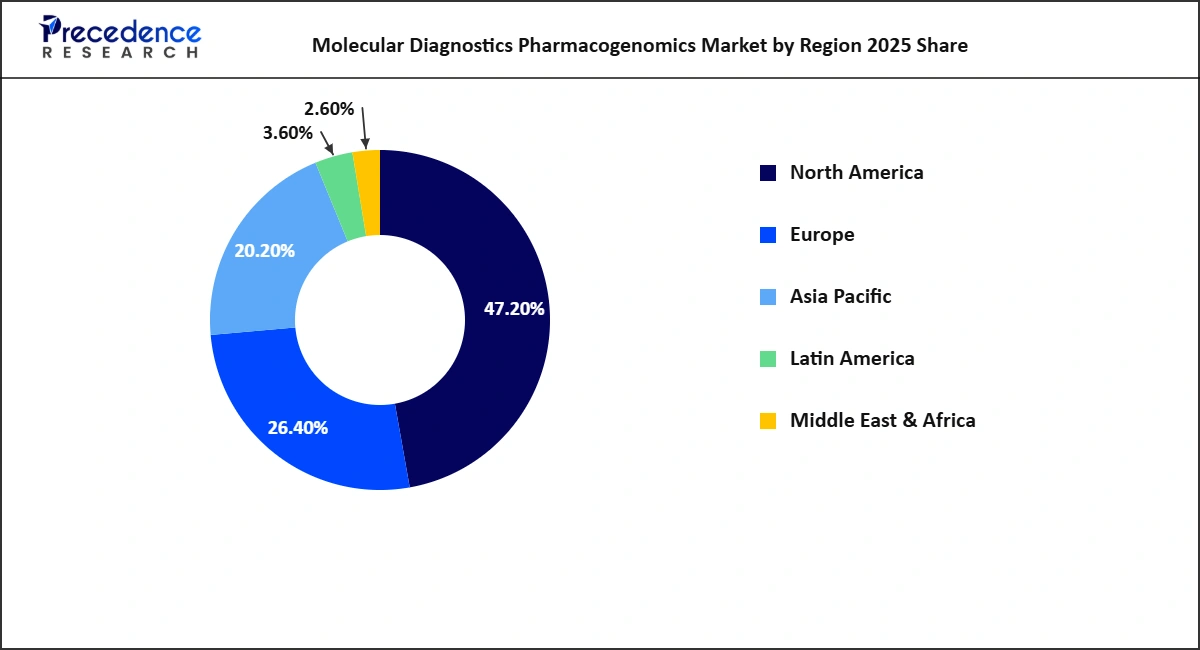
- North America led the market with a prominent share of 47.20% (USD 3.60 billion) in 2025.
- Europe accounted for 26.40% share and was valued at USD 2.01 billion in 2025.
- Asia Pacific held 20.20% of the market share and reached USD 1.54 billion in 2025 and is projected to be the fastest-growing region, at a CAGR of 12.55% from 2026 to 2035.
Segmental Spotlight
- By offering, the Products segment accounted for the largest share of 64.80% (USD 4.94 billion) in 2025.
- By technology, the Sequencing segment captured 41.20% share and was valued at USD 3.14 billion in 2025.
- By application, Oncology accounted for 34.80% (USD 2.65 billion) of the market share in 2025.
- By end user, the Hospitals & Clinics segment held 38.60% of the market share and reached USD 2.94 billion in revenue in 2025.
Molecular Diagnostics Pharmacogenomics Market Size and Forecast, 2025-2035 (USD Billion)
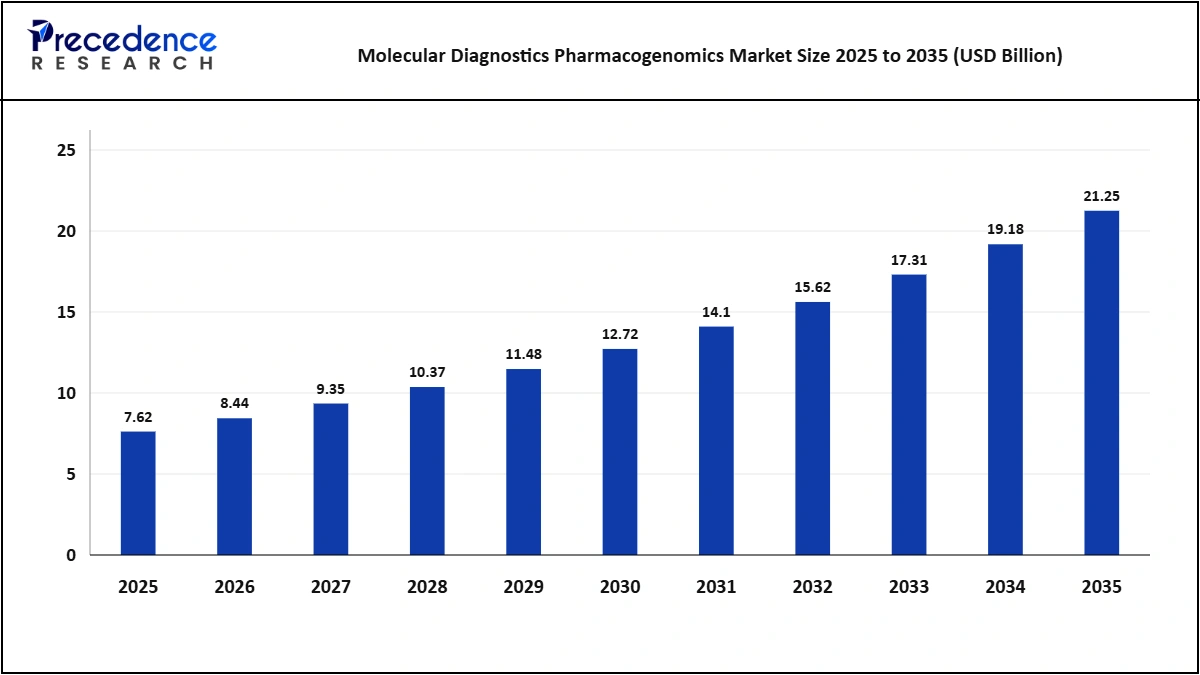
Note: 2025 is the base year; 2026-2035 values are forecasts.
Sources: Expert interviews, secondary sources, Precedence Research database, and Precedence Research analysts.
The molecular diagnostics pharmacogenomics market is estimated to grow from USD 7.62 billion in 2025 to USD 21.25 billion by 2035 because clinicians use pharmacogenomic tests to choose drugs and doses that reduce side effects and improve response, and drug developers use them to stratify trial patients. Expanding drug labels, clinical guidelines, and multigene panels increase testing volumes, lifting the market to USD 12.72 billion by 2030 and sustaining a CAGR of 10.80% over the forecast period.
- Analyst View: The market estimate is based on annual pharmacogenomic testing volumes across clinical applications and regions, multiplied by average test prices, alongside revenue from kits, instruments, software, and services for laboratories and drug developers. The figure was validated against molecular diagnostics and laboratory company revenues and published market reports. Growth is driven by expanding drug labels, broader reimbursement, and declining sequencing costs, although inconsistent payer coverage remains a key constraint.
Market Trends
- DPYD testing expands before fluoropyrimidine chemotherapy.
- Oncology companies add germline PGx to tumor profiling.
- Multigene panels replace single-gene tests.
- Decision-support software links results in prescribing.
- High-throughput PCR kits bring CYP2C19 testing to hospital laboratories.
- Health systems adopt pre-emptive PGx testing.
Drivers, Restraints and Opportunities
Driver
Adverse drug reactions cause significant harm and cost, and pharmacogenomic tests help clinicians avoid drugs and doses that patients cannot safely metabolize. FDA labeling updates, including recommendations for DPYD testing before fluoropyrimidines, are increasing clinical demand. Clinical guidelines from expert groups give actionable recommendations for many gene-drug pairs. Falling sequencing costs make multigene panels affordable. Precision medicine programs in oncology, psychiatry, and cardiology are expanding.
Restraint
Reimbursement for pharmacogenomic testing remains inconsistent across payers and countries. Many clinicians lack training in interpreting PGx results. Evidence of outcome benefit is still debated for some applications, such as antidepressant selection. Integration of results into electronic health records and prescribing systems is often limited. Turnaround times can be too slow for urgent prescribing decisions.
Opportunity
Pre-emptive testing, where results are stored for lifetime use, could greatly increase test volumes. Point-of-care and rapid PCR tests can support urgent decisions such as clopidogrel use after stroke. Decision-support software and AI can make results easier to apply. Testing for responses to newer drug classes, including GLP-1 therapies, is emerging. Growing genomics medicine programs in Asia Pacific and the Middle East offer expansion.
Molecular Diagnostics Pharmacogenomics Market Segmentation: 2025 Share and Value
Molecular Diagnostics Pharmacogenomics Market By Offering 2025 Share
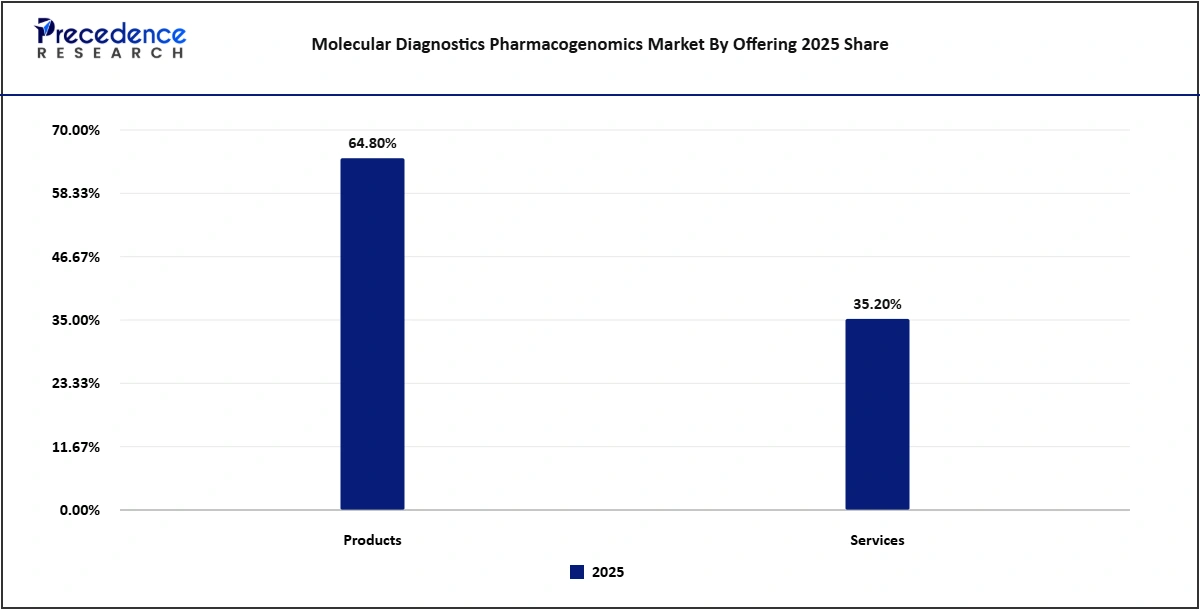
Note: 2025 is the base year.
Sources: Expert interviews, secondary sources, Precedence Research database, and Precedence Research analysts.
Products segment accounted for 64.80% share and valued at USD 4.94 billion in 2025 because laboratories purchase reagents, kits, arrays, and instruments to run pharmacogenomic assays, and each test consumes reagents that generate recurring revenue. Leading platform suppliers sell genotyping kits and sequencing chemistries that are used for both research and clinical PGx testing. Services, at 35.20% share (USD 2.68 billion), are the fastest-growing offering because reference laboratories, specialty testing companies and contract research organizations provide end-to-end testing, interpretation and decision-support reports, and drug developers outsource genotyping for clinical trials.
Molecular Diagnostics Pharmacogenomics Market By Technology 2025 Share & Size
| Segments | 2025 Share | 2025 Market Value |
| Polymerase Chain Reaction (PCR) | 36.40% | USD 2.77 billion |
| Sequencing | 41.20% | USD 3.14 billion |
| Microarray | 12.60% | USD 0.96 billion |
| Others | 9.80% | USD 0.75 billion |
Note: 2025 is the base year.
Sources: Expert interviews, secondary sources, Precedence Research database, and Precedence Research analysts.
Sequencing accounted for 41.20% (USD 3.14 billion) of the market share in 2025 because next-generation sequencing panels can assess many pharmacogenes at once and detect rare variants, and falling costs make broad panels affordable. Sequencing is also the fastest-growing technology as oncology laboratories combine germline PGx with tumor profiling. Polymerase Chain Reaction (PCR), at 36.40% (USD 2.77 billion), remains widely used for targeted single-gene tests such as CYP2C19 and DPYD because it is fast, low-cost, and suited to hospital laboratories. Microarrays held 12.60% share (USD 0.96 billion) and serve high-volume genotyping, while other technologies, including mass spectrometry-based genotyping, account for 9.80% share (USD 0.75 billion) in 2025.
Molecular Diagnostics Pharmacogenomics Market By Application 2025 Share
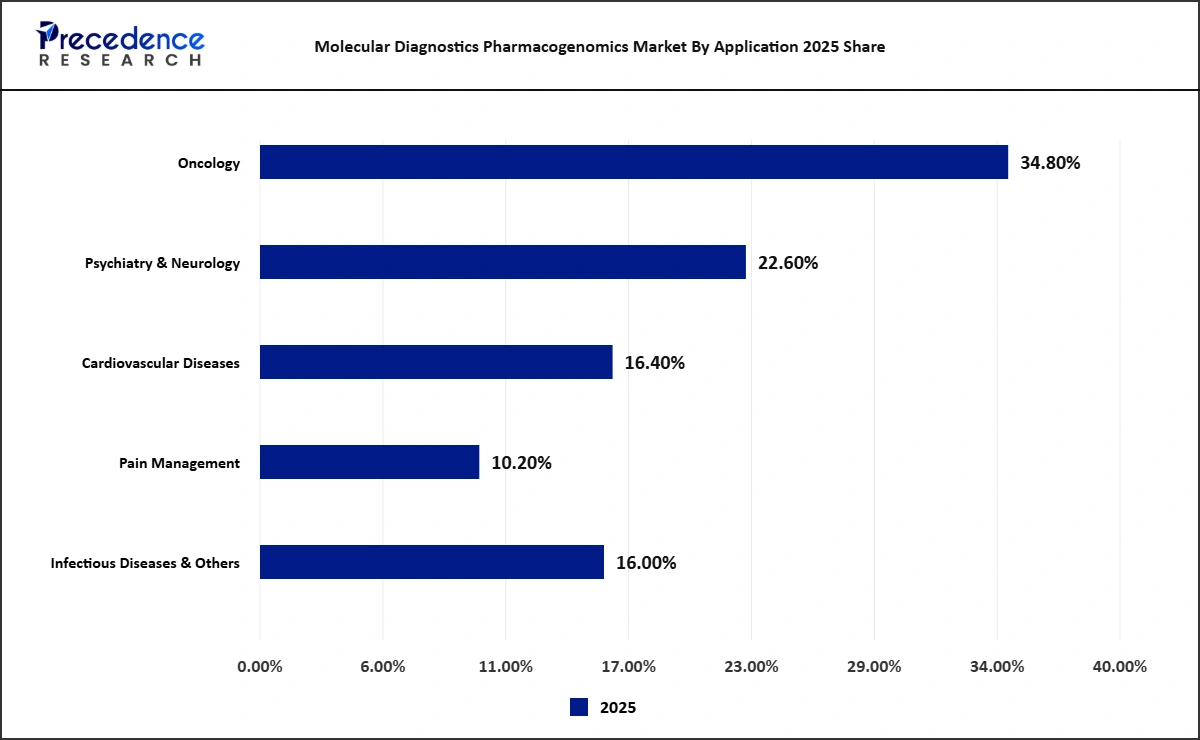
Note: 2025 is the base year.
Sources: Expert interviews, secondary sources, Precedence Research database, and Precedence Research analysts.
Oncology segment held the largest share of 34.80% and valued at USD 2.65 billion in 2025 because tests for genes such as DPYD, UGT1A1, and TPMT help prevent severe toxicity from chemotherapy, and FDA labeling now recommends DPYD testing before common fluoropyrimidine therapies. Psychiatry & neurology, at 22.60% (USD 1.72 billion), are the fastest-growing application areas as multigene panels guide antidepressant and antipsychotic choices. Cardiovascular diseases account for 16.40% share and reach USD 1.25 billion in 2025, led by CYP2C19 testing for clopidogrel. Pain management accounts for 10.20% (USD 0.78 billion) and infectious diseases & others account for 16.00% (USD 1.22 billion) of the market share in 2025.
Molecular Diagnostics Pharmacogenomics Market By End User 2025 Share & Size
| Segments | 2025 Share | 2025 Market Value |
| Hospitals & Clinics | 38.60% | USD 2.94 billion |
| Reference & Diagnostic Laboratories | 32.40% | USD 2.47 billion |
| Pharmaceutical & Biotechnology Companies | 18.80% | USD 1.43 billion |
| Academic & Research Institutes | 10.20% | USD 0.78 billion |
Note: 2025 is the base year.
Sources: Expert interviews, secondary sources, Precedence Research database, and Precedence Research analysts.
Hospitals & clinics accounted for 38.60% (USD 2.94 billion) share in 2025 because large health systems are building pre-emptive PGx programs and in-house testing. Reference & diagnostic laboratories held 32.40% share (USD 2.47 billion) and run most panel testing ordered by physicians. Pharmaceutical & biotechnology companies account for 18.80% share, valued at USD 1.43 billion, and use PGx in drug development and companion diagnostics, while academic & research institutes account for 10.20% (USD 0.78 billion) in 2025.
- Analyst View: Segment values were allocated by matching test volumes and prices to offerings, technologies, clinical areas, and end users, using laboratory and supplier revenue mixes. Products lead because every test consumes reagents, and sequencing leads technology because panel testing carries higher value per test. We expect services, sequencing, and psychiatry to gain share as panel testing and interpretation services expand.
Regional Analysis
Molecular Diagnostics Pharmacogenomics Market by Region 2025 Share
Note: 2025 is the base year.
Sources: Expert interviews, secondary sources, Precedence Research database, and Precedence Research analysts.
North America region held the largest share of 47.20% (USD 3.60 billion) in 2025, supported by large reference laboratories, FDA labeling that cites pharmacogenomic biomarkers, health-system PGx programs, and growing payer coverage for selected tests. Europe, at 26.40% (USD 2.01 billion), is supported by national genomic medicine services, DPYD testing recommendations, and growing CYP2C19 testing in stroke care. Asia Pacific region captures a 20.20% share (USD 1.54 billion) and is projected to be the fastest-growing region, supported by HLA testing practices and expanding genomic medicine in China, Japan, and South Korea. Also, supported by large patient populations. Latin America, at 3.60% (USD 0.27 billion), and the Middle East & Africa, at 2.60% (USD 0.20 billion), are smaller markets where testing is concentrated in private laboratories and academic centers.
North America accounted for 47.20% share (USD 3.60 billion) in 2025. Large reference laboratories such as Quest and Labcorp offer multigene PGx panels, and many academic health systems run pre-emptive testing programs. The presence of FDA labeling updates, including DPYD testing recommendations, is increasing clinical demand.
Europe held 26.40% share and was valued at USD 2.01 billion in 2025. National genomic services, including the NHS Genomic Medicine Service, are adding pharmacogenomic testing. DPYD testing before fluoropyrimidine chemotherapy is recommended in many countries. CYP2C19 testing in stroke care is expected to expand as high-throughput laboratory kits gain certification.
Asia Pacific region is growing at 20.20% share (USD 1.54 billion) in 2025 and is the fastest-growing region. HLA-B testing before certain drugs is established practice in several Asian countries. China, Japan, and South Korea are investing in genomic medicine and laboratory capacity. Large patient populations and falling sequencing costs support faster growth.
Latin America is estimated to grow at 3.60% share (USD 0.27 billion) in 2025. Testing is concentrated in private laboratories and oncology centers in Brazil, Mexico, and Argentina. Limited reimbursement policy slows adoption, although awareness among oncologists and psychiatrists is growing.
The Middle East & Africa accounted for 2.60% share and reached USD 0.20 billion in 2025. National genome programs in Gulf countries are building pharmacogenomic capability. Elsewhere, testing is limited to academic and private laboratories.
Analyst View: Regional shares were built from test volumes, prices, and laboratory capacity in each region. North America leads because of laboratory scale, FDA, and payer coverage. We project Asia Pacific to have the highest growth premium because genomic medicine investment and testing adoption are expanding fastest in this region.
Top 10 Players in the Molecular Diagnostics Pharmacogenomics Market
| Rank | Company Name | Market-Specific Revenue (USD Billion) | 2025 Share | Key Products / Business | Headquarters |
| 1 | Thermo Fisher Scientific | 0.64 | 8.40% | TaqMan genotyping assays, PharmacoScan arrays and QuantStudio Dx PCR systems | United States |
| 2 | Illumina | 0.48 | 6.30% | Sequencing systems and PGx panels | United States |
| 3 | Roche | 0.36 | 4.72% | cobas molecular diagnostic and sequencing platforms | Switzerland |
| 4 | QIAGEN | 0.30 | 3.94% | PCR and sample preparation solutions for PGx | Netherlands |
| 5 | Agilent Technologies | 0.26 | 3.41% | Target enrichment and microarray solutions | United States |
| 6 | Myriad Genetics | 0.24 | 3.15% | GeneSight psychotropic test | United States |
| 7 | Quest Diagnostics | 0.20 | 2.62% | Advanced PGx panel testing services | United States |
| 8 | Labcorp | 0.18 | 2.36% | Pharmacogenomic testing and drug development services | United States |
| 9 | Tempus AI | 0.12 | 1.57% | OneOme RightMed PGx tests | United States |
| 10 | Fulgent Genetics | 0.10 | 1.31% | PGx testing services and partner laboratory testing | United States |
Note: Company revenues and shares are 2025 estimates.
Sources: Company press releases, expert interviews, secondary sources, Precedence Research database and Precedence Research analysts.
Thermo Fisher Scientific led the molecular diagnostics pharmacogenomics market with an estimated 8.40% share and USD 0.64 billion of 2025 revenue, followed by Illumina at 6.30% (USD 0.48 billion) and Roche at 4.72% (USD 0.36 billion). Thermo Fisher Scientific leads because its TaqMan genotyping assays, PharmacoScan arrays, and QuantStudio Dx PCR systems are widely used in clinical and research pharmacogenomic laboratories, and its platforms form the base for partner tests such as high-throughput CYP2C19 kits. Illumina and Roche supply the sequencing and molecular platforms on which laboratories build broad PGx and oncology panels, supported by large installed bases worldwide. QIAGEN and Agilent Technologies provide PCR, sample preparation, target enrichment and array tools, while Myriad Genetics, Quest Diagnostics, Labcorp, Tempus AI, and Fulgent Genetics generate service revenue from clinical PGx testing in psychiatry, oncology, and other specialties. The top 10 companies accounted for an estimated 37.78% share and USD 2.88 billion of 2025 revenue, while the remaining 62.22% share (USD 4.74 billion) was shared among specialty PGx laboratories, decision-support software providers, and regional molecular diagnostic organizations. The molecular diagnostics pharmacogenomics market combines platform suppliers with testing laboratories, and competition centers on panel breadth, turnaround time, interpretation and clinical decision support, reimbursement, and integration with health records. Partnerships between platform manufacturers, oncology testing companies and reference laboratories are widening access, while consolidation, such as Tempus's acquisition of OneOme, is bringing PGx into broader precision medicine platforms.
Recent Developments
- September 2025: Quest Diagnostics launched an advanced pharmacogenomic test service developed in collaboration with Coriell Life Sciences, covering 17 genes and 4 HLA alleles. The service gives genetic insights and personalized medication guidance to help clinicians make more informed drug selection and dosing decisions.
- June 2026: Genedrive announced a collaboration with Thermo Fisher Scientific to develop a high-throughput CYP2C19 pharmacogenetic in vitro diagnostic test on the QuantStudio 5 Dx PCR platform, targeting UKCA certification by the end of 2026 for NHS genomic laboratories.
- July 2026: Tempus AI announced the national launch of OneOme pharmacogenomics testing, advancing patient safety and precision medicine, including the 27-gene RightMed Comprehensive test and standalone DPYD and UGT1A1 tests, following Tempus's acquisition of OneOme in November 2025.
Molecular Diagnostics Pharmacogenomics Market Segments
By Offering
- Products
- Services
By Technology
- Polymerase Chain Reaction (PCR)
- Sequencing
- Microarray
- Others
By Application
- Oncology
- Psychiatry & Neurology
- Cardiovascular Diseases
- Pain Management
- Infectious Diseases & Others
By End User
- Hospitals & Clinics
- Reference & Diagnostic Laboratories
- Pharmaceutical & Biotechnology Companies
- Academic & Research Institutes
By Region
- North America (U.S., Canada, Mexico)
- Europe (Germany, U.K., France, Italy, Spain, Rest of Europe)
- Asia Pacific (China, Japan, India, South Korea, Taiwan, Rest of Asia Pacific)
- Latin America (Brazil, Argentina, Rest of Latin America)
- Middle East & Africa (GCC, South Africa, Rest of MEA)
Research Methodology
The molecular diagnostics pharmacogenomics market was defined as PCR, sequencing, microarray, and other molecular pharmacogenomic tests, kits, instruments, software, and services for clinical and research use. The 2025 base year was built bottom-up from test volumes by clinical area and region, average test prices and laboratory product sales, and checked top-down against the pharmacogenomic revenue of molecular diagnostic companies and testing laboratories. Segment, regional, and company values were allocated from offerings, technologies, applications, end users, and regional demand. Key estimates were verified by cross-checking company disclosures, regulatory and industry data, and published third-party estimates, and inputs that could not be reconciled were excluded. All segment, regional, and company figures were reconciled to the same 2025 base year, and the 2026-2035 forecast, which applies a constant CAGR from the 2025 base, was recalculated and validated.
Analyst View: Overall Market
The molecular diagnostics pharmacogenomics market is moving from niche single-gene testing to routine panel testing supported by drug labels and guidelines. Our estimate links demand to evaluate volumes, prices, and laboratory product sales, so the forecast follows label changes, reimbursement, and sequencing costs. The main upside comes from pre-emptive testing and oncology integration, while the main risks are uneven reimbursement policy and limited clinician adoption.
Sources and References
- Investor Meet Company Ltd. "Genedrive partners with Thermo Fisher on NHS testing". 2026-06-29. CYP2C19 HT kit collaboration.
(Source: investegate.co.uk) - Tempus. "Tempus Announces National Launch of OneOme Pharmacogenomics Testing". 2026-07-22. OneOme national launch. (Source: tempus.com)
For inquiries regarding discounts, bulk purchases, or customization requests, please contact us at sales@precedenceresearch.com
Frequently Asked Questions





Ask For Sample
No cookie-cutter, only authentic analysis – take the 1st step to become a Precedence Research client
 Get a Sample




 sales@precedenceresearch.com
 Schedule a Meeting
