



Network Point-of-Care Glucose Testing Market Trends, Leading Companies, Company Revenue / Sales Performance, Procedure Volume, Healthcare Spending, Technology Adoption, Reimbursement Analysis, Competitive Landscape, and Growth Outlook
Payal Rabde, a Healthcare Industry Expert, highlights that the network point-of-care glucose testing market has reached USD 1.62 billion in 2026 to USD 2.51 billion by 2035, growing at a CAGR of 5%. Key network point-of-care glucose testing market companies shaping the market include Roche Diagnostics, Nova Biomedical, Abbott, Siemens Healthineers while major growth segments span product, connectivity, application, end user and region.
Source: https://www.precedenceresearch.com/network-point-of-care-glucose-testing-market
 Get a Sample
 Report Description


Network Point of Care Glucose Testing Market Size, Share, Trends, and Forecast Analysis 2035
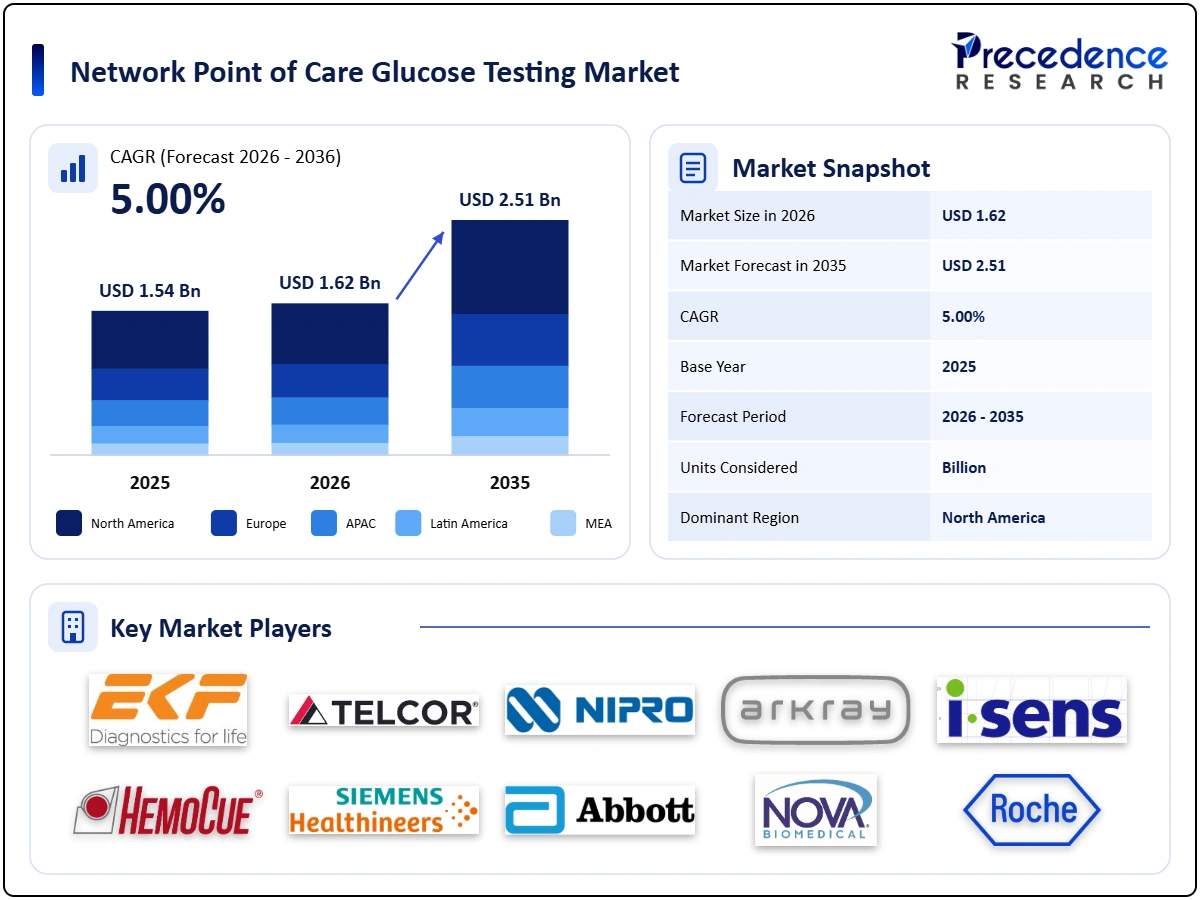
The network point-of-care glucose testing market is forecasted to expand from USD 1.62 billion in 2026 to USD 2.51 billion by 2035, growing at a CAGR of 5% from 2026 to 2035.
Key Takeaways
Market Size & Growth Outlook
- Market Size in 2025: USD 1.54 billion
- Estimated Market Size in 2026: USD 1.62 billion
- Expected Market Size by 2035: USD 2.51 billion
- CAGR (2026-2035): 5%
Regional Market Spotlight
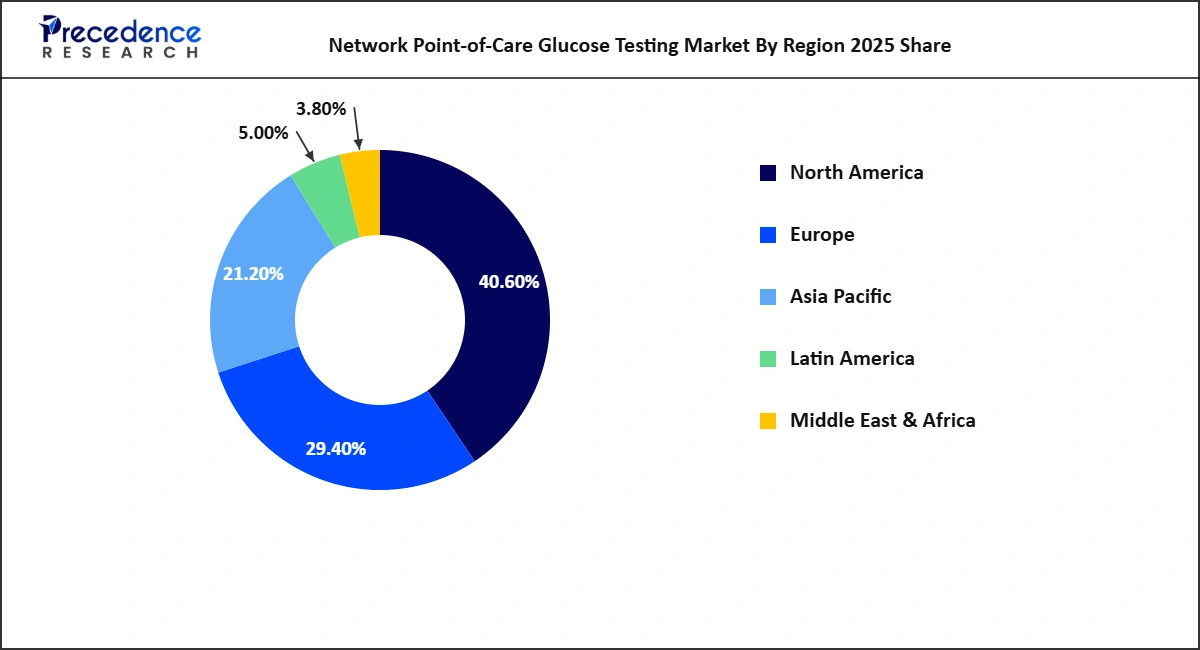
- North America led the market with the largest share of 40.60% (USD 0.63 billion) in 2025.
- Europe accounted for 29.40% share and was valued at USD 0.45 billion in 2025.
- Asia Pacific held 21.20% share and reached USD 0.33 billion in 2025 and is projected to be the fastest-growing region, at a CAGR of 6.86% from 2026 to 2035.
Segmental Spotlight
- By product, Test Strips & Consumables accounted for 62.40% share (USD 0.96 billion) in 2025.
- By connectivity, the Wireless (Wi-Fi) Connectivity segment accounted for 58.60% share and was valued at USD 0.90 billion in 2025.
- By application, General Wards captured 42.60% share (USD 0.66 billion) in 2025.
- By end user, the Hospitals segment accounted for an estimated 72.40% share and reached USD 1.11 billion in 2025.
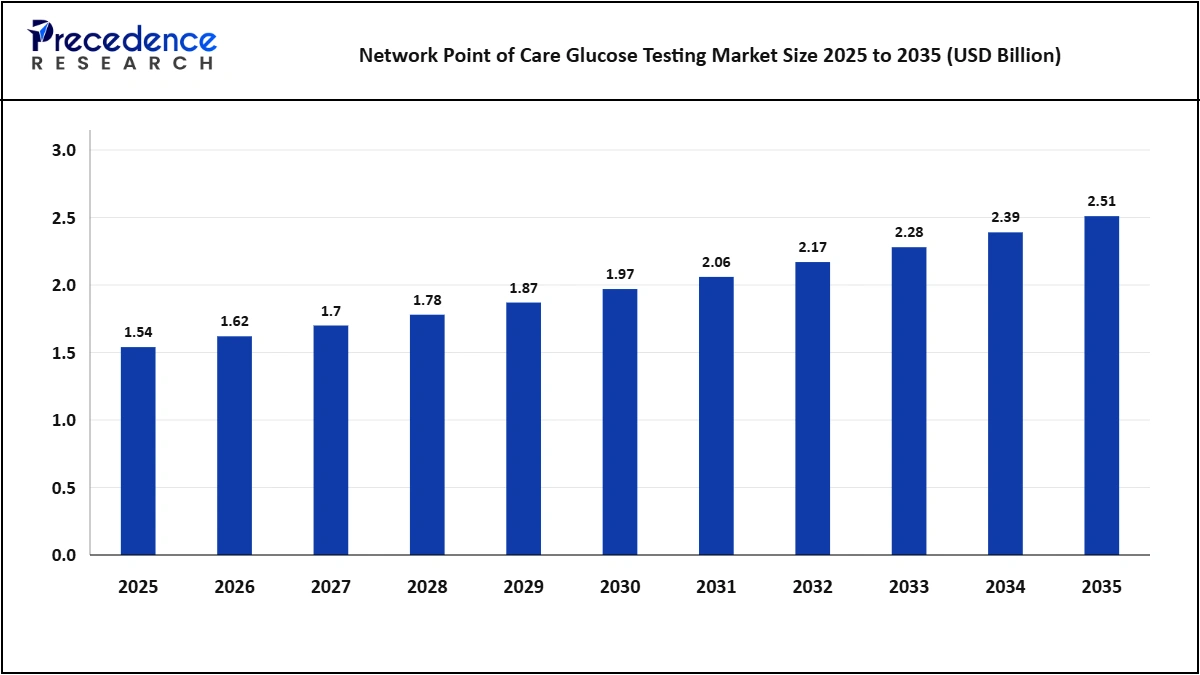
Network Point-of-Care Glucose Testing Market Size and Forecast, 2025-2035 (USD Billion)
Note: 2025 is the base year; 2026-2035 values are forecasts.
Sources: Expert interviews, secondary sources, Precedence Research database, and Precedence Research analysts.
The network point-of-care glucose testing market is projected to grow from USD 1.54 billion in 2025 to USD 2.51 billion by 2035, as healthcare providers increasingly prioritize rapid glucose assessment at the bedside, reducing dependence on centralized laboratories and supporting faster clinical decision-making. Replacement of older meters with smart, wireless systems adds device revenue, lifting the market to USD 1.97 billion by 2030 and sustaining a CAGR of 5.00% from 2026 to 2035.
- Analyst View: We estimate the market using hospital and long-term care beds, inpatient glucose testing frequency, networked meter adoption, and revenue from test strips, devices, software, and services across regions. The figure was cross-checked for the hospital glucose testing revenue of leading suppliers and against published estimates, which places our base year slightly above the comparable figures. Growth reflects consistent testing demand and equipment upgrades, partially offset by pricing pressure and the gradual adoption of inpatient continuous glucose monitoring device.
Market Trends
- Smart meters run clinical apps at the bedside and Wi-Fi replaces docking for result transfer.
- Combined glucose and ketone testing expands.
- Middleware automates operator and quality control compliance.
- Hospitals evaluate inpatient continuous glucose monitoring.
- Meters cleared for critically ill patients gain preference.
Network Point-of-Care Glucose Testing Market Dynamics
Driver
A large share of hospital inpatients have diabetes or stress hyperglycemia and need frequent glucose checks. Tight glycemic control protocols in intensive care and surgery increase testing frequency. Connected meters send results directly to health records, cutting transcription errors and documentation time. Accreditation rules require recorded operator certification and quality control, which networked systems automate.
Restraint
Strip prices face pressure from hospital purchasing groups and tenders. Meter accuracy limitations in critically ill patients have led to regulatory scrutiny and restrictions on some devices. Hospital IT integration requires investment and technical support. Continuous glucose monitoring may reduce fingerstick testing in some inpatients. Budget constraints delay fleet upgrades in public hospitals.
Opportunity
Smart meters that run additional clinical apps can expand the role of the bedside device. Ketone and other combined tests add value per device. Long-term care facilities and ambulatory centers are adopting connected meters. Data analytics on glucose results can support hospital-wide glycemic management programs. Growing hospital capacity in the Asia Pacific region offers new installations.
Market Segmentation: 2025 Share and Value
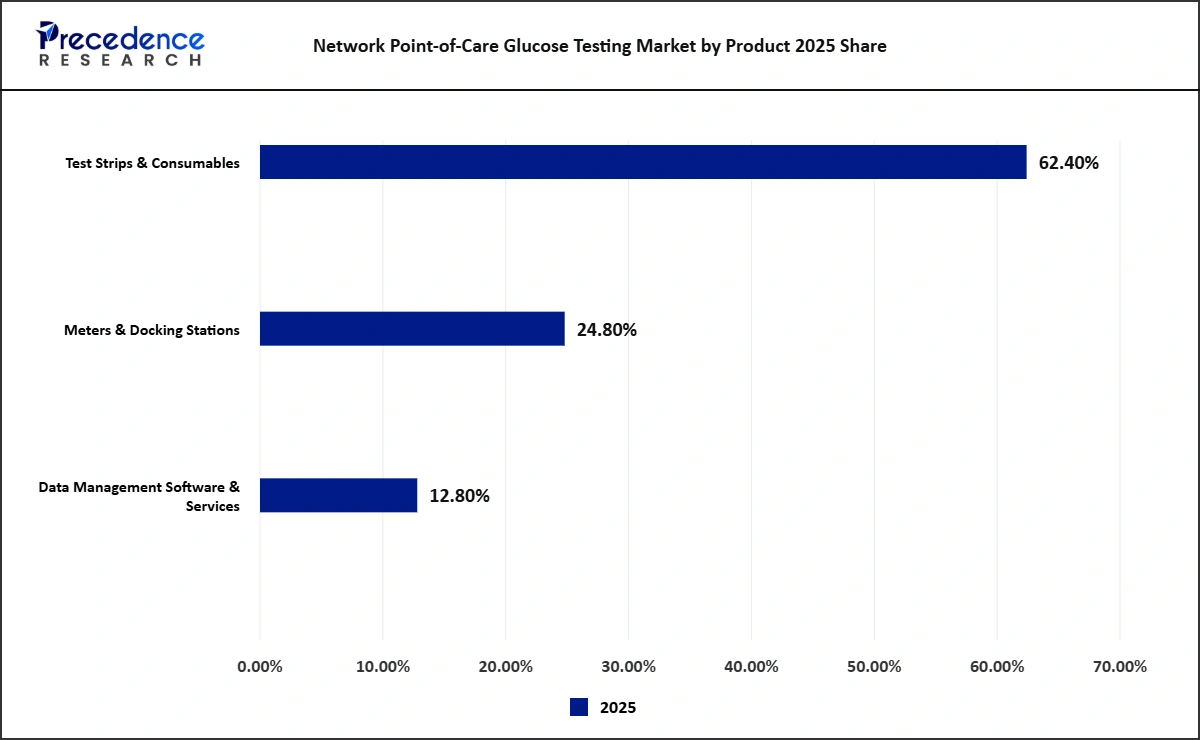
Network Point-of-Care Glucose Testing Market by Product 2025 Share
Note: 2025 is the base year.
Sources: Expert interviews, secondary sources, Precedence Research database, and Precedence Research analysts.
Test strips & consumables segment held 62.40% share (USD 0.96 billion) in 2025 because every bedside glucose check consumes a strip, and hospitals perform many tests per patient per day under insulin and glycemic control protocols. Hospital strips are priced above consumer strips because they must meet stricter accuracy and interference standards, including clearance for use in critically ill patients. Meters & docking stations account for 24.80% share and are valued at USD 0.38 billion, supported by fleet replacement as hospitals move to smart and wireless devices. Data management software & services, at 12.80% (USD 0.20 billion), are the fastest-growing product because hospitals pay for middleware that manages operator certification, quality control, and connection to laboratory and health record systems.
Network Point-of-Care Glucose Testing Market by Connectivity 2025 Share & Size
| Segments | 2025 Share | 2025 Market Value |
| Wireless (Wi-Fi) Connectivity | 58.60% | USD 0.90 billion |
| Docking & Wired Connectivity | 41.40% | USD 0.64 billion |
Note: 2025 is the base year.
Sources: Expert interviews, secondary sources, Precedence Research database, and Precedence Research analysts.
Wireless (Wi-Fi) connectivity accounted for 58.60% (USD 0.90 billion) in 2025 and is the fastest-growing connectivity type because Wi-Fi meters transmit results immediately after testing, reducing documentation delays and transcription errors. Hospitals prefer wireless systems for real-time access to results and remote device management. Docking & wired connectivity held 41.40% share and was valued at around USD 0.64 billion in 2025; it remains common in older fleets and in facilities with limited wireless infrastructure, where results upload when the meter is returned to its base.
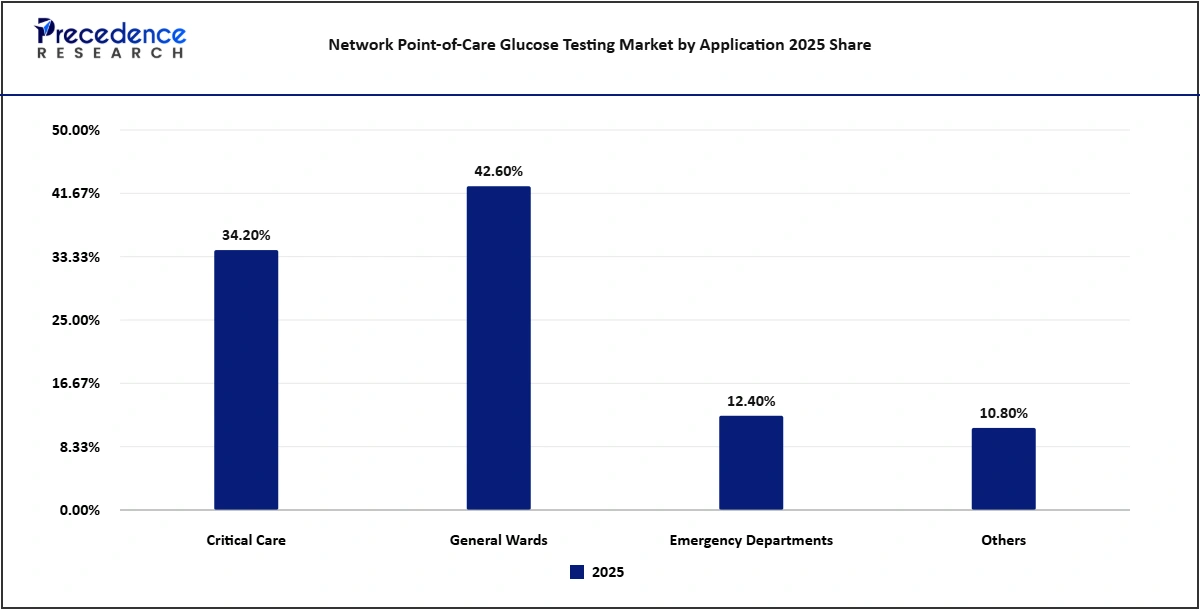
Network Point-of-Care Glucose Testing Market by Application 2025 Share
Note: 2025 is the base year.
Sources: Expert interviews, secondary sources, Precedence Research database, and Precedence Research analysts.
General wards held the largest share of 42.60% (USD 0.66 billion) in 2025 because most inpatients with diabetes are treated outside intensive care and are tested before meals and at bedtime. Critical care, at 34.20% (USD 0.53 billion), is the fastest-growing application because intensive care units test frequently under tight glycemic control and require meters cleared for critically ill patients. Emergency departments captured 12.40% share (USD 0.19 billion), and others account for 10.80% share (USD 0.17 billion) in 2025.
Network Point-of-Care Glucose Testing Market by End User 2025 Share & Size
| Segments | 2025 Share | 2025 Market Value |
| Hospitals | 72.40% | USD 1.11 billion |
| Long-Term Care Facilities | 14.60% | USD 0.22 billion |
| Ambulatory Surgical & Diagnostic Centers | 13.00% | USD 0.20 billion |
Note: 2025 is the base year.
Sources: Expert interviews, secondary sources, Precedence Research database, and Precedence Research analysts.
Hospitals accounted for 72.40% share and were valued at USD 1.11 billion in 2025 because they run large, connected meter fleets across wards and intensive care units. Long-term care facilities, at 14.60% share (USD 0.22 billion), are the fastest-growing end user as they adopt connected meters for documentation and regulatory compliance, and the ambulatory surgical & diagnostic centers segment accounts for 13.00% share (USD 0.20 billion) in 2025.
- Analyst View: Segment values were allocated by matching testing volumes, strip prices, and meter fleets to products, connectivity types, care settings, and end users. Strips lead because of recurring use, and hospitals lead because of their bed count and testing intensity. We expect software and services, wireless meters, and critical care to gain share as hospitals upgrade fleets.
Network Point-of-Care Glucose Testing Market Regional Analysis
Network Point-of-Care Glucose Testing Market By Region 2025 Share
Note: 2025 is the base year.
Sources: Expert interviews, secondary sources, Precedence Research database, and Precedence Research analysts.
North America region held the largest share of 40.60% and reached USD 0.63 billion in 2025, supported by high inpatient diabetes prevalence, strict U.S. FDA requirements for hospital meters, laboratory accreditation rules that require documented operator and quality control data, and widespread health record integration. Europe held 29.40% share (USD 0.45 billion) and is supported by national health services adopting connected meters, strong point-of-care testing governance, and replacement of older fleets. Asia Pacific is the fastest-growing region with 21.20% share (USD 0.33 billion) in 2025, supported by large diabetes populations, hospital construction in China and India, and digital hospital programs in Japan, South Korea, and Australia. Latin America, at 5.00% (USD 0.08 billion), and the Middle East and Africa, at 3.80% (USD 0.06 billion), are smaller markets led by private and large public hospitals.
North America accounted for 40.60% share (USD 0.63 billion) in 2025. Established healthcare IT infrastructure and the integration of glucose meters with hospital information systems support the adoption of connected testing solutions. Laboratory accreditation rules require documented operator certification and quality control, which connected systems record automatically.
Europe held 29.40% share (USD 0.45 billion) in 2025. National health services are replacing older meters with connected glucose and ketone devices, such as recent rollouts in NHS trusts. Well-established point-of-care testing governance further encourages the adoption of systems that improve testing oversight and data management. Germany, the United Kingdom and France remain the region's leading markets.
Asia Pacific is projected to be the fastest-growing region, holding 21.20% share (USD 0.33 billion) in 2025. China and India have large diabetes populations and are increasing the construction of new hospitals. Japan, South Korea, and Australia are investing in digital hospital systems that integrate point-of-care devices.
Latin America accounted for 5.00% share and USD 0.08 billion in revenue. Private hospitals in Brazil and Mexico lead adoption of connected meters. Public hospitals often still use non-networked meters, limiting growth.
The Middle East & Africa is estimated to account for 3.80% share (USD 0.06 billion) in 2025. Gulf hospitals adopt connected meters as part of digital health programs. In Africa, adoption of networked glucose testing systems remains concentrated in major urban hospitals due to infrastructure limitations and budget constraints.
Analyst View: Regional shares were built from hospital beds, inpatient testing frequency, networked meter penetration, and strip prices in each region. North America leads because of high testing intensity and regulatory requirements. We project Asia Pacific will have the highest growth premium because hospital capacity and connected device adoption are expanding fastest in the region.
Top 10 Companies in the Network Point-of-Care Glucose Testing Market
| Rank | Company Name | Market-Specific Revenue (USD Billion) | 2025 Share | Key Products / Business | Headquarters |
| 1 | Roche Diagnostics | 0.52 | 33.77% | Accu-Chek Inform II and cobas pulse hospital glucose systems | Switzerland |
| 2 | Nova Biomedical | 0.28 | 18.18% | StatStrip glucose and ketone hospital meter systems | United States |
| 3 | Abbott | 0.18 | 11.69% | i-STAT and Precision hospital glucose systems | United States |
| 4 | Siemens Healthineers | 0.06 | 3.90% | Point-of-care data management and testing systems | Germany |
| 5 | HemoCue | 0.05 | 3.25% | HemoCue Glucose 201 systems | Sweden |
| 6 | i-SENS | 0.04 | 2.60% | CareSens hospital glucose meters | South Korea |
| 7 | ARKRAY | 0.03 | 1.95% | Hospital glucose meters | Japan |
| 8 | Nipro | 0.02 | 1.30% | Hospital blood glucose systems | Japan |
| 9 | Telcor | 0.02 | 1.30% | QML point-of-care data management software | United States |
| 10 | EKF Diagnostics | 0.02 | 1.30% | Point-of-care glucose and lactate analyzers | United Kingdom |
Note: Company revenues and shares are 2025 estimates.
Sources: Company press releases, expert interviews, secondary sources, Precedence Research database, and Precedence Research analysts.
Roche Diagnostics led the network point-of-care glucose testing market with an estimated 33.77% share and reached USD 0.52 billion in 2025 revenue, followed by Nova Biomedical at 18.18% (USD 0.28 billion) and Abbott at 11.69% (USD 0.18 billion). Roche Diagnostics leads because its Accu-Chek Inform II system, introduced as the first wireless hospital glucose meter, has an exceptionally large installed base, and its newer cobas pulse system adds a touchscreen, Wi-Fi connectivity, and clinical apps on a single bedside device. Nova Biomedical is a strong second supplier with StatStrip glucose and ketone meters, which were the first hospital meters cleared by the FDA for use in critically ill patients. Abbott supplies i-STAT and Precision hospital systems, Siemens Healthineers and Telcor provide point-of-care data management software, and HemoCue, i-SENS, ARKRAY, Nipro and EKF Diagnostics compete in regional and specialized settings.
The top 10 players accounted for an estimated 79.24% share (USD 1.22 billion) of 2025 revenue, while the remaining 20.76% (USD 0.32 billion) was shared among regional meter makers, data management software providers and distributors. The network point-of-care glucose testing market is concentrated because regulatory clearance for hospital and critical care use and integration with hospital IT systems create high barriers to entry. Competition centers on accuracy across hematocrit and interfering substances, clearance for critically ill patients, connectivity, data management, and strip pricing, while inpatient continuous glucose monitoring is a long-term competitive factor.
Recent Developments
- October 2026: Nova Biomedical announced a global medical device correction for its StatStrip Glucose Hospital Meter System after identifying a software issue that could associate glucose results with the wrong patient record, prompting corrective measures and a planned software update.
Network Point of Care Glucose Testing Market Segments
By Product
- Test Strips & Consumables
- Meters & Docking Stations
- Data Management Software & Services
By Connectivity
- Wireless (Wi-Fi) Connectivity
- Docking & Wired Connectivity
By Application
- Critical Care
- General Wards
- Emergency Departments
- Others
By End User
- Hospitals
- Long-Term Care Facilities
- Ambulatory Surgical & Diagnostic Centers
By Region
- North America (U.S., Canada, Mexico)
- Europe (Germany, U.K., France, Italy, Spain, Rest of Europe)
- Asia Pacific (China, Japan, India, South Korea, Taiwan, Rest of Asia Pacific)
- Latin America (Brazil, Argentina, Rest of Latin America)
- Middle East & Africa (GCC, South Africa, Rest of MEA)
Research Methodology
The network point-of-care glucose testing market was defined as connected hospital blood glucose meters, test strips, controls, docking stations, and data management software and services, worldwide. The 2025 base year was built bottom-up approach from hospital beds, inpatient testing frequency, networked meter penetration and average strip and device prices, and checked top-down against the hospital glucose testing revenue of leading suppliers. Segment, regional and company values were allocated from products, connectivity types, applications, end users, and regional demand. Estimates were verified by cross-checking company disclosures, regulatory and industry data, and published third-party estimates, and inputs that could not be reconciled were excluded. All segment, regional, and company estimates were aligned to the 2025 base year, and the 2026–2035 forecast was calculated using the projected CAGR and checked for consistency.
Analyst View: Overall Market
The network point-of-care glucose testing market is a mature, recurring-revenue market driven by inpatient testing volumes and regulatory requirements for documented results. Our estimate links demand to beds, testing frequency, connected meter penetration, and strip prices, so the forecast follows hospital capacity, diabetes prevalence, and fleet upgrades. The main upside comes from smart meters and data services, while the main risks are strip price pressure and gradual adoption of inpatient continuous monitoring.
Sources and References
- Roche. "Roche launches cobas pulse system". 2022-01-12. cobas pulse launch. (Source: roche.com)
- RegDataLab. "510(k) K220272 cobas pulse blood glucose monitoring system". 2024-04-26. FDA clearance record. (Source: regdatalab.com)
- Nova Biomedical. "StatStrip Xpress hospital meter receives FDA clearance for critically ill patients". 2015-05-26. Critical care clearance (Source: novabiomedical.com)
For inquiries regarding discounts, bulk purchases, or customization requests, please contact us at sales@precedenceresearch.com
Frequently Asked Questions





Ask For Sample
No cookie-cutter, only authentic analysis – take the 1st step to become a Precedence Research client
 Get a Sample




 sales@precedenceresearch.com
 Schedule a Meeting
