


Oil Gas Processing Seal Market Size, Key Companies, Company Production Capacity, Manufacturing Efficiency, Capacity Utilization, Raw Material Consumption, Cost Structure, Export Trends, Company Expansion Strategies, and Competitive Landscape
Vidyesh Swar, a Chemical and Materials Industry Expert, estimates the oil gas processing seal market at USD 6.66 billion in 2026 to USD 9.32 billion by 2035, growing at a CAGR of 3.80%. Major oil gas processing seal market companies such as John Crane, Flowserve, EagleBurgmann, Trelleborg are competing across key material and application segments, including seal type, material, application, processing and region.
Source: https://www.precedenceresearch.com/oil-gas-processing-seal-market
 Get a Sample
 Report Description


Oil Gas Processing Seal Market Size, Demand, and Trends Analysis 2035
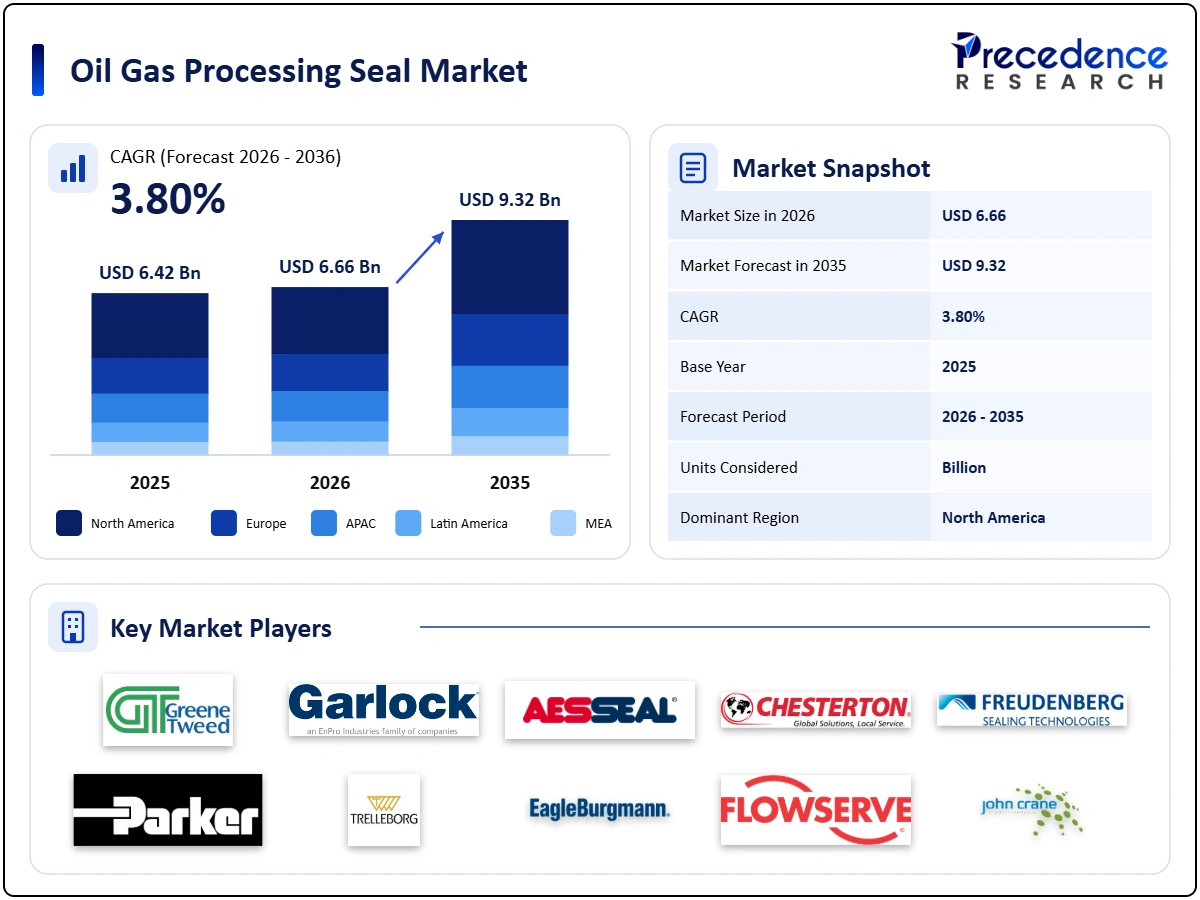
The oil gas processing seal market is forecasted to expand from USD 6.66 billion in 2026 to USD 9.32 billion by 2035, growing at a CAGR of 3.80% from 2026 to 2035.
Key Takeaways
Market Size & Growth Outlook
- Market Size in 2025: USD 6.42 Billion
- Estimated Market Size in 2026: USD 6.66 Billion
- Projected Market Size by 2035: USD 9.32 Billion
- CAGR (2026-2035): 3.80%
Regional Market Highlights
- North America led the market with 31.20% share and reached USD 2.00 billion in 2025.
- Asia Pacific region held 27.40% of the market share and was valued at USD 1.76 billion in 2025.
- Middle East & Africa accounted for 18.60% (USD 1.19 billion) of the market share in 2025 and is projected to be the fastest-growing region, at a CAGR of 4.73% from 2026 to 2035.
Segmental Spotlight
- By seal type segment, Mechanical Seals held the largest share of 38.40% and reached USD 2.47 billion in 2025.
- By material, the Elastomers segment captured 28.40% share and generated USD 1.82 billion in 2025.
- By application, the Pumps segment registered 36.20% of the market share (USD 2.32 billion) in 2025.
- By processing, the Downstream segment held 45.20% share of the market in 2025, reaching USD 2.90 billion.
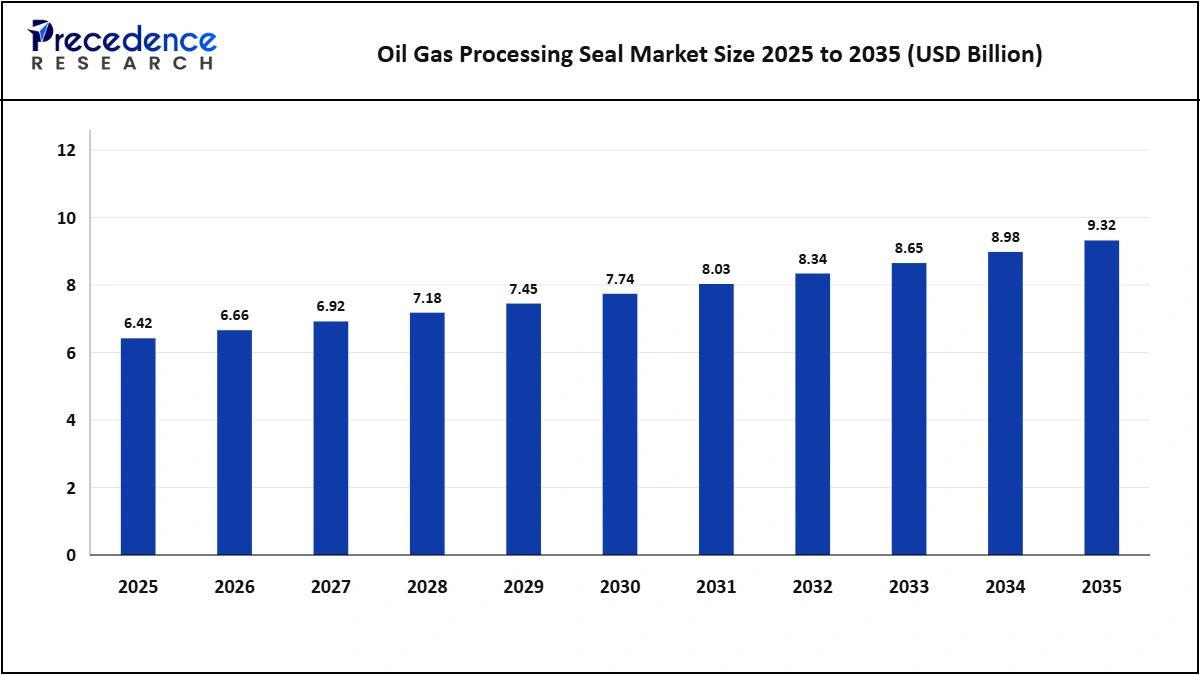
Oil Gas Processing Seal Market Size and Forecast, 2025-2035 (USD Billion)
Note: 2025 is the base year; 2026-2035 values are forecasts.
Sources: Expert interviews, secondary sources, Precedence Research database, and Precedence Research analysts.
The oil gas processing seal market is projected to grow from USD 6.42 billion in 2025 to USD 9.32 billion by 2035, driven by the widespread use of seals in pumps, compressors, valves, and flanges to prevent hydrocarbon leakage. Maintenance and replacement required due to wear and operating conditions further support market demand. Additionally, emission rules and new gas, LNG, and CO2 infrastructure raise demand for higher-value engineered seals, lifting the market to USD 7.74 billion by 2030 and sustaining a CAGR of 3.80% from 2026 to 2035.
- Analyst View: The market is estimated to witness steady growth, driven by installed base and new installations of pumps, compressors, valves, and piping in upstream, midstream, and downstream facilities by region, seal replacement rates and average seal and service prices, plus seal support systems. Aftermarket replacement and repair represent most demand, while new projects add original equipment seals. The growth rate reflects steady maintenance demand, emission rules and gas infrastructure, moderated by oil price cycles.
Market Trends
- Low-emission seals meet methane rules.
- Dry gas seals grow with LNG and CO2 compression.
- Seals are engineered for ethane and NGL pipelines.
- Carbon capture projects create new sealing needs.
- Long-term reliability service agreements expand.
- Condition monitoring supports predictive seal maintenance.
Drivers, Restraints, and Opportunities
Driver
Large installed bases of pumps and compressors require regular seal replacement and repair. Methane and fugitive emission regulations require low-leakage seals. LNG, gas processing, and natural gas liquids projects increase compressor and pump installations. Carbon capture and supercritical CO2 systems need specialized dry gas seals. Refinery and petrochemical expansion in Asia Pacific and the Middle East adds demand.
Restraint
Oil price cycles affect upstream spending and maintenance budgets. Long seal life reduces replacement frequency. Price competition from regional seal makers pressures margins. Energy transition may reduce long-term refinery capacity in mature markets. Supply chain issues for specialty materials can delay deliveries.
Opportunity
Carbon capture, hydrogen, and supercritical CO2 projects offer new sealing applications. Digital seal monitoring can support service revenue. Emission rules can accelerate upgrades to dual and gas seals. Gas infrastructure in the Middle East & Africa and Asia Pacific offers market growth. Long-term asset management contracts can secure recurring revenue.
Oil Gas Processing Seal Market Segmentation: 2025 Share and Value
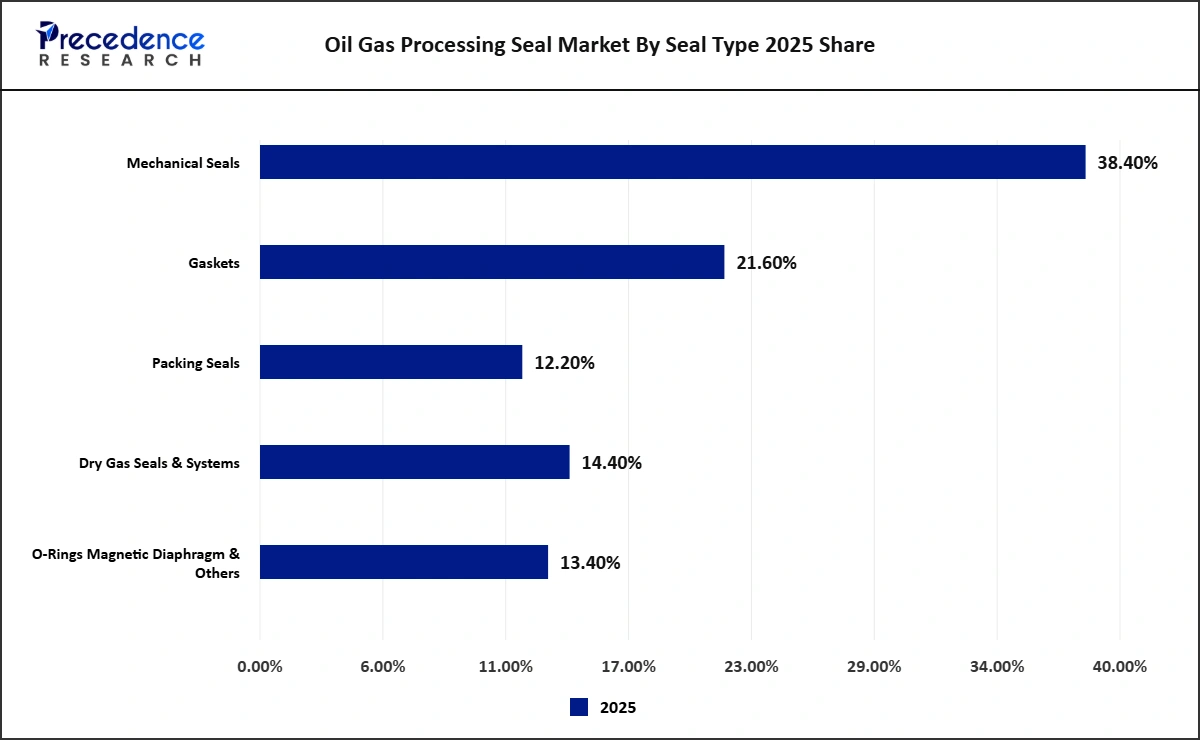
Oil Gas Processing Seal Market By Seal Type 2025 Share
Note: 2025 is the base year.
Sources: Expert interviews, secondary sources, Precedence Research database, and Precedence Research analysts.
By seal type, the mechanical seals accounted for 38.40% of the market share (USD 2.47 billion) in 2025 because centrifugal pumps throughout refineries, petrochemical plants, pipelines, and production facilities use single, double, and tandem mechanical seals to prevent hydrocarbon leaks, and API 682 standards define their design. Seals are replaced or repaired regularly, creating large aftermarket demand. The gaskets segment held 21.60% share and was valued at USD 1.39 billion in 2025. Packing seals accounted for 12.20% share (USD 0.78 billion), and O-rings, magnetic, diaphragm & others accounted for 13.40% share (USD 0.86 billion). Dry gas seals & systems account for 14.40% share and reached USD 0.92 billion; they are the fastest-growing seal type because centrifugal compressors for LNG, gas processing, pipelines, and CO2 compression depend on them.
Oil Gas Processing Seal Market By Material 2025 Share & Size
| Segments | 2025 Share | 2025 Market Value |
| Elastomers | 28.40% | USD 1.82 billion |
| Metals | 24.60% | USD 1.58 billion |
| Polymers | 18.20% | USD 1.17 billion |
| Ceramics & Seal Face Materials | 20.40% | USD 1.31 billion |
| Others | 8.40% | USD 0.54 billion |
Note: 2025 is the base year.
Sources: Expert interviews, secondary sources, Precedence Research database, and Precedence Research analysts.
Elastomers accounted for 28.40% share and registered USD 1.82 billion in 2025 because O-rings and secondary seals use NBR, HNBR, FKM, and FFKM compounds. Metals captured 24.60% share and USD 1.58 billion in value; ceramics & seal face materials such as silicon carbide and carbon accounted for 20.40% (USD 1.31 billion); polymers such as PTFE and PEEK held 18.20% share (USD 1.17 billion) in 2025. Other segments held 8.40% (USD 0.54 billion). High-performance polymers and perfluoroelastomers are gaining traction in demanding applications involving sour service, high temperatures, and COâ‚‚ handling.
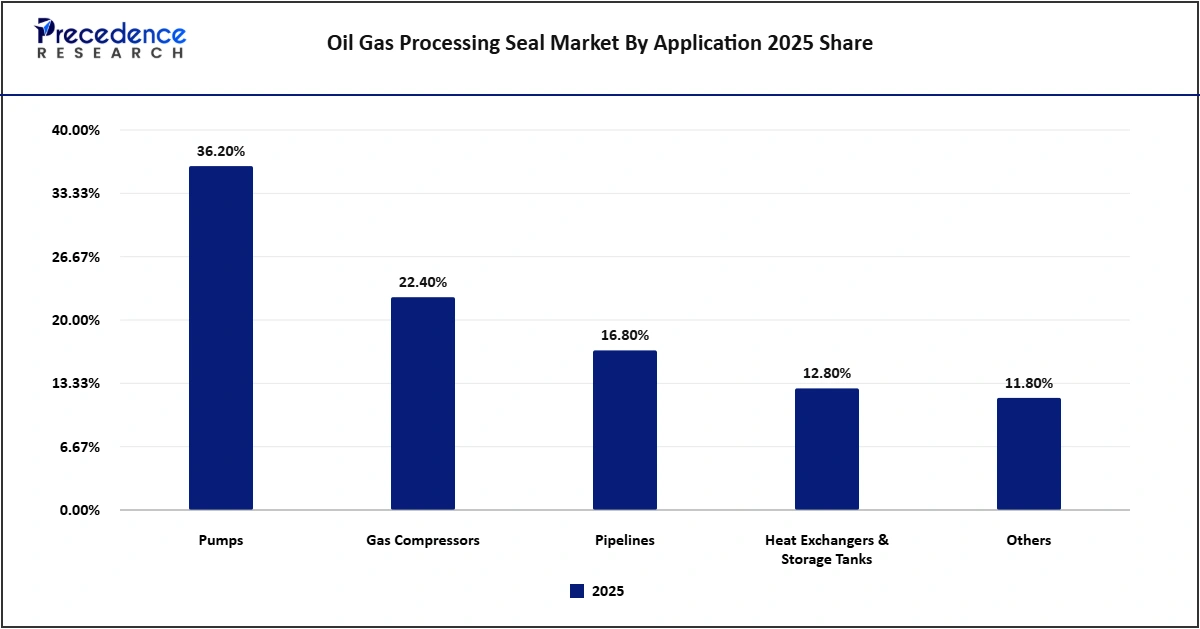
Oil Gas Processing Seal Market By Application 2025 Share
Note: 2025 is the base year.
Sources: Expert interviews, secondary sources, Precedence Research database, and Precedence Research analysts.
Pumps accounted for the largest share of 36.20% and valued at USD 2.32 billion in 2025, due to their extensive use in fluid transfer and circulation across oil and gas processing facilities. Gas compressors accounted for 22.40% share (USD 1.44 billion), supported by their role in gas compression and transportation. Pipelines held 16.80% share and reached USD 1.08 billion in 2025, because of the need for reliable sealing to prevent leaks during transportation. Heat exchangers & storage tanks held 12.80% share (USD 0.82 billion) because of their use in heat transfer and hydrocarbon storage, while other applications accounted for 11.80% share (USD 0.76 billion) in 2025. Gas compressors are the fastest-growing application with LNG and carbon capture projects.
Oil Gas Processing Seal Market By Processing 2025 Share & Size
| Segments | 2025 Share | 2025 Market Value |
| Upstream | 30.60% | USD 1.96 billion |
| Midstream | 24.20% | USD 1.55 billion |
| Downstream | 45.20% | USD 2.90 billion |
Note: 2025 is the base year.
Sources: Expert interviews, secondary sources, Precedence Research database, and Precedence Research analysts.
Downstream segment dominated the market with 45.20% (USD 2.90 billion) share in 2025 because refineries and petrochemical plants operate very large numbers of pumps and compressors. Upstream held 30.60% of the market share and was valued at USD 1.96 billion, and midstream accounted for 24.20% share (USD 1.55 billion) in 2025. Midstream is projected to be the fastest-growing segment, supported by expanding gas pipelines, natural gas liquids, and LNG infrastructure.
- Analyst View: Segment values were allocated by matching equipment installed base, replacement rates, and prices to seal types, materials, applications, and processing segments, using seal maker revenue mixes. Mechanical seals lead because of pump populations, and downstream leads because of refinery equipment density. We expect dry gas seals, compressors, and midstream to gain share.
Regional Analysis
Oil Gas Processing Seal Market by Region 2025 Share
Note: 2025 is the base year.
Sources: Expert interviews, secondary sources, Precedence Research database, and Precedence Research analysts.
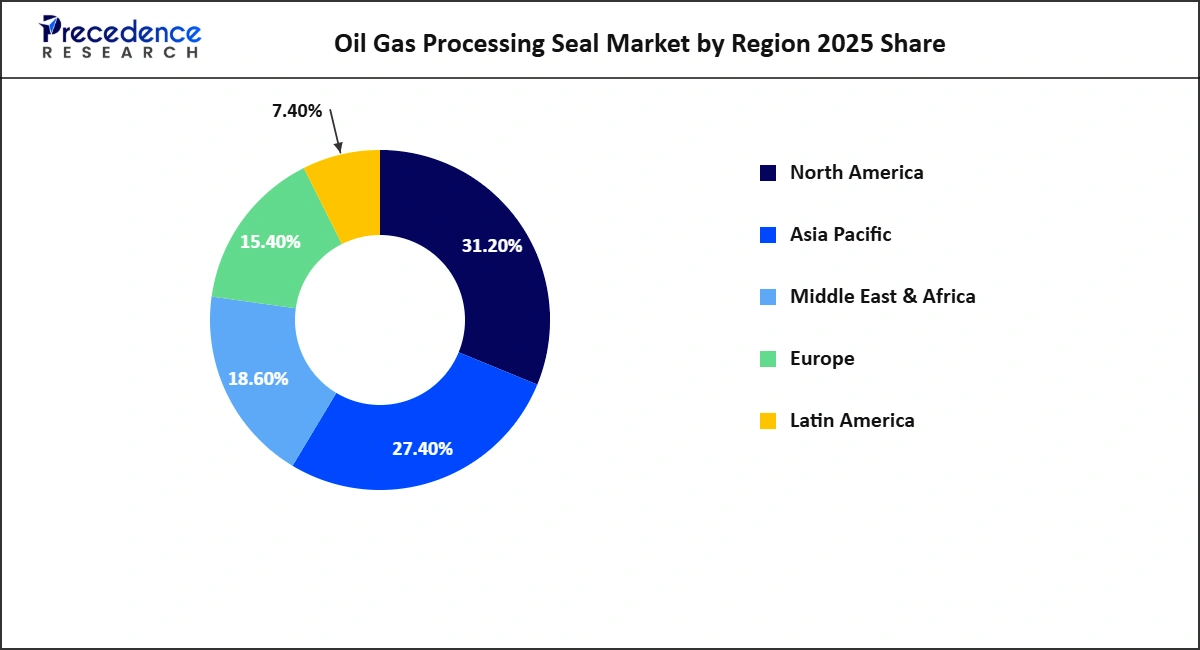
North America dominates the market with 31.20% share (USD 2.00 billion) in 2025, supported by shale oil and gas production, the largest pipeline network, extensive refining and petrochemical capacity, growing LNG exports, and methane emission rules. Asia Pacific, at 27.40% share, reached USD 1.76 billion in 2025 and is supported by refinery and petrochemical expansion in China and India and LNG import terminals. The Middle East & Africa held 18.60% share (USD 1.19 billion) and is expected to be the fastest-growing region, supported by gas processing, LNG, and refinery projects in Qatar, Saudi Arabia, and the UAE. Europe captured a market share of 15.40% (USD 0.99 billion) in 2025 and is growth-driven by refinery maintenance, LNG import terminals, and carbon capture projects, while Latin America, at 7.40% share (USD 0.48 billion), is growing due to offshore production in Brazil and Guyana.
North America accounted for 31.20% share, valued at USD 2.00 billion in 2025. Shale production, natural gas liquids pipelines, and LNG export terminals need large numbers of seals. Methane emission rules encourage low-leakage seals.
Asia Pacific region captured 27.40% of the market share and generated USD 1.76 billion in 2025. China and India continue to build refineries and petrochemical complexes. LNG import terminals in Japan, South Korea, China, and India use compressors and cryogenic pumps.
The Middle East & Africa held a market share of 18.60%, reaching USD 1.19 billion in 2025 and is the fastest-growing region. Qatar's LNG expansion and gas projects in Saudi Arabia and the UAE require compressors and dry gas seals. Seal makers offer long-term asset management contracts with regional petrochemical companies.
Europe accounts for 15.40% share of the market (USD 0.99 billion) in 2025. Refinery maintenance and LNG import terminals drive the demand. Carbon capture and storage projects in the UK and North Sea use dry gas seals for CO2 compression.
Latin America registered 7.40% share (USD 0.48 billion) in 2025. Offshore developments in Brazil and Guyana use subsea and topsides seals. Refinery maintenance adds demand.
Analyst View: Regional shares were built from the installed base, new projects, replacement rates, and prices in each region. North America leads because of production, pipeline, and refining scale. We project the Middle East and Africa the highest growth premium because gas, LNG, and refining projects are expanding fastest in this region.
Top 10 Market Players in the Oil Gas Processing Seal Market
| Rank | Company Name | Market-Specific Revenue (USD Billion) | 2025 Share | Key Products / Business | Headquarters |
| 1 | John Crane | 0.86 | 13.40% | Mechanical seals, dry gas seals and seal support systems | United States |
| 2 | Flowserve | 0.72 | 11.21% | Mechanical seals and seal systems | United States |
| 3 | EagleBurgmann | 0.62 | 9.66% | Mechanical and dry gas seals | Germany |
| 4 | Trelleborg | 0.34 | 5.30% | Elastomer and polymer seals | Sweden |
| 5 | Parker Hannifin | 0.32 | 4.98% | O-rings and engineered seals | United States |
| 6 | Freudenberg Sealing Technologies | 0.28 | 4.36% | Elastomer seals | Germany |
| 7 | A.W. Chesterton | 0.22 | 3.43% | Mechanical seals and packing | United States |
| 8 | AESSEAL | 0.18 | 2.80% | Mechanical seals and support systems | United Kingdom |
| 9 | Garlock | 0.16 | 2.49% | Gaskets and packing | United States |
| 10 | Greene Tweed | 0.12 | 1.87% | High-performance polymer and FFKM seals | United States |
Note: Company revenues and shares are 2025 estimates.
Sources: Company press releases, expert interviews, secondary sources, Precedence Research database, and Precedence Research analysts.
John Crane led the oil gas processing seal market with 13.40% share (USD 0.86 billion) of 2025 revenue, followed by Flowserve at 11.21% (USD 0.72 billion) and EagleBurgmann at 9.66% (USD 0.62 billion). John Crane leads with a broad portfolio of mechanical seals, dry gas seals and seal support systems for pumps and compressors and a large global service network, and in 2025 it launched an ethane pipeline seal, a next-generation coaxial dry gas seal and supplied seals for UK carbon capture and supercritical CO2 projects. Flowserve and EagleBurgmann are the other leading mechanical and dry gas seal suppliers, with strong positions in refineries, pipelines and LNG. Trelleborg, Parker Hannifin, Freudenberg and Greene Tweed supply elastomer and polymer seals, while Chesterton, AESSEAL and Garlock compete in mechanical seals, packing and gaskets.
The top 10 companies accounted for a market share of 59.50% and valued at USD 3.82 billion of 2025 revenue, while the remaining 40.50% (USD 2.60 billion) was shared among regional seal manufacturers, gasket manufacturers, and repair service providers. The oil gas processing seal market is concentrated in mechanical and dry gas seals, where API standards, reliability records, and global service networks favor established suppliers, and more fragmented in gaskets and elastomer seals. Competition centers on reliability, emission performance, application engineering, repair and service capability, delivery times, and long-term service agreements.
Recent Developments
- February 2025: John Crane partnered with Franco Tosi Meccanica to supply dry gas seals and a gas seal system for a supercritical CO2 pilot plant, supporting the development of an efficient and scalable concentrated solar power system.
- June 2025: John Crane introduced a next-generation dry gas seal Type 93AX Coaxial Separation Seal, designed to reduce nitrogen consumption by up to 80% for versatility and efficiency in compressor applications.
- August 2025: John Crane sealing technology was selected to support a landmark carbon capture and storage project in the United Kingdom, with dry gas seals for CO2 compression. The project supports carbon capture and storage infrastructure designed to transport captured COâ‚‚ from industrial facilities and store it beneath the seabed in depleted offshore fields.
- September 2025: John Crane has launched the Type 8628VL, a next-generation mechanical seal engineered to solve the oil and gas industry's toughest challenges: maintaining sealing integrity in multiphase ethane and ethylene pipelines. Designed to perform under volatile pressure and temperature conditions.
Oil Gas Processing Seal Market Segments
By Seal Type
- Mechanical Seals
- Gaskets
- Packing Seals
- Dry Gas Seals & Systems
- O-Rings, Magnetic, Diaphragm & Others
By Material
- Elastomers
- Metals
- Polymers
- Ceramics & Seal Face Materials
- Others
By Application
- Pumps
- Gas Compressors
- Pipelines
- Heat Exchangers & Storage Tanks
- Others
By Processing
- Upstream
- Midstream
- Downstream
By Region
- North America (U.S., Canada, Mexico)
- Europe (Germany, U.K., France, Italy, Spain, Rest of Europe)
- Asia Pacific (China, Japan, India, South Korea, Taiwan, Rest of Asia Pacific)
- Latin America (Brazil, Argentina, Rest of Latin America)
- Middle East & Africa (GCC, South Africa, Rest of MEA)
Research Methodology
The oil gas processing seal market was defined as mechanical seals, dry gas seals, gaskets, packing, O-rings, and other seals and seal systems for oil and gas processing, worldwide. The 2025 base year was built bottom-up from installed and new pumps, compressors, valves and piping, seal replacement rates and average prices, and checked top-down against the oil and gas sealing revenue of leading seal makers. Segment, regional, and company values were allocated from seal types, materials, applications, processing segments and regional demand. Key estimates were verified by cross-checking company disclosures, regulatory and industry data and published third-party estimates, and inputs that could not be reconciled were excluded. All segment, regional, and company figures were reconciled to the same 2025 base year, and the 2026-2035 forecast, which applies a constant CAGR from the 2025 base, was recalculated and validated.
Analyst View: Overall Market
The oil gas processing seal market is a stable, maintenance-driven market supported by large installed equipment bases, with growth from gas infrastructure, emission rules, and carbon capture. Our estimate links demand to installed base, replacement rates and prices, so the forecast follows maintenance cycles, project activity and regulation. The main upside comes from LNG, CO2 and emission upgrades, while the main risks are oil price cycles and long seal life.
Sources and References
- John Crane. "2025 press releases". 27-02-2025. Franco Tosi Meccanica Partners with John Crane for Supercritical CO2 Pilot.
(Source: johncrane.com) - John Crane. "Next-generation sealing solutions for the oil and gas industry". 2025. Sealing solutions. (Source: johncrane.com)
- John Crane. Landmark Carbon Capture and Storage Project in the UK. (Source: johncrane.com)
- John Crane. Unveils game-changing mechanical seal. (Source: johncrane.com)
For inquiries regarding discounts, bulk purchases, or customization requests, please contact us at sales@precedenceresearch.com
Frequently Asked Questions





Ask For Sample
No cookie-cutter, only authentic analysis – take the 1st step to become a Precedence Research client
 Get a Sample




 sales@precedenceresearch.com
 Schedule a Meeting