



Oilfield Stimulation Chemicals Market Size, Key Companies, Company Market Share, Production Capacity, Raw Material Pricing, Export & Import Analysis, Manufacturing Cost, Competitive Positioning, and Demand Forecast
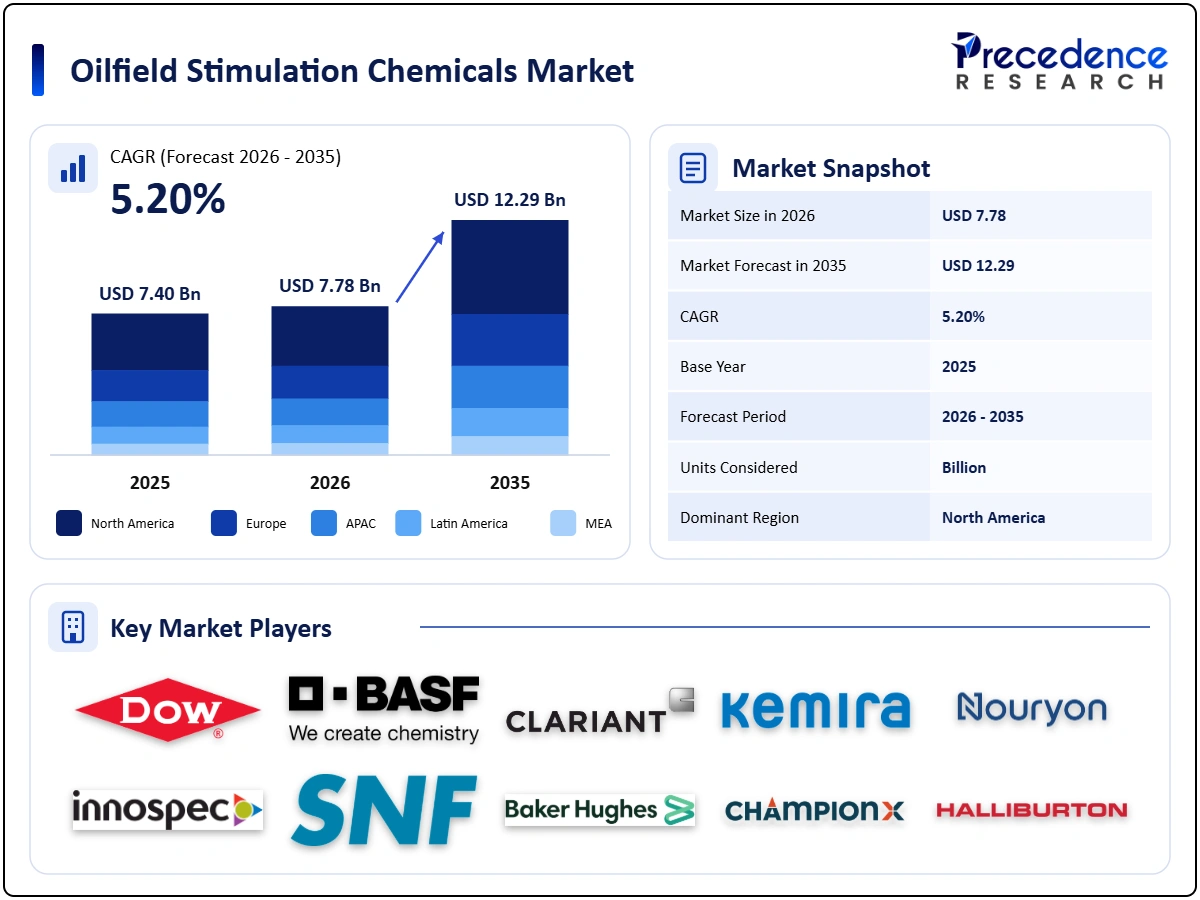
Vidyesh Swar, a Chemical and Materials Industry Expert, estimates the oilfield stimulation chemicals market at USD 7.78 billion in 2026 to USD 12.29 billion by 2035, growing at a CAGR of 5.20%. Major oilfield stimulation chemicals market companies such as Halliburton, Baker Hughes, Innospec are competing across key material and application segments, including product type, application, well type, and region.
Source: https://www.precedenceresearch.com/oilfield-stimulation-chemicals-market
 Get a Sample
 Report Description


Oilfield Stimulation Chemicals Market Growth, Innovations, and Market Size Forecast 2035
The oilfield stimulation chemicals market is forecasted to expand from USD 7.78 billion in 2026 to USD 12.29 billion by 2035, growing at a CAGR of 5.20% from 2026 to 2035.
Key Takeaways
Market Size & Growth Outlook
- Oilfield Stimulation Chemicals Market Size in 2025: USD 7.40 billion
- Estimated Oilfield Stimulation Chemicals Market Size in 2026: USD 7.78 billion
- Projected Oilfield Stimulation Chemicals Market Size by 2035: USD 12.29 billion
- CAGR (2026-2035): 5.20%
Regional Market Spotlight
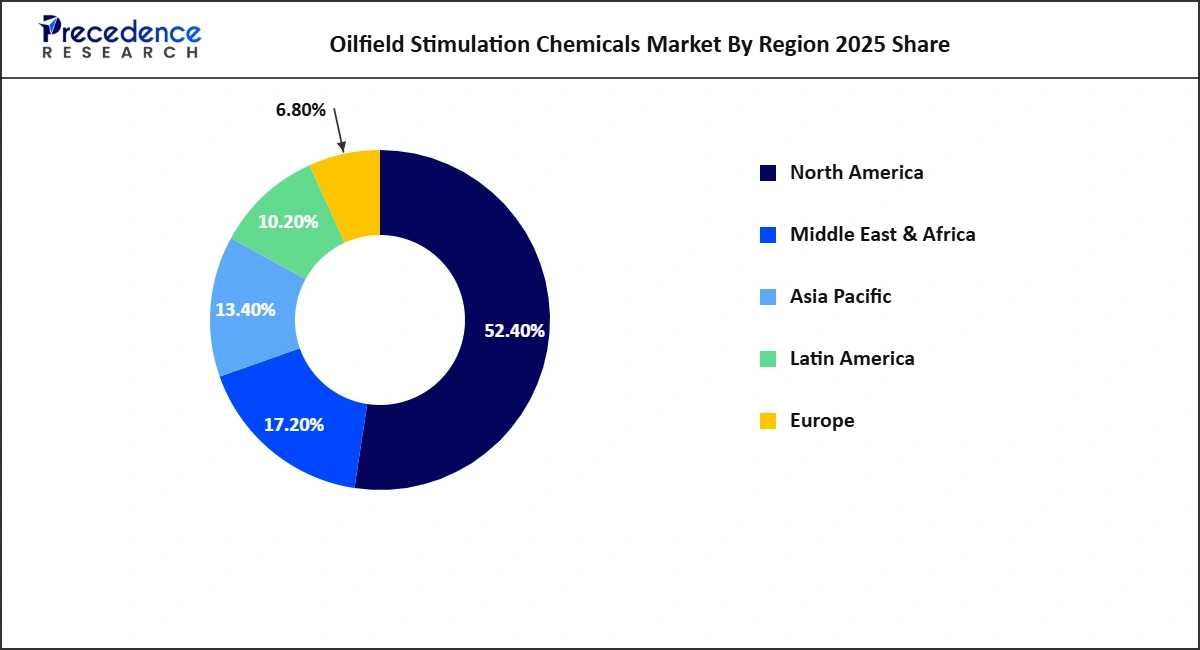
- North America dominates the market with 52.40% (USD 3.88 billion) share in 2025.
- Middle East & Africa accounted for 17.20% share and was valued at USD 1.27 billion in 2025 and is projected to be the fastest-growing region, at a CAGR of 6.63% from 2026 to 2035.
- Asia Pacific captured 13.40% of the market share and reached USD 0.99 billion in 2025.
Segmental Spotlight
- By product type, Friction Reducers accounted for 24.60% share and generated USD 1.82 billion in 2025.
- By application, Hydraulic Fracturing dominated with 62.40% market share (USD 4.62 billion) in 2025.
- By well type, the onshore segment held 81.20% share in 2025 and was valued at USD 6.01 billion.
Oilfield Stimulation Chemicals Market Size and Forecast, 2025-2035 (USD Billion)
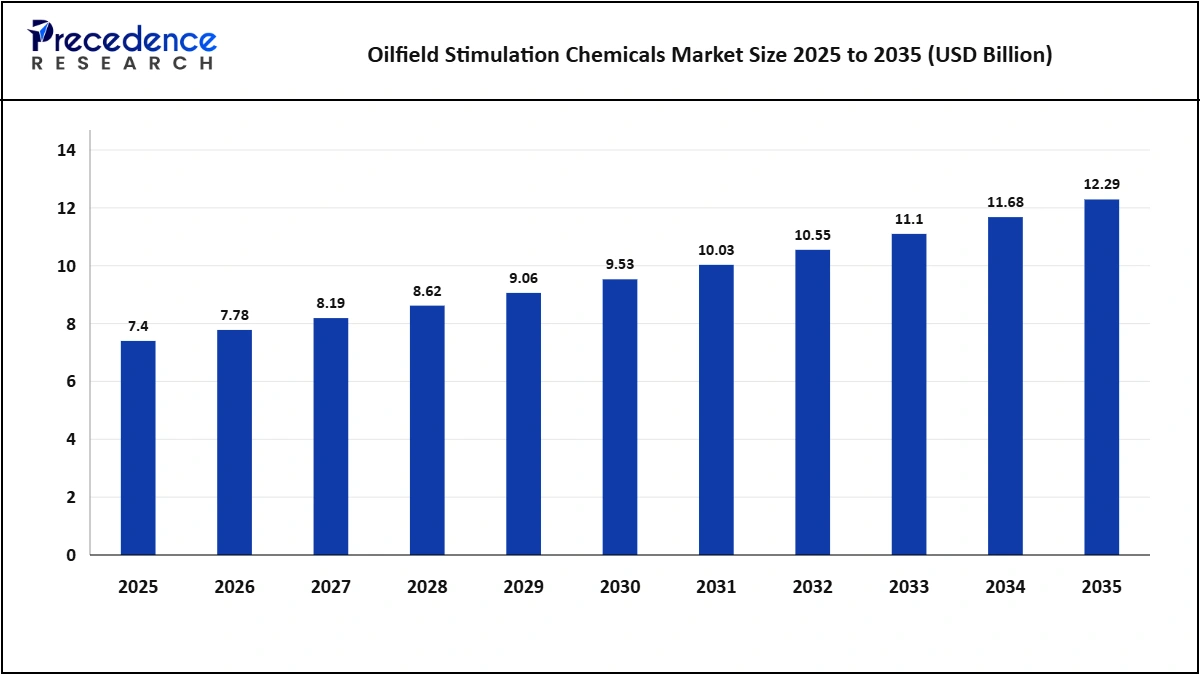
Note: 2025 is the base year; 2026-2035 values are forecasts.
Sources: Expert interviews, secondary sources, Precedence Research database, and Precedence Research analysts.
The oilfield stimulation chemicals market is projected to grow from USD 7.40 billion in 2025 to USD 12.29 billion by 2035 because operators use stimulation chemicals to create and maintain flow paths in reservoirs, and each fracturing or acid job consumes large volumes of chemicals. In addition, longer laterals, intensive completions, and offshore stimulation increase chemical use per well, lifting the market to USD 9.53 billion by 2030 and sustaining a CAGR of 5.20% from 2026 to 2035.
- Analyst View: We built the estimate from the number of fractured and acidized wells by region, fluid and chemical volumes per job, chemical loadings by product and average prices, including chemicals supplied by service companies and specialty producers. Well counts reflect unconventional completions in North America and other regions, and acidizing reflects carbonate reservoirs and offshore programs. The growth rate reflects completion intensity and international stimulation, moderated by oil price cycles and efficiency gains.
Market Trends
- Brine-tolerant friction reducers enable produced water reuse.
- Water-based friction reducers simplify logistics.
- Vessel-based stimulation grows offshore.
- Longer laterals increase chemical volumes per well.
- Environmentally improved chemistries gain preference.
Oilfield Stimulation Chemicals Market Dynamics
Driver
Unconventional oil and gas wells require hydraulic fracturing with large chemical volumes. Longer laterals and more stages increase chemical use per well. Carbonate reservoirs in the Middle East and elsewhere need acid stimulation. Offshore operators use stimulation to boost production from new and mature wells. Produced water reuse drives demand for specialized friction reducers and biocides.
Restraint
Oil and gas price cycles affect drilling and completion activity. Efficiency gains reduce the number of rigs and crews needed. Environmental concerns and regulations on fracturing and chemical disclosure can limit activity in some regions. Price pressure from operators and service companies squeezes chemical margins. The energy transition may slow long-term upstream investment.
Opportunity
Unconventional development in Argentina, Saudi Arabia, China, and Australia offers growth. Environmentally improved and bio-based chemistries can command premiums. Offshore stimulation vessel programs create international demand. Geothermal well stimulation offers a new application.
Market Segmentation: 2025 Share and Value
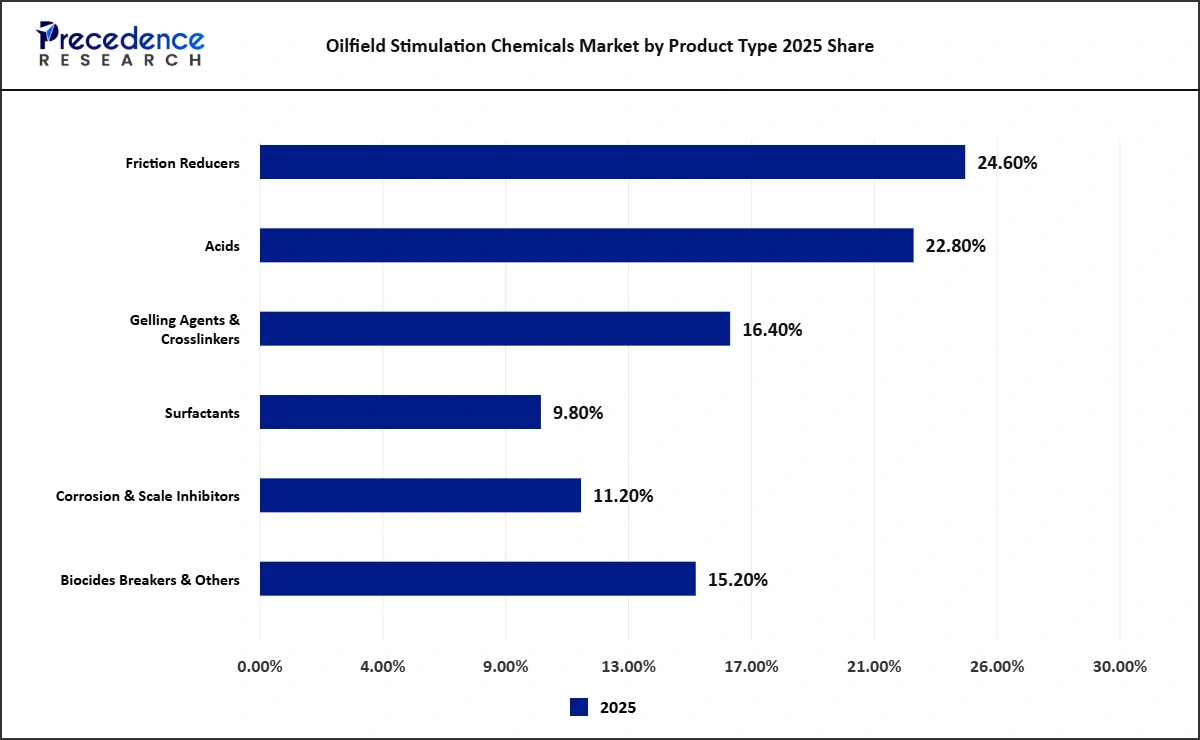
Oilfield Stimulation Chemicals Market by Product Type 2025 Share
Note: 2025 is the base year.
Sources: Expert interviews, secondary sources, Precedence Research database, and Precedence Research analysts.
Friction reducers held the largest share of 24.60%, reaching USD 1.82 billion in 2025 because slickwater fracturing, the dominant completion method in shale and tight formations, uses polyacrylamide friction reducers to cut pumping pressure and carry proppant at high rates, and high-brine-tolerant versions allow reuse of produced water. Acids, at 22.80% share (USD 1.69 billion), are used in matrix acidizing and acid fracturing of carbonate reservoirs and to clean perforations. Gelling agents & crosslinkers account for 16.40% market share and are valued at USD 1.21 billion, surfactants hold 9.80% (USD 0.73 billion), corrosion and scale inhibitors capture 11.20% (USD 0.83 billion); and biocides, breakers and others accounted for 15.20% (USD 1.12 billion). The surfactants segment is growing fastest as operators use them to improve fluid recovery and production.
Oilfield Stimulation Chemicals Market by Application 2025 Share & Size
| Segments | 2025 Share | 2025 Market Value |
| Hydraulic Fracturing | 62.40% | USD 4.62 billion |
| Matrix Acidizing | 22.60% | USD 1.67 billion |
| Acid Fracturing | 15.00% | USD 1.11 billion |
Note: 2025 is the base year.
Sources: Expert interviews, secondary sources, Precedence Research database, and Precedence Research analysts.
Hydraulic fracturing accounted for the largest share of 62.40% and was valued at USD 4.62 billion in 2025 because shale and tight wells use large fluid volumes per stage and many stages per well. Matrix acidizing, at 22.60% of the market share, reaching USD 1.67 billion, is common in carbonate reservoirs in the Middle East and offshore, while acid fracturing accounts for 15.00% (USD 1.11 billion) share in 2025. Matrix acidizing is the fastest-growing application with international and offshore stimulation programs.
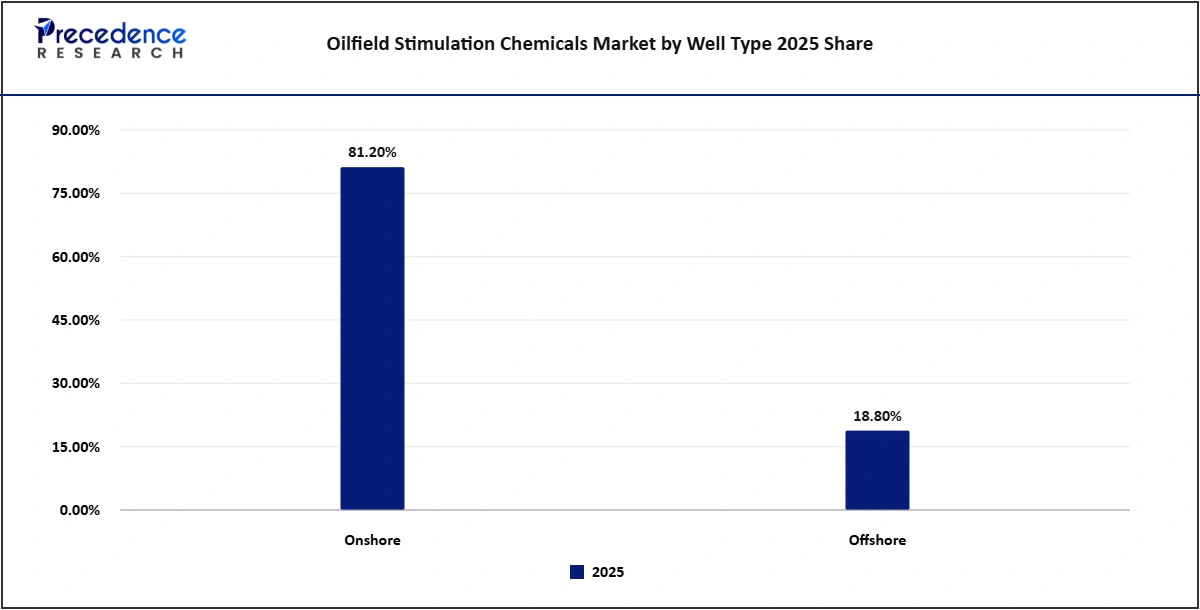
Oilfield Stimulation Chemicals Market by Well Type 2025 Share
Note: 2025 is the base year.
Sources: Expert interviews, secondary sources, Precedence Research database, and Precedence Research analysts.
By well type, the onshore segment accounted for 81.20% (USD 6.01 billion) in 2025 because unconventional fracturing is overwhelmingly an onshore well. Offshore, at 18.80% share (USD 1.39 billion), is the faster-growing well type as vessel-based stimulation supports deepwater developments in Brazil and production enhancement in the North Sea.
- Analyst View: The market is driven by the extensive use of hydraulic fracturing in unconventional oil and gas production, keeping friction reducers as the dominating product type segment and onshore as a dominant market. Segment values were allocated by matching well counts, job volumes and chemical loadings to products, applications and well types, using service company and supplier data. We expect surfactants, matrix acidizing and offshore stimulation to gain share.
Oilfield Stimulation Chemicals Market Regional Analysis
Oilfield Stimulation Chemicals Market By Region 2025 Share
Note: 2025 is the base year.
Sources: Expert interviews, secondary sources, Precedence Research database, and Precedence Research analysts.
North America is the dominant region with 52.40% share and was valued at USD 3.88 billion in 2025, because the U.S. and Canada complete thousands of horizontal shale and tight wells each year using slickwater fracturing with large chemical volumes. The Middle East & Africa, at 17.20% (USD 1.27 billion), is the fastest-growing region, supported by acidizing of carbonate reservoirs and unconventional gas development in Saudi Arabia, the UAE, and Oman. Asia Pacific held 13.40% of the market share, reaching USD 0.99 billion, and is supported by shale gas in China and tight gas in Australia and India. Latin America, at 10.20% share, generating USD 0.75 billion, is supported by deepwater stimulation in Brazil, while Europe, at 6.80% (USD 0.50 billion), is driven by the support of North Sea well stimulation.
North America accounted for 52.40% (USD 3.88 billion) of the market share in 2025. The Permian, Haynesville, Marcellus and Montney basins use large volumes of friction reducers, surfactants and biocides. Operators reuse produced water, increasing demand for brine-tolerant chemicals.
The Middle East & Africa held 17.20% market share and reached USD 1.27 billion in 2025 and is projected to be the fastest-growing region. Driven-growth due to Saudi Arabia's Jafurah unconventional gas field and other projects use fracturing chemicals. National oil companies award large stimulation contracts.
Asia Pacific captured 13.40% share (USD 0.99 billion) in 2025. China's Sichuan Basin shale gas uses fracturing chemicals. Tight gas development in Australia and India adds demand.
Latin America held 10.20% (USD 0.75 billion) of the market share in 2025. Argentina's Vaca Muerta is the largest shale play outside North America. Petrobras awarded Halliburton vessel stimulation contracts for deepwater fields starting in 2026.
Europe accounts for 6.80% share in 2025, reaching USD 0.50 billion. North Sea operators use vessel-based stimulation to boost production from new and mature wells.
Analyst View: The oilfield stimulation chemicals market is heavily concentrated in North America, due to its established shale industry and demand for high volumes of fracturing chemicals. Meanwhile, Asia Pacific and Latin America offer potential for expansion through shale, tight gas, and deepwater projects. We project that the Middle East & Africa is the highest growth region because unconventional gas and acid stimulation are expanding fastest there.
Top 10 Companies in the Oilfield Stimulation Chemicals Market
| Rank | Company Name | Market-Specific Revenue (USD Billion) | 2025 Share | Key Products / Business | Headquarters |
| 1 | Halliburton | 1.10 | 14.86% | Stimulation fluids and multi-Chem chemicals | United States |
| 2 | SLB (incl. ChampionX) | 0.96 | 12.97% | Stimulation fluids and production chemicals | United States |
| 3 | Baker Hughes | 0.62 | 8.38% | Chemical Stimulation and StimFORCE services | United States |
| 4 | SNF | 0.42 | 5.68% | Polyacrylamide friction reducers | France |
| 5 | Innospec | 0.28 | 3.78% | Friction reducers and stimulation chemicals | United States |
| 6 | Nouryon | 0.22 | 2.97% | Surfactants and chelates for stimulation | Netherlands |
| 7 | Kemira | 0.20 | 2.70% | Friction reducers and polymers | Finland |
| 8 | Clariant | 0.18 | 2.43% | Oil services chemicals | Switzerland |
| 9 | BASF | 0.16 | 2.16% | Oilfield chemicals and polymers | Germany |
| 10 | Dow | 0.14 | 1.89% | Surfactants, biocides and solvents | United States |
Note: Company revenues and shares are 2025 estimates.
Sources: Company press releases, expert interviews, secondary sources, Precedence Research database, and Precedence Research analysts.
Halliburton led the oilfield stimulation chemicals market with 14.86% share (USD 1.10 billion) of 2025 revenue, followed by SLB at 12.97% (USD 0.96 billion) and Baker Hughes at 8.38% (USD 0.62 billion). Halliburton leads because it is the largest pressure pumping company in North America and supplies its own stimulation fluid systems, and it is expanding offshore with vessel stimulation contracts from Petrobras starting in 2026. SLB strengthened its chemicals position by completing the acquisition of ChampionX in July 2025, and Baker Hughes offers stimulation chemicals and services, including a 2026 North Sea well stimulation contract with bp based on its StimFORCE package. SNF, Kemira and Innospec are major suppliers of friction reducers, while Nouryon, Clariant, BASF and Dow supply surfactants, acid additives, biocides and specialty chemicals.
The top 10 players accounted for 57.84% share, reaching USD 4.28 billion of 2025 revenue, while the remaining 42.16% (USD 3.12 billion) share in 2025 was shared among regional chemical blenders, guar and polymer producers, and acid suppliers. The oilfield stimulation chemicals market combines vertically integrated service companies with specialty chemical suppliers, and competition centers on performance in high-brine water, environmental profile, logistics to remote well sites, cost per stage, and technical support. Pressure pumping consolidation and operator efficiency programs increase price pressure, while offshore and international stimulation create new opportunities.
Recent Developments
- July 2025: SLB completed its acquisition of ChampionX on July 16, 2025, expanding its production and strengthening its capabilities in artificial lift, digital production technologies, and emissions monitoring to support oil and gas production and recovery.
- October 2025: Petrobras awarded Halliburton multiple contracts for vessel-based stimulation, intelligent completions, and safety valves across Brazil's deepwater fields. Work is expected to begin in 2026, supporting reservoir productivity and offshore production optimization.
- September 2026: Baker Hughes won a contract from bp to provide vessel-based offshore well stimulation services across its UK North Sea operations, using a vessel-based system built around its StimFORCE package.
Oilfield Stimulation Chemicals Market Segments
By Product Type
- Friction Reducers
- Acids
- Gelling Agents & Crosslinkers
- Surfactants
- Corrosion & Scale Inhibitors
- Biocides, Breakers & Others
By Application
- Hydraulic Fracturing
- Matrix Acidizing
- Acid Fracturing
By Well Type
- Onshore
- Offshore
By Region
- North America (U.S., Canada, Mexico)
- Europe (Germany, U.K., France, Italy, Spain, Rest of Europe)
- Asia Pacific (China, Japan, India, South Korea, Taiwan, Rest of Asia Pacific)
- Latin America (Brazil, Argentina, Rest of Latin America)
- Middle East & Africa (GCC, South Africa, Rest of MEA)
Research Methodology
The oilfield stimulation chemicals market was defined as friction reducers, acids, gelling agents, crosslinkers, surfactants, inhibitors, biocides, breakers, and other stimulation chemicals. The 2025 base year was built bottom-up from fractured and acidized wells by region, chemical volumes per job and average prices, and checked top-down against the stimulation and production chemicals revenue of service companies and chemical suppliers. Segment, regional and company values were allocated to product types, applications, well types, and regional demand. Key estimates were verified by cross-checking company disclosures, regulatory and industry data and published third-party estimates, and inputs that could not be reconciled were excluded. All segment, regional, and company figures were reconciled to the same 2025 base year, and the 2026-2035 forecast, which applies a constant CAGR from the 2025 base, was recalculated and validated.
Analyst View: Overall Market
The oilfield stimulation chemicals market is tied to well completions, with North American shale as the largest demand center and international unconventional and offshore stimulation as growth areas. Our estimate links demand to well counts, volumes, and chemical prices, so the forecast follows completion activity and intensity. The main upside comes from international unconventional and offshore programs, while the main risks are oil price cycles and efficiency-driven volume declines.
Sources and References
- Innospec. "Demands for friction reducers are changing". 31-05-2024. AquaBourne friction reducer. (Source: innospec.com)
- SLB. "SLB completes ChampionX acquisition". 16-07-2025. ChampionX acquisition. (Source: investorcenter.slb.com)
- Halliburton. "Halliburton awarded Petrobras contracts". 15-10-2025. Petrobras stimulation contracts. https://www.halliburton.com/en/about-us/press-release/petrobras-awards-halliburton-deepwater-contracts-completion-stimulation-brazil
- aker Hughes. "Baker Hughes wins bp well stimulation contract for UK North Sea". 04-09-2026. bp North Sea contract. (Source: investors.bakerhughes.com)
For inquiries regarding discounts, bulk purchases, or customization requests, please contact us at sales@precedenceresearch.com
Frequently Asked Questions





Ask For Sample
No cookie-cutter, only authentic analysis – take the 1st step to become a Precedence Research client
 Get a Sample




 sales@precedenceresearch.com
 Schedule a Meeting
