



Petroleum Resins Market Trends, Leading Companies, Company Revenue / Sales Performance, Plant Utilization, Production Volume, Pricing Dynamics, Supply Chain Performance, Competitive Landscape, and Industry Growth
Vidyesh Swar, a Chemical and Materials Industry Expert, estimates the petroleum resins market at USD 5.08 billion in 2026 to USD 7.22 billion by 2035, growing at a CAGR of 4%, Major petroleum resins market companies such as ExxonMobil, Eastman, Kolon Industries are competing across key material and application segments, including product, application, end use, region.
Source: https://www.precedenceresearch.com/petroleum-resins-market
 Get a Sample
 Report Description


Petroleum Resins Market Growth, Innovations, and Market Size Forecast 2035
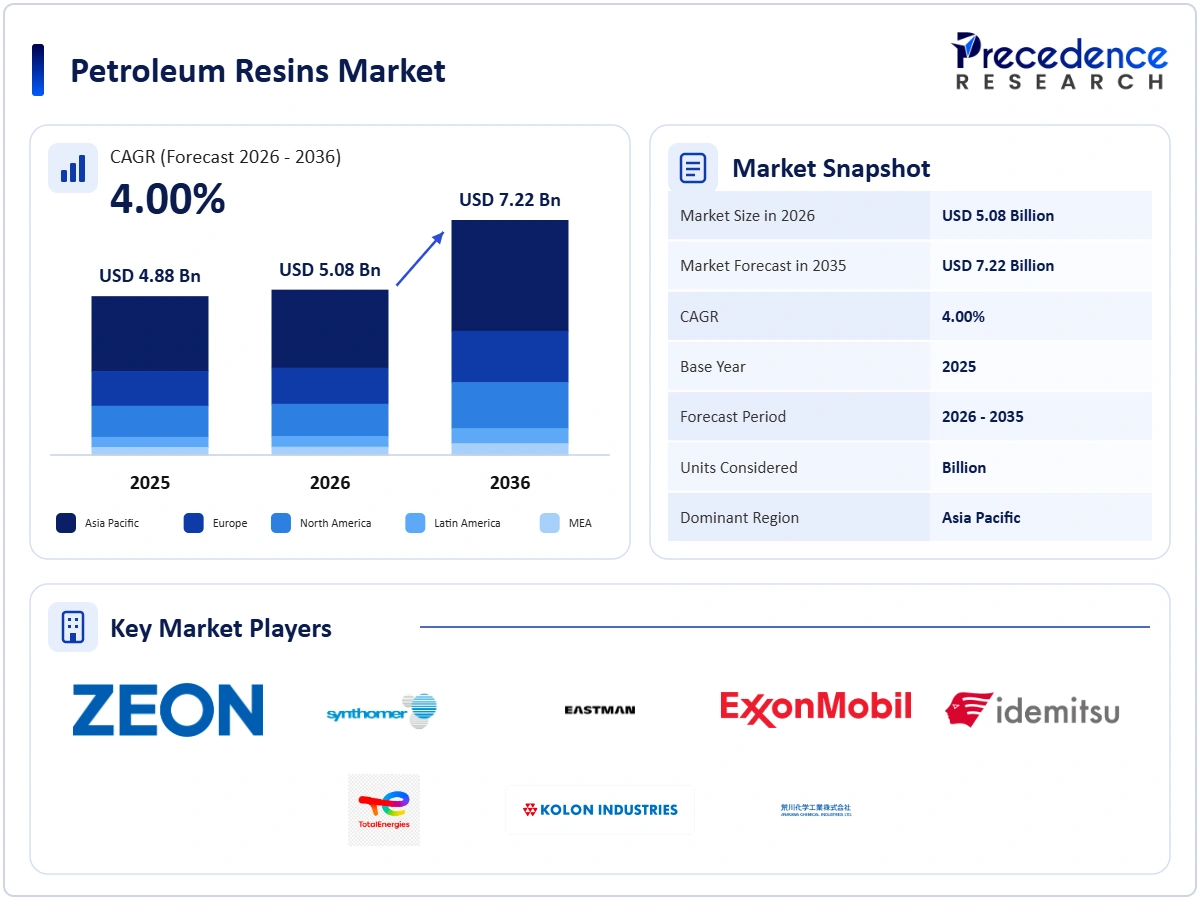
The petroleum resins market is forecasted to expand from USD 5.08 billion in 2026 to USD 7.22 billion by 2035, growing at a CAGR of 4% from 2026 to 2035.
Key Takeaways
Market Size & Growth Outlook
- Market size in 2025: USD 4.88 billion
- Estimated market size in 2026: USD 5.08 billion
- Projected market size by 2035: USD 7.22 billion
- CAGR (2026-2035): 4%
Regional Market Spotlight
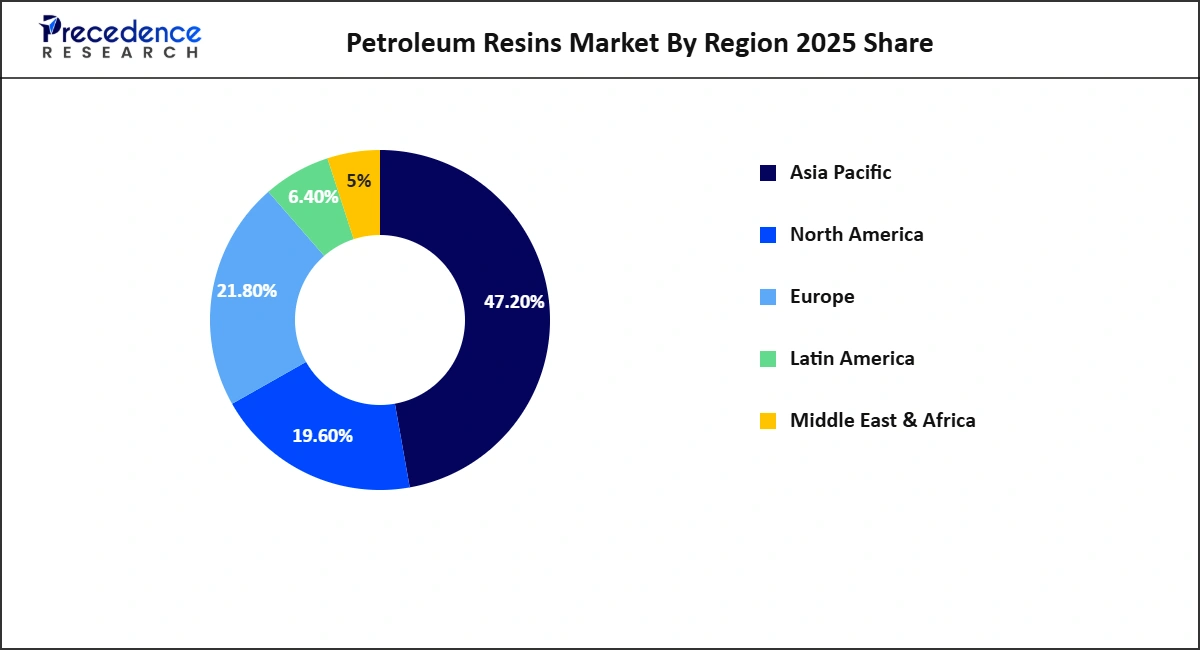
- In 2025, Asia Pacific accounted for 47.2% of the market, valued at USD 2.30 billion. The region is projected to report a CAGR of 4.51% from 2025 to 2035, making Asia Pacific the fastest-growing region.
- Europe is valued at USD 1.06 billion, representing 21.8% of the market in 2025.
- North America accounted for 19.6% of the market, generating USD 0.96 billion in 2025.
Segmental Spotlight
- By product, C5 Resins, valued at USD 1.63 billion, accounted for 33.4% in 2025.
- In 2025, based on applications, adhesives & sealants accounted for 38.6% and valued at USD 1.88 billion.
- By end use, packaging & hygiene accounted for 34.2% in 2025.
Petroleum Resins Market Size and Forecast, 2025-2035 (USD Billion)
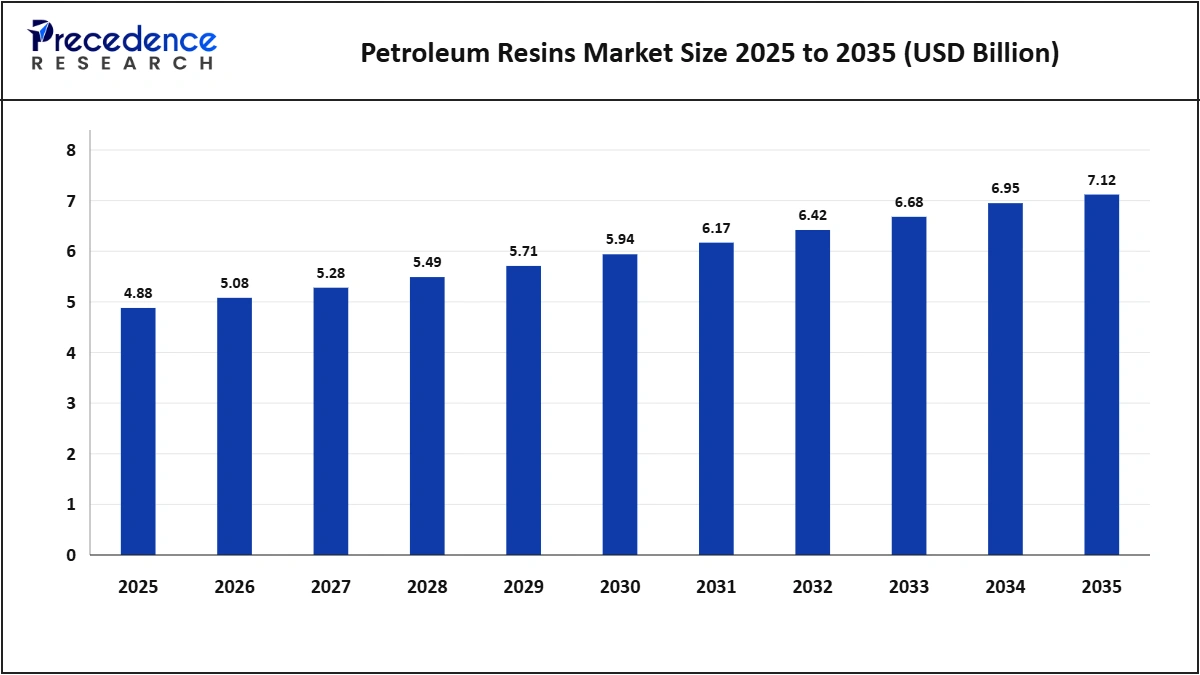
Note: 2025 is the base year; 2026-2035 values are forecasts.
Sources: Expert interviews, secondary sources, Precedence Research database and Precedence Research analysts.
The petroleum resins market is projected to grow from USD 4.88 billion in 2025 to USD 7.22 billion by 2035. Adhesive, tire, road marking, and coating makers prefer petroleum resins to provide tack, adhesion, hardness, and processability. The cost is comparatively lower than natural resin and terpene resins. Premium hydrogenated resins for hygiene and packaging adhesives raise average prices, optimizing revenue growth to USD 5.94 billion by 2030 and a CAGR of 4% from 2026 to 2035.
- Analyst View: The petroleum resins market is expected to grow steadily, supported by rising demand for packaging, hygiene products, tires, adhesives, and infrastructure applications. Increasing the adoption of hydrogenated resins in premium adhesives is expected to improve market value. However, volatility in C5 and C9 feedstock prices, changing production capacities, and competition from alternative tackifiers may moderate expansion, supporting a projected 4% CAGR through 2035.
Market Trends
- Hydrogenated resins are widely utilized in hygiene and packaging.
- There is a shift in capacity from the United States to Asia.
- Low-odor, water-white grades are priced at a premium.
- The demand for hot melt adhesives is boosted by e-commerce packaging.
- Bio-based tackifiers are developing as alternative options.
- Road marking demand correlates with rising infrastructure spending.
Drivers, Restraints, and Opportunities
Driver
Over the past few years, petroleum resins have been gaining prominence due to their widespread applications across multiple domains. Additionally, the rise in emerging markets contributes to this trend. Road construction is also surging demand for thermoplastic road marking paint. In tire production, hydrocarbon resins are utilized to enhance grip and processing capabilities, while premium adhesives require clear, low-odor hydrogenated resins. Packaging and e-commerce growth is raising demand for hot melts and pressure-sensitive adhesives.
Restraint
The petroleum resins market faces challenges from feedstock price volatility, supply fluctuations, and increasing competition from alternative materials. Steam cracker operating rates and naphtha prices directly influence C5 and C9 feedstock availability and production costs. Meanwhile, overcapacity in China puts downward pressure on resin prices, while bio-based and rosin resins gain attention amid sustainability concerns. Plant closures and trade barriers are estimated to disrupt supply chains.
Opportunity
Hydrogenated resins are witnessing growth in hygiene, packaging, and polymer modification sectors. The demand for high-performance and electric vehicle tires is driving tire manufacturers to seek out these resins. Additionally, infrastructure projects in Asia, the Middle East, and Africa are raising the need for road marking materials. Recycled and bio-attributed resins are being utilized to meet sustainability objectives, while new production capacity in Asia is expected to support export markets. These factors are predicted to open new avenues for the market in the upcoming years.
Petroleum Resins Market Segmentation: 2025 Share and Value
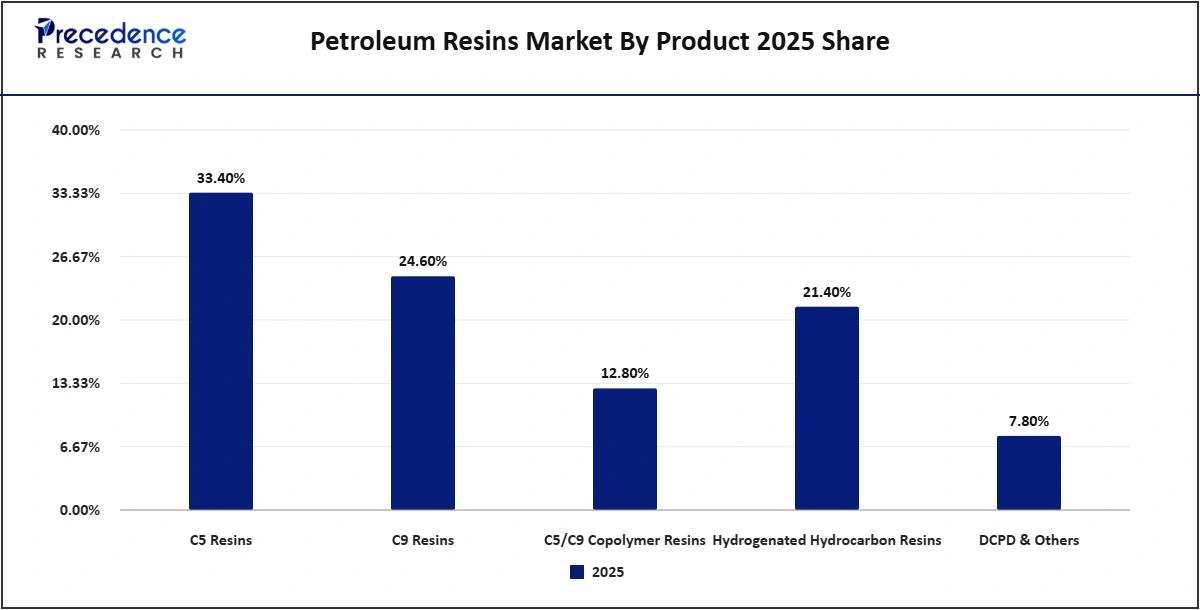
Petroleum Resins Market By Product 2025 Share
Note: 2025 is the base year.
Sources: Expert interviews, secondary sources, Precedence Research database and Precedence Research analysts.
In 2025, C5 resins dominated the market, valued at 33.4% of revenue, equivalent to USD 1.63 billion. Their use in hot melt adhesives for packaging and road marking paints is supporting the segmental growth.
C9 resins captured 24.6% and is valued at USD 1.20 billion, as they are widely utilized in inks and lower-cost adhesives. Hydrogenated hydrocarbon resins represented a 21.4% portion of the market in 2025, valued at USD 1.04 billion because they are favored for their low odor and stability in premium applications. C5/C9 copolymers and DCPD resins generated 12.8% (USD 0.62 billion) and 7.8% (USD 0.38 billion), respectively.
Petroleum Resins Market By Application 2025 Share & Size
| Segments | 2025 Share | 2025 Market Value |
| Adhesives & Sealants | 38.6% | USD 1.88 billion |
| Road Marking Paints | 14.2% | USD 0.69 billion |
| Rubber & Tires | 17.4% | USD 0.85 billion |
| Printing Inks | 9.2% | USD 0.45 billion |
| Paints & Coatings | 11.4% | USD 0.56 billion |
| Others | 9.2% | USD 0.45 billion |
Note: 2025 is the base year.
Sources: Expert interviews, secondary sources, Precedence Research database and Precedence Research analysts.
In 2025, Adhesives and sealants accounted for USD 1.88 billion, equivalent to 38.6% of the overall market. The tackifier resins in hot melt and pressure-sensitive adhesives are distinguishing the segment. Other sectors include rubber and tires at USD 0.85 billion, representing 17.4%, road marking paints at USD 0.69 billion, with 14.2% of the market. Paints and coatings at USD 0.56 billion (11.4%), and printing inks at USD 0.45 billion (9.2%). The adhesives sector is expanding rapidly due to the growth of e-commerce packaging and hygiene products.
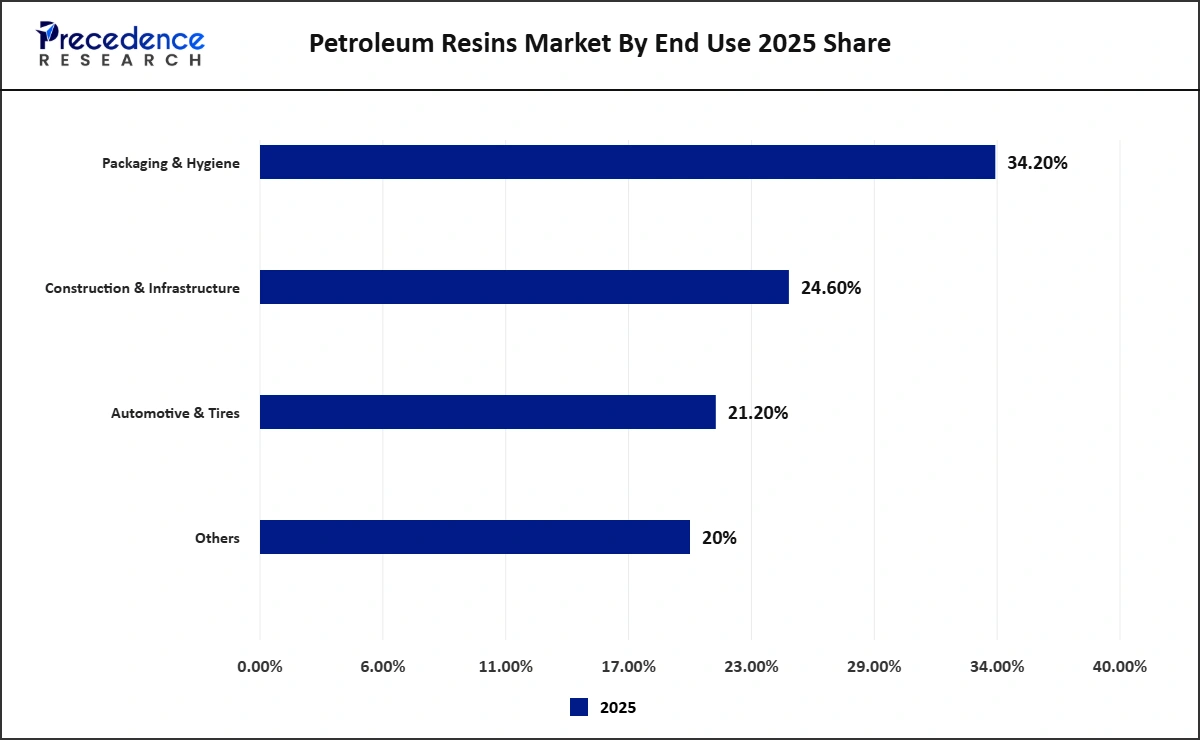
Petroleum Resins Market By End Use 2025 Share
Note: 2025 is the base year.
Sources: Expert interviews, secondary sources, Precedence Research database and Precedence Research analysts.
Packaging and hygiene contributed 34.2% to the overall market in 2025, with a market value of USD 1.67 billion. Construction and infrastructure is the second largest category, accounting for 24.6%, with a valuation of USD 1.20 billion. Automotive and tires' market valuation reached USD 1.03 billion in 2025, securing a 21.2% share. Other end uses accounted for the remaining 20% in 2025, valued at USD 0.98 billion.
- Analyst View: C5 resins lead the market due to their widespread use in adhesives and road marking paints. We expect hydrogenated resins to gain share as demand grows for low-odor, high-performance adhesives in packaging and hygiene applications. However, feedstock price volatility and competition from alternative tackifiers may influence future segment growth.
Regional Analysis
Petroleum Resins Market By Region 2025 Share
Note: 2025 is the base year.
Sources: Expert interviews, secondary sources, Precedence Research database and Precedence Research analysts.
Asia Pacific held the largest share of the market in 2025 at 47.2%. The region's growth is attributed to significant resin production capacities in China, Japan, South Korea, and Singapore, alongside robust demand in packaging, hygiene, tire, and road construction sectors. Europe, with a 21.8% share, has benefited from its adhesive and hygiene manufacturing capabilities, and is highlighted by an established hydrogenated resin production base. North America, at 19.6%, was driven by its packaging, hygiene, and tire industries; however, the closure of local tackifier capacities is leading to increased imports. Latin America and the Middle East and Africa accounted for 6.4% and 5%, with demand supported by packaging, construction, and road building activities.
Asia Pacific's market valuation reached USD 2.30 billion in 2025, securing a 47.2% share. China's dominance as C5 and C9 resin producer is strengthening the regional market. On the other hand, ExxonMobil runs a significant hydrogenated hydrocarbon resin plant in Singapore for export. The demand is driven by packaging, hygiene, and road building sectors.
North America represented a 19.6% portion of the market in 2025, valued at USD 0.96 billion. ExxonMobil planned to close its C5 and hydrogenated resin units in Baton Rouge in 2025, due to which the U.S. is becoming a net importer of the tackifiers, primarily used in packaging and hygiene adhesives
Europe captured 21.8% of the market in 2025, with its market size estimated at USD 1.06 billion. Eastman and other producers in Europe manufacture hydrogenated resins, primarily catering to hygiene and packaging adhesive industries. There is a growing trend toward bio-based alternatives driven by sustainability goals.
Latin America accounted for USD 0.31 billion, representing 6.4% of the total market in 2025. The region is gaining momentum with the packaging, road marking, and tire industries development in Brazil and Mexico.
The Middle East and Africa accounted for 5%, valued at USD 0.24 billion in 2025. Road construction and packaging drive demand. New petrochemical complexes are predicted to add feedstock supply to the product range.
Analyst View: Asia Pacific is leading because of ongoing production scale and demand. Our forecast indicates that Asia Pacific will record the strongest growth, subject to validation against regional forecasts.
Top 10 Companies in the Petroleum Resins Market
| Rank | Company Name | Market-Specific Revenue (USD Billion) | 2025 Share | Key Products / Business | Headquarters |
| 1 | ExxonMobil | 0.52 | 10.66% | Escorez hydrocarbon resins | United States |
| 2 | Eastman | 0.46 | 9.43% | Regalite, Piccotac and Eastotac resins | United States |
| 3 | Kolon Industries | 0.28 | 5.74% | Hikotack and Sukorez resins | South Korea |
| 4 | Zeon | 0.22 | 4.51% | Quintone resins | Japan |
| 5 | Idemitsu Kosan | 0.20 | 4.1% | I-MARV hydrogenated resins | Japan |
| 6 | Synthomer | 0.18 | 3.69% | Hydrocarbon tackifier resins | United Kingdom |
| 7 | Arakawa Chemical | 0.16 | 3.28% | Arkon hydrogenated resins | Japan |
| 8 | TotalEnergies (Cray Valley) | 0.12 | 2.46% | Wingtack and Norsolene resins | France |
| 9 | Neville Chemical | 0.08 | 1.64% | NEVTAC and Nevchem resins | United States |
| 10 | Puyang Changyu | 0.08 | 1.64% | C5 and hydrogenated resins | China |
Note: Company revenues and shares are 2025 estimates.
Sources: Company press releases, expert interviews, secondary sources, Precedence Research database and Precedence Research analysts.
The top 10 companies are estimated to capture 47.13% of 2025 revenue, with the remaining 52.87% distributed among Chinese C5 and C9 resin producers, as well as regional resin manufacturers. ExxonMobil was the leader in the market with an estimated 10.66% (USD 0.52 billion) of 2025 revenue, primarily through its Escorez resin range and a focus on its Singapore hydrogenated resin plant following the closure of its Baton Rouge units. Eastman follows with 9.43% (USD 0.46 billion), supplying Regalite, Piccotac, and Eastotac resins from U.S. and European plants. Kolon Industries, a major Korean producer, holds 5.74% (USD 0.28 billion) with its C5, C9, and hydrogenated resins.
Zeon, Idemitsu, and Arakawa are leading Japanese producers, while Synthomer is a major remaining U.S. producer of C5 and hydrogenated hydrocarbon tackifiers. Additionally, TotalEnergies' Cray Valley, Neville Chemical, and Chinese companies like Puyang Changyu are expanding production capacity. The petroleum resins market is moderately concentrated for hydrogenated and premium grades, while it is fragmented for standard C5 and C9 resins, especially in China. Key competition factors include color, odor, thermal stability, polymer compatibility, feedstock integration, regional supply, and pricing, with capacity shifts influencing trade flows between Asia and North America.
Recent Developments
- April 2026: Neville Chemical launched its novel NEVTAC T950 and NEVTAC T1000 C5 hydrocarbon tackifiers during the Adhesive and Sealant Council Convention.
- May 2025: Neville Chemical Company broadened its U.S. distribution partnership with IMCD Group to improve the supply and market presence of its NEVTAC tackifying resins throughout the United States.
Petroleum Resins Market Segments
By Product
- C5 Resins
- C9 Resins
- C5/C9 Copolymer Resins
- Hydrogenated Hydrocarbon Resins
- DCPD & Others
By Application
- Adhesives & Sealants
- Road Marking Paints
- Rubber & Tires
- Printing Inks
- Paints & Coatings
- Others
By End Use
- Packaging & Hygiene
- Construction & Infrastructure
- Automotive & Tires
- Others
By Region
- North America (U.S., Canada, Mexico)
- Europe (Germany, U.K., France, Italy, Spain, Rest of Europe)
- Asia Pacific (China, Japan, India, South Korea, Taiwan, Rest of Asia Pacific)
- Latin America (Brazil, Argentina, Rest of Latin America)
- Middle East & Africa (GCC, South Africa, Rest of MEA)
Research Methodology
The petroleum resins market is defined as C5, C9, C5/C9, DCPD, and hydrogenated hydrocarbon resins for adhesives, road marking, rubber, inks, and coatings worldwide. The 2025 base year was built bottom-up from resin consumption volumes by type, application, and region and average selling prices. The overall estimate was cross-checked against a top-down assessment of leading producers' petroleum-resin revenues. Segment, regional, and company values were allocated from products, applications, end uses, and regional demand. Key estimates were verified by cross-checking company disclosures, regulatory and industry data, and published third-party estimates, and inputs that could not be reconciled were excluded. All segment, regional and company figures were reconciled to the same 2025 base year. The 2026-2035 forecast, which applies a constant CAGR from the 2025 base, was recalculated and validated.
Analyst View: Overall Market
The petroleum resins market is a steadily growing market tied to adhesives, tires, and infrastructure, with value growth from hydrogenated grades and capacity moving toward Asia. Our estimate links demand to resin volumes and prices by type and application, so the forecast follows packaging, hygiene, tire, and road construction trends. The main upside comes from hydrogenated resins and Asian demand, while the prime risks are feedstock volatility and bio-based substitution.
Sources and References
- Neville Chemical. "News". 2026-04-29. IMCD partnership and NEVTAC launches. https://www.nevchem.com/news/
- Argus Media. "How will ExxonMobil's US tackifier closure affect the US market". 2025-07-10. Baton Rouge closure. https://www.argusmedia.com/ja/news-and-insights/market-opinion-and-analysis-blog/how-will-exxonmobils-us-tackifier-closure-affect-the-us-market
- ChemXplore. "Eastman completes expansion of hydrogenated hydrocarbon resin production in the Netherlands". 2011-10-18. Eastman Middelburg capacity. https://chemxplore.com/news/eastman-completes-expansion-of-hydrogenated-hydrocarbon-resin-production-in-the-netherlands
For inquiries regarding discounts, bulk purchases, or customization requests, please contact us at sales@precedenceresearch.com
Frequently Asked Questions





Ask For Sample
No cookie-cutter, only authentic analysis – take the 1st step to become a Precedence Research client
 Get a Sample




 sales@precedenceresearch.com
 Schedule a Meeting
