



Photovoltaics (PV) Films Market Trends, Leading Companies, Company Revenue / Sales Performance, Installed Capacity, Production Output, Grid Expansion, Market Share, Technology Adoption, and Industry Outlook
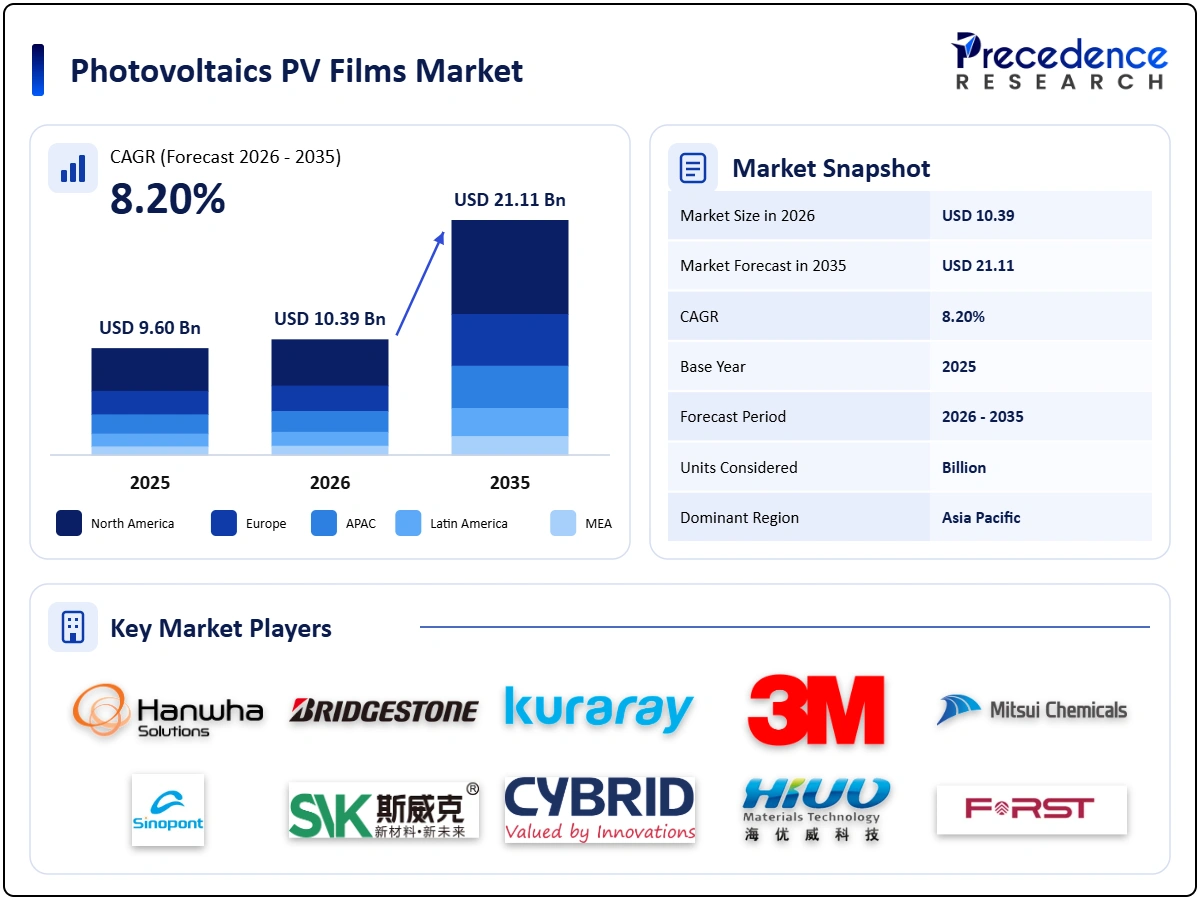
According to energy and power expert Laxmi Narayn, the photovoltaics (PV) films market has reached USD 10.39 billion in 2026 to USD 21.11 billion by 2035, growing at a CAGR of 8.20%. The photovoltaics (PV) films market companies such as Shanghai HIUV, Cybrid Technologies, Jiangsu Sveck are playing a key role in market expansion, with major opportunities emerging across film type, raw material, application and region segments.
Source: https://www.precedenceresearch.com/photovoltaics-pv-films-market
 Get a Sample
 Report Description
Key Takeaways
Market Size & Growth Outlook
- Market size in 2025: USD 9.60 billion
- Estimated market size in 2026: USD 10.39 billion
- Projected market size by 2035: USD 21.11 billion
- CAGR (2026-2035): 8.20%
Regional Market Spotlight
- Asia Pacific led the market with a 72.60% share, worth USD 6.97 billion in 2025.
- North America accounted for 11.40% with USD 1.09 billion of the market in 2025 and is projected to be the fastest-growing region, at a CAGR of 10.24% from 2025 to 2035.
- Europe accounted for 9.20% with USD 0.88 billion of the market in 2025.
Segmental Spotlight
- By film type, the encapsulant Films accounted for 68.40% with USD 6.57 billion in 2025.
- By raw material, the EVA accounted for 44.60% with USD 4.28 billion in 2025.
- By application, the utility-scale ground-mounted accounted for 58.40% with USD 5.61 billion in 2025.
Photovoltaics (PV) Films Market Size and Forecast, 2025-2035 (USD Billion)
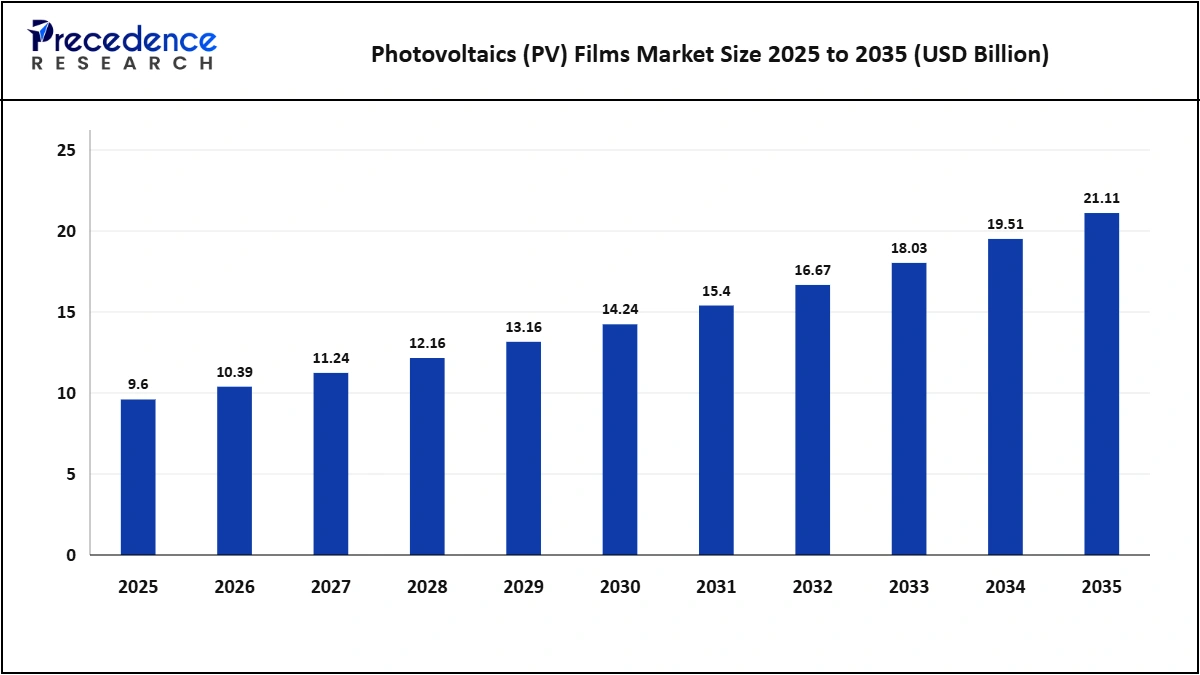
Note: 2025 is the base year; 2026-2035 values are forecasts.
Sources: Expert interviews, secondary sources, Precedence Research database, and Precedence Research analysts.
The photovoltaics (PV) films market is projected to grow from USD 9.60 billion in 2025 to USD 21.11 billion by 2035 because every solar module needs encapsulant and protective films, and global PV installations remain at record levels. Higher-value POE and EPE films for advanced cells and glass-glass modules offset price pressure, lifting the market to USD 14.24 billion by 2030 and sustaining a CAGR of 8.20% from 2026 to 2035.
- Analyst View: We built the estimate from annual module production by technology and region, film area per module by encapsulant and backsheet type, and average film prices, which fell sharply between 2022 and 2025. Production reflects global PV installations, the share of bifacial and glass-glass modules and cell technology mix. The total was cross-checked against the PV film revenue of leading Chinese and international producers. Some published estimates do not reflect recent price declines, so our base year is set on a volume and price basis. The growth rate reflects continued solar growth and premium film mix, moderated by price competition and a pause in 2026 installations.
Market Trends
- POE and EPE films replace EVA in TOPCon modules.
- Glass-glass bifacial modules increase encapsulant use.
- Film prices fall sharply due to overcapacity.
- Capacity expands in Southeast Asia and the US.
- Transparent backsheets compete with rear glass.
- Resin supply integration lowers film costs.
Drivers, Restraints and Opportunities
Driver
Global solar installations remain at very high levels. TOPCon, heterojunction and back-contact cells require higher-performance POE and EPE encapsulants. Bifacial glass-glass modules use two encapsulant layers. Long module warranties require durable films. Domestic manufacturing policies create new film demand outside China.
Restraint
Overcapacity has driven film prices down by around half since 2022. Solar installations may pause in some markets. POE resin supply has been tight and costly. Trade barriers complicate supply chains. Thin margins limit investment.
Opportunity
BIPV and lightweight modules can use specialty films. Local film production in the US, India, and Europe can capture policy-supported demand. Recyclable and fluorine-free backsheets address sustainability. Perovskite and tandem modules may need new encapsulants. Resin integration can improve competitiveness.
Market Segmentation: 2025 Share and Value
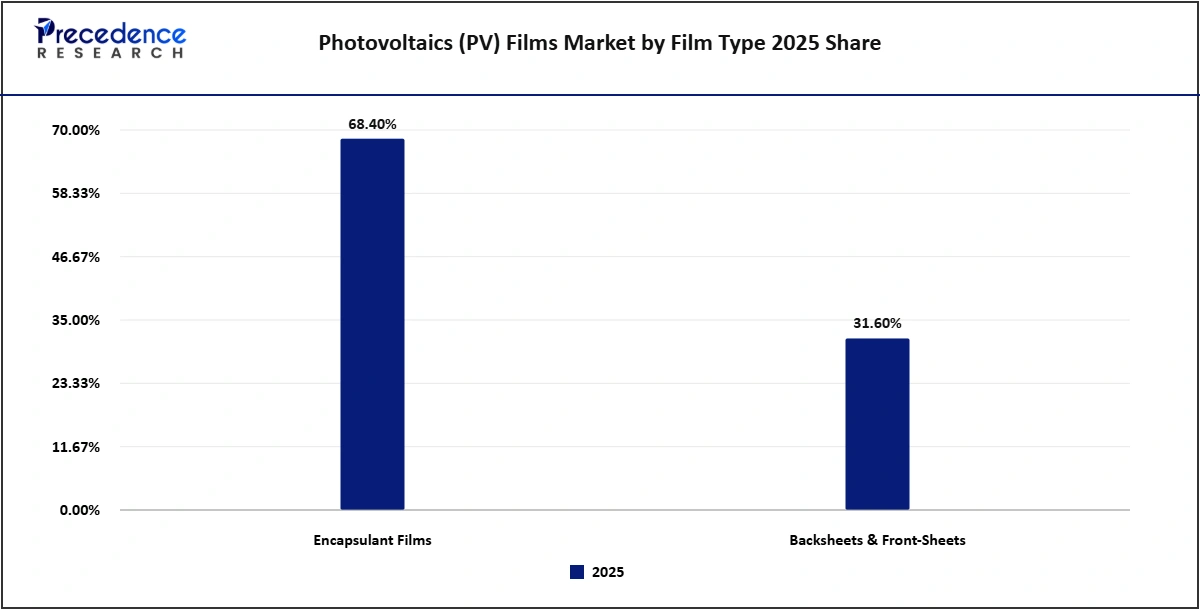
Photovoltaics (PV) Films Market by Film Type 2025 Share
Note: 2025 is the base year.
Sources: Expert interviews, secondary sources, Precedence Research database and Precedence Research analysts.
Encapsulant films accounted for 68.40% with USD 6.57 billion in 2025 because every module uses encapsulant on both sides of the cells, and the rise of bifacial glass-glass modules increases encapsulant area per module while reducing the need for polymer backsheets. Encapsulants are also the faster-growing film type. Backsheets and front-sheets, at 31.60% with USD 3.03 billion, protect monofacial modules from moisture and UV, and transparent backsheets compete with glass in lightweight bifacial designs.
Photovoltaics (PV) Films Market by Raw Material 2025 Share & Size
| Segments | 2025 Share | 2025 Market Value |
| EVA | 44.60% | USD 4.28 billion |
| POE & EPE Co-Extruded | 34.20% | USD 3.28 billion |
| PVB & Others | 6.20% | USD 0.60 billion |
| Fluoropolymer & PET Backsheet Films | 15.00% | USD 1.44 billion |
Note: 2025 is the base year.
Sources: Expert interviews, secondary sources, Precedence Research database, and Precedence Research analysts.
EVA accounted for 44.60% with USD 4.28 billion in 2025 because it remains the lowest-cost encapsulant and is widely used in PERC and many TOPCon modules. POE and EPE co-extruded films, at 34.20% with USD 3.28 billion, are the fastest-growing material because their low water vapour transmission and resistance to potential-induced degradation suit TOPCon, heterojunction, and bifacial modules. Fluoropolymer films and PET backsheet films account for 15.00% with USD 1.44 billion, and PVB and others for 6.20% with USD 0.60 billion.
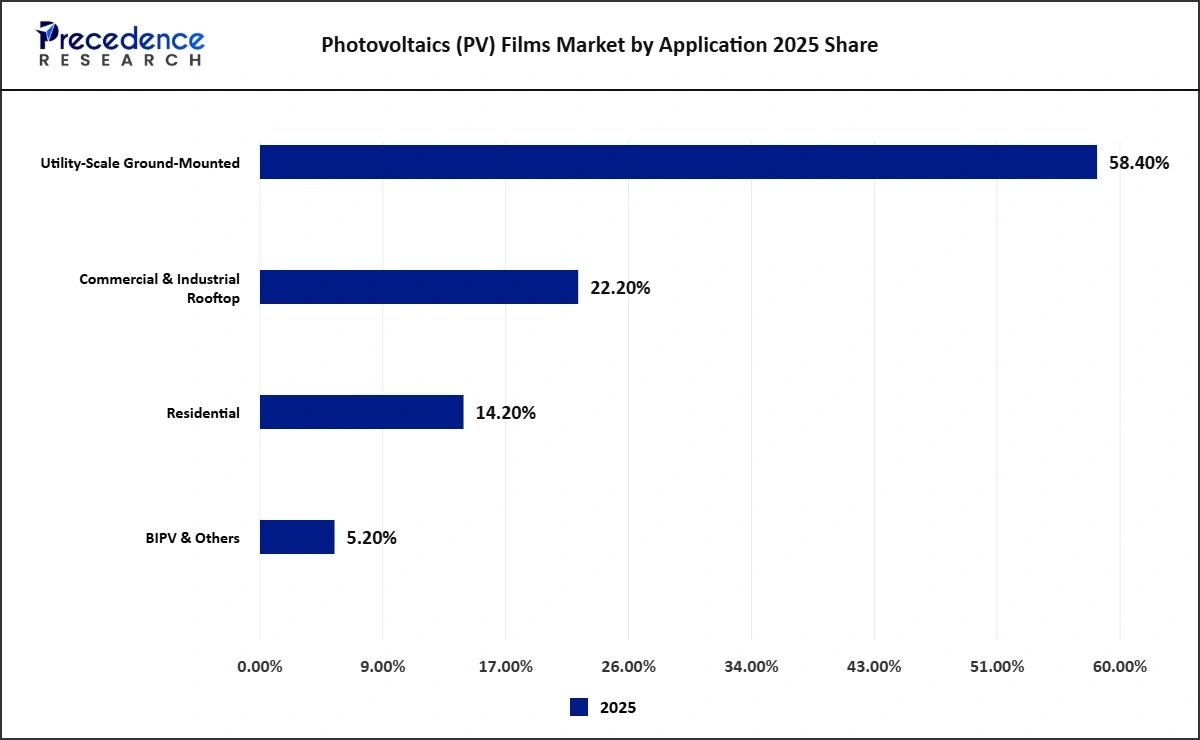
Photovoltaics (PV) Films Market by Application 2025 Share
Note: 2025 is the base year.
Sources: Expert interviews, secondary sources, Precedence Research database, and Precedence Research analysts.
Utility-scale ground-mounted projects accounted for 58.40% with USD 5.61 billion in 2025 because they install the largest volumes of bifacial modules. Commercial and industrial rooftop accounts for 22.20% with USD 2.13 billion, residential for 14.20% with USD 1.36 billion, and BIPV and others for 5.20% with USD 0.50 billion, the fastest-growing application from a small base.
- Analyst View: Segment values were allocated by matching module production, film area, and prices to film types, materials, and applications, using producer revenue mixes. Encapsulants and EVA lead because of volume. We expect POE and EPE films, glass-glass modules, and BIPV to gain share.
Regional Analysis
Photovoltaics (PV) Films Market by Region 2025 Share
Note: 2025 is the base year.
Sources: Expert interviews, secondary sources, Precedence Research database, and Precedence Research analysts.
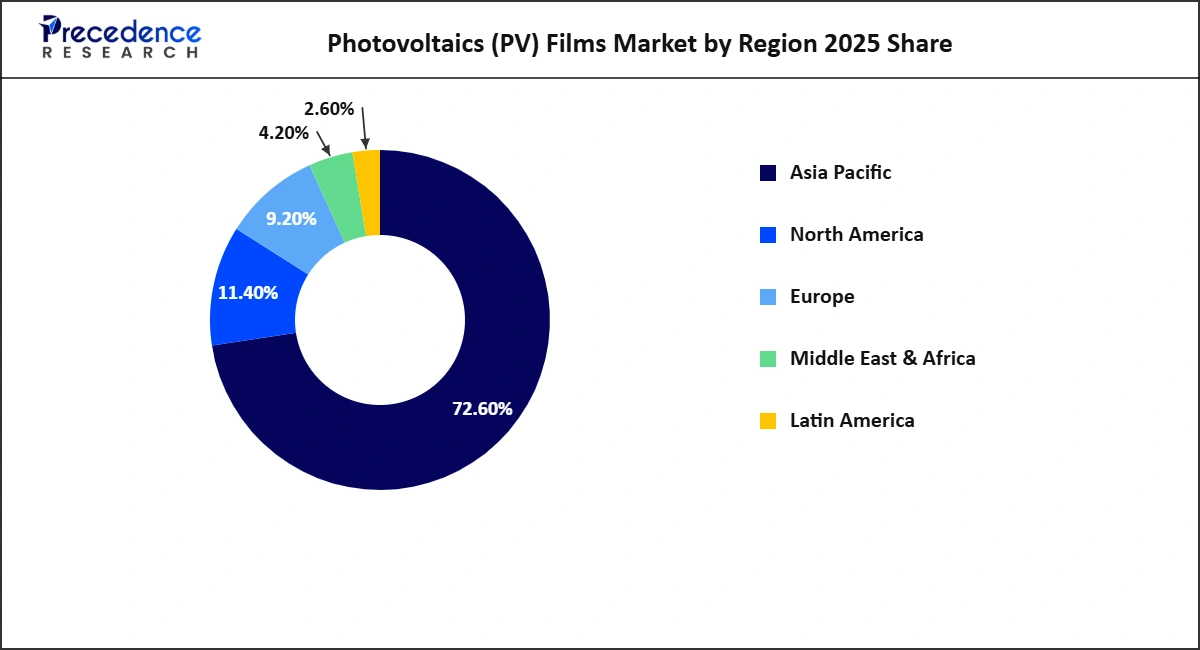
Asia Pacific accounted for 72.60% with USD 6.97 billion in 2025 because China produces most of the world's modules and encapsulant films, and Southeast Asia and India are expanding module output. North America, at 11.40% with USD 1.09 billion, is the fastest-growing region, supported by new US module factories under domestic manufacturing incentives and local film supply agreements. Europe, at 9.20% with USD 0.88 billion, is supported by a smaller but strategic module manufacturing base and BIPV. The Middle East and Africa, at 4.20% with USD 0.40 billion, and Latin America, at 2.60% with USD 0.25 billion, are supported by new module assembly in the Gulf, Turkey, and Brazil.
Asia Pacific accounted for 72.60% with USD 6.97 billion in 2025. China holds more than 85% of global encapsulant capacity, led by companies such as First Applied, HIUV and Cybrid. First Applied is building encapsulant capacity in Thailand and backsheet capacity in Vietnam. Price declines have squeezed margins.
North America accounted for 11.40% with USD 1.09 billion in 2025 and is the fastest-growing region. New US module plants need local encapsulant and backsheet supply. Thin-film manufacturers use captive or contracted encapsulant supply.
Europe accounted for 9.20% with USD 0.88 billion in 2025. Module manufacturing is limited but supported by industrial policy. BIPV and specialty modules use premium films.
The Middle East and Africa accounted for 4.20% with USD 0.40 billion in 2025. Module factories in Turkey, Saudi Arabia and the UAE are increasing film demand.
Latin America accounted for 2.60% with USD 0.25 billion in 2025. Brazil has growing module assembly.
Analyst View: Regional shares were built from module production, film area and prices in each region. Asia Pacific leads because of manufacturing concentration. We assign North America the highest growth premium because domestic module manufacturing is expanding fastest there.
Competitive Landscape
Top 10 Companies in the Photovoltaics (PV) Films Market 2025
| Rank | Company Name | Market-Specific Revenue (USD Billion) | 2025 Share | Key Products / Business | Headquarters |
| 1 | Hangzhou First Applied Material | 2.10 | 21.88% | EVA, POE and EPE encapsulants and backsheets | China |
| 2 | Shanghai HIUV | 0.98 | 10.21% | Encapsulant films | China |
| 3 | Cybrid Technologies | 0.68 | 7.08% | Backsheets and encapsulants | China |
| 4 | Jiangsu Sveck | 0.62 | 6.46% | Encapsulant films | China |
| 5 | Zhejiang Sinopont | 0.24 | 2.50% | Encapsulant films | China |
| 6 | Mitsui Chemicals | 0.18 | 1.88% | Solar encapsulant sheets and POE | Japan |
| 7 | 3M | 0.12 | 1.25% | Backsheet and specialty PV films | United States |
| 8 | Kuraray | 0.10 | 1.04% | PVB and ionomer encapsulants | Japan |
| 9 | Bridgestone | 0.08 | 0.83% | EVA encapsulant films | Japan |
| 10 | Hanwha Solutions | 0.08 | 0.83% | EVA resins and encapsulants | South Korea |
Note: Company revenues and shares are 2025 estimates.
Sources: Company press releases, expert interviews, secondary sources, Precedence Research database and Precedence Research analysts.
First Applied led the photovoltaics (PV) films market with an estimated 21.88% with USD 2.10 billion of 2025 revenue, followed by HIUV at 10.21% with USD 0.98 billion and Cybrid at 7.08% with USD 0.68 billion. Hangzhou First Applied Material leads as the world's largest PV encapsulant producer, supplying EVA, POE and co-extruded EPE films and backsheets, and is adding capacity in China, Thailand and Vietnam. Shanghai HIUV is the second-largest encapsulant producer by capacity, with new lines in Cangzhou and Yibin, and Cybrid Technologies is a leading backsheet and encapsulant supplier. Jiangsu Sveck and Zhejiang Sinopont expand Chinese capacity, while Mitsui Chemicals, 3M, Kuraray, Bridgestone and Hanwha Solutions supply specialty films, resins and encapsulants for international module makers.
The top 10 companies accounted for an estimated 53.96% with USD 5.18 billion of 2025 revenue, while the remaining 46.04% with USD 4.42 billion was shared among smaller Chinese film producers, resin suppliers' downstream units and regional encapsulant makers. The photovoltaics (PV) films market is concentrated among Chinese producers with large scale and low costs, and competition centres on price, cost per square metre, reliability with new cell technologies, supply security and proximity to module factories. International suppliers differentiate through specialty materials, localised supply outside China and long-term reliability data.
Companies Ecosystem
The PV films ecosystem links resin and fluoropolymer producers with film manufacturers, module makers and project developers. Resin supply, especially POE, and film pricing strongly influence module costs and profitability.
| Ecosystem Stage | Role in the Market | Key Companies |
| Resin & Material Suppliers | Produce EVA, POE, PVB, PET and fluoropolymer resins and additives | Hanwha Solutions, Wanhua Chemical, Dow, Mitsui Chemicals, Kuraray, Arkema |
| Film Manufacturers | Extrude encapsulants and laminate backsheets | First Applied, HIUV, Cybrid, Sveck, Sinopont, 3M, Bridgestone |
| Module Manufacturers | Laminate cells with encapsulants, glass and backsheets | LONGi, JinkoSolar, Trina Solar, JA Solar, First Solar, Canadian Solar |
| Project Developers & EPCs | Install modules in utility, commercial and residential projects | NextEra, ACWA Power, EPC contractors |
| End Users | Utilities, businesses and households generating solar power | Utilities, C&I customers, homeowners |
Sources: Company press releases, expert interviews, secondary sources, Precedence Research database and Precedence Research analysts.
Precedence Research Companies Quadrant
The Precedence Research Companies Quadrant positions key participants in the photovoltaics (PV) films market by market strength, reflecting revenue scale, market share and geographic reach, and by innovation and growth strategy, reflecting product portfolio breadth, R&D intensity and partnerships. Positions reflect each company's estimated 2025 PV film revenue and our assessment of its technology, capacity investment and module maker partnerships.
Sources: Company press releases, expert interviews, secondary sources, Precedence Research database and Precedence Research analysts.
Leaders: First Applied, HIUV and Cybrid combine the largest film volumes with POE and EPE technology for advanced cells and continuing capacity expansion.
Challengers: Sveck and Hanwha Solutions have significant capacity or resin integration but narrower technology differentiation.
Innovators: Mitsui Chemicals, 3M and Kuraray offer specialty encapsulant, ionomer, PVB or backsheet technologies valued for reliability and BIPV.
Niche Players: Sinopont and Bridgestone serve specific regional or specialty segments.
Recent Developments
- In early 2026, HIUV brought its Yibin encapsulant plant online, while BloombergNEF projected 2026 global PV installations slightly below 2025 levels.
- In 2025, Leading Chinese producers commissioned new encapsulant lines, including First Applied in Suqian, HIUV in Cangzhou and Sveck in Meishan and Yancheng, as China's encapsulant prices fell about 50 to 60% from 2022 peaks.
- In October 2023, Hangzhou First Applied Material announced about USD 270 million of investment in new encapsulant and backsheet plants in China, Thailand and Vietnam.
Photovoltaics PV Films Market Segments
By Film Type
- Encapsulant Films
- Backsheets & Front-Sheets
By Raw Material
- EVA
- POE & EPE Co-Extruded
- PVB & Others
- Fluoropolymer & PET Backsheet Films
By Application
- Utility-Scale Ground-Mounted
- Commercial & Industrial Rooftop
- Residential
- BIPV & Others
By Region
- North America
- U.S.
- Canada
- Mexico
- Europe
- Germany
- U.K.
- France
- Italy
- Spain
- Rest of Europe
- Asia Pacific
- China
- Japan
- India
- South Korea
- Taiwan
- Rest of Asia Pacific
- Latin America
- Brazil
- Argentina
- Rest of Latin America
- Middle East & Africa
- GCC
- South Africa
- Rest of MEA
Research Methodology
The photovoltaics (PV) films market was defined as EVA, POE, EPE, PVB and specialty encapsulant films and backsheets and front-sheets for PV modules, worldwide. The 2025 base year was built bottom-up from module production by technology and region, film area per module and average film prices, and checked top-down against the PV film revenue of leading producers.
Segment, regional and company values were allocated from film types, raw materials, applications and regional demand. Key estimates were verified by cross-checking company disclosures, regulatory and industry data and published third-party estimates, and inputs that could not be reconciled were excluded. All segment, regional and company figures were reconciled to the same 2025 base year, and the 2026-2035 forecast, which applies a constant CAGR from the 2025 base, was recalculated and validated.
Analyst View: Overall Market
The photovoltaics (PV) films market follows solar module production, with growth in volume and a shift to premium POE and EPE films offset by steep price declines. Our estimate links demand to module output, film area and prices, so the forecast follows installations, technology mix and pricing. The main upside comes from advanced cell technologies and localised supply, while the main risks are overcapacity and installation slowdowns.
Sources and References
- Yicai Global. "First Applied to invest USD270 million to hike PV film packaging capacity in China, Thailand, Vietnam". 2023-10-30. First Applied expansion. https://yicaiglobal.com/news/first-applied-to-invest-usd270-million-to-hike-pv-film-packaging-capacity-in-china-thailand-vietnam
For inquiries regarding discounts, bulk purchases, or customization requests, please contact us at sales@precedenceresearch.com
Frequently Asked Questions





Ask For Sample
No cookie-cutter, only authentic analysis – take the 1st step to become a Precedence Research client
 Get a Sample




 sales@precedenceresearch.com
 Schedule a Meeting
