



Pipeline Monitoring System Market Trends, Leading Companies, Company Revenue / Sales Performance, Installed Capacity, Production Output, Grid Expansion, Market Share, Technology Adoption, and Industry Outlook
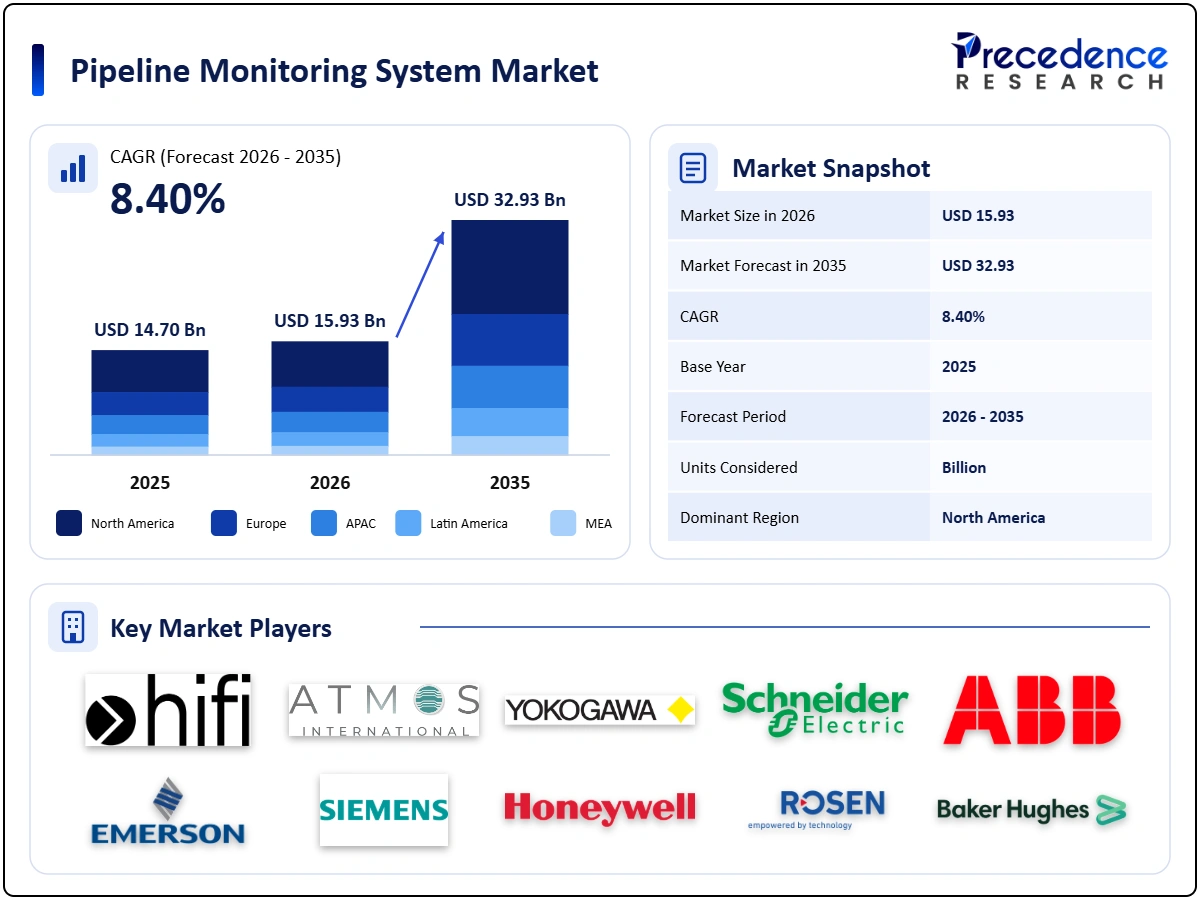
According to energy and power expert Laxmi Narayn, the pipeline monitoring system market has reached USD 15.93 billion in 2026 to USD 32.93 billion by 2035, growing at a CAGR of 8.40%. The pipeline monitoring system market companies such as Baker Hughes, ROSEN Group, Honeywell are playing a key role in market expansion, with major opportunities emerging across component, technology, application, pipeline Type and region segments.
Source: https://www.precedenceresearch.com/pipeline-monitoring-system-market
 Get a Sample
 Report Description
Key Takeaways
Market Size & Growth Outlook
- Market size in 2025: USD 14.70 billion
- Estimated market size in 2026: USD 15.93 billion
- Projected market size by 2035: USD 32.93 billion
- CAGR (2026–2035): 8.40%
Regional Market Spotlight
- North America led the market with a 29.40% share of USD 4.32 billion in 2025.
- Asia Pacific accounted for 26.20% with USD 3.85 billion of the market in 2025 and is projected to be the fastest-growing region, at a CAGR of 9.81% from 2025 to 2035.
- Europe accounted for 20.40% with USD 3.00 billion of the market in 2025.
Segmental Spotlight
- By component, the hardware accounted for 52.40% with USD 7.70 billion in 2025.
- By technology, the acoustic & ultrasonic accounted for 25.40% with USD 3.73 billion in 2025.
- By application, the leak detection accounted for 36.20% with USD 5.32 billion in 2025.
- By pipeline type, the oil & refined products accounted for 38.40% with USD 5.64 billion in 2025.
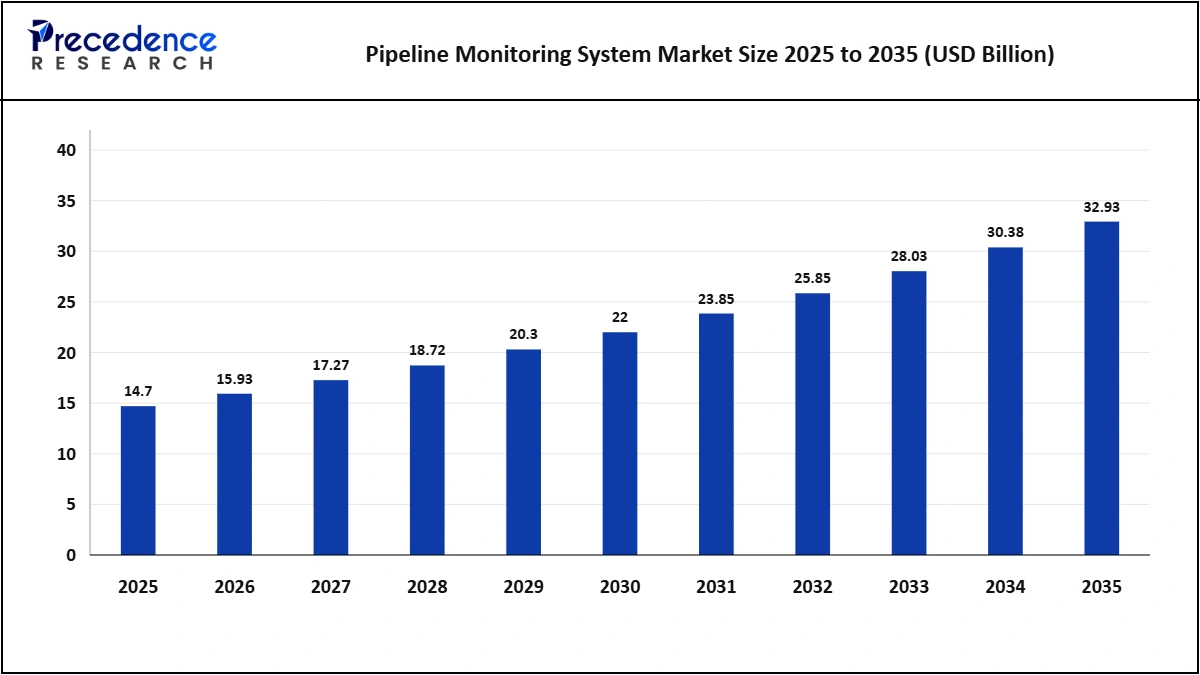
Pipeline Monitoring System Market Size and Forecast, 2025-2035 (USD Billion)
Note: 2025 is the base year; 2026-2035 values are forecasts.
Sources: Expert interviews, secondary sources, Precedence Research database, and Precedence Research analysts.
The pipeline monitoring system market is projected to grow from USD 14.70 billion in 2025 to USD 32.93 billion by 2035 because operators must detect leaks, corrosion, ground movement, and intrusions quickly to meet safety and environmental rules and avoid costly incidents. New pipelines for gas, hydrogen and CO2, plus water network digitalisation, broaden demand, lifting the market to USD 22.00 billion by 2030 and sustaining a CAGR of 8.40% from 2026 to 2035.
- Analyst View: We built the estimate from the length of operating and new pipelines by type and region, monitoring technology penetration and average spending per kilometre on hardware, software and services, plus in-line inspection runs and integrity services. Spending reflects regulatory requirements, pipeline age, risk profile and new construction. The total was cross-checked against the pipeline monitoring and integrity revenue of leading suppliers and against published estimates, which places our base year slightly above the comparable figures. The growth rate reflects regulation, new pipelines and digitalisation, moderated by oil and gas budget cycles.
Market Trends
- Distributed fibre sensing covers entire pipeline routes.
- AI analytics reduce false leak alarms.
- Methane rules drive gas leak detection.
- Hydrogen and CO2 pipelines need new monitoring.
- Water utilities adopt leak monitoring.
- Long-term monitoring service contracts grow.
Drivers, Restraints and Opportunities
Driver
Pipeline safety and integrity regulations require inspection and leak detection. Methane emission rules increase monitoring of gas networks. Ageing pipelines need more frequent integrity assessment. New gas, hydrogen and CO2 pipelines require modern monitoring. Theft and third-party damage drive security monitoring.
Restraint
Monitoring systems require significant capital investment. False alarms can reduce operator confidence. Retrofitting fibre to existing pipelines is costly. Oil and gas budget cycles affect spending. Integration with legacy SCADA systems is complex.
Opportunity
AI and digital twins can improve detection and predictive maintenance. Hydrogen and CO2 transport networks offer new markets. Water loss reduction programmes create demand. Monitoring-as-a-service can create recurring revenue. Satellite and drone monitoring can complement ground systems.
Market Segmentation: 2025 Share and Value
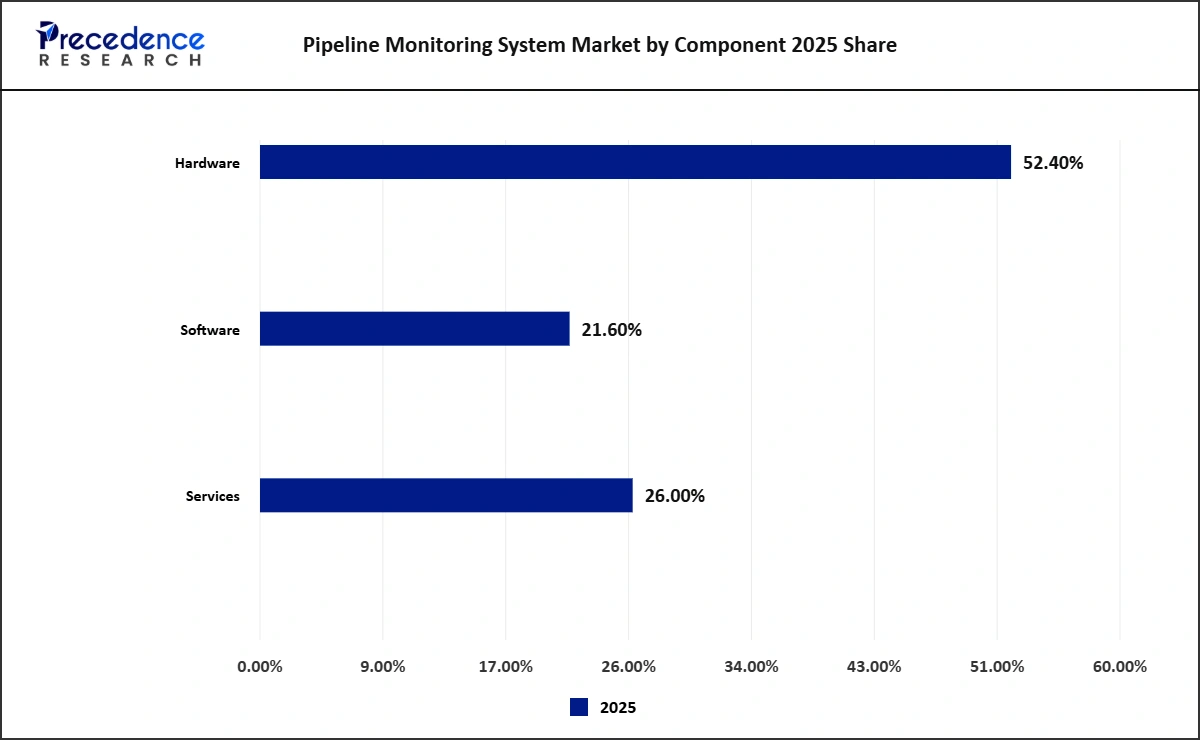
Pipeline Monitoring System Market by Component 2025 Share
Note: 2025 is the base year.
Sources: Expert interviews, secondary sources, Precedence Research database, and Precedence Research analysts.
Hardware accounted for 52.40% with USD 7.70 billion in 2025 because sensors, fibre-optic interrogators, in-line inspection tools, flow meters and RTUs represent most of the investment in monitoring systems, particularly on new pipelines. Services, at 26.00% with USD 3.82 billion, include inspection runs, data interpretation, 24/7 monitoring centres and integrity assessments. Software accounts for 21.60% with USD 3.18 billion and is the fastest-growing component as operators adopt computational leak detection, digital twin and AI analytics.
Pipeline Monitoring System Market by Technology 2025 Share & Size
| Segments | 2025 Share | 2025 Market Value |
| Acoustic & Ultrasonic | 25.40% | USD 3.73 billion |
| Fibre Optic Sensing | 21.80% | USD 3.20 billion |
| Smart Pigs & In-Line Inspection | 22.60% | USD 3.32 billion |
| Magnetic Flux Leakage | 12.40% | USD 1.82 billion |
| SCADA-Based & Others | 17.80% | USD 2.62 billion |
Note: 2025 is the base year.
Sources: Expert interviews, secondary sources, Precedence Research database, and Precedence Research analysts.
Acoustic and ultrasonic technologies accounted for 25.40% with USD 3.73 billion in 2025 because they detect leaks and measure flow and wall thickness on many pipeline types.
Smart pigs and in-line inspection account for 22.60% with USD 3.32 billion, fibre-optic sensing for 21.80% with USD 3.20 billion, the fastest-growing technology as distributed acoustic sensing detects leaks, digging, and theft along entire routes, magnetic flux leakage for 12.40% with USD 1.82 billion, and SCADA-based and others for 17.80% with USD 2.62 billion.
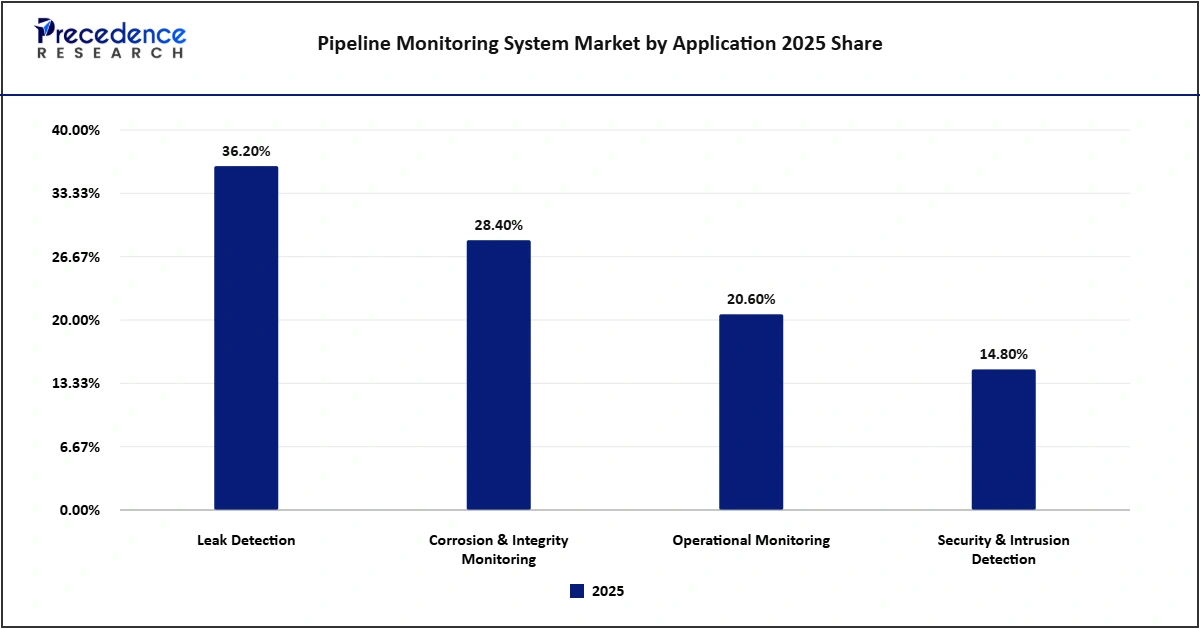
Pipeline Monitoring System Market by Application 2025 Share
Note: 2025 is the base year.
Sources: Expert interviews, secondary sources, Precedence Research database, and Precedence Research analysts.
Leak detection accounted for 36.20% with USD 5.32 billion in 2025 because regulations and environmental risks make rapid leak identification a priority. Corrosion and integrity monitoring accounts for 28.40% with USD 4.17 billion, operational monitoring for 20.60% with USD 3.03 billion, and security and intrusion detection for 14.80% with USD 2.18 billion, which is growing quickly in regions affected by theft.
Pipeline Monitoring System Market by Pipeline Type 2025 Share & Size
| Segments | 2025 Share | 2025 Market Value |
| Oil & Refined Products | 38.40% | USD 5.64 billion |
| Natural Gas | 36.20% | USD 5.32 billion |
| Water & Wastewater | 17.60% | USD 2.59 billion |
| Chemicals, Hydrogen & CO2 | 7.80% | USD 1.15 billion |
Note: 2025 is the base year.
Sources: Expert interviews, secondary sources, Precedence Research database, and Precedence Research analysts.
Oil and refined product pipelines accounted for 38.40% with USD 5.64 billion in 2025, natural gas for 36.20% with USD 5.32 billion, water and wastewater for 17.60% with USD 2.59 billion, and chemicals, hydrogen, and CO2 for 7.80% with USD 1.15 billion. Hydrogen and CO2 pipelines are the fastest-growing type from a small base, while water networks are adopting monitoring to cut losses.
- Analyst View: Segment values were allocated by matching pipeline length, technology penetration, and spending to components, technologies, applications, and pipeline types, using supplier revenue mixes. Hardware and leak detection lead because of regulatory and capital requirements. We expect software, fibre-optic sensing, and hydrogen and CO2 pipelines to gain share.
Regional Analysis
Pipeline Monitoring System Market by Region 2025 Share
Note: 2025 is the base year.
Sources: Expert interviews, secondary sources, Precedence Research database, and Precedence Research analysts.
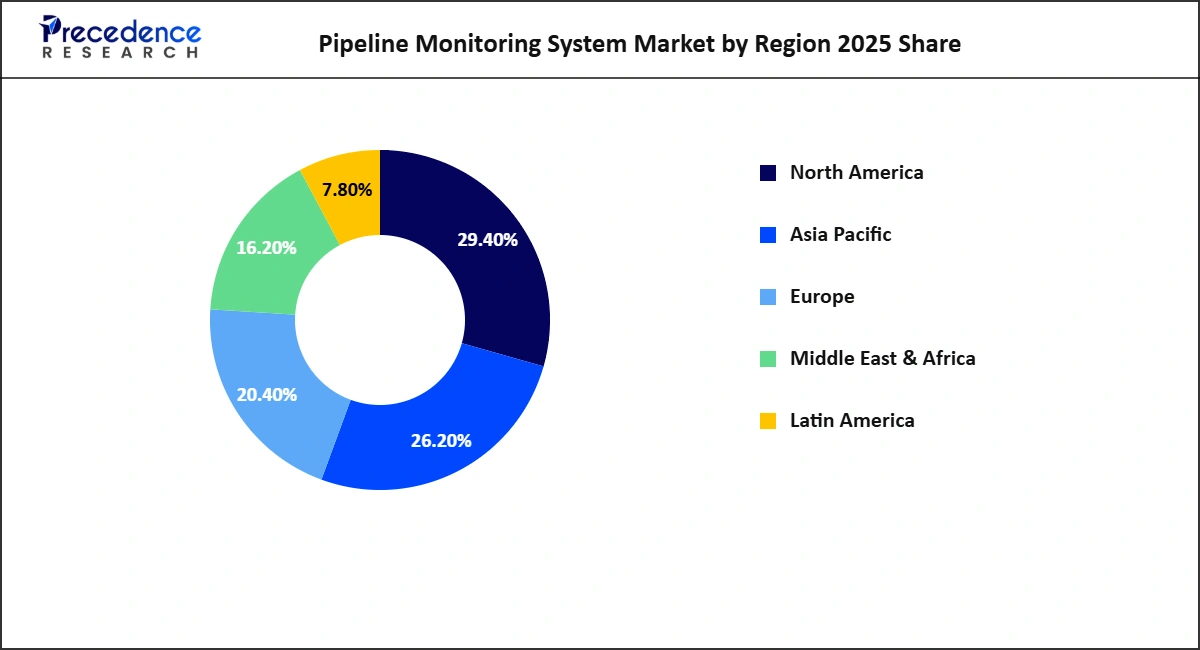
North America accounted for 29.40% with USD 4.32 billion in 2025, supported by the largest pipeline network, PHMSA and Canadian integrity regulations, ageing infrastructure, and new export and gathering pipelines. Asia Pacific, at 26.20% with USD 3.85 billion, is the fastest-growing region, supported by gas grid expansion in China and India, new cross-border pipelines and water network investment. Europe, at 20.40% with USD 3.00 billion, is supported by methane rules, hydrogen-ready networks, and CO2 transport projects. The Middle East and Africa, at 16.20% with USD 2.38 billion, is supported by large oil and gas pipelines and theft prevention, and Latin America, at 7.80% with USD 1.15 billion, is supported by Mexico, Brazil, and Argentina.
North America accounted for 29.40% with USD 4.32 billion in 2025. Integrity management rules require regular inspection and leak detection. Trans Mountain signed a 10-year fibre-optic monitoring agreement for its expansion pipeline in 2024. New gas pipelines serving LNG exports add demand.
Asia Pacific accounted for 26.20% with USD 3.85 billion in 2025 and is the fastest-growing region. China and India are expanding natural gas transmission and city gas networks. Water utilities are adopting leak detection to reduce losses. Huawei and regional suppliers compete with global vendors.
Europe accounted for 20.40% with USD 3.00 billion in 2025. EU methane regulation requires leak detection and repair. Hydrogen and CO2 pipeline projects need new monitoring approaches. Water utilities invest in network monitoring.
The Middle East and Africa accounted for 16.20% with USD 2.38 billion in 2025. Long crude and gas pipelines in the Gulf require integrity monitoring. Pipeline theft in parts of Africa drives security monitoring. Desalination water pipelines add new applications.
Latin America accounted for 7.80% with USD 1.15 billion in 2025. Fuel theft in Mexico and pipeline expansion in Brazil and Argentina drive monitoring demand.
Analyst View: Regional shares were built from pipeline length, regulatory intensity, technology penetration and spending in each region. North America leads because of network size and regulation. We assign Asia Pacific the highest growth premium because pipeline construction and water network investment are expanding fastest there.
Competitive Landscape
Top 10 Companies in the Pipeline Monitoring System Market, 2025
| Rank | Company Name | Market-Specific Revenue (USD Billion) | 2025 Share | Key Products / Business | Headquarters |
| 1 | Baker Hughes | 1.10 | 7.48% | In-line inspection and pipeline integrity services | United States |
| 2 | ROSEN Group | 0.96 | 6.53% | Smart pigs and integrity management | Switzerland |
| 3 | Honeywell | 0.72 | 4.90% | SCADA, leak detection and pipeline management | United States |
| 4 | Siemens | 0.64 | 4.35% | Pipeline SCADA and leak detection | Germany |
| 5 | Emerson | 0.58 | 3.95% | Flow measurement and leak detection software | United States |
| 6 | ABB | 0.52 | 3.54% | Pipeline automation and monitoring | Switzerland |
| 7 | Schneider Electric | 0.46 | 3.13% | Pipeline management software | France |
| 8 | Yokogawa | 0.34 | 2.31% | Pipeline control and monitoring | Japan |
| 9 | Atmos International | 0.12 | 0.82% | Leak detection and theft detection | United Kingdom |
| 10 | Hifi Engineering | 0.06 | 0.41% | High-fidelity distributed fibre sensing | Canada |
Note: Company revenues and shares are 2025 estimates.
Sources: Company press releases, expert interviews, secondary sources, Precedence Research database and Precedence Research analysts.
Baker Hughes led the pipeline monitoring system market with an estimated 7.48% with USD 1.10 billion of 2025 revenue, followed by ROSEN at 6.53% with USD 0.96 billion and Honeywell at 4.90% with USD 0.72 billion. Baker Hughes leads through its in-line inspection tools and pipeline integrity services used by operators worldwide, and ROSEN Group is a leading specialist in smart pigs, data analysis and integrity management. Honeywell supplies SCADA, leak detection and pipeline management software, while Siemens, Emerson, ABB, Schneider Electric and Yokogawa provide automation, measurement and computational leak detection systems integrated into operator control rooms. Atmos International specialises in leak and theft detection, and Hifi Engineering provides high-fidelity distributed fibre sensing, including a 10-year monitoring agreement with Trans Mountain.
The top 10 companies accounted for an estimated 37.41% with USD 5.50 billion of 2025 revenue, while the remaining 62.59% with USD 9.20 billion was shared among fibre-optic sensing specialists, regional integrity service firms and water leak detection companies. The pipeline monitoring system market is fragmented across automation majors, inspection specialists and sensing innovators, and competition centres on detection sensitivity, false alarm rates, coverage, integration with SCADA, data analytics, regulatory acceptance and lifecycle service. Long-term monitoring service agreements and AI-based analytics are becoming key differentiators.
Companies Ecosystem
The pipeline monitoring ecosystem combines sensor and fibre suppliers, technology and software providers, inspection service companies, systems integrators and pipeline operators. Value increasingly shifts from hardware to recurring data, analytics and monitoring services.
| Ecosystem Stage | Role in the Market | Key Companies |
| Sensor & Fibre Suppliers | Supply acoustic, pressure, flow and fibre-optic sensing components | Corning, Prysmian, KROHNE, Emerson |
| Technology & Software Providers | Provide SCADA, leak detection software, interrogators and analytics | Honeywell, Siemens, ABB, Schneider Electric, Atmos International, Hifi Engineering |
| Inspection & Integrity Services | Run smart pigs and integrity assessments | Baker Hughes, ROSEN Group, T.D. Williamson |
| Systems Integrators & EPCs | Integrate monitoring into pipeline construction and control rooms | Wood, Worley, regional integrators |
| Pipeline Operators | Operate oil, gas, water, hydrogen and CO2 pipelines | Midstream operators, national oil companies, water utilities |
Sources: Company press releases, expert interviews, secondary sources, Precedence Research database and Precedence Research analysts.
Precedence Research Companies Quadrant
The Precedence Research Companies Quadrant positions key participants in the pipeline monitoring system market by market strength, reflecting revenue scale, market share and geographic reach, and by innovation and growth strategy, reflecting product portfolio breadth, R&D intensity and partnerships. Positions reflect each company's estimated 2025 pipeline monitoring revenue and our assessment of its technology portfolio, analytics capability and partnerships.
Sources: Company press releases, expert interviews, secondary sources, Precedence Research database and Precedence Research analysts.
Leaders: Baker Hughes, ROSEN Group, Honeywell and Siemens combine large integrity and monitoring revenue with broad technology portfolios, global service networks and strong analytics.
Challengers: Emerson and ABB have strong automation and measurement positions with pipeline operators but less specialised integrity innovation.
Innovators: Schneider Electric, Atmos International and Hifi Engineering bring advanced software, leak and theft detection or distributed fibre sensing that is winning long-term monitoring contracts.
Niche Players: Yokogawa serve specific regions or control system segments.
Recent Developments
- In 2026, Atmos International reported support for a large desalination water pipeline project and expansion into nuclear power applications in its second-quarter update.
Pipeline Monitoring System Market Segments
By Component
- Hardware
- Software
- Services
By Technology
- Acoustic & Ultrasonic
- Fibre Optic Sensing
- Smart Pigs & In-Line Inspection
- Magnetic Flux Leakage
- SCADA-Based & Others
By Application
- Leak Detection
- Corrosion & Integrity Monitoring
- Operational Monitoring
- Security & Intrusion Detection
By Pipeline Type
- Oil & Refined Products
- Natural Gas
- Water & Wastewater
- Chemicals, Hydrogen & CO2
By Region
- North America
- U.S.
- Canada
- Mexico
- Europe
- Germany
- U.K.
- France
- Italy
- Spain
- Rest of Europe
- Asia Pacific
- China
- Japan
- India
- South Korea
- Taiwan
- Rest of Asia Pacific
- Latin America
- Brazil
- Argentina
- Rest of Latin America
- Middle East & Africa
- GCC
- South Africa
- Rest of MEA
Research Methodology
The pipeline monitoring system market was defined as hardware, software, and services for leak detection, integrity, operational, and security monitoring of oil, gas, water, chemical, hydrogen, and CO2 pipelines worldwide. The 2025 base year was built bottom-up from pipeline length by type and region, technology penetration and spending per kilometre, and checked top-down against the pipeline monitoring and integrity revenue of leading suppliers. We allocated segment, regional, and company values from components, technologies, applications, pipeline types, and regional demand.
Key estimates were verified by cross-checking company disclosures, regulatory and industry data and published third-party estimates, and inputs that could not be reconciled were excluded. All segment, regional and company figures were reconciled to the same 2025 base year, and the 2026-2035 forecast, which applies a constant CAGR from the 2025 base, was recalculated and validated.
Analyst View: Overall Market
The pipeline monitoring system market is growing with regulation, emission control and digitalisation, and value is shifting toward software and services. Our estimate links demand to pipeline length, technology penetration, and spending, so the forecast follows regulation, new construction, and digital adoption. The main upside comes from fibre sensing and new energy pipelines, while the main risks are budget cycles and integration challenges.
Sources and References
- Pipeline Journal. "Trans Mountain signs 10-year pipeline monitoring deal with Hifi Engineering". 2024-10-09. Trans Mountain fibre monitoring. https://pipeline-journal.net/news/trans-mountain-signs-10-year-pipeline-monitoring-deal-hifi-engineering
- Atmos International. "News". 2026. Atmos updates. https://www.atmosi.com/en/news-events/news/
For inquiries regarding discounts, bulk purchases, or customization requests, please contact us at sales@precedenceresearch.com
Frequently Asked Questions





Ask For Sample
No cookie-cutter, only authentic analysis – take the 1st step to become a Precedence Research client
 Get a Sample




 sales@precedenceresearch.com
 Schedule a Meeting
