



Serum Separation Gel Market Trends, Leading Companies, Company Revenue / Sales Performance, Procedure Volume, Healthcare Spending, Technology Adoption, Reimbursement Analysis, Competitive Landscape, and Growth Outlook
Payal Rabde, a Healthcare Industry Expert, highlights that the serum separation gel market has reached USD 3.04 billion in 2026 to USD 5.32 billion by 2035, growing at a CAGR of 6.40%. Key serum separation gel market companies shaping the market include BD, Greiner Bio-One, Sarstedt, Terumo, while major growth segments span Product, tube type, material, end user and region.
Source: https://www.precedenceresearch.com/serum-separation-gel-market
 Get a Sample
 Report Description


Serum Separation Gel Market Size, Demand, and Trends Analysis 2035
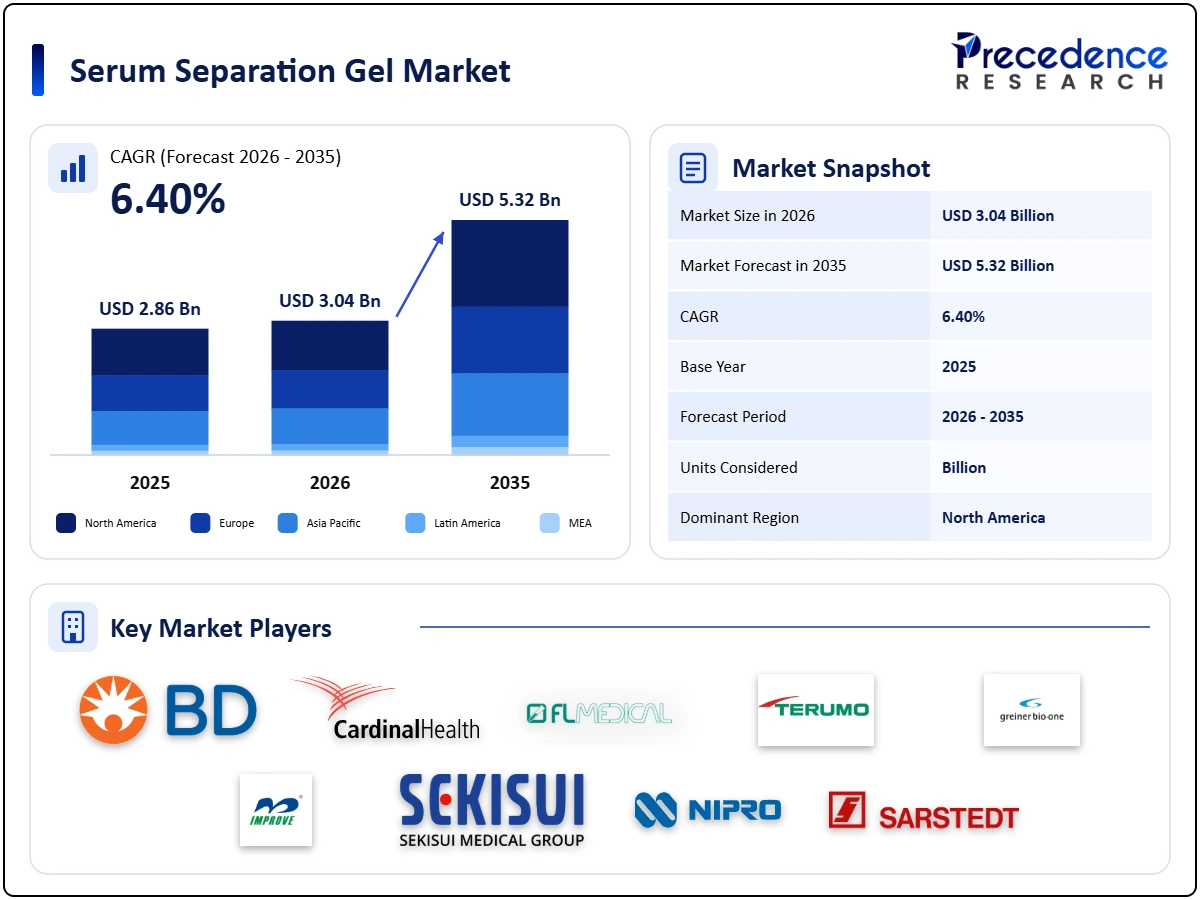
The serum separation gel market is forecasted to expand from USD 3.04 billion in 2026 to USD 5.32 billion by 2035, growing at a CAGR of 6.40% from 2026 to 2035.
Key Takeaways
Market Size & Growth Outlook
- Market size in 2025: USD 2.86 billion
- Estimated market size in 2026: USD 3.04 billion
- Projected market size by 2035: USD 5.32 billion
- CAGR (2026-2035): 6.40%
Regional Market Spotlight
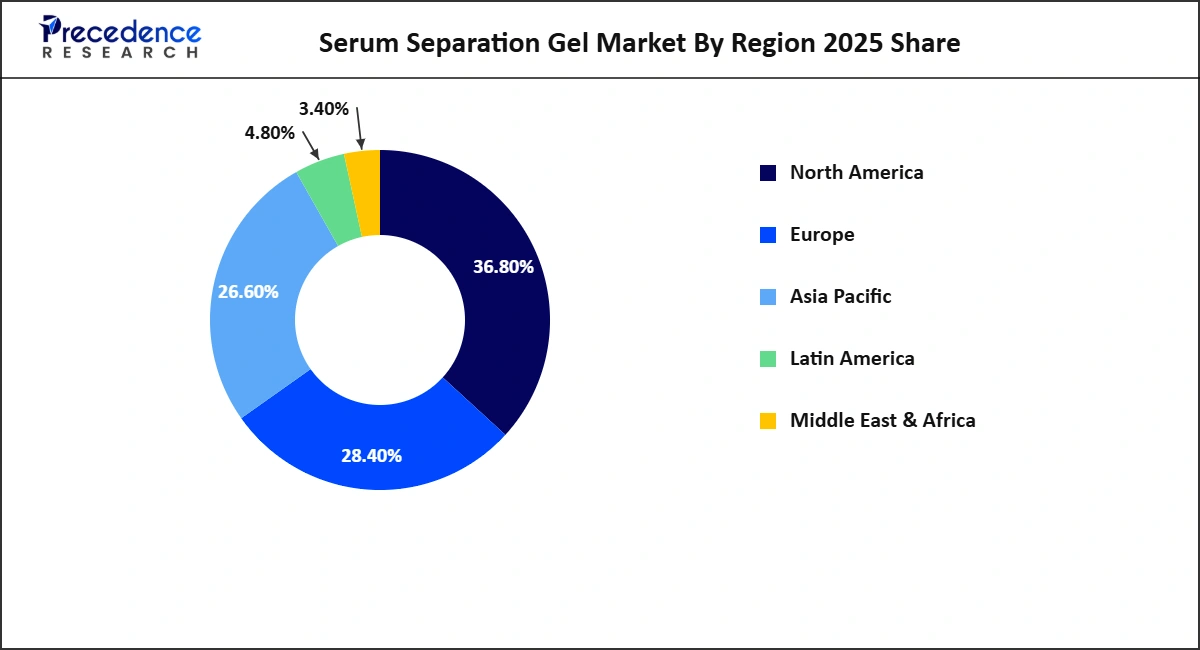
- North America held the largest market share in 2025, accounting for 36.80% of revenue, valued at USD 1.05 billion.
- Europe represented 28.40% of the market in 2025, with revenue reaching USD 0.81 billion.
- Asia Pacific captured 26.60% of the market in 2025, generating USD 0.76 billion, and is projected to record the fastest growth at a CAGR of 7.98% from 2025 to 2035.
Segmental Spotlight
- By product, serum separation gel with integrated tubes dominated the market in 2025, accounting for 82.60% of revenue, equivalent to USD 2.36 billion.
- By tube type, serum separator tubes held the largest share in 2025, representing 64.20% of the market, or USD 1.84 billion.
- By material, polymer-based gels accounted for 72.40% of the market in 2025, generating USD 2.07 billion in revenue.
- By end use, hospitals represented the largest end-use segment in 2025, accounting for 41.60% of market revenue, or USD 1.19 billion.
Serum Separation Gel Market Size 2025 to 2035 (USD Billion)
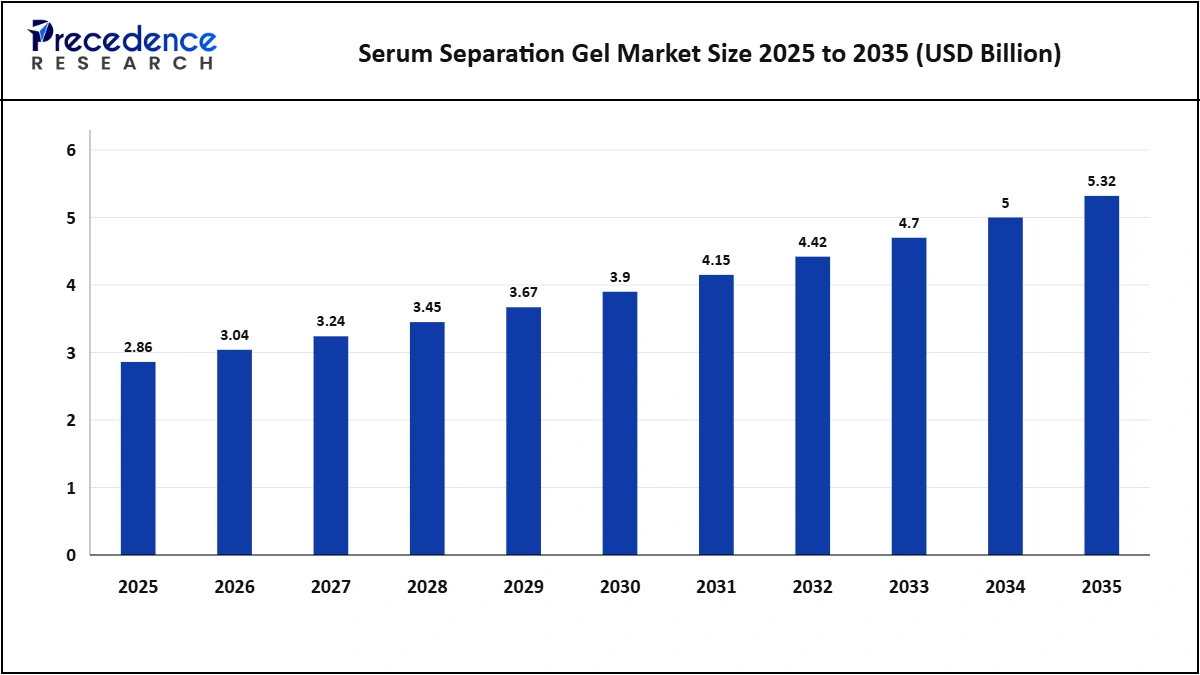
Note: 2025 is the base year; 2026-2035 values are forecasts.
Sources: Expert interviews, secondary sources, Precedence Research database, and Precedence Research analysts.
The serum separation gel market is projected to increase from USD 2.86 billion in 2025 to USD 5.32 billion by 2035. Growth is driven by high blood sample volumes across hospitals and reference laboratories, where gel tubes support direct serum or plasma analysis for chemistry and immunoassay testing. Laboratory consolidation and increased sample transportation further support demand for gel barrier tubes. The market is projected to reach USD 3.90 billion by 2030, with a CAGR of 6.40% from 2026 to 2035.
- Analyst View: We built the estimate from annual blood collection tube consumption by tube type and region, the share of serum and plasma tubes containing separation gel and average gel tube prices, plus bulk gel sales to tube manufacturers. Tube consumption reflects laboratory test volumes, the number of tubes drawn per patient and the mix of chemistry, immunoassay and blood bank testing.
Market Trends
- Plasma separator tubes shorten turnaround time.
- Fast-clotting serum tubes speed chemistry results.
- Laboratory automation favours primary-tube sampling.
- Gel formulations reduce analyte interference.
- Asian tube makers expand bulk gel use.
- Needle-free collection links to tube systems.
Key Growth Drivers, Market Restraints and Opportunities
Rising chronic disease prevalence and ageing populations are increasing diagnostic testing volumes. Gel tubes support laboratory automation by enabling direct serum or plasma analysis from the primary tube. Laboratory consolidation and increased sample transport further drive demand for gel barrier tubes that maintain sample stability. In emerging markets, laboratories are shifting from plain tubes to gel tubes. Plasma separator tubes also support faster turnaround times in emergency testing.
Higher costs than plain tubes limit gel tube adoption in price-sensitive markets. Certain gel formulations also present risks of drug absorption or assay interference, requiring careful product selection. Price competition from regional manufacturers puts pressure on profit margins. Past tube supply disruptions have encouraged buyers to diversify suppliers. In addition, regulatory requirements for medical device manufacturing increase compliance costs.
Expanding laboratory networks across Asia, Latin America, and Africa create opportunities for higher sales volumes. Advances in gel formulations can broaden adoption in sensitive assays by reducing analyte interference. Specialised gel tubes for molecular diagnostics and liquid biopsy testing offer opportunities for higher-value products. Capillary and low-volume gel tubes support decentralised testing and smaller sample collection requirements. Local manufacturing also provides opportunities to meet growing demand in emerging markets and improve supply reliability.
Serum Separation Gel Market 2025 Performance by Product and End-User Segment
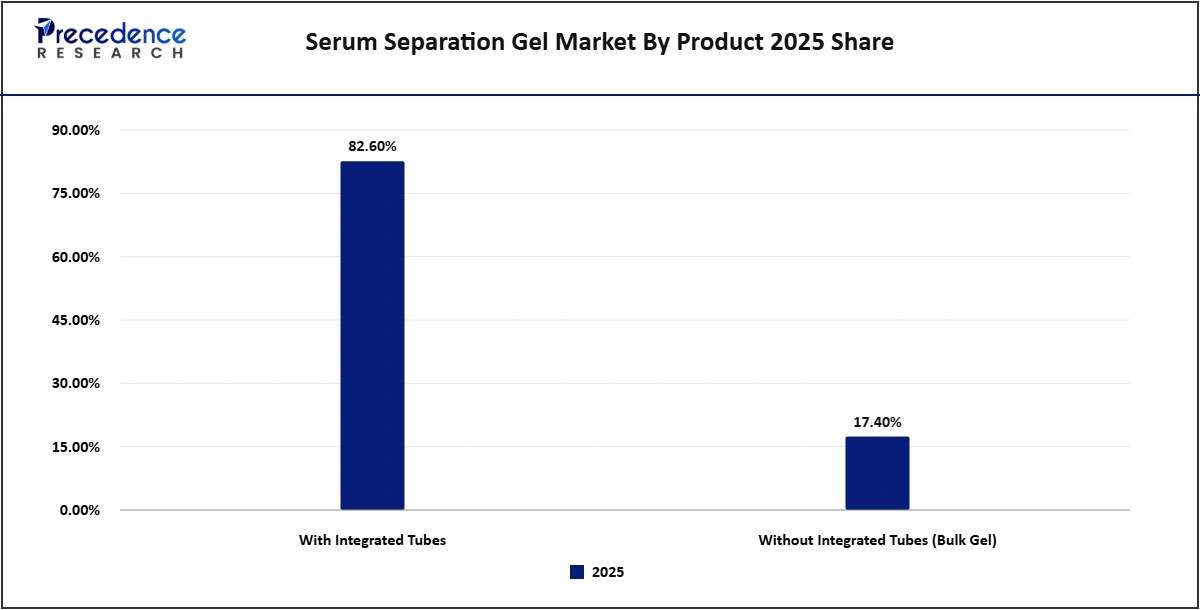
Serum Separation Gel Market By Product 2025 Share
Note: 2025 is the base year.
Sources: Expert interviews, secondary sources, Precedence Research database, and Precedence Research analysts.
The integrated tube segment accounted for 82.60% of the serum separation gel market in 2025, with revenue of USD 2.36 billion. Demand is supported by the widespread adoption of pre-filled evacuated blood collection tubes for routine sample collection and centrifugation. These products offer a complete collection solution, incorporating the tube, closure, vacuum system, separation gel, and relevant additives.
The bulk gel segment held a 17.40% share in 2025, valued at USD 0.50 billion. Tube manufacturers use bulk gel in the production of serum and plasma separator tubes. Asia represents an important growth market for this segment, driven by regional manufacturers supplying both domestic and international customers.
Serum Separation Gel Market By Tube Type 2025 Share & Size
| Segments | 2025 Share | 2025 Market Value |
| Serum Separator Tubes | 64.20% | USD 1.84 billion |
| Plasma Separator Tubes | 29.60% | USD 0.85 billion |
| Others | 6.20% | USD 0.18 billion |
Note: 2025 is the base year.
Sources: Expert interviews, secondary sources, Precedence Research database, and Precedence Research analysts.
In 2025, serum separator tubes accounted for 64.20% of the serum separation gel market, with revenue of USD 1.84 billion. This leading position reflects their established role in routine clinical chemistry, immunoassay, serology, and therapeutic drug monitoring.
Plasma separator tubes represented 29.60% of the market, valued at USD 0.85 billion, and recorded the strongest growth outlook among tube types. Lithium heparin gel tubes enable rapid sample processing by allowing centrifugation immediately after collection, making them suitable for time-sensitive hospital and emergency testing. Other tube types, including specialised products for molecular and infectious disease testing, contributed 6.20%, or USD 0.18 billion.
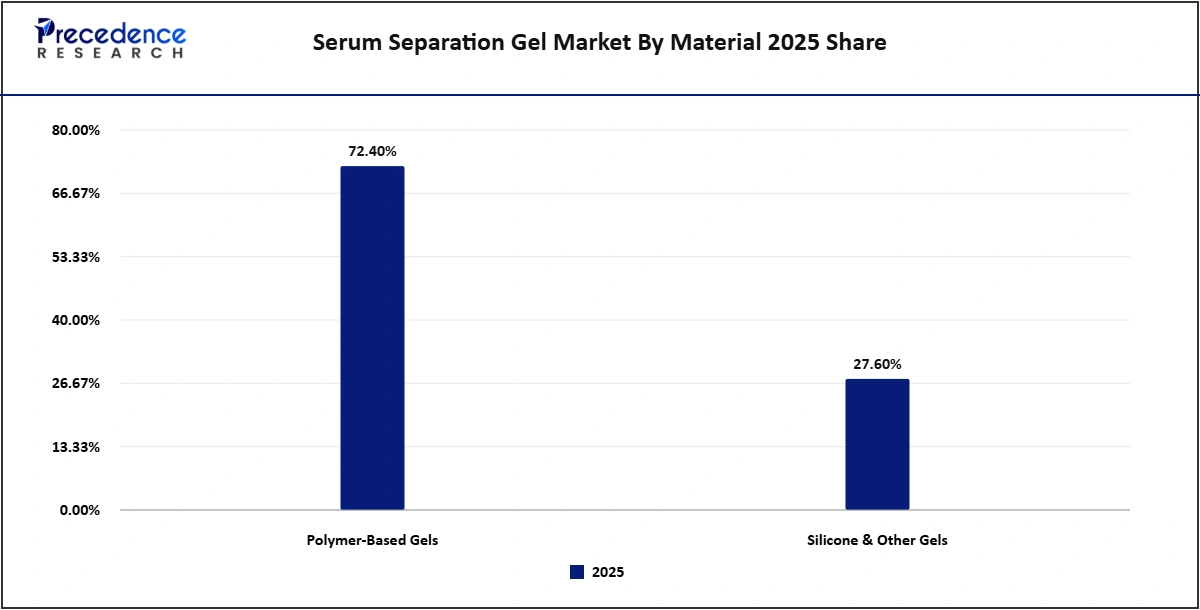
Serum Separation Gel Market By Material 2025 Share
Note: 2025 is the base year. Sources: Expert interviews, secondary sources, Precedence Research database and Precedence Research analysts.
Polymer-based gels dominated the market in 2025, accounting for 72.40% of revenue. Modern acrylic- and polyester-based formulations provide stable barrier formation and low analyte interference, supporting their widespread use in blood collection tubes. Silicone and other gels accounted for the remaining 27.60%, valued at USD 0.79 billion, and continue to serve lower-cost tube applications. Product development focuses on gel formulations that minimise drug and hormone absorption.
Serum Separation Gel Market By End Use 2025 Share & Size
| Segments | 2025 Share | 2025 Market Value |
| Hospitals | 41.60% | USD 1.19 billion |
| Diagnostic Laboratories | 33.20% | USD 0.95 billion |
| Blood Banks | 16.80% | USD 0.48 billion |
| Pharmaceutical Companies & Others | 8.40% | USD 0.24 billion |
Note: 2025 is the base year.
Sources: Expert interviews, secondary sources, Precedence Research database, and Precedence Research analysts.
Hospitals led the end-use segment in 2025, with a 41.60% market share worth USD 1.19 billion. Diagnostic laboratories accounted for 33.20%, or USD 0.95 billion, and recorded the fastest growth, driven by the consolidation of testing services among reference laboratories. Blood banks contributed 16.80%, equivalent to USD 0.48 billion, while pharmaceutical companies and other end users accounted for 8.40%, or USD 0.24 billion.
- Analyst View: Segment values were allocated by matching tube consumption, gel tube penetration, and prices to products, tube types, materials, and end uses, using tube maker revenue mixes. Integrated tubes lead because laboratories buy ready-to-use tubes, and serum tubes lead because of chemistry and immunoassay demand. We expect plasma separator tubes, bulk gel in Asia, and reference laboratories to gain share.
Serum Separation Gel Market Regional Dynamics and Expansion Opportunities
Serum Separation Gel Market By Region 2025 Share
Note: 2025 is the base year.
Sources: Expert interviews, secondary sources, Precedence Research database, and Precedence Research analysts.
North America: With revenue of USD 1.05 billion, North America represented 36.80% of the global serum separation gel market in 2025. Large reference laboratories rely on distributed patient collection networks and centralised testing facilities, supporting demand for tubes that preserve sample integrity during transport. BD's Broken Bow site in Nebraska is a key manufacturing facility for Vacutainer tubes. The adoption of automated laboratory workflows further supports the use of gel tubes for primary-tube sampling.
Europe: Europe held a 28.40% market share in 2025, equivalent to USD 0.81 billion. Major suppliers, including Greiner Bio-One in Austria and Sarstedt in Germany, support the region's established market. Faster-clotting serum tubes help reduce testing turnaround times, while laboratory consolidation increases specimen transport to central facilities.
Asia Pacific: Asia Pacific accounted for 26.60% of the market in 2025, valued at USD 0.76 billion, and is the fastest-growing region. China's domestic tube manufacturers generate demand for bulk separation gel, while expanding diagnostic laboratory chains in India are increasing gel tube consumption. Japan's established suppliers, including Sekisui and Terumo, also contribute to regional supply.
Latin America: Latin America represented 4.80% of the market in 2025, valued at USD 0.14 billion. Diagnostic laboratory chains in Brazil support regional demand, while price sensitivity favours competitively priced products from regional suppliers.
Middle East and Africa: The region accounted for 3.40% of the market in 2025, equivalent to USD 0.10 billion. Hospitals in Gulf countries show widespread use of gel tubes, while plain collection tubes remain common in parts of Africa due to cost considerations.
Analyst View: Regional shares were built from tube consumption, gel tube penetration, and prices in each region. North America leads because of high test volumes and gel tube use. We assign Asia Pacific the highest growth premium because laboratory capacity and gel tube adoption are expanding fastest there.
Serum Separation Gel Market: Top Companies and Competitive Positioning
| Rank | Company Name | Market-Specific Revenue (USD Billion) | 2025 Share | Key Products / Business | Headquarters |
| 1 | BD | 0.92 | 32.17% | BD Vacutainer SST and PST tubes | United States |
| 2 | Greiner Bio-One | 0.38 | 13.29% | VACUETTE serum and plasma separator tubes | Austria |
| 3 | Sarstedt | 0.22 | 7.69% | S-Monovette gel tubes | Germany |
| 4 | Terumo | 0.14 | 4.90% | VENOJECT II blood collection tubes | Japan |
| 5 | Sekisui Medical | 0.12 | 4.20% | INSEPACK tubes and separation gels | Japan |
| 6 | Cardinal Health | 0.08 | 2.80% | Monoject and private-label collection tubes | United States |
| 7 | Nipro | 0.06 | 2.10% | Blood collection tubes | Japan |
| 8 | Improve Medical | 0.05 | 1.75% | Vacuum blood collection tubes | China |
| 9 | Shandong Weigao | 0.04 | 1.40% | Blood collection tubes | China |
| 10 | FL Medical | 0.03 | 1.05% | Vacuum tubes and separation gels | Italy |
Note: Company revenues and shares are 2025 estimates.
Sources: Company press releases, expert interviews, secondary sources, Precedence Research database and Precedence Research analysts.
BD led the serum separation gel market with an estimated 32.17% (USD 0.92 billion) of 2025 revenue, followed by Greiner Bio-One at 13.29% (USD 0.38 billion) and Sarstedt at 7.69% (USD 0.22 billion). BD leads because its Vacutainer SST and PST gel tubes are the most widely used blood collection tubes in North America and many other markets, supported by large-scale manufacturing at sites such as Broken Bow, Nebraska, where it has invested more than USD 50 million since 2020. Greiner Bio-One and Sarstedt are strong European suppliers with VACUETTE and S-Monovette systems used in hospitals and laboratories worldwide. Terumo, Sekisui and Nipro are major suppliers in Asia; Sekisui also produces separation gels; Cardinal Health supplies tubes through its distribution network; and Chinese makers such as Improve Medical and Weigao compete on price in domestic and export markets.
The top 10 companies accounted for an estimated 71.33% (USD 2.04 billion) of 2025 revenue, while the remaining 28.67% (USD 0.82 billion) was shared among regional tube makers, bulk gel suppliers and private-label manufacturers. The serum separation gel market is concentrated in integrated tubes, where BD, Greiner and Sarstedt hold strong positions through long-term laboratory contracts, while bulk gel and lower-cost tubes are more fragmented. Competition centres on gel barrier stability, analyte compatibility, clotting speed, compatibility with automation, supply reliability, and price.
Recent Developments
- October 2025: BD marked 65 years of its Broken Bow, Nebraska site, the world's largest manufacturer of BD Vacutainer tubes, noting more than USD 50 million invested there since 2020 to expand operations and modernise equipment.
Serum Separation Gel Market Segments
By Product
- With Integrated Tubes
- Without Integrated Tubes (Bulk Gel)
By Tube Type
- Serum Separator Tubes
- Plasma Separator Tubes
- Others
By Material
- Polymer-Based Gels
- Silicone & Other Gels
By End Use
- Hospitals
- Diagnostic Laboratories
- Blood Banks
- Pharmaceutical Companies & Others
By Region
- North America (U.S., Canada)
- Europe (Germany, U.K., France, Italy, Spain, Rest of Europe)
- Asia Pacific (China, Japan, India, South Korea, Taiwan, Rest of Asia Pacific)
- Latin America (Brazil, Argentina, Rest of Latin America)
- Middle East & Africa (GCC, South Africa, Rest of MEA)
Research Methodology
The serum separation gel market was defined as serum and plasma separation gels sold in integrated blood collection tubes and as bulk gel, worldwide.
The 2025 base year was built bottom-up from blood collection tube consumption by tube type and region, gel tube penetration, average prices and bulk gel sales, and checked top-down against the specimen collection revenue of leading tube makers. Segment, regional and company values were allocated from products, tube types, materials, end uses and regional demand. Key estimates were verified by cross-checking company disclosures, regulatory and industry data and published third-party estimates, and inputs that could not be reconciled were excluded. All segment, regional and company figures were reconciled to the same 2025 base year, and the 2026-2035 forecast, which applies a constant CAGR from the 2025 base, was recalculated and validated.
Analyst View: Overall Market
The serum separation gel market is a steady, volume-driven market tied to laboratory testing and blood collection practice. Our estimate links demand to tube consumption, gel tube penetration and prices, so the forecast follows test volumes and gel tube adoption in emerging markets. The main upside comes from Asian growth and plasma tubes, while the main risks are price competition and assay interference concerns.
Sources and References
- BD. "BD Advances One-Stick Hospital Stay Vision with Launch of Next-Generation Needle-Free Blood Draw Technology". 2023-11-02. PIVO Pro launch. https://news.bd.com/2023-11-02-BD-Advances-One-Stick-Hospital-Stay-Vision-with-Launch-of-Next-Generation-Needle-Free-Blood-Draw-Technology
- BD. "BD Looks Ahead to the Next Era of Manufacturing Excellence in Broken Bow, NE". 2025-10-16. Vacutainer manufacturing. https://news.bd.com/2025-10-16-BD-Looks-Ahead-to-the-Next-Era-of-Manufacturing-Excellence-in-Broken-Bow,-NE-and-Celebrates-65-Years-of-Innovation-in-the-Region
- Medical Device Network. "New serum tube from Greiner Bio-One for quick analysis". Undated. VACUETTE CAT Serum Fast tube. https://www.medicaldevice-network.com/contractors/biotechnology/greiner-bio-one-preanalytics/pressreleases/new-serum-tube-greiner-bio-one-quick-analysis/
For inquiries regarding discounts, bulk purchases, or customization requests, please contact us at sales@precedenceresearch.com
Frequently Asked Questions
Tags





Ask For Sample
No cookie-cutter, only authentic analysis – take the 1st step to become a Precedence Research client
 Get a Sample




 sales@precedenceresearch.com
 Schedule a Meeting
