



Specimen Validity Testing Market Size, Key Companies, Company Market Share, Patient Volume, Treatment Adoption Rates, Pricing Analysis, Regulatory Landscape, Competitive Positioning, and Demand Forecast
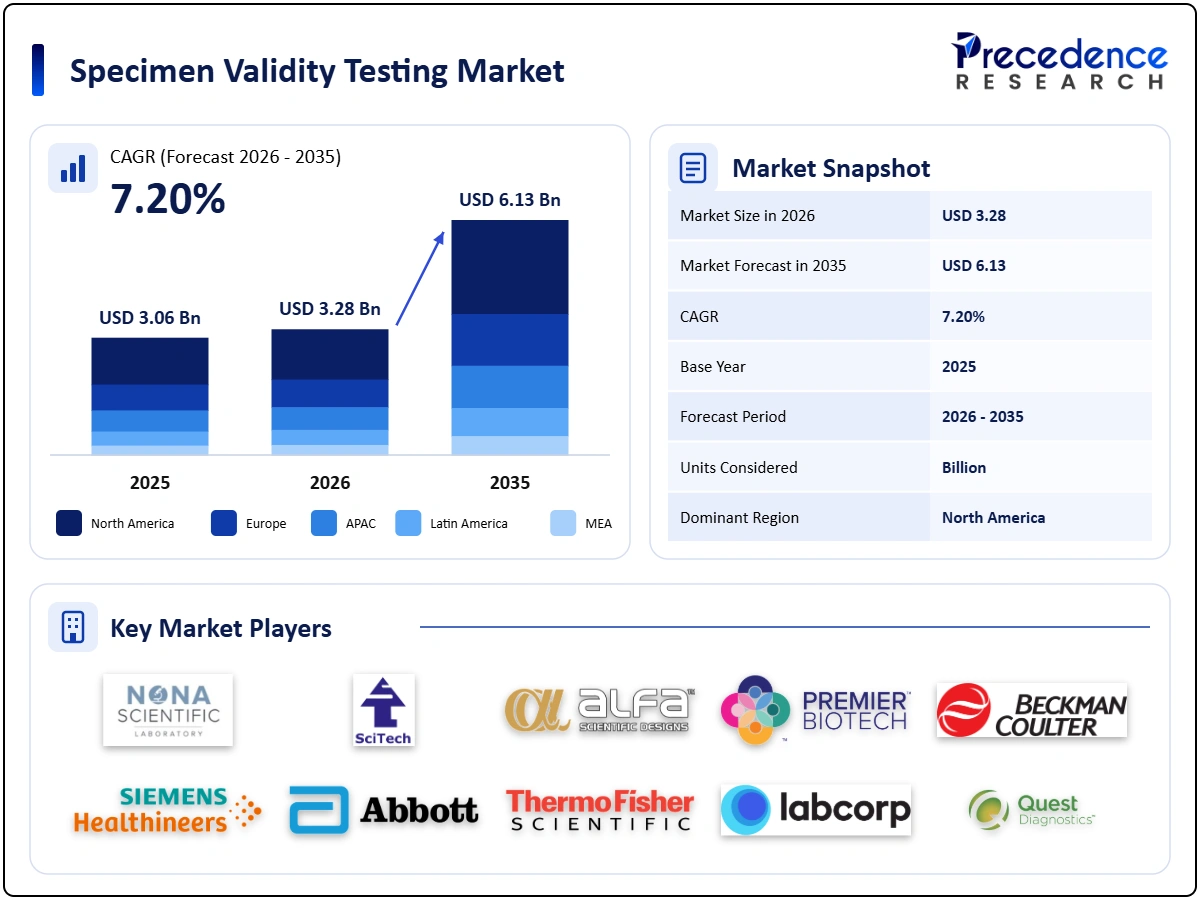
Paya; Rabde, a Healthcare Industry Expert, highlights that the specimen validity testing market has reached USD 3.28 billion in 2026 to USD 6.13 billion by 2035, growing at a CAGR of 7.20%. Key specimen validity testing market companies shaping the market include Quest Diagnostics, LabCorp, Thermo Fisher Scientific, while major growth segments span product & service, product & service type, type, end use and region.
Source: https://www.precedenceresearch.com/specimen-validity-testing-market
 Get a Sample
 Report Description
Key Takeaways
Market Size & Growth Outlook
- Market size in 2025: USD 3.06 billion
- Estimated market size in 2026: USD 3.28 billion
- Projected market size by 2035: USD 6.13 billion
- CAGR (2026-2035): 7.20%
Regional Market Spotlight
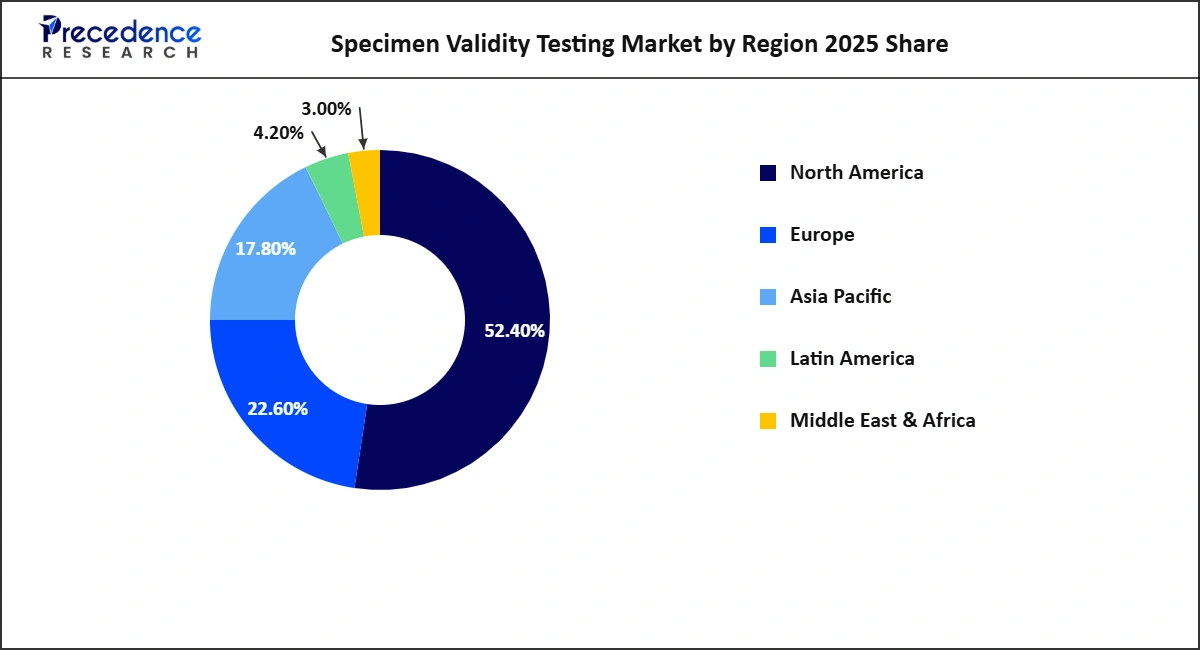
- North America dominated the market with a 52.40% (USD 1.60 billion) share in 2025.
- Europe accounted for 22.60% (USD 0.69 billion) of revenue in 2025.
- Asia Pacific held a market share of 17.80% (USD 0.54 billion) in 2025 and is expected to grow at the fastest CAGR of 9.01% during the forecast period.
Segmental Spotlight
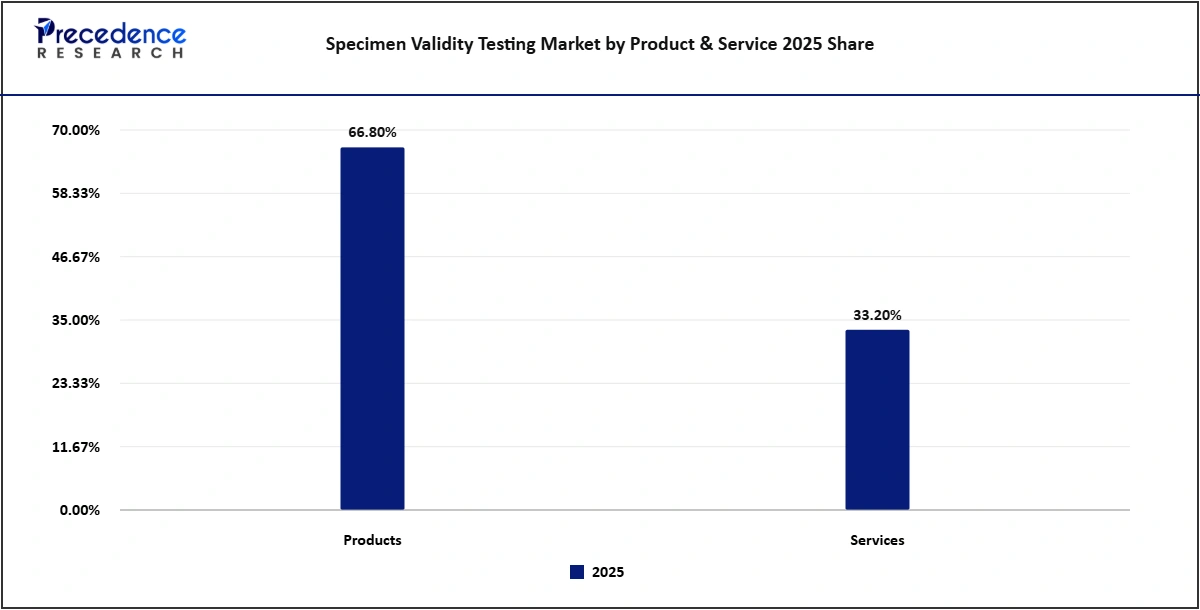
- By product & service, products accounted for 66.80% (USD 2.04 billion) of revenue in 2025.
- By product & service type, the laboratory services segment held a market share of 33.20% (USD 1.02 billion) in 2025.
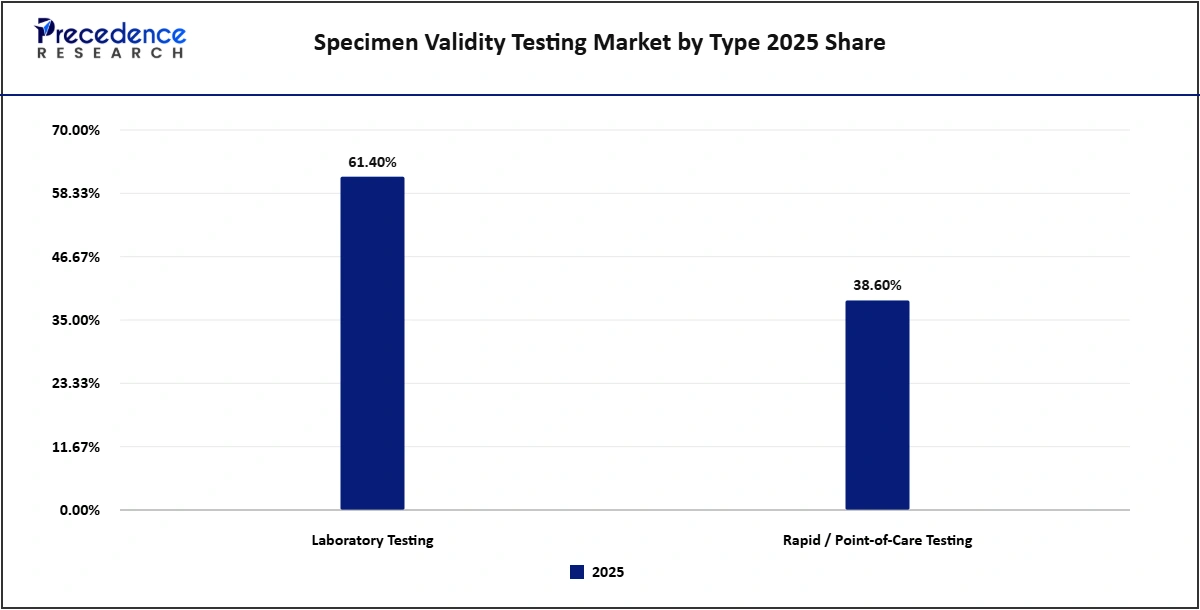
- Laboratory Testing dominated the by type segment with a 61.40% (USD 1.88 billion) share in 2025.
- By end use, the drug Screening Laboratories segment accounted for 46.20% (USD 1.41 billion) of revenue in 2025.
Specimen Validity Testing Market Size and Forecast, 2025-2035 (USD Billion)
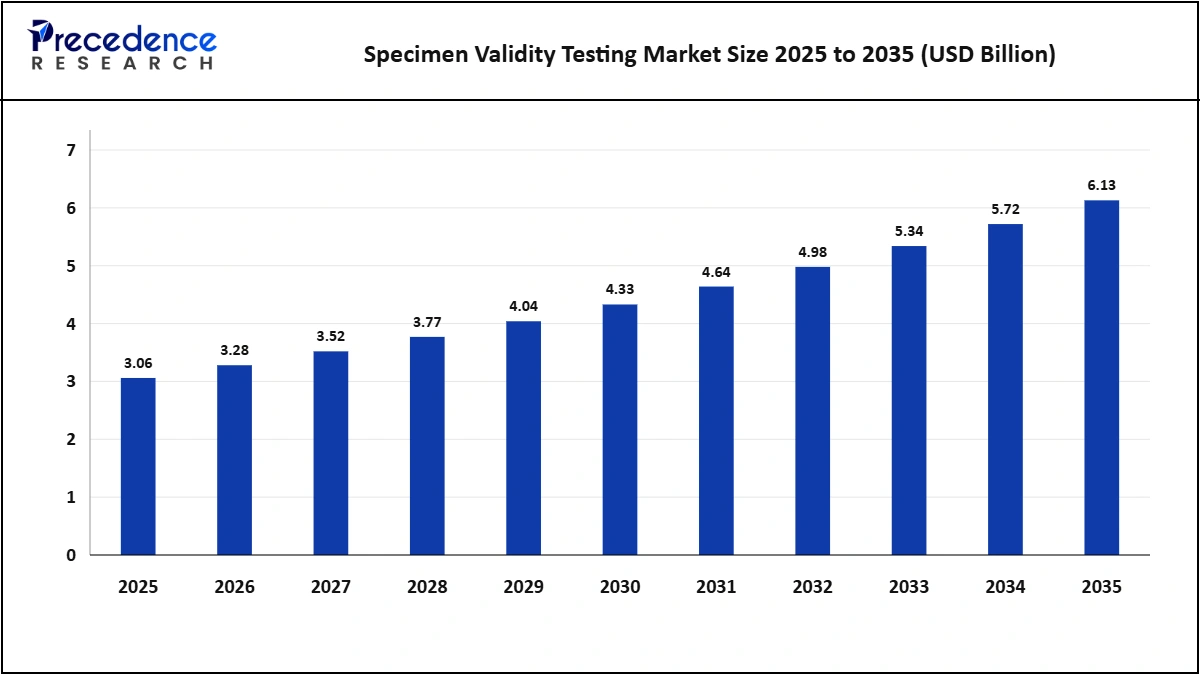
Note: 2025 is the base year; 2026-2035 values are forecasts.
Sources: Expert interviews, secondary sources, Precedence Research database and Precedence Research analysts.
The market is expected to grow from USD 3.06 billion in 2025 to USD 6.13 billion by the end of the forecast period because every regulated urine drug test needs to be checked for adulteration, dilution, and substitution, and workplace and clinical programs increasingly screen non-regulated specimens as well. Rising rates of substituted and invalid specimens prompt employers and laboratories to strengthen validity checks, propelling the market to USD 4.33 billion by 2030 and maintaining a CAGR of 7.20% during the forecast period.
- Analyst View: We built the estimate from annual drug test specimen volumes by program type and region, the share of specimens receiving validity testing and the average cost of validity reagents, strips, rapid devices and laboratory validity panels, plus confirmatory testing of suspect specimens. Volumes reflect workplace, federally regulated, criminal justice, pain management and addiction treatment testing. The total was cross-checked against the drug testing revenue of prominent laboratories and test manufacturers and against published estimates, which places our base year slightly above the comparable figures. The growth rate highlights rising tampering and treatment monitoring, moderated by the shift toward oral fluid and c in some programs.
Market Trends
- Synthetic urine detection is added to validity panels.
- Adulteration strips are built into rapid cups.
- Substituted and invalid specimens increase.
- Employers add observed oral fluid and hair testing.
- Treatment programs monitor validity more often.
- Automated validity assays run with drug screens.
Drivers, Restraints and Opportunities
Driver
Drug testing volumes remain high across workplace, clinical, and criminal justice programs. Rates of substituted and invalid urine specimens have increased, fueling the need for validity checks. Federal rules require validity testing to be performed on regulated specimens. Opioid treatment and pain management programs test patients frequently. Synthetic urine and new adulterants prompt laboratories to add new assays.
Restraint
Oral fluid and hair testing, which are harder to tamper with, may reduce dependence on urine validity testing. Some states have legalized cannabis, and some employers have reduced pre-employment marijuana testing. Price pressure from employers and payers limits revenue per test. New adulterants can evade existing assays. Limited reimbursement for clinical validity testing hampers market growth.
Opportunity
Synthetic urine detection assays can create new demand. Integrated rapid cups with validity strips can grow in treatment centers. Expansion of workplace testing in Asia and Latin America offers growth potential. Validity testing for oral fluid and other specimens may develop. Data analytics on tampering trends can support employer programs.
Market Segmentation: 2025 Share and Value
Specimen Validity Testing Market by Product & Service 2025 Share
Note: 2025 is the base year.
Sources: Expert interviews, secondary sources, Precedence Research database and Precedence Research analysts.
Products accounted for 66.80% (USD 2.04 billion) of revenue in 2025 due to the fact that laboratories, collection sites, and clinics consume validity reagents, calibrators, strips, and test cups on each specimen, generating repetitive sales tied to drug testing volumes. Federal programs need validity checks such as creatinine, specific gravity and pH on regulated urine specimens. The services segment held a market share of 33.20% (USD 1.02 billion), covering laboratory validity panels, confirmatory testing of suspect specimens and medical review, and is the faster-growing segment as laboratories add synthetic urine and oxidant screening for employer programs.
Specimen Validity Testing Market by Product & Service Type 2025 Share & Size
| Segments | 2025 Share | 2025 Market Value |
| Assay Kits | 26.40% | USD 0.81 billion |
| Reagents & Calibrators | 22.20% | USD 0.68 billion |
| Disposables & Test Strips | 18.20% | USD 0.56 billion |
| Laboratory Services | 33.20% | USD 1.02 billion |
Note: 2025 is the base year.
Sources: Expert interviews, secondary sources, Precedence Research database and Precedence Research analysts.
Laboratory services led the market with a 33.20% (USD 1.02 billion) share in 2025, because certified laboratories bundle validity panels with drug screening. The assay kits segment accounted for 26.40% (USD 0.81 billion) of revenue due to the fact that automated analyzers run validity panels on high specimen volumes, and reagents and calibrators account for 22.20% (USD 0.68 billion). Disposables and test strips, at 18.20% (USD 0.56 billion), are the fastest-growing type, owing to the integration of adulteration strips into point-of-collection cups.
Specimen Validity Testing Market by Type 2025 Share
Note: 2025 is the base year.
Sources: Expert interviews, secondary sources, Precedence Research database and Precedence Research analysts.
Laboratory testing held a market share of 61.40% (USD 1.88 billion) in 2025 because regulated and large employer programs send specimens to certified laboratories, where validity testing is performed alongside drug screening. Rapid and point-of-care testing, at 38.60% (USD 1.18 billion), is the faster-growing type as clinics, treatment centers and employers use instant cups with built-in validity strips.
Specimen Validity Testing Market by End Use 2025 Share & Size
| Segments | 2025 Share | 2025 Market Value |
| Drug Screening Laboratories | 46.20% | USD 1.41 billion |
| Workplaces | 18.60% | USD 0.57 billion |
| Drug Rehabilitation Centers | 14.40% | USD 0.44 billion |
| Pain Management Centers | 12.20% | USD 0.37 billion |
| Others | 8.60% | USD 0.26 billion |
Note: 2025 is the base year.
Sources: Expert interviews, secondary sources, Precedence Research database and Precedence Research analysts.
Drug screening laboratories accounted for 46.20% (USD 1.41 billion) share in 2025, workplaces accounted for 18.60% (USD 0.57 billion), drug rehabilitation centers for 14.40% (USD 0.44 billion), pain management centers for 12.20% (USD 0.37 billion) and others, including criminal justice, for 8.60% (USD 0.26 billion). The drug rehabilitation centers segment is growing at the fastest rate as opioid treatment programs monitor patients at a significant frequency.
- Analyst View: Segment values were allocated by matching specimen volumes, validity testing rates and prices to products, services, testing types and end uses. Products lead because every specimen consumes validity reagents or strips, and laboratories lead because regulated testing is centralized. We expect services, rapid testing and treatment center use to gain share.
Regional Analysis
Specimen Validity Testing Market by Region 2025 Share
Note: 2025 is the base year.
Sources: Expert interviews, secondary sources, Precedence Research database and Precedence Research analysts.
North America accounted for 52.40% (USD 1.60 billion) of revenue in 2025, owing to federally mandated workplace testing under HHS and DOT rules, large non-regulated employer testing, criminal justice testing, and clinical monitoring in pain management and opioid treatment. Europe held a market share of 22.60% (USD 0.69 billion), with the market ecosystem benefiting from workplace testing in safety-critical industries, roadside and forensic testing, and addiction treatment monitoring. Asia Pacific, at 17.80% (USD 0.54 billion), is the fastest-growing region, supported by expanding workplace testing in Australia, mining and transport testing, and growing laboratory capacity in China, India and Southeast Asia. Latin America held 4.20% (USD 0.13 billion) of revenue, and the Middle East and Africa, at 3.00% (USD 0.09 billion), are smaller markets led by mining, oil and gas and transport employers.
North America accounted for 52.40% (USD 1.60 billion) of revenue in 2025. Federal rules require validity testing of regulated urine specimens at certified laboratories. Quest Diagnostics reported a sharp spike in substituted and invalid specimens in 2023, highlighting tampering risks. As of April 2026, no laboratories were yet certified for federal oral fluid testing, so urine continues to be the main regulated specimen.
Europe held a market share of 22.60% (USD 0.69 billion) in 2025. Workplace testing is common in transport, energy, and construction. Forensic and treatment programs test specimen validity. The United Kingdom, Germany, and the Nordic countries are some of the important regional markets.
Asia Pacific accounted for a market share of 17.80% (USD 0.54 billion) in 2025 and is the fastest-growing region. Australia has extensive workplace testing in the mining and transport sectors. China and Southeast Asia are expanding drug testing programs. Laboratory capacity is growing in India.
Latin America held 4.20% (USD 0.13 billion) of revenue in 2025. Mining, oil and gas, and transport companies in Brazil, Chile, and Mexico fuel demand for testing. Validity testing is less standardized than in North America.
The Middle East and Africa accounted for 3.00% (USD 0.09 billion) of revenue in 2025. Oil and gas employers and aviation drive testing in the Gulf. Mining companies in South Africa use workplace testing.
Analyst View: Regional shares were built from drug testing volumes, validity testing rates, and prices in each region. North America dominates because of federally mandated and employer testing. We assign Asia Pacific the highest growth rate because workplace testing programs are expanding fastest in this region.
Top 10 Companies in the Specimen Validity Testing Market
| Rank | Company Name | Market-Specific Revenue (USD Billion) | 2025 Share | Key Products / Business | Headquarters |
| 1 | Quest Diagnostics | 0.36 | 11.76% | Employer drug testing and validity services | United States |
| 2 | Labcorp | 0.28 | 9.15% | Drug testing and specimen validity services | United States |
| 3 | Thermo Fisher Scientific | 0.22 | 7.19% | DRI and specimen validity reagents | United States |
| 4 | Abbott | 0.18 | 5.88% | Toxicology rapid tests and cups | United States |
| 5 | Siemens Healthineers | 0.12 | 3.92% | EMIT and validity assays | Germany |
| 6 | Danaher (Beckman Coulter) | 0.08 | 2.61% | Drug and validity assays for AU analyzers | United States |
| 7 | Premier Biotech | 0.05 | 1.63% | Drug test cups with adulteration strips | United States |
| 8 | Alfa Scientific Designs | 0.04 | 1.31% | Rapid drug and adulteration tests | United States |
| 9 | Sciteck | 0.03 | 0.98% | Specimen validity reagents | United States |
| 10 | Nona Scientific | 0.02 | 0.65% | NonaClear synthetic urine detection | United States |
Note: Company revenues and shares are 2025 estimates.
Sources: Company press releases, expert interviews, secondary sources, Precedence Research database and Precedence Research analysts.
Quest led the market with 11.76% (USD 0.36 billion) share in 2025, followed by Labcorp at 9.15% (USD 0.28 billion) and Thermo Fisher at 7.19% (USD 0.22 billion). Quest Diagnostics leads because it is one of the largest workplace drug testing providers in the United States, runs specimen validity testing on millions of samples each year, and publishes its Drug Testing Index, which tracks substituted, invalid, and positive results. Labcorp is another prominent certified laboratory provider for workplace, clinical and forensic testing. Thermo Fisher Scientific, Siemens Healthineers and Beckman Coulter supply validity and drug assays for laboratory analyzers, while Abbott, Premier Biotech and Alfa Scientific Designs offer rapid cups and strips, and Sciteck and Nona Scientific provide specialized reagents and synthetic urine detection. The top 10 companies accounted for an estimated 45.10% (USD 1.38 billion) of revenue in 2025, while the remaining 54.90% (USD 1.68 billion) was shared among third-party administrators, collection site networks and regional test manufacturers.
The market combines large certified laboratories with reagent and rapid test makers, and competition revolves around the detection of new adulterants and synthetic urine, regulatory compliance, turnaround time, integration with drug panels, and price. The rising use of oral fluid and hair testing could potentially change demand patterns, as these specimens are observed at collection and are harder to tamper with.
Recent Developments
- April 2026: SAMHSA's monthly notice of certified federal workplace drug testing laboratories listed urine testing laboratories but no laboratories certified for oral fluid testing.
- July 2026: Quest Diagnostics released its 2026 Drug Testing Index, reporting 19.1% hair test positivity in 2025 and noting that hair and oral fluid collection is harder to tamper with than urine.
Specimen Validity Testing Market Segments
By Product & Service
- Products
- Services
By Product & Service Type
- Assay Kits
- Reagents & Calibrators
- Disposables & Test Strips
- Laboratory Services
By Type
- Laboratory Testing
- Rapid / Point-of-Care Testing
By End Use
- Drug Screening Laboratories
- Workplaces
- Drug Rehabilitation Centers
- Pain Management Centers
- Others
By Region
- North America (U.S., Canada, Mexico)
- Europe (Germany, U.K., France, Italy, Spain, Rest of Europe)
- Asia Pacific (China, Japan, India, South Korea, Taiwan, Rest of Asia Pacific)
- Latin America (Brazil, Argentina, Rest of Latin America)
- Middle East & Africa (GCC, South Africa, Rest of MEA)
Research Methodology
The market is defined as specimen validity assay kits, reagents, calibrators, strips, rapid devices, and laboratory services for drug testing, worldwide. The 2025 base year was built bottom-up from drug test specimen volumes by program and region, validity testing rates and average validity test costs, and checked top-down against the drug testing revenue of leading laboratories and test makers. Segment, regional and company values were allocated from products and services, product types, testing types, end uses and regional demand. Key estimates were verified by cross-checking company disclosures, regulatory and industry data and published third-party estimates, and inputs that could not be reconciled were excluded. All segment, regional and company figures were reconciled to the same 2025 base year, and the 2026–2035 forecast, which applies a constant CAGR from the 2025 base, was recalculated and validated.
Analyst View: Overall Market
The market is tied to drug testing volumes and to the arms race between tampering methods and detection. Our estimate links demand to specimen volumes, validity testing rates and prices, so the forecast takes into consideration workplace testing, treatment monitoring and specimen mix. The main upside comes from synthetic urine detection and treatment monitoring, while the main risk is the transition to oral fluid and hair testing.
Sources and References
- Safety+Health Magazine. "Drug test cheating surges to highest rate ever, annual index shows". 2024-05-21. Substituted and invalid specimen data. https://www.safetyandhealthmagazine.com/?p=11543
- Quest Diagnostics. "One in Five American Workers Tested Had a Positive Hair Drug Test in 2025". 2026-07-10. 2026 Drug Testing Index. https://s2.q4cdn.com/390454341/files/doc_news/One-in-Five-American-Workers-Tested-Had-a-Positive-Hair-Drug-Test-in-2025-Signaling-Persistent-Long-Term-Substance-Use-Patterns-2026.pdf
For inquiries regarding discounts, bulk purchases, or customization requests, please contact us at sales@precedenceresearch.com
Frequently Asked Questions





Ask For Sample
No cookie-cutter, only authentic analysis – take the 1st step to become a Precedence Research client
 Get a Sample




 sales@precedenceresearch.com
 Schedule a Meeting
