



Urine Testing Cups Market Size, Key Companies, Company Market Share, Patient Volume, Treatment Adoption Rates, Pricing Analysis, Regulatory Landscape, Competitive Positioning, and Demand Forecast
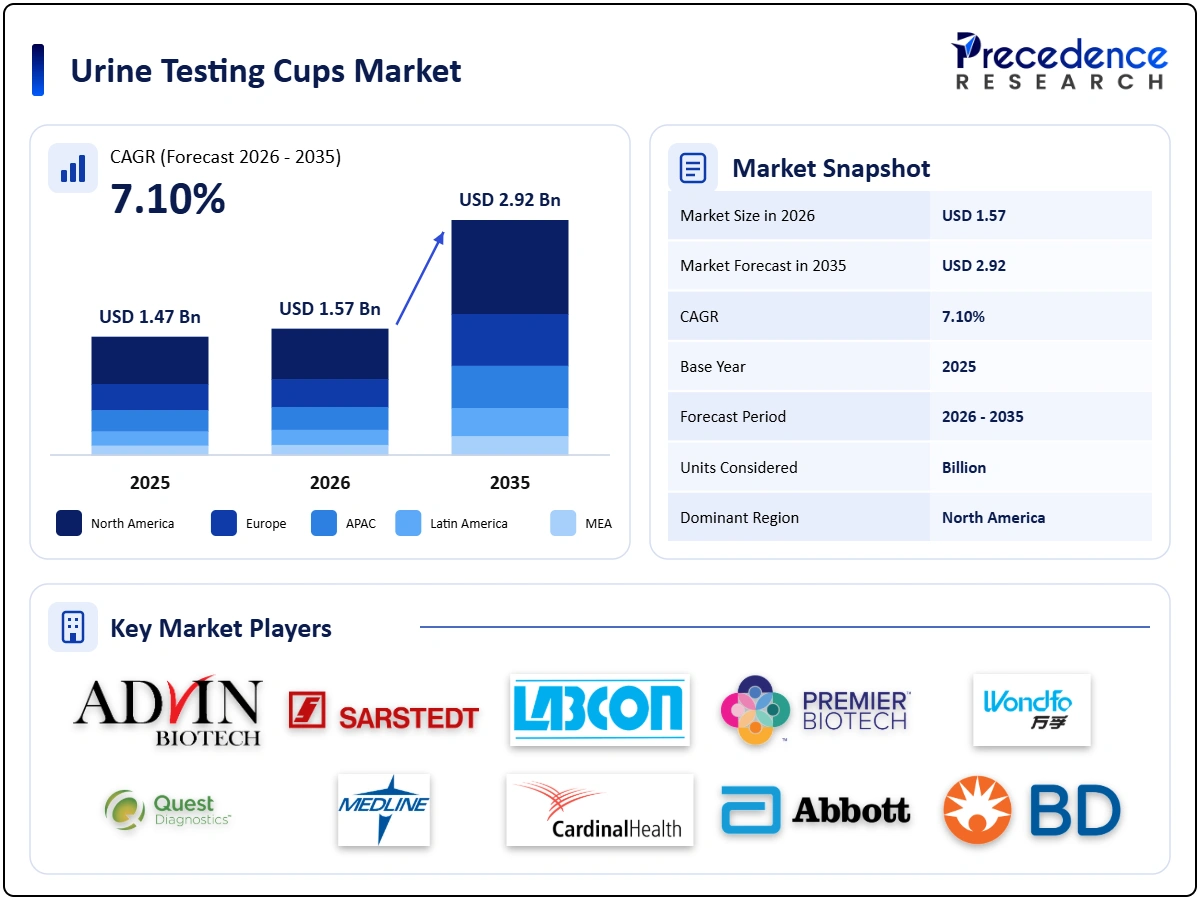
Payal Rabde, a Healthcare Industry Expert, highlights that the urine testing cups market has reached USD 1.57 billion in 2026 to USD 2.92 billion by 2035, growing at a CAGR of 7.10%. Key urine testing cups market companies shaping the market include BD, Abbott, Cardinal Health, Medline while major growth segments span sterility, product, application, End Use region.
Source: https://www.precedenceresearch.com/urine-testing-cups-market
 Get a Sample
 Report Description
Key Takeaways
Market Size & Growth Outlook
- Market size in 2025: USD 1.47 billion
- Estimated market size in 2026: USD 1.57 billion
- Projected market size by 2035: USD 2.92 billion
- CAGR (2026-2035): 7.10%
Regional Market Spotlight
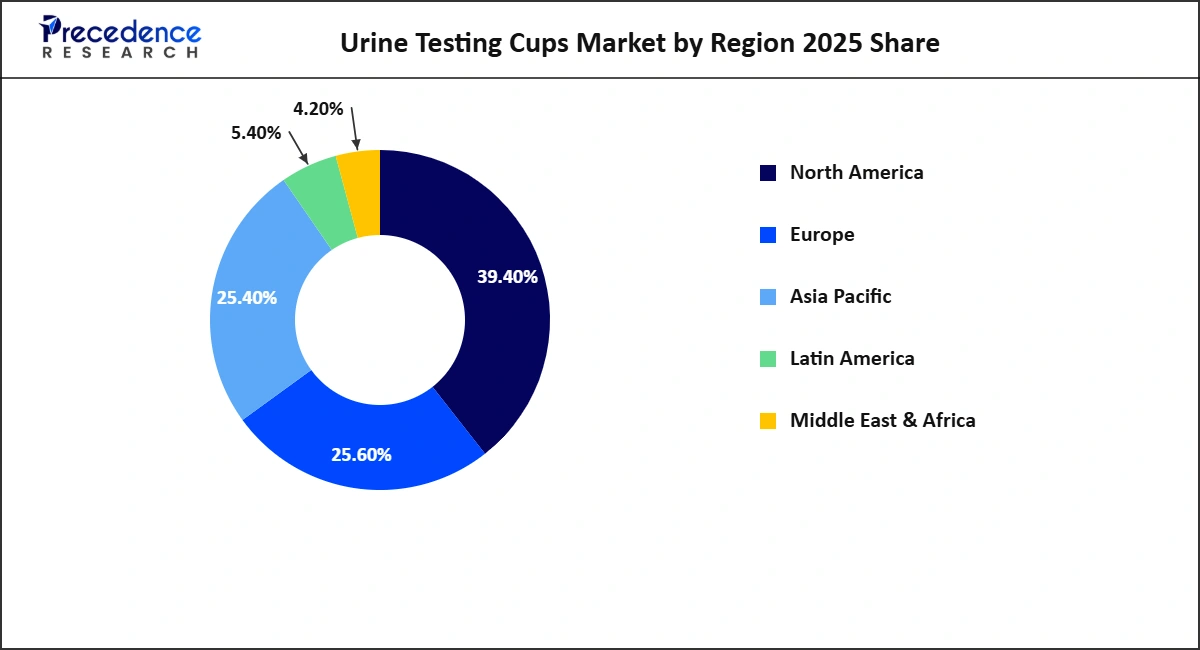
- North America led the market with a 39.40% (USD 0.58 billion) share in 2025.
- Europe accounted for 25.60% (USD 0.38 billion) of the market in 2025.
- Asia Pacific accounted for 25.40% (USD 0.37 billion) of the market in 2025 and is projected to be the fastest-growing region, at a CAGR of 8.71% from 2025 to 2035.
Segmental Spotlight
- By sterility, Sterile accounted for 79.20% (USD 1.16 billion) in 2025.
- By product, Cups with Temperature Strips accounted for 32.40% (USD 0.48 billion) in 2025.
- By application, Drug Testing accounted for 44.20% (USD 0.65 billion) in 2025.
- By end use, Hospitals & Clinics accounted for 40.40% (USD 0.59 billion) in 2025.
Urine Testing Cups Market Size and Forecast, 2025-2035 (USD Billion)
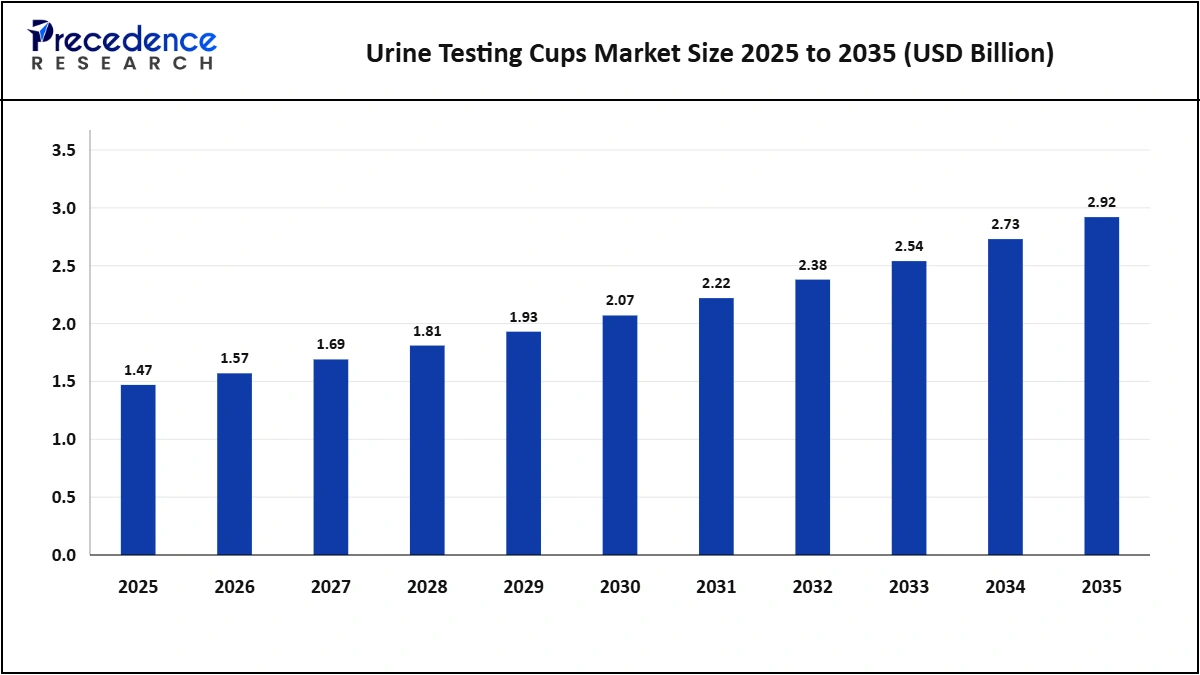
Note: 2025 is the base year; 2026–2035 values are forecasts.
Sources: Expert interviews, secondary sources, Precedence Research database, and Precedence Research analysts.
The urine testing cups market is expected to reach USD 2.92 billion by 2035, growing at a CAGR of 7.10% from 2025 to 2035 due to the fact that billions of urine samples are collected every year by hospitals, laboratories, employers, and treatment programs for analysis, cultivation, and screening tests, and all of these require a cup. Integrated drug test cups and home screening help drive the market value up to USD 2.07 billion by 2030.
- Analyst View: The forecast was derived based on annual urine specimen volumes by application and region, the proportion of basic cups, temperature strip cups, and drug testing cups, along with the average prices of each cup category, in addition to urine transfer cups and molecular specimen collection systems. Volume includes clinical urinalysis and culture tests, workplace, clinical, and criminal justice drug testing, pregnancy testing, and home testing. The figure has been validated against the specimen cups and toxicology revenues of key players as well as published forecasts, which makes our base year slightly higher than the comparable numbers. Growth is driven by an increase in drug testing and more valuable integrated cups.
Market Trends
- Integrated multi-drug cups add new drug panels.
- Home-use drug test cups gain clearance.
- Temperature and adulteration strips are built in.
- Urine liquid biopsy collection systems emerge.
- Closed transfer systems reduce handling.
- Asian manufacturers expand exports.
Drivers, Restraints and Opportunities
Driver
Drug and substance abuse testing continues to be widespread in workplaces, clinical laboratories, and rehab facilities. Urine tests and culture are some of the most commonly used lab tests. Chronic kidney disease and diabetes require ongoing urine monitoring. Integrated drug test cups offer immediate results on-site. There is increasing demand for home-based testing.
Restraint
Basic urine collection cups have to face tough pricing competition. Oral fluid and hair drug testing will pose competition to urine drug testing. The plastic waste issue might impact single-use products. Sample manipulation could render urine testing ineffective. Integrated test cups need regulatory approval.
Opportunity
Urine-based liquid biopsy or molecular tests could generate the need for specialized urine collection products. Home-based testing could become more widespread due to telemedicine and consumer healthcare, Integrated cups could include additional drugs such as fentanyl and xylazine. The growing number of laboratories in Asia and Africa could drive volume.
Market Segmentation: 2025 Share and Size
Urine Testing Cups Market by Sterility 2025 Share
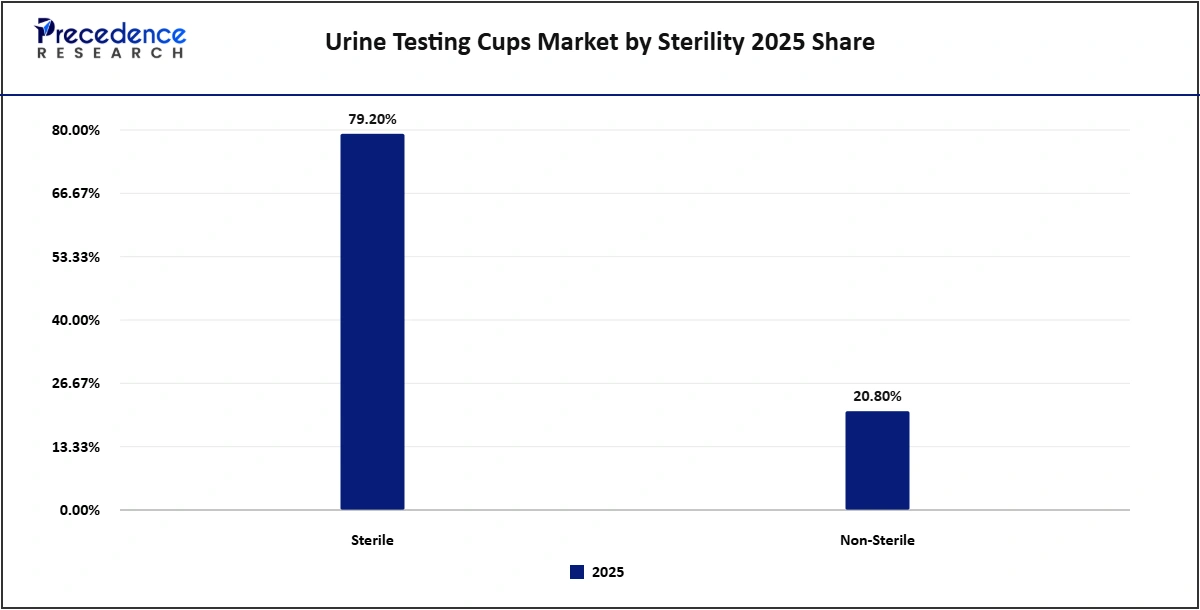
Note: 2025 is the base year.
Sources: Expert interviews, secondary sources, Precedence Research database, and Precedence Research analysts.
The sterile cup held 79.20% (USD 1.16 billion) in 2025 due to the need for culture and contamination-free cups for urine and drug tests, as well as the use of these products by hospitals and laboratories for chain-of-custody drug tests. The non-sterile cups held 20.80% (USD 0.31 billion), which are used for regular screening without culture and represent the most rapidly growing type in price-sensitive and home markets.
Urine Testing Cups Market by Product 2025 Share & Size
| Segments | 2025 Share | 2025 Market Value |
| Cups with Temperature Strips | 32.40% | USD 0.48 billion |
| Integrated Drug Test Cups | 28.60% | USD 0.42 billion |
| Standard Collection Cups | 30.20% | USD 0.44 billion |
| Cups with Transfer Devices & Others | 8.80% | USD 0.13 billion |
Note: 2025 is the base year.
Sources: Expert interviews, secondary sources, Precedence Research database, and Precedence Research analysts.
Cups with temperature strips held 32.40% (USD 0.48 billion) in 2025, since workplace and regulated drug testing needs immediate verification of the temperature of the specimen to ensure that there are no substituted specimens. The standard collection cups captured a 30.20% share (USD 0.44 billion) in 2025 and are used for hospital and laboratory urinalysis.
The integrated drug test cups held 28.60% (USD 0.42 billion) in 2025 and are the fastest-growing product due to the combination of collection, immunoassay of multi-drug strips, and adulteration test. Cups with transfer devices and other types held 8.80% (USD 0.13 billion) in 2025.
Urine Testing Cups Market by Application 2025 Share
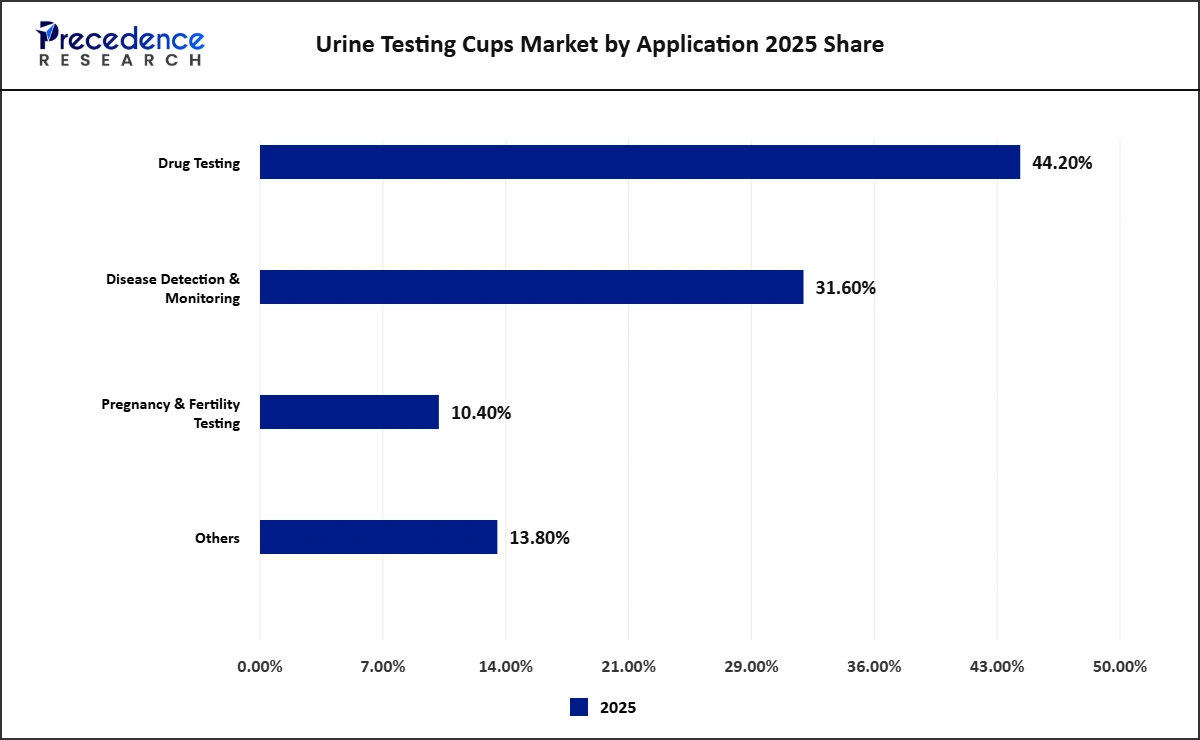
Note: 2025 is the base year.
Sources: Expert interviews, secondary sources, Precedence Research database, and Precedence Research analysts.
Drug testing contributed 44.20% (USD 0.65 billion) in 2025 due to testing of a huge number of urine samples in work, clinic, pain management, substance abuse treatment, and law enforcement programs. The fastest-growing use of urine tests was disease detection and monitoring, contributing 31.60% (USD 0.46 billion), driven by urinary tract infection, kidney diseases, and diabetes tests, along with liquid biopsy and molecular urine tests. Pregnancy and fertility testing contributed 10.40% (USD 0.15 billion), and others 13.80% (USD 0.20 billion).
Urine Testing Cups Market by End Use 2025 Share & Size
| Segments | 2025 Share | 2025 Market Value |
| Hospitals & Clinics | 40.40% | USD 0.59 billion |
| Diagnostic Laboratories | 28.60% | USD 0.42 billion |
| Workplaces & Rehabilitation Centers | 18.20% | USD 0.27 billion |
| Home Use | 12.80% | USD 0.19 billion |
Note: 2025 is the base year.
Sources: Expert interviews, secondary sources, Precedence Research database, and Precedence Research analysts.
The hospital and clinic segment was valued at 40.40% (USD 0.59 billion) in 2025, the diagnostic lab segment at 28.60% (USD 0.42 billion), the workplace and rehab facilities segment at 18.20% (USD 0.27 billion), and the home-use segment at 12.80% (USD 0.19 billion). Home use is the fastest-growing end-use due to the increasing availability of FDA-approved home drug test cups and consumer urine tests.
- Analyst View: The values of segments have been assigned based on the matching of specimen volumes and product mix in accordance with sterility types, products, applications, and end-uses based on revenue shares of suppliers. Sterile cups hold the leadership position due to the requirement in clinical practice, and drug testing holds the leadership position due to large-scale testing programs.
Regional Analysis
Urine Testing Cups Market by Region 2025 Share
Note: 2025 is the base year.
Sources: Expert interviews, secondary sources, Precedence Research database and Precedence Research analysts.
North America held a share of 39.40% (USD 0.58 billion) in 2025, which is aided by the presence of extensive workplace, clinical, and criminal justice drug testing programs, high-volume laboratory urinalysis, and a regular supply of FDA-approved drug test cups. The European market had a share of 25.60% (USD 0.38 billion), which is aided by the presence of hospital and laboratory urinalysis, extensive workplace testing of safety-sensitive industries, and monitoring programs. The Asia Pacific market held a share of 25.40% (USD 0.37 billion) and is the fastest-growing market, which is supported by increasing hospital and laboratory infrastructure in China and India, manufacturing hubs for cups and rapid tests, and drug testing programs.
North America accounted for 39.40% (USD 0.58 billion) in 2025. Drug test cups find a lot of usage in workplace, pain management and addiction treatment programmes. In 2025, the FDA approved various multi-drug test cups. Sterile cups are used by hospitals and laboratories for urinalysis and culture.
Europe accounted for 25.60% (USD 0.38 billion) in 2025. Hospital laboratories perform high volumes of urinalysis. A lot of urinalysis takes place in hospitals. Various drug test cups are used in workplaces and treatment programmes. Major markets include Germany, the UK and France.
Asia Pacific accounted for 25.40% (USD 0.37 billion) in 2025 and is the fastest-growing region. Major producer of cups and rapid drug tests is China which exports the products to the United States. Laboratory chains in India are expanding. Growing drug testing programmes in several nations.
Latin America accounted for 5.40% (USD 0.08 billion) in 2025. Hospital laboratories and employer testing drive demand in Brazil and Mexico. Price sensitivity favours basic cups.
The Middle East and Africa accounted for 4.20% (USD 0.06 billion) in 2025. Gulf hospitals and employers drive demand. Basic collection cups dominate in Africa.
Analyst View: The regional shares have been derived using the specimen volume, product mix, and pricing in the respective regions. North America is the leader region for this reason that it has the highest drug testing volume along with integrated cups that are highly valued.
Top 10 Companies in the Urine Testing Cups Market
| Rank | Company Name | Market-Specific Revenue (USD Billion) | 2025 Share | Key Products / Business | Headquarters |
| 1 | BD | 0.16 | 10.88% | BD Vacutainer urine collection cups and transfer systems | United States |
| 2 | Abbott | 0.14 | 9.52% | iCup and iScreen drug test cups | United States |
| 3 | Cardinal Health | 0.09 | 6.12% | Urine specimen containers | United States |
| 4 | Medline | 0.08 | 5.44% | Sterile urine specimen cups | United States |
| 5 | Quest Diagnostics | 0.06 | 4.08% | Drug testing collection supplies | United States |
| 6 | Wondfo | 0.05 | 3.40% | SAFElife T-Cup multi-drug test cups | China |
| 7 | Premier Biotech | 0.04 | 2.72% | Drug test cups with adulteration strips | United States |
| 8 | Labcon North America | 0.03 | 2.04% | Urine collection cups | United States |
| 9 | Sarstedt | 0.03 | 2.04% | Urine Monovette and collection systems | Germany |
| 10 | Advin Biotech | 0.02 | 1.36% | VINScreen urine drug test cups | United States |
Note: Company revenues and shares are 2025 estimates.
Sources: Company press releases, expert interviews, secondary sources, Precedence Research database and Precedence Research analysts.
BD led the urine testing cups market with a 10.88% share (US $0.16 billion), Abbott came next with a 9.52% share (US $0.14 billion), and then Cardinal Health had a 6.12% share (US $0.09 billion). BD is the market leader in clinical urine sampling owing to its Vacutainer urine sampling cups and transfer system, and PreAnalytiX, its joint venture with QIAGEN, introduced a urine liquid biopsy collection set in 2024. Abbott is a market leader in integrated drug test cups with its iCup and iScreen range, which are used by employers, clinics and treatment centres. Cardinal Health and Medline are market leaders in sterile specimen cups because of their distribution networks in hospitals, and Quest Diagnostics offers collection devices for its drug testing ser vices; Wondfo, Premier Biotech, Labcon, Sarstedt, and Advin Biotech are competitors in drug test cups and collection systems.
The top ten companies constituted an estimated share of 47.62% (USD 0.70 billion) of the revenue for 2025, whereas the rest of 52.38% (USD 0.77 billion) was held by regional cup manufacturers, rapid test producers, and private label suppliers. The urine testing cups market has low fragmentation when it comes to basic cups since it is influenced by cost and distribution; however, it is relatively more concentrated when it comes to integrated drug testing cups due to FDA approval and test performance.
Recent Developments
- February 2026: BD (Becton, Dickinson and Company), a renowned global manufacturer of medical devices, has announced the introduction of the BD Vacutainer Urine Complete Cup Kit, a system consisting of three tubes that allows for expanded testing based on one urine sample.
- November 2025: Wondfo received FDA 510(k) clearance for its SAFElife T-Cup Multi-Drug Urine Test Cup and Dx version.
- October 2025: Advin Biotech received FDA 510(k) clearance for its VINScreen Urine Drug Test Cup, including a home test version.
Urine Testing Cups Market Segments
By Sterility
- Sterile
- Non-Sterile
By Product
- Cups with Temperature Strips
- Integrated Drug Test Cups
- Standard Collection Cups
- Cups with Transfer Devices & Others
By Application
- Drug Testing
- Disease Detection & Monitoring
- Pregnancy & Fertility Testing
- Others
By End Use
- Hospitals & Clinics
- Diagnostic Laboratories
- Workplaces & Rehabilitation Centers
- Home Use
By Region
- North America (U.S., Canada, Mexico)
- Europe (Germany, U.K., France, Italy, Spain, Rest of Europe)
- Asia Pacific (China, Japan, India, South Korea, Taiwan, Rest of Asia Pacific)
- Latin America (Brazil, Argentina, Rest of Latin America)
- Middle East & Africa (GCC, South Africa, Rest of MEA)
Research Methodology
The urine testing cups market was described as sterile and non-sterile urine specimen cups, urine cups with temperature strips, urine transfer devices, and drug test cups incorporated in one, globally. The base year for 2025 was estimated using the bottom-up approach based on the volume of urine specimens by application and geography, product mix and pricing, and then verified using the top-down method based on the specimen collection and toxicology revenue of top suppliers. Segment, regional, and company revenues were derived using the allocation methodology based on sterility types, products, applications, end users, and geographical demand. The key assumptions were verified using third-party sources, company disclosures, regulatory and industry data, and estimates that failed the consistency check were excluded. The segment, regional, and company numbers were normalized to the same 2025 base year, and the forecast for 2026 to 2035 was recalculated.
Analyst View: Overall Market
The urine testing cups market is a volume-driven market, driven by clinical urinalysis and drug testing, and grows due to integration into cups and home testing. The forecasted growth rate is correlated with the number of specimens collected, types and prices of products; hence, it depends on testing programs and new product launches. The key drivers are integration into cups and molecular urine testing, while the threats are pricing pressure and alternative drug specimens.
Sources and References
- QIAGEN. "PreAnalytiX launches novel solution for liquid biopsy from urine samples". 2024-09. PAXgene urine set. https://corporate.qiagen.com/English/newsroom/press-releases/press-release-details/2024/PreAnalytiX-a-QIAGEN-and-BD-joint-venture-launches-novel-solution-for-liquid-biopsy-from-urine-samples/default.aspx
- 510(k) Database. "K252867 VINScreen Urine Drug Test Cup". 2025-10-09. Advin clearance. https://www.510kdatabase.net/k252867
- Innolitics FDA database. "K252550 SAFElife T-Cup Multi-Drug Urine Test Cup". 2025-11-18. Wondfo clearance. https://fda.innolitics.com/device/K252550
For inquiries regarding discounts, bulk purchases, or customization requests, please contact us at sales@precedenceresearch.com
Frequently Asked Questions





Ask For Sample
No cookie-cutter, only authentic analysis – take the 1st step to become a Precedence Research client
 Get a Sample




 sales@precedenceresearch.com
 Schedule a Meeting
