



Vacuum Grease Market Trends, Leading Companies, Company Revenue / Sales Performance, Plant Utilization, Production Volume, Pricing Dynamics, Supply Chain Performance, Competitive Landscape, and Industry Growth
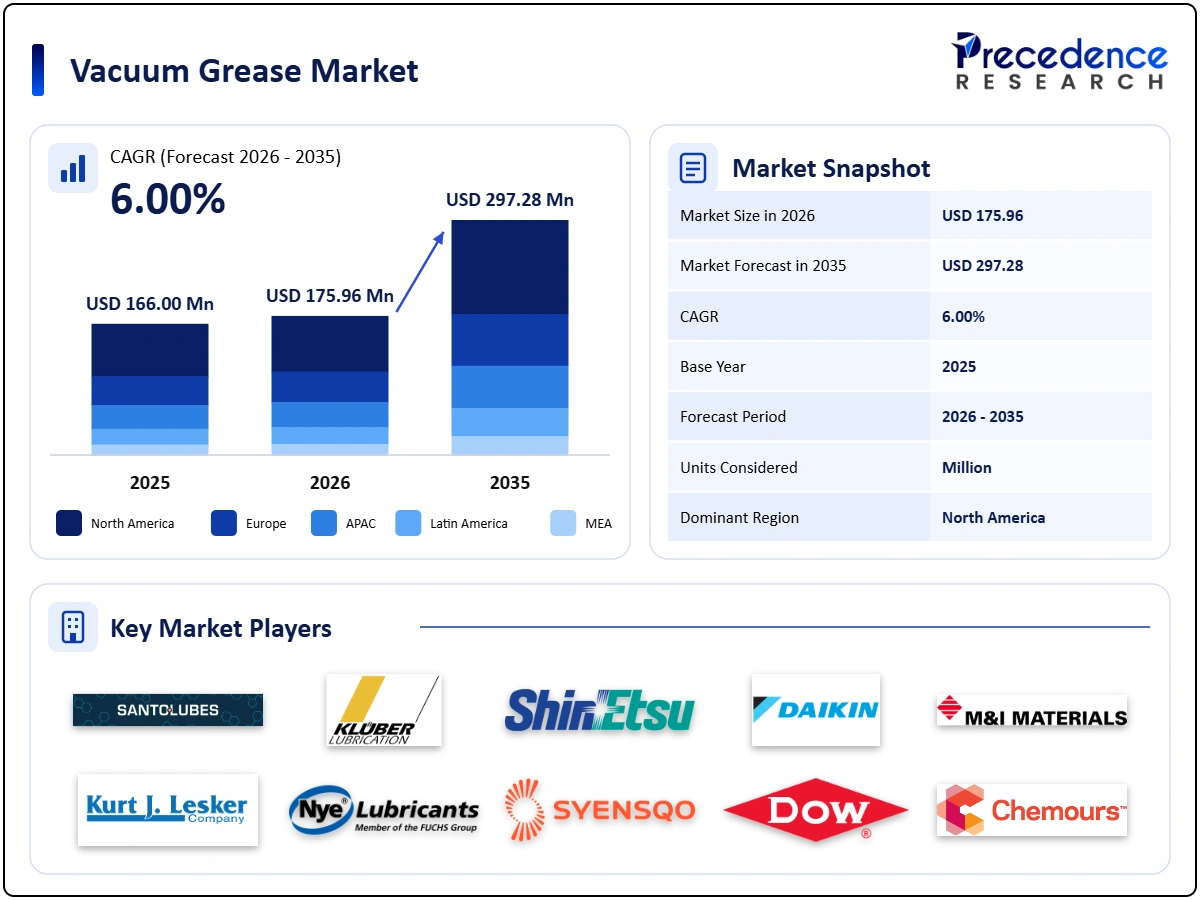
Vidyesh Swar, a Chemical and Materials Industry Expert, estimates the vacuum grease market at USD 175.96 million in 2026 to USD 297.28 million by 2035, growing at a CAGR of 6%. Major vacuum grease market companies such as Chemours, Dow, Syensqo, Nye Lubricants are competing across key material and segments, including product, application. end Use and region
Source: https://www.precedenceresearch.com/vacuum-grease-market
 Get a Sample
 Report Description
Key Takeaways
Market Size & Growth Outlook
- Market size in 2025: USD 166.00 million
- Estimated market size in 2026: USD 175.96 million
- Projected market size by 2035: USD 297.28 million
- CAGR (2026-2035): 6%
Regional Market Spotlight
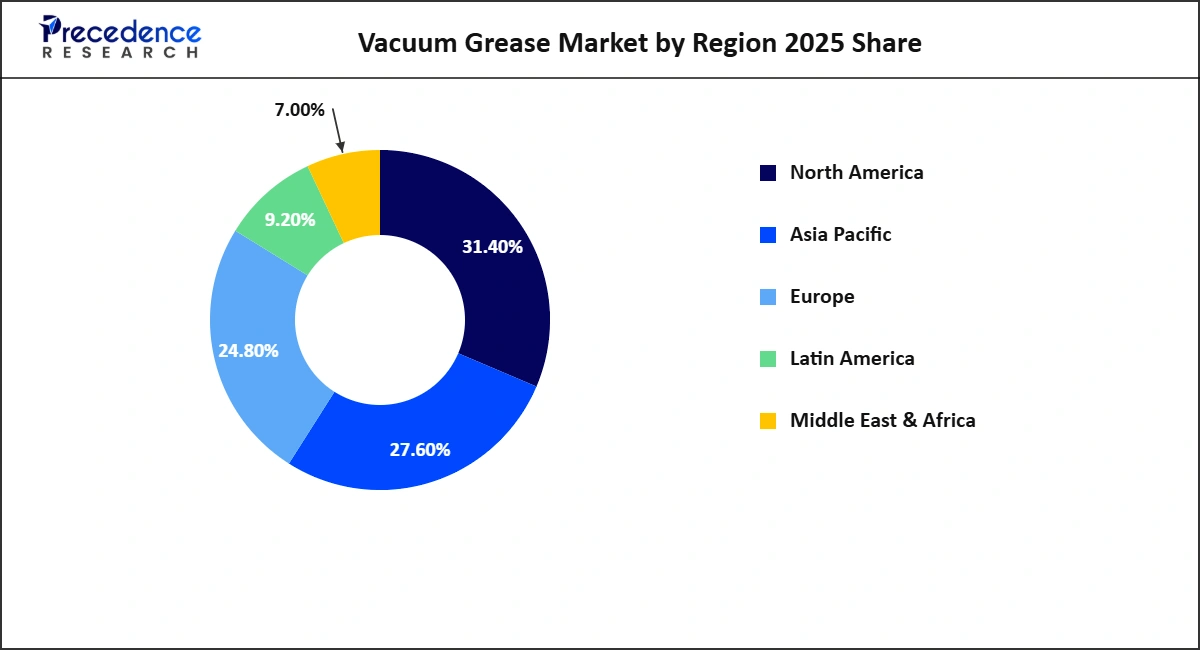
- North America led the market with a 31.40% (USD 52.12 million) share in 2025.
- Asia Pacific accounted for 27.60% (USD 45.82 million) of the market in 2025 and is projected to be the fastest-growing region, at a CAGR of 7.53% from 2025 to 2035.
- Europe accounted for 24.80% (USD 41.17 million) of the market in 2025.
Segmental Spotlight
- By product, Silicone-Based accounted for 44.20% (USD 73.37 million) in 2025.
- By application, Sealing & Lubrication accounted for 42.20% (USD 70.05 million) in 2025.
- By end use, Electronics & Semiconductor accounted for 28.20% (USD 46.81 million) in 2025.
Vacuum Grease Market Size and Forecast, 2025-2035 (USD Million)
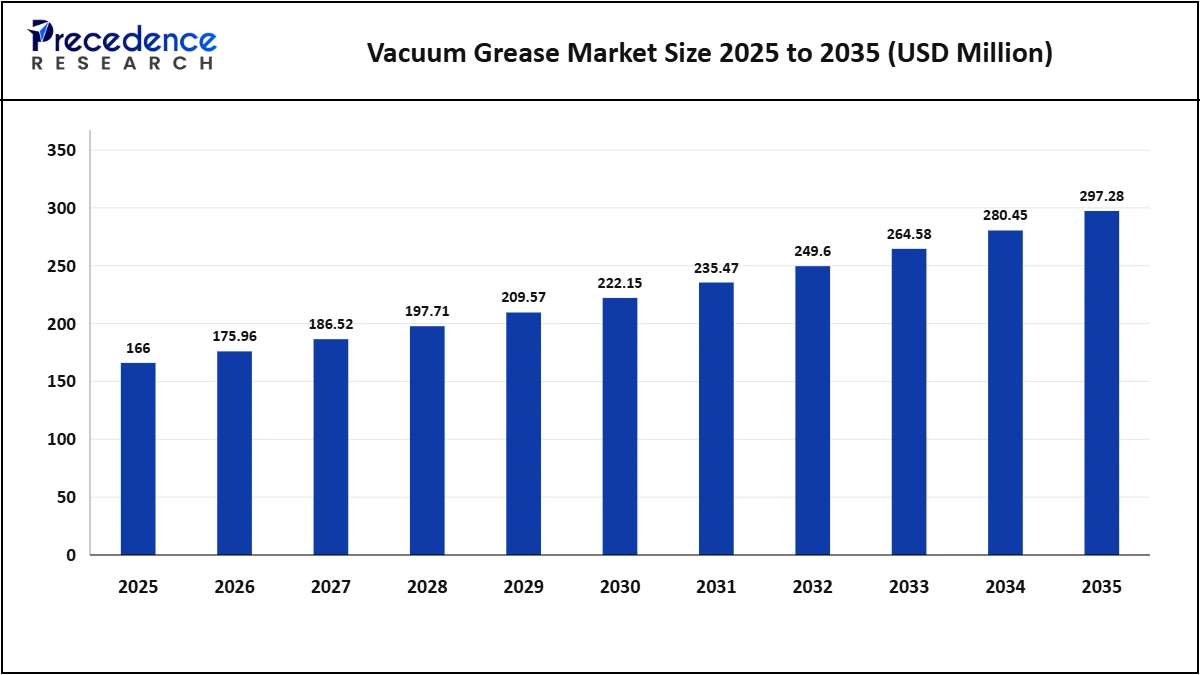
Note: 2025 is the base year; 2026-2035 values are forecasts.
Sources: Expert interviews, secondary sources, Precedence Research database, and Precedence Research analysts.
The vacuum grease market is expected to increase from USD 166.00 million in 2025 to USD 297.28 million in 2035 due to the need for greases that can seal joints and lubricate components without evaporating and without contaminating the vacuum in vacuum systems used in fabs, labs, and coating lines. Growth in semiconductor equipment and thin film equipment creates an increasing demand for high purity and low outgassing grades, resulting in the market reaching USD 222.15 million in 2030 and maintaining a CAGR of 6.00% between 2026 and 2035.
- Analyst View: Our projection was derived based on the number of installed base and new installations of vacuum equipment in semiconductors, laboratories, coating, aerospace, pharmaceutical, and industrial applications by region, consumption of grease per unit, and pricing of grease types. Consumption accounts for maintenance cycles, number of seals and valves, and the ratio of silicone, PFPE, and hydrocarbon types. This total was then verified using the revenue in the vacuum lubricants category of the major suppliers and using published projections, which results in our base year being higher than the equivalent estimates.
Market Trends
- PFAS rules reshape fluorinated grease supply.
- Semiconductor fabs drive high-purity grease demand.
- Low-outgassing greases serve space and aerospace.
- Vacuum coating expands in electronics and solar.
- Users qualify alternatives to PFPE greases.
- Cleanroom packaging and purity certification grow.
Drivers, Restraints and Opportunities
Drivers
The construction of semiconductor fabrication facilities and the installation of equipment require clean vacuum greases. Vacuum coating and thin film deposition are becoming increasingly popular in electronics, optics, and solar industries. Vacuum greases are routinely used by laboratories and analytical instrumentation. The space and aerospace sectors require low outgassing greases. Equipment maintenance ensures repeat purchases.
Restraints
PFAS regulations may restrict the use of PFPE greases or increase compliance costs. Volumes per system are relatively small, which limits the size of the market. Dry pumps and grease-free designs limit the use of greases in some equipment. Speciality ingredients are expensive. Equipment manufacturers' qualification delays the adoption of new products.
Opportunities
High purity greases for semiconductor equipment are premium products. Non-PFAS greases for vacuum applications can target the switching business. The space industry expansion boosts the demand for space-qualified greases. Construction of fabs in the US, Japan, Europe, and India increases the demand. Clean room certified packaging offers a competitive advantage.
Market Segmentation: 2025 Share and Value
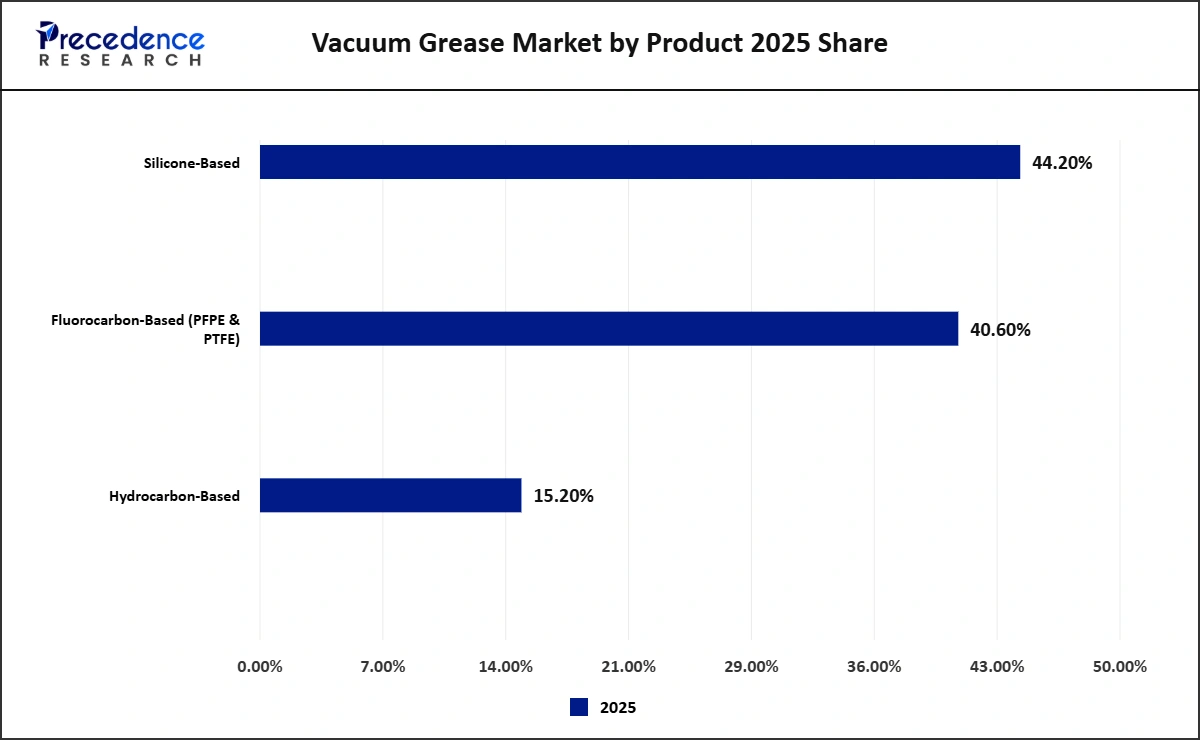
Vacuum Grease Market by Product 2025 Share
Note: 2025 is the base year.
Sources: Expert interviews, secondary sources, Precedence Research database, and Precedence Research analysts.
The share of silicone-based greases was 44.20% (USD 73.37 million) in 2025 as they offer low vapour pressure, temperature stability, compatibility with elastomers, and moderate pricing, which makes them suitable for use in lab glassware, desiccators, and other general vacuum components. The share of fluorocarbon-based greases was 40.60% (USD 67.40 million). They are based on PFPE oils with PTFE as a thickener. Fluorocarbon-based greases are used in semiconductor applications, oxygen, reactive gas, and ultra-high vacuum because they are chemically inert and have very low outgassing. This type of grease shows the highest revenue growth amid the growing regulation of PFAS products.
Vacuum Grease Market by Application 2025 Share & Size
| Segments | 2025 Share | 2025 Market Value |
| Sealing & Lubrication | 42.20% | USD 70.05 million |
| Vacuum System Maintenance | 24.60% | USD 40.84 million |
| Laboratory Glassware & Instruments | 18.40% | USD 30.54 million |
| Others | 14.80% | USD 24.57 million |
Note: 2025 is the base year.
Sources: Expert interviews, secondary sources, Precedence Research database, and Precedence Research analysts.
Sealing and lubrication comprised 42.20% (USD 70.05 million) in 2025 due to the use of grease on O-rings, flanges, valves, and other moving parts to keep the vacuum intact.
Maintenance of vacuum systems constituted 24.60% (USD 40.84 million), laboratory glassware and instruments constituted 18.40% (USD 30.54 million), and others comprised 14.80% (USD 24.57 million).
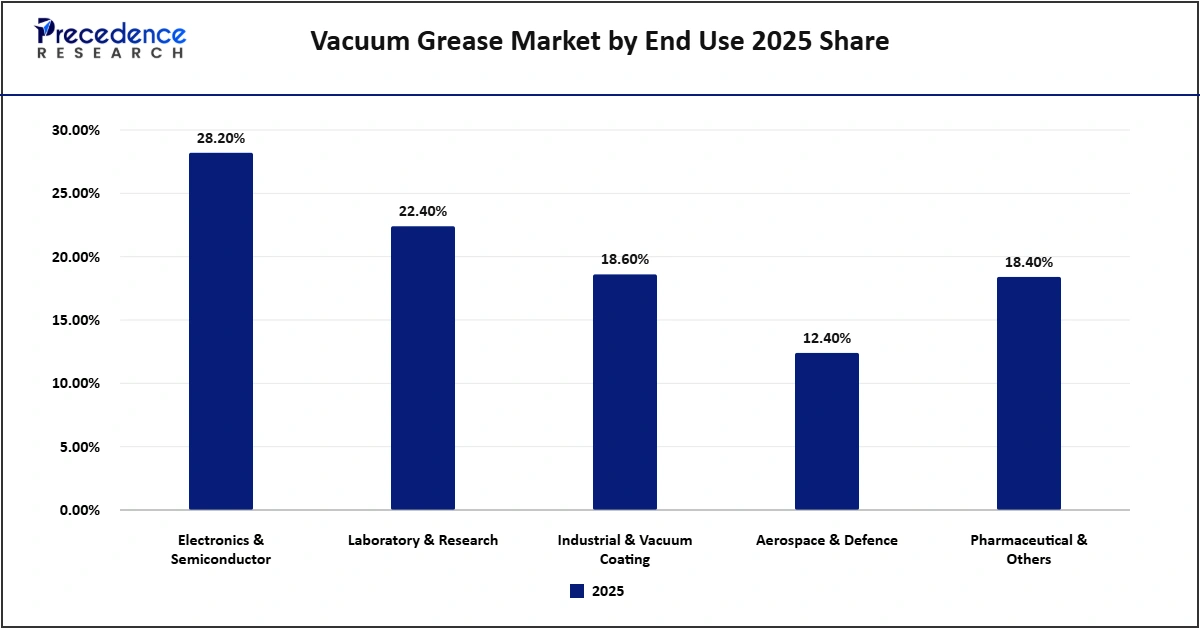
Vacuum Grease Market by End Use 2025 Share
Note: 2025 is the base year.
Sources: Expert interviews, secondary sources, Precedence Research database, and Precedence Research analysts.
In 2025, electronics and semiconductor captured 28.20% (USD 46.81 million) since wafer processing, deposition, and etch machinery need clean vacuum systems, and this is the fastest-growing end use with the construction of new fabs. Laboratory and research captured 22.40% (USD 37.18 million); industrial and vacuum coating captured 18.60% (USD 30.88 million); aerospace and defense captured 12.40% (USD 20.58 million), and pharmaceutical and others captured 18.40% (USD 30.54 million).
- Analyst View: Segment sizes were estimated using vacuum equipment installed base, consumption, and prices matched to products, applications, and end uses using supplier revenue mixes. Silicone grease dominates in terms of volume and value in general vacuum, and PFPE in semiconductors. We forecast growth in fluorocarbon and other high-purity greases and semiconductor end use.
Regional Analysis
Vacuum Grease Market by Region 2025 Share
Note: 2025 is the base year.
Sources: Expert interviews, secondary sources, Precedence Research database, and Precedence Research analysts.
North America held a 31.40% (USD 52.12 million) share in 2025, driven by construction of semiconductor fabs, national laboratories and universities, manufacturers of analytical instruments, and aerospace and space programs. Asia-Pacific is expected to grow at the highest CAGR and hold a 27.60% (USD 45.82 million) market share, driven by semiconductor and display fabs in Taiwan, South Korea, China, and Japan, and vacuum coating and electronics manufacturing. Europe held 24.80% (USD 41.17 million) market share in 2025, driven by research institutes, vacuum equipment manufacturers, and fluorochemical producers, but PFAS regulations were a significant issue. Latin America held 9.20% (USD 15.27 million) market share, and the Middle East & Africa held 7.00% (USD 11.62 million) market share.
North America accounted for 31.40% (USD 52.12 million) in 2025. New fabs supported by the CHIPS Act use clean vacuum lubricants. National laboratories and universities are major users of laboratory vacuum greases. Aerospace and space programmes require low-outgassing greases.
Asia Pacific accounted for 27.60% (USD 45.82 million) in 2025 and is the fastest-growing region. Taiwan, South Korea, China, and Japan host most semiconductor and display fabs. Vacuum coating for electronics, solar, and optics adds demand.
Europe accounted for 24.80% (USD 41.17 million) in 2025. Research institutes and vacuum equipment makers in Germany and other countries drive demand. The proposed EU restriction on PFAS creates uncertainty for fluorinated greases, though critical uses may be exempted.
Latin America accounted for 9.20% (USD 15.27 million) in 2025. Laboratory and industrial uses in Brazil and Mexico drive demand.
The Middle East and Africa accounted for 7.00% (USD 11.62 million) in 2025. Research institutions and industrial users in Gulf countries and South Africa drive demand.
Analyst View: Regional shares are created using the installed base, consumption, and prices in the regions. North America ranks first due to fabs, laboratories, and aerospace applications. The highest growth premium is assigned to Asia Pacific due to the rapid expansion of the semiconductor and electronics industries.
Top 10 Companies in the Vacuum Grease Market
| Rank | Company Name | Market-Specific Revenue (USD Million) | 2025 Share | Key Products / Business | Headquarters |
| 1 | Chemours | 24.00 | 14.46% | Krytox PFPE vacuum greases | United States |
| 2 | Dow | 20.00 | 12.05% | DOWSIL high vacuum grease | United States |
| 3 | Syensqo | 16.00 | 9.64% | Fomblin PFPE vacuum greases | Belgium |
| 4 | Nye Lubricants | 12.00 | 7.23% | Vacuum and cleanroom lubricants | United States |
| 5 | Kurt J. Lesker | 9.00 | 5.42% | Vacuum greases and fluids | United States |
| 6 | M&I Materials | 8.00 | 4.82% | Apiezon vacuum greases | United Kingdom |
| 7 | Daikin | 8.00 | 4.82% | Demnum PFPE greases | Japan |
| 8 | Shin-Etsu Chemical | 7.00 | 4.22% | Silicone vacuum greases | Japan |
| 9 | Klüber Lubrication | 7.00 | 4.22% | Barrierta PFPE greases | Germany |
| 10 | Santolubes | 3.00 | 1.81% | Santovac vacuum fluids and greases | United States |
Note: Company revenues and shares are 2025 estimates.
Sources: Company press releases, expert interviews, secondary sources, Precedence Research database and Precedence Research analysts.
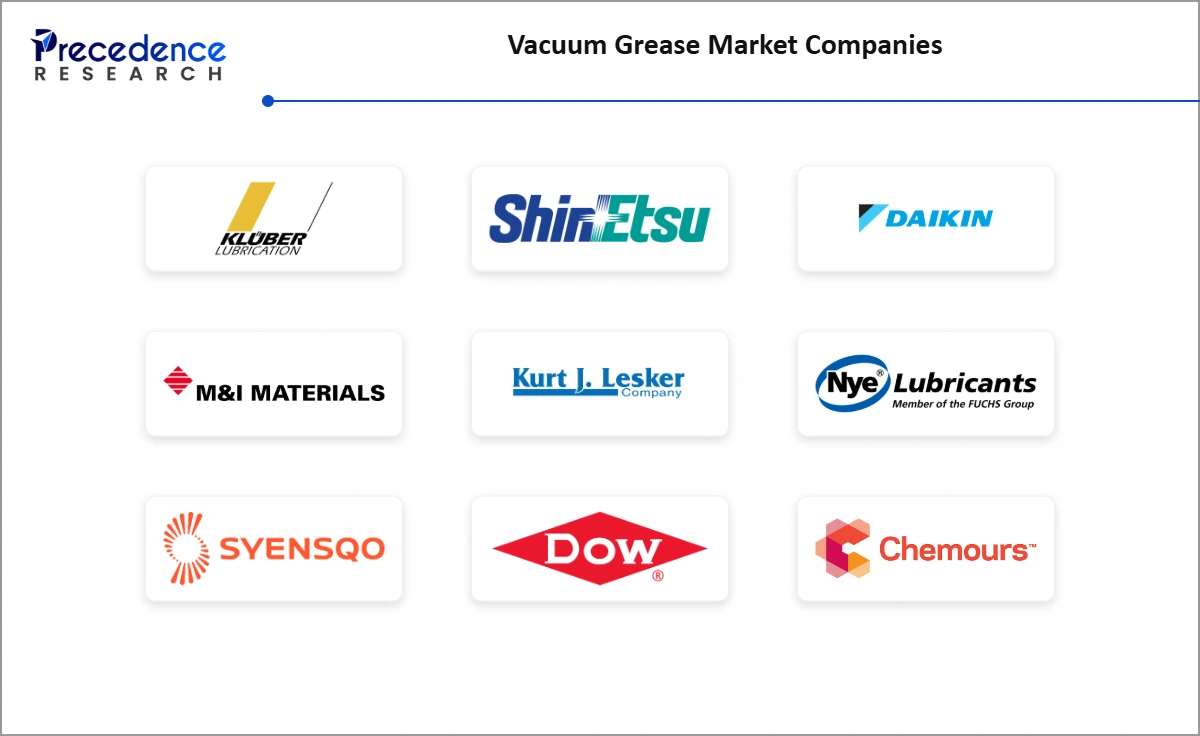
Chemours was the market leader for vacuum greases with a market share of approximately 14.46% (USD 24.00 million) in 2025, followed by Dow, with 12.05% (USD 20.00 million), and Syensqo, with 9.64% (USD 16.00 million). Chemours is the top supplier of fluoroelastomer (fluorocarbon) based vacuum grease with its range of Krytox PFPE, widely used in semiconductors, oxygen systems, and ultra-high vacuum systems. Dow provides DOWSIL high vacuum silicone grease that has been a traditional standard for laboratories, and Syensqo provides Fomblin PFPE greases for semiconductors and vacuum pumps. Nye Lubricants under the brand name of FUCHS, Kurt J. Lesker, M&I Materials' Apiezon series, Daikin, Shin-Etsu, Klüber, and Santolubes are the major companies operating in the silicone, PFPE, hydrocarbon, and polyphenyl ether vacuum grease industry.
The 10 leading companies contributed 68.67% (US$114.00 million) of revenues in 2025, whereas the remaining 31.33% (US$52.00 million) was captured by laboratory supplies distributors, special lubricants formulators, and regional silicone producers. The vacuum grease market consists of several fluorochemical and silicone manufacturers and special formulators; the competition is based on vapour pressure, outgassing, chemical inertness, purity, temperature stability, and qualification with equipment manufacturers. The PFAS regulations and exit of suppliers from some of the fluorochemicals are making customers ensure supply and qualification of alternatives, thus preferring diversified suppliers.
Vacuum Grease Market Segments
By Product
- Silicone-Based
- Fluorocarbon-Based (PFPE & PTFE)
- Hydrocarbon-Based
By Application
- Sealing & Lubrication
- Vacuum System Maintenance
- Laboratory Glassware & Instruments
- Others
By End Use
- Electronics & Semiconductor
- Laboratory & Research
- Industrial & Vacuum Coating
- Aerospace & Defence
- Pharmaceutical & Others
By Region
- North America (U.S., Canada, Mexico)
- Europe (Germany, U.K., France, Italy, Spain, Rest of Europe)
- Asia Pacific (China, Japan, India, South Korea, Taiwan, Rest of Asia Pacific)
- Latin America (Brazil, Argentina, Rest of Latin America)
- Middle East & Africa (GCC, South Africa, Rest of MEA)
Research Methodology
The global vacuum grease market was segmented into silicones, fluorocarbon (PFPE and PTFE), and hydrocarbon vacuum greases used in semiconductor, laboratory, industrial, aerospace, and pharmaceutical applications. The 2025 base year was calculated bottom-up from the installed base and installations of vacuum equipment by application and region, the amount of grease per unit and the price level, and then validated top-down from the vacuum lubricant revenue of leading companies. Company, regional, and segment values were derived from product, application, end use, and regional demand. The key numbers were validated by cross-checking with the public information provided by companies, regulatory authorities, and other reliable sources, and all inconsistent inputs were discarded. All company, regional and segment values have been brought to the same 2025 base year, and the 2026-2035 forecast based on a constant CAGR from the 2025 base year was recalculated.
Analyst View: Overall Market
The vacuum grease market can be characterized as a specialized market that has a correlation with semiconductor, lab, coating, and aerospace vacuum applications, with the regulation of PFAS being the core of the structure of the market. Our estimate of the demand is based on the existing fleet of vacuum equipment, consumption, and price; thus, our forecast depends on fab construction and the results of the regulation. The upside factors are semiconductors and non-PFAS solutions.
Sources and References
- LabTech. "Krytox PFPE/PTFE vacuum grease". Undated. Krytox vacuum greases. https://www.labtech.com/?p=40384
For inquiries regarding discounts, bulk purchases, or customization requests, please contact us at sales@precedenceresearch.com
Frequently Asked Questions





Ask For Sample
No cookie-cutter, only authentic analysis – take the 1st step to become a Precedence Research client
 Get a Sample




 sales@precedenceresearch.com
 Schedule a Meeting
