



Vapor Recovery Unit Market Size, Key Companies, Company Market Share, Power Generation Capacity, Energy Consumption, Pricing Trends, Investment Analysis, Competitive Positioning, and Demand Forecast
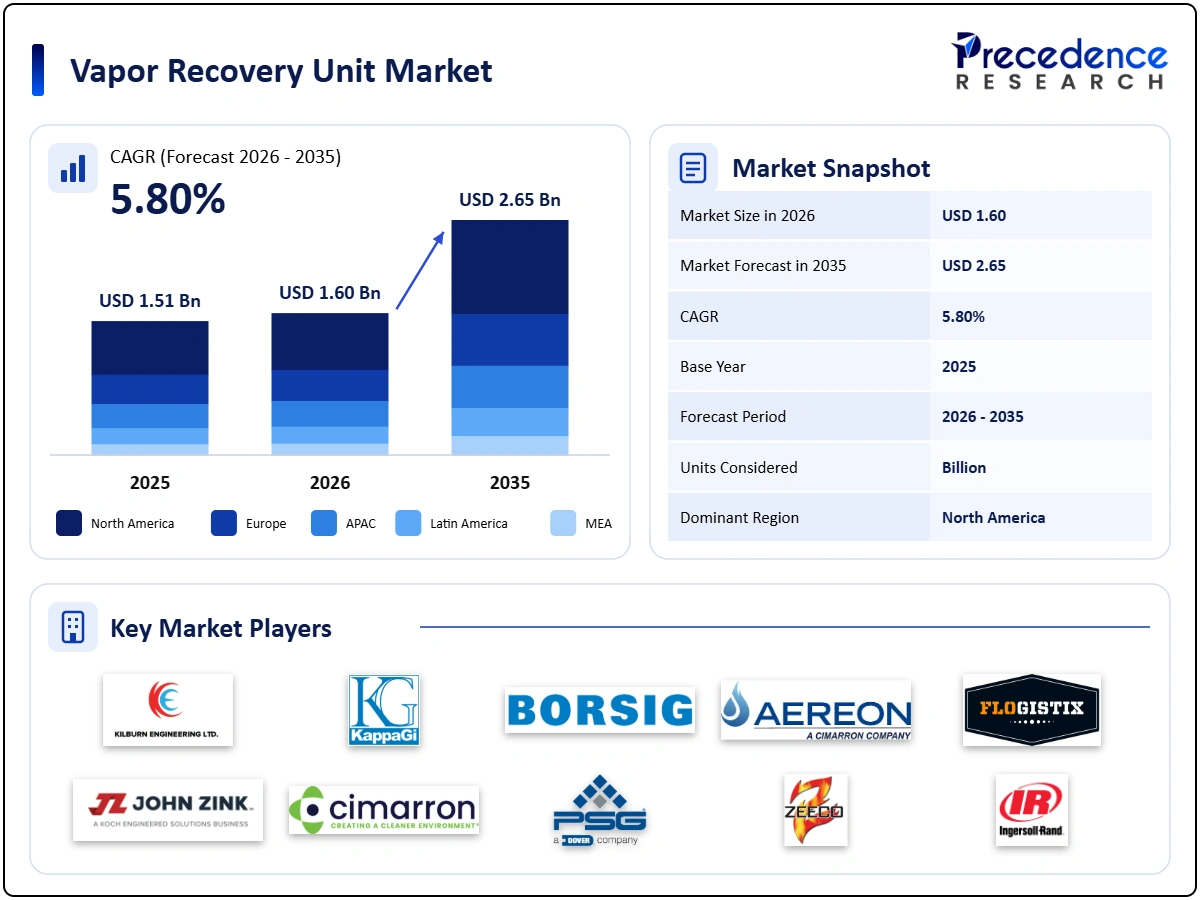
According to energy and power expert Laxmi Narayan, the vapor recovery unit market has reached USD 1.60 billion in 2026 to USD Â 2.65Â billion by 2035, growing at a CAGR of 5.80%. The vapor recovery unit market companies such as Ingersoll Rand, Zeeco, Cimarron Energy, John Zink are playing a key role in market expansion, with major opportunities emerging across technology, application, end use and region segments.
Source: https://www.precedenceresearch.com/vapor-recovery-unit-market
 Get a Sample
 Report Description
Key Takeaways
Market Size & Growth Outlook
- Market size in 2025: USD 1.51 billion
- Estimated market size in 2026: USD 1.60 billion
- Projected market size by 2035: USD 2.65 billion
- CAGR (2026-2035): 5.80%
Regional Market Spotlight
- North America led the market in 2025, with a 37.80% share, worth USD 0.57 billion.
- Asia Pacific held 24.20% of the market, worth USD 0.37 billion, in 2025. It is expected to be the fastest-growing region, with a CAGR of 7.05% from 2025 to 2035.
- Europe accounted for 21.60% of the market, worth USD 0.33 billion, in 2025.
Segmental Spotlight
- By technology, compression led the market in 2025 with a 42.40% share, worth USD 0.64 billion.
- By application, storage tanks held the largest share at 38.60%, worth USD 0.58 billion, in 2025.
- By end use, oil and gas led the market with a 64.80% share, worth USD 0.98 billion, in 2025.
Vapor Recovery Unit Market Size and Forecast, 2025-2035 (USD Billion)
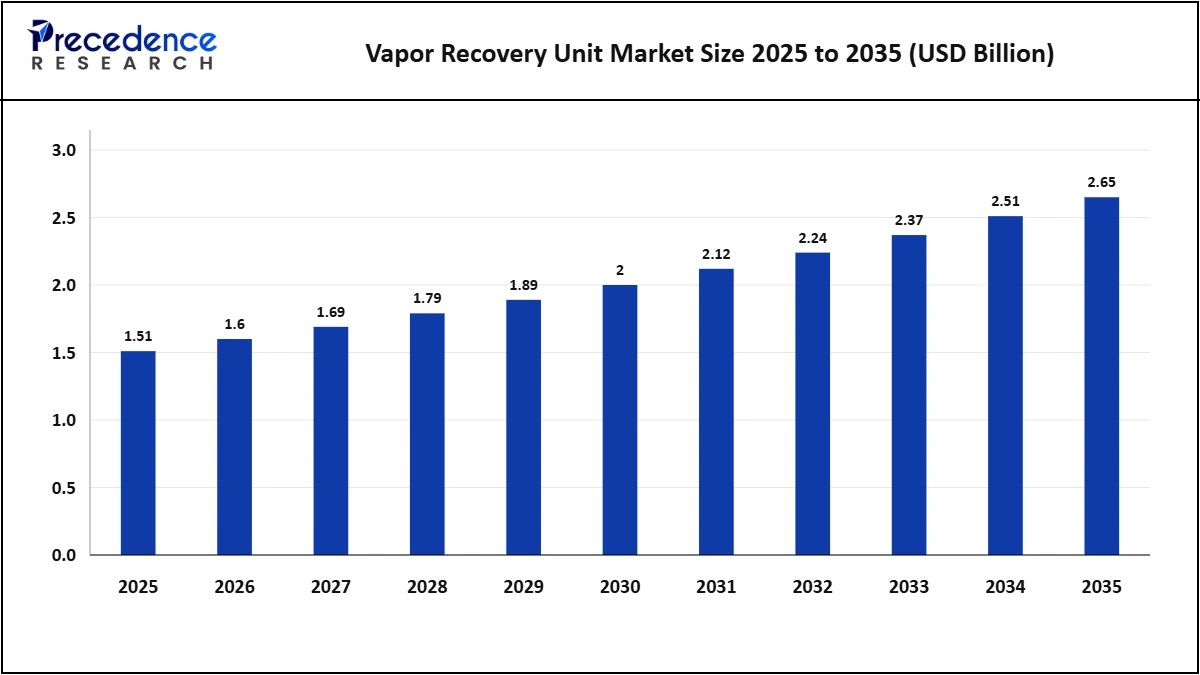
Note: 2025 is the base year, while the figures from 2026 to 2035 are forecasts.
Sources: Expert interviews, secondary sources, Precedence Research database and Precedence Research analysts.
The vapor recovery unit market is expected to grow from USD 1.51 billion in 2025 to USD 2.65 billion by 2035. This growth is mainly due to the need to control vapour emissions and comply with methane and VOC regulations. Companies can also sell or reuse the gas and other products they recover, which can help them recover their investment in VRUs more quickly.
Stricter methane rules for storage tanks and wellsites are expected to increase the number of installed units. As a result, the market is projected to reach USD 2.00 billion by 2030 and grow at a CAGR of 5.80% from 2026 to 2035.
- Analyst View: We estimated the market by looking at the number of VRUs installed each year across different technologies, applications and regions. We also considered average system prices, service revenue and rental income. The analysis covered oil and gas tank sites, gas processing plants, fuel terminals, refineries and chemical plants that need to control emissions.
Installation estimates are based on regulations, oil and gas activity, and investment in terminals and refineries. We compared the total estimates with the vapour recovery revenue of leading equipment manufacturers and published market estimates. This comparison places our base-year estimate slightly above similar published figures. The expected growth rate reflects stricter regulations and the value of recovered products, while also considering changes in oil and gas activity.
Market Trends
- Stricter methane rules are increasing the need to control vapours from storage tanks.
- Ready-made, modular VRUs help reduce installation time.
- Membrane systems are helping companies recover light hydrocarbons.
- Rental-based VRU services are becoming more common in shale production areas.
- Remote monitoring helps improve VRU performance and reduce downtime.
- Fuel terminals are upgrading vapour recovery systems to meet VOC regulations.
Drivers, Restraints and Opportunities
Driver
Methane and VOC regulations require companies to control vapours at storage tanks, wellsites and fuel terminals. Recovered vapours can be sold, which makes these systems more financially attractive. Companies are also working to reduce emissions and meet their sustainability targets. The expansion of refineries, petrochemical plants and fuel terminals in Asia and the Middle East is creating additional demand. Policies aimed at reducing flaring also encourage companies to recover vapours instead of burning them.
Restraint
Changes in oil and gas activity can affect spending on equipment. Regulatory deadlines and requirements may also change. VRUs need regular maintenance and can experience downtime. When gas prices are low, recovering gas may become less profitable. Some sites may also choose combustion systems instead of vapour recovery units.
Opportunity
New regulations are creating opportunities to install VRUs at existing tank sites. Membrane-based and hybrid systems may help improve recovery performance. Remote monitoring and service contracts can provide regular income for suppliers. LNG, hydrogen and biofuel facilities also need vapour control systems. Emerging markets that introduce stricter VOC rules offer further growth opportunities.
Market Segmentation: 2025 Share and Value
Vapor Recovery Unit Market by Technology 2025 Share
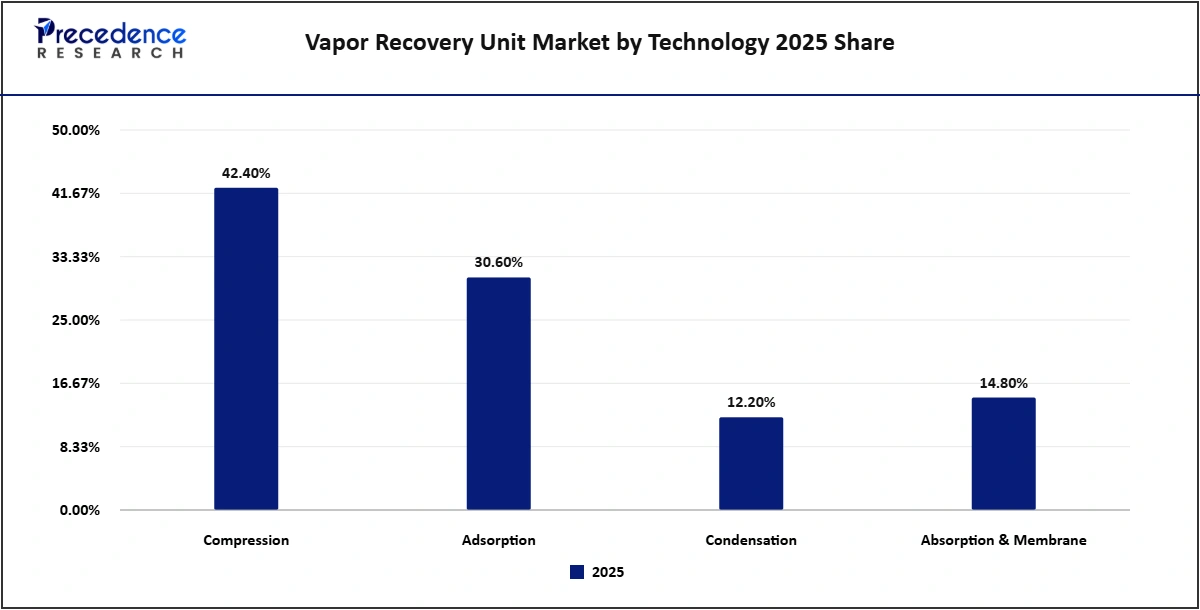
Note: 2025 is the base year.
Sources: Expert interviews, secondary sources, Precedence Research database and Precedence Research analysts.
Compression held the largest share in 2025, at 42.40%, worth USD 0.64 billion. These systems use rotary vane, screw and reciprocating compressors to capture vapours from oil and gas tank sites and gas facilities. The recovered gas can then be sent to sales pipelines, helping companies earn revenue and offset equipment costs.
Adsorption accounted for 30.60% of the market, worth USD 0.46 billion. These systems use activated carbon to capture gasoline and VOC vapours at fuel terminals and loading racks.
Condensation accounted for 12.20%, worth USD 0.18 billion. Absorption and membrane systems held 14.80%, worth USD 0.22 billion. Membrane-based systems are expected to gain importance as improvements help recover light hydrocarbons and VOCs more effectively.
Vapor Recovery Unit Market by Application 2025 Share & Size
| Segments | 2025 Share | 2025 Market Value |
| Storage Tanks | 38.60% | USD 0.58 billion |
| Processing | 30.20% | USD 0.46 billion |
| Loading, Unloading & Transportation | 22.40% | USD 0.34 billion |
| Others | 8.80% | USD 0.13 billion |
Note: 2025 is the base year.
Sources: Expert interviews, secondary sources, Precedence Research database and Precedence Research analysts.
Storage tanks accounted for the largest share in 2025, at 38.60%, worth USD 0.58 billion. Crude oil, condensate and other product tanks release vapours during storage and handling. These emissions are a major target of environmental regulations, creating strong demand for recovery systems.
Processing accounted for 30.20% of the market, worth USD 0.46 billion. Loading, unloading and transportation represented 22.40%, worth USD 0.34 billion, while other applications accounted for 8.80%, worth USD 0.13 billion.
Demand from loading and transportation applications is growing quickly as fuel terminals and marine loading facilities face stricter emission control requirements.
Vapor Recovery Unit Market by End Use 2025 Share
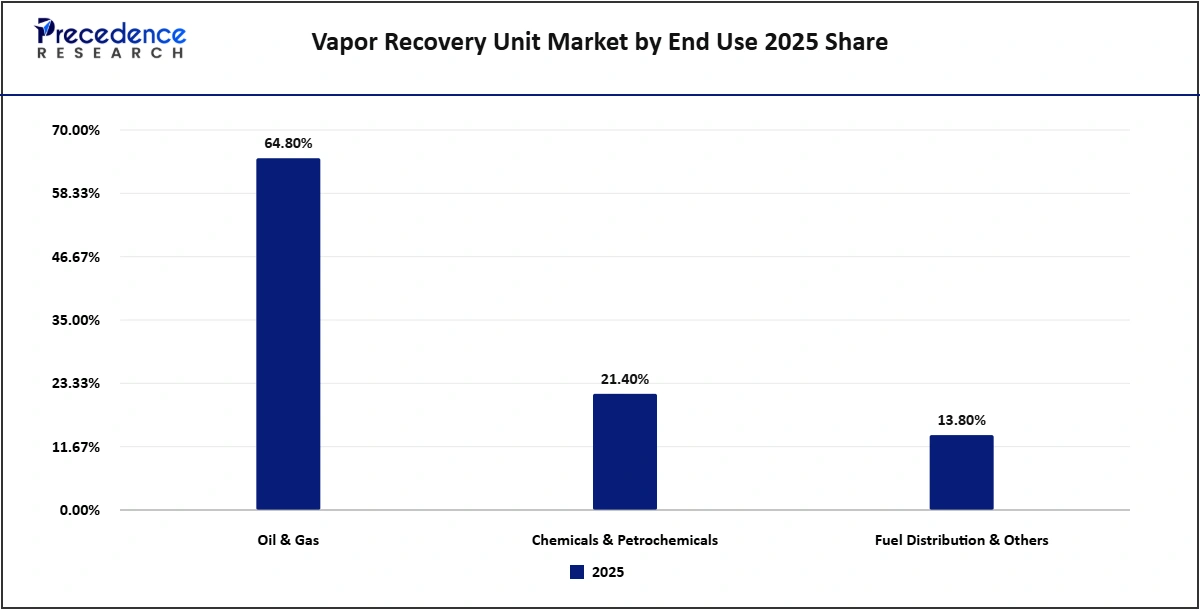
Note: 2025 is the base year.
Sources: Expert interviews, secondary sources, Precedence Research database and Precedence Research analysts.
The oil and gas sector held the largest share in 2025, at 64.80%, worth USD 0.98 billion. This is because upstream, midstream and downstream oil and gas facilities produce large amounts of vapour that need to be controlled.
Chemicals and petrochemicals accounted for 21.40% of the market, worth USD 0.32 billion. Fuel distribution and other uses represented 13.80%, worth USD 0.21 billion.
- Analyst View: We estimated the value of each segment by matching the number of installations and average prices with the relevant technologies, applications and end-use industries. We also considered suppliers' revenue breakdowns. Compression systems and storage tank applications lead because of methane regulations affecting upstream operations. We expect membrane systems, loading applications and petrochemical facilities to gain a larger share over time.
Regional Analysis
Vapor Recovery Unit Market by Region 2025 Share
Note: 2025 is the base year.
Sources: Expert interviews, secondary sources, Precedence Research database and Precedence Research analysts.
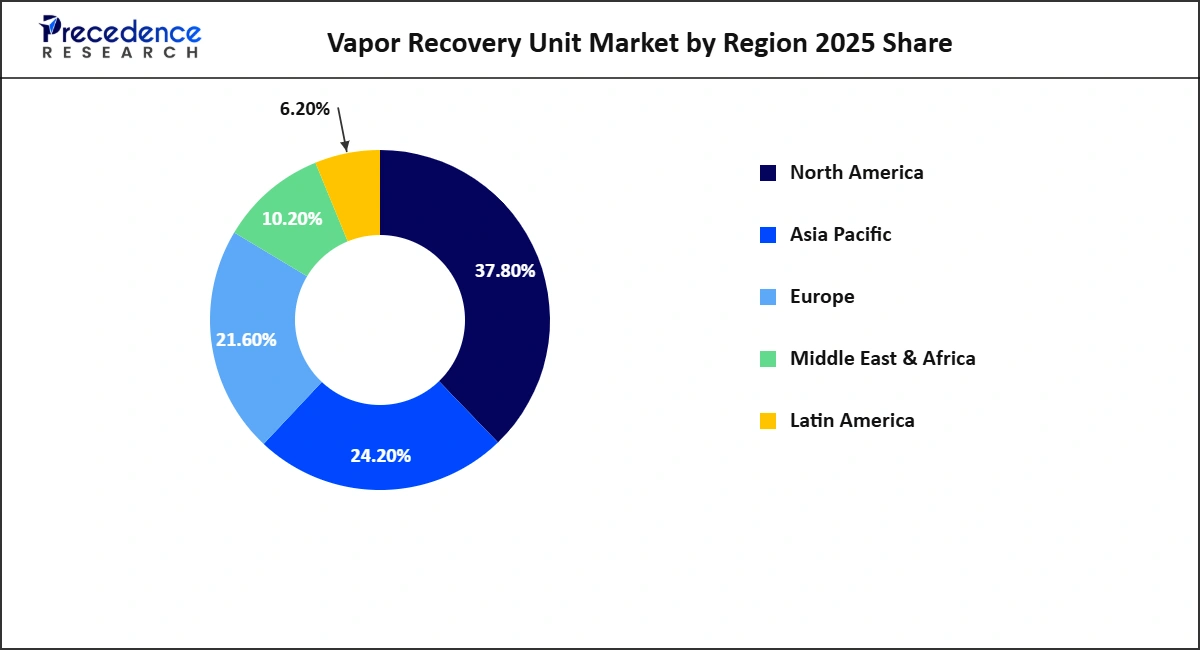
North America held the largest regional share in 2025, at 37.80%, worth USD 0.57 billion. Its position is supported by U.S. shale production, EPA methane and VOC rules for storage tanks and equipment, state regulations in Colorado, New Mexico and Texas, and the presence of many fuel terminals.
Asia Pacific accounted for 24.20% of the market, worth USD 0.37 billion. It is expected to be the fastest-growing region because refineries, petrochemical plants and fuel terminals are expanding, while China and India are introducing stricter VOC controls.
Europe held a 21.60% share, worth USD 0.33 billion. Demand is supported by long-standing VOC rules for petrol stations and fuel terminals, along with EU methane regulations.
The Middle East and Africa accounted for 10.20% of the market, worth USD 0.15 billion. Latin America held 6.20%, worth USD 0.09 billion. Oil and gas projects, along with the development of fuel terminals, support demand in both regions.
North America: North America accounted for 37.80% of the market, worth USD 0.57 billion, in 2025. The EPA finalised methane standards in December 2023, strengthening controls on storage tanks and other emission sources. Thousands of tank sites use compression-based VRUs, while rental and maintenance services are common in the region.
Asia Pacific: Asia Pacific held a 24.20% share, worth USD 0.37 billion, in 2025 and is expected to grow the fastest. China and India are expanding their refineries, petrochemical complexes and fuel terminals while tightening VOC regulations. Indian suppliers such as Kilburn Engineering are serving demand in the region.
Europe: Europe accounted for 21.60% of the market, worth USD 0.33 billion, in 2025. VOC regulations require vapour recovery at petrol stations and terminals. EU methane rules are also adding requirements for oil and gas operators.
Middle East & Africa: This region accounted for 10.20% of the market, worth USD 0.15 billion, in 2025. National oil companies are working to reduce flaring and methane emissions, while investment in terminals and refineries is creating demand for recovery systems.
Latin America: Latin America held a 6.20% share, worth USD 0.09 billion, in 2025. Oil production in Brazil, Mexico and Argentina, along with the development of fuel terminals, supports market demand.
Analyst View: We estimated regional market shares using installation levels, local regulations and equipment prices. North America leads because of its strong shale industry and EPA rules. Asia Pacific is expected to grow the fastest because refinery, petrochemical and fuel terminal capacity is expanding and VOC regulations are becoming stricter.
Competitive Landscape
Top 10 Companies in the Vapor Recovery Unit Market, 2025
| Rank | Company Name | Market-Specific Revenue (USD Billion) | 2025 Share | Key Products / Business | Headquarters |
| 1 | Ingersoll Rand | 0.17 | 11.26% | Compressors and vapour recovery systems | United States |
| 2 | Zeeco | 0.12 | 7.95% | Vapour combustion and recovery systems | United States |
| 3 | PSG (Dover) | 0.10 | 6.62% | Blackmer vapour recovery compressors | United States |
| 4 | Cimarron Energy | 0.09 | 5.96% | Upstream emissions control and VRUs | United States |
| 5 | John Zink | 0.08 | 5.30% | Vapour recovery and combustion systems | United States |
| 6 | Flogistix | 0.07 | 4.64% | Vapour recovery compression services | United States |
| 7 | Aereon | 0.05 | 3.31% | Vapour recovery and combustion systems | United States |
| 8 | BORSIG | 0.05 | 3.31% | Membrane vapour recovery units | Germany |
| 9 | Kappa GI | 0.03 | 1.99% | Vapour recovery units | Italy |
| 10 | Kilburn Engineering | 0.02 | 1.32% | Vapour recovery systems | India |
Note: Company revenues and market shares are estimates for 2025.
Sources: Company press releases, expert interviews, secondary sources, Precedence Research database and Precedence Research analysts.
Ingersoll Rand led the vapor recovery unit market in 2025, with an estimated 11.26% share, worth USD 0.17 billion. Zeeco followed with a 7.95% share, worth USD 0.12 billion, while PSG held 6.62%, worth USD 0.10 billion.
Ingersoll Rand benefits from its wide range of compressors used in vapour recovery and gas gathering, along with its global service network. Zeeco provides vapour recovery and combustion systems for fuel terminals, refineries and upstream oil and gas sites. PSG, which is part of Dover, supplies Blackmer compressors that are widely used in vapour recovery applications.
Other important companies include Cimarron Energy, John Zink, Flogistix, Aereon, BORSIG, Kappa GI and Kilburn Engineering. These companies compete in areas such as upstream emission control, terminal vapour recovery, membrane systems and regional markets.
The top 10 companies accounted for an estimated 51.66% of the market in 2025, worth USD 0.78 billion. The remaining 48.34%, worth USD 0.73 billion, was shared by regional equipment manufacturers, rental service providers and companies making adsorption-based systems.
The market remains fragmented, with competition based on recovery efficiency, regulatory compliance, equipment reliability in difficult operating conditions, modular designs, rental and service options, and price. Rental and service models are important in upstream oil and gas operations, while fuel terminals and refineries generally use specially engineered systems.
Companies Ecosystem
The vapor recovery unit market brings together component suppliers, equipment manufacturers, rental and service providers, engineering contractors and industrial operators. Regulations create the need for these systems, while the value of recovered products helps make projects financially attractive.
| Ecosystem Stage | Role in the Market | Key Companies |
| Component Suppliers | Supply compressors, activated carbon, membranes, control systems and instruments | Ingersoll Rand, Gardner Denver, Calgon Carbon, Emerson |
| VRU Manufacturers | Design and build compression, adsorption and membrane-based VRUs | Zeeco, John Zink, Cimarron Energy, Aereon, BORSIG, Kappa GI, Kilburn Engineering |
| Rental & Service Providers | Install, rent and maintain VRUs at wellsites | Flogistix, Cimarron Energy, regional service firms |
| EPC Contractors | Add vapour recovery systems to terminals, refineries and industrial plants | Engineering and construction firms |
| Operators | Include oil and gas producers, midstream companies, terminals, refineries and chemical plants | Upstream operators, terminal owners, refiners |
Sources: Company press releases, expert interviews, secondary sources, Precedence Research database and Precedence Research analysts.
Precedence Research Companies Quadrant
The Precedence Research Companies Quadrant compares major companies in the vapor recovery unit market based on their market strength and growth strategies.
Market strength considers factors such as revenue, market share and geographic reach. Innovation and growth strategy are assessed based on product range, research and development (R&D) activity and partnerships. The positions are based on each company's estimated 2025 vapour recovery revenue and our assessment of its technology range, service model and partnerships.
Sources: Company press releases, expert interviews, secondary sources, Precedence Research database and Precedence Research analysts.
Leaders: Ingersoll Rand, Zeeco, PSG (Dover) and Cimarron Energy have significant vapour recovery revenue, a wide range of technologies, strong service networks and new modular products.
Challengers: John Zink has an established position in equipment, but its focus on vapour recovery is narrower.
Innovators: Flogistix, BORSIG and Kilburn Engineering offer solutions such as membrane technology, rental-based compression and regional engineering services. These offerings are gaining attention.
Niche Players: Aereon and Kappa GI focus on specific regional markets and terminal applications.
Recent Developments
- August 2025: Kilburn Engineering signed a master agreement with Komline-Sanderson, expanding its range of process equipment.
Link- (Source: themachinemaker.com)
Vapor Recovery Unit Market Segments
By Technology
- Compression
- Adsorption
- Condensation
- Absorption & Membrane
By Application
- Storage Tanks
- Processing
- Loading, Unloading & Transportation
- Others
By End Use
- Oil & Gas
- Chemicals & Petrochemicals
- Fuel Distribution & Others
By Region
- North America (U.S., Canada, Mexico)
- Europe (Germany, U.K., France, Italy, Spain, Rest of Europe)
- Asia Pacific (China, Japan, India, South Korea, Taiwan, Rest of Asia Pacific)
- Latin America (Brazil, Argentina, Rest of Latin America)
- Middle East & Africa (GCC, South Africa, Rest of MEA)
Research Methodology
The vapor recovery unit market includes compression, adsorption, condensation, absorption and membrane-based vapour recovery units, along with related services worldwide.
The 2025 base-year market estimate was calculated using a bottom-up approach. This involved estimating the number of VRUs installed across different technologies, applications and regions, along with average system prices and revenue from services and rentals. The results were then checked against the vapour recovery revenue of leading equipment manufacturers using a top-down approach.
Market values for individual segments, regions and companies were allocated based on technology, application, end use and regional demand. Key estimates were checked against company disclosures, regulatory and industry data, and published third-party estimates. Inputs that could not be matched or reconciled were excluded.
All segment, regional and company estimates were aligned with the same 2025 base year. The forecast for 2026–2035 was then calculated using a constant CAGR from the 2025 base and checked for consistency.
Analyst View: Overall Market
The vapor recovery unit market is mainly driven by environmental regulations and the financial benefits of recovering gas and other products. The market is expected to grow steadily as methane and VOC rules become stricter.
Our estimate connects market demand with equipment installations, prices and service revenue. This means the forecast reflects changes in regulations and activity across the oil and gas industry and fuel terminals.
Stricter methane rules and the installation of VRUs at existing sites offer the main growth opportunities. Changes in regulations and fluctuations in oil and gas activity remain the key risks.
Sources and References
- Journal of Petroleum Technology. "New EPA regulation offers opportunities for emissions and waste gas". Undated. EPA methane rule. (Source: jpt.spe.org)
For inquiries regarding discounts, bulk purchases, or customization requests, please contact us at sales@precedenceresearch.com
Frequently Asked Questions





Ask For Sample
No cookie-cutter, only authentic analysis – take the 1st step to become a Precedence Research client
 Get a Sample




 sales@precedenceresearch.com
 Schedule a Meeting
