



Whole Genome Bisulfite Sequencing Market Size, Key Companies, Company Market Share, Patient Volume, Treatment Adoption Rates, Pricing Analysis, Regulatory Landscape, Competitive Positioning, and Demand Forecast
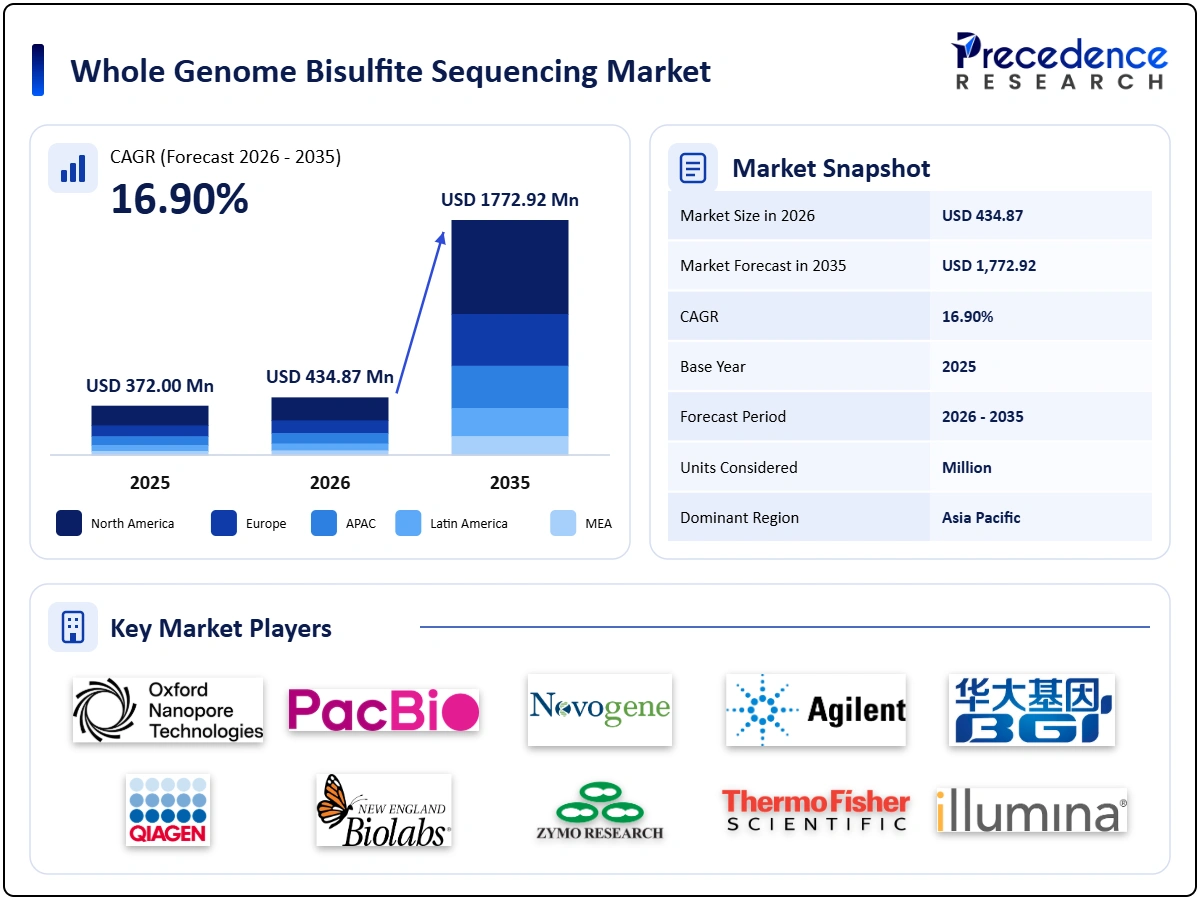
Payal Rabde, a Healthcare Industry Expert, highlights that the whole genome bisulfite sequencing market has reached USD 434.87 million in 2026 to USD 1,772.92 million by 2035, growing at a CAGR of 16.90%. Key whole genome bisulfite sequencing market companies shaping the market include Illumina, Thermo Fisher Scientific, Zymo Researchwhile major growth segments span product & service, workflow, application, end use and region.
Source: https://www.precedenceresearch.com/whole-genome-bisulfite-sequencing-market
 Get a Sample
 Report Description
 Key Takeaways
Market Size & Growth Outlook
- Market size in 2025: USD 372.00 million
- Estimated market size in 2026: USD 434.87 million
- Projected market size by 2035: USD 1,772.92 million
- CAGR (2026-2035): 16.90%
Regional Market Spotlight
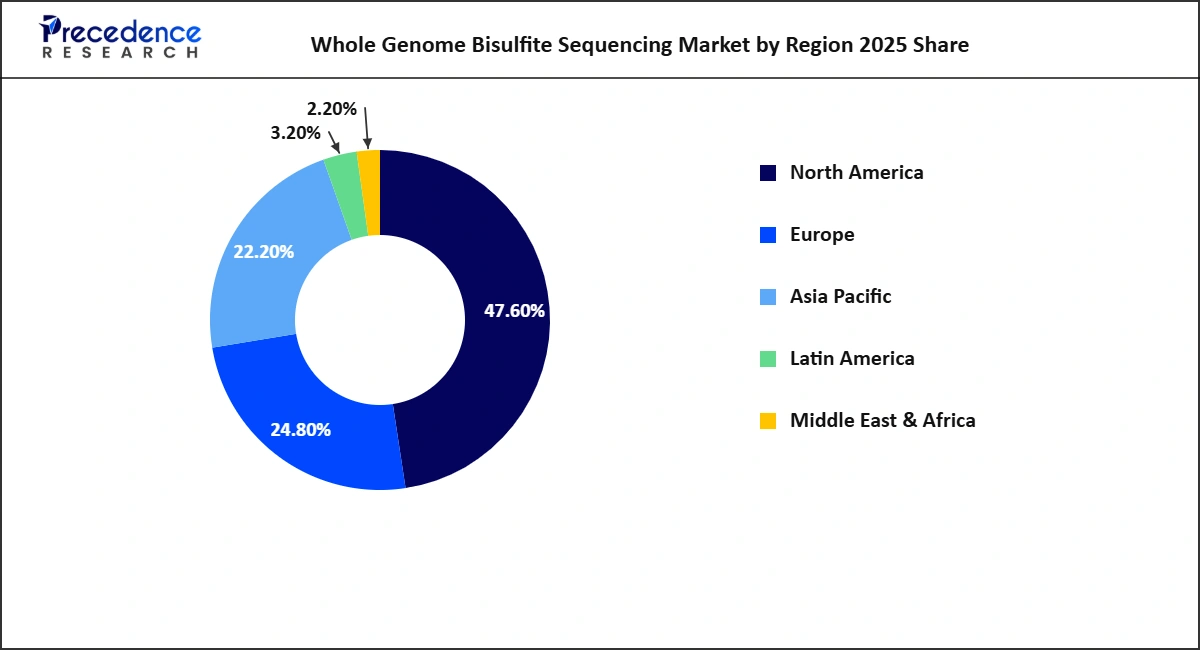
- North America led the market in 2025, with a 47.60% (USD 177.07 million) share.
- Europe accounted for 24.80% (USD 92.26 million) of the market in 2025.
- Asia Pacific accounted for 22.20% (USD 82.58 million) of the market in 2025. It is expected to be the fastest-growing region, with a CAGR of 18.61% from 2025 to 2035.
Segmental Spotlight
- By product and service, Kits & Reagents held a 58.80% (USD 218.74 million) share in 2025.
- By workflow, Sequencing accounted for 38.20% (USD 142.10 million) of the market in 2025.
- By application, Cancer Research & Liquid Biopsy Development held a 42.60% (USD 158.47 million) share in 2025.
- By end user, Academic & Research Institutes accounted for 50.40% (USD 187.49 million) of the market in 2025.
Whole Genome Bisulfite Sequencing Market Size and Forecast, 2025-2035 (USD Million)
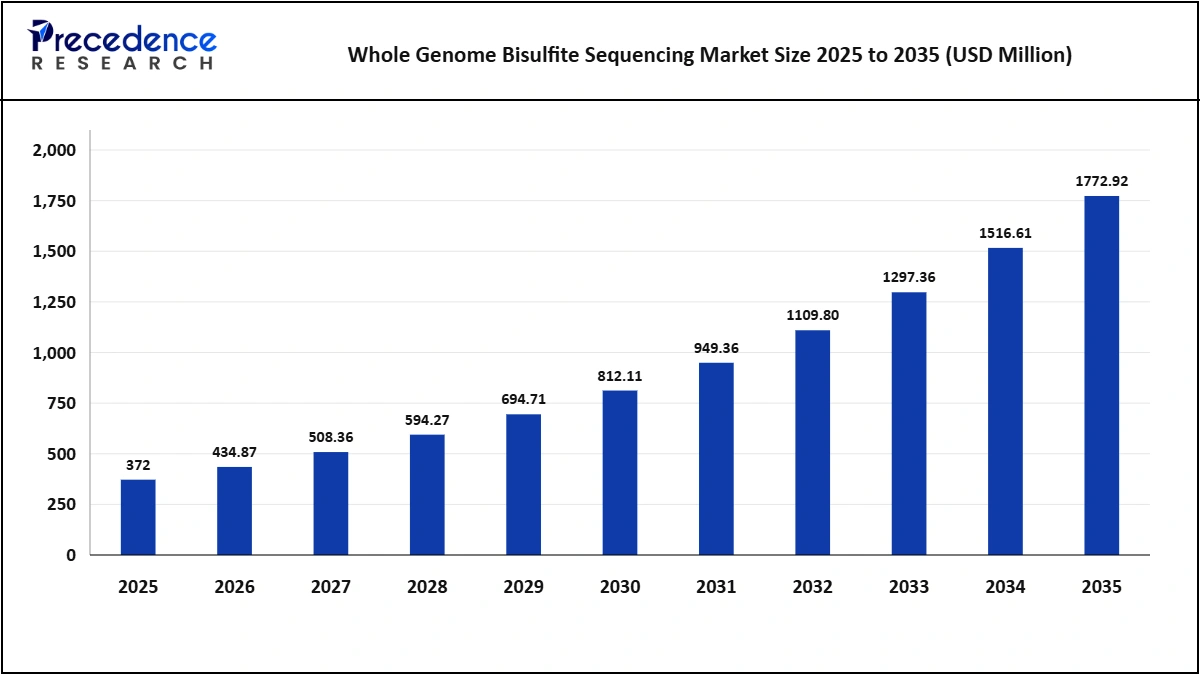
Note: 2025 is the base year; 2026-2035 values are forecasts.
Sources: Expert interviews, secondary sources, Precedence Research database and Precedence Research analysts.
The whole genome bisulfite sequencing market is expected to grow from USD 372.00 million in 2025 to USD 1,772.92 million by 2035. This growth is mainly driven by the need for researchers and test developers to study DNA methylation across the entire genome in detail. These studies help researchers understand how genes work, find cancer-related biomarkers and develop new tests based on methylation patterns.
Liquid biopsy and early cancer detection programmes are also increasing the need for whole-methylome sequencing. The market is expected to reach USD 812.11 million by 2030 and grow at a CAGR of 16.90% from 2026 to 2035.
- Analyst View: We estimated the market by looking at how many whole-methylome samples are sequenced each year across different regions and end users. We then applied the average costs of conversion kits, library preparation kits, sequencing consumables, sequencing services and data analysis. We also included the relevant share of instrument sales.
Our sample estimates take into account academic epigenetics research, pharmaceutical biomarker studies, liquid biopsy development and the capacity of sequencing service providers. We compared the total estimate with methylation-related revenue from kit manufacturers, sequencing platform suppliers and service providers. Some published market estimates appear to include a wider range of methylation and sequencing activities. For this reason, our base-year estimate is based on sample volumes and related costs. The expected growth reflects the rising use of methylation studies in cancer research and diagnostic development, starting from a relatively small market base.
Market Trends
- New conversion methods help reduce DNA damage during testing.
- Combined workflows are being developed to study genetic changes and DNA methylation together.
- DNA methylation is becoming more important in early cancer detection tests.
- Low-input kits help researchers study cell-free DNA samples.
- Long-read sequencing can detect DNA methylation directly.
- AI tools are helping researchers analyse methylation data more easily.
Drivers, Restraints and Opportunities
Driver
DNA methylation plays an important role in controlling how genes work. Changes in methylation are linked to cancer and many other diseases. Methylation patterns are also used to develop liquid biopsy and multi-cancer early detection tests. Lower sequencing costs are making whole-methylome studies more affordable. Large epigenome and population research projects are creating further demand. Pharmaceutical companies are also using methylation biomarkers during drug development.
Restraint
Bisulfite treatment can damage DNA and reduce the amount of useful data available for sequencing. Whole-genome methylation studies also need deep sequencing coverage, which increases costs. Analysing the results can be difficult and requires specialised skills. Enzymatic conversion and long-read sequencing methods are creating competition for traditional bisulfite workflows. Clinical use is also limited by the need for further validation and clear reimbursement pathways.
Opportunity
Methylation-based cancer screening tests could create strong demand from clinical laboratories. Combined genetic and epigenetic testing could expand the use of these methods in rare disease and cancer research. Cloud-based tools and AI analysis could make the technology easier to use. Growing investment in genomics across Asia could create further opportunities. Single-cell methylation methods may also open up new areas of research.
Market Segmentation: 2025 Share and Value
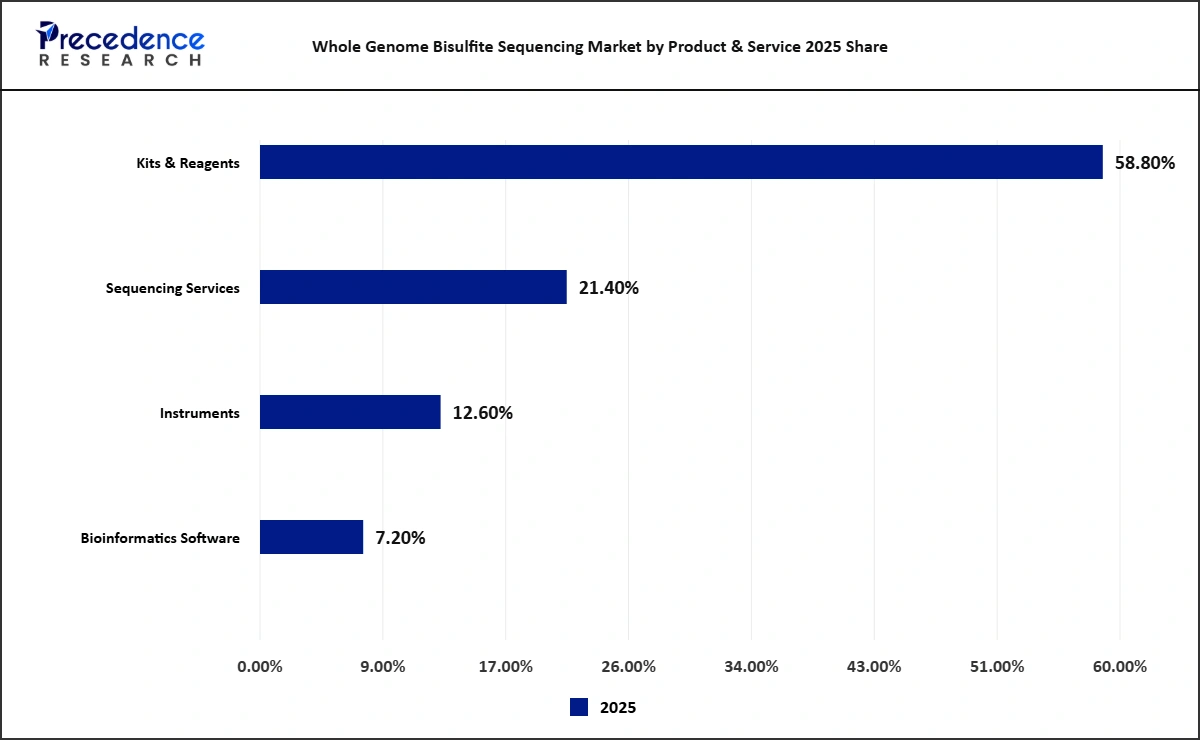
Whole Genome Bisulfite Sequencing Market by Product & Service 2025 Share
Note: 2025 is the base year.
Sources: Expert interviews, secondary sources, Precedence Research database and Precedence Research analysts.
Kits and reagents accounted for 58.80% (USD 218.74 million) of the market in 2025. This is because every methylome experiment requires conversion chemicals, library preparation reagents and sequencing consumables. These materials are used repeatedly, creating regular sales for suppliers.
New kits that require less DNA and cause less damage are also allowing researchers to work with more types of samples, including cell-free DNA. Sequencing services accounted for 21.40% (USD 79.61 million) of the market. These services are useful for laboratories that do not have their own high-output sequencing systems.
Instruments accounted for 12.60% (USD 46.87 million), while bioinformatics software held a 7.20% (USD 26.78 million) share. Bioinformatics software is the fastest-growing product category as methylation data becomes more complex and researchers need better tools to identify and analyse methylation patterns.
Whole Genome Bisulfite Sequencing Market by Workflow 2025 Share & Size
| Segments | 2025 Share | 2025 Market Value |
| Sample Preparation & Conversion | 22.40% | USD 83.33 million |
| Library Preparation & Amplification | 24.60% | USD 91.51 million |
| Sequencing | 38.20% | USD 142.10 million |
| Data Analysis & Interpretation | 14.80% | USD 55.06 million |
Note: 2025 is the base year.
Sources: Expert interviews, secondary sources, Precedence Research database and Precedence Research analysts.
Sequencing accounted for the largest workflow share in 2025, at 38.20% (USD 142.10 million). This is because whole-methylome studies need enough sequencing data to cover the entire genome in detail, usually using high-output sequencing systems.
Library preparation and amplification accounted for 24.60% (USD 91.51 million). Sample preparation and conversion held a 22.40% (USD 83.33 million) share. Data analysis and interpretation accounted for 14.80% (USD 55.06 million) and was the fastest-growing workflow step.
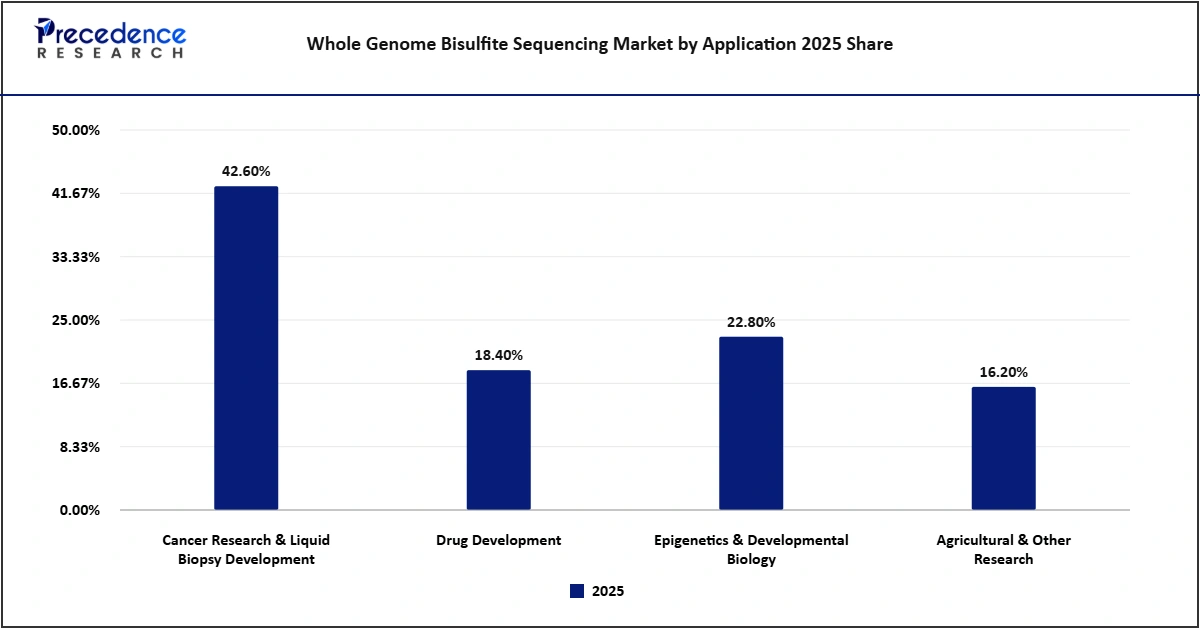
Whole Genome Bisulfite Sequencing Market by Application 2025 Share
Note: 2025 is the base year.
Sources: Expert interviews, secondary sources, Precedence Research database and Precedence Research analysts.
Cancer research and liquid biopsy development accounted for 42.60% (USD 158.47 million) of the market in 2025. This is because DNA methylation patterns can provide useful information about cancer and are used in many multi-cancer early detection tests. This is also the fastest-growing application area.
Epigenetics and developmental biology accounted for 22.80% (USD 84.82 million) of the market. Drug development held an 18.40% (USD 68.45 million) share, while agricultural and other research accounted for 16.20% (USD 60.26 million).
Whole Genome Bisulfite Sequencing Market by End User 2025 Share & Size
| Segments | 2025 Share | 2025 Market Value |
| Academic & Research Institutes | 50.40% | USD 187.49 million |
| Pharmaceutical & Biotechnology Companies | 31.20% | USD 116.06 million |
| Clinical Laboratories | 10.80% | USD 40.18 million |
| Contract Research Organizations | 7.60% | USD 28.27 million |
Note: 2025 is the base year.
Sources: Expert interviews, secondary sources, Precedence Research database and Precedence Research analysts.
Academic and research institutes accounted for 50.40% (USD 187.49 million) of the market in 2025. Pharmaceutical and biotechnology companies held 31.20% (USD 116.06 million), while clinical laboratories accounted for 10.80% (USD 40.18 million). Contract research organisations made up the remaining 7.60% (USD 28.27 million).
Clinical laboratories are the fastest-growing end-user group as methylation-based tests move closer to wider clinical use.
- Analyst View: We estimated each segment by matching sample volumes and costs with the relevant products, workflow steps, applications and end users. We also used revenue information from suppliers and service providers. Kits lead the market because they are needed for each experiment, while cancer research leads because of growing liquid biopsy development. We expect software, data analysis and clinical laboratories to account for a larger share of the market over time.
Regional Analysis
Whole Genome Bisulfite Sequencing Market by Region 2025 Share
| Region | 2025 Share | 2025 Market Value |
| North America | 47.60% | USD 177.07 million |
| Europe | 24.80% | USD 92.26 million |
| Asia Pacific | 22.20% | USD 82.58 million |
| Latin America | 3.20% | USD 11.90 million |
| Middle East & Africa | 2.20% | USD 8.18 million |
Note: 2025 is the base year.
Sources: Expert interviews, secondary sources, Precedence Research database and Precedence Research analysts.
North America accounted for 47.60% (USD 177.07 million) of the market in 2025. Its leading position is supported by strong research funding, major cancer centres and the presence of companies developing cancer detection tests based on DNA methylation.
Europe accounted for 24.80% (USD 92.26 million) of the market. Demand is supported by epigenome research projects, well-established academic genomics centres and growing biotechnology activity.
Asia Pacific held a 22.20% (USD 82.58 million) share and is the fastest-growing region. Growth is supported by large sequencing service providers in China, increasing genomics research in Japan and South Korea, and growing investment in cancer research.
Latin America accounted for 3.20% (USD 11.90 million) of the market, while the Middle East and Africa held a 2.20% (USD 8.18 million) share. These are smaller markets, with demand mainly coming from academic and research activities.
North America
North America accounted for 47.60% (USD 177.07 million) of the market in 2025. Major research institutes and cancer centres use whole-methylome sequencing in their studies. Several companies developing methylation-based multi-cancer early detection tests are also based in the United States. Kit and sequencing platform suppliers introduced new methylation testing workflows in 2025.
Europe
Europe accounted for 24.80% (USD 92.26 million) of the market in 2025. European epigenome research projects and academic genomics centres support demand for these technologies. The United Kingdom, Germany and the Netherlands are major markets. Biotechnology companies in the region also use methylation biomarkers in drug development.
Asia Pacific
Asia Pacific accounted for 22.20% (USD 82.58 million) of the market in 2025 and is the fastest-growing region. Chinese sequencing service providers such as BGI and Novogene offer whole-methylome sequencing services on a large scale. Japan and South Korea are investing in cancer genomics, while Singapore is an important regional centre for research.
Latin America
Latin America accounted for 3.20% (USD 11.90 million) of the market in 2025. Academic research in Brazil and Mexico supports demand. Many research groups in the region use external service providers for sequencing work.
Middle East & Africa
The Middle East and Africa accounted for 2.20% (USD 8.18 million) of the market in 2025. Genome research programmes in Gulf countries are supporting epigenetics studies, while activity in other parts of the region remains limited.
Analyst View: We estimated regional market shares using sample volumes, costs and research spending in each region. North America leads because it has strong research funding and many companies developing diagnostic tests. We expect Asia Pacific to grow the fastest because sequencing capacity and research investment are expanding quickly.
Top 10 Companies in the Whole Genome Bisulfite Sequencing Market
| Rank | Company Name | Market-Specific Revenue (USD Million) | 2025 Share | Key Products / Business | Headquarters |
| 1 | Illumina | 118.00 | 31.72% | NovaSeq systems, methylation kits and 5-base solution | United States |
| 2 | Thermo Fisher Scientific | 28.00 | 7.53% | Bisulfite conversion and methylation reagents | United States |
| 3 | Zymo Research | 22.00 | 5.91% | EZ DNA Methylation kits and Pico Methyl-Seq | United States |
| 4 | New England Biolabs | 20.00 | 5.38% | NEBNext EM-seq kits | United States |
| 5 | QIAGEN | 16.00 | 4.30% | EpiTect bisulfite kits | Netherlands |
| 6 | BGI Genomics | 16.00 | 4.30% | Whole-methylome sequencing services and platforms | China |
| 7 | Agilent Technologies | 12.00 | 3.23% | SureSelect Methyl-Seq | United States |
| 8 | Novogene | 10.00 | 2.69% | Methylation sequencing services | China |
| 9 | Pacific Biosciences | 8.00 | 2.15% | Long-read sequencing with methylation detection | United States |
| 10 | Oxford Nanopore Technologies | 6.00 | 1.61% | Nanopore sequencing with native methylation calling | United Kingdom |
Note: Company revenues and shares are 2025 estimates.
Sources: Company press releases, expert interviews, secondary sources, Precedence Research database and Precedence Research analysts.
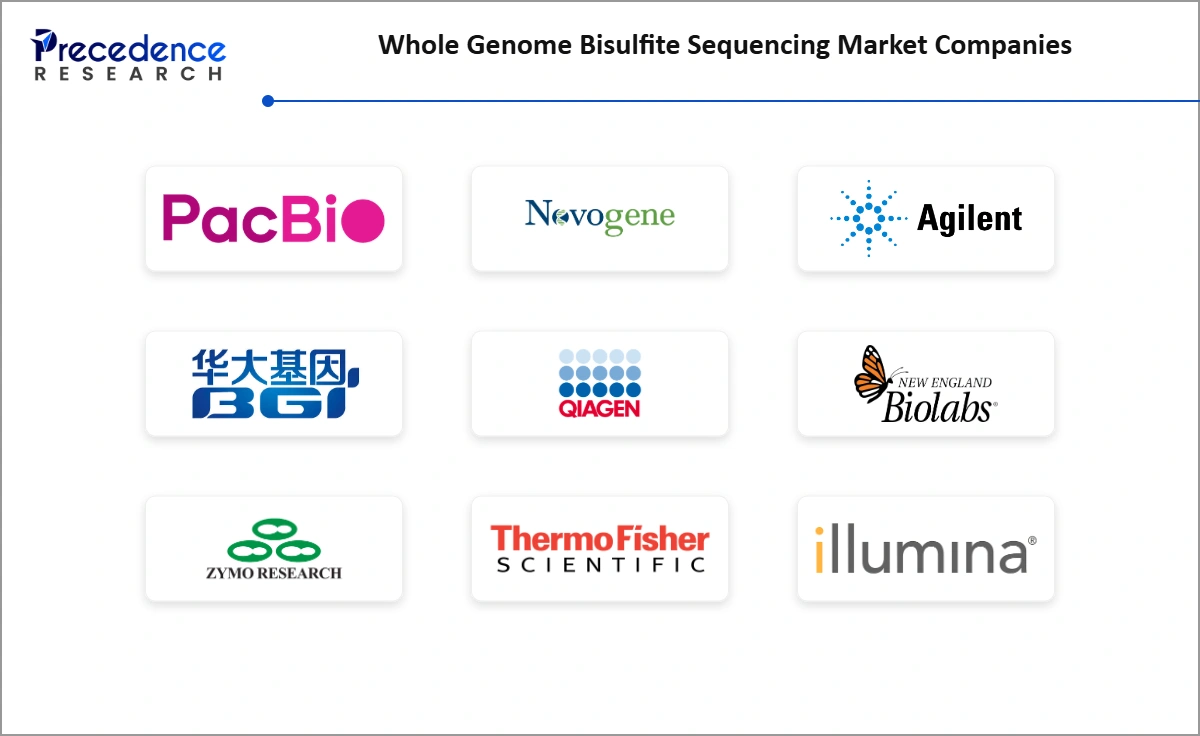
Illumina led the whole genome bisulfite sequencing market in 2025, with an estimated 31.72% (USD 118.00 million) share of revenue. Thermo Fisher Scientific ranked second with 7.53% (USD 28.00 million), followed by Zymo Research with 5.91% (USD 22.00 million).
Illumina holds a leading position because many whole-methylome libraries are sequenced using its NovaSeq and NextSeq systems. In October 2025, the company launched its 5-base solution, which can detect genetic variants and DNA methylation in a single workflow.
Thermo Fisher Scientific and Zymo Research are major suppliers of bisulfite conversion and methylation library kits. Zymo's EZ DNA Methylation kits are widely used in research. New England Biolabs competes with its enzymatic EM-seq kits, which were updated in January 2025. QIAGEN and Agilent supply conversion and target enrichment products. BGI and Novogene provide large-scale sequencing services, while Pacific Biosciences and Oxford Nanopore offer long-read sequencing methods that can detect methylation directly.
The top 10 companies accounted for an estimated 68.82% (USD 256.00 million) of market revenue in 2025. The remaining 31.18% (USD 116.00 million) came from sequencing service providers, bioinformatics companies and regional kit manufacturers.
The market is led by companies that supply sequencing platforms and reagents. Competition mainly depends on how well conversion methods work, how much DNA damage they cause, how much sample material they need, how evenly they cover the genome, the cost per sample and the quality of data analysis software.
Enzymatic conversion, combined genetic and epigenetic testing, and long-read methods that detect methylation directly are creating alternatives to traditional bisulfite methods. At the same time, demand for whole-methylome research continues to grow.
Recent Developments
- January 2025: New England Biolabs launched EM-seq v2, an updated methylation kit that does not use bisulfite treatment. The kit supports DNA inputs starting at 100 picograms and offers a shorter workflow. (Source: neb.com)
- October 2025: Illumina launched its 5-base solution, including whole-genome and enrichment kits that can detect genetic variants and DNA methylation from one sample using NovaSeq and NextSeq 2000 systems. (Source: illumina.com)
Whole Genome Bisulfite Sequencing Market Segments
By Product & Service
- Kits & Reagents
- Sequencing Services
- Instruments
- Bioinformatics Software
By Workflow
- Sample Preparation & Conversion
- Library Preparation & Amplification
- Sequencing
- Data Analysis & Interpretation
By Application
- Cancer Research & Liquid Biopsy Development
- Drug Development
- Epigenetics & Developmental Biology
- Agricultural & Other Research
By End User
- Academic & Research Institutes
- Pharmaceutical & Biotechnology Companies
- Clinical Laboratories
- Contract Research Organizations
By Region
- North America (U.S., Canada, Mexico)
- Europe (Germany, U.K., France, Italy, Spain, Rest of Europe)
- Asia Pacific (China, Japan, India, South Korea, Taiwan, Rest of Asia Pacific)
- Latin America (Brazil, Argentina, Rest of Latin America)
- Middle East & Africa (GCC, South Africa, Rest of MEA)
Research Methodology
This report defines the whole genome bisulfite sequencing market as the market for bisulfite and related whole-methylome conversion kits, library preparation reagents, sequencing instruments and consumables, sequencing services and software worldwide.
We estimated the 2025 market size from the bottom up by calculating the number of whole-methylome samples sequenced by each end-user group and region, along with the average cost per sample. We then compared this estimate with methylation-related revenue from kit manufacturers, sequencing platform suppliers and service providers.
We divided the market among products and services, workflow steps, applications, end users and regions based on demand and estimated spending. We checked the main estimates against company disclosures, regulatory and industry data, and published estimates from other sources. Inputs that could not be matched or reconciled were excluded.
All segment, regional and company figures were aligned with the same 2025 base year. We then prepared the 2026–2035 forecast using a constant CAGR from the 2025 base, and recalculated and checked the forecast values.
Analyst View: Overall Market
The whole genome bisulfite sequencing market is growing quickly as DNA methylation becomes more important in cancer research and the development of diagnostic tests. Our estimate links market demand to sample volumes and the cost of each sample. This means future growth will depend on research funding, liquid biopsy development and sequencing costs.
The biggest growth opportunity comes from the increasing use of methylation-based tests in clinical settings. However, high costs and competition from other methylation testing methods remain important challenges.
Sources and References
- New England Biolabs. "New England Biolabs launches EM-seq v2". 2025-01-06. EM-seq v2 launch. (Source: neb.com)
- Nasdaq. "Illumina fuels multiomic discovery with launch of 5-base solution". 2025-10-15. Illumina 5-base launch. (Source: nasdaq.com)
- Illumina. "An introduction to the Illumina 5-base solution". 2025-08-08. 5-base chemistry. (Source: illumina.com)
For inquiries regarding discounts, bulk purchases, or customization requests, please contact us at sales@precedenceresearch.com
Frequently Asked Questions





Ask For Sample
No cookie-cutter, only authentic analysis – take the 1st step to become a Precedence Research client
 Get a Sample



 sales@precedenceresearch.com
 Schedule a Meeting
