



Agrochemicals Market Size, Key Companies, Company Production Capacity, Manufacturing Efficiency, Capacity Utilization, Raw Material Consumption, Cost Structure, Export Trends, Company Expansion Strategies, and Competitive Landscape
Agrochemicals Market (By Product: Fertilizers, Crop Protection Chemicals, Plant Growth Regulators, Others; By Application: Cereals & Grains, Oilseeds & Pulses, Fruits & Vegetables, Others) - Global Industry Analysis, Size, Trends, Leading Companies, Regional Outlook, and Forecast 2026 to 2035
Source: https://www.precedenceresearch.com/agrochemicals-market
 Get a Sample
 Table Of Content


What is Agrochemicals Market Size?
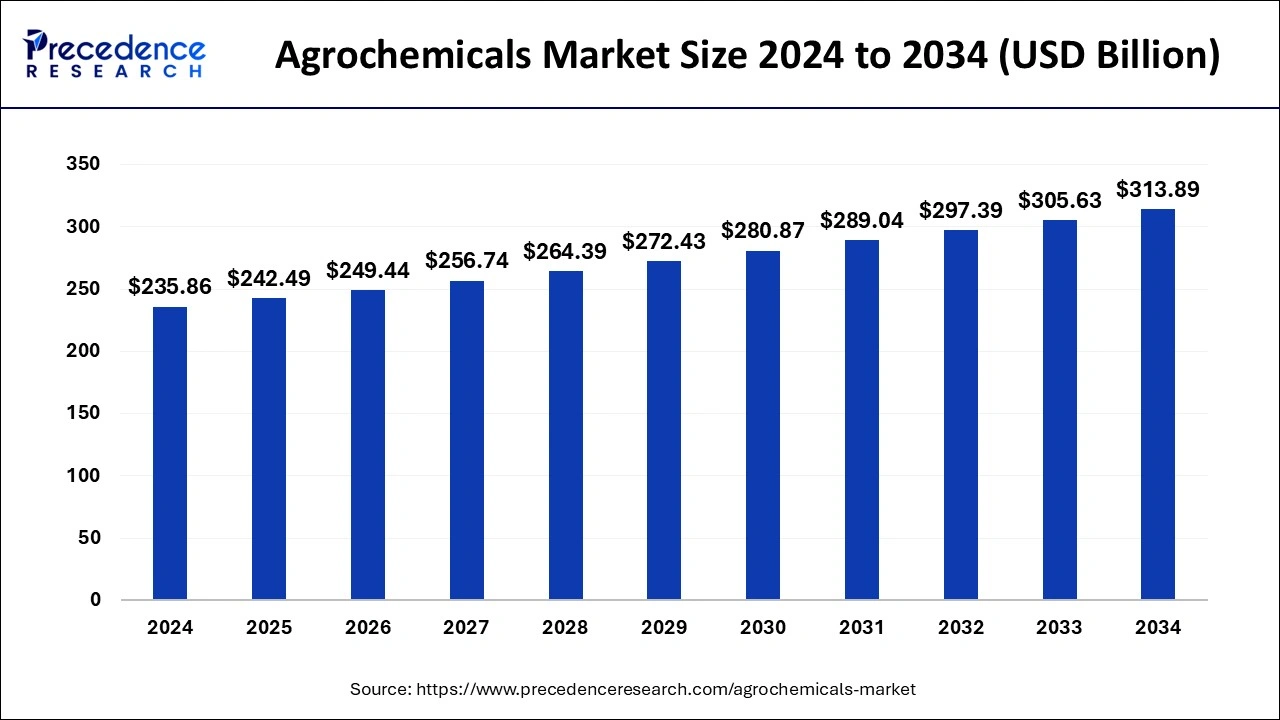
The global agrochemicals market size is calculated at USD 249.44 billion in 2026 and is predicted to reach around USD 322.18 billion by 2035, expanding at a CAGR of 2.90% from 2026 to 2035. The demand for agrochemicals is growing to secure harvests from disturbing pest losses, grow crop yields, and substitute important soil nutrients. With the globe's population growing and cultivable land shrinking, farmers totally depend on such chemical solutions to ensure worldwide food security.
Market Highlights
- Asia Pacific agrochemicals market has captured a revenue share of around 29.18% in 2025.
- By Products, the fertilizers segment has generated a revenue share of 68% in 2025.
- By Application, the cereals and grains segment has generated a revenue share of over 50% in 2025.
- The oilseeds & pulses application segment has held a revenue share of 19% in 2025.
Agrochemicals Market Growth Factors
Agrochemicals are chemical or biological compositions that are created to increase the quality and productivity of crops. The insecticides and fertilizers are the two types of agrochemicals. The pesticides protect crops by controlling, killing, and repelling pests and weeds that can harm them. The fertilizers improve crop quality by providing essential nutrients to the crop and soil, on the other hand pesticides protect crops by controlling, killing, and repelling weeds and pests that can harm them. Due to the current global population situation, increasing agricultural output on existing agricultural land is critical to feeding the world's population. As a result, agrochemicals play a very vital role in the agricultural business, supporting farmers in improving both the quality and quantity of their crops.
Agrochemicals are highly used in agricultural activities. It helps to enhance productivity of agriculture business. That's the reason; agrochemicals have become one of the key components in agriculture. The constant research and development activities are being carried out for producing high quality of agrochemicals in the market. The consumption of food is highly dependable on agriculture. As a result, government agencies pay more attention towards agriculture business. Thus, all these above-mentioned factors are driving the growth of the global agrochemicals market during the forecast period.
The expanding global population combined with rising propensity, is causing a shift in purchasing habits. Not only must supply be increased to satisfy demand, but also the nutritional demands of an increasingly affluent population must be satisfied. The wastage results from diminishing agricultural land and crop losses owing to pest infestations, posing a serious threat to food and nutritional security. The agrochemicals sector is a vital agriculture support sector that helps farmers produces more quantity. These elements are assisting the agrochemicals market's expansion.
Contribution of Artificial Intelligence in Agrochemicals Market
Advanced generative models such as IBM RXN for AlphaFold and Chemistry are now being utilized to structure completely new molecules that are smooth, biodegradable, and less toxic. Such systems can effectively screen many chemical structures in minutes, drastically lessening the research and development cycle. Furthermore, AI is also assisting in revealing the capability of biofertilizers, specifically nitrogen-fixing microbes. By tracking large soil data, probiotic strains have been personalized to various soil and crop types.
Agrochemicals Market Trends:
- The growth of Eco-Friendly and Bio-Based Agrochemical Pesticides: One of the most promising trends in agrochemical pesticides is the move towards organic and bio-based choices. Due to rising user demand for residue-free products and strict eco-friendly regulations, the sector is shifting far from regular synthetic chemicals in terms of sustainable options.
- Regulatory Updates and the Encouragement for Secure Pesticide Rules: The regulatory scenario is growing quickly, which encourages agrochemical pesticides globally. In the United States, Georgia and North Dakota have enacted current pesticide laws, but Vermont is debating current approval for pesticides such as PFAS and is checking Isocycloseram. Worldwide, debates around molecules such as glyphosate and chlorpyrifos have continued, with limitations of security studies that are emphasized on demand for transparent research.
- Addressing Weed Resistance with Current Herbicide Pattern of Action: Weed resistance has been a long-time issue, as there are many issues in agriculture, but the current year has brought hope by revealing novel herbicide action, as primary herbicides are closer to years. Companies are revealing herbicides that focus on resistant weeds such as waterhemp and Palmer amaranth, which serve farmers with the latest machines to manage crop health.
- Eco-Friendly Effects and the Demand for Sustainable Options: The move towards regenerative agriculture solves such issues that concentrate on lowering the synthetic inputs. Bio-based agrochemical pesticides serve as a direction forward, which assist climate-intelligent rules that protect soil health.
Market Scope
| Report Coverage | Details |
| Market Size in 2025 | USD 242.49 Billion |
| Market Size in 2026 | USD 249.44 Billion |
| Market Size by 2035 | USD 322.18 Billion |
| Growth Rate from 2026 to 2035 | CAGR of 2.88% |
| Largest Market | Asia Pacific |
| Fastest Growing Market | North America |
| Base Year | 2025 |
| Forecast Period | 2026 to 2035 |
| Segments Covered | Product, and Application, and region |
| Regions Covered | North America, Europe, Asia-Pacific, Latin America, and Middle East & Africa |
The high population and associated growth in food consumption, soil pollution, arable land, and increased consumer knowledge of the advantages of the agrochemicals industry. On the other hand, the potential danger of synthetic pesticides like atrazine herbicide could stymie the industry growth. When agrochemicals are used in larger concentrations, they pollute surface water and have a negative impact on the ecosystem. As a result, the manufacturing of bio-based fertilizers and pesticides has opened up a lot of new market prospects for key market players for agrochemicals.
The food consumption has increased globally as a result of high population growth, driving up demand for agricultural products. This has resulted in a rise in the usage of agricultural chemicals to improve crop productivity and agricultural development. As a result, the usage of agrochemicals such as pesticides and fertilizers has become a need in order to fulfill rising food demand. This, in turn, is increasing global demand for new agricultural technologies and developments. The agrochemicals are essential for improving crop quality and output.
The growing population necessitated increased crop output. Apart from that, water and land scarcity forces people to employ fertilizers and pesticides to assist them grow many crops in specific spaces, which drives the agrochemicals market growth during the forecast period. The increasing use of agrochemicals in developing countries boosts the expansion of the agrochemicals market. The agriculture's new technologies may boost growth of the market. Farmers must employ such agrochemicals like pesticides and fertilizers in farming to boost land production and maintain soil quality as a result of the rising effect of urbanization.
Increasing environmental risks from pesticides and fertilizers could limit the agrochemicals market's growth. The chemical fertilizer utilization is being hampered by rising demand for organic food products and increased use of biofertilizers, which is restraining market development.
Segments Insights
Products Insights
In 2025, the fertilizers segment dominated the agrochemicals market with highest revenue share. Fertilizers are commonly utilized to boost crop output in a short amount of time. The growing global food demand around the world is putting additional strain on agricultural land, hence farmers are using more fertilizers to boost the productivity and yield of various crops.
The crop protection chemicals segment, on the other hand, is predicted to develop at the quickest rate in the future years. The fungicides, insecticides, herbicides, and other pesticides such as rodenticides and bactericides are examples of crop protection chemicals. In the agriculture industry, herbicides are widely used as pesticides.
Application Insights
The cereals and grains segment accounted largest revenue share in 2025. Cereals and grains are the most widely consumed crops, especially in Asian countries. Furthermore, this segment covers a large portion of the world's agricultural land. The use of fertilizers in the production of cereals and grains has almost become mandatory.
The fruits and vegetables segment is the fastest-growing segment of the agrochemicals market in 2025. This is attributed to the surge in demand for fresh vegetables and fruits around the world as people become more health conscious.
Regional Insights
Asia Pacific Agrochemicals Market Size and Growth 2026 to 2035
The Asia Pacific agrochemicals market size is exhibited at USD 72.75 billion in 2025 and is projected to be worth around USD 98.23 billion by 2035, growing at a CAGR of 3.05% from 2026 to 2035
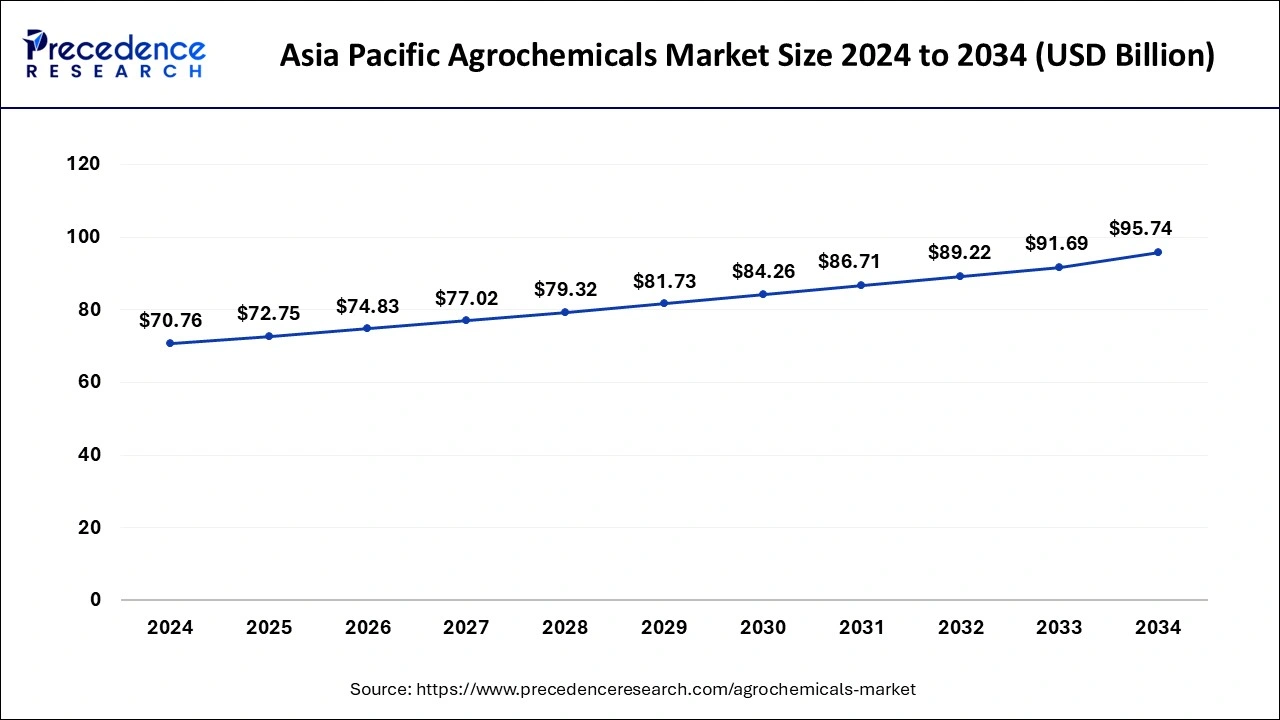
Asia-Pacific region hit the largest revenue share of around 29.18% in 2024. The Asia-Pacific region is an important market for agrochemicals because it is the world's largest and most populous area.
India Market Analysis
India leads in the Asia Pacific market, with strong demand from its smart agrochemicals that have become strongly powerful when they are being used with accuracy and digital farming machines. AI-based advisory platforms and mobile apps can direct farmers on correct doses, pest identification, and safety precautions in simple local languages. Furthermore, satellite images and drones can display spaces of the field that are infected or stressed, so that chemicals are sprinkled only on patches.
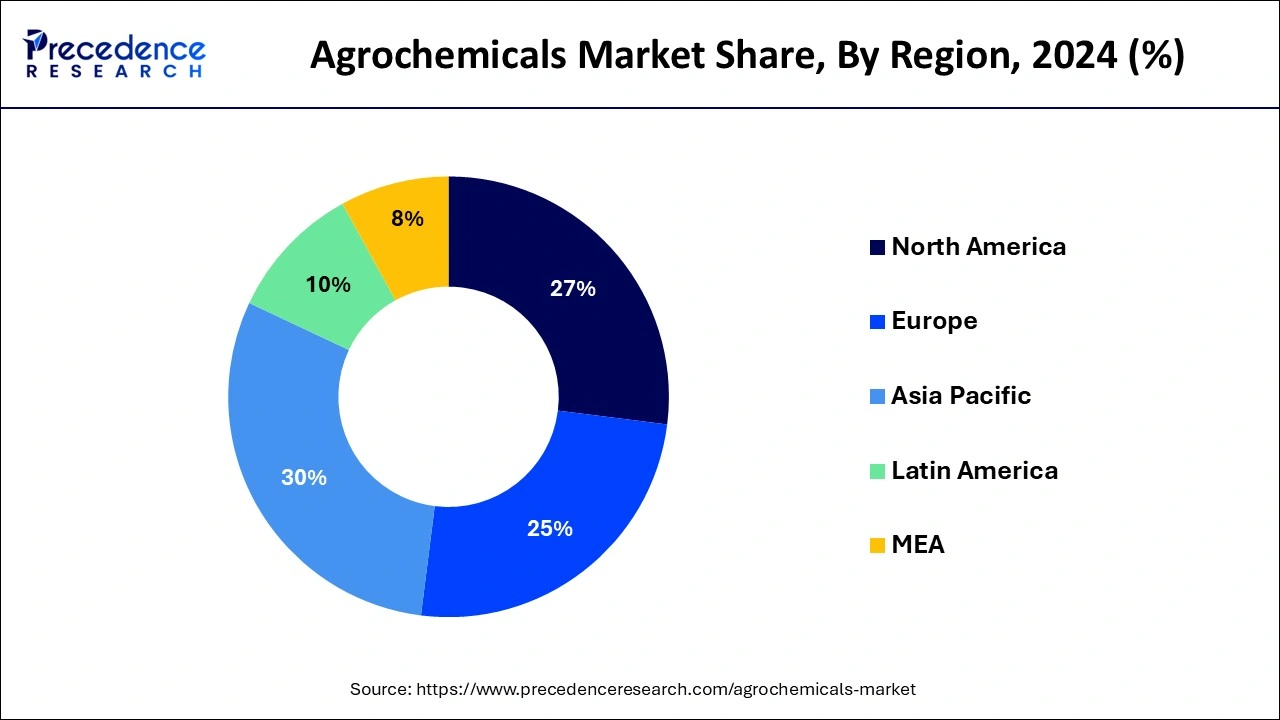
North America will hit a notable revenue share in 2024. The region's overall agricultural land is declining as a result of rising population and fast urbanization and industrialization. As a result, farmers turn to agrochemicals to boost productivity and quality.
Europe Held a 25% Market Share in 2025
Pesticide sales in Europe have gone down to 8% in 2024 as compared to the last year, which reached 316.000 tones, as per the current Eurostat data. The newest data has rejected the Commission's claim, which is a 61% reduction in terms of pesticide application, a figure dependent on a flawed indicator. The EU is far from the aim of suddenly lowering farmers' reliance on pesticides.
Germany Market Analysis
Germany is at the forefront of the European agrochemicals market, driven by growing advanced analytics, real-time data collection and artificial intelligence. Such inventive methodology enables an in-depth understanding of industry dynamics, growing trends, and user choices, which allows stakeholders to make informed decisions. By using scenario tracking and predictive modelling, brands can identify potential issues and possibilities in the industry, which ultimately helps design methods that match rising market demands.
How is the Opportunistic Rise of the Middle East & Africa in the Market?
The Middle East & Africa (MEA) held nearly 8% share of the agrochemicals market in 2025 and is expected to grow in the coming years. This growth is supported by the South African Ministry of Forestry, Agriculture, Forestry and Fisheries, which is the latest one, and this region has planted areas and manufacturing for the current year, with a total planted space for main summer crops.
UAE Market Analysis
In the United Arab Emirates, there is growing demand for pesticides because of users developed capability for purpose of subpar agricultural products. Smooth pest tracking procedures are necessary for the regions that are constantly growing the agricultural sector by ensuring maximum crop yield and health. In the United Arab Emirates, pesticides are essential for food protection to assist and satisfy this need. Strong regulations manage the application and import of pesticides in the United Arab Emirates to secure public health and the environment.
What Drives the Market Within Latin America?
Latin America held nearly a 10% share of the liquid crystal polymer market in 2025 and is projected to grow in the coming years, driven by commodity prices and agrochemical amounts that have stayed low by an historical rules, which have usually developed the weather conditions in which positives for industry are developed. Despite such growth, it is significantly due to constant pricing effects, the Agbi oInvestors are totally ready for crop prevention industry in South and Central America.
Brazil Market Analysis
In Latin America, Brazil are the biggest chemical industry ,that has topped the industry in the region. Abiquim, which displays about 750 brands, producing more than 1500 chemical items, has kept its different industrial potential and its high importance in delivering chemical items for different segments, such as food, agriculture, petrochemicals, and cosmetics, which all support around two million jobs.
Competitive Landscape
The agrochemicals market is consolidated and excessively competitive, being dominated by main players such as Bayer Crop Science, Syngenta, Monsanto, DuPont, along with growing companies such as Nufarm, Adama, and FMC. Syngenta and Bayer Crop Science have topped with sharp industry shares, which is supported by various product profiles that count insecticides, herbicides, and fungicides. From a financial point of view, such companies generate main revenues driven by agricultural demand,with a strong focus on research & development to make eco-friendly products.
Agrochemicals Market Companies
- BASF SE
- Adama Agricultural Solutions Ltd.
- Arysta Lifesciences Corporation
- America Vanguard Corporation
- Jiangsu Yangnong Chemical Group Co. Ltd
- The Dow Chemical
- Sumitomo Chemical Co. Ltd
- Bayer Cropscience AG
- Nufarm Limited
Recent Developments
- In May 2026, Atul Limited has mainly developed its main position in the regular agrochemical industry by revealing three current tailored crop prevention solutions. This shift aligns with the company's long-term strategy to repurpose towards high-margin value-added items. (Source: https://www.sahi.com)
- In February 2026, Crop security major brand Godrej Agovet Limited stated that it has expanded its crop development and coverage for its product portfolio as part of a strategy to check growth in its respective crop protection business amid a long-term slowdown in the agrochemical sector. (Source: https://economictimes.indiatimes.com)
Key Developments
- Solvay and Anthea, a renowned specialty chemical manufacturer in India, formed a joint venture called ‘CAT`Asynth Specialty Chemicals' in December 2019.
- Corteva Agriscience launched the Cerefit fungicide with a dual mode of action that targets leaf diseases, giving growers a higher output potential.
- Iblo technology, the latest fungicide innovation from Bayer Cropscience AG, was announced in September 2019. This method is based on the active component Isoflucypram, which belongs to a new subclass of succinate dehydrogenase inhibitors (SDHIs) that are highly valued.
- BASF SE increased its global pesticide offering in June 2018. Inscalis insecticide acquired registration in a number of key markets throughout the world.
- BASF SE declared in November 2016 that it would start a new fungicide production line at its Spain facility.
- In June 2018, Bayer AG completed the acquisition of Monsanto, a biotech crop protection and innovation chemical product manufacturer based in the U.S.
- Syngenta Group purchased one of the leading biological companies Valagro by their business unit Syngenta crop protection in October 2020.
- Sumitomo Chemical, a well-known chemical firm, announced the purchase of subsidiaries in April 2020.
The major agrochemicals market players conduct substantial research and development to develop agrochemicals with greater requirements. These compounds are subjected to lot of restrictions, including chemical registration, codes of practice, product laboratory evaluations, environmental health impact assessments, and limitations on storage, use, and transportation.
Segments Covered in the Report
By Product
- Fertilizers
- Nitrogenous
- Phosphatic
- Potassic
- Secondary Fertilizers (Calcium, Magnesium, and Sulfur Fertilizers)
- Others
- Crop Protection Chemicals
- Herbicides
- Insecticides
- Fungicides
- Others
- Plant Growth Regulators
- Others
By Application
- Cereals & Grains
- Oilseeds & Pulses
- Fruits & Vegetables
- Others
By Region
- North America
- Europe
- Asia-Pacific
- Latin America
- Middle East and Africa
For inquiries regarding discounts, bulk purchases, or customization requests, please contact us at sales@precedenceresearch.com
Frequently Asked Questions
Tags





Ask For Sample
No cookie-cutter, only authentic analysis – take the 1st step to become a Precedence Research client
 Get a Sample




 sales@precedenceresearch.com
 Schedule a Meeting
