



Business Process Management Market Size, Key Companies, Market Share, Cloud Adoption, Automation Deployment, Enterprise Adoption, Technology Investment, Competitive Positioning, and Market Outlook
Business Process Management Market (By Solution: Automation, Process Modelling, Content & Document Management, Monitoring & Optimization, Content & Document Management, Integration, Others; By Application: IT, BFSI, Manufacturing, Retail, Government & Defense, Healthcare, Others; By Deployment: On-premise, Cloud; By End-User: Large Enterprise, SMEs;) - Global Industry Analysis, Size, Trends, Leading Companies, Regional Outlook, and Forecast 2026 to 2035
Source: https://www.precedenceresearch.com/business-process-management-market
 Get a Sample
 Table Of Content


What is the Business Process Management Market Size?
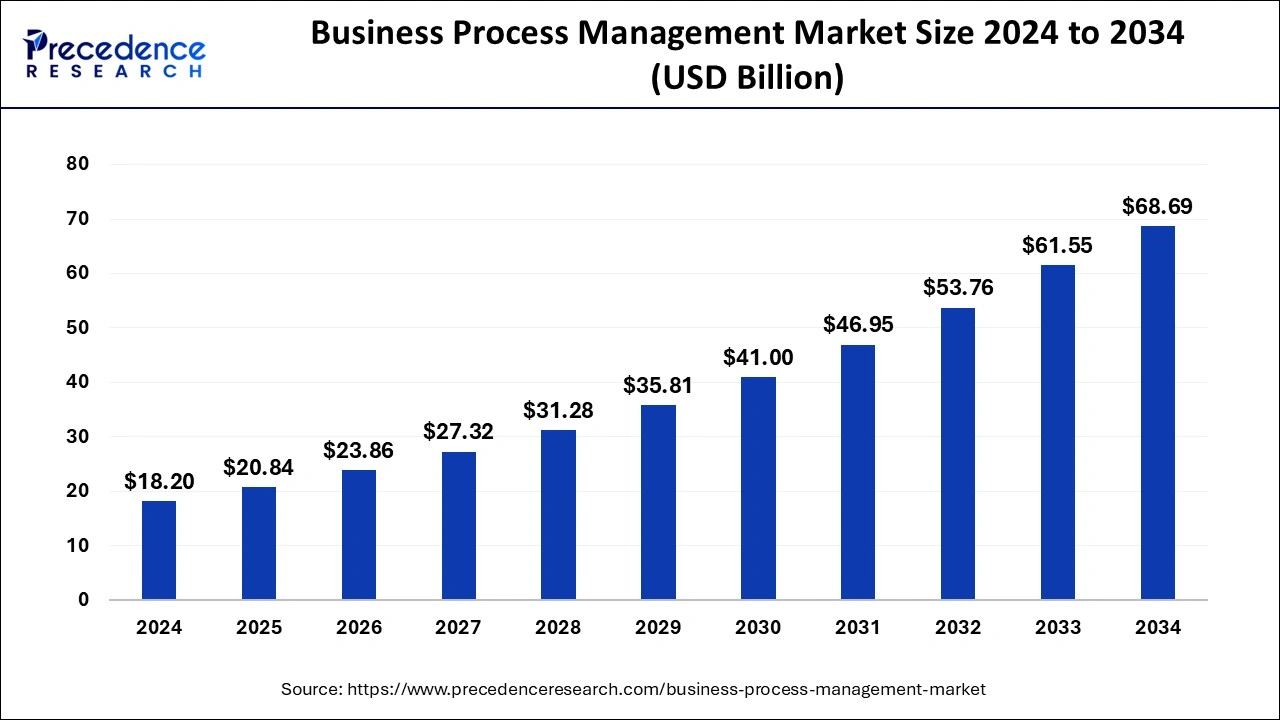
The global business process management market size is accounted for USD 20.84 billion in 2025, and is expected to reach around USD 76.26 billion by 2035, expanding at a CAGR of 13.85% from 2026 to 2035. Business process management suites are able to coordinate systems, people, materials, and information to achieve business outcomes.
Market Highlights
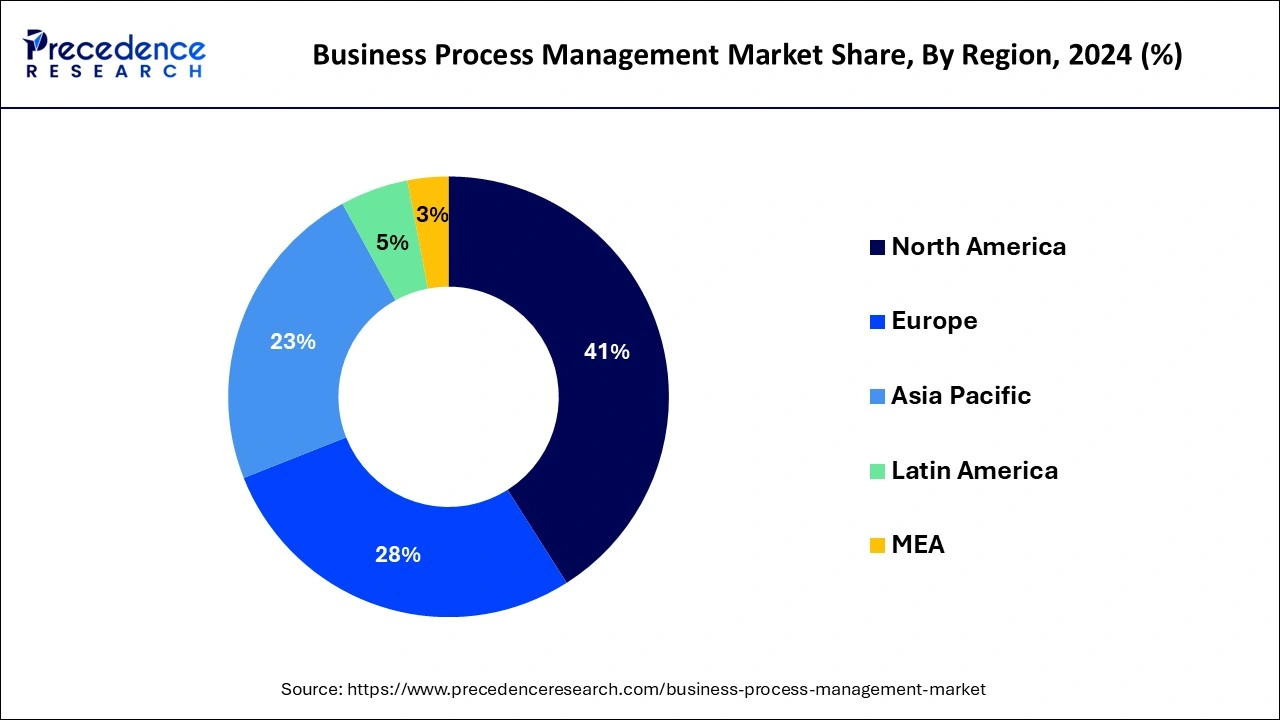
- The North American region captured more than 41% of the revenue share in 2025.
- the automation solution segment is projected to grow at a noteworthy CAGR of 21.6% from 2026 to 2035
- The IT segment holds the major market share and is predicted to grow at a CAGR of 21.8% from 2026 to 2035
- The cloud-based deployment segment contributed more than 64% of revenue share in 2025.
- the SME end-user segment is predicted to grow the largest growth between 2026 to 2035
Market Overview
Business process management (BPN) is an area of operation management that focuses on enhancing corporate performance through the upkeep, administration, and optimization of business processes. Supporting organizational goals entails design, automation, modeling, execution, control, process optimization, measurement, and others.
The market for business process management (BPM) includes research on the software and services used to carry out the tasks above with maximum effectiveness and output. Most businesses typically utilize on-premise BPM, although recent developments in cloud computing have raised interest in software-as-a-service (SaaS) on-demand options.
The need to adhere to strict government regulations and policies, increase return on investments (RoI) for organizations and growing demand for improved efficiency and process automation are all factors driving the expected rapid growth of the worldwide business process management (BPM) market shortly.
Additionally, improvements in Big Data and cloud computing that increased BPM software efficiency and IT spending will likely provide a measurable gain for the worldwide BPM market. However, the market expansion is hampered by middle management's reluctance to implement BPM solutions and end users' misunderstanding of the advantages of these solutions.
One of the key factors boosting the BPM market's expansion is a rise in the use of cloud-based BPM software. When it comes to providing a flexible IT environment, cloud-based BPM is far more efficient than traditional BPM. BPM solutions, which are offered as SaaS in the cloud, don't need to be installed or maintained and offer complete software functionality. Low code functionality, which also propelled the adoption of the cloud-based BPM market by deployment, helps SaaS-based BPM platforms in enhancing business units.
BPM software is enhanced by incorporating cutting-edge technology like artificial intelligence and machine learning, ensuring compliance and security. Businesses offer BPM software that incorporates ML and AI technology, like Infosys Limited, SAP SE, BP Logix, Inc., etc. RPA (Robotic Process Automation) is a crucial technology that has made its way into BPM software; this combination enables staff reorganization and job acceleration, among other things.
For instance, K2 Software Inc., whose RPA, workflows, and other technologies helped Nintex Global Ltd. turn into a digital business, was bought by Nintex Global Ltd. in October 2020. Numerous businesses in the business process management sector provide software incorporated with RPA, ML, AI, etc. This has improved BPM's capabilities even further, contributing significantly to cloud endpoint management's market expansion.
The need for BPM is increasing across industries, particularly in IT & Telecom and banking. This is primarily due to increased service quality, flexibility, and lower costs, among other factors. For instance, 70% of the firms implementing BPM, according to the status of BPM by Signavio, did so to increase productivity or cut expenses. Additionally, 36% of the organization said they had worked on more than ten process transformation initiatives, and 60% of the organization had participated in at least one transformation project.
What is the Potential Impact of AI in the Business Process Management Market?
AI-driven business process management delivers several benefits such as increased efficiency, improved accuracy, continuous process improvement, workforce empowerment, and scalability. AI plays an important role in business process management, including front-office processes, process mining, object-centric process mining, large process models, data extraction and enrichment, low-code or no-code development, work network analysis, digital twins, business process mapping, business process analysis, chatbots, digital assistants, and natural language processing. AI automates complex tasks with self-improving, real-time workflows. AI also eliminates manual handling and processes unstructured documents immediately.
Business Process Management Market Trends
- Adaptive Case Management: With this flexible approach, knowledge workers receive support to drive human-centric decisions. It allows users to apply their knowledge during unexpected situations and conduct business processes as needed. It allows effective engagement with colleagues and leadership through soft skills.
- Digital Adoption Platforms: Digitalization involves the effective use of technologies to their maximum value and capacity. These platforms are making processes and software more accessible and simpler for users, that drive real, tangible results. They also help users to more easily use and train software.
- Robotic Process Automation: It delivers great benefits to the business process, such as boosting employee morale, saving money, higher quality, improved accuracy, better customer service, and repositioning resources. It is software that is vital in automating aspects of business and work. It saves employees valuable time, which can reduce stress and raise spirits.
Market Outlook
- Market Growth Overview: The business process management market is growing rapidly, driven by rising demand for operational efficiency, automation, and process optimization across industries. Adoption of advanced technologies like AI, analytics, and cloud computing further accelerates market expansion.
- Global Expansion: The market is expanding worldwide due to increasing digital transformation initiatives and the need for streamlined business operations. Emerging regions such as Asia Pacific and MEA offer opportunities with cost-effective solutions, growing IT infrastructure, and rising investments in automation technologies.
- Major Investors: Key investors include IT service providers, software vendors, and venture capital firms focusing on enterprise automation. They contribute by funding technology development, supporting digital transformation projects, and enabling the adoption of advanced BPM solutions across industries.
Market Scope
| Report Coverage | Details |
| Market Size in 2025 | USD 20.84 Billion |
| Market Size in 2026 | USD 23.86 Billion |
| Market Size by 2035 | USD 76.26 Billion |
| Market Growth Rate from 2026 to 2035 | CAGR of 13.85% |
| Dominating Region | North America |
| Fastest Growing Region | Asia Pacific |
| Base Year | 2025 |
| Forecast Period | 2026 to 2035 |
| Segments Covered | Solution, Application, Deployment, End User, and Region |
| Regions Covered | North America, Europe, Asia-Pacific, Latin America, and Middle East & Africa |
Market Dynamics
Driver
How Does Business Process Management Strategically Support Governance?
The business process management market plays a critical role in assisting and enabling organizations to implement a strategic and structured approach to integrate new technologies while ensuring regulatory compliance. It also revolves around enhanced regulations on social, environmental, and governance reporting. It helps address compliance and security proactively across the supply chain.
Restraint
What are the Primary Challenges in the Business Process Management Market?
One of the most challenging factors is disconnected systems and data silos, for which standards must be set for accuracy, privacy, and ownership. Skilled people do not focus on ideas, customer experience, and strategy. Manual and time-consuming tasks are fixed with enhanced efficiency, lower costs, and far fewer bottlenecks.
Opportunity
How does Well-Designed, Automated Business Workflow Drive the Market?
Business process management introduces numerous benefits to companies, which include better business outcomes and efficiency, leading to cost reduction. It is a systematic method to improve the core operations of the company through BPM tools. These tools enable data-driven decisions, real-time process visibility, and collaboration across departments.
Segments Insights
Solution Insights
By solution, the automation segments is predicted to grow at a remarkable CAGR of 21.6% from 2026 to 2035. Furthermore, by 2035, this market category is anticipated to have a sizable market share. The automation segment has expanded due to the digitalization of workplaces and process automation.
Reduced operational expenses, increased productivity, shorter execution times, and enhanced internal communication are all advantages of automation. These elements will likely have fueled the market for business process management's automation segment expansion. During the projected period, a sizable number of BPM market players that provide solutions for automation have also had a favorable impact on the industry's expansion. Companies that specialize in automation include Accenture, Appian Corporation, and Kissflow Inc.
Application Insights
The BFSI segment dominated the market in 2025, owing to high expectations of customers for fast digital services through mobile applications and websites across the banking sector. The core banking areas that benefit from business process management are customer onboarding, loan processing, credit card services, core banking operations, and risk and compliance management.
The healthcare segment is expected to grow at the fastest CAGR in the market during the forecast period due to the advantages of using business process management in healthcare, such as optimizing workflow, improving the patient experience, reducing errors and rework, and enabling real-time process monitoring. Moreover, data-driven decision-making and efficient resource management contribute to sustainability and success.
Deployment Insights
The cloud-based segment generated more than 64% of the revenue share in 2025. In comparison to the on-premises BPM deployment technique, cloud-based BPM delivers improved performance in areas like reduced error, performance, process improvement, data accuracy, etc. Another factor luring organizations, particularly SMEs, is the cost-effectiveness of cloud-based BPM, which is fueling the expansion of this market.
Numerous cloud-based BPM service providers, including Genpact, IBM, Appian Corporation, and Kissflow Inc., have enabled clients to benefit from the advantages of cloud-based BPM deployment. The market has become more competitive due to the availability of cloud-based BPM providers, which has also reduced the price of cloud-based BPM. These factors have fueled the development of cloud-based BPM software.
End-User Insights
Between 2026 and 2035, the SME end-user sector of the business process management market will likely grow the fastest. Cost-reduction measures, particularly when employing cloud-based BPM, help eliminate or minimize the need for previous equipment and technology needed to complete operations. This has been a key driver of the SME segment's growth throughout the projected period.
According to the SBA Office of Advocacy, there are a lot of SME companies in nations like the U.S., which has 31.6 million small enterprises. With the lower cost of cloud-based BPM, the huge number of SMEs will serve as a potential client base, which will likely lead to greater adoption of BPM within the SME section of the business process management market by end-users.
In addition to cost-effectiveness, BPM's key benefits for SMEs include optimizing company operations, eliminating inefficient bottlenecks, and automating repetitive work. All of these factors ensure that the business's requirements are met, enhancing teamwork and communication. Throughout the anticipated period, these factors have significantly contributed to the expansion of the SME market for business process management.
The large enterprise segment is estimated to grow at the fastest rate in the market during the predicted timeframe due to the immense potential of large companies to manage thousands of interconnected processes across different regions and departments. Large enterprises focus on resource availability and invest in BPM software, specialized consultants, and process improvement teams.
Regional Insights
U.S. Business Process Management Market Size and Growth 2026 to 2035
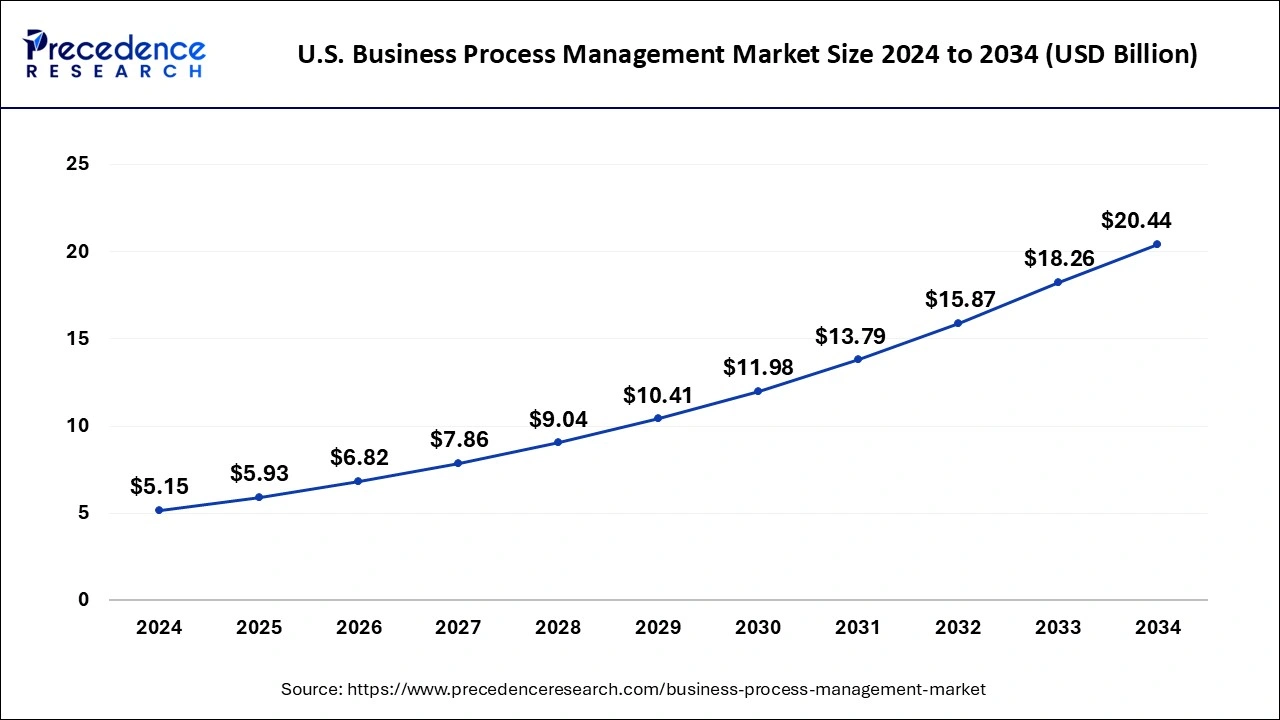
The U.S. business process management market size is estimated at USD 5.93 billion in 2025 and is predicted to be worth around USD 22.76 billion by 2035, at a CAGR of 14.4% from 2026 to 2035.
North American Business Process Management Market Trends
The North American region generated more than 41% of the revenue share in 2024. The region's business process management market development has been aided by factors such as data protection, productivity improvement, and the presence of several BPM-related businesses, including Appian Corporation, International Business Machines Corporation, Genpact, and Open Text Corporation, among others. Some of the world's largest BFSI, IT, and healthcare companies are based in the North American region, and these industries have a significant demand for BPM software.
Major businesses in various areas, including IT, healthcare, banking, insurance, etc., are based in the North American region. In 2023, the U.S. provided almost 24% of the world's GDP alone. These factors apply to the North American region and will likely propel the growth of this region in the market for business process management during the forecast period. In addition to BPM providers with headquarters in North America, many businesses in other parts of the world also have a substantial presence in the region, such as Accenture.
U.S. Market Analysis
The U.S. business process management market is expanding due to increasing demand for operational efficiency, automation, and streamlined workflows across various industries. Additionally, the adoption of advanced technologies such as AI, cloud computing, and analytics is enabling organizations to optimize processes and improve decision-making, driving market growth.
Europe-Notably growing region
Europe is growing notably in the business process management market, primarily due to the increasing adoption of automation technologies, particularly in the banking, retail, and manufacturing sectors. Regulatory compliance, as well as digitization & efficiency improvement, are promoting organizations to invest in BPM solutions for greater operational efficiencies.
Germany Market Analysis
Germany is a major contributor to the European business process management market due to its strong industrial base and high adoption of digital transformation initiatives. The country's focus on process optimization, automation, and integration of advanced technologies like AI and analytics drives significant demand for BPM solutions.
Asia Pacific: Fastest-growing region
Asia Pacific is the fastest-growing region for the business process management market, driven by rapid industrialization, robust IT infrastructure development, and cloud service adoption. Countries including India, China, and Japan are witnessing BPM demand growth as companies look for agility, cost savings, and better customer service in competitive and rapidly changing markets.
India Market Analysis
India is a major player in the Asia Pacific business process management market due to its large pool of skilled IT professionals and established presence of global outsourcing and IT service providers. The country's focus on digital transformation, cost-effective solutions, and adoption of advanced technologies like AI and cloud-based BPM drives significant market growth.
What Potentiates the Market in Latin America?
The business process management market in Latin America is expected to grow at a substantial rate throughout the forecast period. This growth is driven by various factors such as increasing digital transformation efforts, regulatory compliance needs, and growing enterprise automation initiatives across key sectors such as banking, manufacturing, and government. The regional market growth is also potentiated by rapid technological adoption and regional digital infrastructure development. Several companies in the region are also adopting BPM solutions in order to enhance operational efficiency, reduce costs, and improve customer experience, supporting market growth.
Brazil Business Process Management Market Trends
Brazil's market is experiencing steady growth as organizations increasingly adopt digital transformation strategies to improve operational efficiency and reduce costs. Companies are integrating BPM solutions with technologies such as cloud computing, automation, and artificial intelligence to streamline workflows and enhance decision-making.
What Opportunities Exist in the Middle East & Africa?
The Middle East & Africa (MEA) presents significant opportunities in the business process management market, driven by increasing investments in automation solutions and the rapid trend toward digital transformation across various sectors. Governments in the region are promoting BPM adoption through supportive policies aimed at improving operational efficiency. Countries such as South Africa and the UAE are key players, attracting both local and international companies and fostering opportunities for innovation and collaboration.
UAE Business Process Management Market Trends
The UAE market is growing rapidly due to strong government-led digital transformation initiatives such as smart government programs and national digital strategies that encourage organizations to modernize workflows and services. Companies across sectors are increasingly adopting BPM platforms integrated with technologies like artificial intelligence, robotic process automation (RPA), and cloud computing to improve efficiency and decision-making.
Business Process Management Regulatory Landscape: Global Regulations
|
Country / Region |
Regulatory Body |
Key Regulations |
Focus Areas |
Notable Notes |
|
US |
Federal Trade Commission (FTC); National Institute of Standards and Technology (NIST); Securities and Exchange Commission (SEC) |
Sarbanes–Oxley Act (SOX); NIST Cybersecurity Framework; Federal Trade Commission Act |
Data governance, cybersecurity, and financial reporting compliance |
BPM platforms used in financial and enterprise operations must support audit trails, compliance reporting, and secure data handling. |
|
Europe |
European Commission; European Data Protection Board (EDPB) |
General Data Protection Regulation (GDPR); Digital Operational Resilience Act (DORA) |
Data protection, workflow transparency, and enterprise data governance |
BPM solutions must ensure privacy compliance, secure workflow automation, and proper management of personal data across digital processes. |
|
China |
Cyberspace Administration of China (CAC); Ministry of Industry and Information Technology (MIIT) |
Cybersecurity Law; Data Security Law; Personal Information Protection Law (PIPL) |
Data localization, cybersecurity, digital governance |
BPM software providers must comply with strict data protection and localization requirements when managing enterprise processes. |
|
India |
Ministry of Electronics and Information Technology (MeitY); Indian Computer Emergency Response Team (CERT-In) |
Digital Personal Data Protection Act; IT Act 2000 |
Data protection, cybersecurity compliance, digital governance |
BPM platforms operating in India must ensure secure data storage, processing transparency, and compliance with data protection laws. |
|
Brazil |
National Data Protection Authority (ANPD) |
Lei Geral de Proteção de Dados (LGPD) |
Data protection, digital compliance |
BPM systems must incorporate privacy protection and secure processing mechanisms to comply with Brazilian data protection regulations. |
Government Initiatives in the Business Process Management Market
China
- In July 2026, China introduced a 2026 action plan to stabilize and optimize the utilization of foreign investment. This action plan includes new features such as financial sector opening, cross-border data flow management, foreign R&D centres, digital service platform, consumption and online protection, regional coordination, and local regulation. (Source: https://www.reedsmith.com)
United States
- In February 2026, the U.S. government announced that it has shifted from policy statements to capital deployment. It uses several federal pipes to boost domestic and allied supply chains for downstream manufacturing and critical minerals. (Source: https://investornews.com)
Germany
- In March 2026, Germany introduced environmental and climate change laws and regulations for the year 2026. It includes the enforcement of environmental policy, waste, environmental permits, and liabilities. (Source: https://iclg.com)
Brazil
- In July 2026, the United Nations Development Programme (UNDP) Brazil announced that it has led a new model of operational transformation. It helps the UN Development System which delivers more sustainable, stronger results while increasing efficiency and reducing costs. (Source: https://www.undp.org)
Saudi Arabia
- In May 2026, Saudi Arabia introduced the national transformation program to modernise government services, build institutional capacity, and create an enabling environment for economic diversification in Saudi Arabia. It will raise the quality of public services, enable private sector growth, create regulatory conditions, and build the delivery mechanisms. (Source: https://vision2030.ai)
Competitive Landscape
The business process management market is driven by technological advancements like AI and generative AI integration, hyperautomation convergence, cloud and SaaS proliferation, demand for cost reduction, and focus on customer experience. The big tech ecosystem players are Microsoft, IBM, ServiceNow, Oracle, Salesforce, etc. The core strength of these leading industries lies in AI skills, enterprise case management and CRM, Copilot AI, ecosystem integration, process mining, ERP compatibility, and cross-departmental enterprise workflows.
Appian platform features a low-code architecture combined with case management, digital process automation, and data fabric. This company has shifted its focus to end-to-end process mining, built-in AI process design, and intelligent document extraction. On the other hand, Pipefy Process Excellence Platform targets medium-to-high complexity workflows by prioritizing speed-to-value. The core tech trends that are driving R&D budgets are generative AI, ProcessGPT, hyperautomation, process mining, low-code/no-code maturity, data security, and sovereign cloud deployment.
Business Process Management Market Companies
- IBM Corporation: IBM provides enterprise BPM solutions through its Business Automation Workflow and Cloud Pak platforms, integrating workflow automation, AI, and analytics. These tools help organizations streamline operations, automate processes, and improve decision-making across industries such as banking, healthcare, and manufacturing.
- Appian Corporation: Appian offers a low-code BPM and process automation platform that enables organizations to design, automate, and optimize complex workflows. Its cloud-based solutions integrate AI, robotic process automation (RPA), and data management to accelerate digital transformation.
- Pegasystems Inc.: Pegasystems delivers intelligent BPM solutions through its Pega Infinity platform, combining workflow automation, case management, and AI-driven decisioning. The company focuses on improving customer engagement and operational efficiency for sectors such as finance, telecommunications, and healthcare.
- Software AG: Software AG provides BPM and process mining solutions that enable organizations to analyze workflows, identify inefficiencies, and automate business operations. Its platforms support hybrid IT environments and help enterprises optimize end-to-end business processes.
Other Major Key Players
- BP Logix, Inc.
- Open Text Corporation
- Nintex Global Ltd
- International Business Machines Corporation
- Accenture
- Tata Consultancy Services Limited
- SAP SE
- Appian Corporation
- Kissflow Inc.
- Red Hat, Inc.
- Infosys Limited
Recent Developments
- In March 2025, Flokzu, which positions itself as a global leader in business process management and automation (BPM), officially launched its presence in South Africa. Flokzu will offer a comprehensive business process management (BPM) solution that integrates with AI, RPA, and advanced analytics to future-proof South African businesses. (Source: https://www.itweb.com)
- In April 2025, Box, Inc., the leading intelligent content management (ICM) provider, and DataBank, a process automation and data solutions provider, announced a strategic partnership that combines their best-in-class offerings to transform the way organizations manage their content. This collaboration will leverage their respective products and services to deliver AI-powered solutions that streamline business processes like contract lifecycle management, digital asset management, and intelligent document processing. (Source: https://www.businesswire.com)
- In February 2025, SmartSuite, the next-generation work management platform, announced a major global expansion fueled by USD 38 million in funding. The latest investment includes a new USD 13 million Series A round led by Canapi Ventures, with participation from Sorenson Capital and High Alpha. SmartSuite provides a comprehensive, all-in-one solution that combines project management, process automation, document collaboration, and real-time team coordination. (Source: https://www.businesswire.com)
Segments Covered in the Report
By Solution
- Automation
- Process Modelling
- Content & Document Management
- Monitoring & Optimization
- Content & Document Management
- Integration
- Others
By Application
- IT
- BFSI
- Manufacturing
- Retail
- Government & Defense
- Healthcare
- Others
By Deployment
- On-premise
- Cloud
By End-User
- Large Enterprise
- SMEs
By Region
- North America
- Europe
- Asia-Pacific
- Latin America
- The Middle East and Africa
For inquiries regarding discounts, bulk purchases, or customization requests, please contact us at sales@precedenceresearch.com
Frequently Asked Questions





Ask For Sample
No cookie-cutter, only authentic analysis – take the 1st step to become a Precedence Research client
 Get a Sample




 sales@precedenceresearch.com
 Schedule a Meeting
