



Elevator and Escalator Market Size, Key Companies, Company Market Share, Equipment Production Volume, Sales Performance, Manufacturing Cost, Export & Import Trends, Competitive Positioning, and Market Analysis
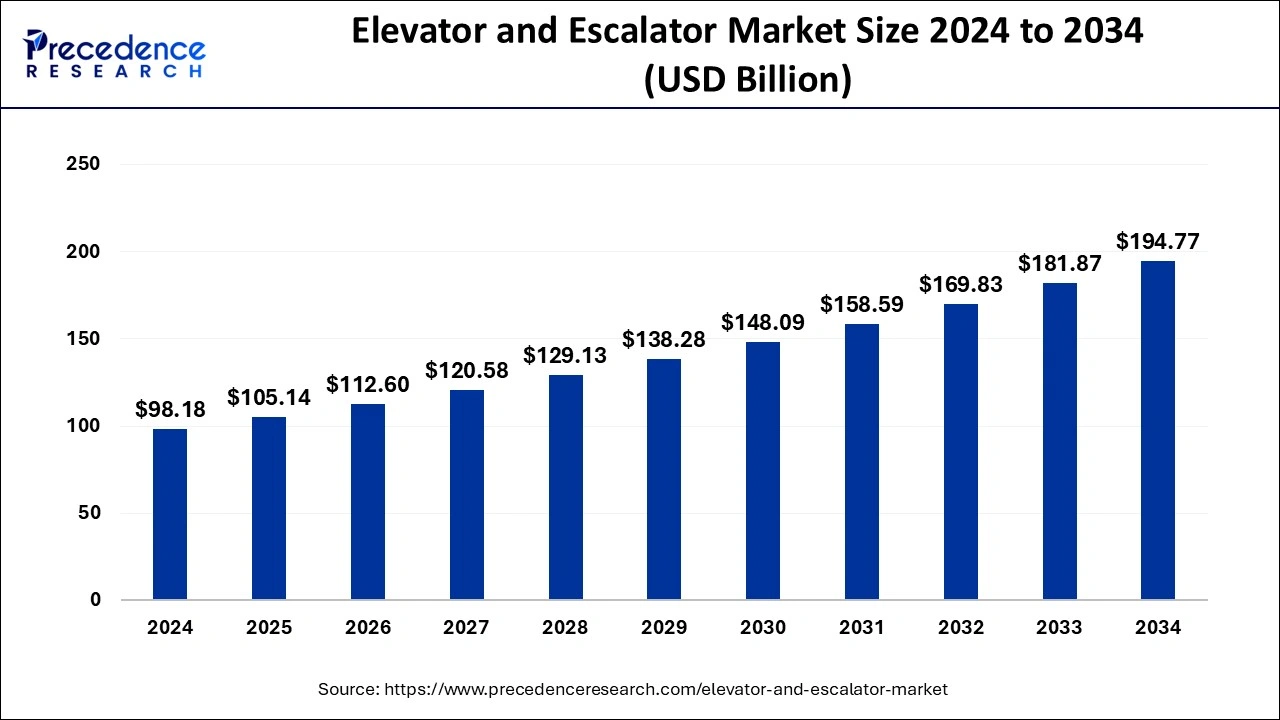
The global elevator and escalator market is projected to grow from USD 112.60 billion in 2026 to USD 207.67 billion by 2035, expanding at a CAGR of 7.04% from 2026 to 2035. Market growth is driven by rapid urbanization, rising construction of high-rise residential and commercial buildings, and increasing investments in smart city and public infrastructure projects. Growing adoption of AI-powered, IoT-enabled, and energy-efficient vertical transportation systems, along with modernization of aging infrastructure and stricter safety regulations, is further accelerating demand for advanced elevators and escalators worldwide.
Source: https://www.precedenceresearch.com/elevator-and-escalator-market
 Get a Sample
 Table Of Content


What is Elevator And Escalator Market Size?
The global elevator and escalator market size is estimated at USD 112.60 billion in 2026 and is anticipated to reach around USD 207.67 billion by 2035, expanding at a CAGR of 7.04% from 2026 to 2035. The rising development of high-rise buildings and commercial complexes in developed and emerging countries contributes to the growth of the elevator and escalator market.
Market Highlights
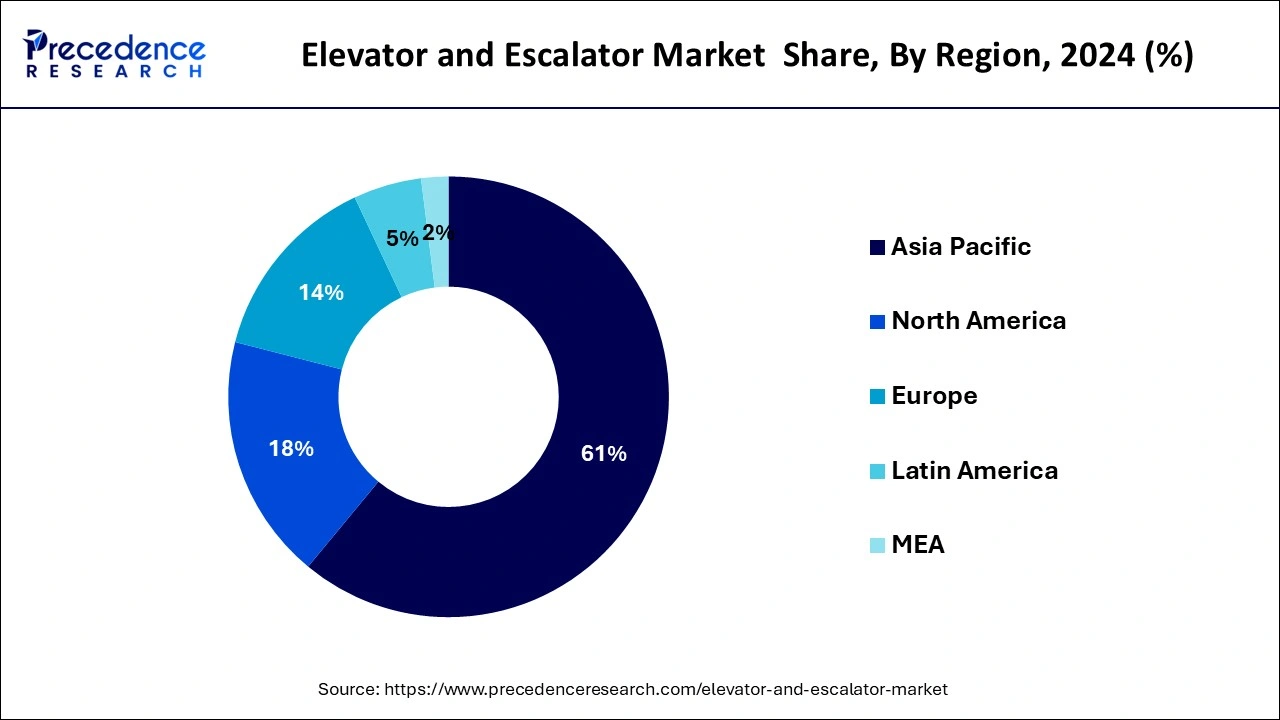
- Asia Pacific led the market with the biggest market share of 61% in 2025.
- Europe is estimated to expand at the fastest CAGR during the forecast period.
- By Product, the escalators segment is expected to grow at a notable CAGR during the forecast period.
- By Business, the equipment segment registered the maximum market share in 2025.
What is the Elevator and Escalator Market?
Elevators are used for moving people and cargo vertically, on an enclosed transport, while escalators are intended to provide an uninterrupted slope for passengers. Elevators and escalators are important for vertical and Inclined movement in building structures. A growing number of shopping malls and public places are driving the demand for elevators and escalators. They offer comfort for people and goods can be easily used and accessed in multi-story structures, eliminating how people used to experience them.
How is Innovation Impacting the Market?
The incorporation of artificial intelligence has changed the way elevators and escalators operate by improving their mechanical functions. As elevators and escalators have become smarter and more intelligent, AI helps operators resolve problems better and manage the traffic flow. It analyzes data from elevator and escalator systems to predict when maintenance is required. AI also detects faults in these systems and resolves them as early as possible, reducing downtime and improving reliability.
Elevator and Escalator Market Trends
- One major trend in the market is smart elevator technology. These elevators will utilize the Internet of Things to provide real-time monitoring, predictive maintenance, and personalized ride experiences.
- Sustainability is another trend, with energy-efficient elevators becoming the norm. Regenerative drives that convert kinetic energy back into power are expected to become standard.
- Safety advancements will also be a significant trend, with elevators incorporating cutting-edge safety features, including smart sensors for accident prevention, real-time communication systems for emergency alerts, and enhanced fire safety protocols.
- The demand for touchless technology, accelerated by the pandemic, is likely to persist. Future elevators will include contactless controls such as mobile app interfaces, voice commands, and gesture recognition.
Elevator and Escalator Market Growth Factors
- Urbanization and government investments in high-rise infrastructure are propelling the demand for elevators and escalators worldwide.
- Expansion of public infrastructure projects of several types, such as airports, metro stations, and shopping complexes, promotes ongoing adoption.
- Growing construction in residential, commercial, and healthcare sectors heightens reliance on vertical transport solutions.
- Tourism development allows installing them in heritage sites, landmarks, and public areas to enhance accessibility.
- Technological advances in areas such as smart elevator-cum-energy-efficient systems further the long-term market opportunities.
Market Outlook
- Industry Growth Offerings-Industry growth in the market is driven by rising urbanization, high-rise construction, and modernization of aging infrastructure. Companies offer smart, energy-efficient, IoT-enabled mobility systems, along with installation, predictive maintenance, and modernization services to enhance safety, performance, and efficiency.
- Global Expansion- Global expansion of the market is fueled by rapid urban development, large-scale infrastructure projects, and growing demand in emerging economies. Companies are widening their international presence through strategic partnerships, smart mobility technologies, and tailored solutions for residential, commercial, and transit applications.
- Startup ecosystem- Startups in the market are focusing on IoT-based monitoring, predictive maintenance, AI-driven safety systems, and energy-efficient designs. They collaborate with builders and tech firms to offer smarter, cost-effective mobility solutions and improve uptime, performance, and user experience.
Market Scope
| Report Highlights | Details |
| Market Size in 2025 | USD 105.14 Billion |
| Market Size in 2026 | USD 112.60 Billion |
| Market Size by 2035 | USD 207.67 Billion |
| Growth Rate from 2026 to 2035 | CAGR of 7.04% |
| Largest Market | Asia Pacific |
| Base Year | 2025 |
| Forecast Period | 2026 to 2035 |
| Segments Covered | By Product, By Application, and By Business, and region |
| Regions Covered | North America, Europe, Asia-Pacific, Latin America, and Middle East & Africa |
Segmental Insights
Product Insights
How Did the Elevator Segment Dominate the Elevator and Escalator Market in 2025?
The elevator segment dominated the market in 2025, driven by urbanization, infrastructure investments, and advancements in technology. Commercial consumers demand much more than just vertical transportation. Consumers are looking for elevators that are energy efficient, stylish, digital, and seamlessly integrated with their building systems. In the residential sector, demand is expanding towards elevators that combine safety, comfort, and aesthetics.
The escalator segment is expected to experience the fastest growth during the forecast period, due to growing demand in commercial and transportation sectors. Escalators help in offering smooth transportation of crowds at transit stations. Further segment growth is driven by an increase in demand for commercial space and growing investments in public transport projects, such as metro rails and airports.
By Business
Why Did the New Equipment Segment Hold the Largest Share of the Market in 2025?
The new equipment segment held the largest share of the market in 2025, driven by the rapid growth of urban infrastructure and the growing complexity of modern buildings. Changing demographics and a rise in construction activities are driving demand for new equipment. Installation of new elevators and escalators in the residential and commercial sectors is driving the new equipment segment.
The modernization segment is anticipated to grow at the fastest CAGR during the forecast period, due to rising demand for advanced elevator and escalator technologies. Modernization enhances performance and reliability, improves sustainability, and offers an opportunity to install the latest technology and safety features to elevate the passenger experience. In addition, modernization reduces repair costs, lowers faults and increases energy savings.
Application Insights
Which Application Segment Dominated the Elevator and Escalator Market in 2025?
The residential segment dominated the market in 2025, driven by growing urbanization and the demand for high-rise residential buildings. Residential Elevators are of significant importance in simplifying life, serving to reduce daily recurring movements of climbing stairs. Today's residential escalators come in sleek and stylish designs that complement various architectural styles, adding a touch of sophistication and luxury to living spaces.
The commercial segment is expected to host the fastest-growing market in the coming years, driven by elevator and escalator vital role in enhancing accessibility in public spaces by offering continuous movement of people across different floor levels. There is rising demand for elevators and escalators in environments such as malls, airports, and train stations where thousands of people pass through daily. Modern elevators play a vital role in facilitating the easy transport of such goods without significantly impacting passenger flow.
Regional Insights
Asia Pacific Elevator and Escalator Market Size and Growth 2026 to 2035
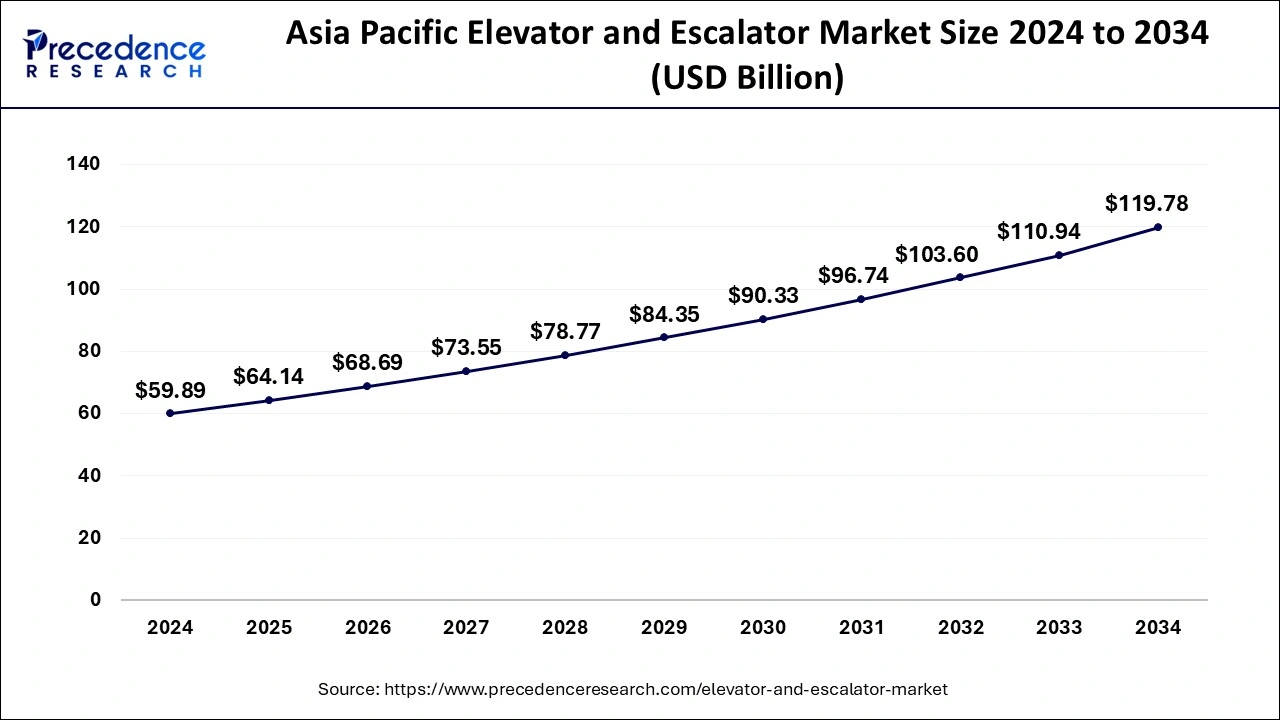
The Asia Pacific elevator and escalator market size is evaluated at USD 64.14 billion in 2025 and is predicted to be worth around USD 128.62 billion by 2035, rising at a CAGR of 7.21% from 2026 to 2035.
Which Region Dominated the Elevator and Escalator Market in 2025?
The Asia Pacific region dominated the market and is anticipated to grow at the fastest rate over the forecast timeframe due to improvements and advancements in the construction industry. In addition, the Asia Pacific region is a manufacturing hub. The growing number of a high rise in buildings and the growth of smart cities are expected to further boost industry growth in the region over the forecast period. Leading manufacturers such as Otis, Schindler, TK Elevator, and KONE are contributing to growth.
India Elevator and Escalator Market Trends
The elevators and escalators sector in India has rapidly become a key player in the country's urbanization narrative. With the urban population expected to rise to nearly 40.8% by 2030, and hundreds of millions of new apartment and office units under construction, elevators have become essential infrastructure. Notably, one of India's most impressive engineering feats, the world's largest passenger elevator, was installed in Mumbai's Jio World Centre, featuring cutting-edge drive and suspension systems.
Europe Elevator and Escalator Market Trends
The elevators and escalators sector in Europe is expected to hold a significant revenue share. Strong urbanization and the construction of tall buildings in major European cities have boosted demand for vertical transportation solutions. Companies in the region are integrating IoT technology into elevators and escalators, which significantly reduces operating costs. Additionally, stringent government regulations and safety standards are driving the need for advanced and compliant elevator systems. The market is further supported by innovations in energy-efficient and sustainable technology, as eco-conscious designs gain popularity.
Germany Elevator and Escalator Market Trends
In Germany, manufacturers in the elevator and escalator industry are increasingly opting for advanced and environmentally friendly solutions to conserve energy. As technology evolves, they are changing the narrative around safety, creativity, reliability, and efficiency in elevator design throughout the country. Moreover, investments in public transport and real estate are driving demand for elevators, bolstered by the federal government's modernization plans.
North America Elevator and Escalator Market Trends
In North America, the market is growing due to ongoing urban development, rising demand for high-rise commercial and residential buildings, and the modernization of aging vertical transport systems. Strict safety regulations and a strong focus on upgrading outdated equipment also drive investments. The adoption of smart, energy-efficient, and digitally connected systems, combined with increasing infrastructure renovation projects, supports steady market expansion across the region.
Elevator and Escalator Market Trends
Elevator and Escalator demand in the U.S. is expanding due to consistent growth in high-rise residential, commercial, and mixed-use construction. There is significant demand for replacing aging equipment in older buildings. Strict safety regulations, modernization requirements, and the push for energy-efficient, smart mobility systems further facilitate market growth. Additionally, ongoing investments in airports, hospitals, and public infrastructure contribute to the sustained adoption of advanced vertical transportation solutions.
Middle East and Africa Elevator and Escalator Market Trends
The demand for elevators and escalators is greatly influenced by the increase in high-rise buildings and commercial complexes. During the forecast period, the demand for these systems in Africa will be fueled by infrastructure expansion in the retail, hospitality, and commercial sectors. In February 2025, TK Elevator (TKE) and Alat, a company funded by the Saudi Public Investment Fund, announced an approximately USD 167 million joint venture to manufacture and provide elevator and escalator solutions in Saudi Arabia and the Middle East and North Africa region.
Saudi Arabia Elevator and Escalator Market Trends
As Saudi Arabia's economy transforms, the demand for elevators and escalators has become vital to support the growth of new cities, commercial buildings, and residential developments. In this country, elevators and escalators must pass conformity assessments and inspection processes before they are commissioned and throughout their operational life. As Saudi Arabia strives to achieve its Vision 2030 goals, the construction sector is expected to play a pivotal role in economic growth.
Latin America Elevator and Escalator Market Trends
Latin America market is experiencing steady growth. The demand for intelligent elevator systems is rising, driven by technological innovation and an increased focus on safety measures in buildings. Additionally, 3D printing technology is emerging as a significant innovation for eco-friendly and cost-effective construction in the region. Rising disposable incomes and a growing real estate sector further encourage installations across the housing, office, hospitality, and healthcare sectors.
Brazil Elevator and Escalator Market Trends
In Brazil, the elevator and escalator sector is anticipated to experience substantial growth in the coming years, thanks to urbanization and infrastructure investments. The country is undergoing a significant shift from sprawling suburbs to thriving high-rises. In São Paulo and the surrounding metro areas, nearly 70% of the country's high-rises are concentrated in just 66 cities.
Value chain analysis
- Raw materials sourcing: In this stage, value chain analysis refers to the procedures related to sourcing, acquisition, and inventorying of raw materials comprising metals and electronic components at the lowest possible cost and with the desired quality for the final product.
Key Players: Otis, Schindler, KONE - Component fabrication and machining: This includes analyzing the production processes and levels at which raw materials are converted into finished elevator and escalator components, focusing on areas such as efficiency, cost, and quality control.
Key Players: Otis, KONE, Schindler, and ThyssenKrupp - Testing and Certification: At this stage, value chain analysis examines the testing standards and certification processes of elevator and escalator component systems to assure their safety, reliability, and conformity to industry standards.
Key Players: TÜV SÜD and TÜV NORD - Maintenance and After-Sales Service: This involves scrutiny of the activities providing support to the customer after the sale, including preventative maintenance, repair, and technical help, to guarantee product durability and customer satisfaction.
Key Players: Otis, KONE, Schindler, and TK Elevator - Product Lifecycle Management for Elevator and Escalator: This stage of value chain analysis takes into account the whole life cycle of the product-from design and development up to end-of-life
Key Players: TK Elevator, Mitsubishi Electric, and Hitachi
Competitive Landscape
The competitive landscape of the Elevator and Escalator market is characterized by growing technological advancements and rising collaboration among top companies. As urbanization continues to drive demand for efficient vertical transportation solutions, key players are increasingly innovating to capture market share and improve service delivery. This environment is poised for sustainable growth driven by both technological evolution and increased consumer expectations.
Industry Leader Announcement
- In March 2023, Hyundai Elevator Co. joined a South Korean government-led team to bid for smart city projects in Indonesia. Jo Jae-cheon, CEO of Hyundai Elevator, stated that the company has been developing non-contact elevator buttons using infrared sensors and open API services that allow various functions like calling an elevator with a smartphone or providing customized information on signage inside an elevator.
Top Vendors and their Offerings
- Otis Elevator Company: Otis offers elevators, escalators, and moving walkways with advanced IoT, predictive maintenance, and energy-efficient technologies. Its portfolio includes installation, modernization, and service solutions tailored for residential towers, commercial buildings, airports, and large infrastructure projects.
- Fujitec: Fujitec provides elevators, escalators, and moving walkways featuring smart controls, safety enhancements, and smooth-ride technology. The company focuses on installation, modernization, and maintenance services for commercial complexes, residential buildings, and transportation hubs worldwide.
- Hitachi Ltd.: Hitachi delivers high-speed elevators, escalators, and intelligent vertical mobility systems with energy-saving features and advanced traffic management. It offers installation, modernization, remote monitoring, and maintenance services for commercial skyscrapers, residential projects, and public infrastructure.
- KONE Corporation: KONE offers eco-efficient elevators, escalators, and smart building mobility solutions integrated with IoT and cloud analytics. Its offerings include installation, modernization, and predictive maintenance for offices, residential buildings, malls, and transit facilities.
- Schindler Group: Schindler provides elevators, escalators, and moving walkways supported by IoT-based monitoring, efficient traffic flow systems, and sustainable designs. The company specializes in installation, modernization, and maintenance for commercial buildings, residential towers, and major transportation environments.
Recent Developments
- In August 2025, Rocket Lab boosts US investments to expand semiconductor manufacturing capacity and supply chain security for space-grade solar cells and electro-optical sensors, supported by $23.9 million Trump Administration award. (Source: https://rocketlabcorp.com)
- In May 2025, Malaysian semiconductor company SMD Semiconductor opened a new R&D Innovation Hub in Wales, aiming to collaborate with UK companies on designing next-generation semiconductor chips. (Source: https://businessnewswales.com)
Segments Covered in the Report
By Product
- Elevators
- Moving Walkways
- Escalators
By Business
- Maintenance
- New Equipment
- Modernization
By Application
- Industrial
- Residential
- Commercial
By Region
- North America
- Europe
- Asia-Pacific
- Latin America
- Middle East & Africa
For inquiries regarding discounts, bulk purchases, or customization requests, please contact us at sales@precedenceresearch.com
Frequently Asked Questions





Ask For Sample
No cookie-cutter, only authentic analysis – take the 1st step to become a Precedence Research client
 Get a Sample




 sales@precedenceresearch.com
 Schedule a Meeting
