



Insulation Market Trends, Leading Companies, Company Revenue / Sales Performance, Plant Utilization, Production Volume, Pricing Dynamics, Supply Chain Performance, Competitive Landscape, and Industry Growth
Vidyesh Swar, a Chemical and Materials Industry Expert, estimates the insulation market at USD 69.84 billion in 2026, with the market projected to reach USD 136.48 billion by 2035 at a CAGR of 7.60%. Major insulation market companies such as saint-gobain, recticel, rockwool group, the knauf group, johns manville are competing across key material and application segments, including insulation type, material type, end user.
Source: https://www.precedenceresearch.com/insulation-market
 Get a Sample
 Table Of Content


What is the Insulation Market Size?
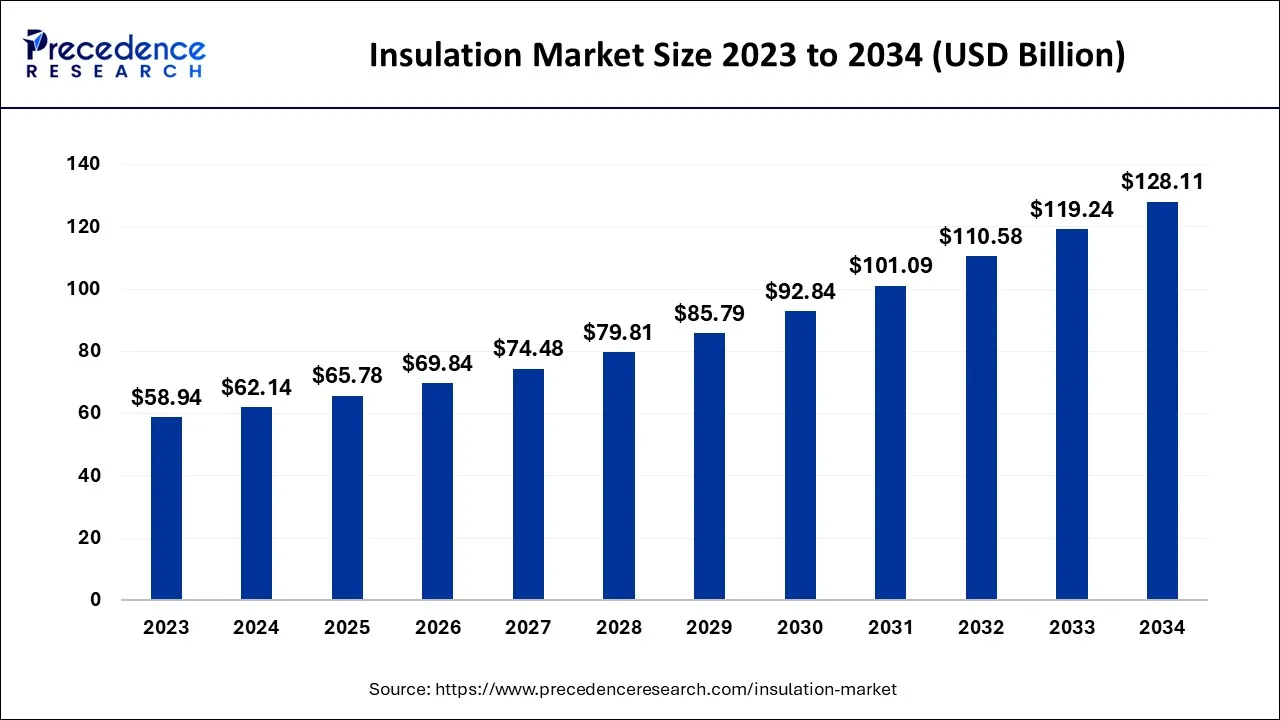
The global insulation market size is accounted at USD 65.78 billion in 2025 and predicted to increase from USD 69.84 billion in 2026 to approximately USD 136.84 billion by 2035, expanding at a CAGR of 7.60% from 2026 to 2035. The market is driven by favorable regulations in a majority of regions and increasing consumer awareness, leading to energy conservation.
Insulation Market Key Takeaways
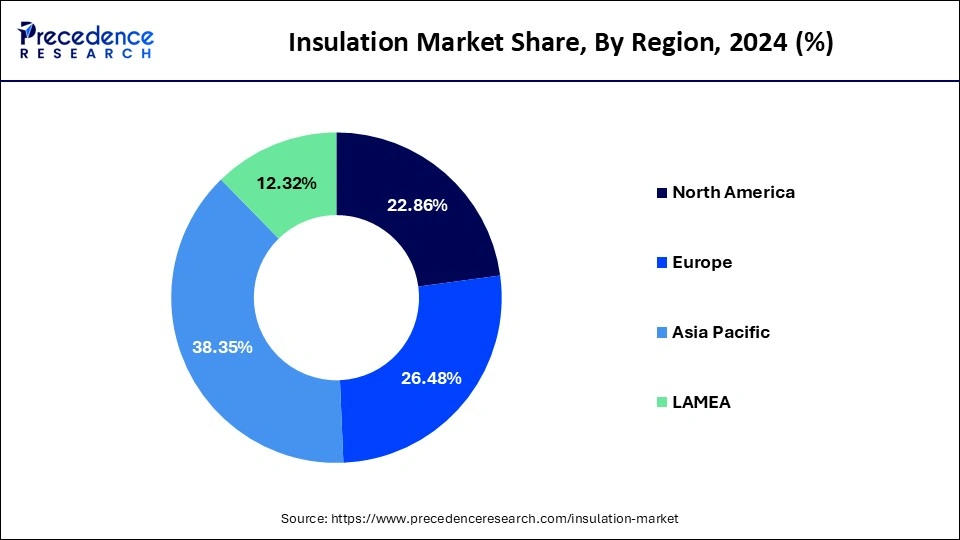
- The Asia Pacific region led the global market with the highest market share of 38.35% in 2025.
- North America is expected to grow fastest during the forecast period.
- By insulation type, the thermal insulation segment dominated the market with a share of 64.80% in 2025.
- By material type, the expanded polystyrene (EPS) segment generated high revenue share in 2025.
- By end-use type, the building and construction segment registered a maximum market share in 2025.
Market Overview
The insulation market focuses on materials and solutions used to control heat transfer and reduce noise across residential, commercial, industrial, and transportation applications. Demand for insulation materials is not only from construction and industrial applications but also from global mandates for energy conservation and carbon reduction, which drives the growth of the market. The market is expanding across materials such as mineral wool, fibreglass, polyurethane foams, cellulose, aerogels, and advanced bio-based alternatives, each fulfilling unique performance niches in residential, commercial, transportation, and industrial sectors.
What is the Role of the AI in the Insulation Market?
Artificial intelligence (AI) based insulation is important due to it can enhance energy efficiency, reduce greenhouse gas emissions, and save money on energy bills. AI techniques like neural networks and machine learning, allows precise fault prediction, real time monitoring, and adaptive control, significantly improving grid reliability. AI technology and tools are used by firms in the construction and mechanical insulation to manage their internal operations and projects more easily, efficiently and cost effectively.
Innovative AI technology offers advanced solutions for improving thermal insulation in many industries. Ai based insulations designed for architects, engineers, and construction professionals, this platform provides the real time data analysis, predictive modeling and energy efficiency recommendations. Enhance sustainability, improve insulation performance, and reduce energy costs with innovative tools.
The Invisible Shield Powering the World's Efficiency Revolution
The insulation market is entering a pivotal era where efficiency, climate adaptation, and building modernization converge. Demand is being fuelled not only by construction and industrial applications but also by global mandates for energy conservation and carbon reduction. Insulation once viewed as a passive structural component, is now recognized as a strategic enabler of operational savings, thermal resilience, and long-term infrastructure sustainability. The market is expanding across materials such as mineral wool, fibreglass, polyurethane foams, cellulose, aerogels, and advanced bio-based alternatives, each fulfilling unique performance niches in residential, commercial, transportation, and industrial sectors.
Insulation Market Growth Factors
- The insulation market is growing due to rising awareness of energy-efficient and sustainable solutions, which encourages the adoption of insulation materials.
- The growing demand for the installation of insulation in various commercial infrastructures contributed to the market growth.
- The increasing number of people moving from rural to urban regions and the massive growth in the global population are increasing residential and commercial building construction, which further drives the market growth.
- Governments are imposing strong environmental regulations and promoting policies aimed at reducing emissions and improving building performance, which have accelerated the adoption of insulation materials across various sectors.
Market Trends
- The need for adequate housing and commercial spaces
- A rising number of people migrating from rural to urban regions
- Development of robust infrastructure
- Increasing investment in the construction sector
Market Outlook
- Industry Outlook: Industry dynamics are shifting toward consolidation and capability expansion. Manufacturers are aligning with sustainability targets, optimizing supply chains, and integrating digital tools to enhance product traceability and lifecycle monitoring. The market is witnessing deeper collaborations between material scientists, construction firms, and energy consultants to develop insulation solutions tailored for net-zero buildings.
- Major Investments: Significant capital is flowing into digitalized production lines, advanced extrusion technologies, expanded capacity for mineral wool and polyurethane foams, and specialized plants for aerogel-infused composites. Investments are also accelerating in green-chemistry initiatives particularly low-GWP blowing agents and renewable feedstocks for foam production. Several global players are reorienting corporate strategies toward net-zero commitments, allocating budgets for decarbonizing manufacturing operations and integrating renewable energy into insulation production units. Additionally, large construction conglomerates are investing in insulation-centric prefabrication facilities to cater to rapid-build and sustainable housing programs.
- Startups Shaping the Future: The startup landscape is vibrant, with innovators developing unconventional material science breakthroughs. Entrepreneurs are pioneering:
- Bio-based insulation from hemp, mushroom mycelium, seaweed, and recycled textiles.
- Aerogel nanocomposites providing extreme thermal resistance in ultrathin layers.
- Recyclable and modular insulation panels enabling easy end-of-life recovery.
- Smart insulation systems integrating sensors to track temperature, humidity, and thermal decay.
- COâ‚‚-derived foams, converting captured emissions into high-value building materials.
Market Scope
| Report Coverage | Details |
| Market Size in 2025 | USD 65.78 Billion |
| Market Size in 2026 | USD 69.84 Billion |
| Market Size by 2035 | USD 136.84 Billion |
| Growth Rate from 2026 to 2035 | CAGR of 7.60% |
| Largest Market | Asia Pacific |
| Base Year | 2025 |
| Forecast Period | 2026 to 2035 |
| Segments Covered | Insulation Type, Material Type, End User, and Region |
| Regions Covered | North America, Europe, Asia-Pacific, Latin America, and Middle East & Africa |
Market Dynamics
Driver
Growing construction and residential industry
The increasing installation of environmentally friendly, recyclable, and efficient materials and increasing emphasis on reducing energy consumption are increasing the market growth. The rising demand for new homes and Increasing customer expenditure have a positive impact on the market demand. In addition, the expansion of the construction industry combined with a rise in energy-efficient innovation further drives the market growth.
Domestic players are expected to compete with international ones, due to the need for a stronger customer relationship in this industry. Manufacturers are supposed to develop robust distribution networks to increase their profits. Furthermore, by decreasing the heating and cooling loads in the building industry, the use of EPS, plastic foam, and glass wool can reduce the overall energy consumption further contributing to propelling the market growth.
Restraint
High Cost and Environmental Concerns
Crude oil is the major raw material for the majority of insulating products. Political uncertainty in these regions has a significant impact on crude oil supply and pricing globally since Middle Eastern countries produce most of the world's crude oil. In addition, the high cost of crude oil is affecting the market demand and further restraining the growth of the insulation market.
Opportunity
Increasing demand for insulation services from developing nations
The high demand from emerging countries will drive the market's growth. The market is growing rapidly in growing markets such as India, Mexico, South Korea, Indonesia, Turkey, Russia, and China. Considerations such as government regulations, low transportation costs, cheap labor, and the availability of land have made manufacturing plants and automobile manufacturers in these countries.
Due to the increasing demand for insulation in the construction and refrigerator sectors, the market is growing rapidly in India. In addition, EPS provides improved high-performance insulation, precision, durability, and moisture resistance. Thus, the growth of the construction industry in developing markets is further anticipated to enhance the growth of the insulation market.
Segment Insights
Insulation Type Insights
Why was the Thermal Insulation Segment Dominant in the Insulation Market?
The thermal insulation segment held a major share of the insulation market in 2025, due to rising demand for energy-efficient buildings and industrial facilities. These materials help reduce heat transfer, lower energy consumption, and improve indoor comfort. Strict regulations related to environmental safety and sustainable constructions are supporting the adoption of insulation materials across residential, commercial, and industrial sectors. Growing investments in green construction continue to strengthen demand for advanced thermal insulation products.
The acoustic insulation segment is expected to grow at a significant CAGR during the studied period in the insulation market due to increasing demand for noise reduction in residential buildings, offices, healthcare facilities, and transportation systems. These materials improve comfort by minimising sound transmission and enhancing indoor environmental peace. Rising awareness regarding occupant well-being and stricter building standards are contributing to the expansion of the acoustic insulation segment.
Insulation Market Revenue, By Insulation Type 2022-2024 (USD Million)
| By Insulation Type | 2022 | 2023 | 2024 |
| Thermal Insulation | 36,429.32 | 38,022.94 | 40,263.85 |
| Acoustic Insulation | 20,091.14 | 20,917.84 | 21,876.39 |
Material Type Insights
What Made the Expanded Polystyrene (EPS) Segment Lead the Insulation Market?
The expanded polystyrene (EPS) segment accounted for a considerable revenue share in the insulation market in 2025, driven by its lightweight structure, durability, and cost-effectiveness. It offers excellent thermal performance and moisture resistance, making it suitable for walls, roofs, floors, and packaging applications. Growing construction activities and increasing emphasis on energy conservation continue to support demand. Expanded polystyrene (EPS) is popular in developing countries due to its affordability and availability.
The aerogel segment is expected to witness the fastest growth in the insulation market with a CAGR over the forecast period. The segment growth is driven by its exceptional thermal resistance and lightweight properties. It is relatively expensive compared to expanded polystyrene (EPS), but it is used increasingly in specialised applications such as aerospace, oil and gas, and advanced construction projects. Continuous technological advancement and growing interest in energy-efficient materials are creating opportunities for wider adoption.
End-use Insights
Why Did the Building and Construction Segment Dominate the Insulation Market?
The building and construction segment led the global insulation market in 2025. Rapid urbanization, population growth, and increasing investments in residential and commercial infrastructure are driving demand for insulation materials. Insulation in building and construction helps to reduce heating and cooling costs and improve indoor comfort. Governments are promoting energy-efficient buildings through stricter regulations and sustainability initiatives. The growing investments in green construction are further supporting the growth of the segment in the market.
The transportation segment is expected to witness the fastest growth in the insulation market, with a CAGR over the forecast period. The transportation sector is increasingly using insulation materials to enhance thermal efficiency, passenger comfort, and noise reduction. Automobiles, aircraft, railways, and marine vessels are increasingly incorporating advanced insulation solutions to improve performance and meet environmental standards. Rising production of electric vehicles and advancements in transportation infrastructure are contributing to market growth.
Insulation Market Revenue, By Material Type 2022-2024 (USD Million)
| By End User | 2022 | 2023 | 2024 |
| Building and Construction | 20,361.40 | 21,259.37 | 22,470.10 |
| HVAC and OEM | 9,389.07 | 9,817.18 | 10,358.91 |
| Transportation | 13,585.42 | 14,198.75 | 15,083.54 |
| Appliances | 5,596.06 | 5,784.36 | 6,078.75 |
| Othes (Furniture, Packaging, etc.) | 7,588.53 | 7,881.13 | 8,148.94 |
Regional Insights
Asia Pacific Insulation Market Size and Growth 2026 to 2035
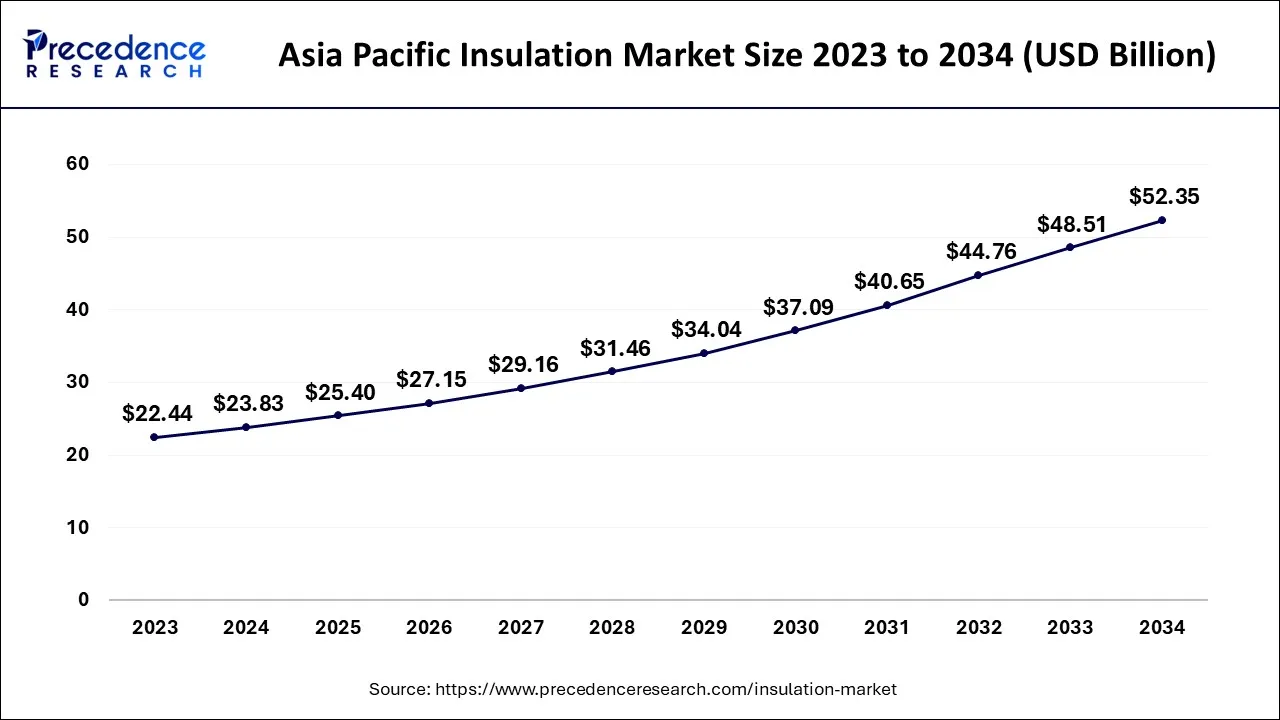
The Asia Pacific insulation market size is exhibited at USD 27.15 billion in 2026 and is projected to be worth around USD 56.13 billion by 2035, growing at a CAGR of 8.25% from 2026 to 2035.
What Factors Made the Asia Pacific Region the Dominant Region in the Market?
Asia Pacific dominated the global insulation market in 2025 due to rapid urbanization, industrialization, and large-scale infrastructure development. Rising population levels and increasing construction activities in developing economies are creating substantial demand for insulation materials. In countries like China and India, increased oil production has led to significant use of insulation materials. Growth in manufacturing industries, transportation, and cold storage facilities is further supporting market expansion in the region.
China Market Trends
China represents the largest share of the insulation market in the Asia Pacific in 2025. The growth is driven by extensive urban development and massive investments in residential and commercial infrastructure. Strong industrial growth and rising awareness regarding energy efficiency are supporting demand for insulation products. Government policies aimed at reducing emissions and improving building performance have accelerated adoption across various sectors. China remains a major producer and consumer of insulation materials globally.
Which Factors Made Europe a Significantly Growing Region in the Market?
Europe is expected to grow at a considerable CAGR in the upcoming period in the insulation market. The growth is supported by their stringent environmental regulations and ambitious energy-saving targets. Countries across the region are focusing on reducing greenhouse gas emissions through improved building efficiency. The European Union has established regulations such as the Energy Performance of Buildings Directive (EPBD) and the Climate Law to promote energy-efficient construction practices. These regulations are compelling building owners and developers to upgrade existing structures with advanced insulation materials.
Germany Market Trends
Germany is one of Europe's leading insulation markets in 2025, supported by its focus on energy-efficient construction and renovation activities. Government programs encouraging building modernization and carbon reduction have stimulated demand for advanced insulation products. Germany is a leader in the development of innovative insulation technology, such as aerogel composites and sustainable building materials. The country's commitment to transitioning toward low-emission housing continues to drive investment in insulation technologies.
Which Factors Influence the Fastest Growth of the North American Market?
North America is expected to grow at the fastest CAGR in the insulation market during the forecast period. The growth of the market is due to increasing investments in energy-efficient buildings and stricter regulations aimed at reducing carbon emissions. The North American region has a great demand for insulation materials. The Rising renovation activities, growing adoption of green construction practices, and demand for advanced thermal and acoustic insulation materials are supporting market expansion. The region is witnessing higher use of insulation in industrial facilities and cold chain infrastructure.
U.S. Market Trends
The United States holds the largest share of the North American insulation market in 2025. Growing construction spending, renovation of ageing buildings, and implementation of energy efficiency standards are driving product demand. Residential housing projects, commercial developments, and industrial expansion have increased the need for thermal insulation materials. Government initiatives promoting sustainable buildings and lower energy consumption are further encouraging manufacturers to introduce innovative insulation solutions with improved performance and environmental benefits.
Latin America Market Trends
Latin America held a considerable share of the insulation market in 2025, supported by urban expansion and increasing construction activities. Demand for insulation materials is rising as governments and businesses place greater emphasis on energy efficiency and sustainable infrastructure. Residential housing developments and industrial projects are contributing to market expansion. The rising awareness of energy savings contributes to the demand for insulation materials. Growing investment in green construction is further contributing to the market growth.
Brazil Market Trends
Brazil accounts for the largest share of the Latin American insulation market in 2025, due to expanding construction and industrial sectors. Rising demand for energy-efficient buildings and modernization of infrastructure are supporting product adoption. Increasing investment in commercial properties and residential housing projects is driving demand for insulation materials. The country is witnessing growing awareness regarding energy conservation and sustainable construction. Government initiatives promoting infrastructure development and industrial growth are expected to support long-term expansion of the market.
Middle East and Africa Market Trends
The Middle East & Africa held a notable share of the insulation market in 2025, driven by increasing infrastructure investments and urban development projects. The Gulf countries, like the UAE and Saudi Arabia, are mandating green building codes, which boosts the demand for insulation. Expansion in commercial buildings, industrial facilities, and oil and gas projects further contributes to the market growth. Governments across the region are introducing sustainability initiatives and building efficiency standards. Growing awareness regarding energy savings is expected to strengthen demand over the coming years.
Saudi Arabia Market Trends
Saudi Arabia represents the leading market within the Middle East and Africa insulation market in 2025, supported by large-scale infrastructure and construction projects under Vision 2030 initiatives. Rapid urbanization and increasing demand for energy-efficient buildings are driving the adoption of insulation materials. High temperatures and rising electricity consumption have encouraged the use of advanced thermal insulation solutions. Growth in industrial facilities, commercial complexes, and residential developments continues to drive the growth of the market.
Market Value Chain Analysis
- Raw Material Sourcing: Raw material sourcing hinges on accessibility, sustainability, and quality assurance. Mineral wool manufacturers depend on basalt, slag, and other industrial by-products; polymer-based insulation relies on petrochemical derivatives, additives, and blowing agents; cellulose insulation draws from recycled paper streams; and bio-based materials rely on agricultural inputs or microbial growth cycles. Supply chains are undergoing transformation to minimize carbon footprints, adopt renewable feedstocks, and ensure compliance with environmental standards. Ethical sourcing, certification schemes, and supplier transparency frameworks are becoming central differentiators for manufacturers.
- Technological Advancements: Technology is reshaping insulation with remarkable sophistication. Advances include, arogel-enhanced composites delivering unmatched thermal conductivity reductions, phase-change materials (PCM) integrating thermal storage into insulation layers. Smart and sensor-enabled insulation for real-time energy monitoring. Digital twin modelling, AI-based building envelope simulations, and automated inspection tools are further enhancing the accuracy and efficiency of insulation deployment.
Competitive Landscape
The insulation market is characterised by the presence of several global and regional manufacturers competing through product innovation, pricing strategies, and expansion of production capacities. Companies are increasingly investing in sustainable and high-performance insulation materials to meet evolving environmental standards. Companies are maintaining their market position through strategic partnerships, acquisitions, and geographic expansion. Growing emphasis on energy efficiency and green construction continues to shape the competitive environment. For future growth, companies should focus on developing eco-friendly materials, improving product performance, and investing in advanced manufacturing technologies. Expanding the distribution networks and supply chain will create long-term opportunities.
Company Profiles
Saint-Gobain
- HQ: Courbevoie, France
- Founded: 1665
- Ownership: Public
- Business Overview: Saint-Gobain is a French multinational company that designs, manufactures, and distributes materials and services for residential, non-residential, and infrastructure markets.
- Products: Saint-Gobain's ISOVER offers Glass Wool, Stone Wool, Elastomeric Foams, Ultimate, PIR, EPS, and XPS Panels, and Wood Fiber.
- Geographic Presence: Saint-Gobain is present in over 80 countries in Europe, the Americas, and Asia-Pacific.
- Revenue: Saint-Gobain's net sales in FY2025 were €46,483 million.
- Recent Developments: In June 2026, Saint-Gobain and Deltec announced the divestment of HKO, a German-based industrial insulation textile business, contributing to the company's ongoing portfolio optimization strategy.
- Key Strategies: Saint-Gobain has formed a “Lead & Grow 2030” strategy plan to be the worldwide leader in light and sustainable construction.
Recticel
- HQ: Brussels, Belgium
- Founded: 1896
- Ownership: Public
- Business Overview: Recticel is a leading insulation company with expertise in the thermal and acoustic insulation business, contributing to the energy transition.
- Products: Recticel's insulation products include Deck-VQ, Eurotan, Eurothane Silver, and Powerdeck+.
- Geographic Presence: Recticel Group has a strong presence in Europe and the U.S.
- Revenue: In the first half of 2026, Recticel's sales increased by 16.4%, accounting for EUR 390.1 million.
- Recent Developments: In February 2026, Recticel opened its first U.S. insulated panels facility in Tennessee.
- Key Strategies: The company commits to addressing the specific needs of its customers, focusing on energy efficiency and delivering value-driven solutions.
ROCKWOOL Group
- HQ: Denmark
- Founded: 1909
- Ownership: Public
- Business Overview: ROCKWOOL Group is the world's leading manufacturer of environmentally friendly stone wool insulation with an experience of over 80 years.
- Products: ROCKWOOL's floor insulation is made from premium stone wool to improve a building's thermal and acoustic performance. Apart from this, it also offers insulation for roofs, ceilings, HVAC, and fire protection.
- Geographic Presence: ROCKWOOL has factories in over 20 countries across 3 continents and supplies its products in more than 120 countries.
- Revenue: The company's revenue reached 3,877 MEUR in 2025, with a profit of 28 MEUR.
- Recent Developments: In March 2025, ROCKWOOL announced the construction of its $175 plant at Wallula Gap to transform rock into green insulation.
- Key Strategies: The business strategy of ROCKWOOL is to create solutions that connect global trends with profitable business opportunities.
The Knauf Group
- HQ: Iphofen, Germany
- Founded: 1932
- Ownership: Private
- Business Overview: The Knauf Group is a globally leading manufacturer of building materials and construction systems.
- Products: Knauf offers the ECOSE Technology, a unique plant-based binder to manufacture its Glass Mineral Wool products.
- Geographic Presence: The Knauf Group is present in more than 40 countries and has 27 manufacturing sites in 15 countries.
- Recent Developments: In January 2026, Knauf Insulation announced the construction of its £180 million Flintshire insulation factory to produce over 100,000 tonnes of rock mineral wool insulation annually.
- Key Strategies: Knauf aims to provide the best value for its customers, act with future generations in mind, and achieve superior performance.
Johns Manville
- HQ: Colorado, United States
- Founded: 1858
- Ownership: Berkshire Hathaway
- Business Overview: Johns Manville is an American company that manufactures premium-quality insulation, commercial roofing, and fibers and nonwovens for commercial, industrial, and residential applications.
- Products: Johns Manville provides insulation materials for insulating buildings, HVAC, industrial, mechanical, OEM, and home applications.
- Geographic Presence: The company has around 44 manufacturing facilities across North America and Europe, while serving customers in more than 80 countries across the globe.
- Recent Developments: In December 2025, Johns Manville launched JM QuickFoam Adhesive, a two-part, low-rise polyurethane foam adhesive for attaching fleece-backed single-ply membranes to insulation boards.
- Key Strategies: The company aims to deliver high-performing solutions and has set the 2030 Sustainability Goals to integrate economic, social, and environmental pillars as equal priorities.
Top Vendors in Insulation Market
- GAF: A significant competitor in the insulation market, often mentioned alongside other major players like Knauf Insulation and Johns Manville.
- Saint-Gobain: A French company with a long history and a strong presence in building and construction products.
- Recticel: A Belgian company that produces insulation boards, such as Eurothane GP, made from rigid polyisocyanurate (PIR) foam.
- Kingspan Group: An Irish company that is a key player in the technical insulation market.
- URSA: Another competitor in the insulation market, frequently listed alongside other major brands like GAF and Rockwool.
- Rockwool Group: A Danish company known for its stone wool insulation products, with a significant global market presence.
- Knauf Insulation: A prominent company in the insulation market with a significant presence in the US.
Johns Manville: A US-based company that is a leading manufacturer of insulation and building materials.
Recent Developments
- In August 2025, the Microcell technology for efficient window system's insulation was launched by Promix Solutions. The insulation characteristics of window systems are largely defined by the function of thermal break profiles, which make a thermal barrier for heat transfer between parts like window frames. (Source: Promix Solutions launches Microcell Technology for efficient window systems' insulation - Interplas Insights)
- In April 2025, the launch of groundbreaking insulation, designed to provide unprecedented weight to warmth comfort and performance for outdoor lifestyle enthusiasts was announced by FOLI AEROGEL, a leading innovator in Aerogel Insulation Technology. (Source: Foli Aerogel launches lightweight insulation for outdoors - Fibre2Fashion)
Segments Covered in the Report
By Insulation Type
- Thermal Insulation
- Acoustic Insulation
By Material Type
- Glass Wool
- Mineral Wool
- Expanded polystyrene (EPS)
- Extruded polystyrene foam insulation (XPS)
- Calcium-Magnesium-Silicate (CMS) Fibers
- Calcium Silicate
- Polyurethane
- Aerogel
- Others (Cellulose, Phenolic Foam, etc.)
By End User
- Building and Construction
- HVAC and OEM
- Transportation
- Appliances
- Others (Furniture, Packaging, etc.)
By Geography
- North America
- U.S.
- Canada
- Europe
- U.K.
- Germany
- France
- Asia-Pacific
- China
- India
- Japan
- South Korea
- Malaysia
- Philippines
- Latin America
- Brazil
- Rest of Latin America
- Middle East & Africa (MEA)
- GCC
- North Africa
- South Africa
- Rest of the Middle East & Africa
For inquiries regarding discounts, bulk purchases, or customization requests, please contact us at sales@precedenceresearch.com
Frequently Asked Questions
Tags





Ask For Sample
No cookie-cutter, only authentic analysis – take the 1st step to become a Precedence Research client
 Get a Sample




 sales@precedenceresearch.com
 Schedule a Meeting
