



Propane Market Size, Key Companies, Company Market Share, Production Capacity, Raw Material Pricing, Export & Import Analysis, Manufacturing Cost, Competitive Positioning, and Demand Forecast
Propane Market (By End Use: Industrial, Commercial, Residential, Transportation, Agriculture, Chemicals and Refineries; By Grade: HD-5 Propane, Others) - Global Industry Analysis, Size, Trends, Leading Companies, Regional Outlook, and Forecast 2026 to 2035
Source: https://www.precedenceresearch.com/propane-market
 Get a Sample
 Table Of Content


What is the Propane Market Size?
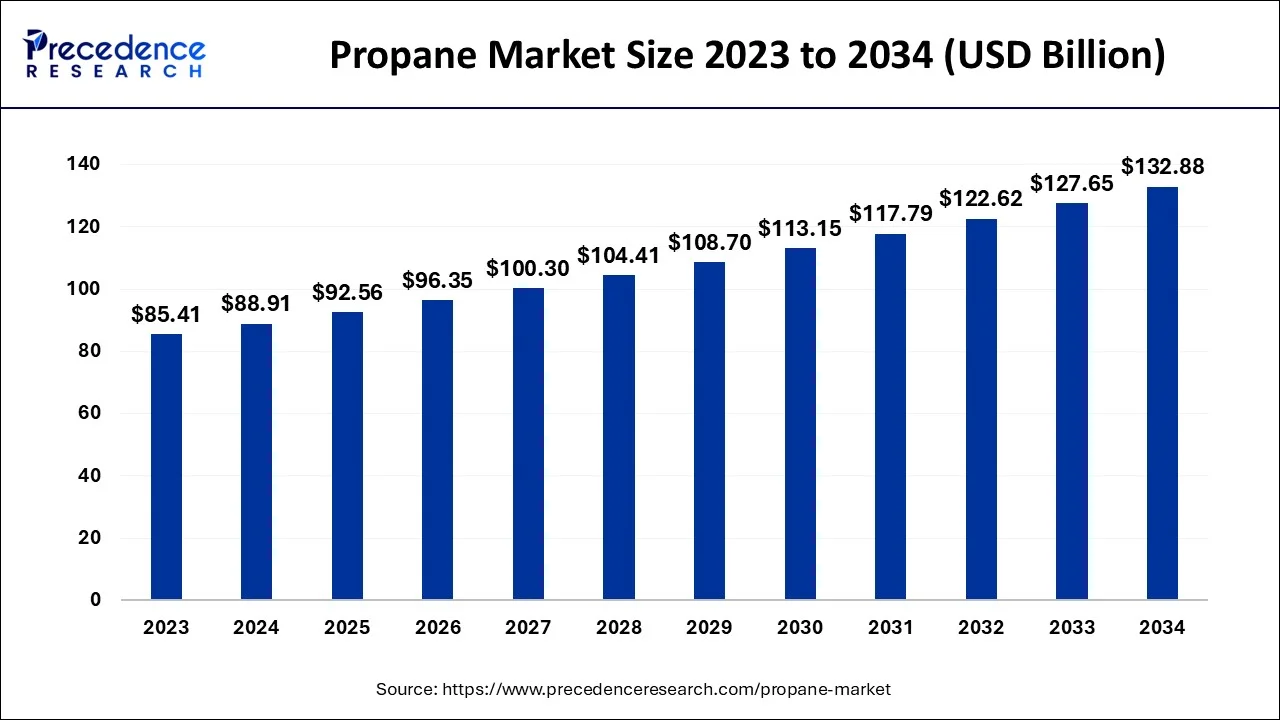
The global propane market size is calculated at USD 92.56 billion in 2025 and is predicted to increase from USD 96.35 billion in 2026 to approximately USD 137.98 billion by 2035, expanding at a CAGR of 4.07% from 2026 to 2035. Propane market growth is driven by rising demand for residential heating, cooking, transportation fuels, industrial applications, petrochemical feedstock, and cleaner-burning energy alternatives.
Propane Market Key Takeaways
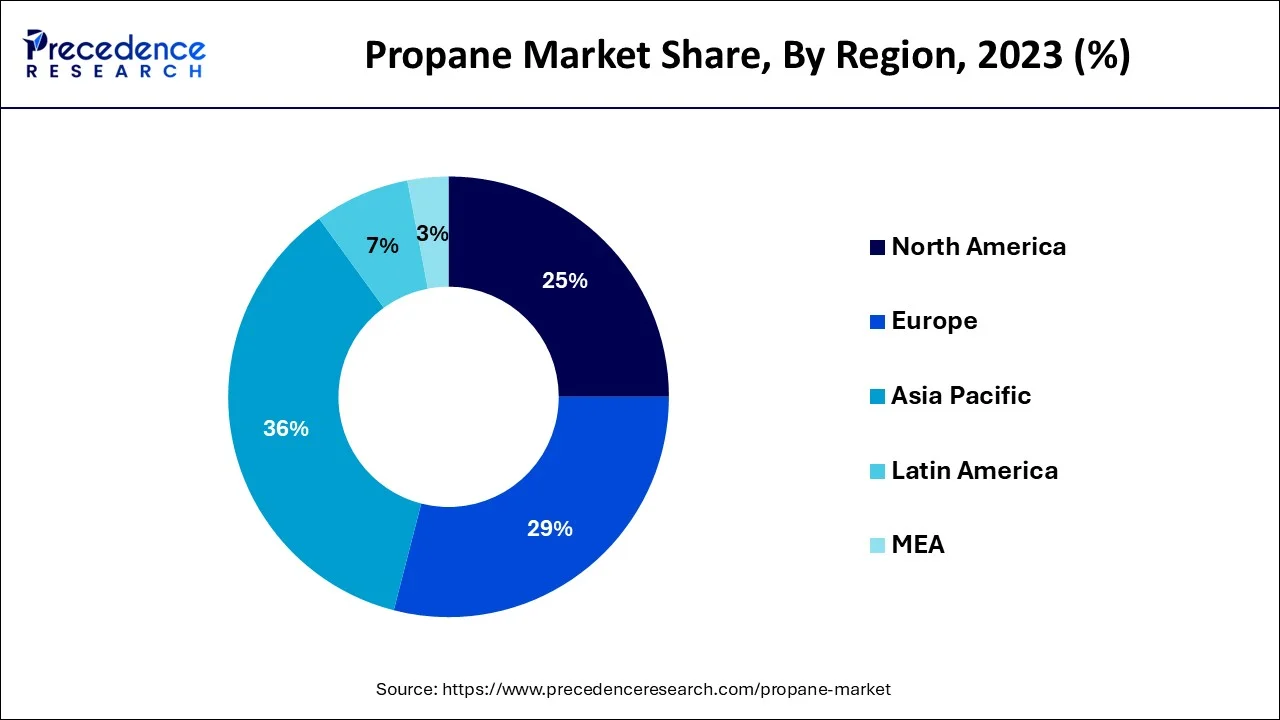
- The Asia Pacific dominated the global propane market in 2025 with 21% market share.
- North America is expected to grow at a notable CAGR in the foreseeable future.
- By end-use, the industry segment contributed more than 39% of total sales in 2025.
- By end-use, the residential category is anticipated to rise at a CAGR of more than 5.2% from 2026 to 2035.
- By grade type the, HD-5 category segment dominated the global market in 2025 and is expected to sustain as a leader in the upcoming period.
Market Overview
The propane market consists of the production of propane, processing, distribution, and usage, which is a hydrocarbon gas deemed to be derived from natural gas processing and oil refining. Propane is used for heating houses and businesses, cooking, heating water, farming, industrial purposes, transportation, and chemical production.
The overall market is growing steadily due to the increase in demand for energy, growth of petrochemical production, more extensive use of propane in agriculture, and increased global trade. The propane produced from natural gas processing contributed to supply, while the increase in export capacity contributed to the connection between global markets. Natural gas production in the U.S. and the world provides increasing availability and export of propane. Seasonal heating, especially in winter, will increase consumption.
AI in the Market
With Artificial Intelligence, the propane market is changing everything: operations are becoming optimized; safety measures are getting enhanced, while. These systems help organizations match their supplies with customer requirements through demand forecasting with AI, thus improving inventory management and delivery scheduling. Intelligent routing reduces the transportation cost and emissions by dynamically adjusting paths for deliveries. Predictive maintenance and AI-enabled monitoring help maintain reliability and compliance. Asset management is one of the areas where AI will ensure sustainability goals while minimizing waste. Customer experiences are enhanced by personalized service, smart device integration, and AI-driven support tools and thus making propane delivery more efficient, reliable, and environmentally responsible.
Propane Market Growth Factors
- Increased Residential Demand: Higher propane use is occurring in home heating, cooking appliances, water heating appliances, and fireplaces, among others, leading to a rise in the market particularly in places looking for reliable, affordable, and clean energy for homes.
- Less Polluting Alternative Fuel: More companies are adopting propane as a cleaner alternative to gasoline, diesel, and other AVI fuels. Increasing awareness of environmental issues and the need for cleaner transportation and energy technologies promotes its use in transportation and commercial sectors.
- Growth of Industrial and Commercial Sectors: With urbanization, industrial developments, and construction activity increasing, there is a proportional growth in the use of propane in the industrial and commercial sectors including manufacturing and metal cutting activities, forklifts, heating and others.
- Governmental Support and Investments: The adoption of propane is supported by governmental policies leading to the popularization of the use of cleaner fuels. Investment in LPG infrastructure and fuel-switching programs are creating additional opportunities in different areas of economic activity.
Future Trends for Propane Market
- Renewable Propane: Rising popularity of bio-propane made from bio-sourced raw materials will facilitate the development of low-carbon fuels. By being compatible with the existing infrastructure for propane, bio-propane will foster the scattered usage of the fuel in the residential, commercial, agricultural, and transport sectors.
- Petrochemical Demand: Propane will increasingly become an important feedstock for petrochemicals, especially propylene production as the manufacturing of the polymer industry is being expanded and the consumption of plastic and packing and automotive and household products grows.
- Autogas Adoption: The use of propane autogas will be multiplied in commercial vehicles, buses, farm vehicles and warehouse-moving equipment. Lower emissions, the presence of the refueling infrastructure and attempts to lower the consumption of traditional fuels will work in favor of the widespread use of propane autogas in the future.
- Smart Distribution: While distributing propane the use of digital technologies will grow. Among them will be the Internet of Things, predictive analytics, remote monitoring, and smart metering. All of these technologies will change the method of delivery and make it easier and more efficient.
- Energy Alternatives: Propane will always play a crucial role in energy alternatives to natural gas in places where the gas infrastructure is scarce. Its portability, facilities for storage, and efficiency in heating and cooking will contribute to its high demand in the areas of low energy supply.
Market Scope
| Report Coverage | Details |
| Market Size in 2025 | USD 92.56 Billion |
| Market Size in 2026 | USD 96.35 Billion |
| Market Size by 2035 | USD 137.98 Billion |
| Growth Rate from 2026 to 2035 | CAGR of 4.07% |
| Base Year | 2025 |
| Forecast Period | 2026 to 2035 |
| Segments Covered |
By End Use, By Grade |
| Regions Covered |
North America, Europe, Asia-Pacific, Latin America, Middle East & Africa |
Market Dynamics
Key Market Drivers
Increasing propane demand in the agriculture sector
- For its needs, the agriculture industry employs propane in irrigation pumps, generators, dryers, and any other agricultural machinery that may run on oil. All kinds of agricultural machinery, including lawnmowers, forklifts, tractors, delivery trucks, and others, may run efficiently on propane. Propane burns cleaner and has lower per-mile operating expenses. It also requires less maintenance for vehicles. The market for propane is being driven by the agriculture sector's expanding expansion. For instance, India is anticipated to have accomplished the ambitious objective of doubling agricultural income by 2022, according to the Indian Brand Equity Foundation (IBEF). In the future years, it is anticipated that increased investment in agricultural infrastructure, such as irrigation systems, warehouses, and cold storage, would strengthen India's agriculture industry. Consequently, during the course of the projection period, the market for propane will continue to develop along with the agriculture sector.
Key Market Challenges
Propane's status as a finite fossil fuel
- Given that propane is a clean-burning fossil fuel, its availability is the primary issue on the market. Most of it is taken out of declining non-renewable natural sources and recovered from them. Propane cannot be used as a replacement when there is a shortage of petroleum since its supply and availability are linked to those of petroleum. Due to its limited supply and declining supply, propane's price is likewise rising as a result. For instance, the price of residential propane in the United States has grown, according to the U.S. Energy Information Administration (EIA), from 2.295 Dollars per Gallon in 2021 to 3.024 Dollars per Gallon in 2022. As a result, the expansion of the propane market will be hampered by the diminishing amounts of non-renewable natural resources.
Key Market Opportunities
LPG consumption will rise in residential applications
A combination of combustible hydrocarbon gases, which includes the often-used fuel propane, make up liquefied petroleum gas (LPG). The main component of LPG is propane. In certain countries, it makes up very close to 100% of the LPG component. The need for LPG for domestic energy needs is being driven by the rapid growth in disposable income around the world, especially in developing nations like India. A modern energy source with no impact on the atmosphere is LPG. It is used for a variety of purposes, including heating, cooking, agriculture, and entertainment. LPG supply has increased as shale gas extraction has increased. Global LPG usage has increased as a result of initiatives by local and international organizations to encourage consumers to convert from dirty to clean energy sources. Thus, throughout the projection period, growth in LPG usage for home purposes is expected to fuel propane demand all over the world.
Segments Insights
End Use Insights
Industrial grew to become a significant end-use sector and contributed to more than 39% of total sales. The expansion of the metal manufacturing industry is seen as a significant demand generator for the industrial sector during the next coming years, notably in Middle Eastern and Asian nations. In the Asia Pacific area, end-use businesses can afford to utilize pricey items because of low labor costs and reasonable operational costs. Because of the rising demand for manufactured goods, the industrial category is expected to continue to be a quickly expanding end-use industry. Metalworkers utilize tiny tanks with cutting torches in the industrial section. Wintertime comfort for construction and road workers is provided by gas-powered semi-portable as well as portable heaters. In addition, it is utilized to provide heat for new roadway construction and maintenance. Because propane burns cleanly, forklift trucks fueled by propane may securely work inside factories and warehouses. Additionally, because of its clean-burning properties, it is perfect for a variety of industrial applications, including cutting and brazing, soldering, preheating, shrink-wrapping, and heat treatment. It is a specialized gas that is blended and used in the petrochemical sector to standardize process control analyzers.
The item is also utilized in refrigerant blends, as an aerosol propellant, or as a refrigerant. Due to extensive use in hotels and restaurants for food preparation, commercial end-use is the second-largest market. During the projection period, the residential category is anticipated to rise at a CAGR of more than 5.2%. Propane is used for space heating, cooking, and burning in homes. In several nations, propane is utilized extensively for heating water as well as other purposes. The demand for propane will probably increase as a result in the coming years.
Grade Type Insights
The propane market's highest share belonged to the HD-5 category. Consumer-grade propane is referred to as HD-5-grade propane. Compared to HD-10 propane, commercial propane, and other types of accessible propane, it is the highest grade. HD-5 designates that propane can be used as an engine fuel. Propane that meets the HD-5 criteria must include at least 90% propane, no more than 5% propylene, and additional gases such as isobutane, butane, methane, and others in the remaining percentages. The term "highest quality propane" refers to propane that complies with the requirements necessary to sell and label as HD-5 propane. As a result, during the course of the projected period, the market for propane will expand in tandem with the expansion of the HD-5 propane sector.
Regional Insights
What is the Asia Pacific Propane Market Size?
The Asia Pacific propane market size is estimated at USD 49.14 billion in 2026 and is expected to be worth around USD 71.25 billion by 2035, rising at a CAGR of 4.20% from 2026 to 2035.
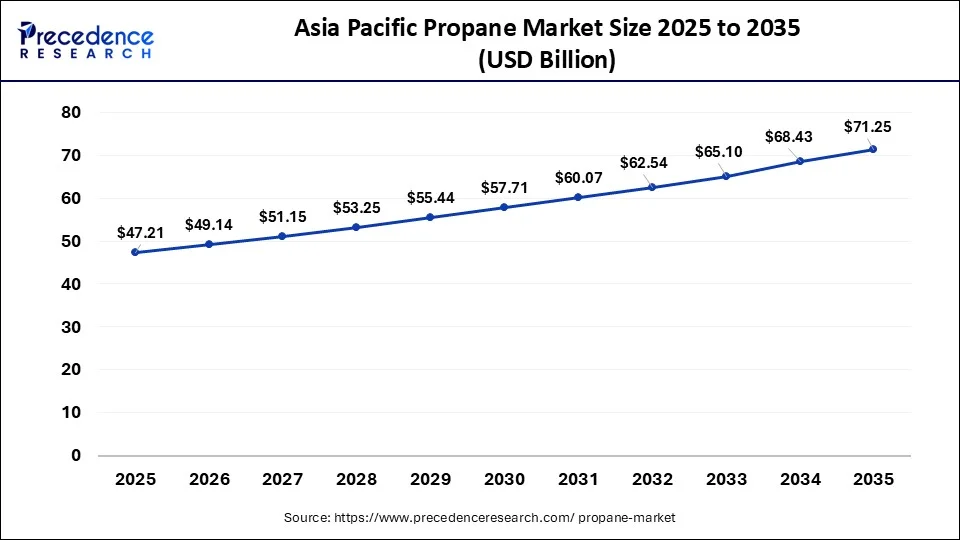
Asia Pacific is the leader of the propane market due to rapid industrial development, urbanization, growth of LPG distribution networks, demand for residential cooking, and increased use of petrochemicals. The increasing capacity of propane dehydrogenation and import requirements boosts demand in the region. The increasing energy consumption in developing countries leads to more long-term market opportunities.
China Propane Market Trends
China is a major propane market because of the development of the capacity of petrochemicals, propane dehydrogenation plants, and imports. The increasing production of propylene through propane is increasing the use
Why North America is Showing the Fastest Growth
North America has high demand for propane because of the high production of natural gas liquids along with established processing and storage infrastructure, residential heating, industrial usage, and the ability to successfully export. The region is also in a good place to export to different countries especially in Asia Pacific.
U.S. Propane Market Trends
The U.S. is the leading propane country in North America because of its high production of natural gas liquids as well as good processing infrastructure and storage facilities. The growth in domestic heating needs and high international demand ensure its important role in global propane supply.
What are the Advancements in the Propane Market in Europe?
Europe is expected to witness significant growth over the forecast years, driven by the need for cleaner energy alternatives and regulatory frameworks that help in promoting low-carbon solutions. Regulatory initiatives aimed at reducing carbon emissions and enhancing energy efficiency are gaining traction, fostering a shift towards propane in various sectors, such as transportation and heating. Germany and France are the leading players in the region.
Germany Propane Market Trends
The country's market landscape is characterized by strategic partnerships and investments in infrastructure to meet the rising demand, positioning it as a significant player in the global market. The region also has a strong presence of key companies, along with local distributors, which helps to ensure a steady supply of propane.
What are the Key Trends in the Propane Market in Latin America?
Latin America is expected to witness substantial growth in the market, driven by increasing industrial and energy demands. The region is also witnessing a growing focus on cleaner energy sources and government initiatives to promote propane as a viable alternative fuel drive market growth further. Regulatory support for energy diversification is also another key driver for its market adoption. Countries like Brazil and Mexico are leading players.
Brazil Propane Market Trends
The region is witnessing high levels of investments in infrastructure and distribution networks. This helps to balance economic growth with environmental sustainability, opening up various opportunities for market growth.
How is the Propane Market Growing in the Middle East and Africa Region?
The Middle East and Africa region is anticipated to have steady growth throughout the forecast period. This growth is due to the increasing demand for propane especially in residential and industrial applications, along with government initiatives aimed to diversify energy sources. Regulatory frameworks in the region also seem to be evolving to support cleaner energy solutions, thus boosting market adoption. Saudi Arabia, the UAE and South Africa are leading players.
Saudi Arabia Propane Market Trends
The country's market landscape includes both local firms and international players, all competing for market share. Investments in infrastructure and distribution networks are gaining traction, as the region seeks to leverage its natural resources for economic development and energy diversification.
Supply Chain Analysis
- Raw Material Sourcing: The initial stage deals with natural gas processing and crude oil refining, making its supply closely linked to upstream hydrocarbon production.
Key Players: ExxonMobil, Chevron, Conoco Phillips - Manufacturing Process: After the extraction process, propane is separated from other hydrocarbons through fractionation processes. It is then liquified or compressed for efficient storage.
Key Players: Shell, Valero, Phillips - Distribution Process: The finished propane is packaged and distributed through bulk storage, terminals, pipelines, tanker trucks and LPG carriers.
Key Players: SHV Energy, UGI Corporation, Ameri Gas
Value Cain Analysis
- Feedstock Procurement: Obtaining raw materials for the production of propane, including the sourcing and acquisition of natural gas and crude oil, from which the propane is extracted.
Key Players: Saudi Aramco, ExxonMobil, Shell - Chemical Synthesis and Processing: Extraction and purification of propane that is produced as a byproduct of crude oil refinement and other operations involving the processing of natural gas, plus odorization of propane for safety.
Key Players: ExxonMobil, Johnson Matthey - Quality Testing and Certification: This includes various tests and inspections to certify propane for its suitability and safety. Propane is tested against certain standards, like HD5 and others, for consumer use, which includes pressure tests and inspections.
Key Players: Bureau of Indian Standards (BIS) and the American Petroleum Institute (API) - Packaging/Labelling:The propane, as a liquefied substance, is stored and transported in pressurized cylinders and tanks, all the while being properly packaged and labeled with all the pertinent information required for consumer use and safety regulations.
Key Players: Manchester Tank, ProGas - Waste Management and Recycling:This consists of the treatment, management, and disposal of waste generated during the processes of producing, refining, and distributing propane in a manner that mitigates the environmental impacts and possibly recovers some resources.
Key Players: Antony Waste Handling Cell Ltd., Eco Recycling Ltd.
Competitive Landscape
The propane market is semi-consolidated in that few large producers/suppliers exist, but a bunch of regional ones nonetheless. Barriers to entry are moderate and exist thanks to scale, infrastructure, access to supply, and established distribution channels.
The most prominent industry players include ExxonMobil, Chevron, Phillips 66, Enterprise Products Partners and AmeriGas Partners, which have large production, storage, transportation and distribution capacities. Competition in the industry is influenced by capacity increases, investments in infrastructure, and supply contracts and deals.
New entrants encounter various hurdles owing to capital-intensive nature of infrastructure investments, compliance with safety regulations, environmental requirements, storage standards, as well as constantly changing feedstock prices, while competition will rely on supply sustainability, efficiency, and geographic reach in the future.
Propane Market Companies
- BP plc
- Chevron Corporation,
- Royal Dutch Shell plc,
- Anadarko Petroleum Corporation,
- ConocoPhillips,
- Reliance Industries Ltd.,
- PetroChina Company Limited,
- Sinopec,
- Evonik, Sika AG,
- Total SA,
- Eni S.p.A,
- Marsh LP Gas Company Inc.,
- Statoil ASA,
- Ferrellgas Partners L.P.
Recent Developments
- In March 2025, TCL introduces a propane heat pump for residential use, providing hot water up to 75C and achieving a performance coefficient of 5.0, with sound levels of 48-66db(A). (Source: https://www.pv-magazine.com)
- In March 2025, South Carolina's independent propane companies launched the South Carolina Independent Propane Providers (SCIPP) website, aiming to educate policymakers and the public about their role in job creation and economic growth. (Source: https://www.lpgasmagazine.com)
Segment Covered in the Report
By End Use
- Industrial
- Commercial
- Residential
- Transportation
- Agriculture
- Chemicals and Refineries
By Grade
- HD-5 Propane
- Others
By Geography
- North America
- Europe
- Asia-Pacific
- Latin America
- Middle East & Africa (MEA)
For inquiries regarding discounts, bulk purchases, or customization requests, please contact us at sales@precedenceresearch.com
Frequently Asked Questions
Tags





Ask For Sample
No cookie-cutter, only authentic analysis – take the 1st step to become a Precedence Research client
 Get a Sample




 sales@precedenceresearch.com
 Schedule a Meeting
