



Quantum Technology Market Size, Key Companies, Company Product Portfolio, Digital Transformation, Technology Investment, Adoption Rates, Customer Acquisition, Company Market Share, and Market Outlook
Quantum Technology Market (By Quantum Computers: Superconducting Qubits, Trapped Ions, Neutral Atoms, Photonic Quantum Computing, Quantum Dots; By Quantum Sensors: Atomic Clocks, Quantum Magnetometers, Gravitational Sensors, Quantum Accelerometers, Quantum Imaging Sensors, Quantum Gyroscopes; By Quantum Communication: Quantum Key Distribution QKD, Quantum Teleportation, Quantum Repeaters, Quantum Internet) - Global Industry Analysis, Size, Trends, Leading Companies, Regional Outlook, and Forecast 2026 to 2035
Source: https://www.precedenceresearch.com/quantum-technology-market
 Get a Sample
 Table Of Content


What is the Quantum Technology Market Size?
The global quantum technology market size is calculated at USD 1.62 billion in 2025 and is predicted to increase from USD 1.99 billion in 2026 to approximately USD 11.12 billion by 2035, expanding at a CAGR of 21.24% from 2026 to 2035.
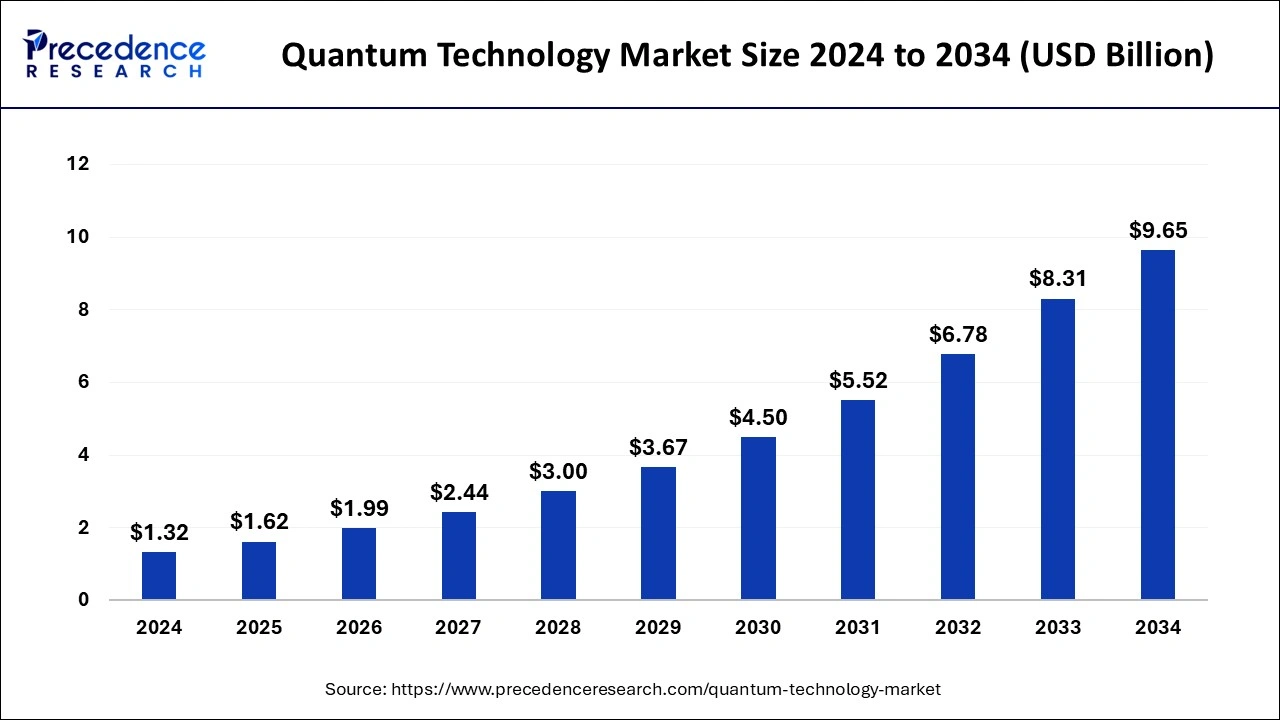
Quantum Technology Market Key Takeaways
- In terms of revenue, the global quantum technology market was valued at USD 1.32 billion in 2025.
- It is projected to reach USD 9.65 billion by 2035.
- The market is expected to grow at a CAGR of 22.01% from 2026 to 2035.
- North America dominates the quantum technology market in 2025.
- Europe showed notable growth in the in recent years the market.
- By quantum computers, the superconducting qubits segment is anticipated to show significant growth in the market over the foreseeable future.
- By quantum computers, the photonic quantum computing segment is expected to register the fastest growth in the market in the upcoming years.
- By quantum sensors, the atomic clocks segment dominated the market in 2025.
- By quantum sensors, the quantum magnetometers segment is projected to show the fastest growth in the market over the forecast period.
- By quantum communication, the quantum key distribution QKD segment is dominated the market globally in 2025.
- By quantum communication, the quantum internet is anticipated to grow at faster rate in the market during the foreseen period.
Market Overview
The quantum technology market is an emerging market that revolves around the adoption of technology based upon the quantum state of the sub-atomic particles such as electrons, protons, and neutrons. Quantum technology is based upon a principle from quantum mechanics known as quantum superposition, quantum entanglement, and quantum tunneling.
Quantum technology encompasses the field of mechanics, engineering, and quantum physics, which is anticipated to give complete access to the motion of the subatomic particle, which leads to generating the desired output at the end of the technological device which works upon quantum technology. Some of the emerging quantum technology-based applications are quantum computing, sensors, cryptography, imaging, measurement and simulation, space navigation, and quantum energy generators.
The quantum technology market encompasses wide applications of quantum technologies in the fields of healthcare, medical research, pre-detection of natural disasters, earth observation, space exploration, etc. Sensors can be mounted in MRI machines used in the healthcare domain for medical imaging. Thus, due to its accuracy and higher speed of working, including continued development and research to achieve quantum supremacy by major players poised to grow the market at a significant level across the globe.
Quantum Technology Market Growth Factors
- Advancements in the area of quantum computing, such as improvements in qubit stability and the ability to correct errors.
- Increased computational power led to solving major complex problems on huge datasets.
- Establishments of quantum research institutions and hubs collaboratively.
- Collaboration between governments and academic institutions to propel quantum technology to achieve quantum supremacy.
- Increased number of private coaching and online classes about quantum technology and its applications.
- People are raising awareness about the huge potential hidden in developing quantum technology to revolutionize humanity completely.
- Rising demand for enhanced computational power in a field such as healthcare, material science, finance, etc.
- Need for secure communication by using advanced technology like quantum key distribution-QKD.
- Development of quantum software and hardware to improve computational powers.
Market Scope
| Report Coverage | Details |
| Market Size in 2025 | USD 1.62 Billion |
| Market Size in 2026 | USD 1.99 Billion |
| Market Size by 2035 | USD 11.12 Billion |
| Market Growth Rate from 2026 to 2035 | CAGR of 21.24% |
| Largest Market | North America |
| Base Year | 2025 |
| Forecast Period | 206 to 2035 |
| Segments Covered | Quantum Computers, Quantum Sensors, Quantum Communication, and Regions |
| Regions Covered | North America, Europe, Asia-Pacific, Latin America, and Middle East & Africa |
Market Dynamics
Driver
Rising demand for exceptional computational powers
The major driver for the quantum technology market would be the increasing demand for exceptional computational power, which is able to resolve highly complex problems in less time than conventional methods of computing, which creates new insight and helps build a robust quantum system. Quantum computing is a method that holds tremendous potential to speed up the calculation powers needed in a certain field, such as finance, to analyze and manage risk involved in investments on a larger scale that reduces chances of failure or huge loss to the company or individual. Similarly, material science also needs a high calculating power as it deals with a material on its subatomic levels, which is hard to analyze by major or physical instruments.
Healthcare will be again a new avenue for quantum technology and its application for medical science and studies or research regarding it to develop precise medical equipment that monitors significant health measures of the patients in real-time and aids in faster treatment plans, particularly in severe medical cases and emergencies. In summary, quantum technology can create a revolutionary change in the human race due to its efficiency and accuracy, which applies to almost every field, and it will inevitably pervade the sectors of science like space exploration beyond a human limit or physical limit. Thus, all these factors and the numerous possibilities for building highly precise technology through the quantum phenomenon drive the quantum technology market exponentially across the globe.
Restraint
The highly unstable nature of qubits
A significant challenge that can be faced by the quantum technology market is the highly unstable nature of the qubits. A qubit is basically a small unit of the data in the quantum world, like bits in classical computations, which refers to either a 0 or 1 value. Since the subatomic particles are highly in the state of continuous vibrations, it is unpredictable which state they will create, as they are generally in the state of superposition, which means these particles always stay in the two states of possibilities at the same time. It shows a single state only when the wave function collapses, called “quantum decoherence.” despite the highly advanced techniques, it is harder to manipulate these states of the quantum particles, which gives the desired result as they move quickly if they get obstructed or observed, particularly by any kind of machine. Hence, to manipulate the quantum state, scientists need to control the environment around it and create a more sophisticated space where quantum particles can act without an observer.
To create and sustain such states is extremely difficult because even a minor change in temperature can affect quantum particles and create errors in calculations. They need extremely low temperatures to work efficiently, which makes it an expensive and complex process to stay by. Also, substantial changes are still needed to do error corrections and predictions in qubit coherence, which makes quantum systems viable for commercial use on a wider scale. Thus, to overcome such challenges, one needs to walk the extra mile to achieve quantum supremacy.
Opportunity
Ultra-secure communications networks
The significant future opportunity for the quantum technology market would be a highly secure communication network and its widespread availability across the globe, the same as that of existing internet connection but with ultra-secure systems using quantum technology in networks. Existing communication networks provide security in a number of ways, but encryption is still prone to be violated by unauthorized access and hackers. Hence, the development of a secure communication system will create a sustainable and reliable network where data leakage is nearly impossible. This highly secured system can be achieved by using two basic principles of quantum mechanics: quantum entanglement and quantum key distribution.
Quantum entanglement refers to the system where two subatomic particles are entangled in a way that even if they are separated over a farthest distance, a small spin change in one particle can impact and change the state of the other one where it is entangled. QDK- quantum distribution key is the method used in the encryption of data, where one atom can be sent with data that is entangled with another atom.
A small spin change occurs in an atom due to the invasion by an unauthorized source, while data transmission can be detected by another entangled atom since it is able to show the same changes as the atom that is sent with the encrypted message. Although this technology is in the incubation process and maybe some decades away from manifesting, it holds an immense potential to drastically change every sector like finance, research, healthcare, retail, IT, and telecommunication, and it can even be used for military purposes to build a robust security system.
Segment Insights
Quantum Computers Insights
The superconducting qubits segment is anticipated to show significant growth in the quantum technology market over the foreseeable future. The growth of this segment is due to several factors, including technological maturity and extensive investments done by major players in the development of superconducting qubits. Superconducting qubits are basically utilizing highly conducting circuits to create and manipulate qubits. Leading tech companies like IBM and Google have extensively invested in this technology as it is the understood and thus developed technology so far in the market. Additionally, superconducting qubits are the most commercially viable quantum technology using multiple companies that are able to offer quantum processors and services in the market.
- In May 2023, IBM signed a USD 100 million partnership with global universities to develop a 100,000-qubit quantum-centric supercomputer.
The photonic quantum computing segment is expected to register the fastest growth in the quantum technology market in the upcoming years due to its scalability in integrating over existing fiber optic communication infrastructure. The recent developments in photonic chips facilitate more efficient and compact yet powerful quantum processors.
Quantum Sensors Insights
The atomic clocks segment dominated the quantum technology market in 2024 owing to their established technology in the quantum world and highly precise output. Atomic clocks are used in a wide range of applications, such as GPS systems, to generate accurate time and location of the moving object to help in precise navigation further. Hence, quantum sensors like atomic clocks can be used again in the telecommunication sector for data transmission synchronously and ensure efficient plus reliable/secure data transmission. Due to its accuracy, the economic impact of applications of atomic clocks in various sectors like finance and healthcare, where precision is required most, are propelling factors of the atomic clock segment in the quantum technology market.
The quantum magnetometers segment is projected to show the fastest growth in the quantum technology market over the forecast period. The growth of this segment is owing to the sensitivity they offer towards magnetic fields, which is immense compared to conventional magnetometers. These magnetometers have a number of applications in fields like healthcare, where non-invasive diagnostic tools like medical imaging fuel the demand for quantum magnetometers to measure sensitive biomagnetism. Further, it can also be applicable to fundamental research in physics, exploration in the geophysical sector, and security screening.
Quantum Communication Insights
The quantum key distribution QKD segment is dominated the quantum technology market globally in 2024. The growth of this segment is attributed to factors like secure communication, protection against malware attacks, and government and private institutions highly investing in the development of OKD due to its benefits of ultra-high security measures. Quantum key distribution technique is developed up to a certain stage where protocols are standardized, which facilitates the deployment and integration of this technology into existing communication infrastructure, fuelling the growth of this segment on a wider scale.
The quantum internet is anticipated to grow at a faster rate in the quantum technology market during the foreseen period. The concept of a quantum internet is connecting the quantum devices and quantum computers globally so that they can be in sync for working mode and, thus, deliver efficient and fastest possible results. Although this technology is still in its initial stage, there are many institutions working on developing an infrastructure for quantum internet, like quantum repeaters, routers, and distributors, which will accelerate the growth of this segment in the market.
Regional Insights
What Makes North America the Dominant Region in the Market?
North America dominates the quantum technology market, driven by substantial investments, advanced research, and strategic initiatives. The United States leads with significant funding from both government agencies and private corporations. Major tech companies like IBM, Google, NASA, and Microsoft are at the forefront, pioneering advancements in quantum computing, communication, and sensing. For instance, In March 2023, the National Aeronautics and Space Administration (NASA) launched a new quantum detector in a collaborative effort by JPL and Caltech. The detector is expected to transform the ways in which geographically separated quantum computers over large distances will be able to share huge quantities of quantum information.
Canada also plays a critical role, with institutions for Quantum Computing contributing to cutting-edge research. The region's robust ecosystem includes startups and established firms collaborating to push the boundaries of quantum technology. The presence of a skilled workforce and strong intellectual property further bolsters North America's dominant position. This leadership is expected to continue as the region invests hugely in developing quantum technologies and integrating them into various industries.
What Makes Asia Pacific a Significant Region in the Market?
Asia Pacific has emerged as a significant player in the global quantum technology market. Countries like China, Japan, South Korea, and Singapore have experienced rapid economic growth, leading to increased investments in research and development, including quantum technology. Asia Pacific is home to renowned research institutions and universities with expertise in quantum science and technology. Institutions and Universities are leading research in quantum computing, communication, and sensing.
Regional collaborations and partnerships, such as the Quantum Alliance Initiative in Japan and the Quantum Technology Flagship in Europe, are facilitating knowledge exchange and accelerating the development and adoption of quantum technologies. With a rapidly expanding economy and a large population, the region presents significant market opportunities for quantum technologies, especially in areas such as telecommunications, finance, and manufacturing.
What Drives the Market in Europe?
Europe showed a notable growth in the recent years in the quantum technology market. As a result, there is a growing demand for quantum solutions and services across various sectors. Additionally, Europe is also leading efforts in quantum-safe cryptography, developing encryption methods that are resilient to quantum attacks. This focus on cybersecurity is driving investment and innovation in quantum-safe solutions.
The growth of this region includes Europe, which has world-class research institutions and universities with expertise in quantum science and technology. Institutions like CERN, ETH Zurich, and the University of Oxford are leading quantum research efforts. A growing number of startups and established companies in Europe are entering the quantum technology space. These companies are developing innovative quantum computing hardware, software, and applications, contributing to market growth.
- In February 2023, Europe introduced a new project to help quantum startups deal with the need for accelerated hardware production using currently existing pilot infrastructure lines. Industries, including finance, healthcare, and automotive, are increasingly recognizing the potential of quantum technologies to address complex challenges.
How is the Opportunistic Rise of Latin America in the Quantum Technology Market?
Latin America is expected to experience an opportunistic rise in the market. This is mainly due to the increasing adoption of quantum technologies across various sectors such as defense, healthcare, and environmental monitoring. As several nations in the region continue to seek to enhance their security infrastructure, improve diagnostic precision, and address complex geophysical challenges, quantum technology is emerging as a critical enabler of innovation. Key factors that are driving the region's market include advancements in quantum coherence control and the integration of sensors into autonomous systems, thus positioning it as a vital hub for quantum-based applications.
What Opportunities Exist in the Middle East & Africa for the Quantum Technology Market?
The Middle East & Africa (MEA) offers immense growth opportunities in the market. These opportunities arise from the region's increasing recognition of quantum computing's transformative potential across sectors such as energy, finance, healthcare, and government. As regional governments and private enterprises strive to harness quantum advantages, early investments and strategic collaborations are also increasing, thus positioning the region as an emerging hub for quantum innovation.
Quantum Technology Market Companies
- D-Wave Quantum Inc.: It is a publicly traded, full-stack quantum computing company known for pioneering quantum annealing and now advancing into gate-based superconducting quantum computing.
- Amazon Braket: It is a fully managed quantum computing service that provides researchers, developers, and enterprises with unified, on-demand access to a broad array of quantum hardware technologies and simulation tools.
- IBM: In the field of quantum computing, IBM maintains a leading position through its robust hardware portfolio, open-source tooling, and comprehensive cloud services.
- IonQ: It is a public quantum computing company, specializing in trapped ion quantum computers and offers a full-stack quantum platform accessible via major cloud services like Amazon Braket and its own IonQ Quantum Cloud.
- Google Quantum AI: It is working to develop practical and transformative quantum computing technologies, combining advances in superconducting hardware with cutting-edge quantum software.
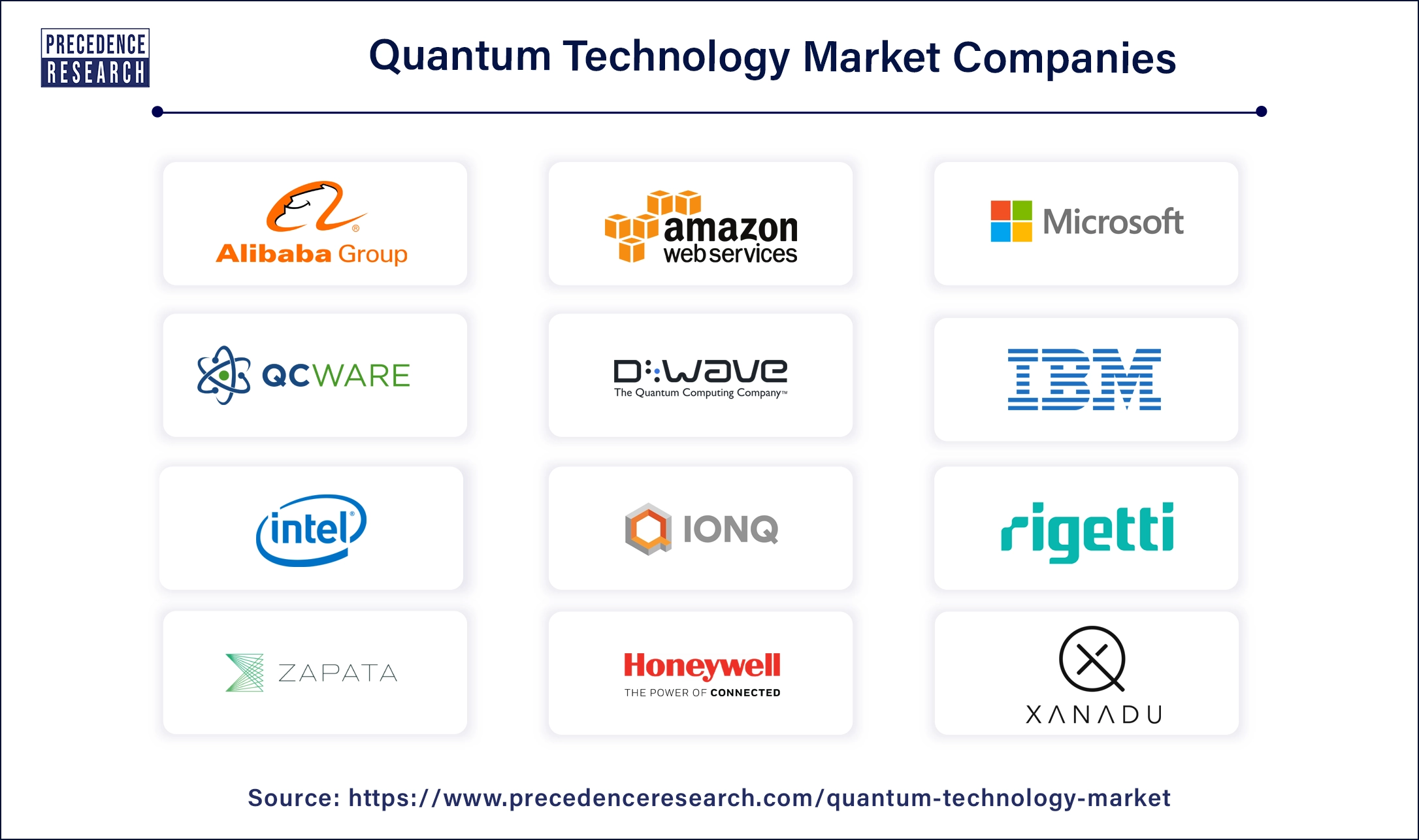
Other Major Key Players
- IBM
- Alibaba Group
- D-Wave Systems
- Toshiba
- IonQ
- Rigetti Computing
- QC Ware
- Microsoft
- Xanadu
- Honeywell Quantum Solutions
- Zapata Computing
- Amazon Web Services
- Rigetti Computing
- Intel
Recent Developments
- In December 2025, IBM announced its commitment to skill 5 million learners across India in Artificial Intelligence (AI), cybersecurity, and quantum computing by 2030. Through this initiative, IBM will expand AI and emerging technology education across schools, universities, and vocational and skilling ecosystems. It will collaborate with institutions like All India Council for Technical Education (AICTE) to drive hands-on AI learning pathways and faculty enablement programs, curriculum integration, hackathons, and internships.
(Source: financialexpress.com ) - In December 2025, MicroCloud Hologram Inc., a technology service provider, innovatively launches a quantum-enhanced deep convolutional neural network image 3D reconstruction technology system. This system first utilizes a quantum convolutional neural network to complete the feature extraction of input images, then generates the core parameters of the 3D model through quantum fully connected layers, and finally imports these parameters into the quantum-optimized 3D model to complete the reconstruction, forming a unique advantageous technical mode.
(Source: finance.yahoo.com ) - In June 2023, IBM, a global technology company and a significant player in the quantum technology industry, announced a new breakthrough. The company, for the first time, demonstrated that quantum computers can produce accurate results at a scale of 100+ qubits.
- In October 2023, researchers at the Indian Institute of Technology (IIT) - Delhi achieved a monumental feat by securing quantum communication over a distance of 380 km using standard fiber used in the telecom industry.
Segments Covered in the Report
By Quantum Computers
- Superconducting Qubits
- Trapped Ions
- Neutral Atoms
- Photonic Quantum Computing
- Quantum Dots
By Quantum Sensors
- Atomic Clocks
- Quantum Magnetometers
- Gravitational Sensors
- Quantum Accelerometers
- Quantum Imaging Sensors
- Quantum Gyroscopes
By Quantum Communication
- Quantum Key Distribution QKD
- Quantum Teleportation
- Quantum Repeaters
- Quantum Internet
By Geography
- North America
- Asia Pacific
- Europe
- Latin America
- Middle East & Africa
For inquiries regarding discounts, bulk purchases, or customization requests, please contact us at sales@precedenceresearch.com
Frequently Asked Questions





Ask For Sample
No cookie-cutter, only authentic analysis – take the 1st step to become a Precedence Research client
 Get a Sample




 sales@precedenceresearch.com
 Schedule a Meeting
