



Spices and Seasonings Market Size, Key Companies, Company Expansion Strategies, Food Processing Capacity, Sales Performance, Export Analysis, Consumer Preferences, Company Investment Strategies, and Market Positioning
Spices and Seasonings Market (By Type: Spices, Herbs, Salt & Salt Substitutes; By Application: Meat & poultry products, Snacks & convenience food, Soups, sauces, and dressings, Bakery & confectionery, Frozen products, Beverages, Others; By Nature: Organic, Conventional; By Form: Whole, Crushed, Powder; By Distribution Channel: Food Service, Retail) - Global Industry Analysis, Size, Trends, Leading Companies, Regional Outlook, and Forecast 2026 to 2035
Source: https://www.precedenceresearch.com/spices-and-seasonings-market
 Get a Sample
 Table Of Content


What is the Spices and Seasonings Market Size?
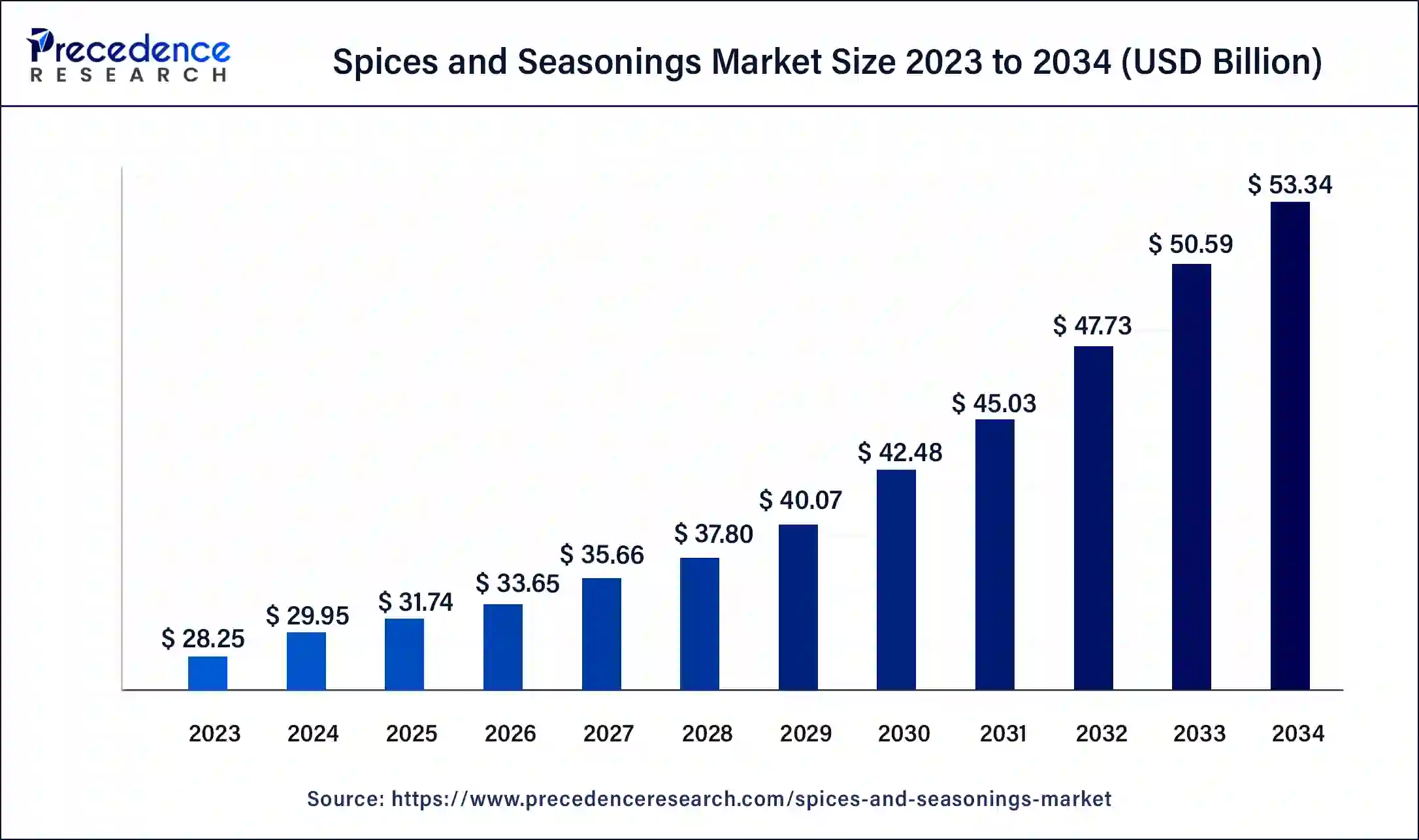
The global spices and seasonings market size is calculated at USD 31.74 billion in 2025 and is predicted to increase from USD 33.65 billion in 2026 to approximately USD 56.16 billion by 2035, expanding at a CAGR of 5.87% from 2026 to 2035. Due to rising demand for convenience foods, ethnic cuisines, clean label ingredients, and increasing consumer preference for natural favours and healthier food products.
Market Highlights
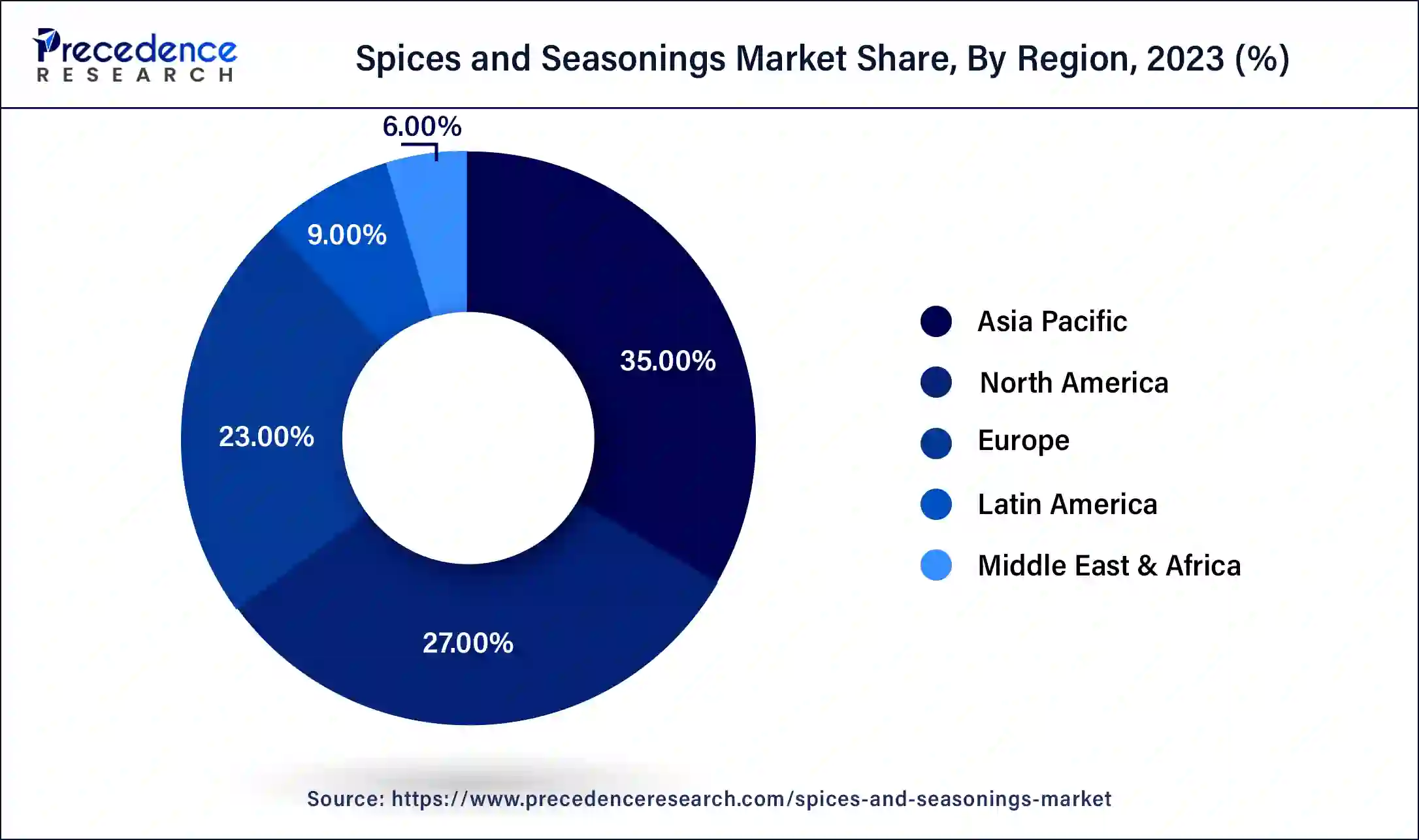
- Asia Pacific led the global market with the highest market share of 39% in 2025.
- Europe region is estimated to expand the fastest CAGR between 2026 and 2035.
- By Type, the spices segment has held the largest market share in 2025.
- By Application, the meat and poultry segment captured the biggest revenue share in 2025.
Market Overview
Growth in the global market of spices and seasonings industry has been consistent owing to an increasing trend among consumers towards the need for genuine taste, healthy ingredients, and varied cuisine experience, the increasing demand for different international cuisines as well as the increase in food service activity contributes positively to this effect.
The demand is also increasing because of the fast growth of convenience foods, ready-to-eat foods, and packaged food items that uses spices and seasoning to hence their taste and odour, producers are now offering various seasoning mixes that are either organic or clean label or have low sodium content to cater to the changing consumer demands.
The Asia Pacific region, continue to be dominant regional market owing to its reach food culture, high population of consumers, and large scale production of spices, where as the North American and European regions are projected to witness steady growth on account of increasing multicultural foods, future growth will be attributed to improvements in food processing, expansion of retail and online sales channels, and health consciousness of consumers regarding natural spices.
AI in the Spices and Seasonings Market
Artificial Intelligence is significantly transforming the landscape of the spices and ingredients industry across various domains, including Research and Development, supply chain management, production processes, and commercial strategies. AI possesses substantial potential to standardize the evaluation of spice quality, safeguard authenticity, and promote intelligent, efficient production methods. The formulation of spice blends is now enhanced through AI, resulting in expedited creation processes and greater consistency in flavor profiles. AI-enabled production monitoring employs sensors and algorithms to predict variables such as moisture levels, flowability, and blending uniformity in seasoning powders. This proactive approach effectively mitigates issues related to clumping, segregation, and dosage inaccuracies.
Trade Analysis of Spices and Seasonings
- During the fiscal year 2025-2026, India exported 1.734 million tons of spices and spice products, generating revenue of approximately USD 4,430.90 million.
- The primary export markets for Indian spices include the United States, China, the United Arab Emirates, Bangladesh, Saudi Arabia, the United Kingdom, Thailand, Malaysia, Indonesia, Sri Lanka, Germany, the Netherlands, Canada, Nepal, and Australia, among others.
- In 2025, the United States imported spices valued at $414 million, ranking as the 557th most imported product out of a total of 1,232 products.
- The leading sources of spice imports to the United States in 2025 were India ($79.1 million), China ($50.6 million), Peru ($50.1 million), Turkey ($41.8 million), and Spain ($29.9 million).
Spices and Seasonings Market Growth Factors
- The spices and seasonings are broadly used to add flavor, fragrance, variety, and taste to food and refreshments, and here and there likewise as additives or antibacterial specialists. Comfort food makers utilize these traits of spices and seasonings to further develop their item quality and taste and increment their time of usability. Customer readiness to explore different avenues regarding new spices and expanding interest in ethnic preferences has created a multiplication in item contributions and an expansion in the offer of spices and seasonings. The progress of this industry can likewise be credited to its reaction to customer interest for better items, comfort, and an assortment of spices.
- The significant patterns impacting the spices and seasonings market are the expansion popular for handled meat and comfort items, clean names progressively becoming required, and an ascent in inclination for regular ingredients and spices. Shoppers are starting to put more worth on food sources that offer them help other than taste, and thus, interest in solid, regular, and safe food items is on the ascent.
- An expanded inclination for western cooking and a social blend in food space has uplifted the interest for spices and spices as zest extricates. As spices are a significant gathering of enhancing specialists, zest blends have turned into an imminent portion for developments. Another excellent explanation reinforcing the interest for flavor mixes and spices is the changing buyer inclination, wherein a remarkable interest has been created in worldwide and ethnic food. The headway of epitome has prompted its application in pretty much every area of the food and refreshment industry. A comparative sort of use design has likewise been seen in the spices and seasonings market. A portion of the critical makers in the flavor and scent industry has been benefiting from the flavor variations in embodied designs.
- European interest inspices and seasonings is expected to enroll the most elevated CAGR of 6.8% over the gauge period. The chief end clients of spices and spices in all EU markets can be partitioned into three portions: modern, retail, and catering. In practically all EU nations, the biggest extent, being 55%-60% (and in certain nations much a greater amount of) the all-out utilization of spices and spices, is consumed by the modern area. The retail area consumes 35%-40% and the providing food area, 10%-15%. In many business sectors, the proportion moves towards higher relative utilization by the modern area, mirroring the developing ubiquity of prepared-to-utilize spices and seasonings combinations.
- The novel Covid-19 pandemic had fundamentally affected practically all enterprises across the globe. This pandemic has brought about large-scale manufacturing closures and inventory network interruptions, which has impacted the economy too.This sickness has a variable effect in various nations relying upon their social standards, moderation endeavors, and wellbeing framework, and every nation is resolving its method for battling against the pandemic. Be that as it may, different examination studies are expressing the utilization of specific spicesthat could support our insusceptibility which could assist us with battling goliaths Covid as well as numerous different infections.In the ongoing situation, it has become critical to support the resistance to battle Covid, alongside keeping up with the cleanliness and following all clinical warnings that have been set down. Indeed, even the rules given by World Health Organization (WHO) in its COVID-19 examination recommend the total populace eats resistant helping food varieties. Consequently, the interest for restorative spices separates conveying properties of helping human resistance is at the flood in the drugs and nutraceuticals industry.
- The overall lockdown, in any case, has additionally impacted cultivating rehearses, which has exceptionally affected the stock of unrefined components of spices and seasonings. The COVID-19 effect on planned operations additionally adds to the expanded costs of unrefined components, which supports the expense for restorative spices and seasonings makers. With hindrances to cross-line transportation of wares in this pandemic circumstance, makers are exceptionally reliant upon neighborhood unrefined substance providers, which expands the bartering force of providers. Subsequently, the expanded natural substance costs, trailed by the appeal for spices and seasonings, would prompt an expanded cost of restorative spices and seasonings for the following couple of years.
Key Market Trends
- There is a growing emphasis on health and wellness, which is leading to an increased demand for spices and seasonings that offer health benefits. Products that are organic, natural, and free from artificial additives are becoming more popular in the market.
- Consumers all over the world are increasingly interested in exploring global cuisines, which is further driving the demand for a wider variety of spices and seasonings. This trend highlights the desire for unique flavors and cooking experiences.
- The rise of e-commerce platforms is transforming the way consumers purchase spices and seasonings. These platforms provide better access to diverse products, allowing consumers to discover niche brands and specialty items.
- The popularity of flavors such as umami and spicy profiles is gaining traction, driving demand for specific spices that enhance culinary creations. This trend towards flavor experimentation is likely to compel manufacturers to come up with innovative and diverse seasoning options.
Market Scope
| Report Coverage | Details |
| Market Size in 2025 | USD 31.74 Billion |
| Market Size in 2026 | USD 33.65 Billion |
| Market Size by 2035 | USD 56.16 Billion |
| Growth Rate from 2026 to 2035 | CAGR of 5.87% |
| Largest Market | Asia Pacific |
| Base Year | 2025 |
| Forecast Period | 2026 to 2035 |
| Segments Covered | Type, By Application, Nature, Form, Distribution Channel, and Region |
| Regions Covered | North America, Europe, Asia-Pacific, Latin America, and Middle East & Africa |
Market Dynamics
Drivers
Rising trend of culinary experience
The rising trend of culinary experiences significantly contributes to the growth of the market. As people explore diverse cuisines and flavors, they seek out a wide range of spices and seasonings to enhance their dishes. This demand for unique an exotic flavor has driven the market, prompting manufacturers to offer a variety of options to cater to consumer preferences. Additionally, the popularity of cooking shows, food blogs and social media platforms has further fueled this trend. Many television channels have started food shows that offer culinary experiences. This inspires individuals to experiment with different ingredients and create their own signature dishes, consequently boosting the demand for a diverse range of spices and seasonings.
Restraint
Disruptions in the global supply chain
Global supply chain disruptions can majorly impact the spices and seasoning market by causing delays in sourcing and distributing products. Fluctuations in transportation availability, increased shipping costs and customs-related issues can lead to supply shortages and price volatility. This can affect the ability of manufacturers and retailers to maintain consistent product availability, potentially leading to dissatisfied customers and reduced sales. Additionally, these disruptions may necessitate adjustments in sourcing strategies, which can lead to higher procurement costs and complexity in managing suppliers from various regions. Thus, the element associated with the supply chain is observed to hinder the market's growth.
Opportunity
Expanding food industry
The expanding food industry across the globe creates a significant opportunity for the global spices and seasonings market. As new food products are being developed and introduced, there is a need for a wide variety of spices and seasonings to cater to diverse consumer preferences. This expansion includes the growth of restaurants, ready-to-eat-meals, packaged foods and culinary innovation, all of which require high-quality spices and seasonings to enhance taste and appeal. By aligning with the trends and demands of the evolving food industry, the spices and seasonings market can position itself for greater market penetration.
Challenges
Fluctuations in agricultural practices
Fluctuations in agricultural practices can be a major challenge for the global spices and seasonings market. These fluctuations can lead to inconsistent crop yields and quality, making it challenging for suppliers to maintain them as a steady and reliable source of raw materials. Variations in weather conditions, pest infestations and diseases can all impact the quantity and quality of the final product. Moreover, unpredictable agricultural practices can result in price volatility due to supply shortages and surpluses. This can lead to increased costs for manufacturers and potentially higher prices for consumers, affecting the overall demand for spices and seasonings.
Segments Insights
Type Insights
Why the Spices Segment Dominates the Spices and Seasonings Market?
The spices segment dominated the Spices and Seasonings market in 2025, Due to their extensive use in cooking, food processing, and food services, consumer inclination toward natural flavouring agents, preference for ethnic foods, and the health advantages of spices like antioxidant and anti-inflammatory nature has further cemented the dominant market position of this category.
Herbs Segment expects the fastest growth in the market during the forecast period, Due to the rising consumer preference for clean label, and organic products, the increased consumption mediterranean and plant-based diets together with the increased application of herbs in functional foods and beverages has contributed to this trend.
Application Insights
Why the Meat & poultry products Segment Dominates the Spices and Seasonings Market?
The meat & poultry products segment dominated the Spices and Seasonings market in 2025, due to the extensive use of spices and seasoning mixes in meat preparation that are fresh, prepared, or pre-cooked, the increasing popularity of marinated and convenience meat preparations, together with the preference for a strong and ethnic flavours, reinforcing the dominance of this segment.
Snacks & convenience food Segment expects the fastest growth in the market during the forecast period, due to rising preference for ready-to-eat and on-the-go products, people are demanding bold, innovative, and did the national flavours leading to the introduction of novel seasoning mixes by companies, the rapid pace of urbanisation and rising snack consumption in packaging form are other factors boosting the growth of this category.
Nature Insights
Why The Conventional Segment Dominates the Spices and Seasonings Market?
The conventional segment dominated the Spices and Seasonings market in 2025, because of their wide availability, low prices and presence in different segments of retail, food service and food processing industries, well-developed supply chain, good quality and a large scale of production of conventional spice is determined their popularity among manufacturers and consumers.
Organic Segment expects the fastest growth in the market during the forecast period, due to the growing inclination of consumers towards natural foods and label- with no chemicals used, the increased consciousness about health, availability of organic spices and demand for quality ingredients have been driving the trend towards organic seasonings.
Distribution Channel Insights
Why the Retail Segment Dominates the Spices and Seasonings Market?
The Retail segment dominated the Spices and Seasonings market in 2025, because of the well- connected network of supermarket, hypermarket, specialty stores, internet grocery stores, availability, varied choice of brands, increase in cooking practises at home, and increased consumption of packaged spices and seasonings have ensured that retail consumers first choice across the world.
Food Service Segment expects the fastest growth in the market during the forecast period, due to owing to the fast growth in the restaurants, quick service chains, cafes, and cloud kitchens, growing consumer preference for delicious and authentic meals along with the growing trend of eating out is fuelling the consumption of high- quality spices and customised seasoning mixes with thin the food service industry.
Form Insights
Why the Powder Segment Dominates the Spices and Seasonings Market?
The Powder segment dominated the Spices and Seasonings market in 2025, because it was easier to use, had a better shelf-life, and had good mixing abilities, spices that are in powdered from the extensively used in cooking at home, in processed foods, and also in foodservice sector because they give uniform taste, easy formulation, and storage.
Crushed Segment expects the fastest growth in the market during the forecast period, due to growing consumer inclination towards genuine texture and fresh flavours, the rising popularity of gourmet cooking and gourmet food products, beside the rising food service industry, is anticipated to increase the usage of crushed spices and herbs.
Regional Insights
Why Asia Pacific is Dominating the Spices and Seasonings Market?
Asia Pacific is dominate the Spices and Seasonings market, due to its diverse culinary culture, population and spice production in countries like India, China, Vietnam, and Indonesia, increasing consumption of packaged foods, rising food service operations, higher exports, and higher consumer demand for authentic local flavours will keep fuelling the dominance of the region.
- India, being the largest producer of spices and seasonings in the region has witnessed a surge in the exports of spices this year. In FY2023, India exported spices almost worth $4 billion, this is an increase of 4.74% as compared to FY2022.
- The spice production in China is expected to reach at 1.2 million metric tons in 2026, registering a growth of 0.5% annually.
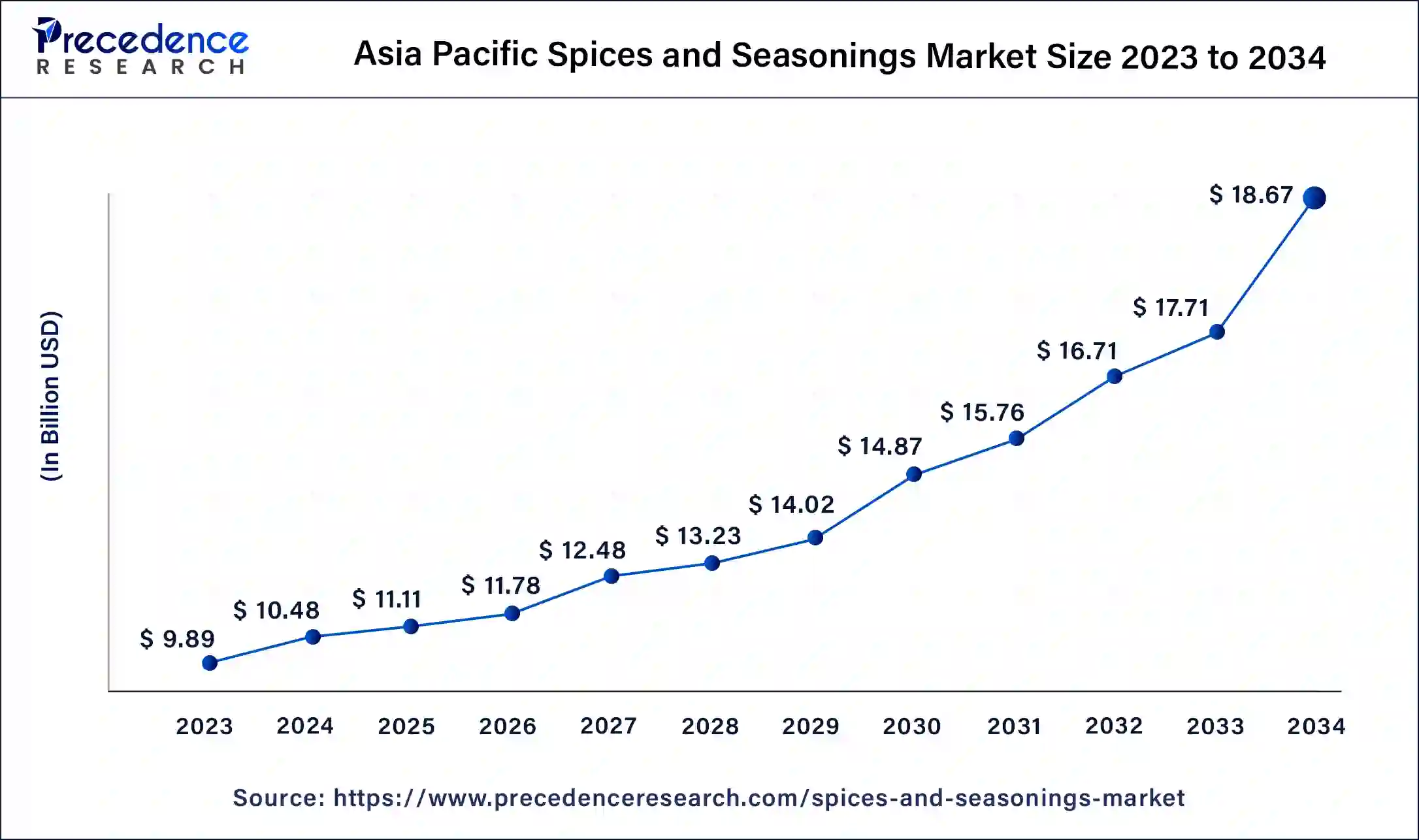
Asia Pacific Spices and Seasonings Market Size and Growth 2026 to 2035
The Asia Pacific spices and seasonings market size is valued at USD 11.11 billion in 2025 and is predicted to be worth around USD 19.66 billion by 2035, at a CAGR of 5.80% from 2026 to 2035.
China Spices and Seasonings Market Trends
Due to the presence of thriving food processing industry, growth in the packaged foods sector, and high demand for tasty and convenient meals, the factors of rising disposable income levels, fast urbanisation, and growing consumer preference for gourmet, natural and foreign seasonings are driving growth in China.
North America Expects the Significant Growth in the Market
Due to the growing popularity of convenience foods, ethnic food trends, and natural/ organic ingredients, growing consumer preference for health- conscious food products, innovative flavour mixes, organic seasonings, combined with technological advancement and a mature food processing industry, is aiding the development of the market in the region.
U.S. Spices and Seasonings Market trends
Due to the high consumption of convenience foods, exotic cuisines, and sophisticated blends, the growing trend for clean label, organic and reduced sodium seasonings, as well as ongoing innovations, is likely to fuel growth in this market.
Europe Expects the Fastest Growth in the Market During the Forecast Period
Due to increased demand for clean label and organic products, increased intake of exotic cuisine, and increase the home cooking, increased health awareness and innovation in the product line have also been contributing to the expansion of the market.
Germany Spices and Seasonings Market Trends
Because robust consumption of organics, clean-label, and high- quality foods, increasing multicultural taste preferences, consumption of prepared meals, and expansion of retail and food service channels are some factors that have spurred growth, in addition, sustainability in sourcing, innovation in seasonings, and use of natural ingredients are gaining importance.
Middle East Expects the Significant Growth in the Market
Due to increased consumer interest in traditional tastes and flavour, increased consumption of processed foods, and growth of the hospitality sector, urbanisation and increased disposable income will play a role in fuelling growth in the spices and seasonings market in the region.
UAE Spices and Seasonings Market TrendS
Because fact that the nation houses a diverse populace, along with the flourishing hospitality sector, increasing consumption of convenience puts coupled with an increasing preference towards organic seasonings is contributing to steady growth within the market.
South America Expects the Significant Growth in the Market
Due to increased consumption of processed food products, urbanisation, and changing diets, growing food processing sector, increased need for natural flavouring ingredients, and increased exports of spices and herbs are additional factors fuelling growth in the market.
Brazil Spices and Seasonings Market Trends
Due to its extensive food processing industry and its appetite for flavour-filled cuisine inspired by the local culture, the growth of the spices and seasonings market can be attributed to increased packaged food consumption, growing food services and retail sales channels, and consumer inclination towards natural seasonings.
Value Chain Analysis
- Raw Material Sourcing: This stage involves cultivating and harvesting raw spices such as pepper, cumin, turmeric, and garlic.
- Key Players: McCormick & Company, Olam International, Spice Chain
- Processing and Manufacturing: After raw spices are sourced, they are processed through grinding, drying, and blending to create seasoning products.
- Key Players: Ajinomoto Co., Inc., Unilever, Kerry Group
- Packaging and Labeling: The processed spices and seasonings are then packaged in various formats (bottles, sachets, bulk packaging) for consumer or industrial use.
- Key Players: McCormick & Company, Goya Foods, Badia Spices
- Distribution and Retail: In this stage, packaged spices are distributed to retailers and wholesalers who ensure that the products reach the end consumer.
- Key Players: Walmart, Costco, Whole Foods Market
Competitive Landscape
The international market of spices and seasonings is very competitive, multinationals and regional firms compete based on innovations, quality control, and a strong distribution networks, major players including McCormick & Company, Kerry Group, Ajinomoto Co, Inc; Sensient Technologies, and Everest spices are further improving their standing on the market by growing their products range and developing sustainable practises including producing organic and clean- label products, firms are improving flexibility and packaging of their products as well as using mergers and acquisitions and online selling to improve their global presence.
Spices and Seasonings Market Companies
- Ajinomoto Co, Inc.
- ARIAKE JAPAN CO, LTD.
- Associated British Foods plc
- Kerry
- McCormick & Company, Inc.
- Baria Pepper
- Dohler Group
- DS Group
- Everest Spices
- Bart Ingredients
Recent Developments
- In December 2025, British plant-based brand Bosh expanded its retail range with three new ambient seasonings: Sweet & Smoky BBQ, Citrus & Spice Zesty, and Rich & Savoury Umami, launching on Ocado in February 2026. Available in 120g tubs from 16 February, each seasoning provides protein and fiber while containing 25% less salt than conventional blends. (Source: foodbev.com )
- In July 2024, Bart Ingredients Company collaborated with The Space Creative, a Bristol-based agency, to revamp its brand and packaging to attract modern food enthusiasts while still appealing to its traditional customer base. Initially focusing on redesigning the packaging for Bart's assortment of spice blends inspired by global cuisines, this new concept extended to cover its extensive product line of more than 100 items, including herbs, spices, chopped ingredients, pastes, salts, peppers, and seasonings. (Source: bing.com)
- In December 2020, McCormick and Company Inc. declared the acquisition of 100 percent portions of FONA International, LLC and certain associates. FONA, a main maker of spotless and regular spices, would give answers for a different client base across different applications for the food, drink, and wholesome business sectors. FONA will be the foundation for speeding up McCormick's flavor stage in the Americas.
- In May 2021, Olam Food Ingredients (OFI) reported the procurement of driving US private-name spices and seasonings maker, Olde Thompson. The securing would expand on a 15-year organization with Olde Thompson and imprint a huge achievement for OFI's spices business.
- In Feb 2021, Kerry declared the procurement of Jining Nature Group, a main maker of exquisite spices and seasonings in China. This procurement will bring an extensive variety of bona fide nearby and territorial taste innovations and application capacities to the Kerry portfolio.
- In March 2021, Sensient Natural Ingredients LLC (SNI) declared that it finished an exchange to secure New Mexico Chili Products Inc., a got dried out stew creation office in Deming, NM, that handled capsicums and an assortment of specialty chilies for business deal to CPG food makers, zest.
- In April 2023, Tabitha Brown and McCormick announced the extension of their partnership to launch a range of five new salt free and vegan seasonings. The new seasoning range by Tabitha Brown and McCormick is aimed to get launched on Amazon this year. The product is being developed to bring smokey taste to the dishes.
- In January 2023, one of the leading companies in India, Tata Sampann announced the launch of a range of blended spices for multiple South Indian dishes across Karnataka. with the commercialization of these newly launched products, the company aim to offer authentic Indian taste to dishes.
- In February 2023, Starwest announced the launch of a new eco-polish line of herbs and spices with innovative packaging. The company has launched new range of ethnically sourced products with recyclable pouches while considering the environmental concerns.
Segments Covered in the Report
By Type
- Spices
- Pepper
- Ginger
- Cinnamon
- Cumin
- Turmeric
- Coriander
- Cardamom
- Cloves
- Others
- Herbs
- Garlic
- Oregano
- Mint
- Parsley
- Rosemary
- Fennel
- Others
- Salt & Salt Substitutes
By Application
- Meat & poultry products
- Snacks & convenience food
- Soups, sauces, and dressings
- Bakery & confectionery
- Frozen products
- Beverages
- Others
By Nature
- Organic
- Conventional
By Form
- Whole
- Crushed
- Powder
By Distribution Channel
- Food Service
- Retail
By Region
- North America
- Europe
- Asia-Pacific
- Latin America
- Middle East & Africa
For inquiries regarding discounts, bulk purchases, or customization requests, please contact us at sales@precedenceresearch.com
Frequently Asked Questions





Ask For Sample
No cookie-cutter, only authentic analysis – take the 1st step to become a Precedence Research client
 Get a Sample




 sales@precedenceresearch.com
 Schedule a Meeting
