



Video Laryngoscope Market Size, Share and Trends 2026 to 2035
Video Laryngoscope Market (By Product: Rigid Video Laryngoscopes, Flexible Video Laryngoscopes; By Usage Type: Reusable Video Laryngoscopes, Disposable Video Laryngoscopes; By Device Type: Cart-based Video Laryngoscopes, Handheld Video Laryngoscopes; By End-User: Hospitals, ENT Clinics, Others) - Global Industry Analysis, Size, Trends, Leading Companies, Regional Outlook, and Forecast 2026 to 2035
Source: https://www.precedenceresearch.com/video-laryngoscope-market
 Get a Sample
 Table Of Content


What is the Video Laryngoscope Market Size?
The global video laryngoscope market size is calculated at USD 986.92 million in 2025 and is predicted to increase from USD 1,169.80 million in 2026 to approximately USD 5,195.87 million by 2035, expanding at a CAGR of 18.07% from 2026 to 2035.
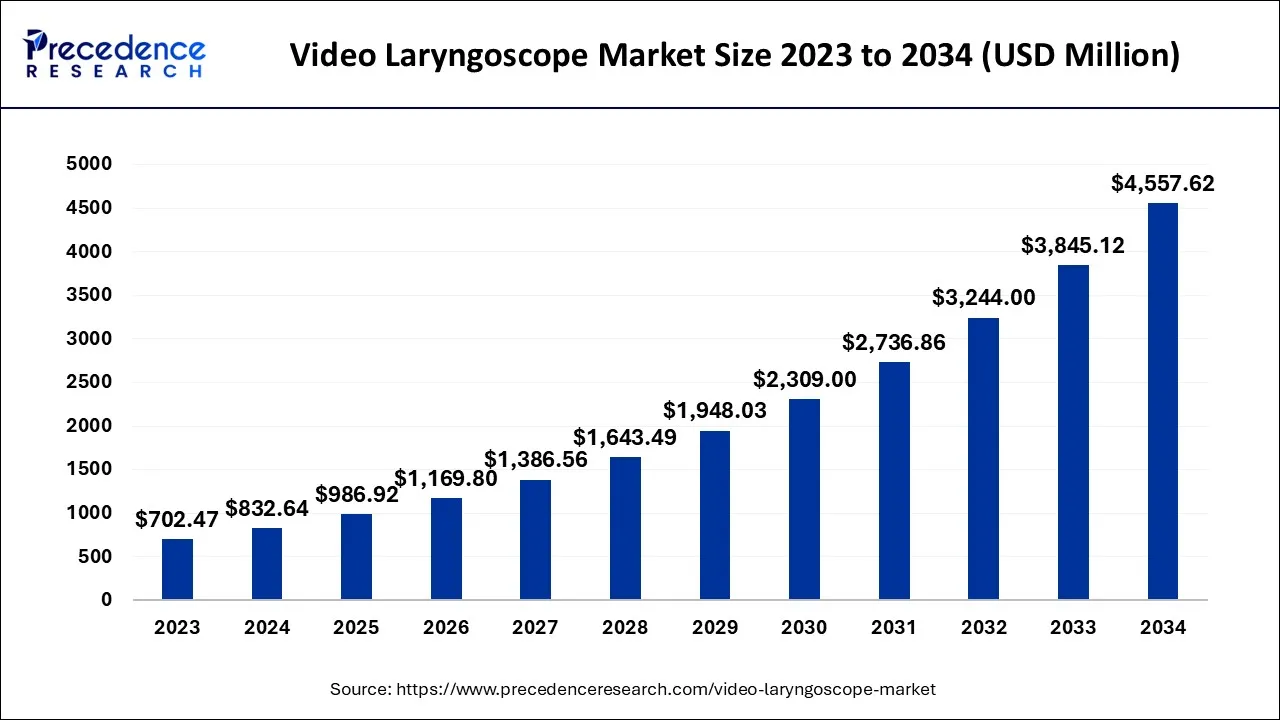
Video Laryngoscope Market Key Takeaways
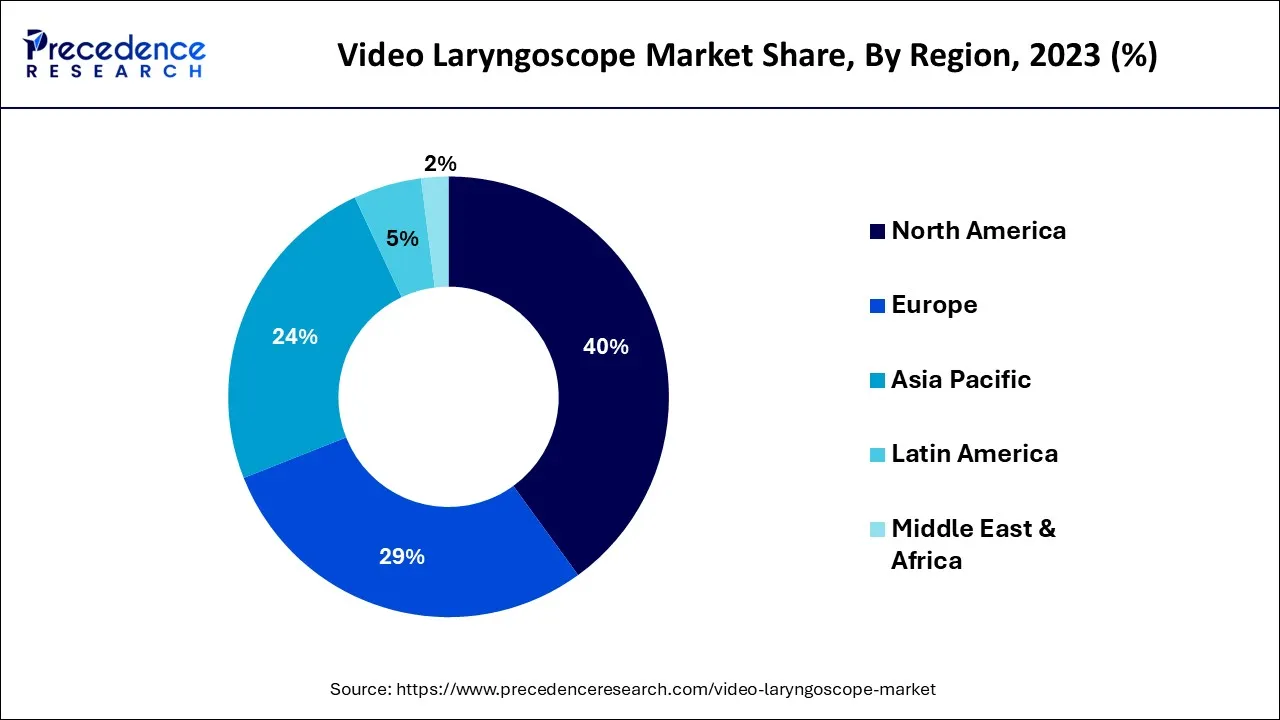
- North America generated more than 40% of revenue share in 2025.
- Asia-Pacific region is expected to expected at the fastest CAGR between 2025 and 2036.
- By Product, the rigid segment captured the maximum revenue share in 2025.
- By Usage Type, the reusable segment recorded the highest revenue share in 2025.
- By End-User, the hospital segment contributed the biggest revenue share in 2025.
Video Laryngoscope: Revolutionizing Airway Management with Precision, Safety, and Enhanced Visualization
Video laryngoscopes consist of display monitor and an integrated camera to indirectly visualize the upper airway during the intubation procedures, helping to place the breathing tube in between the trachea and vocal cords. In addition to intubation, the recording and display features of video laryngoscopes are beneficial for teaching intubation techniques, chiefly in patients with difficult airways. These devices consist of four main components namely: interchangeable reusable or single-use blades, high-resolution small camera, integrated (attached) or stand-alone (cart-based) monitor and single or multiple internal power sources.
The growing awareness of the benefits of video laryngoscopes compared to the traditional laryngoscopes is a significant factor driving the growth of the market during the forecast period. These advantages include improved laryngeal visualization, reduction in applied force, reduced risk of cross contamination, visual confirmation of tube placement, and increased success rates for rescuing failed direct laryngoscopy, all of this is contributing to the increased demand of video laryngoscopes.
Video Laryngoscope Market Growth Factors
The rising occurrence of respiratory diseases is anticipated to augment the growth of the video laryngoscope market within the estimated timeframe. As robot-assisted intubation is gaining more popularity, the demand for video laryngoscopes is expected to increase further. With advancements in intubation, manufacturers have developed innovative solutions that provide medical professionals with more support and precision. By automating anesthetic treatment and improving all aspects of patient care, robot-assisted technologies reduce the burden on anesthesiologists. Various manufacturers and researchers are exploring the use of robotics in a range of laryngoscopy techniques.
Furthermore, as minimally invasive surgeries are preferred over open/invasive surgeries, the demand for minimally invasive laryngoscopic technologies is expected to increase in the years to come. Factors driving this trend include greater financial viability, higher patient satisfaction, shorter hospital stay, and fewer postoperative complications. Moreover, laryngoscopy is a relatively safe procedure, further boosting the growth of the video laryngoscope market by reducing surgical complications and the time required for recovery.
In addition, video laryngoscopes manufacturers across the globe are expanding their production units in emerging countries. The rise in demand and inadequate medical facilities in these economies are driving the market for video laryngoscopes. Nevertheless, the growth of the video laryngoscope industry is hindered by a shortage of qualified medical professionals and certified experts, especially in developing and underdeveloped countries.
Video Laryngoscope Market Outlook
- Industry Growth Overview: The video laryngoscope market is currently growing at a high rate since there is increasing demand for advanced airway management in hospitals, emergency, and intensive care units. The adoption of the market is further accelerated by increasing surgical volumes and the increased attention to patient safety.
- Global Expansion: The manufacturers are taking their businesses to the whole world by increasing their distribution channels and launching affordable gadgets in the underdeveloped healthcare markets. Increased efforts regarding infrastructural development as well as training are helping to sustain greater use across the globe.
- Major Investors: The major stakeholders and dominant players like Medtronic, Ambu a/s, Olympus Corporation, Karl Storz, and Verathon, are engaged in the process of product innovation and portfolio growth. The business of these companies involves high-resolution imaging, disposable larynxblades, and portable video laryngoscopes.
- Startup Ecosystem: Startups such as Vyaire Medical, Intersurgical, UE Medical, and IntuBrite are developing smaller, wireless, AI-controlled video laryngoscopes. These new companies are catching on due to their affordability and convenience to use in emergency and pre-hospital locations.
Market Scope
| Report Coverage | Details |
| Market Size in 2025 | USD 986.92 Million |
| Market Size in 2026 | USD 1,169.80 Million |
| Market Size by 2035 | USD 5,195.87 Million |
| Growth Rate from 2026 to 2035 | CAGR of 18.07% |
| Largest Market | North America |
| Fastest Growing Market | Asia Pacific |
| Base Year | 2025 |
| Forecast Period | 2026 to 2035 |
| Segments Covered | Product, Usage Type, Device Type, End-User, and Region |
| Regions Covered | North America, Europe, Asia-Pacific, Latin America and, Middle East & Africa |
Market Dynamics
Driver
Increasing prevalence of respiratory diseases
The increasing prevalence of respiratory diseases is likely to contribute to the growth of the video laryngoscopes market during the forecast period. According to the World Health Organization, Chronic respiratory illnesses (CRIs) impact the lungs' airways and other skeletal and functional components. In 2019, chronic obstructive pulmonary disease (COPD) caused 3.23 million deaths worldwide, making it the third leading cause of death globally.
The majority of these deaths occur in low- and middle-income countries (LMIC), with nearly 90% of COPD deaths in those under the age of 70 being reported in LMIC. Furthermore, COPD is the seventh leading cause of poor health worldwide, as measured by disability-adjusted life years. Tobacco smoking is responsible for over 70% of COPD cases in high-income countries. However, in LMIC, household air pollution is a major risk factor, with tobacco smoking accounting for 30-40% of COPD cases.
As respiratory diseases become more common, the demand for video laryngoscopes is rising globally. This is because video laryngoscopes are an effective tool for the placement of breathing tubes between the vocal cords and into the trachea to maintain the airway. They provide indirect visualization of the upper airway, which is particularly useful in people with difficult airways. In addition, the record and display features of video laryngoscopes are helpful for teaching intubation techniques, thereby increasing their adoption.
When it comes to difficult airway cases, the video laryngoscope is considered a crucial tool. It can be used as the primary method for tracheal intubation or as a backup rescue technique. Given the constantly evolving and challenging nature of difficult airway cases, it is important for anesthesiologists to have access to video laryngoscopes to ensure safe tracheal intubation. Therefore, the video laryngoscope must be considered an essential resource for anesthesiologists in such scenarios. Consequently, the increasing prevalence of respiratory diseases is creating a greater need for video laryngoscopes, which is driving the growth of the market.
Restraints
High costs of the device
When healthcare providers consider incorporating video laryngoscopy into their regular clinical practice, the cost of the equipment is often a primary concern. There are several factors that can impact the cost of video laryngoscopes, including the cost of the laryngoscope handle and blade. Video laryngoscope systems are generally classified as either cart-based or handheld, and these different types affect how the systems are used and the associated costs.
The cost of video laryngoscopes can range from $1,000 to $15,000, in contrast to a single-use, disposable laryngoscope which costs around $18 apiece. Bulk purchases may lower the total purchase cost, with the McGRATH MAC video laryngoscope costing less than $1,000 each when bought in bulk. The cost of the laryngoscope blade is also a factor, with reusable blades having a higher upfront cost and recurring cleaning costs after each intubation.
In comparison, disposable blades have only an upfront purchase cost, ranging from $6 to $18 per blade. This is expected to restrain the growth of the video laryngoscope market within the estimated timeframe.
Opportunities
Introduction of new technologies
Manufacturers of video laryngoscopes are addressing the unmet needs of healthcare professionals who perform difficult intubations. They focus on introducing advanced devices to improve performance and safety during intubations. In February 2018, Dilon Technologies Inc. launched CoPilot VL+, an advanced device designed to provide optimal view of the airway during placement of breathing tubes.
The market players are introducing fully disposable devices, such as Vivid Medical and Intersurgical Ltd., which are preferred by healthcare providers due to the reduced risk of cross-contamination compared to reusable direct laryngoscopes. Key players are also adopting inorganic growth strategies such as acquisitions to establish their foothold in the market and commercialize their products globally. These initiatives are expected to result in the introduction of advanced devices, which will boost the demand for video laryngoscopes during the forecast period.
Segment Insights
Product Insights
On the basis of product, the rigid segment held largest revenue share in 2023. The growth of the segment is expected to be driven by increase in development of the product and investments by various market players. The segmental growth is also attributed to the decreasing use of traditional laryngoscopes. The rigid video laryngoscopes have advantages over direct laryngoscopy as they overcome line-of-sight limitations. Minimal head manipulation and positioning are required for rigid video laryngoscopes, compared to conventional direct laryngoscopy. Therefore, this trend is expected to boost the growth of the segment in the global video laryngoscope market during the forecast period.
Usage Type Insights
On the basis of usage type, the reusable segment held the largest revenue share in 2023. Medical professionals and hospitals consider reusability as a significant factor when making purchasing decisions for video laryngoscopes. These devices are preferred because they are easy to use and offer greater functionality than traditional laryngoscopes. While reusable video laryngoscopes may have higher upfront costs, they do not need to be replaced as frequently, leading to increased adoption and a larger market share.
End-User Insights
Based on the end-user, hospital segment held the largest market share in 2023. The increase in the number of airway management procedures that are performed in hospitals is making them the primary users of video laryngoscopes. The adoption of video laryngoscopes has increased due to their ability to provide improved visualization, leading to higher success rates in intubation procedures and improving safety for patients and healthcare practitioners compared to traditional direct laryngoscopy. In February 2021, Ambu expanded its presence in the endoscope market by extending contracts with two key Group Purchasing Organizations in the United States, which granted around 90% of US hospitals access to the company's range of single-use endoscopes such as rhino laryngoscopes and cystoscopes.
Regional Insights
What is the U.S. Video Laryngoscope Market Size?
The U.S. video laryngoscope market size is exhibited at USD 276.34 million in 2025 and is projected to be worth around USD 1,488.41 million by 2035, growing at a CAGR of 18.34% from 2026 to 2035.
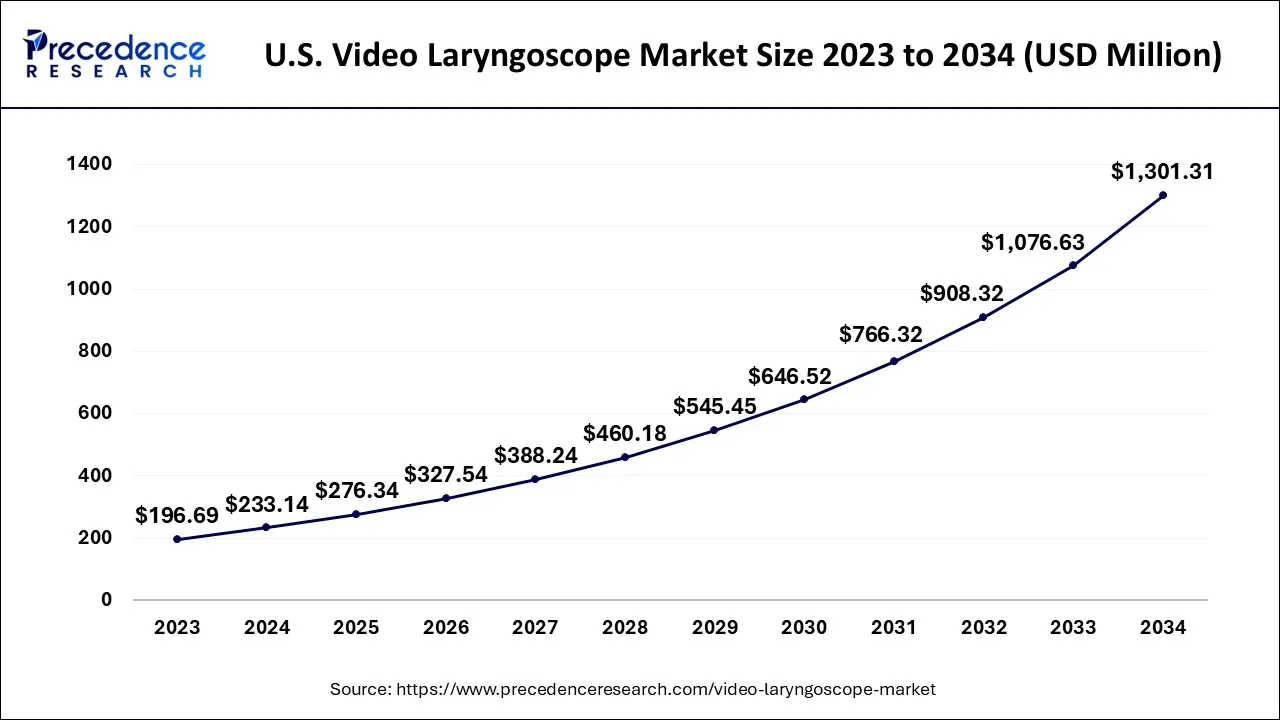
North America has held largest revenue share 40% in 2023. This is owing to the early adoption of technologies in the region even in the healthcare industry. The market for video laryngoscope in the United States is anticipated to grow significantly during the study period as a result of increased investments by large corporations and expansion strategies like mergers, acquisitions, and the introduction of novel products by market participants. Furthermore, the increasing occurrence of respiratory diseases is also likely to support the regional growth of the video laryngoscope market during the forecast period.
U.S. Market Analysis
The U.S. video laryngoscope market is growing due to rising demand for advanced airway management, the prevalence of difficult airway cases, and the need for safer intubation procedures. Adoption in hospitals, emergency care, and teaching institutions, coupled with technological advancements such as high-resolution cameras and disposable blades, improves success rates, reduces infection risk, and drives market growth during the forecast period.
Additionally, the availability of guidelines for practicing by various healthcare organizations and American Society of Anesthesiologists (ASA) along with supportive government initiatives is also expected to contribute to the regional growth of the video laryngoscope market during the forecast period.
Asia-Pacific is expected to grow at the fastest CAGR during the forecast period. The region is home to some of the world's largest and fastest-growing cities which is likely to increase the demand for video laryngoscopes, and this trend is expected to continue in the coming years. The rising government policies and incentives are likely to encourage the adoption of video laryngoscope which is driving market growth in the region. Further, the growing investment in the modernizing of the healthcare systems along with the growing need to reduce the healthcare costs is also likely to support the regional growth of the video laryngoscope market during the forecast period.
Indian Market Analysis
India's video laryngoscope market is growing due to increased awareness of advanced airway management, rising surgical procedure volumes, and the growing prevalence of difficult airway cases. Expanding hospital infrastructure, adoption in teaching and emergency care, and demand for safer, more efficient intubation procedures with disposable or reusable blades drive market growth during the forecast period.
Why is Europe Considered a Notably Growing Region in the Video Laryngoscope Market?
Europe is expected to grow at a notable rate in the market during the projection period. This is mainly due to the increasing adoption of advanced airway management devices, the rising prevalence of complex airway cases, and the growing demand for minimally invasive procedures. Ongoing technological advancements, demand for high-resolution imaging and disposable blade options, and supportive healthcare infrastructure further drive market growth.
What Are the Key Trends in the Latin America Video Laryngoscope Market?
It is projected that the Latin American market will experience significant growth in the prospective period, which will be mainly as a result of modernization efforts in the hospital anesthesia departments and emergency care units. Early-stage adoption is being aided by increasing awareness among clinicians of the benefits of video-assisted intubation. Brazil is becoming a major marketplace as a result of investments made in tertiary care centers, the development of emergency response systems, and the development of healthcare infrastructures.
Also, the government programs and the investment in the training of personnel and the equipment provided by the private sector are stimulating the increase in the application of the advanced airway management devices.
In July 2025, Scientific Reports published a paper on a 3D-printed videolaryngoscope for tracheal intubation that is relatively cheap and could be used extensively in Brazil. They can afford to produce the device at about USD 30, and thus it can be used in low and middle-income healthcare environments. (https://pmc.ncbi.nlm.nih.gov )
What Are the Key Trends in the Middle East and Africa Video Laryngoscope Market?
The Middle East and Africa market is also expected to expand substantially within the forecast period because health care providers are likely to focus on emergency preparedness and the use of advanced airway management equipment. The Gulf countries with more wealth, such as the UAE and Saudi Arabia, are the first to adopt and are especially successful in the fields of trauma, critical care, and surgical units.
Market penetration is also being enhanced by the growth of the private hospitals as well as by the government's effort to modernize the healthcare infrastructure. The adoption of mid-range and high-performance video laryngoscope systems, increased awareness of the benefits of patient safety and improved procedural outcomes.
Value Chain Analysis
- R&D
R&D in video laryngoscopes focuses on improving airway visualization, patient safety, ergonomics, affordability, and AI integration for advanced intubation solutions.
Key players: Medtronic, Ambu A/S, Verathon Inc., Teleflex, Karl Storz, Drägerwerk. - Component Sourcing & Manufacturing
This stage involves procuring high-resolution cameras, optics, displays, and disposable blades, ensuring quality components for reliable device performance.
Key players: Sony Corporation, Omron Healthcare, Laird Technologies, Medtronic, Ambu A/S. - Product Assembly & Quality Testing
Devices are assembled and rigorously tested for performance, sterility, and clinical reliability to meet healthcare standards.
Key players: Karl Storz, Drägerwerk, Smiths Medical, Verathon Inc., Medtronic. - Distribution & Sales Channels
Finished products are distributed through hospital suppliers, medical distributors, and direct sales networks to reach healthcare facilities globally.
Key players: Cardinal Health, McKesson Medical-Surgical, Medline Industries, Henry Schein, BPL Medical Technologies.
Video Laryngoscope Market Companies
- AAM Healthcare: Supplies video laryngoscopes and airway management solutions for hospitals and emergency care, focusing on reliable visualization and improved intubation performance.
- Hebei Vimed Medical Device Company, Ltd.: Develops and manufactures video laryngoscope systems and airway devices with proprietary technologies and multiple certified models for clinical airway management.
- Salter Labs: Offers video laryngoscope products and airway management devices designed to enhance intubation safety and clinician performance in various care settings.
- VDO Medical Inc.: Provides video laryngoscopes and visualization tools for airway management in hospitals and emergency environments, emphasizing image clarity and ergonomic design.
- Marshall Products: Supplies video laryngoscope equipment and related airway devices, supporting safe intubation procedures across clinical and emergency care settings.
Other Major Key Players
- Medtronic
- KARL STORZ SE & Co. KG
- Nihon Kohden Corporation
- Verathon Inc.
- Ambu A/S
Recent Developments
- In January 2023, during Arab Health 2023, Timesco Healthcare will introduce its revolutionary video laryngoscope to help intubation in patients with challenging airways. The Optima View video laryngoscope from Timesco is built with a high-resolution, wide-angle integrated camera and video display panel to provide incredibly clear, color-correct output.
- In July 2020, Nihon Kohden declared that the NK AWS-S200 video laryngoscope is now available as a part of its critical care portfolio. The NK AWS-S200 may lessen exposure to aerosolized particles ii, which can assist safeguard physicians while intubating patients suffering from COVID-19 or other respiratory illnesses. It is designed for the safe and secure intubation of patients in even the most challenging circumstances.
- In November 2025, Penlon introduced the availability of the reusable Diamond Video Laryngoscope through the NHS Supply Chain, featuring single-use blades for adults and children, a 3.5-inch HD touchscreen, HDMI/Wi-Fi connectivity, rechargeable battery, and easy cleaning for safe, efficient intubation.
(Source: penlon.com) - In January 2025, IVOS Medical unveiled the BOSS G4, a single-use video laryngoscope sheath enhancing safety during high-risk intubations with clear visualization and continuous oxygen delivery, with full market launch planned for 2026.
(Source: ivosmedical.com)
Segments Covered in the Report
By Product
- Rigid Video Laryngoscopes
- Flexible Video Laryngoscopes
By Usage Type
- Reusable Video Laryngoscopes
- Disposable Video Laryngoscopes
By Device Type
- Cart-based Video Laryngoscopes
- Handheld Video Laryngoscopes
By End-User
- Hospitals
- ENT Clinics
- Others
By Geography
- North America
- Europe
- Asia-Pacific
- Latin America
- Middle East and Africa
For inquiries regarding discounts, bulk purchases, or customization requests, please contact us at sales@precedenceresearch.com
Frequently Asked Questions





Ask For Sample
No cookie-cutter, only authentic analysis – take the 1st step to become a Precedence Research client
 Get a Sample



 sales@precedenceresearch.com
 Schedule a Meeting
