



Artificial Intelligence (AI) Robots Market Size, Key Companies, Company Market Share, User Adoption, Technology Deployment, Revenue Growth, Competitive Positioning, and Demand Forecast
The artificial intelligence robots market is growing rapidly as businesses adopt autonomous systems to enhance efficiency, accuracy, and operational flexibility. Advances in machine learning, computer vision, generative AI, and collaborative robotics are transforming industries such as manufacturing, healthcare, logistics, and retail. Growing demand for smart automation, labor optimization, and human-robot collaboration is expected to drive significant market expansion through 2035.
Source: https://www.precedenceresearch.com/artificial-intelligence-robots-market
 Get a Sample
 Table Of Content


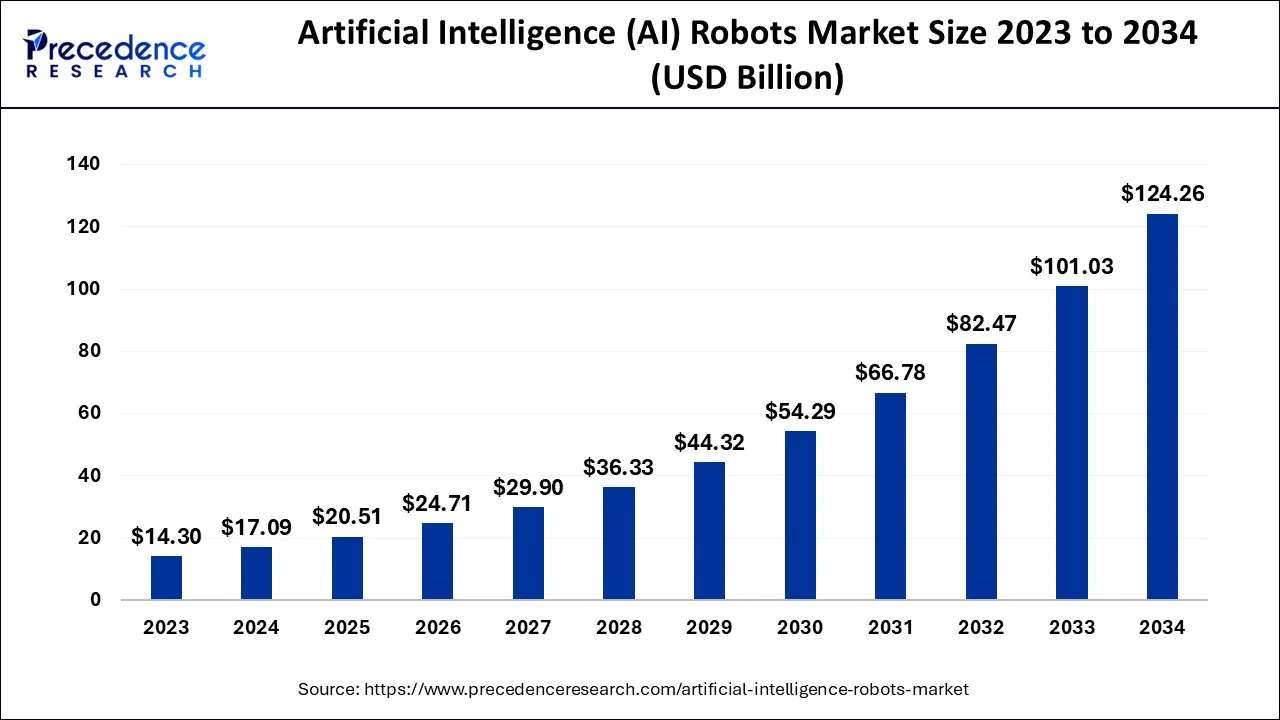
The global artificial intelligence robots market size was estimated at USD 20.51 billion in 2025 and is predicted to increase from USD 24.71 billion in 2026 to approximately USD 144.38 billion by 2035, expanding at a CAGR of 21.55% from 2026 to 2035. The market is witnessing substantial growth, mainly accelerated by breakthroughs in machine learning, sensor fusion, and natural language processing, sparking massive investments and widespread adoption of intelligent, autonomous systems to enhance operational efficiency and productivity.
Artificial Intelligence (AI) Robots Market Key Takeaways
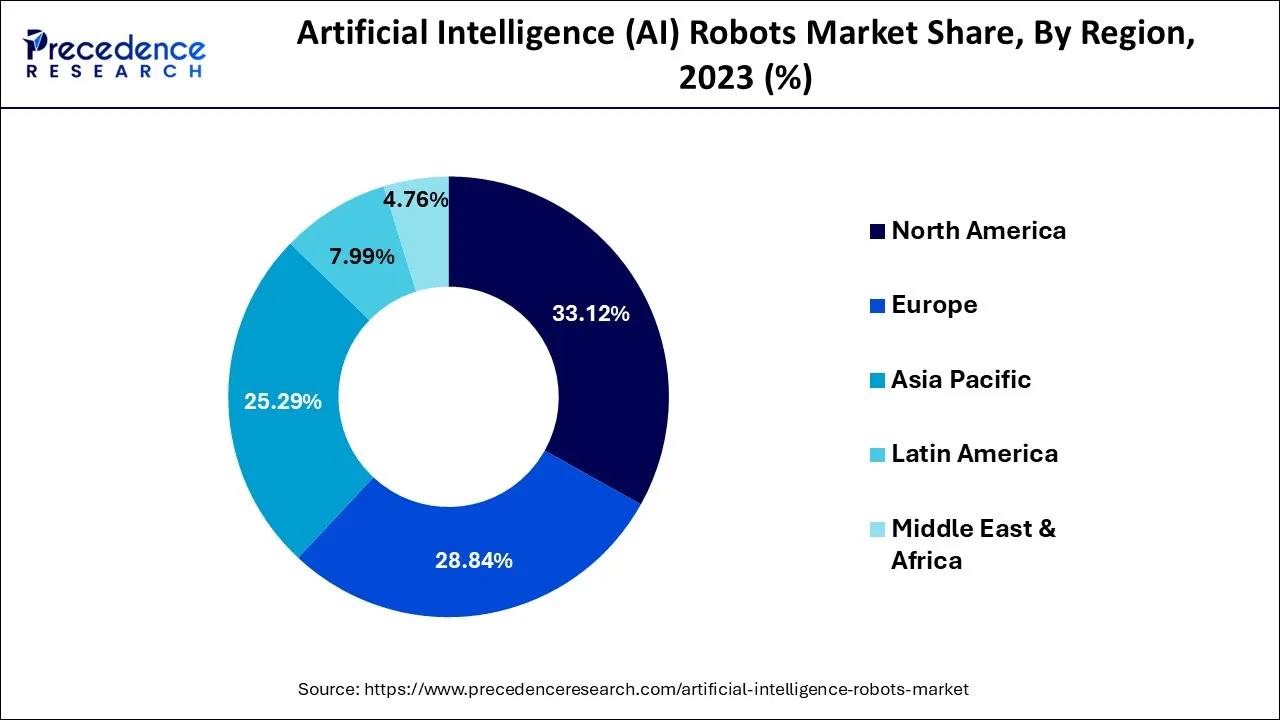
- North America dominated the market with a major market share of 33.14% in 2025.
- Asia Pacific is expected to grow at the fastest CAGR between 2026 and 2035.
- By offering, the services segment contributed the highest market share in 2025.
- By offering, the hardware segment is growing at a strong CAGR between 2026 and 2035.
- By robot type, the industrial robots segment held a major market share in 2025.
- By robot type, the service robots segment is expected to expand at a notable CAGR from 2026 to 2035.
- By technology, the machine learning segment generated the biggest market share in 2025.
- By technology, the context awareness segment is expanding at the fastest CAGR between 2026 and 2035.
- By deployment mode, the cloud segment accounted for the largest market share in 2025.
- By deployment mode, the on-premises segment is projected to grow at a solid CAGR between 2026 and 2035.
- By application, the industrial application segment captured the highest market share in 2025.
- By application, the healthcare segment is poised to grow at a healthy CAGR between 2026 and 2035.
Global Artificial Intelligence (AI) Robots Market Overview and Key Metrics
The artificial intelligence robots market includes industrial, collaborative, and service robots utilized in sectors such as manufacturing, healthcare, logistics, and retail for automating complex manual tasks. The market is shifting from conventional rule-based automation to highly adaptive and digitally advanced models. This shift is driven by the adoption of machine learning, computer vision, natural language processing (NLP), and edge AI technologies. Factors such as growing structural labor shortages, increasing demands for precision intralogistics, and a rising need for continuous operational efficiency are fueling market growth.
Government initiatives and supportive technology policies are also contributing to market expansion by promoting factory automation, increasing funding for deep tech, and encouraging the integration of smart, interconnected robotics. Programs like national digitalization and smart manufacturing missions are enhancing industrial productivity and supporting the modernization of commercial services. Additionally, the rise of Robot-as-a-Service (RaaS) models, advancements in sensor hardware, and the deployment of collaborative robots (cobots) are improving market accessibility, safety, and adoption.
Key Technological Shifts in Robots
AI is fundamentally transforming robots' functions. AI replaces rigid traditional programming with cognitive automation, enabling mechanical systems to perceive their environments, learn from real-time data, and adapt to unpredictable scenarios. By combining ML algorithms with sensor fusion, these systems can optimize workflows, automate repetitive tasks, and collaborate safely with humans in complex environments.
Key technological shift toward advanced service robots within healthcare, logistics, and hospitality. Manufacturers are currently focusing on the convergence of robotics engineering and semiconductor innovations, deploying specialized Edge AI chips to deliver high computational power directly to devices. Additionally, surging investments in humanoid robots and the integration of IoT are expanding the operational capacity and affordability of these systems across global industry verticals.
Major Trends in the Artificial Intelligence Robots Market
- Integration of Generative AI: Generative AI enables robots to evolve from rule-based automation into self-learning systems. It allows robots to generate training data through simulations, learn new tasks autonomously, and interpret and execute complex, multi-step natural language commands from humans.
- Expanding Adoption of Collaborative Robots (Cobots): There is a significant shift towards robots designed to operate safely alongside humans. These AI-powered cobots utilize advanced computer vision and context awareness to adapt to human movements, making them increasingly common in service industries, healthcare, and modern manufacturing.
- Immersive Edge-AI and Real-Time Onboard Processing: Modern robots leverage edge computing, running complex ML models on the robot itself using specialized, lower-cost AI chips. This approach eliminates latency for real-time obstacle detection, dynamic path planning, and instant decision-making in unpredictable environments.
- Humanoid and Service Robot Expansion: Robotics hardware is no longer solely focused on industrial arms. There is a surge in developing multi-purpose humanoid robots and service robots tailored for specific applications such as e-commerce fulfillment, eldercare, and personal assistance in everyday unstructured environments.
Artificial Intelligence (AI) Robots Market Growth Factors
Many government agencies are taking initiatives to expand the approval of inventions in robotics and artificial intelligence. The growing acceptance of AI robots in the sector of health care as it supports starting a good link between patients and healthcare professionals. These creativities inspire businesses to transmit new expansions to support the delivery of the latest machinery and robotics around different areas. Different industries like healthcare, manufacturing, construction and automobile are progressively accepting industrial automation. AI robots are purposely used to transfer materials in the manufacturing and production industry and also carry several automated responsibilities. The acceptance of AI robots has improved owing to their extremely constant and accurate performance. An important quantity of robots is used for the submission of material management in numerous industries. The main reason for such implementation is to get good quality and protect employees from damages that happen due to faulty machines.
Artificial intelligence is the proficiency that replicates intelligent behavior acquires and accomplishes operations or processes. Robotic structures with artificial intelligence allow industry segments to develop extra flexibility in their actions. So, robots are connected with the technology of artificial intelligence which supports in assisting daily jobs and industries jobs, thus reducing human interference. The growing acceptance of artificial intelligence robots for individual use and growing government initiatives for developing recent technologies will show the major market driving factors.
Growing effort on dropping the human mistakes in the increasing profitability of industrial robots, manufacturing processes, Growing digitization in several businesses like financial services, banking, insurance, and the establishment of IT sector in evolving countries like China and India are showing the highest market growth. Robotics when united with AI, systems of robotic can participate in different events and whole responsibilities separately removing the requirement for human involvement. This benefit will appear as one of the major drivers for AI in robotics in the future growth of the market. Though, the absence of an expert labor force and technical skills person in developing and underdeveloped economies leads to growth limiting factors for the market. The rising distribution of the 5G set-up and the growing demand for smart supporters are factors boosting the market growth.
Market Report Coverage
| Report Attributes | Details |
| Growth Rate from 2026 to 2035 | CAGR of 21.55% |
| Market Size in 2025 | USD 20.51 Billion |
| Market Size in 2026 | USD 24.71 Billion |
| Market Size by 2035 | USD 144.38 Billion |
| Base Year | 2025 |
| Forecast Period | 2026 to 2035 |
| Segments Covered | Offering, Robot Type, Technology, Deployment Mode, Application, and Region |
| Regions Covered | North America, Europe, Asia-Pacific, Latin America and the Middle East & Africa |
Market Dynamics
Driver
The Rapid Shift Toward Autonomous Decision-Making
Integrating deep learning and computer vision enables machines to perceive, learn, and adapt to unstructured environments without ongoing human instruction. This advancement reduces human error, lowers operational costs, and greatly expands the utility of robots across complex logistics, healthcare, and retail operations.
- In February 2026, Vision-Language-Action (VLA) models emerged as unified AI systems that combine visual perception, language understanding, and motor control, directly translating images and natural instructions into continuous physical actions.
Restraint
High Implementation Costs and Integration Complexity
This hinders the widespread adoption of AI robots. The initial deployment costs, steep maintenance fees, and the complex process of integrating these systems with legacy enterprise infrastructure pose significant challenges. Moreover, the market faces a global shortage of highly skilled workers who can program and service these advanced systems, alongside ethical and safety regulatory hurdles.
Opportunities
Human-Robot Collaborative Services
The development of highly perceptive cobots designed to work safely alongside humans enhances prospects in personal assistance, elderly care, and smart manufacturing. By leveraging natural language processing and advanced sensor technologies, these AI systems can provide on-demand assistance, personal companionship, and specialized medical support, creating new multi-billion-dollar consumer and B2B markets.
Segmentation Analysis
Offering Insights
How did the Services Segment Lead the Artificial Intelligence Robots Market?
The services segment led the market in 2025, primarily due to increased adoption of cloud-based operations and SaaS, as well as rapid advances in industrial and service automation. This integration of AI capabilities into existing workflows eliminates the need for significant upfront physical investments, making AI robotics more accessible to businesses of all sizes. Key industries benefiting from these developments include logistics, healthcare, and public safety. AI-driven software and services offer features like autonomous navigation, machine vision, and real-time coordination, transforming basic hardware into intelligent, autonomous solutions.
The hardware segment is expected to experience the fastest growth during the forecast period, driven by the demand for advanced physical devices that enable robots to perceive their environments, perform tasks, and process complex AI workloads. There is a soaring need for specialized processors such as GPUs, ASICs, and edge computing chips, which are essential for executing intensive AI algorithms, allowing robots to make real-time decisions. Compact, energy-efficient chips modeled after the human brain are replacing larger devices, enabling them to be embedded directly into humanoid service robots.
Artificial Intelligence (AI) Robots Market Revenue, By Offering (USD Million)
| By Offering | 2022 | 2023 | 2024 |
| Software | 4,512.6 | 5,375.7 | 6,430.6 |
| Hardware | 2,814.4 | 3,356.5 | 4,019.8 |
| Services | 4,689.8 | 5,567.9 | 6,638.1 |
Robot Type Insights
What Made Industrial Robots the Leading Segment in the Artificial Intelligence Robots Market?
The industrial robots segment led the market in 2025, mainly due to the critical demand for automating manufacturing processes. Significant investments in Industry 4.0, smart factory modernization, and the transition to software-defined, self-optimizing robotic production systems are driving this trend. These robots are being enhanced with advanced deep learning and computer vision capabilities to perform complex, high-precision tasks. Cobots are emerging as a transformative sub-segment, capable of working safely alongside human workers without the need for heavy physical barriers, facilitating the integration of AI robots.
- In July 2025, a $105M initiative to develop a universal robot foundation model and AI platform was launched by Robotics Lab Genesis AI, a global physical artificial intelligence research lab that develops AI models for smart robotics.
(Source: https://siliconangle.com)
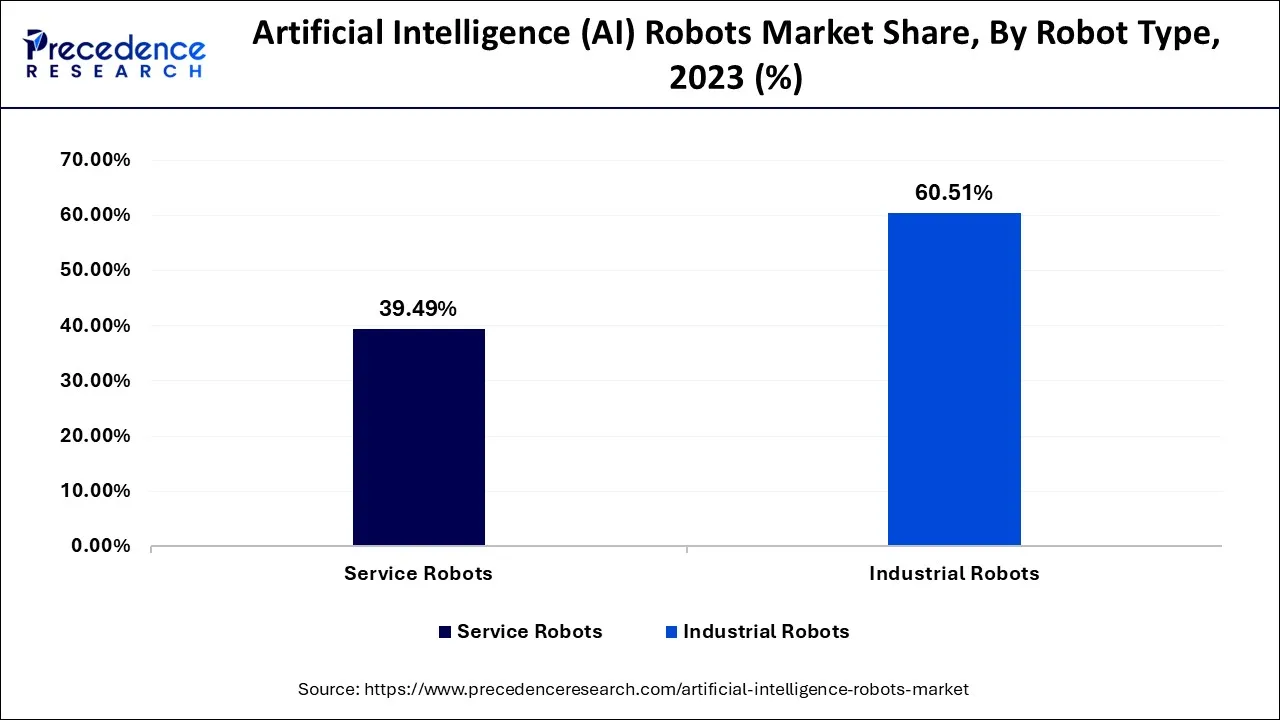
The service robots segment is expected to grow at the fastest rate during the forecast period, driven by increasing automation demands in logistics, healthcare, and hospitality. The boom in e-commerce and advancements in warehouse automation require AI to navigate unstructured environments safely alongside human workers. The rapid growth of medical and surgical robots can be attributed to AI advancements that enable precision in minimally invasive surgeries and automated diagnostics for cleaning and sanitation robots due to post-pandemic hygiene standards and commercial floor-cleaning applications
- In August 2025, Robot Food Delivery Service was launched by Old Dominion University (ODU).
(Source: https://www.odu.edu)
Artificial Intelligence (AI) Robots Market Revenue, By Robot Type (USD Million)
| By Robot Type | 2022 | 2023 | 2024 |
| Service Robots | 4,670.6 | 5,564.9 | 6,658.2 |
| Industrial Robots | 7,346.2 | 8,735.1 | 10,430.3 |
Technology Insights
Why did the Machine Learning Segment Dominate the Artificial Intelligence Robots Market?
The machine learning segment dominated the market in 2025, largely because it leverages real-time sensor data to adapt to dynamic environments and execute complex, autonomous tasks without rigid pre-programming. ML algorithms analyze inputs from cameras, LiDAR, and other sensors to identify objects, plan optimal movement paths, and avoid obstacles in real-time. By utilizing ML, robots can improve their accuracy through experience, enabling them to handle unstructured tasks, such as sorting varied consumer goods, more effectively.
- In August 2025, the shipping of the next-generation system-on-chip platform specifically designed for multi-model physical AI workloads was announced by Artificial Intelligence chip startup SiMa Technologies, Inc. The new chip, named MLSoC Modalix, is intended to be embedded in robots, industrial equipment, vehicles, and more. (Source: https://siliconangle.com)
The context awareness segment is anticipated to experience the fastest growth during the forecast period. This growth stems from the increasing demand for adaptive real-time sensors, smart-city projects, and automated solutions that require an understanding of situational nuances and spatial awareness. By integrating data from multiple sensors, context awareness enables robots to interpret situational complexities, obstacles, and the proximity of humans. This allows robots to assess their surroundings and adjust their behavior accordingly, enhancing operational safety and improving task accuracy.
Artificial Intelligence (AI) Robots Market Revenue, By Technology (USD Million)
| By Technology | 2022 | 2023 | 2024 |
| Machine Learning | 4,082.8 | 4,866.7 | 5,825.3 |
| Computer Vision | 2,115.1 | 2,519.9 | 3,014.8 |
| Context Awareness | 3,134.1 | 3,732.9 | 4,464.9 |
| Natural Language Processing | 2,684.8 | 3,180.5 | 3,783.4 |
Deployment Insights
How did the Cloud Segment Lead the Artificial Intelligence Robots Market?
The cloud segment led the market in 2025, primarily because it enables robots to offload heavy computational workloads to central servers. This approach overcomes the processing, memory, and energy limitations of onboard hardware, allowing robots to run complex ML models. Cloud-connected robots can share data, learn from one another's experiences, and update their operational parameters in real-time. Cloud architectures provide the necessary software and middleware to manage complex operations, such as coordinating autonomous robots in logistics warehouses.
- In May 2025, Cloud Lab, to accelerate pharmaceutical formulation development, raised $12M series A funding, which was launched by Persist AI, a pioneer in AI-driven robotics for pharmaceutical formulation development and chemistry, manufacturing, and controls (CMC). (Source: https://www.prnewswire.com)
The on-premises segment is projected to experience the fastest growth during the forecast period. This is driven by stringent data security and privacy requirements, as well as the need for real-time responsiveness in sectors like defense, healthcare, and manufacturing. Industries such as military and medical robotics handle confidential information, necessitating solutions that prevent data breaches by keeping all information strictly within a local, closed network. This approach mitigates connectivity delays associated with cloud-based models for seamless integration with local infrastructure and legacy hardware.
- In July 2025, PUDU T600 Series, to redefine heavy-payload industrial delivery robots purpose-built for high-payload, autonomous goods handling in complex industrial environments, was launched by Pudu Robotics, a global leader in service robotics. (Source: https://www.prnewswire.com)
Application Insights
What Made Industrial Application the Dominant Segment in the Artificial Intelligence Robots Market?
The industrial application segment dominated the market in 2025, driven by specific technological and market advancements. By utilizing ML and advanced vision, industrial robots are automating complex processes such as material handling, welding, and assembly. AI-powered cobots can safely share workspaces with humans, allowing small to midsize enterprises to implement flexible automation. The integration of AI enables robotic systems to monitor their own wear and tear. By predicting failures before they occur, factories can avoid costly production halts
The healthcare segment is expected to experience the fastest growth during the forecast period. This growth is due to the high demand for minimally invasive procedures and clinical requirements, along with the need for precision. AI algorithms process complex patient data to assist surgeons in real-time. These robots utilize ML and cloud-based systems to provide tailored physical therapy for patients recovering from strokes and movement-limiting illnesses. Additionally, AI-powered mobile robots autonomously deliver medications, lab samples, and supplies to mitigate the impact of healthcare workforce shortages.
Regional Analysis: North America, Europe, Asia-Pacific
U.S. Artificial Intelligence (AI) Robots Market Size and Growth 2026 to 2035
The U.S. artificial intelligence (AI) robots market size accounted for USD 7.68 billion in 2026 and is projected to be worth around USD 45.22 billion by 2035, poised to grow at a CAGR of 21.67% from 2026 to 2035.
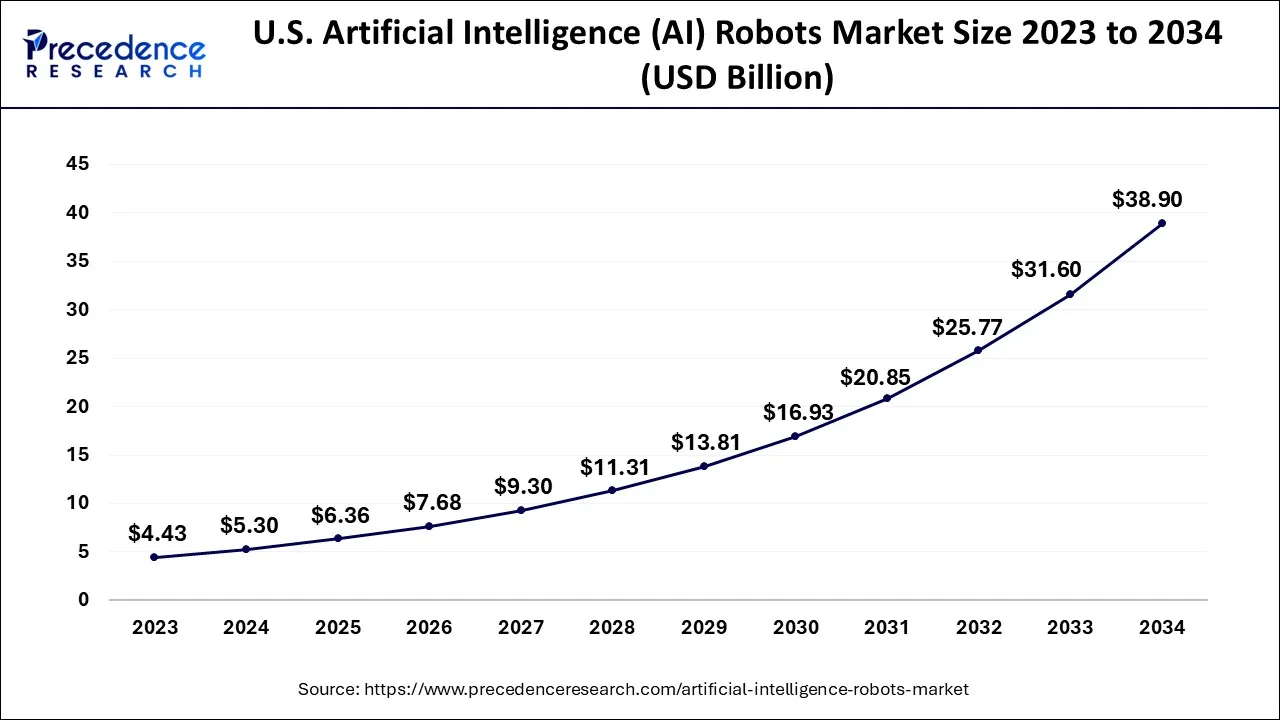
The U.S. is a leader within the region due to advancements in AI development, foundational AI models, and venture capital funding. American companies and research institutions excel in integrating advanced cognitive and generative AI with robotic hardware, particularly in autonomous systems, surgical robotics, and space exploration. Initiatives like the National AI Research Resource (NAIRR) Pilot, supported by the National Science Foundation and the Department of Energy.
How did North America Dominate the Artificial Intelligence Robots Market?
North America led the artificial intelligence robots market in 2025, primarily due to its strong technology ecosystem, significant public and private investment in research and development, and critical workforce shortages. A high concentration of premier AI innovators, tech giants, and research institutions facilitates rapid prototyping and early integration of ML and computer vision into robotics. Substantial venture capital and corporate funding provide the necessary financial resources for startups and established companies to commercialize complex AI robotics solutions and maintain productivity.
How is Asia Pacific Growing in the Artificial Intelligence Robots Market?
Asia Pacific is expected to grow at the fastest rate during the forecast period, driven largely by significant demographic shifts, strong government policies, and advancements in manufacturing hardware and 5G infrastructure. Countries like Japan and South Korea are experiencing rapid population aging, which is pushing the healthcare, personal assistance, and manufacturing sectors to adopt service and collaborative robots. This includes deploying AI-enabled industrial robots, autonomous mobile robots, and robotic arms to increase precision, reduce long-term labor costs, and enhance assembly-line efficiency.
India Market Trends
India is emerging as a significant player in the region, transitioning from being an importer of robotics to a localized developer. The country leverages its vast IT talent pool to create smart, affordable, AI-driven robotic solutions for agriculture, healthcare, and logistics. The India AI Mission has been launched to enhance computing infrastructure, alongside a Draft National Strategy on Robotics aimed at accelerating local hardware manufacturing and testing.
How is the opportunistic Rise of Europe in the Artificial Intelligence Robots Market?
Europe is witnessing notable growth in the global market, primarily due to ongoing structural labor shortages, an aging workforce, a historical legacy of industrial automation, and strategic EU policies that promote sovereign AI initiatives. Europe is home to well-known robotics companies such as ABB in Switzerland, KUKA in Germany, and Universal Robots in Denmark, which build on a strong foundation of automation hardware. Major initiatives like Horizon Europe and the Apply AI Strategy are injecting non-dilutive capital into research and development and scaling up smart factories.
Germany Market Trends
Germany stands out as a key player in this region, operating as a global leader in industrial robotics. The German federal government's ongoing framework promotes the application of AI in the economy, supports applied AI research, and encourages responsible robotic automation in manufacturing. The EXIST Start-up Germany program provides grants and funding to university spin-offs focused on deep tech and AI, aimed at bringing hardware-software robotic integration to market.
How will Latin America Emerge in the Artificial Intelligence Robots Market?
Latin America is emerging as a significantly growing region in the global market. This growth is driven by the pressing need to increase historically low productivity, embrace diverse backgrounds in new AI solutions, and boost investments in regional supply chain automation. Tech leaders like Microsoft, along with regional development banks, are actively investing in expanding cloud-based infrastructure and funding digital transformation initiatives in countries such as Brazil, Mexico, Chile, and Colombia. The rise of regional, localized, and open-source models reduced barriers for businesses to automate their tasks.
Brazil Market Trends
Brazil is emerging as a key player in the region, due to its status as an agricultural and industrial powerhouse that focuses heavily on applied AI and robotics in agribusiness, manufacturing, and public services. The country has launched the Brazilian Artificial Intelligence Plan to enhance infrastructure and public services, established a new research and development partnership between SENAI CIMATEC and Germany's DFKI in advanced robotics to promote regional tech investments.
How will the Middle East & Africa Grow in the Artificial Intelligence Robots Market?
The Middle East & Africa is also experiencing significant growth in the global market. This growth is largely attributed to economic diversification, substantial investments in smart-city infrastructure, and the urgent need to address labor shortages and improve supply-chain efficiency in logistics and manufacturing. Resource-rich nations, especially Saudi Arabia and the UAE, are investing billions in AI and automation to transition their economies away from oil dependency. AI robots are being extensively integrated into urban infrastructure to help create sustainable, tech-driven megacities.
The UAE Market Trends
The UAE plays a unique role in this region, transitioning from an oil-reliant economy to a leading global digital and technological hub. It serves as a key deployment market and infrastructure provider for emerging markets in the Global South. The Ministry of Industry and Advanced Technology has spearheaded a USD 300 million initiative to encourage the adoption of AI-powered robotics and operational benchmarks among UAE manufacturers.
Competitive Landscape: Leading Companies and Strategies
The artificial intelligence robotics market is highly consolidated, and companies are focusing on developing intelligent, autonomous service robots and collaborative robots (Cobots). Leading players like NVIDIA Corporation, Tesla, Inc., Alphabet Inc., and Boston Dynamics are driving innovation through hardware integration and adaptive autonomy. For instance, Starship Technologies deploys autonomous AI delivery robots to navigate urban streets and deliver groceries, showcasing the transition toward highly adaptable, cloud-connected robotic services.
Emerging players like Figure AI, Neura Robotics, and Generalist are well-positioned to capitalize on the rapidly growing global demand for elderly care assistants and smart factory solutions. However, significant barriers such as high initial capital investments, steep deployment costs, and complex software integration continue to hinder the adoption of AI robotics among small and medium-sized enterprises.
Artificial Intelligence (AI) Robots Market Companies
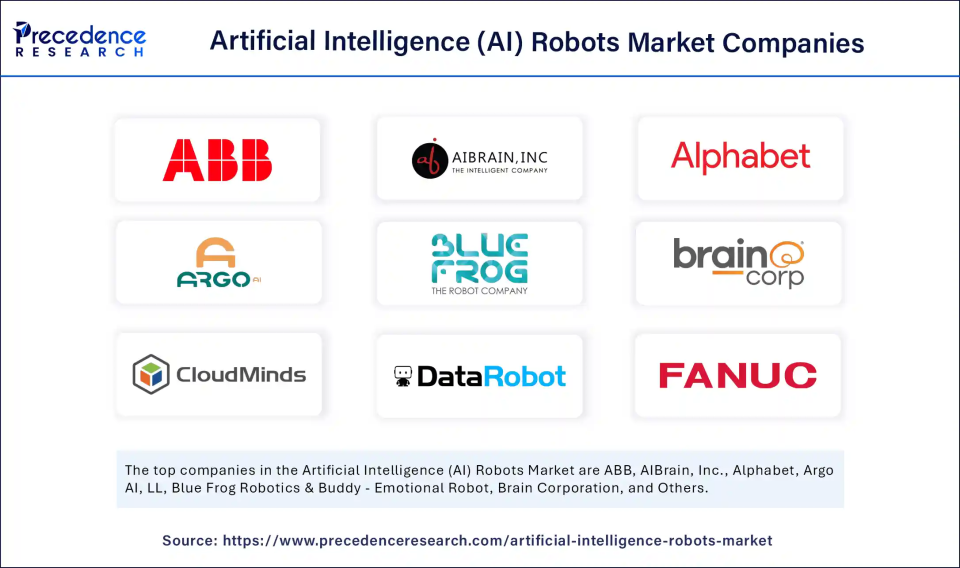
- ABB
- AIBrain, Inc.
- Alphabet
- Argo AI, LLC
- Blue Frog Robotics & Buddy - Emotional Robot
- Brain Corporation
- CloudMinds Technology Inc.
- DataRobot, Inc.
- Fanuc
- Hanson Robotics Ltd.
- Harman International Industries
- IBM Corporation
- Intel Corporation
- International Business Machines Corporation
- Kawasaki
- Microsoft Corporation
- Mitsubishi
- Neurala, Inc.
- NVIDIA Corporation
- Omron
- Promobot
- SoftBank Corp.
- UB Tech Robotics, Inc.
- Veo Robotics, Inc.
- Vicarious
- Xilinx
- Yaskawa
Recent Developments in the Artificial Intelligence (AI) Robots Market (2025–2026)
- In January 2026, Arm Holdings restructured into three divisions: Cloud and AI, Edge, and a new Physical AI unit, to leverage the growing robotics market. By merging its robotics and automotive teams, due to their shared focus on safety and efficiency, Arm plans to quickly grow its staff amid significant industry investments and major events like CES. (Source: https://scanx.trade)
- In February 2026, Alibaba launched RynnBrain, an open-source AI model aimed at advancing physical AI. It helps robots understand their surroundings, recognize objects, and perform complex navigation tasks. This enhances Alibaba's stance in robotics and positions it as a competitor to U.S. firms like Nvidia and Google. (Source: https://www.cnbc.com)
- In October 2025, Alibaba Group created a 'Robotics and Embodied AI Group' within its Qwen lab, marking a strategic shift to integrate large language models into physical hardware. This move signifies Alibaba's entry into the embodied AI space, supported by recent investments in robotics startups and a focus on developing real-world AI agents. (Source: https://pandaily.com)
- In June 2025, a new AI foundation model to power its robotic fleet and deploy its 1 millionth robot was launched by Amazon. A new generative AI foundation model will improve robot fleet travel efficiency by 10%. Technology advances support faster delivery times and lower costs for customers. (Source: https://www.aboutamazon.com)
- In August 2025, multi-view physical AI training model, Vider which stands for “video diffusion for action reasoning” was launched by ShengShu Technology. Using Vidu's capabilities in semantic and video understanding, Vider uses a limited set of physical data to stimulate a robot's decision making in real world environments. ( Source: https://www.therobotreport.com)
Segments are covered in the report
By Offering
- Software
- Hardware
- Services
By Robot Type
- Service Robots
- Industrial Robots
- Others
By Technology
- Machine Learning
- Computer Vision
- Context Awareness
- Natural Language Processing
By Deployment Mode
- Cloud
- On-premises
By Application
- Law Enforcement
- Road Patrol
- Riot Control
- Military & Defense
- Border Security
- Search and Rescue Operations
- Combat Operations
- Spying
- Public Relations
- Reception Robots
- Tour Guiding Robots
- Personal Assistance and Care
- Elderly Assistance Robots
- Companion Robots
- Education and Entertainment
- Research and Space exploration
- Industrial
- Agriculture
- Healthcare Assistants
- Stock Management
- Others
By Region
- North America
- Europe
- Asia-Pacific
- Latin America
- Middle East & Africa (MEA)
For inquiries regarding discounts, bulk purchases, or customization requests, please contact us at sales@precedenceresearch.com
Frequently Asked Questions





Ask For Sample
No cookie-cutter, only authentic analysis – take the 1st step to become a Precedence Research client
 Get a Sample




 sales@precedenceresearch.com
 Schedule a Meeting
