



Biochar Market Size, Key Companies, Company Market Share, Production Capacity, Raw Material Pricing, Export & Import Analysis, Manufacturing Cost, Competitive Positioning, and Demand Forecast
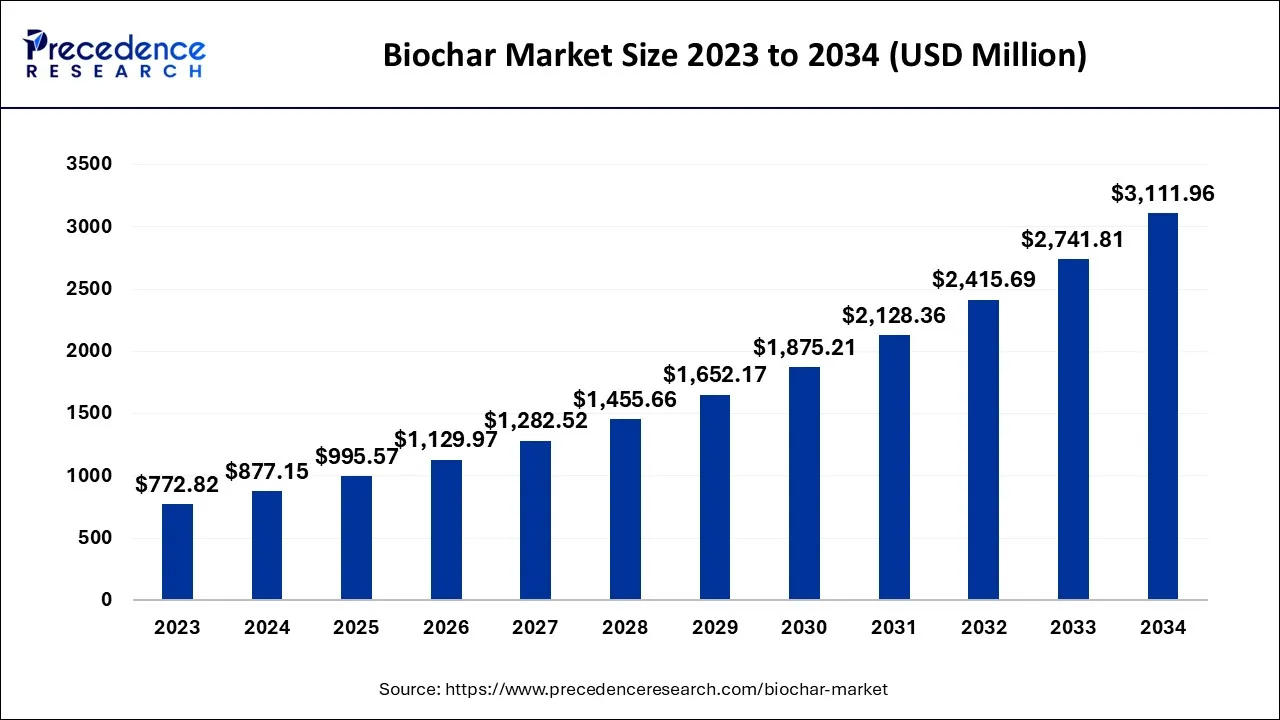
Vidyesh Swar, a chemical and materials industry expert, estimates the biochar market at USD 1,129.97 million in 2026, with the market projected to reach USD 3,452.76 million by 2035 at a CAGR of 13.24%. Major biochar market companies such as Exomad Green, Airex Energy, Phoenix Energy are competing across key material and application segments, including by feedstock, by technology, by application, by end user, by product type, by carbon-removal model, and region.
Source: https://www.precedenceresearch.com/biochar-market
 Get a Sample
 Table Of Content


What is the Biochar Market Size?
The global biochar market size was calculated at USD 995.57 million in 2025 and is predicted to increase from USD 1,129.97 million in 2026 to approximately USD 3,452.76 million by 2035, expanding at a CAGR of 13.24% from 2026 to 2035. The rising importance of biochar to increase soil porosity and reduce soil water loss is considered to boost the demand for biochar in the global market.
Key Takeaways
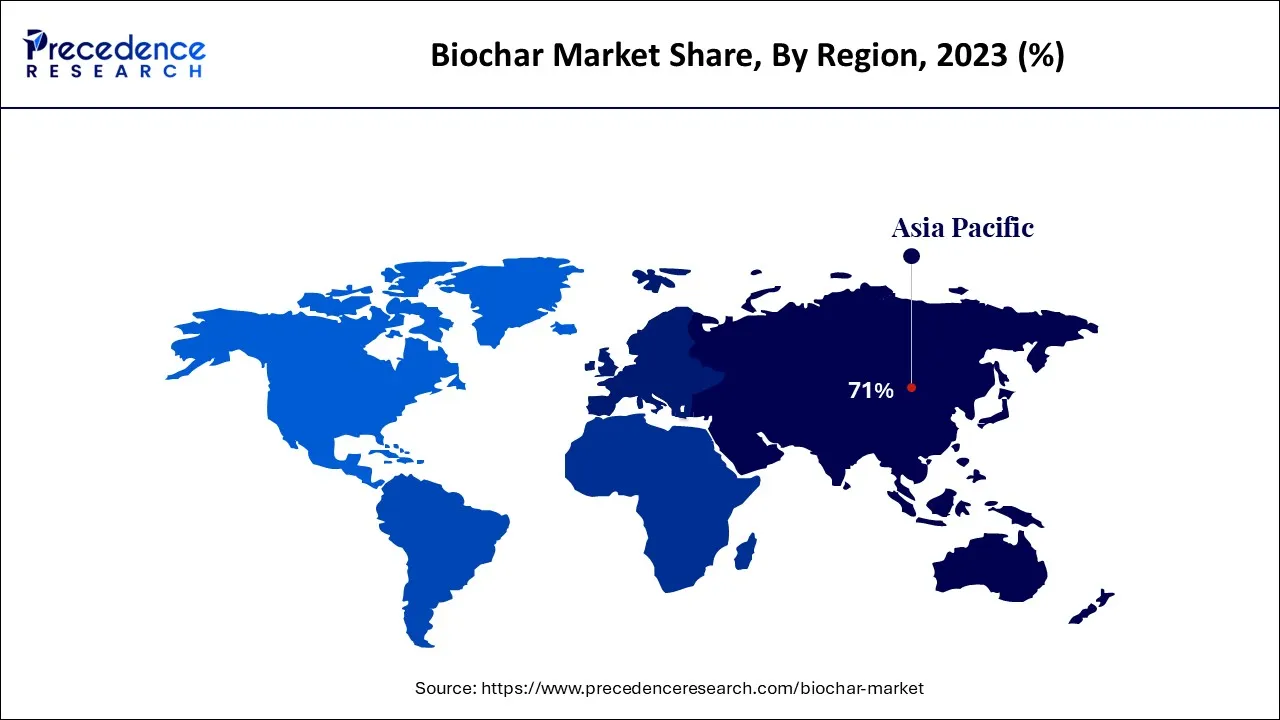
- Asia Pacific led the global market with the highest market share of 71% in 2025.
- Europe is expected to host the fastest-growing market in the coming years.
- By technology, the pyrolysis technology segment dominates the market and is expected to sustain growth between 2026 and 2035.
- By feedstock, the agricultural waste feedstock segment leads the biochar market in 2025.
- By feedstock, the animal manure segment is expected to gain the highest market share with a highest CAGR between 2026 and 2035.
- By application, the agriculture segment held a major revenue share in the market in 2025.
- By application, the waterways segment is expected to witness the fastest growth in the market over the forecast period.
Overview: Biochar is Evolving From a Soil Amendment Into a Dual Revenue Market
The biochar industry is moving beyond conventional agricultural soil applications toward an integrated business model combining biomass waste management, renewable energy, soil enhancement and durable carbon removal. Global biochar production reached approximately 521 thousand tons in 2025, demonstrating that physical production remains relatively small compared with the underlying biomass resource base. At the same time, contracted biochar carbon removal volumes reached approximately 3.04 million tonnes between 2022 and H1 2025, indicating that carbon credit markets are developing as a separate growth engine.
The market is therefore increasingly defined by two connected but economically distinct value pools: physical biochar sales and carbon removal revenues. Physical biochar economics depend on feedstock availability, processing costs, transportation, product specifications and end-use value, while carbon-removal economics depend on permanence, certification, measurement, reporting, verification and buyer willingness to pay.
Our Analyst View: The most important structural change is that biochar producers can potentially monetize the same underlying biomass conversion process through multiple revenue streams. The ability to combine product sales with carbon-removal credits could materially improve project economics and influence investment decisions.
Key Coverage:
- Biochar market structure and evolution
- Physical biochar and carbon-removal revenue pools
- Production volume and market development
- Biomass resource availability
- Agricultural and environmental applications
- Industry maturity and commercialization status
- Key market growth drivers and constraints
Market Size and Forecast: Biochar Growth Will Depend on the Expansion of Commercial Production and Carbon Removal
The global biochar market is estimated at approximately USD 995.57 million in 2025, with market development influenced by both physical biochar demand and carbon-removal procurement. Production of approximately 521 thousand tons in 2025 provides a useful indicator of the industry's current physical scale, while the significantly larger contracted carbon-removal pipeline highlights the potential for demand to grow faster than historical biochar consumption.
Through 2030 to 2035, growth is expected to depend on commercial-scale pyrolysis deployment, feedstock aggregation, agricultural adoption, carbon-removal purchasing, certification availability and improvements in project-level economics. Markets with abundant low-cost biomass residues and established agricultural demand could develop differently from regions where feedstock logistics and transportation costs dominate economics.
Our Analyst View: The market should not be evaluated solely through conventional biochar sales. Carbon-removal procurement could become an increasingly important determinant of project-level revenue and installed production capacity.
Key Coverage:
- Historical market size
- Market size and forecast through 2035
- Production volume forecast
- Revenue growth
- Biochar carbon-removal volume forecast
- Physical biochar versus carbon-removal revenue contribution
- Regional growth outlook
- Scenario-based market projections
Market Segmentation
Feedstock, Technology and End Use Create Different Economic Models
Biochar demand and profitability vary significantly by feedstock, technology, application and geographic market. Relevant feedstocks include forestry residues, agricultural residues, manure, woody biomass, green waste, municipal organic waste and other biomass streams. Technology differentiation includes batch and continuous pyrolysis systems, slow pyrolysis, fast pyrolysis and integrated biomass conversion platforms.
Applications span soil amendment, agriculture, horticulture, animal feed, water treatment, construction materials, filtration, environmental remediation and carbon removal. Each application has different quality requirements, pricing structures and customer purchasing criteria.
Our Analyst View: Feedstock and application segmentation is more commercially meaningful than a simple product categorization because production economics are strongly influenced by local biomass availability and the value generated in the final application.
Key Coverage:
- By feedstock
- By technology
- By application
- By end user
- By physical form
- By carbon-removal integration
- By region
- By production scale
Which Demand Drivers and Supply Constraints Will Determine the Commercial Scaling of Biochar?
Biochar demand is being shaped by two interconnected markets: conventional demand for soil improvement, agricultural productivity and biomass-waste utilization, and emerging demand for durable carbon removal. Approximately 3.04 million tonnes of contracted biochar carbon-removal volumes were recorded between 2022 and H1 2025, compared with global physical biochar production of approximately 521 thousand tonnes in 2025, indicating that carbon-removal procurement is developing as a potentially significant demand catalyst alongside traditional end-use markets.
Our analysis indicates that this demand expansion does not automatically translate into commercially viable production. Supply is constrained less by theoretical biomass availability than by commercially usable feedstock at viable delivered costs, with moisture, contamination, particle size, transportation, technology CAPEX, certification requirements and customer education all adding friction. The emerging constraint is project execution: developers must simultaneously secure feedstock, permits, financing, processing capacity and offtake, creating a gap between nominal announced capacity and commercially deployable capacity. Our assessment is that projects with secure low-cost biomass access and multiple revenue streams are better positioned than those dependent on a single end-use market.
In our view, the most significant implication is that commercialization will depend on combining physical product economics with carbon-removal revenues. Carbon-removal procurement can accelerate project development and improve revenue visibility, but long-term expansion requires competitive economics without relying exclusively on premium carbon-credit pricing. This favors vertically integrated models combining feedstock sourcing, efficient conversion, certification and contracted offtake.
The full report evaluates demand by agricultural and carbon-removal applications, biomass availability by region and feedstock, logistics constraints, project CAPEX, certification barriers, adoption factors, installed and planned capacity, utilization and the evolving supply-demand balance.
Which Demand Drivers and Supply Constraints Will Determine the Commercial Scaling of Biochar?
Biochar demand is being shaped by two interconnected markets: conventional demand for soil improvement, agricultural productivity and biomass-waste utilization, and emerging demand for durable carbon removal. Approximately 3.04 million tonnes of contracted biochar carbon-removal volumes were recorded between 2022 and H1 2025, compared with global physical biochar production of approximately 521 thousand tonnes in 2025, indicating that carbon-removal procurement is developing as a potentially significant demand catalyst alongside traditional end-use markets.
Our analysis indicates that this demand expansion does not automatically translate into commercially viable production. Supply is constrained less by theoretical biomass availability than by commercially usable feedstock at viable delivered costs, with moisture, contamination, particle size, transportation, technology CAPEX, certification requirements and customer education all adding friction. The emerging constraint is project execution: developers must simultaneously secure feedstock, permits, financing, processing capacity and offtake, creating a gap between nominal announced capacity and commercially deployable capacity. Our assessment is that projects with secure low-cost biomass access and multiple revenue streams are better positioned than those dependent on a single end-use market.
In our view, the most significant implication is that commercialization will depend on combining physical product economics with carbon-removal revenues. Carbon-removal procurement can accelerate project development and improve revenue visibility, but long-term expansion requires competitive economics without relying exclusively on premium carbon-credit pricing. This favors vertically integrated models combining feedstock sourcing, efficient conversion, certification and contracted offtake.
The full report evaluates demand by agricultural and carbon-removal applications, biomass availability by region and feedstock, logistics constraints, project CAPEX, certification barriers, adoption factors, installed and planned capacity, utilization and the evolving supply-demand balance.
How Are Biochar Prices and Production Costs Shaping Project-Level Profitability?
Physical biochar pricing spans approximately USD 300 per tonne to more than USD 1,300 per tonne, reflecting differences in feedstock, processing technology, product quality, geography, packaging and application. Production costs range from approximately USD 150 per tonne to more than USD 1,500 per tonne, so achievable margins vary substantially across production models. Biochar carbon removal adds a separate value pool, with transactions commonly reaching approximately USD 150 per tCO2e, although realized pricing varies with certification, permanence, project characteristics and buyer requirements.
Our analysis indicates that price alone is not a reliable measure of project attractiveness. Projects with higher product prices may still face weaker economics if feedstock, transportation or processing costs are elevated, while producers with low-cost biomass and efficient conversion can create stronger margins even at lower ASPs. Our assessment is that the ability to monetize both physical biochar and verified carbon removal can materially influence project economics.
In our view, cost control and revenue diversification are becoming more important than headline biochar pricing. Producers that secure low-cost feedstock, minimize logistics expenses, maintain consistent specifications and qualify for higher-value carbon-removal markets have greater flexibility across applications and regions. The report therefore evaluates pricing as an integrated function of ASP, cost structure and carbon-removal monetization rather than as a standalone metric.
The full report covers biochar ASP by feedstock, application and geography, production, feedstock and transportation costs, CAPEX and OPEX, carbon-removal pricing, margin sensitivity and pricing scenarios, and how input costs, product quality, scale and carbon-credit revenues influence profitability and investment attractiveness.
Where Along the Biochar Value Chain Is the Greatest Economic Value Being Captured?
The biochar value chain spans biomass collection, preprocessing, pyrolysis, product conditioning, certification, distribution and end-use, with additional revenue potential from energy recovery, bio-oil and syngas, specialized products and carbon-removal credits. Because biomass is dispersed and transportation can materially increase delivered feedstock costs, production economics are strongly influenced by the proximity of processing facilities to reliable, low-cost biomass.
Our analysis indicates that value capture is shifting toward participants that control multiple stages of the chain. Feedstock access provides cost visibility, efficient conversion technology improves yield and operating economics, and certification and downstream distribution determine access to higher-value applications and carbon-removal markets. Our assessment is that vertical integration can improve both margin capture and resilience against feedstock and logistics volatility.
In our view, feedstock control and technology integration can become competitive advantages comparable to production scale. Producers combining local biomass aggregation, efficient conversion, product conditioning and direct access to customers or carbon-removal buyers may capture a larger share of the value pool, while specialized suppliers in preprocessing, pyrolysis equipment, certification and downstream applications capture distinct margin pools.
The full report maps the value chain from biomass sourcing through final application and carbon-removal verification, quantifying cost and value drivers, supplier concentration, preprocessing, equipment, certification, distribution structures, downstream customers and the relative margin pools at each stage.
Which Technology Advances Are Most Likely to Improve Biochar Commercialization and Project Economics?
Biochar technology is progressing from basic thermal conversion toward integrated systems focused on conversion efficiency, feedstock flexibility, automation, energy recovery and consistent product quality. Continuous and modular pyrolysis configurations are expanding project designs, while carbon measurement and accounting are becoming commercially important because verified carbon content, stability and permanence influence eligibility for carbon-removal markets.
Our analysis indicates that technology differentiation is moving beyond the ability to produce biochar itself. Carbon yield, energy consumption, throughput, feedstock tolerance, operating stability and product consistency directly influence production costs and the range of applications served. Our assessment is that technologies maintaining consistent output across heterogeneous feedstocks will have greater commercial relevance as producers move toward larger and more distributed biomass networks.
In our view, technology selection is increasingly an economic rather than purely engineering decision. Automation, improved energy recovery and flexible feedstock handling can reduce operating costs and improve utilization, while robust carbon measurement can unlock additional carbon-removal revenue. The strongest platforms will integrate efficient pyrolysis with measurement, certification and downstream monetization.
The full report benchmarks slow and fast pyrolysis, continuous and modular systems, automation, energy recovery, feedstock flexibility, product quality, carbon measurement and certification technologies, technology maturity, throughput, carbon yield and operating requirements.
How Are Regulation, Certification and Carbon Accounting Influencing Biochar Market Access?
Biochar commercialization is shaped by environmental regulations, waste-management requirements, agricultural standards, carbon-removal methodologies and sustainability certification, with requirements varying by geography and end use. Carbon-removal markets add requirements for feedstock eligibility, traceability, carbon accounting, permanence, and monitoring, reporting and verification (MRV). These raise development and operating costs, but they also provide the evidence base needed to validate environmental claims and access structured carbon-removal procurement.
Our analysis indicates that compliance is becoming more than a market-entry requirement, because certification and traceability directly influence the commercial value of biochar and its carbon-removal attributes. Projects with documented feedstock origins, robust carbon accounting and credible permanence assessments can access broader customers and procurement channels. Our assessment is that regulatory fragmentation will remain an important consideration for international scaling, particularly where the same product faces different requirements depending on application.
In our view, measurement, certification and traceability are becoming part of the market's commercial infrastructure. Producers that build these capabilities into project design are better positioned to demonstrate quality and substantiate carbon-removal claims, whereas evolving standards or inconsistent regulatory treatment could increase compliance costs and delay commercialization.
The full report evaluates environmental, agricultural and waste regulations, carbon-removal methodologies, sustainability certification, MRV, feedstock traceability, permanence and environmental-claim requirements across key regions, and their effect on market access, project economics, customer adoption, international expansion and commercialization timelines.
Which Customer Applications Can Generate the Strongest Commercial Value for Biochar?
Agriculture remains a core demand channel, particularly where soil health, water retention, nutrient efficiency and soil-carbon management provide measurable economic value. Horticulture, landscaping and specialty growing can support higher-value positioning where product consistency and application-specific performance matter. Carbon-removal buyers are a distinct segment, purchasing the verified environmental attribute rather than the physical product's agronomic value.
Our analysis indicates that customer economics differ substantially across applications, making a uniform pricing and commercialization strategy unlikely to be effective. Agricultural and horticultural customers evaluate application performance, quality and cost effectiveness, while carbon-removal buyers emphasize durability, traceability, certification and verified tonnes. Our assessment is that producers tailoring specifications, pricing and contracts to these criteria can access multiple demand pools from the same production process.
In our view, application diversification strengthens revenue resilience while premium applications improve physical-product economics. Specialty agricultural and environmental uses may support higher-value products, and longer-term carbon-removal contracts add revenue visibility, allowing producers to segment output by customer value rather than treating biochar as a standardized commodity.
The full report evaluates demand across agriculture, horticulture, soil amendment, animal applications, water treatment, construction, environmental remediation, carbon removal and industrial uses, including purchasing criteria, application-specific pricing, contract structures, distribution channels and the relative attractiveness of each demand pool.
How is Competition Differentiating Across Biochar Producers, Technology Providers and Carbon-Removal Platforms?
The competitive landscape spans dedicated biochar producers, pyrolysis technology providers, biomass-conversion companies, carbon-removal developers and integrated waste-management businesses. Physical producers compete primarily on product economics and applications, while carbon-removal-focused participants compete on project quality, verification, durability and contracted removal volumes. Companies are also pursuing distinct commercialization models: cost-oriented production, proprietary or licensed technology, premium agricultural applications, integrated biomass conversion or carbon-removal development.
Our analysis indicates that the market remains fragmented because no single commercialization model has become dominant. Low-cost biomass supports cost-oriented production, technology providers capture value through equipment and intellectual property, and carbon-removal developers build positions through project pipelines and buyer relationships. Our assessment is that advantage will depend on combining capabilities rather than production capacity alone: cost models rely on feedstock, logistics and utilization; technology models on efficiency and process control; and carbon-removal models on certification, traceability and contracted demand.
In our view, competitive positioning should be evaluated across the full biochar ecosystem rather than by revenue or scale alone, and the market is likely to support multiple viable models. Vertical integration offers control over feedstock, production and monetization, geographic specialization leverages localized biomass, and partnership-led strategies provide access to technology, customers or carbon-removal markets without owning every stage.
The full report benchmarks the competitive structure by business model, production scale, technology differentiation, feedstock access, carbon-removal capabilities, geographic presence, certification and customer base, including cost leadership, premium applications, vertical integration and partnership strategies.
Tentative Leading Company Universe
The report will benchmark a representative universe of biochar producers, technology companies and integrated project developers, covering physical biochar production, carbon-removal development, pyrolysis technology and integrated biomass conversion, including:
- Exomad Green
- PYREG
- Airex Energy
- Pacific Biochar
- Phoenix Energy
- Biochar Now
- Carbon Gold
- Carbofex
- Novocarbo
- Swiss Biochar
- Wakefield Biochar
- Biochar Supreme
- Bioforcetech
- ArSta Eco
- Standard Bio
- Carbo Culture
- Myno Carbon
- Cool Terra
- Full Circle Biochar
- Soil Reef
- Biochar Solutions
- Oregon Biochar Solutions
- Farm2Energy
- Vow
- Freres Biochar
How Do Production Scale and Carbon-Removal Exposure Shape Competitive Market Share in Biochar?
Biochar market share cannot be assessed through revenue alone because participants generate value through different commercial models. Physical production, revenue, installed capacity and carbon-removal activity are distinct measures of scale: a company with modest product sales may have significant exposure through contracted carbon-removal volumes, while a high-capacity producer may have limited participation in carbon markets.
Our analysis indicates that production volume and installed capacity are the clearest indicators of physical-market scale, while carbon-removal volumes indicate future commercial positioning. Our assessment is that concentration will differ by technology, application and geography, making aggregate market share less informative than segment-level positioning.
In our view, companies should be benchmarked across multiple indicators rather than ranked solely by reported revenue. Top 5 and Top 10 concentration, production-volume share, installed-capacity share, regional presence and carbon-removal exposure reveal different aspects of market power and help identify participants building capacity or securing carbon-removal demand ahead of broader physical-market expansion.
The full report provides Top 5 and Top 10 market-share analysis across revenue, production volume and installed capacity, alongside carbon-removal volumes, regional shares, technology-specific positioning and concentration by application and geography.
Which Capabilities Most Clearly Differentiate Biochar Companies Across Cost, Technology, Products and Carbon Removal?
Biochar companies compete across production capacity, utilization, feedstock access, technology maturity, product breadth, pricing, certification, geographic reach and customer relationships. Companies with reliable low-cost feedstock may have an advantage in production economics, while others differentiate through premium applications, proprietary technology, large-scale project development or carbon-removal monetization.
Our analysis indicates that benchmarking is most meaningful when these capabilities are assessed together: feedstock strategy influences cost, technology influences conversion efficiency and product consistency, and certification and carbon-removal capabilities influence access to higher-value demand pools. Our assessment is that companies with stronger alignment across these capabilities can convert operational advantages into more durable commercial positions.
In our view, product and application fit are equally important. Agricultural customers prioritize agronomic performance and cost per hectare, whereas carbon-removal buyers prioritize carbon stability, traceability, certification and verified volumes. Product benchmarking therefore considers feedstock, carbon content, particle size, pH, ash content, moisture, stability and agricultural grades, while technology benchmarking covers pyrolysis configuration, processing temperature, throughput, thermal efficiency, energy recovery, automation, feedstock flexibility and carbon yield.
The full report provides multi-dimensional benchmarking across these dimensions, including pricing, customer segments, business models, proprietary and licensed technology, and application coverage. A structured dataset can track company, facility, capacity, utilization, technology, feedstock, product specifications, pricing, certification, geography, application and carbon-removal capability, filterable by competitor, region, technology and application.
Which Regions Offer the Strongest Structural Advantages for Biochar Production and Market Expansion?
Biochar production is inherently regional because project economics depend on the availability, quality and delivered cost of biomass. North America, Europe, Latin America, Asia-Pacific, Australia and parts of the Middle East and Africa offer different combinations of agricultural and forestry residues, established end-use markets, regulatory support and emerging carbon-removal demand, creating distinct regional economics rather than a uniform global structure.
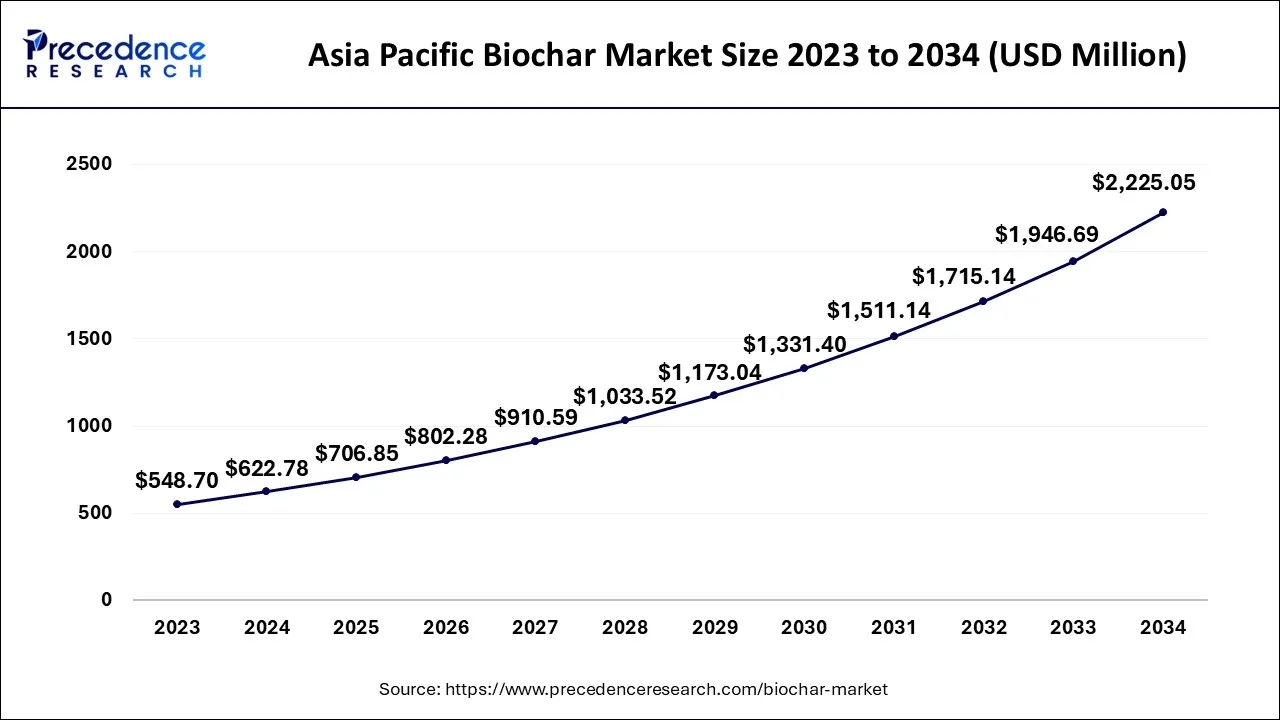
What is the Asia Pacific Biochar Market Size?
The Asia Pacific biochar market size was exhibited at USD 706.85 million in 2025 and is projected to be worth around USD 2,472.20 million by 2035, growing at a CAGR of 13.34% from 2026 to 2035.
Our analysis indicates that feedstock availability alone does not determine regional attractiveness. Transportation infrastructure, local production capacity, agricultural demand, regulation, carbon-removal procurement and established participants also matter. Our assessment is that regions combining abundant low-cost biomass with nearby demand centers and supportive carbon-removal frameworks offer stronger conditions for scalable project development.
In our view, geographic expansion should be based on integrated feedstock, demand and regulatory economics rather than market size alone. Biomass-rich regions with limited infrastructure may require localized processing models, while mature agricultural or carbon-removal markets may support higher-value applications and contracted demand, depending on whether strategy prioritizes low-cost production, premium applications, carbon removal or technology deployment.
The full report compares North America, Europe, Latin America, Asia-Pacific, the Middle East and Africa across regional production, installed and planned capacity, feedstock availability, regulation, carbon-removal demand, competitive presence and market-entry considerations. A structured dataset can track region, country, capacity, operating facilities, planned projects, feedstock, applications, regulatory status, carbon-removal activity and company presence.
Which Capabilities Determine a Biochar Producer's Ability to Scale From Capacity Expansion to Commercial Demand?
Installed and planned capacity indicate how quickly the industry can move from fragmented production toward larger-scale commercialization, but manufacturing scale alone does not establish commercial strength. Operating facilities, utilization, feedstock security, announced capacity additions, customer commitments and distribution capabilities must be evaluated together because nominal capacity does not necessarily translate into commercially viable supply.
Our analysis indicates that executable capacity and secured demand are increasingly interconnected. Producers need reliable feedstock, efficient utilization and consistent quality alongside routes to market: direct contracts offer demand visibility and customer control, distributors and agricultural networks extend geographic reach, industrial customers require consistent specifications and long-term supply, and carbon-removal buyers rely on verified volumes, certification and structured offtake agreements.
In our view, manufacturing scale creates greater competitive value when supported by a scalable customer and channel strategy. Long-term offtake improves demand visibility and supports project financing, and diversified distribution reduces dependence on individual customers; direct sales improve margin capture, while intermediaries broaden access at additional channel cost. Customer concentration, channel economics and contract structure therefore complement facility-level capacity benchmarking.
The full report benchmarks installed and operating capacity, planned projects, pipelines, utilization and manufacturing footprint alongside direct sales, distributors, agricultural channels, industrial customers, carbon-removal buyers, project developers and offtake agreements. A structured dataset can track facility, country, capacity, operating status, commissioning year, planned expansion, feedstock, technology, utilization, project stage, customer type, sales channel, contract structure, offtake volume and duration, pricing model and customer concentration.
Which Strategic Moves Are Reshaping Biochar Capacity, Capabilities and Market Positioning?
Strategic activity is extending beyond incremental production growth toward capacity expansion, new pyrolysis facilities, technology partnerships, carbon-removal offtake agreements, agricultural partnerships, certification initiatives, geographic expansion and targeted investments. Acquisitions and investments can further accelerate access to production capacity, proprietary technology, project pipelines and customer relationships.
Our analysis indicates that strategic activity is focused on the market's principal barriers to scale. New facilities expand physical supply, technology partnerships and acquisitions improve conversion efficiency and feedstock flexibility, offtake contracts and agricultural partnerships improve demand visibility, and investments in certification and project development open higher-value markets. M&A across producers, technology companies, biomass processors, carbon-removal developers and adjacent environmental businesses can support both horizontal expansion and vertical integration.
In our view, strategic investments and transactions are becoming mechanisms for assembling integrated biochar capabilities rather than simply increasing production volume. Transaction activity will therefore be evaluated based on the assets acquired, including technology, geography, production capacity, feedstock access, project pipelines and carbon-removal exposure, rather than transaction count alone.
The full report tracks capacity expansions, new facilities, technology partnerships, offtake and carbon-removal contracts, agricultural partnerships, certification developments, acquisitions and investments, including transaction value, target, acquirer or investor, technology, geography, acquired capabilities and strategic rationale. A structured dataset can track transaction type, company, target, year, disclosed value, geography, technology, capacity, feedstock, application, carbon-removal capability, partnership type and rationale.
What Will Determine Biochar's Transition From Emerging Market to Scalable Commercial Platform Through 2030-2035?
Through 2030-2035, biochar is likely to evolve from predominantly small-scale production and demonstration projects toward integrated commercial systems combining physical biochar, biomass valorization, energy recovery and durable carbon removal. Larger facilities, improved pyrolysis efficiency, stronger certification infrastructure and increasing carbon-removal procurement could broaden the addressable market, with the pace depending on feedstock availability, project economics, technology performance, regulatory development and reliable demand.
Our analysis indicates that the next phase will depend less on increasing biochar output and more on creating standardized, bankable and repeatable project models. Producers will need to demonstrate competitive economics while managing feedstock logistics, product quality and multiple revenue streams, including carbon-removal revenues, physical sales, energy recovery, specialized applications, technology licensing and project-development services.
In our view, the long-term opportunity extends beyond biochar as a standalone product toward integrated biomass-to-value platforms. Companies able to monetize multiple outputs from the same feedstock may capture a broader share of the value chain, although commercialization remains exposed to risks including feedstock availability, transportation costs, technology performance, certification requirements, carbon-removal pricing, customer adoption, project financing and regulatory changes.
The full report develops 2030-2035 market, production, carbon-removal and capacity-expansion scenarios and assesses technology development, feedstock economics, application growth, regional opportunities, emerging profit pools, investment opportunities and strategic risks. A forward-looking scenario framework can track production volume, installed capacity, feedstock costs, biochar and carbon-removal pricing, project economics, technology adoption, application demand and regional deployment.
Recent Developments
- In February 2026, PYREG and SUEZ introduced a creative unified pyrocarbonisation solution that will help advance the production of biochar from sewage sludge. The new Pyrolis S2B is a robust converter empahsizing on eco-friendly carbon sequestration solution. (Ref: https://www.suez.com)
- In July 2026, Verde Resources fixed a 10-year commercialization deal with Ergon Asphalt & Emulsions for installing an active biochar solution in cold paving applications. This green deal confirmed equal or said share with precision and green enhancement to Ergon's cold paving emulsion products (Ref: https://carbonherald.com)
- In July 2026, the researchers explored a new biochar-based material enhancing PFOS removal in two ways. This involves a spotting and breaking process highlighting the impact of the technology to overcome the challenges and meet the advance need within a short time. (Ref: https://www.innovationnewsnetwork.com)
- In August 2025, Airex Energy Inc. reported its efforts to scale biochar from niche to industrial mainstay through tailored solutions and strategic partnerships. Timothy Harfield profiles Airex Energy and the French Canadian to model and proprietary technology representation of the shift towards industrial and tailored solutions for decarbonization and residue management. (Source: https://biochartoday.com )
- In December 2025, Better Cotton Initiative, in collaboration with Planboo, a climate technology startup, announced the launch of a biochar project in India. The collaboration aims to boost the production and use of biochar on cotton farms in India to drive scalability within the agricultural sector. (Source: https://bettercotton.org)
- In January 2025, Google signed major agreements with Indian startup Varaha and U.S. firm Charm Industrial. The agreement is signed to purchase substantial amounts of biochar-based carbon removal credits, the largest deals of their kind to date. (Source: techcrunch.com)
- In December 2022, Crystal Courtney from Cincinnati Parks Division invested $1.1 million in a carbon-negative biochar project. The investment aims to launch a small pilot project for biochar production.
Biochar Market Segments Covered in the Report
By Feedstock
- Forestry Residues
- Agricultural Residues
- Woody Biomass
- Manure
- Green Waste
- Municipal Organic Waste
- Other Biomass
By Technology
- Slow Pyrolysis
- Fast Pyrolysis
- Continuous Pyrolysis
- Batch Pyrolysis
- Modular Pyrolysis
- Integrated Biomass Conversion
By Application
- Soil Amendment
- Agriculture
- Horticulture
- Animal Applications
- Water Treatment
- Construction Materials
- Environmental Remediation
- Carbon Removal
- Industrial Applications
- Other Applications
By End User
- Agricultural Producers
- Horticulture Producers
- Industrial Users
- Environmental Organizations
- Carbon-Removal Buyers
- Research Institutions
- Government and Public-Sector Organizations
- Other End Users
By Product Type
- Standard Biochar
- Premium Biochar
- Engineered Biochar
- Activated Biochar
- Biochar-Based Products
By Carbon-Removal Model
- Direct Biochar Sales
- Carbon-Removal Credits
- Integrated Biochar and Carbon-Removal Revenue
- Carbon-Removal Offtake Agreements
By Geography
North America
- United States
- Canada
Europe
- Germany
- United Kingdom
- Finland
- Switzerland
- Norway
- Rest of Europe
Asia-Pacific
- China
- India
- Australia
- Japan
- Rest of Asia-Pacific
Latin America
- Brazil
- Bolivia
- Rest of Latin America
Middle East and Africa
- GCC
- South Africa
- Rest of Middle East and Africa
For inquiries regarding discounts, bulk purchases, or customization requests, please contact us at sales@precedenceresearch.com
Frequently Asked Questions
Tags





Ask For Sample
No cookie-cutter, only authentic analysis – take the 1st step to become a Precedence Research client
 Get a Sample




 sales@precedenceresearch.com
 Schedule a Meeting
