



Gasification Market Size, Share and Trends 2026 to 2035
Gasification Market (By Feedstock: Coal, Petroleum, Natural Gas, Waste, Biomass; By Application: Chemical, Liquid Fuel, Gaseous Fuel, Power) - Global Industry Analysis, Size, Trends, Leading Companies, Regional Outlook, and Forecast 2026 to 2035
Source: https://www.precedenceresearch.com/gasification-market
 Get a Sample
 Table Of Content


What is the Gasification Market Size?
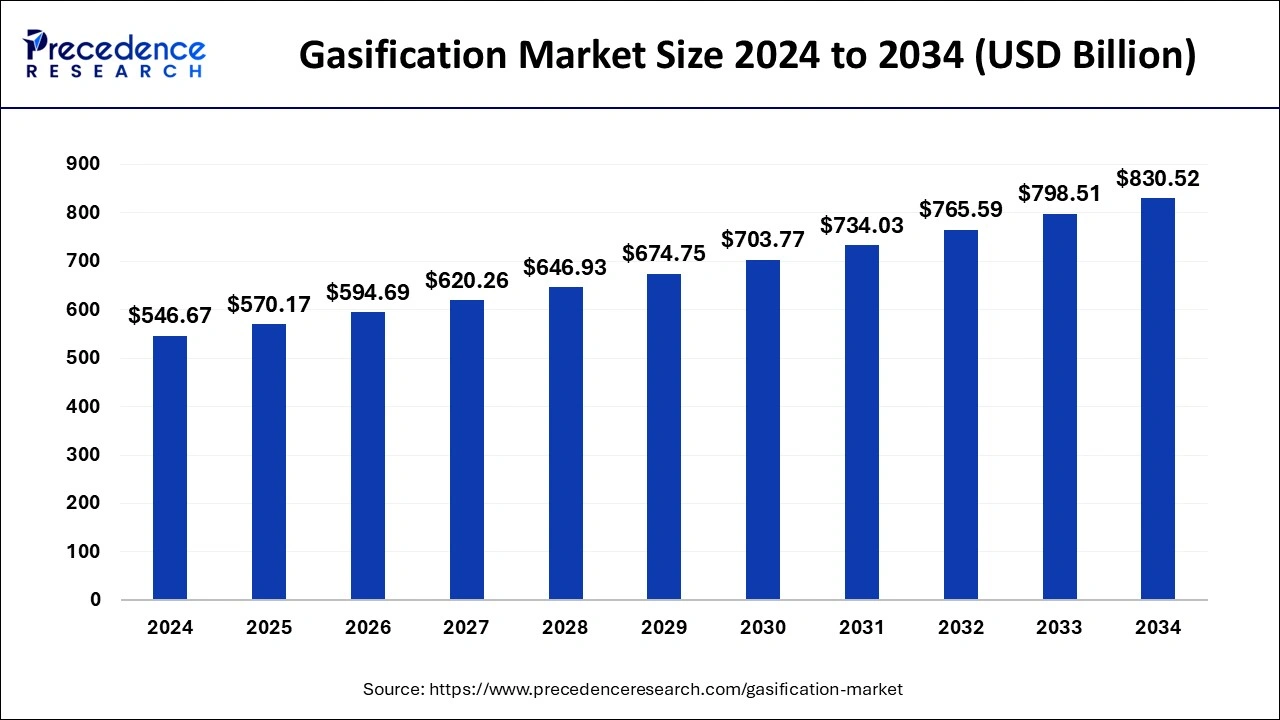
The global gasification market size was estimated at USD 570.17 billion in 2025 and is predicted to increase from USD 594.69 billion in 2026 to approximately USD 863.14 billion by 2035, expanding at a CAGR of 4.23% from 2026 to 2035.
Gasification Market Key Takeaways
- In terms of revenue, the global gasification market was valued at USD 570.17 billion in 2025.
- It is projected to reach USD 863.14 billion by 2035.
- The market is expected to grow at a CAGR of 4.23% from 2026 to 2035.
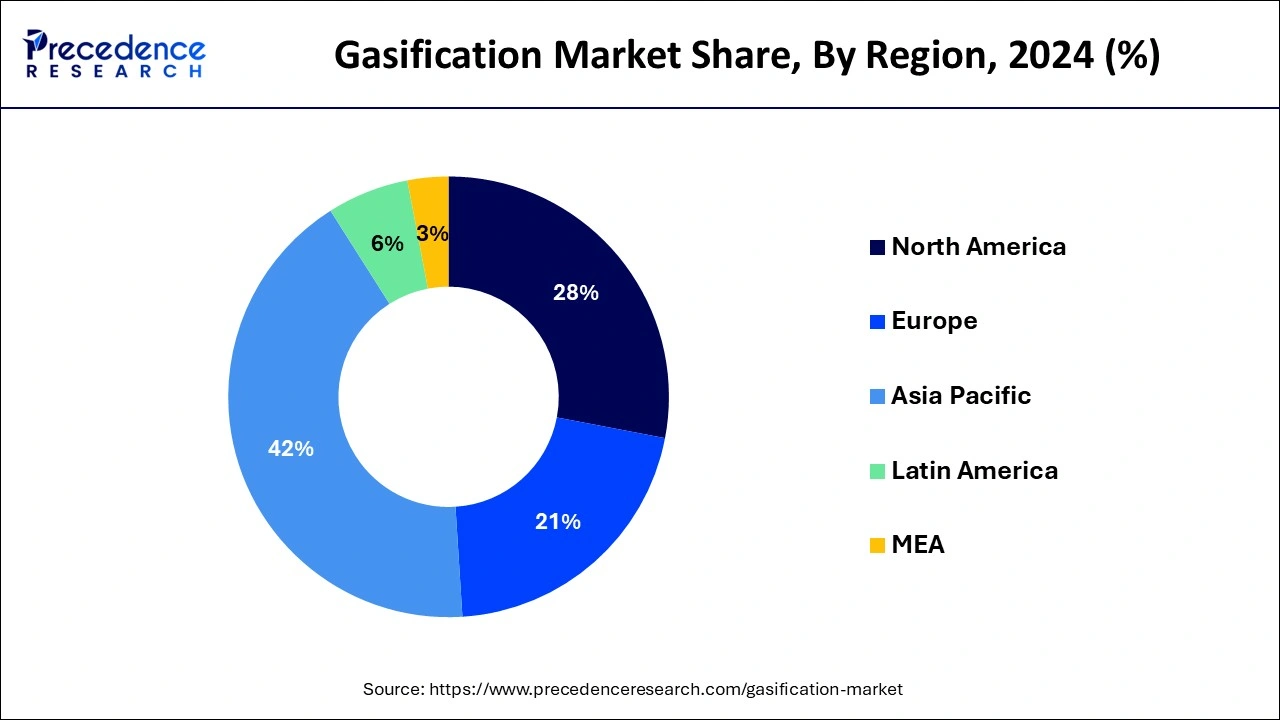
- Asia Pacific dominated the gasification market with the largest market share of 42% in 2025.
- Europe is projected to expand at a rapid pace in the global market during the forecast period.
- By feedstock, the coal segment accounted for the dominating share of the market in 2025.
- By feedstock, the biomass waste segment is expected to witness significant growth during the forecast period.
- By application, the chemical segment held the largest share of the market in 2025.
- By application, the power segment is expected to grow at a robust rate during the forecast period.
Market Overview
Gasification is a process that converts carbonaceous raw materials such as coal, biomass, and waste into fuel gas, known as synthesis gas or syngas. Synthesis gas or syngas is the by-product of this process. Syngas produced via gasification have numerous applications such as power generation, as fuel in industrial processes, reduction in carbon emissions, and production of various chemicals and fuels. Generally, gasification occurs in a gasifier at a high temperature without combustion, with a controlled amount of oxygen and/or steam.
Gasification Market Growth Factors
- The growth of the gasification market is primarily driven by the rising population, rapid progress of industrialization & urbanization, and reduced reliance on fossil fuels.
- The increasing use of sustainable and eco-friendly energy sources that are alternatives to traditional fossil fuels due to growing environmental concerns contributes to the growth of the gasification market. To align with the rising focus on reducing greenhouse gas emissions and transitioning to a circular economy.
- The rapid advancements in gasification technology have significantly enhanced the efficiency and performance of coal gasification processes. Governments around the world, using gasification technologies to address waste management issues and produce eco-friendly energy which increases the focus on waste-to-energy, is anticipated to provide lucrative opportunities for market expansion.
- The increasing application of syngas for the production of methanol and hydrogen and other major applications makes a substantial contribution to the gasification market growth.
Gasification Market Scope
| Report Coverage | Details |
| Market Size in 2025 | USD 570.17 Billion |
| Market Size in 2026 | USD 593.69 Billion |
| Market Size by 2035 | USD 863.14 Billion |
| Growth Rate from 2026 to 2035 | CAGR of 4.23% |
| Largest Market | Asia Pacific |
| Base Year | 2025 |
| Forecast Period | 2026 to 2035 |
| Segments Covered | Feedstock, Application, and Regions |
| Regions Covered | North America, Europe, Asia-Pacific, Latin America, and Middle East & Africa |
Market Dynamics
Driver
Increasing demand for clean and sustainable energy sources
The rising demand for clean and sustainable energy sources is expected to boost the growth of the gasification market during the forecast period. Gasification is increasingly being used as the need for clean and sustainable energy sources to reduce reliance on fossil fuels. Gasification provides a cleaner and eco-friendly alternative to conventional fossil fuel combustion by efficiently converting biomass, coal, or waste into syngas or synthesis gas, which is widely used for power generation and as a feedstock for chemicals, fertilizers, and fuels.
Additionally, electrification through biomass gasifiers in rural areas is increasingly becoming popular in rural areas and aims to provide electricity by converting biomass, such as crop wastes, wood, and agricultural residues like wheat straw, rice husks, or corn stalks into a combustible gas known as producer gas. The producer gas is extensively used to fuel a gas engine or generator for electricity generation. Thereby bolstering the gasification market growth.
Restraint
High initial investment
The high initial investment involved in setting up a gasification plant is anticipated to hinder the global gasification market. The gasification plant requires a substantial initial investment for the installment of gasifiers and a high cost involved in designing and manufacturing gasifiers and other gasification parts and units, which can be expensive for many potential market entrants. In addition, increasing usage of bio-fuels for power generation may restrict the expansion of the global market in the coming years.
Opportunity
Rising investment in coal gasification
The increasing investment in coal gasification is projected to offer an immense opportunity for the coal gasification market. Coal gasification is a widely used process to convert carbonaceous material, including coal, petroleum, or biomass, into carbon monoxide and hydrogen. Thus driving the gasification market growth.
Syngas are commonly used for power generation, chemical production, transportation, and other industrial applications. It requires reduced reliance on limited resources, which significantly drives the growth of coal gasification as alternative fuels. Additionally, governments are encouraging the use of sustainable and clean energy sources through investment, financial incentives, and various other incentives.
- In January 2024, the Union Cabinet of India approved an ?8,500 crore incentive scheme for coal gasification projects. The Government is targeting to gasify 100 million tonnes (MT) of coal by 2030, with investments worth over Rs. 4 trillion. To encourage the use of clean fuels, the government has provided a 20% revenue share concession under commercial coal block auctions.
Segment Insights
Feedstock Insights
The coal segment accounted for the dominating share of the gasification market in 2025, owing to the increasing number of coal reserves in countries such as the U.S., China, Russia, and India. Coal is the most abundant energy resource globally and economically feasible in many countries, which leads to a surge in several gasification plants and reduces dependence on imported fuels. The syngas produced via coal gasification are most commonly used to generate electricity in various industrial and chemical processes. Additionally, the growth of the segment is driven by increasing energy demand, economic benefits of coal gasification, and rising government support for coal gasification.
The biomass waste segment is expected to witness significant growth in the gasification market during the forecast period. Biomass gasification is a technology that uses a controlled process involving heat, oxygen, and steam to convert biomass into hydrogen and other valuable eco-friendly products without combustion. The market has witnessed the increasing use of biomass gasification to generate electricity in several developing countries, especially in rural areas, to reduce carbon dioxide emissions. Biomass is organic matter obtained from animals and plants and is widely used to produce heat and energy for industrial and residential applications. The rapid growth of the segment is majorly driven by the rise in harmful greenhouse gas emissions, which has led to the use of sustainable energy sources.
- In December 2023, Thermax Group made an announcement outlining its vision and the future of the company in alignment with global energy transition goals. The company, through one of its subsidiaries, has secured orders worth more than Rs. 500 crores from a leading energy conglomerate for setting up five bio-CNG plants across India.
Application Insights
The chemical segment held the largest share of the gasification market in 2025. The syngas produced via gasification assist in generating various valuable chemicals, including methanol, dimethyl ether, ammonia, synthetic natural gas, and others. These chemicals are most commonly used across various industries, such as fertilizers, fuels, plastics, and others.
The power segment is expected to grow at a robust rate during the forecast period. The growth of the segment is majorly driven by the rise in power generation due to rapid industrialization and urbanization. Since carbon emissions have increased significantly, the demand for clean and sustainable energy sources has risen. Market players and the government are actively participating and investing in eco-friendly options to reduce dependence on fossil fuels and lower carbon emissions.
Regional Insights
What is the Asia Pacific Gasification Market Size?
The Asia Pacific gasification market size was estimated at USD 239.47 billion in 2025 and is predicted to be worth around USD 368.05 billion by 2035 with a CAGR of 4.39% from 2026 to 2035.
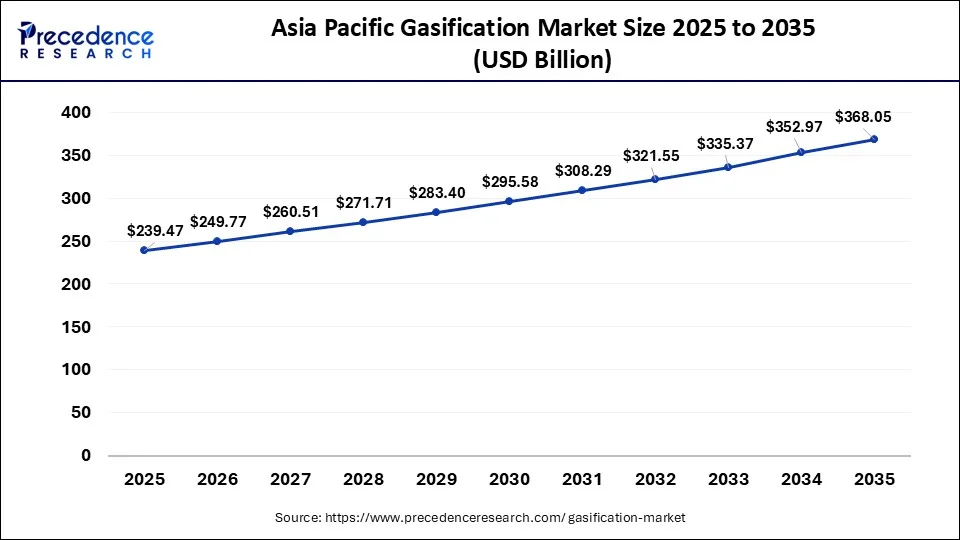
Asia Pacific held the dominant share of the gasification market in 2025. The region is observed to witness notable growth during the forecast period. The rising demand for energy, including cleaner and more efficient sources across the Asia Pacific, especially in developing countries like China, India, and Japan, is bolstering the demand for the gasification process. The region is experiencing robust growth for biomass gasification, particularly in rural areas, due to the growing power demand. The rising use of biomass fuels for electricity and transportation generation is gaining attention in various developing nations to avoid carbon dioxide emissions from using fossil fuels.
China and India have a high accessibility of inexpensive coal in Asia Pacific, which led to increasing production of electricity, heat, and chemicals through the gasification process. Several countries in the region usually depend on imported fossil fuels to meet their energy needs. Gasification plays an active role in diversifying their energy sources and reducing reliance on external suppliers for imports. Moreover, the increasing demand for electricity due to the rise in population, rapid urbanization, and industrialization are likely to drive the growth of the gasification market in the region during the forecast period. Furthermore, the supportive government policies, financial incentives, and initiatives for clean energy projects, as well as actively supporting coal gasification and biomass gasification, are expected to boost the market growth in the region during the forecast period.
- In March 2024, L&T emerged as the best technical bidder for NLC India's lignite gasification project. The NLC India's Chairman and Managing Director stated that price negotiations between the two companies are ongoing.
- In October 2023, China has been employing its technologies to help its Belt and Road Initiative (BRI) partners in turning waste into wealth. There are abundant biomass resources in Southeast Asia, mainly including waste from agriculture and forestry.
- In April 2021, AIR Products announced the acquisition of the remaining 50% stake in a gasification joint venture from China Shenhua Coal to Liquid and Chemical. Air Products acquired General Electric's gasification business in 2018, which included a 50% stake in a Syngas joint venture with China Shenhua Coal to Liquid and Chemical, a subsidiary of China Energy Group.
- According to the IEA Bioenergy report in 2023, in recent days, green methanol has been a low-carbon fuel in the shipping industry. China has developed green technologies for methanol for maritime applications based on biomass gasification with a capacity to produce 50,000 tons annually by 2024.
What are the Advancements in the Gasification Industry in Europe?
Europe is projected to expand at a rapid pace in the global gasification market during the forecast period. The growth of the region is attributed to the increasing significance of sustainable and clean energy sources as an alternative to fossil fuels, resulting in the rising adoption of gasification in Europe. In addition, increasing focus on waste-to-energy and biomass gasification, a rise in the number of coal reserves, and growing demand for syngas and other chemicals in European nations are the key factors that propel the growth of the gasification market in the region.
Germany Gasification Market Trends: The country has a strong focus on innovation and sustainability, with numerous projects aimed at enhancing efficiency and reducing costs. The presence of established players and supportive government policies further creates a favorable environment for market growth.
What are the Key Trends in the Gasification Industry in Latin America?
Latin America is expected to witness a substantial amount of growth in the market. This growth is driven by increasing energy demands and a shift towards sustainable energy sources. Government initiatives aimed at enhancing energy security and reducing pollution are gaining traction in the region, propelling market growth. There is also a rising awareness of environmental issues, which further contributes to the demand for cleaner energy solutions. Countries like Brazil and Mexico are leading players.
Brazil Gasification Market Trends: The country's market landscape features both local and international players, who are aiming at expanding their operations. The region's diverse biomass resources and supportive policies further help to create a fertile environment for market expansion, attracting investments and fostering innovation.
How is the Middle East and Africa Region Growing in the Gasification Market?
The Middle East and Africa are expected to witness steady growth throughout the forecast years. This growth is driven by the need for energy diversification and sustainable development. Countries like South Africa, the UAE, Saudi Arabia, and Kenya are exploring biomass gasification as a viable solution to address energy shortages and environmental concerns. Government policies promoting renewable energy are further driving high investments in the market.
Saudi Arabia Gasification Market Trends: The country's market landscape still appears to be in its developing stages, but is growing steadily. The region's abundant biomass resources and increasing awareness of sustainable practices are expected to drive market growth in the upcoming years.
Gasification Market Companies
- Royal Dutch Shell
- Air Liquide
- Siemens
- KBR, Inc.
- Lummus Technology
- Sedin Engineering
- Shell Plc.
- SEDIN Engineering Company Limited
- ThyssenKrupp AG.
- Thyssenkrupp
- Shell
- Mitsubishi Heavy Industries
- Synthesis Energy Systems
Recent Developments
- In February 2026, Adani Group started its work on a 70,000 crore coal gasification plant in Nagpur. This project is planning to provide 30,000 jobs and boost national self-reliance. The plant is also expected to produce syngas, ammonia, and hydrogen. This new venture positions Nagpur as a global hub for clean energy technologies.
(Source: https://energy.economictimes.indiatimes.com) - In June 2022, Zichai Power announced the commissioning of the biomass gasification and cogeneration project in Thailand was completed and officially put into operation. The project is equipped with a biomass gasification device, using two 500kW biomass gas-fired generator sets of New Energy Company, supporting a cooling system, a power distribution system, a remote-control system, and a waste gas waste heat utilization system.
- In February 2024, Two of India's top companies, Maharatna CPSE entities, Coal India Limited (CIL) and Bharat Heavy Electricals Limited (BHEL), formally signed a joint venture agreement (JVA) for setting up an ammonium nitrate plant through surface coal gasification (SCG) technology route. The plant to come up in the Lakhanpur area of Mahanadi Coalfields Limited, Odisha, is planned to produce 2000 tons of ammonium nitrate daily.
Segments Covered in the Report
By Feedstock
- Coal
- Petroleum
- Natural Gas
- Waste
- Biomass
By Application
- Chemical
- Liquid Fuel
- Gaseous Fuel
- Power
By Geography
- North America
- Asia Pacific
- Europe
- Latin America
- Middle East & Africa
For inquiries regarding discounts, bulk purchases, or customization requests, please contact us at sales@precedenceresearch.com
Frequently Asked Questions
Tags





Ask For Sample
No cookie-cutter, only authentic analysis – take the 1st step to become a Precedence Research client
 Get a Sample




 sales@precedenceresearch.com
 Schedule a Meeting
