



Coal Gasification Market Size, Share and Trends 2026 to 2035
Coal Gasification Market (By Gasifier: Fixed Bed, Fluidized Bed, Entrained Flow; By Application: Fertilizers, Electricity Generation, Chemicals, Hydrogen Generation, Steel Production, Others) - Global Industry Analysis, Size, Trends, Leading Companies, Regional Outlook, and Forecast 2026 to 2035
Source: https://www.precedenceresearch.com/coal-gasification-market
 Get a Sample
 Table Of Content


What is the Coal Gasification Market Size?
The global coal gasification market size was estimated at USD 258.59 billion in 2025 and is predicted to increase from USD 288.10 billion in 2026 to approximately USD 733.77 billion by 2035, expanding at a CAGR of 10.99% from 2026 to 2035. The rising investment in coal gasification projects is expected to drive the growth of the coal gasification market during the forecast period.
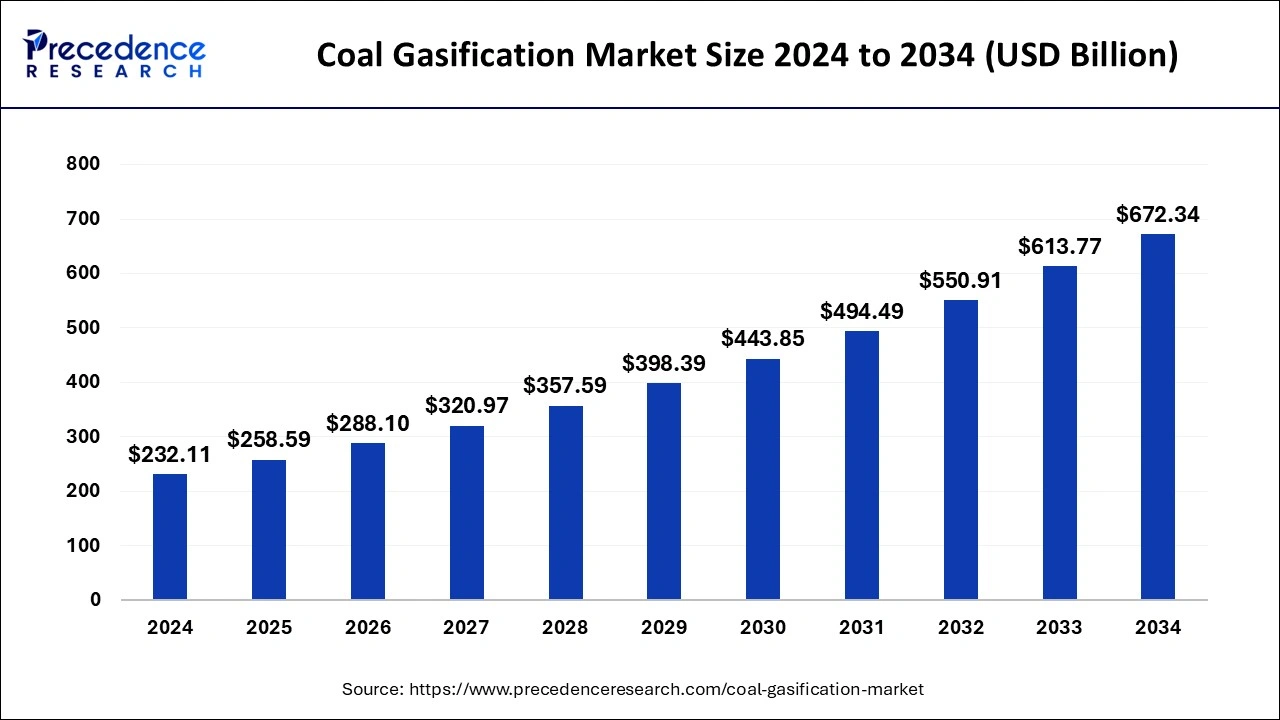
Coal Gasification Market Key Takeaways
- In terms of revenue, the global coal gasification market was valued at USD 258.59 billion in 2025.
- It is projected to reach USD 733.77 billion by 2035.
- The market is expected to grow at a CAGR of 10.99% from 2026 to 2035.
- Asia Pacific held the dominant share of the coal gasification market in 2025. The region is observed to witness prolific growth during the forecast period.
- North America is observed to expand at a rapid pace during the forecast period.
- By gasifier, the fluidized bed segment accounted for the dominating share in 2025.
- By gasifier, the entrained flow segment is expected to witness a significant share during the forecast period.
- By application, the electricity generation segment held the largest share of the coal gasification market in 2025.
- By application, the steel production segment is expected to grow fastest during the forecast period.
Market Overview
Coal gasification is a process used to convert carbonaceous material, such as coal, petroleum, petroleum coke, or biomass, into carbon monoxide and hydrogen. In the coal gasification process, coal is partially oxidized with oxygen, air, steam, or carbon dioxide under controlled conditions to generate fuel gas. Synthesis gas or syngas is used as a fuel gas. Syngas is widely used as a fuel for chemical production, transportation, power generation, and various other industrial applications. Coal gasification facilitates numerous benefits, such as reduced emissions, improved efficiency, and versatility in feedstock utilization, which promotes the growth of the coal gasification market.
Coal Gasification Market Growth Factors
- The rise in the number of coal deposits in developing economies promotes the market's growth in the coming years.
- The increasing focus on clean and efficient energy sources and reducing reliance on fossil fuels & natural gas are the major drivers boosting the coal gasification market's expansion during the forecast period.
- The rapid urbanization and industrialization are anticipated to propel the demand for coal gasification during the forecast period.
- The rapid adoption of underground coal gasification (UCG) to convert coal into valuable gases without the need for mining, which is anticipated to fuel the market's expansion.
Market Scope
| Report Coverage | Details |
| Growth Rate from 2026 to 2035 | CAGR of 10.99% |
| Market Size in 2025 | USD 258.59 Billion |
| Market Size in 2026 | USD 288.10 Billion |
| Market Size by 2035 | USD 733.77 Billion |
| Largest Market | Asia Pacific |
| Base Year | 2025 |
| Forecast Period | 2026 to 2035 |
| Segments Covered | Gasifier, By Application, and Regions |
| Regions Covered | North America, Europe, Asia-Pacific, Latin America, and Middle East & Africa |
Market Dynamics
Driver
Rising demand for hydrogen gas
The demand for hydrogen gas is expected to propel the growth of the coal gasification market during the forecast period. Hydrogen is increasingly becoming popular as a clean energy carrier with various applications. The market has witnessed the increasing utilization of coal gasification for the production of hydrogen gas. The coal gasification process has the significant potential to produce hydrogen with reduced emissions and contribute to a more sustainable energy system. Hydrogen is widely used to generate electricity, power vehicles, and power industry and heat, as well as reduce dependency on fossil fuels. For instance, in recent years, India has embarked on a massive coal gasification push to combat the climate crisis and reduce reliance on fossil fuels, and lower carbon emission intensity to achieve a net zero by 2070. Thereby spurring the demand for growth in the coal gasification market.
Restraint
High cost
The high cost involved in setting up a coal gasification plant is anticipated to hamper the growth of the market during the forecast period. A huge amount of capital is required to set up a coal gasification plant, which often discourages middle and lower-income countries with limited budgets. In addition, Countries with water scarcity issues may face challenges in setting up coal gasification plants as a significant amount of water is required for cooling purposes in the coal gasification process, which may restrict the expansion of the global coal gasification market.
Opportunity
Supportive government investment and initiatives
The rising government investment and initiatives are projected to offer a lucrative opportunity for the growth of the coal gasification market during the forecast period. The government is actively engaged in eco-friendly solutions and sustainable solutions for electricity generation. Governments around the world are directing investments in clean energy production, which is likely to boost the adoption of coal gasification technologies for power generation and the industrial sector. Supportive government investment, policies, subsidies, and incentives are positively influencing the growth of clean energy technologies and resulting in the rise in coal gasification plants.
Moreover, the environmental benefit from UCG technology can assist in mitigating the impact of coal utilization on the climate. Underground coal gasification (UCG) has the potential to lower greenhouse gas emissions compared to conventional coal combustion methods. Thereby driving the market's growth in the coming years.
Segment Insights
Gasifier Insights
The fluidized bed segment accounted for the dominant share in 2025. Fluidized bed gasifiers are used for coal gasification owing to their high reaction rates and efficient mixing. Compared to other gasification techniques, these gasifiers produce lower tar and heavy hydrocarbons.
India has created a domestic method for producing methanol from high-ash Indian coal. In order to create syngas and subsequently convert syngas into 99% pure methanol, Bharat Heavy Electricals Limited (BHEL) has developed a fluidized bed gasification method that is appropriate for high ash Indian coals. By encouraging the use of methanol as a transportation fuel (mixing it with gasoline), this technology will assist the nation in implementing clean technology and help cut down on the importation of crude oil.
The entrained flow segment is expected to witness a significant share during the forecast period owing to its excellent efficiency and flexibility in any coal feedstock. Entrained-flow gasifiers can handle practically any coal feedstock and generate clean, tar-free syngas. The fine coal feed can be fed to the gasifier in either dry or slurry form. Thus, these factors are anticipated to propel the entrained flow gasifier market share in the coming years.
Application Insights
The coal gasification market was dominated by the electricity generating segment in 2025. The increasing demand for power generation is fueling the segment's expansion. In comparison to burning coal to produce energy, coal gasification offers a practical and environmentally friendly energy source. The IGCC generates a lot of electricity through the process of coal gasification. Power plants that use the Integrated Gasification Combined Cycle (IGCC) are more efficient. Syngas, a cleaner and more concentrated fuel produced through gasification, is made possible. Hydrogen is present in syngas generated by coal gasification. Several industrial uses for hydrogen-rich syngas exist, such as chemical processing, fuel cell utilization, power utilities, and other uses. Hydrogen is another byproduct of coal gasification, which can be stored and used to produce energy at a later time.
The steel production segment is expected to grow fastest during the forecast period owing to the rise in steel production via coal gasification processes. Coal is converted into a liquid fuel known as syngas, which is then used as fuel for steel production in coal gasification processes. The development of cost-effective coal gasification processes helps steelmakers produce steel substantially.
Regional Insights
Asia Pacific held the dominant share of the coal gasification market in 2025. The region is observed to witness prolific growth during the forecast period. The region is the largest coal producer, and the increasing energy demand will likely accelerate the growth of the region's coal gasification market. In the Asia Pacific region, developing countries such as China, India, Japan, and Indonesia have been actively engaging in numerous coal gasification projects owing to the presence of significant coal reserves. The region's rapid growth is attributed to the increasing focus on reducing carbon emissions and transitioning to cleaner energy sources, the robust advancements in IGCC power plants, increasing emphasis on reducing dependence on fossil fuels & natural gas, rising demand for chemical products, rising demand for electricity, rise in the number of coal deposits in developing economies, and the increasing demand for clean and efficient energy generation sources in industries and household applications.
- The International Energy Agency (IEA) predicts that in 2022, the world's coal consumption will increase by 1.2% and reach 8 billion tons in a single year for the first time. The International Energy Agency (IEA) predicts that the demand for coal will reach a record high globally in 2022, primarily due to the rise in coal power in China, the EU, and India. The countries with the biggest increases in coal burning are predicted to be Southeast Asia (+14%), China (+5%), and India (+7%).
Governments are also looking for more sustainable methods to use coal resources, and as coal gasification provides cleaner energy options, they encourage programs and invest more in coal gasification technologies.
China ranks among the top producers of lignite and coal worldwide. India's coal output has also increased significantly, helped by government initiatives to reduce reliance on coal imports and investments.
- Approximately 56% of China's yearly domestic energy consumption was derived from coal. China has benefited greatly from the coal industry's contributions to social and economic advancement.
- A representative from the National Energy Administration's coal division claims that seven significant coal companies, including Shandong Energy, China National Coal Group Corporation, and China Energy Investment Corporation.
Conversely, North America is anticipated to grow quickly over the projection period due to the growing focus on lowering carbon emissions, the growing demand for clean hydrogen, and an increase in gasification activities in the syngas and chemical industries. Over the course of the projection period, the U.S.'s active participation in coal gasification projects is anticipated to propel market expansion.
What are the Advancements in the Coal Gasification Industry in Europe?
Europe is expected to witness significant growth in the market. This is due to the region's strong commitment to sustainability and reducing carbon footprints, which is thus driving demand for cleaner energy solutions. Regulatory frameworks, such as the EU Green Deal, are driving investments in innovative technologies, making coal gasification a viable and popular option for energy production. Countries like Germany and France are leading players.
Germany Coal Gasification Market Trends: The country is witnessing increased collaborations between industry and government, fostering research and development activities. As the region transitions to a low-carbon economy, coal gasification is positioned to grow even further.
What are the Key Trends in the Coal Gasification Industry in Latin America?
Latin America is expected to witness substantial growth in the market, fueled by rapid industrialization, urbanization, and increasing energy demands. Countries such as Brazil and Mexico are increasingly investing in coal gasification to ensure energy security while transitioning to cleaner energy sources. Regulatory support and government initiatives are further driving the adoption of gasification technologies.
Brazil Coal Gasification Market Trends: The country's market landscape is characterized by a mix of domestic and international companies, all competing for market share. As the region continues to expand its energy infrastructure, coal gasification is expected to play a crucial role in meeting future energy needs while addressing environmental concerns.
How is the Middle East and Africa Region Growing in the Coal Gasification Industry?
The Middle East and Africa are expected to witness steady growth throughout the forecast years. This growth is driven by the need for energy diversification and the utilization of local coal resources. Governments in the region are increasingly recognizing the importance of coal gasification in achieving energy security and reducing dependence on oil and gas. Regulatory frameworks are also being developed to support this transition.
Saudi Arabia Coal Gasification Market Trends: The country's market landscape still appears to be in development, with opportunities coming up for both local and international players to enter the market. As the region seeks to enhance its energy mix, coal gasification is expected to gain traction.
Coal Gasification Market Companies
- Synthesis Energy Systems Inc.
- Swan Hills Synfuels LLP
- Siemens AG
- SEDIN Engineering Co. Ltd.
- Sasol Ltd.
- Regius Synfuels Ltd.
- Mitsubishi Heavy Industries Ltd.
- McDermott International Ltd.
- Larsen and Toubro Ltd.
- KBR Inc.
- Johnson Matthey Plc
- Ergo Exergy Technologies Inc.
- CNCEC
- Chiyoda Corp.
- CASE GROUP
- Basin Electric Power Cooperative
- Air Products and Chemicals Inc.
Recent Developments
- Building on research conducted last year on ammonia-fired power generation using gas turbines, Mitsubishi Heavy Industries, Ltd. (MHI) and Indonesia's Institut Teknologi Bandung (ITB) announced in November 2023 that they would be extending their joint R&D partnership to support the development of cleaner fuel firing. The extension will involve additional analyses and trials. The partnership aims to advance MHI and its power solutions brand, Mitsubishi Power, in the direction of integrating tried-and-true technology into its H-25 gas turbine and to make ammonia co-firing in Indonesia a reality.
- Underground coal gasification (UCG) is slated to be initiated in May 2024 by Coal India and two commercial companies. This is a groundbreaking project for India. With a budget of Rs 70 crore, the pilot project intends to transform coal into chemicals and syngas, providing a viable substitute for conventional mining methods. The ambitious goal is to reach 100 million tonnes of UCG by 2030.
Segments Covered in the Report
By Gasifier
- Fixed Bed
- Fluidized Bed
- Entrained Flow
By Application
- Fertilizers
- Electricity Generation
- Chemicals
- Hydrogen Generation
- Steel Production
- Others
By Geography
- North America
- Asia Pacific
- Europe
- Latin America
- Middle East & Africa
For inquiries regarding discounts, bulk purchases, or customization requests, please contact us at sales@precedenceresearch.com
Frequently Asked Questions
Tags





Ask For Sample
No cookie-cutter, only authentic analysis – take the 1st step to become a Precedence Research client
 Get a Sample




 sales@precedenceresearch.com
 Schedule a Meeting
