



Biometric Technology Market Size, Key Companies, Company Market Share, User Adoption, Technology Deployment, Revenue Growth, Competitive Positioning, and Demand Forecast
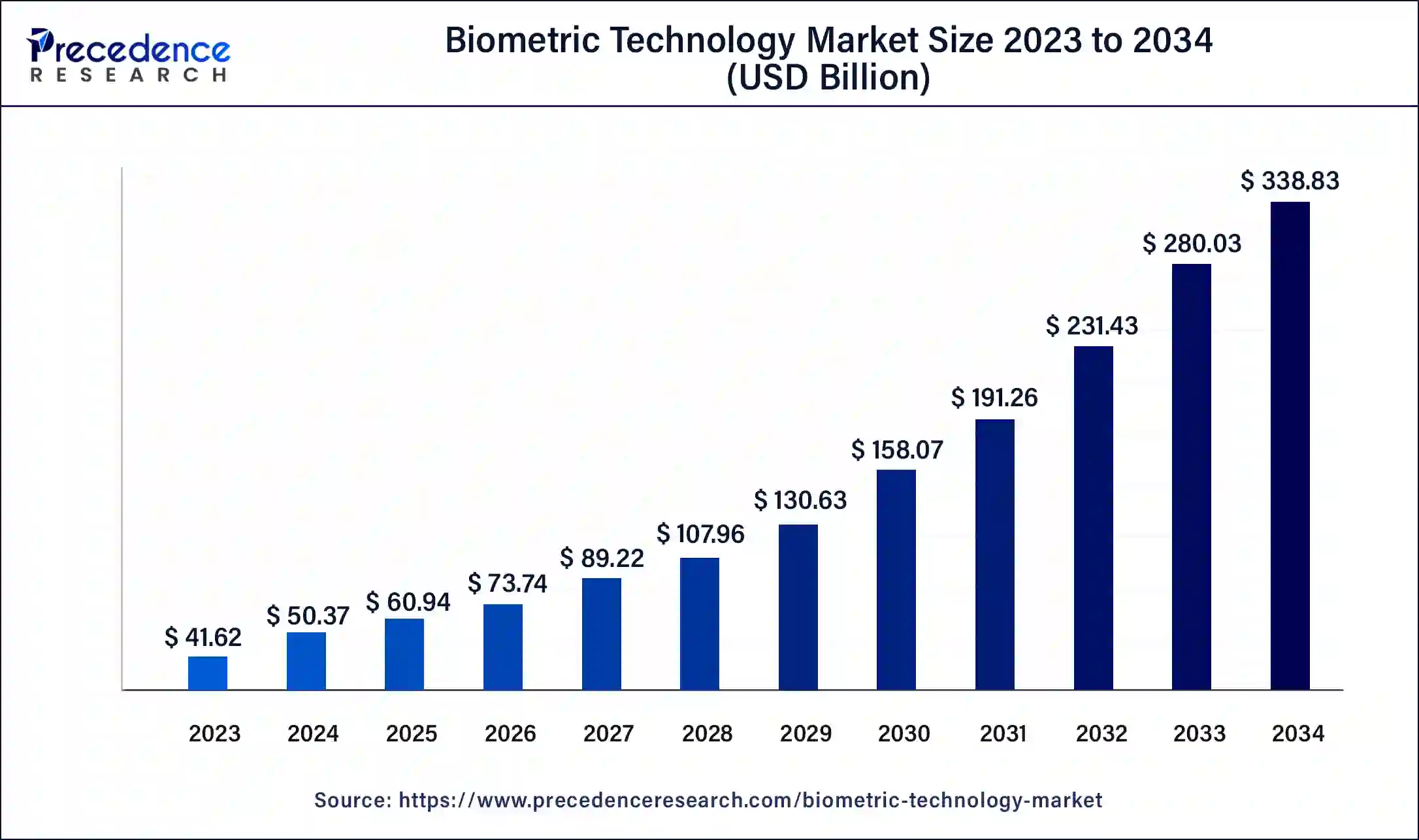
The global biometric technology market size is estimated at USD 60.94 billion in 2026 and is predicted to reach around USD 338.83 billion by 2034, accelerating at a CAGR of 21% from 2025 to 2034. The North America biometric technology market size surpassed USD 15.61 billion in 2024 and is expanding at a CAGR of 21.02% during the forecast period. The market sizing and forecasts are revenue-based (USD Million/Billion), with 2024 as the base year.
Source: https://www.precedenceresearch.com/biometric-technology-market
 Get a Sample
 Table Of Content


Biometric Technology Market Size and Forecast 2026 to 2034
The global biometric technology market size was estimated at USD 60.94 billion in 2025 and is predicted to increase from USD 73.74 billion in 2026 to approximately USD 338.83 billion by 2034, expanding at a CAGR of 21% from 2026 to 2034. Biometric Technology Market growth is driven by increasing demand for secure authentication, rising digital identity adoption, government initiatives, expanding fintech, and AI-powered biometric solutions.
Biometric Technology Market Key Takeaways
- North America led the global market with the highest market share of 31% in 2025.
- Asia Pacific region is expected to grow at a CAGR between 2026 and 2035.
- By authentication type, the multifactor authentication segment dominated the market in 2025 and also expected to witness the fastest growth in the market over the forecast period.
- By component, the hardware segment has accounted market share of around 61% in 2025.
- By component, the software segment is expected to grow with the highest CAGR in the market during the studied years.
- By type, the contact-based segment accounted highest revenue share in 2025.
- By type, the contact-less segment is expected to grow at the fastest CAGR in the market between 2026 and 2035.
- By application, the IFIS segment held a major revenue share of the market in 2025.
- By application, the Non-AFIS segment is expected to gain the highest market share with a CAGR between 2026 and 2035.
- By end user, the government segment registered its dominance over the global market with a share in 2025.
- By end user, the healthcare segment is expected to show the fastest growth with a CAGR over the forecast period.
Market Overview
Biometric technology is classified as hardware utilized in the clinical area for containing of painful injuries. Wide assortment of wounds is introduced by the patients coming about because of nearby wounds or street car crashes and careful injuries. The different stitching materials that are utilized by the medical care area so as to play out an ideal conclusion of the fresh injuries has helped the market for careful focuses. The quality and material of the stitches relies on the kind of wound and the area of the injury on the body.
The biometric technology is additionally partitioned by the different shapes and sizes of the needles that are appended to the stitching material. The example of stitch that must be performed on the body of the individual additionally influences the determination of the stitching material. Pretty much every significant medical procedure is finished by the utilization of biometric technology which helps in shutting the body part and reestablishing the typical outside life systems of the individual. Other than the string kind of biometric technology which are normally utilized, staple's structure very surprising sort of stitches which makes the work quicker and gives fast recuperating. These are basically utilized in the muscular area to stay away from sepsis and disease in the body of the person.
Biometric Technology Market Growth Factors
- The technology presents a few benefits like elevated degree of safety in the private, public, and business areas. It records extraordinary human qualities, like retina, fingerprints, DNA, and voice designs, for approval. Besides, the market is getting momentum attributable to spiraling utilization of the innovation across a few verticals in various areas for upgrading security.
- With biometrics innovation, there are diminished fakes and security breaks when contrasted with customary techniques like utilization of tokens and passwords. A biometrics framework utilizes a peruser, related programming, and a data set to look at, in this way giving a serious level of precision and security. Also, expanding reception of the innovation in the online business industry for secure installments is supposed to impel the market during the estimate time frame.
- Rising worries in regards to interior and outer protections are probably going to drive the market during a similar period. Also, expanding utilization of the innovation in government and confidential areas for representative distinguishing proof and participation is projected to fuel the general interest throughout the next few years. In addition, developing reception of biometrics frameworks in the BFSI area for getting monetary exchanges across the globe is assessed to expand the market. Furthermore, flooding reception of cutting edge validation and acknowledgment frameworks in cell phones and tablets is prompting expansion in the reception of interest for biometrics innovation across the globe.
- Nonetheless, these frameworks are normally higher in cost when contrasted with their substitutes, which is adversely affecting the development of the market. Mechanical headways, for example, the appearance of multimodal biometrics innovation, are ready to give new learning experiences to the market over the estimate period.
Trends in Biometric Technology in 2025
Biometric Border Control and Air Travel Automation
- Airports all over the world are quickly implementing biometric boarding systems that use digital identity apps and facial recognition by incorporating self-service gates and digital passports this trend is growing in 2025 increasing passenger volume and decreasing the need for manual ID checks.
AI-powered biometrics
- The formulations of dermal fillers will keep getting better and many of the products will have longer-lasting effects. These days, some fillers are made to have effects that last for at least 18 months. By decreasing the convenience of aesthetic treatment, this trend satisfies consumer demands for more long-lasting results.
Integration with Smart Devices and Wearables
- The formulations of dermal fillers will keep getting better and many of the products will have longer-lasting effects. These days, some fillers are made to have effects that last for at least 18 months. By decreasing the need for frequent touch-ups and increasing the convenience of aesthetic treatments, this trend satisfies consumer demands for more long-lasting results.
Key Trends
- Rising security issues: Increasing threats of cybercrime and identity theft are forcing governments and companies to turn to biometric systems for better authentication, fuelling the growth of the market across sectors including banking, defense, and healthcare.
- Technology advancements: Developments in technology, including AI-enabled facial recognition and contactless biometrics, are improving accuracy and convenience and creating market-wide appeal for mainstream adoption in commercial electronics and public security.
Market Scope
| Report Coverage | Details |
| Market Size in 2026 | USD 73.74 Billion |
| Market Size in 2025 | USD 60.94 Billion |
| Market Size by 2034 | USD 338.83 Billion |
| Growth Rate from 2026 to 2034 | CAGR of 21% |
| Base Year | 2025 |
| Forecast Period | 2026 to 2034 |
| Segments Covered | Authentication Type, Component, Type, Mobility, Application, End User and Geography |
| Regions Covered | North America, Asia Pacific, Europe, Latin America, Middle East and Africa |
Market Dynamics
Drivers
- Makers of buyer gadgets, including cell phones, tablets, workstations, and home mechanization gadgets, are enthusiastic about coordinating high level elements and functionalities into their items to draw in additional clients and extend their client base. As buyers embrace exceptionally progressed associated gadgets and advanced innovations to deal with basic data, it makes security worries among end clients. In this manner, the present customers favor utilizing gadgets that help biometric validation to get to ledgers, email accounts, and other individual information like clinical records and monetary data.
- Likewise, biometric innovation-based cell phones are progressively being utilized to get qualifications for getting to structures, entryways, and IT frameworks, in this way conveying a superior encounter to clients and introducing different open doors to suppliers of compact access control arrangements. This multitude of variables support the interest for cell phones as of now, and a comparable pattern is probably going to see soon.
Opportunities
- Significant advances in biometric arrangements intended for confirmation and distinguishing proof applications. Biometric arrangements have gone through critical mechanical advances in the new past. Propels in detecting advances and the broad utilization of gadgets, for example, PCs and cell phones offer new open doors for catching the physiological and conduct characteristics of people and breaking down related information for biometric validation. AI and man-made reasoning innovation controlled biometric frameworks are carrying additional opportunities to successfully distinguish any uncommon way of behaving and give an extra layer of verification, if essential.
- Biometric arrangements with multifaceted verification are getting momentum to keep away from potential information breaks. The rising interest for contactless frameworks and extending applications regions urge biometric framework makers to ceaselessly put resources into R&D exercises to upgrade their arrangement of cutting-edge biometric frameworks.
Challenges
- Biometric frameworks are progressively being utilized to keep up with and safeguard the character of regular people. In this cutting-edge time, residents think about security as perhaps of the main right, and there is a typical discernment that biometric situation attack these privileges inferable from their confidential data being known to sources. Such data is supposed to be abused by country opponents or criminal investigators for unreasonable practices and controlling popular assessment.
- Abuse of the lost data might prompt legal claims or administrative fines against the organization that released the information. Conventions like limitations in duplicating and downloading of individual data by outsiders trying to diminish the likeliness of loss of data for unlawful use are expected to be forced by concerned specialists.
Segments Insights
Authentication Type Insights
The multifactor authentication fragment is supposed to develop at the quickest CAGR in the biometric framework market during the conjecture time frame. The developing interest for multifaceted verification is credited to the rising requirement for extra protection from the robbery of delicate information, particularly in government and safeguard verticals.
Joining numerous identifiers adds an additional degree of security, making the framework more compelling, precise, and dependable. Moreover, a multimodal biometric framework can lessen the inability to enlist (FTE) and inability to catch (FTC) rates. The fast improvement of biometric brilliant cards for installment and ID objects is supposed to drive the interest for multifaceted during the estimate time frame.
Application Insights
The government segment registered the largest market share in 2025, due to its widespread use in law enforcement, investigations of criminal activities, border control operations, and various national identity programs that require highly reliable technology for fingerprint identification and ensure proper management of biometric databases.
The Non-AFIS show expected growth during the years between 2026 and 2035 because of increased use of multimodal biometric technologies, such as facial recognition, iris scanning software, voice recognition systems, and behavioral biometrics, aimed at verifying electronic identity in both commercial and consumer environments.
End User Insights
Government vertical is supposed to have the biggest portion of the overall industry during the estimate time frame and the pattern is supposed to go on during the conjecture time frame. Biometrics helps in excusing debasement through different government-sent projects for huge scope recognizable proof, for example, biometric common IDs. Through biometric distinguishing proof, government endowments, refunds, and impetuses that incorporate proportions and others can be effectively proposed to the entitled residents while keeping away from any potential provisos in the framework. Government organizations likewise use biometric answers for checking distinction across global limits. In specific nations, visa competitors are ordered to give biometric tests that are scanned in criminal records and movement data sets for holding back the wrongdoers to enter their geologies.
The healthcare sector is expected to progress rapidly because of the growing introduction of biometrics to patient identification systems, access to electronic health records, telemedicine, prescription management, etc. Other than this, utilization of biometrics frameworks for safeguarding patient protection as well as checking bogus protection claims and other medical services cheats.
Component Insights
The hardware division constituted about 61% of the overall biometric technology market in 2025 thanks to the extensive usage of fingerprint scanners, facial recognition cameras, iris scanners, and access control devices in government, finance, health, and corporate security settings that require secure authentication systems.
The software sector is expected to experience the highest growth rates in the period from 2026 to 2035 due to the rising usage of biometric matching technologies powered by AI, smart cloud-enabled identity management systems, biometric security systems, and analytics software that offer greater efficiency and adaptability for various digital ecosystems.
Type Insights
The contact-based segment was the one that earned the biggest revenue in 2025 thanks to its use in employee attendance, border control, banking, and identity programs in governmental organizations. The contact-based segment is still widely used across multiple industries thanks to its reliability and cost-effectiveness.
The contactless division is expected to record the highest growth in the period between 2026 and 2035, credited with the growing demand for non-invasive biometric systems, AI and facial recognition, mobile ID verification, and no-touch systems usage in different industries like health, aviation, retail, etc.
Regional Insights
U.S. Biometric Technology Market Size and Growth 2026 to 2034
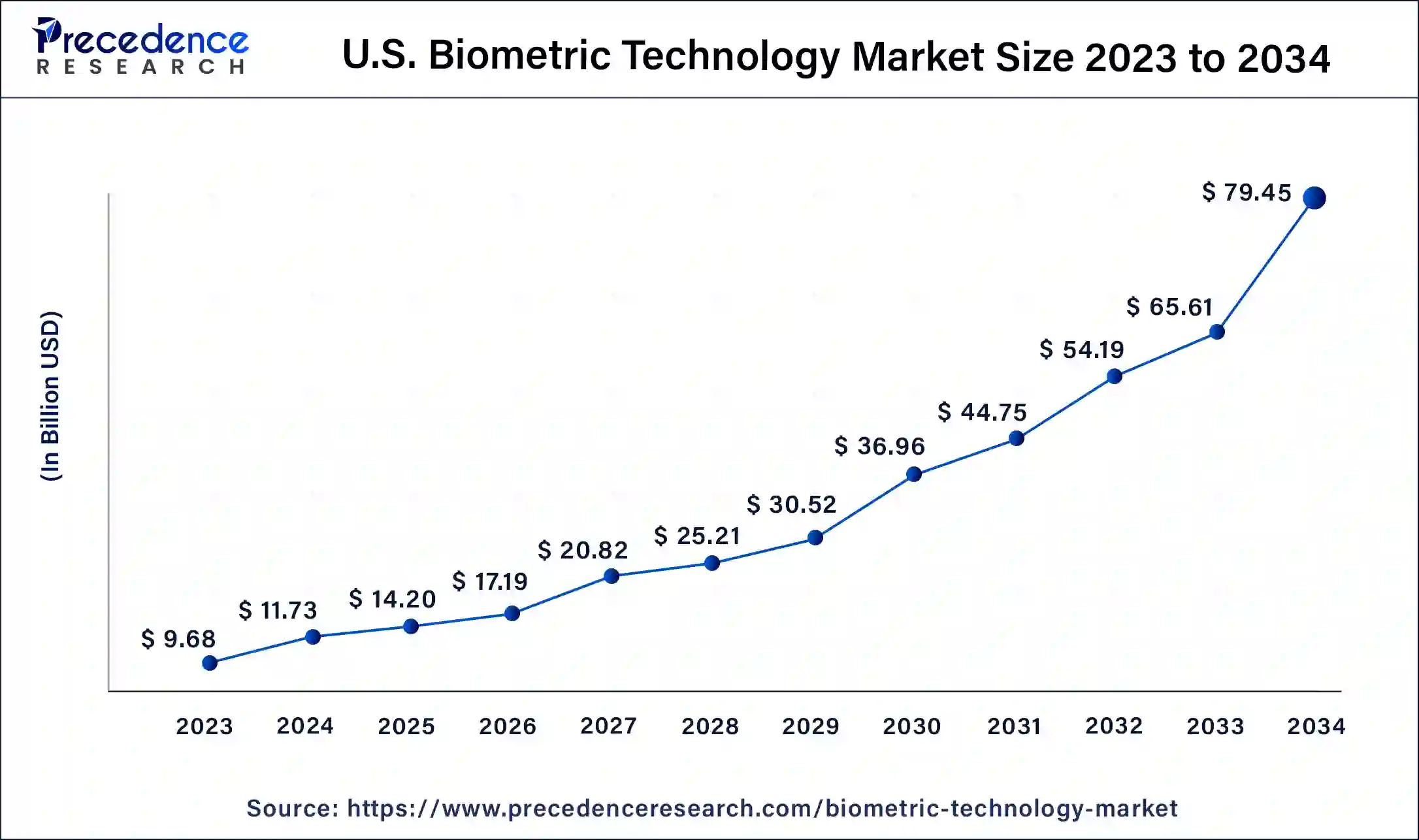
The U.S. biometric technology market size was estimated at USD 17.19 billion in 2026 and is predicted to be worth around USD 79.45 billion by 2034, at a CAGR of 21.08% from 2026 to 2034.
North America Dominated the Biometric Technology Market
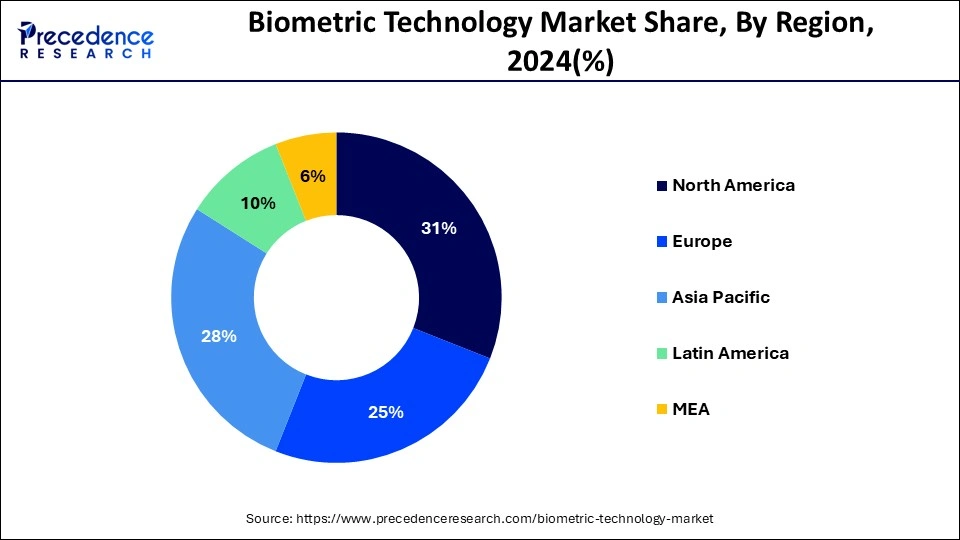
North America dominated the biometric technology market in 2024 with the largest share of 31.0%. The overall spurge in technological adaptation in the region has promoted the market's expansion in last few years. Furthermore, increasing demand for biometric identification systems, such as fingerprint scanning, facial recognition, and iris detection, for securing digital payments and personal data has also contributed to this dominance. Government initiatives aimed at enhancing national security and implementing biometric authentication in critical infrastructures further boost the market in North America.
U.S. Biometric Technology Market Tends
The U.S. leads the regional market through extensive biometric deployment in homeland security, banking, healthcare, and enterprise authentication. Growing digital identity programs, rising cyber threats, and continuous investments in AI-enabled biometric solutions strengthen adoption across airports, financial services, and government agencies.
Why APAC is Fastest Growing Region in Biometric Technology Market?
The market in APAC will develop at the most noteworthy CAGR during the conjecture time frame. The biometric framework market in APAC is fragmented into China, Japan, India, Australia, South Korea, and the Rest of APAC. The presence of unmistakable biometric framework makers including Fujitsu and NEC Corporation is supposed to add to the income portion of this district attributable to the quick financial development in significant nations like China, Japan, India, and South Korea. The development of the biometric framework market in APAC is additionally ascribed to mechanical headways, expanded mindfulness among the majority in regards to the utilization of biometric frameworks for security purposes, and brought down the expense of gadgets in light of these advances.
China Biometric Technology Market Tends
China remains a major contributor through large-scale deployment of biometric systems in public security, financial services, transportation, and smart city infrastructure. Strong investments in artificial intelligence, digital surveillance, and identity verification technologies continue to accelerate biometric innovation and implementation across multiple industries.
Europe Biometric Technology Market Tends
Europe maintains steady growth through increasing adoption of biometric authentication across banking, healthcare, transportation, and government services. Strong emphasis on privacy-compliant identity verification, digital transformation, and secure cross-border travel supports market development. Rising implementation of biometric access control and digital identity solutions continues to enhance security and operational efficiency.
Germany Biometric Technology Market Tends
Germany leads regional adoption through advanced industrial automation, secure enterprise authentication, and digital public services. Growing investments in cybersecurity, biometric access management, and smart manufacturing encourage wider implementation of facial recognition, fingerprint authentication, and identity verification technologies across commercial and public sectors.
Middle East & Africa Biometric Technology Market Tends
The Middle Eastern and African biometrics industry is growing as a result of investments in intelligent cities, border protection, digital government initiatives, and inclusion in the capital. There is a greater focus on combining technology with objectives in the public sector and safety, in addition to the boom in banking and healthcare services.
UAE Biometric Technology Market Tends
The UAE is a leader in terms of using biometrics due to its pioneering initiatives in the implementation of smart government, digital identification, innovations at airports, and in financial technology. There is a major focus on the application of technology in processes, such as the automated processing of travelers and the provision of online services.
Latin America Biometric Technology Market Tends
Latin America is experiencing gradual adoption of digital identity. Governments and financial institutions are increasingly utilizing biometric technologies. The growth of payment systems, national ID systems, and mobile authentication methods has led to growing demand throughout the region. The growing awareness about cybersecurity is stimulating the growing adoption of biometric systems.
Brazil Biometric Technology Market Tends
Brazil is in the top of the market. This country is introducing biometric voting, digital banking, and healthcare system modernization. The increasing need for fraud protection and secure digital transactions attracts funds into biometric system technology.
Competitive Landscape
The biometric market is semi-consolidated where the market is recognized for established companies and niche players. Strong technology capabilities, compliance with security regulations, and experience in large deployments create moderate market entry barriers and potential for innovation in new applications.
The market is led by companies such as Thales, IDEMIA, NEC Corporation, HID Global, and Fingerprint Cards AB, which are known for their innovation capabilities and global reach.
Competition is driven by innovations in products, strategic partnerships, and acquisitions. Further, development costs, regulatory requirements, cybersecurity needs, and protection of intellectual property are the main barriers.
Biometric Technology Market Companies
- NEC Corporation
- Precise Biometrics AB
- Fujitsu Limited
- 3M Cogent
- Hitachi
- FaceFirst
- Nuance Communications
Recent Developments
- In May 2025, India launched a nationwide rollout of Chip-Based E-Passports to boost security. The new e-passports feature an embedded RFID chip storing both printed and encrypted biometric data, aimed at enhancing document security and aligning with international standards for travel documentation.
- In January 2025, IDEX Biometrics entered a new market, together with LIFE CARD, with the first commercial launch of biometric payment cards in Japan. Biometric payment cards will be a key differentiator and amplifier as LIFE CARD continues to lead innovation in the market.
- In April 2025, Amadeus launched free-flow biometric technology to transform the passenger experience at global airports. It includes wide corridors equipped with AI-powered cameras and image recognition systems. Passengers, pre-registered via smartphone-based biometric apps or Bluetooth-enabled digital wallets, simply walk through these lanes without stopping.
- In April 2025, Power Dynamic Technology launched next-generation biometric solutions for retail and digital identity in Bucharest. These offerings integrate advanced facial recognition technology to deliver seamless, secure, and user-friendly experiences.
- In January 2025, BioConnect, the market leader in AI-powered biometric and multi-modal authentication, introduced its highly anticipated Arc Series biometric devices. The Arc Touch offers class-leading fingerprint authentication, featuring a rugged design with IP67 and IK09 certifications for exceptional durability in demanding environments.
- In September 2024, NEC Corporation launched a new system using biometric authentication technology that is capable of quickly authenticating large numbers of people at one time, even while they are in motion. This new system features NEC's world-class face recognition technology and matching technology, which evaluates the characteristics of movement and clothing to quickly detect persons in designated areas.
- 15 March 2024, NEC unveiled the latest version of its NeoFace software designed for large-scale facial recognition applications. The system features faster processing speeds, improved matching accuracy, and enhanced performance in low-light and high-crowd conditions. It's geared toward improving surveillance and access control in urban security environments, airports, and national ID programs.
- 18 December 2024, London-based biometric authentication firm Keyless reported a 657% annual growth, driven by the widespread adoption of its zero-knowledge biometric platform. Keyless does not store biometric data, enhancing privacy and security. It expanded operations in North America, strengthened leadership, and formed new fintech partnerships to scale secure authentication across finance and gaming.
- On 08 January 2025, Smile ID introduced a major upgrade to its SmartSelfie product, incorporating AI-powered liveness detection to fight digital fraud. The updated system prompts users to perform randomized facial movements to confirm their identity, making it resistant to deepfakes and spoofing. Certified with ISO Level 2, the tool is optimized for low bandwidth and supports widespread deployment across African countries.
- In July 2021, Thales Group sent off another voice biometric arrangement, a piece of the Trusted Digital Identity Service Platform, for onboarding and validation. It permits recognizing fraudsters endeavouring to impersonate clients.
- Biometric Technology Market, the obtaining permitted Fujitsu Frontech North America, Inc. to fortify its contributions and extend its biometric confirmation arrangements business locally and internationally.
Segments Covered in the Report
By Authentication Type
- Single-Factor Authentication
- Multi-Factor Authentication
By Component
- Hardware
- Software
By Type
- Contact-Based
- Contact-less
- Hybrid
By Mobility
- Fixed
- Portable
By Application
- Face
- Hand geometry
- Voice
- Signature
- Iris
- AFIS
- Non-AFIS
- Others
By End User
- Government
- Banking and Finance
- Consumer Electronics
- Healthcare
- Transport/Logistics
- Defense & Security
- Others
By Geography
- North America
- Europe
- Asia-Pacific
- Latin America
- Middle East & Africa (MEA)
For inquiries regarding discounts, bulk purchases, or customization requests, please contact us at sales@precedenceresearch.com
Frequently Asked Questions
Tags





Ask For Sample
No cookie-cutter, only authentic analysis – take the 1st step to become a Precedence Research client
 Get a Sample




 sales@precedenceresearch.com
 Schedule a Meeting
