



Cryptocurrency Mining Market Trends, Leading Companies, Company Revenue / Sales Performance, Subscriber Growth, Pricing Strategies, Cloud Adoption, Infrastructure Expansion, Competitive Landscape, and Industry Outlook
Cryptocurrency Mining Market (By Offering: Hardware, Software; By Process: Mining, Transaction; By Type: Bitcoin, Ethereum, Bitcoin Cash, Ripple, Litecoin, Dash, Others; By End-User: Trading, E-commerce and Retail, Peer-to-Peer Payment, Remittance) - Global Industry Analysis, Size, Trends, Leading Companies, Regional Outlook, and Forecast 2026 to 2035
Source: https://www.precedenceresearch.com/cryptocurrency-mining-market
 Get a Sample
 Table Of Content


What is the Cryptocurrency Mining Market Size?
The global cryptocurrency mining market size was valued at USD 26.89 billion in 2025 and is predicted to increase from USD 31.76 billion in 2026 to approximately USD 62.29 billion by 2035, expanding at a CAGR of 7.77% from 2026 to 2035.
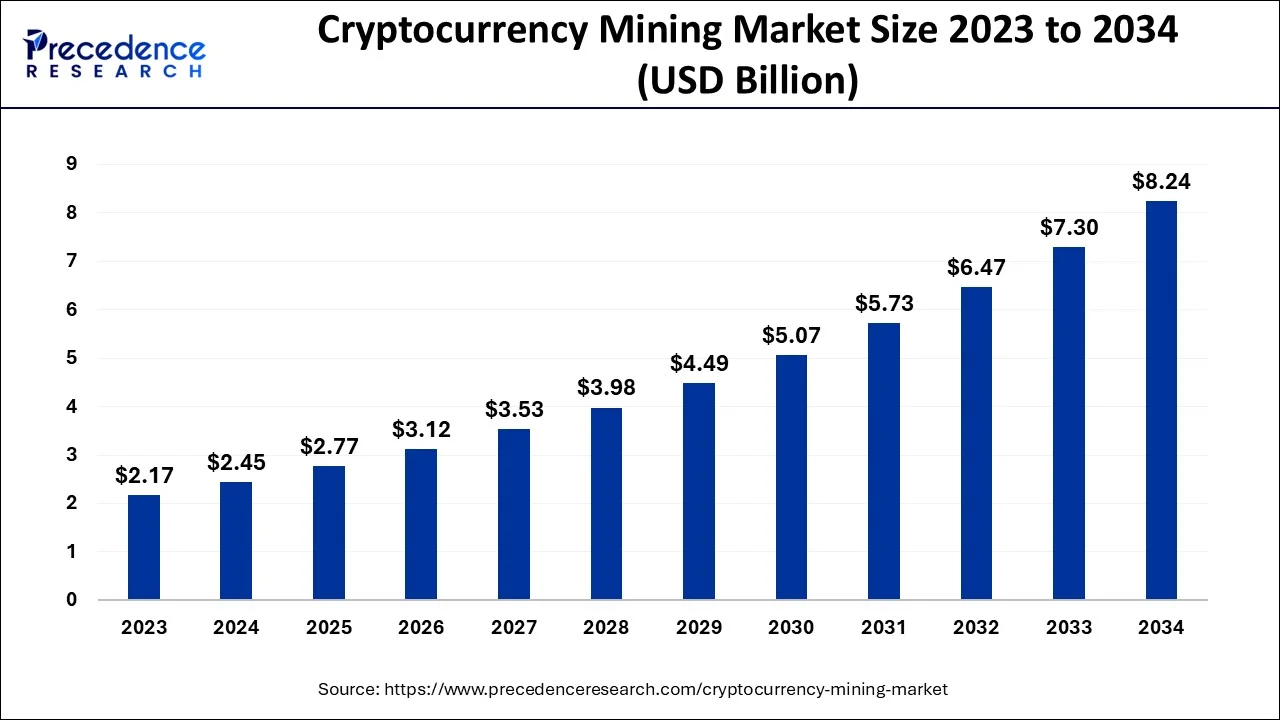
Bitcoin and numerous other cryptocurrencies service the mining progression to produce a new exchange and validate fresh transactions. Bitcoin operates on a distributed network or decentralized computer network that keeps track of cryptocurrency. New bitcoins are generated or mined when machines on the system authenticate and process the transaction. The transaction is processed by these computer networks, or miners, in return for a Bitcoin reward.
Cryptocurrency Mining Market Key Takeaways
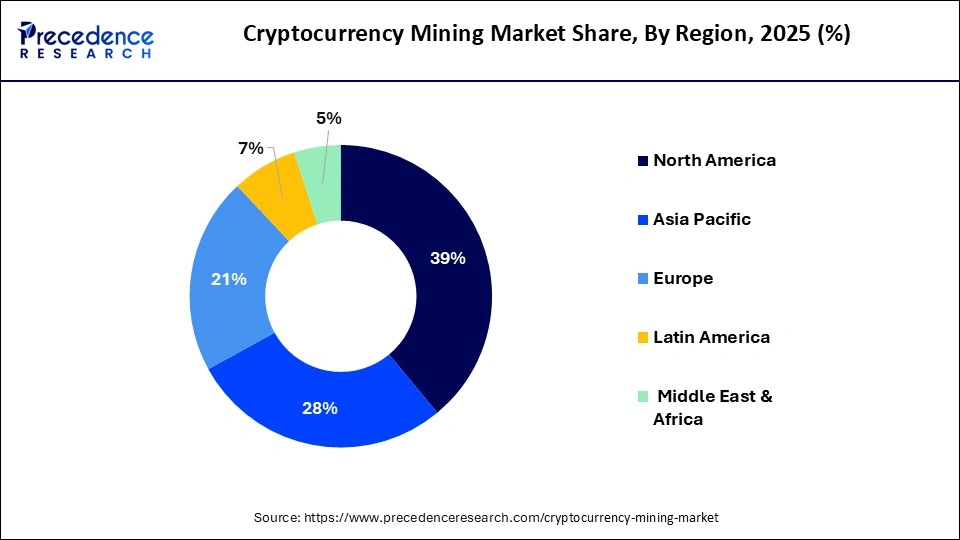
- North America generated the largest portion of the worldwide market share of 39% in 2025
- By hardware architecture, the application-specific integrated circuits (ASICs) segment will support the largest cryptocurrency industry in 2025.
- By service delivery, the proprietary self-mining (owner-operator) segment held a major market share in 2025.
- By protocol income stream, the block subsidy (newly minted coins) segment led the market in 2025.
- By scale of operation, the industrial/utility-scale (publicly traded/institutional) segment held a dominant position in the market in 2025.
- By network consensus asset, the SHA-256 (bitcoin/BCH) segment held the largest market share in 2025.
- By power integration model, the grid-tethered (standard utility) segment accounted for a market in 2025.
Cryptocurrency Mining Market Growth Factors
The industry is expanding primarily because of the development of distributed ledger technologies and an increase in electronic venture capital investment. Digital currency is now being used by developing nations as a means of financial transactions. Additionally, blockchain technology is frequently used in conjunction with virtual currency to provide decentralized and managed related capital. Blockchain technology enables quick decentralization.
Transactions that are efficient, safe, and transparent. For instance, the Singapore-based Qtum Chains Association and Amazon Web Services Chinese collaborated in October 2018 to implement decentralized applications on the AWS cloud. This partnership aims to make it simpler and more effective for AWS users to create and distribute contracts using Amazon Machine Images (AMI). Such actions taken by market participants are anticipated to aid in the expansion of the industry.
How is AI contributing to the Cryptocurrency Mining Industry?
AI also plays a crucial role in the modernization of cryptocurrency mining as it increases the returns, efficiency, and stability of the operations. It examines the different markets and directs the mining power to the coins that are the most profitable, anticipates the failure of hardware for maintenance actions taken beforehand, controls the use of power in a responsive way, and adjusts the performance of hardware.
Consequently, there is less downtime, lower operating costs, and more production, which allows the miners to be smart even during price swings and in energy-hungry areas.
Market Outlook
- Industry Growth Overview:
The market steadily grows with the growing digital asset adoption and the never-ending mining technologies. - Sustainability Trends:
There is an increasing interest in using renewable energy and applying efficiency-oriented consensus mechanisms to lessen the impact on the environment. - Global Expansion:
The mining operations are spreading around the world to places that offer not only good electricity but also clear-cut rules. - Major Investors:
Among the major investors are Andreessen Horowitz and technology giants like Bitmain that foster the ecosystem's growth. - Startup Ecosystem:
The startups are constantly coming up with new mining software, optimization platforms, and hardware efficiency solutions.
Market Scope
| Report Coverage | Details |
| Market Size in 2025 | USD 26.89 Billion |
| Market Size in 2026 | USD 31.76 Billion |
| Market Size by 2035 | USD 62.29 Billion |
| Growth Rate from 2026 to 2035 | CAGR of 7.77% |
| Base Year | 2025 |
| Forecast Period | 2026 to 2035 |
| Segments Covered | Offering, Process, Type, End-User, Region |
| Regions Covered | North America, Europe, Asia-Pacific, Latin America and Middle East & Africa |
Market Dynamics
Key Market Drivers
Distributed database technology's transparency: Difficulties with a lack of transparency and when transactions occur without the awareness of stakeholders, particularly in Asian nations where numerous instances of unauthorized or fraudulent activities, such as the withdrawal of scheduled costs, are regularly seen.
Customers may lose a significant amount of money as a result of this, which could be brought on by human error, mechanical fault, or manipulation of data even during the transaction process. Additionally, financial firms typically do not acknowledge their mistakes. The public is dissatisfied with the present money system because of its lack of transparency.
Demand for virtual currency is driven by regional instability and a focus on financial crisis mitigation: Financial catastrophe is a significant problem that affects financial services and the financial industry. The economy is hampered by economic uncertainty since the price of the currency declines. For example, the 2008 Lehman Brothers crisis, which had an impact on the country's economy, was a huge issue for India's ICICI bank.
The financial crisis has had little impact on Bitcoins and other cryptocurrencies because of their uniformly balanced worth. In places with shaky economic systems, cryptocurrencies are a preferable option in times of financial instability, which is increasingly a key market-driving driver.
Growing bitcoin usage to experience exploding demand in the crypto market: Growing capital investment, increased visibility, and favorable rules are all contributing to the industry's expansion. The market worth of digital cash is also rising as a result of mature bitcoin dollar amount and the ability to pay rewards for transactions. People's propensity for digital money is evident in developing nations like the U.S., Japan, Europe, and many others. This trend is anticipated to support the development of the cryptocurrency industry in the next few years.
Key Market Challenges
Worries about privacy, security, and control: Peer-to-peer & transfer transactions free from conformity get the capacity to be transformed and revolutionized by cryptocurrencies; however, end users must overcome some obstacles relating to security, confidentiality, and control to take advantage of bitcoin. Because cryptocurrency activities are stored in bitcoin, a decentralized public database, hackers have a huge attack surface to obtain sensitive data.
It is possible that duplicating the file will make it simpler for attackers to access the public ledger if it is employed to store private information about contracts or payment details. if a compromised key. Both a distributed system and a hub-spoke architecture can use to retrieve the data.
Key Market Opportunities
Significant growth prospects in developed and emerging markets: For businesses operating in the cryptocurrency sector, emerging markets (like China, India, China, Brazil, and developed nations (like the US, German, and Japan are anticipated to have considerable growth prospects. For example, Brazilian cryptocurrency businesses signed a rule of personality in 2020 intending to legitimize and accelerate the acceptance of digital currencies in the nation. The agreement was signed on behalf of the nation's organization of cryptocurrency businesses, Abcripto.
The agreement's goal is to create operating procedures and compliance requirements that all participants must follow. Several well-known bitcoin companies from the nation have signed the code, including Bitcoin Market, Foxbit, Ripio, and Nolvadex.
Segmental Insight
Hardware Architecture Insights
ASICs dominate the cryptocurrency mining market because they are purpose-built for specific algorithms (especially SHA-256), delivering unmatched computational efficiency and hash rates compared to general-purpose hardware. Their superior energy efficiency per hash and economies of scale make them the preferred choice for large-scale miners, particularly those mining Bitcoin. High barriers to entry, including capital intensity and supply chain control, further consolidate ASIC dominance among industrial players.
FPGAs are expected to grow at the fastest rate due to their balance between efficiency and flexibility. Unlike ASICs, they can be reprogrammed for different algorithms, making them attractive in a rapidly evolving crypto ecosystem where algorithm shifts and new coins emerge. Their lower upfront cost relative to ASIC development and increasing optimization for niche mining use cases are driving adoption, especially among mid-tier and experimental mining operations.
Service Delivery Insights
Owner-operated mining remains dominant as large mining firms prefer full control over infrastructure, energy sourcing, and operational efficiency. This model maximizes margins by eliminating third-party fees and allows miners to directly benefit from block rewards and transaction fees. Institutional players especially favor this approach to optimize performance and manage risks related to uptime, regulation, and cost structures.
Hashpower leasing is growing rapidly due to its low barrier to entry for retail and small institutional investors. Users can participate in mining without owning hardware or managing operations, making it appealing in volatile markets. The rise of cloud-based platforms and financialization of mining (e.g., contracts, derivatives tied to hash rate) is accelerating adoption, particularly among new entrants seeking exposure without capital-heavy investments.
Protocol Income Stream Insights
Block subsidies remain the primary revenue source for miners, especially in networks like Bitcoin, where newly minted coins still constitute a significant portion of mining rewards. Despite periodic halving events, the absolute value of block rewards remains high due to price appreciation, ensuring continued dominance in miner revenue streams.
MEV is emerging as the fastest-growing income stream as blockchain ecosystems become more complex. It enables miners or validators to extract additional value by reordering, including, or excluding transactions within a block. Growth in decentralized finance (DeFi), arbitrage opportunities, and sophisticated trading strategies is expanding MEV potential, particularly in programmable blockchain environments.
Scale of Operation Insights
Industrial-scale mining dominates due to its access to capital, advanced infrastructure, and cheaper energy contracts. Publicly traded mining firms benefit from economies of scale, vertical integration, and optimized cooling and hardware deployment. These players are better positioned to withstand market volatility and regulatory pressures, consolidating market share over smaller operators.
Retail mining is experiencing renewed growth driven by decentralization trends, improved accessibility to mining tools, and interest in financial sovereignty. Innovations such as plug-and-play mining devices, home-friendly rigs, and participation in smaller or privacy-focused networks are enabling individuals to re-enter the market despite industrial dominance.
Network Consensus Asset Insights
SHA-256-based networks, led by Bitcoin, dominate due to their massive network value, security, and mining ecosystem maturity. The high market capitalization and liquidity of Bitcoin incentivize sustained investment in SHA-256 mining infrastructure, reinforcing its leadership position.
RandomX is growing rapidly due to increasing demand for privacy-centric cryptocurrencies like Monero. Its CPU-friendly design discourages ASIC dominance, promoting decentralization and accessibility. Rising concerns over financial privacy and surveillance are driving adoption of privacy coins, boosting demand for RandomX-based mining.
Power Integration Model Insights
Grid-connected mining operations dominate because they offer stable, scalable, and predictable power supply essential for continuous mining. Industrial miners rely on long-term utility contracts and established infrastructure to maintain high uptime and operational efficiency. Renewable-powered mining is expanding rapidly as environmental concerns, regulatory pressures, and ESG mandates reshape the industry. Miners are increasingly deploying operations near hydroelectric, solar, and wind resources to reduce costs and carbon footprints. This shift is also driven by the need to secure long-term energy sustainability and improve public perception of crypto mining.
Regional Insights
In 2025, North America accounted for the largest portion of the worldwide market since most of that region considered bitcoins more like a tax-related means of exchange than a form of money. Many wealthy nations continue to prioritize using electronic currency, even though the state does not have any legal restrictions on it. The marketplace is growing as a result of customers' and merchants' acceptance of electronic money.
Furthermore, the North American market is dominated by the prevalence of mining bitcoin and also the existence of a plurality of prominent firms. APAC will experience the highest CAGR concerning value growth in the forthcoming years. Because of its low electricity prices and abundance of huge mining enterprises, China has the greatest market of all the APAC nations.
How is North America leading in the Cryptocurrency Mining Market?
North America leads the market, thanks to superior infrastructure, participation of institutions, and the availability of low-cost power. The region's great reliance on renewable energy sources, its friendly policies towards the industry, and the presence of state-of-the-art data-center facilities all contribute to the setting up of large-scale mining operations and the management of energy in a way that is responsive to the grid across the whole region.
What is the U.S. Cryptocurrency Mining Market Size in 2026?
The U.S. cryptocurrency mining market size is estimated at USD 10.57 billion in 2026 and is projected to reach approximately USD 20.77 billion by 2035, with a 7.80% CAGR from 2026 to 2035.
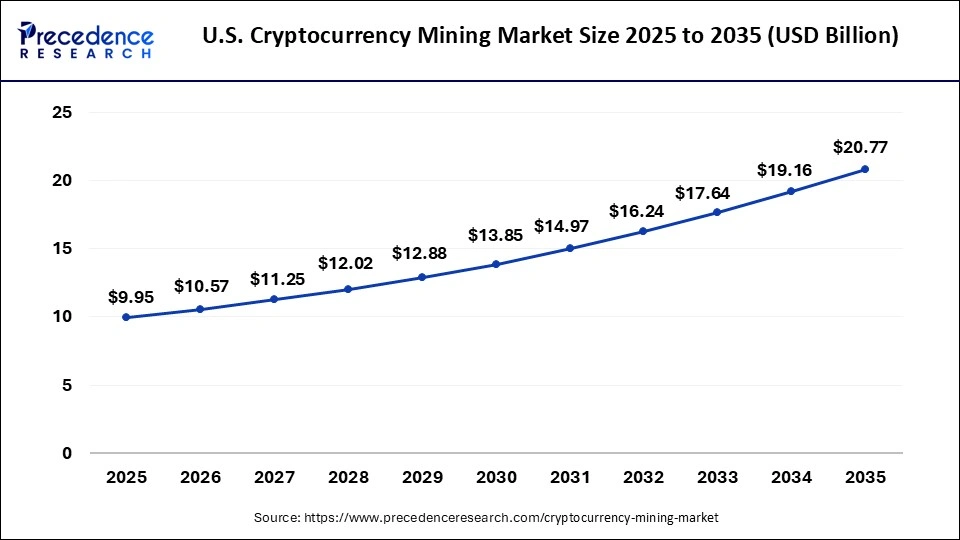
U.S. Cryptocurrency Mining Market Trends:
The U.S. is the frontrunner in the regional mining industry due to the favorable energy markets, decentralized power grids, and blockchain-ready environments. The access to renewable resources, participation in demand-response programs, and the presence of strong mining infrastructure all help to make mining operations efficient while also enhancing grid stability and thus long-term investment confidence.
How is Asia-Pacific performing in the Cryptocurrency Mining Market?
Asia-Pacific continues to be an important market, especially due to the adoption of technology and strong manufacturing ecosystems. The region is also characterized by advanced hardware development capabilities that are accompanied by increasing interest in blockchain and expanding infrastructure related to mining, which are all contributing to the development of both equipment supply chains and regional participation in mining.
India Cryptocurrency Mining Market Trends:
India is presently a country where the adoption of mining hardware is gaining momentum, and this is being supported by investments in blockchain technology and the growing awareness of digital assets. The technology ecosystem and the entrepreneurs' activities around them are facilitating the market development, although the regulatory issues are evolving and still playing a part in the long-term operational strategies.
What are the driving factors of the Cryptocurrency Mining Market in Europe?
Europe is gradually becoming a marketplace for cryptocurrency miners to exploit, even if the unprofitability of mining due to high energy prices and regulatory complications still exists. In certain areas, the initiatives that are driven by innovations, the usability of digital currencies, and the existence of blockchain frameworks are the reasons for the gradual development and the focus on creating efficient mining models.
The UK Cryptocurrency Mining Market Trends:
The UK is the one that is getting the most benefits from the fact that there is a greater acceptance of blockchain, and the government is taking a positive stance toward it. The market expansion is supported by the growing interest in the region's digital assets and the upgrading of the mining infrastructure, while addressing the energy and compliance issues of the area.
Cryptocurrency Mining Market-Value Chain Analysis
- Inbound Logistics: Receiving, storage, and coordination of mining hardware, components, and supporting infrastructure from worldwide suppliers are being managed.
Key players: Nvidia, AMD, Bitmain, Canaan, Intel - Operations: Mining activities are carried out by converting computing power and energy inputs into recognized blockchain transactions.
Key players: Core Scientific, Marathon Digital Holdings - Outbound Logistics: Through proper digital and financial channels, the mined digital assets and operational outputs are being processed and securely distributed.
Key players: Binance, Coinbase, Kraken, Ledger, Trezor - Marketing and Sales: The mining services, pools, and solutions are being advertised alongside the support you get for your participation and the signing of contracts.
Key players: Genesis Mining, NiceHash, ECOS, Shamining - Service: The company offers technical assistance, system maintenance, upgrades, and performance improvement after the installation.
Key players: BitGo, Xapo, Blockchain.com, BitPay, Ledger
Top Companies in the Cryptocurrency Mining Industry
- Advanced Micro Devices: Provides the worldwide mining operations with graphics processors and computing chips that are the very essence of high-performance, mounted crypto-mining.
- Alcheminer: Lines up solar plus mining hardware for the crypto market and technology support for undisrupted, profitable digital assets' maturity.
- Binance Holdings: Creates e-smart mining pools where the whole computer participation comes together for better efficiency and constant mining rewards.
Cryptocurrency Mining Market Companies
- Advanced Micro Devices (US)
- Alcheminer (US)
- Binance Holdings (China)
- Bitfury Group (Netherlands)
- BitGo (US)
- Bitmain (China)
- Bitstamp (Luxemburg)
- Canaan Creative (China)
- Coinbase (US)
- Ethereum Foundation (Switzerland)
- Ifinex (Hong Kong)
- Intel (US)
- Ledger SAS (France)
- NVIDIA (US)
- Ripple Labs (US)
- Xapo (Hong Kong)
- Xilinx (US)
Recent Developments
- TeraGo Inc.'s cloud computing and co-location network infrastructure operations were purchased by Hut 8 Mining Corporation in January 2022. 5 data centers in Canada are included in the deal, along with a full range of configurable cloud services. As a result, this will assist the organization in growing both its clientele and market share.
- iMining Tech revealed in August 2021 that they have purchased the three validators protecting the Ethereum Proof-of-Stake network. These 3 Eth2.0 validators are working and situated in the cloud. As a result, the acquisition will enable the business to avoid costs and months of betting prizes, so promoting business growth.
- In June 2021, 650 banks and credit unions will be able to buy cryptocurrencies thanks to a partnership between NYDIG, a digital investment holding company, and NCR Corporation. Customers of NCR Banking who are currently buying digital currency via third-party markets have requested the endeavor in response to customer demand.
- Visa Inc. handled cryptocurrency direct payment just on Ethereum Blockchain in March 2021 and intends to make it a new form of service payment. The company hopes to expand the use of cryptocurrency within finance sector with this important endeavor.
- January 2020 saw Binance.com buy the Mumbai, India-based WazirX Bitcoin exchange. Binance.com is emphasizing an emphasis on growing its business portfolio in India with this purchase. The Fiat Gateway platform, which Binance has licensed, will be combined using WazirX's peer-to-peer (P2P) engines to make it easier to trade Binance virtual money with purchases of Tether or USDT.
- To order to install blockchain technologies on the AWS cloud, the Singapore-based Qtum Network Foundation teamed up with AWS China in early October 2018. This partnership aims to make it simpler and more effective for AWS users to create and distribute payment systems using Amazon Elastic compute cloud images (AMI).
- The prospective inference market for NVIDIA has increased to 30 mn hyper scale web servers in March 2018, as well as the cost of providing deep learning-powered services, was significantly reduced.
- The AMD Ryzen Embedding V1000 and EPYC Embedding 3000 series processors, which offer excellent connectivity, on-chip safety, and excellent quality, were introduced in Feb 2018.
- In December 2025, A campaign targets AWS customers with compromised IAM credentials for cryptocurrency mining. Detected by GuardDuty on November 2, 2025, it uses innovative persistence techniques to evade incident response efforts. (https://thehackernews.com)
- In November 2025, UAE residents can mine Bitcoin easily via du's Cloud Miner service, the first official MaaS from a telecom company. This allows users to earn BTC without hardware, expertise, or high electricity bills. (https://timesofindia.indiatimes.com)
Segments Covered in the Report
By Hardware Architecture
- Application-Specific Integrated Circuits (ASICs)
- Graphics Processing Units (GPUs)
- Field Programmable Gate Arrays (FPGAs)
- Central Processing Units (CPUs)
By Service Delivery
- Proprietary Self-Mining (Owner-Operator)
- Hashpower Leasing (Cloud Provider)
- Colocation & Managed Services (Infrastructure Provider)
By Protocol Income Stream
- Block Subsidy (Newly minted coins)
- Network Transaction Fees (User-paid)
- MEV (Maximal Extractable Value) / Transaction Reordering
By Scale of Operation
- Industrial/Utility-Scale (Publicly traded/Institutional)
- Mid-Tier Commercial (SME)
- Distributed/Retail (Individual/Home)
By Network Consensus Asset
- SHA-256 (Bitcoin/BCH)
- Scrypt (Litecoin/Dogecoin)
- Etchash (Ethereum Classic)
- RandomX (Monero/Privacy)
By Power Integration Model
- rid-Tethered (Standard utility)
- Off-Grid/Stranded Gas (Energy-producer co-location)
- Sustainable/Renewable-Dedicated (Solar/Hydro/Wind)
By Geography
- North America
- Europe
- Asia-Pacific
- Latin America
- The Middle East and Africa
For inquiries regarding discounts, bulk purchases, or customization requests, please contact us at sales@precedenceresearch.com
Frequently Asked Questions





Ask For Sample
No cookie-cutter, only authentic analysis – take the 1st step to become a Precedence Research client
 Get a Sample




 sales@precedenceresearch.com
 Schedule a Meeting
