



Dolomite Market Size, Share and Trends 2026 to 2035
Dolomite Market (By Product: Calcined, Sintered, Agglomerated; By End-use: Iron & Steel, Construction, Glass & Ceramics, Water Treatment, Agriculture, Others) - Global Industry Analysis, Size, Trends, Leading Companies, Regional Outlook, and Forecast 2026 to 2035
Source: https://www.precedenceresearch.com/dolomite-market
 Get a Sample
 Table Of Content


What is the Dolomite Market Size?
The global dolomite market size is calculated at USD 2.45 billion in 2025 and is predicted to increase from USD 2.62 billion in 2026 to approximately USD 4.70 billion by 2035, expanding at a CAGR of 6.73% from 2026 to 2035.
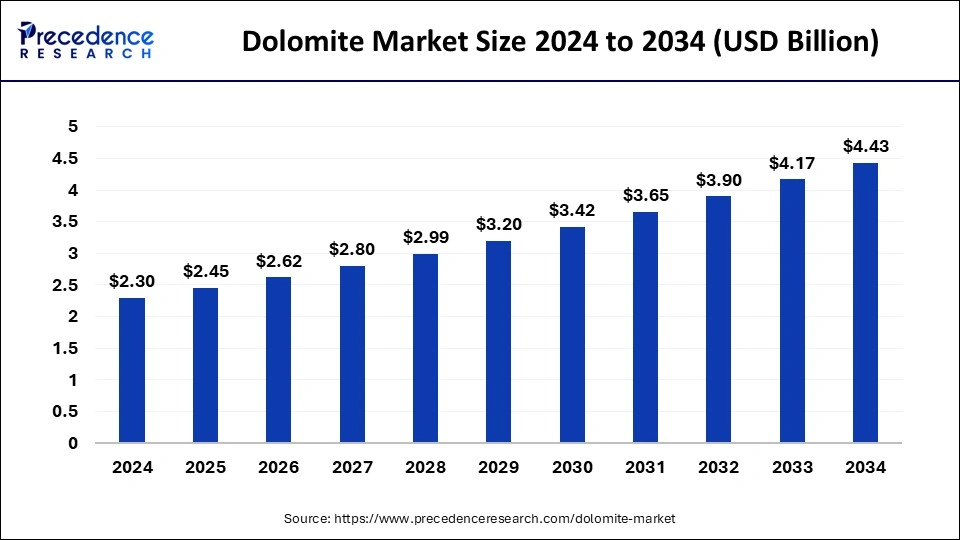
Market Highlights
- Asia Pacific led the market with the largest market share of 37% in 2025.
- North America is expected to grow at the fastest rate during the forecast period.
- By product, the calcined segment has contributed more than 40% of revenue share in 2025.
- By product, the sintered segment is expected to grow at the fastest rate in the market in the coming years.
- By end use, the iron & steel segment has recorded more than 62% of revenue share in 2025.
- By end use, the construction segment is expected to grow at the fastest rate in the market in the coming years.
Market Overview
The dolomite market refers to the market for the carbonate mineral dolomite, which is made up of calcium magnesium carbonate. The production, sale, and consumption of dolomite in a variety of industries and applications make up the market economically, including the dynamics of the world's supply and demand for dolomite.
Because of its unique physical and chemical characteristics, dolomite is widely used in a wide range of sectors, including water treatment, iron and steel, ceramics, and agriculture. The harmony between the world's dolomite output and its utilization in various industries. Among its many uses are as a refractory material, a source of magnesium oxide for a variety of industrial purposes, a flux in the manufacturing of iron and steel, a soil conditioner in agriculture, and a material for ceramics.
There are dolomite resources in many parts of the world, and Mexico, China, India, the United States, and other countries produce a sizable amount of the mineral. These include shifts in pricing, improvements in mining and processing technology, environmental issues surrounding the extraction of dolomite, and changes in regulations pertaining to its use.
Dolomite Market Growth Factors
- Dolomite is a durable and robust material that is used in building. Demand is driven by an increase in construction activities, particularly in emerging economies.
- Dolomite is applied as a soil conditioner to supply calcium and magnesium nutrients while counterbalancing acidic soils. The dolomite market expansion is facilitated by the expansion of agriculture and the emphasis on improving crop yields.
- Dolomite is employed in many industrial processes, including glassmaking, ceramics, iron and steel manufacture, and refractories. The dolomite market demand is increased by the expansion of these industries.
- Dolomite is needed in infrastructure projects, including roads, bridges, and buildings, as an aggregate for concrete and as a component of asphalt and cement mixtures.
- In the steelmaking process, dolomite is used as a flux to eliminate impurities and raise the grade of steel. Demand for the dolomite market is strongly impacted by growth in global steel production.
- Demand may be influenced by environmental regulations that support the use of dolomite in pollution control measures, including treating acid mine drainage and lowering sulfur emissions.
- New growth opportunities may arise from research & development into dolomite's potential uses, such as in the manufacturing of magnesium metal and the treatment of water.
- The dolomite market major companies' investments, mergers, and acquisitions can affect supply chains, prices, and new product developments.
AI's use in the Dolomite Sector
Dolomite is a mechanical and niche sector where science-based theories matters but AI's use in this sector is a huge contribution. The AI algorithms raise the expectations in blast fragmentation efficiency. It helped to modulate rock size and refine explosive use in dolomite quarries. Whereas the AI monitors the potential value and the life cycle of the heavy machines, such as crushers and drills, to prevent any unexpected failure.
Artificial Intelligence supports the dolomite optimisation process with its comprehensive systems that utilise the genuine robust time sensor data that customise classification and grinding settings to promise a premium quality powder.
Market Outlook
- Start-up Ecosystem : The dolomite industry runs with two distincts one is a decentralised finance (DeFi), and another is a mineral commodity. With the growing construction and heavy use of iron and steel in the suitable sectors, are bringing new start-ups to the new home of sustainable dolomite as the industry tends to advance not only quality-wise but operational/process-wise too.
- Industry Growth Overview : The dolomite industry is witnessing growth in different sectors like agriculture, iron and steel manufacturing process, and in water treatment too. The demand for sustainable dolomite-based products is elevating the green building projects in the construction industry. The water treatment industry considers dolomite as a source of alkaline to purify drinking water and balance the pH level in desalination plants.
Dolomite Market Scope
| Report Coverage | Details |
| Market Size in 2025 | USD 2.45 Billion |
| Market Size in 2026 | USD 2.62 Billion |
| Market Size by 2035 | USD 4.43 Billion |
| Growth Rate from 2026 to 2035 | CAGR of 6.73% |
| Largest Market | Asia Pacific |
| Base Year | 2025 |
| Forecast Period | 2026 to 2035 |
| Segments Covered | Product, End-use, and Regions |
| Regions Covered | North America, Europe, Asia-Pacific, Latin America, and Middle East & Africa |
Market Dynamics
Drivers
Growing demand for construction
Dolomite is a raw material used in the production of cement and concrete. It is crucial for infrastructure projects because it gives building materials strength and longevity. In addition, dolomite is utilized in bitumen and asphalt mixtures, which aid in the building of roads and highways. These surfaces perform better and last longer because of their qualities. Dolomite is occasionally applied to soils as a soil conditioner to increase their pH balance and fertility. Construction tasks related to agriculture and landscaping are supported by this program. Dolomite is used as a fluxing agent in the steelmaking process to help remove impurities and guarantee the quality of the steel that is produced. This helps construction inadvertently by providing necessary building supplies.
Restraint
Health and safety issues
Breathing in dust from dolomite deposits can cause respiratory issues such as asthma, coughing, and dyspnea. Depending on the amount of silica in the dust, prolonged exposure might result in diseases such as silicosis or pneumoconiosis (dust lung disease). Silica is frequently found in dolomite deposits and can be discharged into the atmosphere during mining and processing. Because it can lead to lung conditions like lung cancer, silicosis, and chronic obstructive pulmonary disease (COPD), silica dust is very dangerous. Risks associated with working at and near mining sites include tripping, falls, and injuries from falling objects or machinery. To reduce these dangers, appropriate safety procedures and personal protective equipment (PPE) are crucial.
Opportunity
Medical and pharmaceutical uses
Dolomite is a naturally occurring source of calcium and magnesium, two vital minerals. In order to treat deficits in these minerals and support bone health and neurological function, it is occasionally taken as a dietary supplement. Because magnesium is essential for the activity of enzymes, muscle contraction, and nerve transmission, it can be found in medicinal formulations made from dolomite. Because of its opacifying and absorbing qualities, dolomite is frequently utilized in cosmetic goods. Face powders, creams, and lotions contain it. Dolomite is helpful in the production of glass and ceramics because of its high melting point and hardness, which tangentially assists businesses that supply raw materials for pharmaceutical and medical equipment.
Segment Insights
[[segment_insights]]
Regional Insights
[[regional_insights]]
Value Chain Analysis
- Raw Material Sourcing : Dolomite is sourced from open pit quarries and underground deposits, where the rock is drilled, blasted, crushed and sorted according to the magnesium and calcium carbonate content that is present. This is because industries require quality and variety. Industries such as steel, glass, agriculture and even ceramics require consistent purity levels, thus creating a strong demand for controlled sourcing.
Key Players: Imerys, Lhoist Group, Sibelco - Manufacturing and Processing : After the extraction process, dolomite undergoes crushing, washing and screening in order to remove any impurities. Here, processing plants integrate rotary kilns, vertical shaft kilns and grinding mills that are tailored to customer requirements such as particle size, magnesium content and reactivity. This stage is seeing a shift towards low emission kilns, in order o alogn with global environmental goals.
Key Players: RHI Magnesita, Calcinor, Omya - Logistics and Distribution : Dolomite is mainly transported in bulk via trucks, rail and coastal shipping, depending on the distance. Due to its heavy and low value per ton nature, logistical processes cost quite a lot, thus making proximity to industrial clusters or hubs a great advantage. Many regions are seen strengthening their integrated supply corridors in order to reduce freight costs for cement, steel and other aggregates, thus boosting the demand for locally sourced dolomite.
Key Players: Nippon, CEMEX Logistics, DP World
Dolomite Market Companies
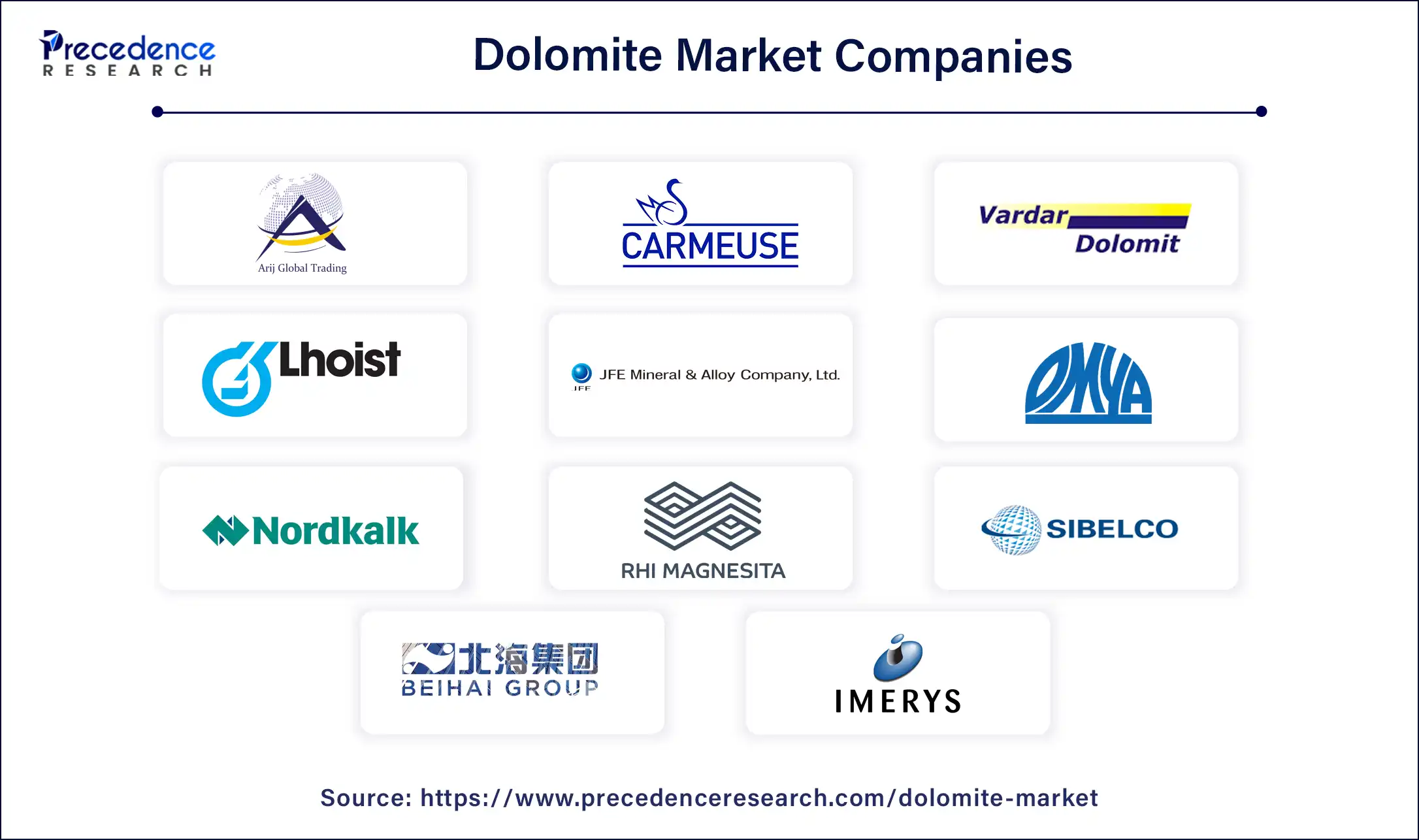
- Imerys S.A.
- Sibelco
- RHI Magnesita
- Omya Group
- JFE minerals
- Varbar dolomite
- Lhoist Group
- Arij Global Trading
- Nordkalk Corporation
- Beihei Group
- Arihant Minchem
- Carmeuse
Recent Developments
- In January 2025, RHI Magnesita, the leading global supplier of high-grade refractory products, systems and solutions, announced the completion of the acquisition of the U.S.-based Resco Group, from an affiliate of Balmoral Funds LLC, a Los Angeles-based private equity firm, and management. The addition of Resco Group to the company's North America operations will significantly increase local-for-local production, improving supply chain security for these critical industries that underpin the economic health of the region. (Source: industrytoday.com )
- In February 2024, Dolomite, a leading Decentralized Exchange (DEX) on Arbitrium has announced its anticipated launch on Polygon's new zkEVM (zero-knowledge Ethereum Virtual Machine), marking a crucial milestone in the expansion of Decentralized Finance (DeFi) into one of the most vibrant ecosystems in crypto.
(Source: cryptonews.net ) - In April 2024, DeFi lending guidelines by formally launching on X Layer, OKX's cutting-edge Ethereum-based Layer 2 network, Dolomite is taking a calculated risk. With this partnership, the Polygon-powered X Layer has strong asset lending capabilities, giving its users even more options. It comes before Dolomite's remarkable rise to become the fourth-largest lending market on Arbitrum.
- In February 2024, the Launch of Arbitrum DEX Dolomite on Polygon zkEVM. Dolomite, a decentralized lending and trade protocol based on argon, is becoming a part of Polygon's zkEVM ecosystem. The margin trading protocol intends to add support for additional tokens as the year goes on, but for now, it will only permit transactions using ETH, USDC, WETH, and MATIC.
Segment Covered in the Market
[[segment_covered]]
For inquiries regarding discounts, bulk purchases, or customization requests, please contact us at sales@precedenceresearch.com
Frequently Asked Questions
Tags





Ask For Sample
No cookie-cutter, only authentic analysis – take the 1st step to become a Precedence Research client
 Get a Sample




 sales@precedenceresearch.com
 Schedule a Meeting
