



High-Performance Computing Market Revenue, Leading Companies, Company Technology / Innovation, Service Utilization, Infrastructure Capacity, Sales Performance, Pricing Metrics, Competitive Positioning, and Growth Opportunities
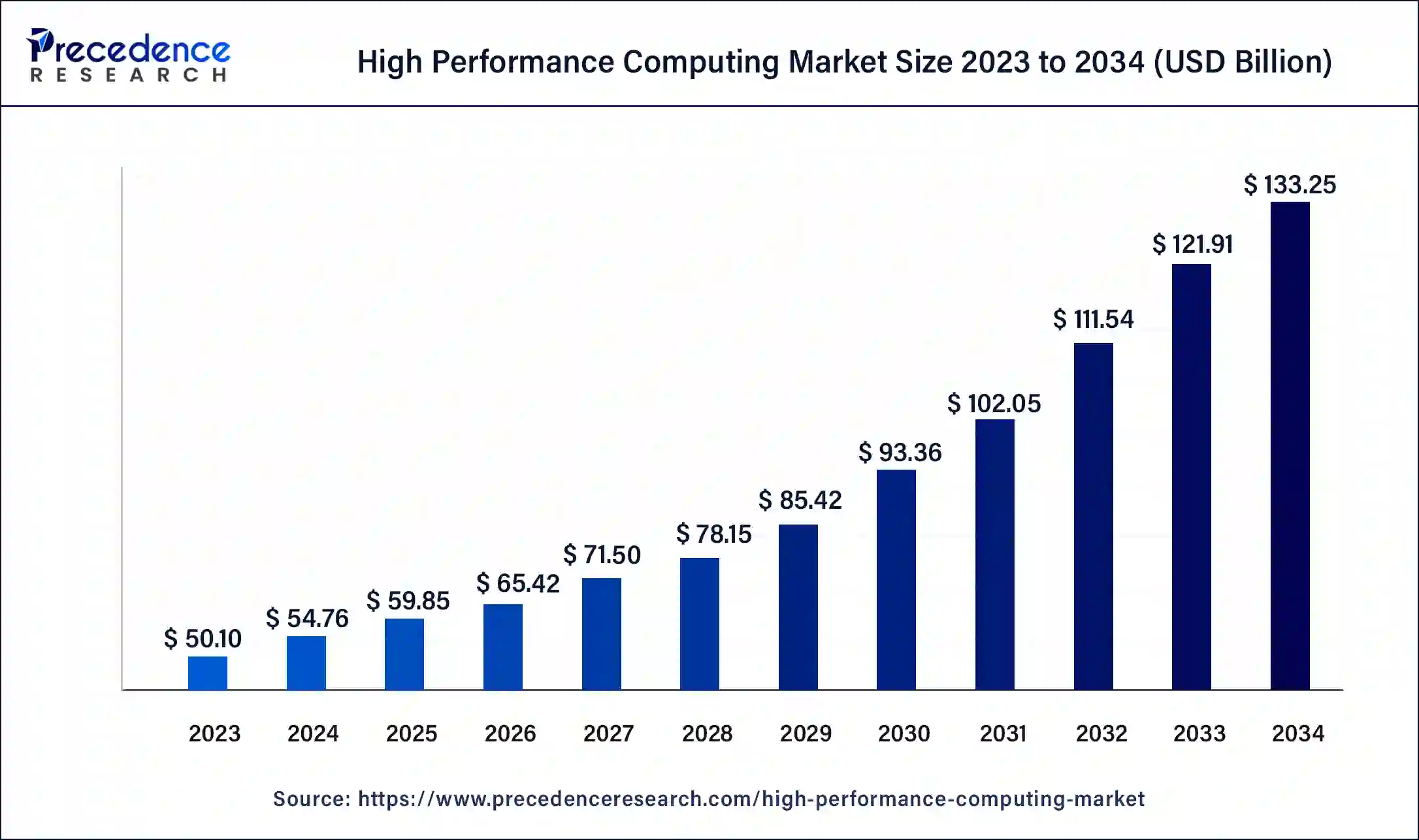
The global High-Performance Computing Market was valued at USD 65.42 billion in 2026 and is projected to reach approximately USD 141.62 billion by 2035, growing at a CAGR of 9.8% from 2026 to 2035. Market growth is driven by rising demand for advanced data processing, AI and machine learning adoption, cloud-based HPC solutions, and investments in supercomputing infrastructure. North America dominated with a 42% revenue share in 2025, while Asia Pacific is expected to grow at the fastest rate. Servers led by component, on-premise deployment held the largest share, and government and defense was the leading end-use segment.
Source: https://www.precedenceresearch.com/high-performance-computing-market
 Get a Sample
 Table Of Content


What is the High Performance Computing Market Size?
The global high-performance computing market size is accounted at USD 59.85 billion in 2025 and is predicted to increase from USD 65.42 billion in 2026 to approximately USD 141.62 billion by 2035, expanding at a CAGR of 9.8% from 2026 to 2035.
High Performance Computing Market Key Takeaway
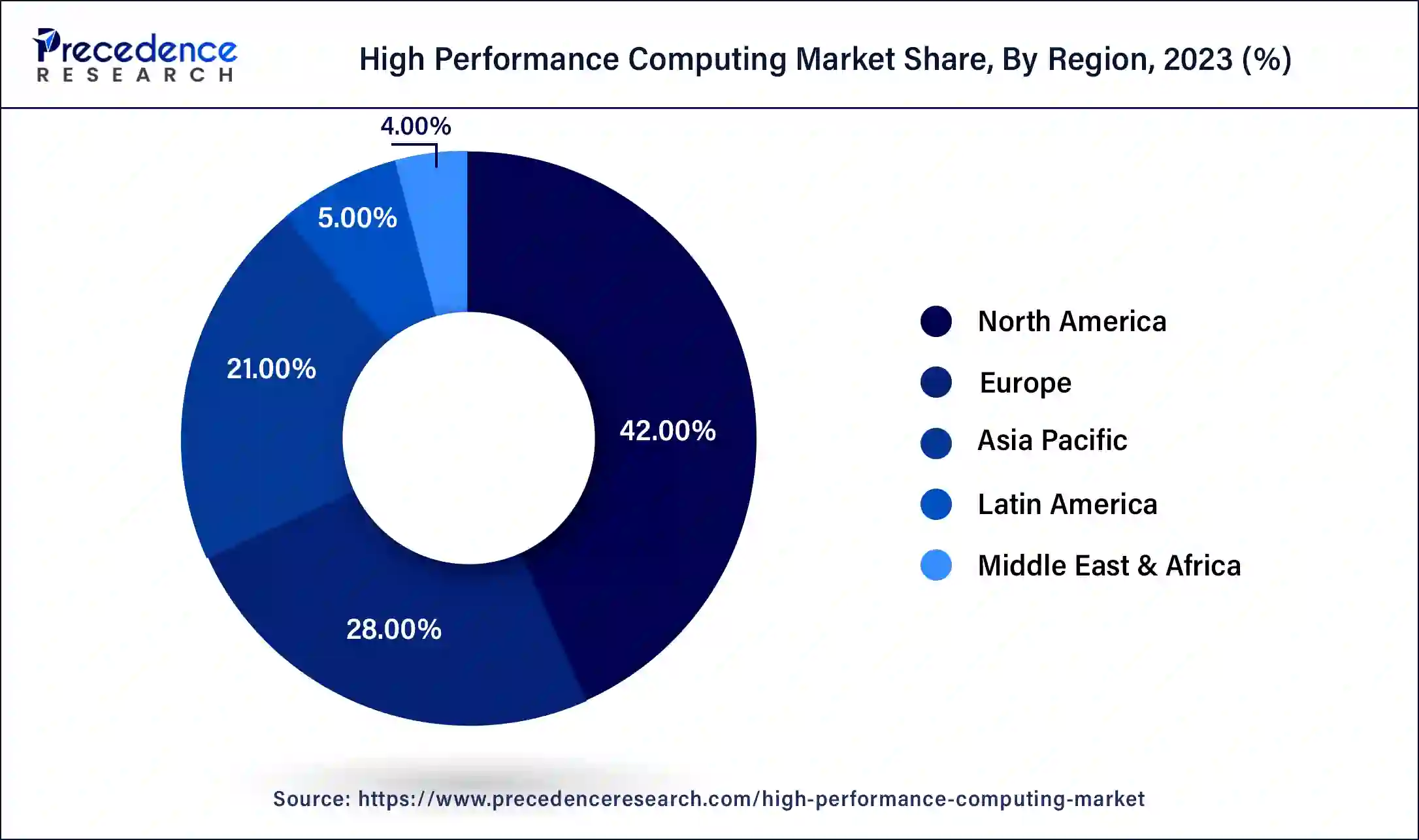
- The North America region has garnered the largest revenue share of 42% in 2025.
- By component, the servers segment has captured the highest revenue share of 34% in 2025.
- By deployment, the on-premise segment has accounted revenue share of 61% in 2025.
- By end-use, the government and defense segment held a revenue share of 26.2% in 2025.
Market Overview
The high performance computing market refers to the development and deployment of cutting-edge computer systems to perform complex simulations, computations, and data analysis. High-performance computing (HPC) systems are characterized by high-speed processing power, high-performance networks, and large-memory capacity. They perform complex calculations much faster than traditional computers. Moreover, HPC is widely used across multiple industries, such as aerospace, automotive, and energy.
Market Trends
- The high-performance computing (HPC) sector is witnessing robust growth, fueled by the increasing demand for sophisticated data processing across various sectors. The surge in the adoption of artificial intelligence (AI) and machine learning (ML) is also driving the market.
- With sectors like healthcare, finance, and autonomous driving relying heavily on AI and ML, the demand for HPC systems is expected to boost.
- With the advent of cloud computing, providers are rolling out scalable HPC solutions, providing organizations with on-demand access to formidable computing resources. This allows small-scale enterprises and research bodies to harness top-tier computational power.
- The market is witnessing various breakthroughs in energy-efficient hardware and cloud-integrated HPC solutions. These are enabling scalable, cost-effective infrastructures that are aligned with sustainability goals.
Market Outlook
- Industry Growth Offerings- The market is growing due to rising demand for advanced data processing, AI, and analytics across sectors like research, finance, and healthcare. Innovations in supercomputers, energy-efficient HPC systems, and cloud-based solutions are driving widespread adoption.
- Global Expansion- The global market is expanding as countries invest in supercomputing infrastructure, AI, and big data initiatives. Cross-border collaborations, government funding, and rising adoption in research, healthcare, and industrial sectors are accelerating international growth.
- Startup ecosystem- The HPC startup ecosystem is thriving, with emerging companies developing AI-driven supercomputing solutions, cloud-based HPC platforms, and energy-efficient servers. Supportive incubators, venture funding, and government initiatives are fostering innovation and accelerating adoption across industries worldwide.
Market Scope
| Report Coverage | Details |
| Market Size in 2025 | USD 59.85 billion |
| Market Size in 2026 | USD 65.42 Billion |
| Market Size by 2035 | USD 141.62 Billion |
| Growth Rate from 2026 to 2035 | CAGR of 9.8% |
| Largest Market | North America |
| Fastest Growing Market | Asia Pacific |
| Base Year | 2025 |
| Forecast Period | 2026 to 2035 |
| Segments Covered | Deployment, Application, Region |
| Regions Covered | North America, Europe, Asia-Pacific, Latin America, and Middle East & Africa |
Segments Insights
Deployment Insights
Which Deployment Segment Dominated the High Performance Computing Market?
The on-premise segment held a dominant position in the market in 2025, as on-premises systems provide greater control over the data. On-premises systems are installed and run on the company's own hardware infrastructure, eliminating data security risks. They do not require annual subscriptions, and the entire instance of software resides within an organization's premises. Organizations can change their on-premises architecture to fit their needs, improving speed and better use of resources.
The cloud segment is expected to grow at the fastest CAGR in the market between 2026 and 2035 due to high scalability, high flexibility, and cost-effectiveness. Cloud systems enable business operators to access their data from anywhere and at any time. They eliminate the need for complex, specialized infrastructure, saving significant time and costs. Cloud systems enable operators to adjust their resources to match demand, avoiding wasteful overprovisioning.
Application Insights
How the High Performance Business Computing Segment Dominated the High Performance Computing Market?
The high performance business computing segment held the largest market share in 2025 due to its widespread applications in business operations to solve complex problems. High performance business computing (HPBC) focuses on commercial transactions, customer data, and market predictions. HPBC can analyze massive sales, run real-time financial risk and stock trades, and detect credit card fraud.
The high performance technical computing segment is expected to grow with the highest CAGR in the market during the studied years. High-performance technical computing (HPTC) focuses on physical simulations, scientific research, and engineering design. HPTC is widely used across multiple sectors, including automotive, aerospace, healthcare, and environmental.
Components Insights
Why Did the Solutions Segment Dominate the High Performance Computing Market?
The solutions segment dominated the market in 2025 due to the availability of user-friendly software solutions. Organizations receive funding from government and private bodies to install advanced solutions. Solutions enable direct control over personal, confidential data without the involvement of third party organizations. Solution developers can tailor their software based on the need of clients.
The services segment is expected to expand rapidly in the market in the coming years due to the presence of favorable infrastructure and skilled professionals. Skilled professionals provide personalized solution to client's complex problems. Business organizations can save time and costs by avoiding the installation of software solutions. Services are comparatively cost-effective, as they are preferred only when required, unlike software, that needs an annual subscription.
Organization Size Insights
Which Organization Size Segment Led the High Performance Computing Market?
The large enterprises segment led the market in 2025 due to the availability of specialized infrastructure and high investments. Large enterprises generates a large amount of data and need to maintain complex data through a centralized system, potentiating the need for HPC. HPC drives critical business value by cutting costs, accelerating research, and enabling real-time decisions.
The small and medium-sized enterprises (SMEs) segment is expected to witness the fastest growth in the market over the forecast period. SMEs receive funding and venture capital investments from government and private organizations, facilitating the installation of HPC systems. HPC enables SMEs to accelerate product innovation, run complex computer simulations, and process big data efficiently.
Regional Insights
The HPC Revolution Driving North America's Tech Frontier
North America held the largest share of 42% in 2024. This is attributed to the region being the largest indigenous market for technology- grounded solution. Also, it's anticipated to be a strong player in the global economy, especially in the perpetration and development of new technologies. While the need to reuse large volumes of raw data is growing, having robust security measures in place is of consummate significance. This is driving the need to apply the rearmost technologies, which, in turn, is encouraging the adoption of HPC systems. Also, North America is the major area of functioning for some of the big enterprises, similar as General Motors and Boeing, which alongside with other SMEs, are aggressively opting for HPC systems to help them in easing the specialized conditions they're facing. As a result, the relinquishment of HPC systems is growing in North America.
U.S. High Performance Computing Market Size and Growth 2026 to 2035
The U.S. high performance computing market size is exhibited at USD 17.70 billion in 2025 and is projected to be worth around USD 43.34 billion by 2035, at a CAGR of 6.57% from 2026 to 2035.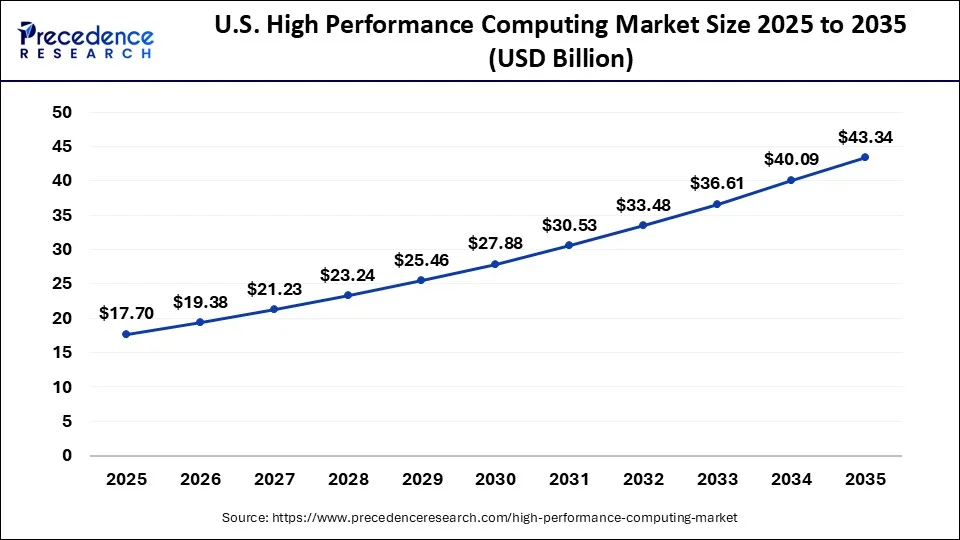
Powering the Future of High-Performance Computing
The U.S. market is growing due to increasing demand for advanced data processing in sectors like scientific research, healthcare, finance, and defense. Rising adoption of AI, machine learning, and big data analytics requires powerful computational capabilities. Government investments, cloud-based HPC solutions, and ongoing innovations in processors and supercomputing infrastructure are further driving growth. Additionally, the need for faster simulations, modeling, and real-time analytics across industries is boosting market expansion.
Riding the Supercomputing Wave to Scientific Breakthroughs
Asia Pacific is projected to expand at the highest CAGR over the forecast period owing to the growing adoption of HPC systems for scientific exploration and weather forecasting. At the same time, China happens to be among the top 10 countries leading in the high performance calculating market. China is also home to supercomputers, similar as Tianhe-2 (Milkyway-2) and Sunway TaihuLight.
Rapid Expansion in High-Performance Computing Landscape in India
India's market is expanding due to growing demand from sectors like scientific research, defense, healthcare, and manufacturing for advanced simulations, modeling, and data analytics. Government initiatives promoting digital infrastructure and supercomputing adoption, coupled with rising investments in AI, machine learning, and big data technologies, are driving growth. Increasing collaboration with global HPC vendors and the development of indigenous supercomputing capabilities further support market expansion across both public and private sectors.
India's Supercomputing Initiative
Government of India's flagship initiative the National Supercomputing Mission (NSM) is empowering the country with high-performance computing abilities and is accessible through the National Knowledge Network (NKN).
- In September 2024, the Indian Government introduced three new supercomputers, PARAM Rudra, across three locations, including Delhi, Pune and Kolkata. Two High-Performance Computing Systems (HPC), named Arka and Arunika were also launched for strengthening India's capacity in technological development and scientific research.
- As of March 2025, a total of 34 supercomputers with a combined computing capacity of 35 Petaflops are positioned across several research organizations, academic institutions and R&D laboratories across India, under the NSM.
Europe: From research Lbs to Real-World HPC Application
Europe's market is increasing due to rising demand for advanced computing in scientific research, healthcare, finance, and automotive sectors. Investments in AI, machine learning, and big data analytics are driving the need for powerful supercomputing infrastructure. Government initiatives, such as the European High-Performance Computing Joint Undertaking (EuroHPC), support the development of next-generation HPC systems. Additionally, growing collaborations between academic institutions, research centers, and technology vendors are accelerating market growth across the region.
UK driving AI and Data-Intensive Innovation with HPC
The UK market is expanding due to increasing demand from sectors like scientific research, finance, healthcare, and defense for advanced simulations, modeling, and data analytics. Government initiatives and funding, including investments in supercomputing infrastructure and AI research, are driving adoption. Collaboration between universities, research institutions, and technology providers is enhancing HPC capabilities. Additionally, the growing need for faster computational power to support AI, machine learning, and big data applications is fueling market growth.
What Potentiates the High Performance Computing Market in Latin America?
The market in Latin America is being driven by ongoing advances in AI-driven workload optimization, which are helping companies gain competitive advantages and form strategic alliances. The region is also witnessing growing investments in 5G connectivity, edge computing, and sovereign cloud initiatives, creating new opportunities for market expansion. Rising demand for AI/ML model training, digital twins, and computational fluid dynamics (CFD) simulations is encouraging organizations to adopt scalable high-performance computing (HPC) infrastructures. Brazil and Mexico are leading the region due to their robust digital transformation efforts. Continuous advancements in cloud architecture and processor technologies are expected to further support market growth.
Brazil High Performance Computing Market Analysis
Brazil is a major contributor to the Latin American market. The market in Brazil is driven by the rising need for high-speed computation without capital-intensive infrastructure. Companies in the area are increasingly adopting high-performance computing services in order to help shorten development cycles and improve innovation speed, which also supports market growth.
What Opportunities Exist in the Middle East & Africa?
The Middle East & Africa (MEA) offers significant opportunities in the high performance computing market. These opportunities arise from the increasing demand for advanced computing solutions in sectors such as oil & gas, healthcare, and education. Governments in this region are recognizing the importance of HPC and are actively investing in infrastructure development, thereby contributing to the market. Countries like the UAE and South Africa are leading players in the region as they benefit from multiple initiatives that are aimed at enhancing research capabilities and boosting technological innovation. The region's focus on building a knowledge-based economy is expected to further drive the demand for HPC solutions in the near future.
Saudi Arabia Performance Computing Market Analysis
Rapid digital transformation initiatives driven by the government Vision 2030 are accelerating enterprise adoption of high-performance computing in the country, especially in sectors like energy, healthcare, and finance. Additionally, initiatives in cloud computing, smart cities, and national research programs are driving demand for scalable HPC infrastructure to support complex data processing and innovation.
Top Vendors and their Offerings
- Atos SE - Provides supercomputing solutions like the BullSequana series, high-performance servers, and AI-enabled HPC platforms for scientific research and enterprise applications.
- Fujitsu - Offers the Fugaku supercomputer, HPC servers, and integrated solutions for AI, data analytics, and large-scale simulations.
- Inspur - Delivers HPC servers, AI computing platforms, and cloud-based high-performance computing solutions for enterprises and research institutions.
- Lenovo - Supplies HPC clusters, servers, and integrated AI and analytics solutions, focusing on energy-efficient and scalable computing systems.
- Intel Corporation - Provides HPC processors, accelerators (like Xeon and Xe GPUs), interconnects, and software tools to support AI, analytics, and supercomputing workloads.
Other Major Key Players
- Advanced Micro Devices, Inc.
- Hewlett Packard Enterprise Development LP
- Cisco Systems, Inc.
- Dell Technologies Inc.
- Intel Corporation
Recent Developments
- In August 2025, IBM (US) unveiled its latest quantum computing system, designed to integrate seamlessly with its existing HPC infrastructure. This development is pivotal as it positions IBM at the forefront of quantum technology, which is anticipated to revolutionize data processing capabilities. By aligning quantum computing with traditional HPC, IBM is likely to attract a diverse range of clients looking for cutting-edge solutions to complex computational problems.
(Source:bing.com ) - In March 2025, Axelera AI, a leading provider of purpose-built AI hardware acceleration technology for computer vision inference and generative AI, launched its high-performance, energy efficient and scalable AI inference chiplet, Titania with an innovative approach to Digital In-Memory Computing (D-IMC) architecture. The development of this chiplet was supported by funding of €61.6 million from the EuroHPC Joint Undertaking (JU) and member states as part of the Digital Autonomy with RISC-V for Europe (DARE) Project, following the successful closing of an oversubscribed Series B financing round of $68 million for Axelera AI.
Segments Covered in the Report
By Deployment
- Cloud
- On-Premise
By Application
- High Performance Technical Computing
- Government
- Chemical
- Bio-Science
- University /Academic
- Large Product Manufacturing
- Consumer product Manufacturing
- Energy
- Electronics
- Others
- High Performance Business Computing
- Media Entertainment
- Online Game
- Retail
- Financial Service
- Ultra-scale Internet
- Transportation
- Others
By Components
- Solutions
- Servers
- Storage
- Networking Devices
- Software
- Services
- Design and Consulting
- Integration and Deployment
- Support and Maintenance, and Management
By Server Price Band
- USD 250,000 to 500,000 and Above
- USD 250,000 to 100,000 and Below
By Organization Size
- Small and Medium-sized Enterprises (SMEs)
- Large Enterprises
By Region
- North America
- Europe
- Asia-Pacific
- Latin America
- Middle East & Africa
For inquiries regarding discounts, bulk purchases, or customization requests, please contact us at sales@precedenceresearch.com
Frequently Asked Questions





Ask For Sample
No cookie-cutter, only authentic analysis – take the 1st step to become a Precedence Research client
 Get a Sample




 sales@precedenceresearch.com
 Schedule a Meeting
