






 Request Consultation
AI sovereignty means keeping control of your AI its data, models, and infrastructure so businesses and nations can stay secure, compliant, and independent while still innovating, rather than relying fully on external tech providers.
Artificial intelligence is no longer just a tool for efficiency or innovation. It has become a strategic asset that shapes national competitiveness, enterprise resilience, and long-term economic control. As organizations increasingly depend on AI for core operations, a new priority has emerged across boardrooms and governments alike: AI sovereignty.
AI sovereignty refers to the ability of nations and enterprises to control how artificial intelligence systems are built, trained, deployed, governed, and secured within their legal, ethical, and strategic boundaries. In today’s environment, where AI models are often trained on global data sets and deployed through foreign cloud infrastructure, sovereignty is becoming as critical as performance.
This shift is not driven by ideology alone. It is driven by regulation, geopolitics, cybersecurity concerns, and the realization that dependency on external AI ecosystems can expose businesses to risks that are operational, legal, and reputational. As a result, AI sovereignty is reshaping how organizations design their AI strategies, choose technology partners, and invest in infrastructure.
The Evolution of AI Sovereignty from Policy Concept to Business Imperative
Initially, AI sovereignty was discussed primarily at the government level. Policymakers focused on national security, data localization, and technological independence. Over the past few years, however, the concept has moved decisively into the private sector.
Large enterprises now recognize that AI systems influence pricing decisions, customer interactions, product development, and risk assessment. When these systems rely on external providers with limited transparency or cross-border data exposure, organizations lose a degree of control over their most critical digital assets.
Industry leaders increasingly acknowledge that AI sovereignty is no longer optional.
A global technology executive recently summarized this shift by stating that AI sovereignty is about ensuring that strategic intelligence remains under the control of the organization, not outsourced entirely to platforms that may be governed by external rules and priorities.
This mindset marks a turning point. AI is no longer treated as a plug-and-play service but as a core capability that requires deliberate ownership and governance.
Why AI Sovereignty Matters More Than Ever
Several forces are converging to make AI sovereignty a defining issue for the next decade.
Regulatory Pressure Is Intensifying
Governments across regions are introducing AI-specific regulations that demand transparency, accountability, and traceability. These regulations increasingly require organizations to demonstrate where data comes from, how models are trained, and how decisions are made.
For multinational enterprises, this creates complexity. AI systems that operate across borders must comply with multiple legal frameworks. Sovereign AI approaches allow companies to localize compliance without fragmenting their entire AI strategy.
A compliance leader from a global financial institution noted that AI sovereignty is becoming essential not because regulators demand isolation, but because they demand clarity and control.
Data Sensitivity and Trust Are Central Concerns
AI systems are only as trustworthy as the data they consume. In sectors such as healthcare, finance, defense, and public services, data sensitivity is extremely high. Unauthorized access, opaque data handling, or foreign jurisdiction exposure can undermine trust overnight.
By adopting sovereign AI models, organizations can ensure that sensitive data remains within approved environments and is governed by internal security and ethics frameworks.
Dependency Risks Are Becoming Visible
The rapid growth of generative AI has concentrated power among a small number of global providers. While these platforms offer speed and scale, they also create dependency risks.
Executives increasingly express concern that over-reliance on external AI ecosystems limits strategic flexibility. Pricing changes, service disruptions, or policy shifts by providers can have immediate downstream impacts on business operations.
AI sovereignty offers a counterbalance by enabling organizations to retain optionality and control over their AI roadmap.
Core Dimensions of AI Sovereignty
AI sovereignty is not a single decision or technology choice. It is a multi-layered strategy built on several interconnected dimensions.
Data Sovereignty
Data sovereignty ensures that data used by AI systems is stored, processed, and governed in accordance with local laws and organizational policies. This includes data residency, access controls, encryption standards, and auditability.
For many organizations, data sovereignty is the foundation upon which all other AI governance efforts are built.
Model and Algorithmic Sovereignty
Beyond data, organizations must understand and control how AI models operate. This includes visibility into training data sources, model behavior, bias mitigation, and decision logic.
Industry leaders emphasize that true sovereignty requires the ability to inspect, test, and adapt models rather than treating them as black boxes.
Infrastructure Sovereignty
Infrastructure sovereignty refers to control over the computing environments that run AI workloads. This may involve on-premises systems, sovereign cloud platforms, or regionally governed infrastructure partners.
The goal is not isolation but assurance that infrastructure aligns with legal, security, and operational requirements.
Operational Sovereignty
Operational sovereignty ensures that organizations can manage, monitor, and modify AI systems independently. This includes incident response, model updates, compliance reporting, and lifecycle management.
An operations executive from a manufacturing firm observed that sovereignty ultimately means being able to act decisively when something goes wrong, without waiting for external approvals or fixes.
Industry Perspectives on AI Sovereignty
Across industries, leaders are articulating similar priorities, even if their implementation approaches differ. A chief information officer at a global bank stated that AI sovereignty is about balancing innovation with responsibility, ensuring that advanced analytics enhance decision-making without compromising regulatory obligations.
A healthcare technology leader emphasized that sovereign AI is essential for maintaining patient trust, particularly as AI becomes more involved in diagnostics and treatment planning.
Meanwhile, a cloud infrastructure executive highlighted that sovereignty does not mean rejecting global platforms but designing architectures that allow portability, transparency, and choice. These perspectives reflect a growing consensus: AI sovereignty is not about retreating from innovation but about governing it intelligently.
AI Sovereignty Approaches and Business Impact
| AI Sovereignty Approach | Description | Business Benefits | Key Challenges |
| On-Premises AI | AI systems hosted entirely within internal infrastructure | Maximum control and security | High cost and limited scalability |
| Sovereign Cloud | Regionally governed cloud platforms | Regulatory alignment and flexibility | Vendor availability may be limited |
| Hybrid AI Models | Combination of public and private environments | Balance of scale and control | Increased architectural complexity |
| Federated AI | Decentralized model training | Data privacy and collaboration | Technical and coordination challenges |
Strategic Approaches to Achieving AI Sovereignty
Organizations are pursuing AI sovereignty through a variety of strategic models, depending on their industry, geography, and risk profile.
Hybrid AI Architectures
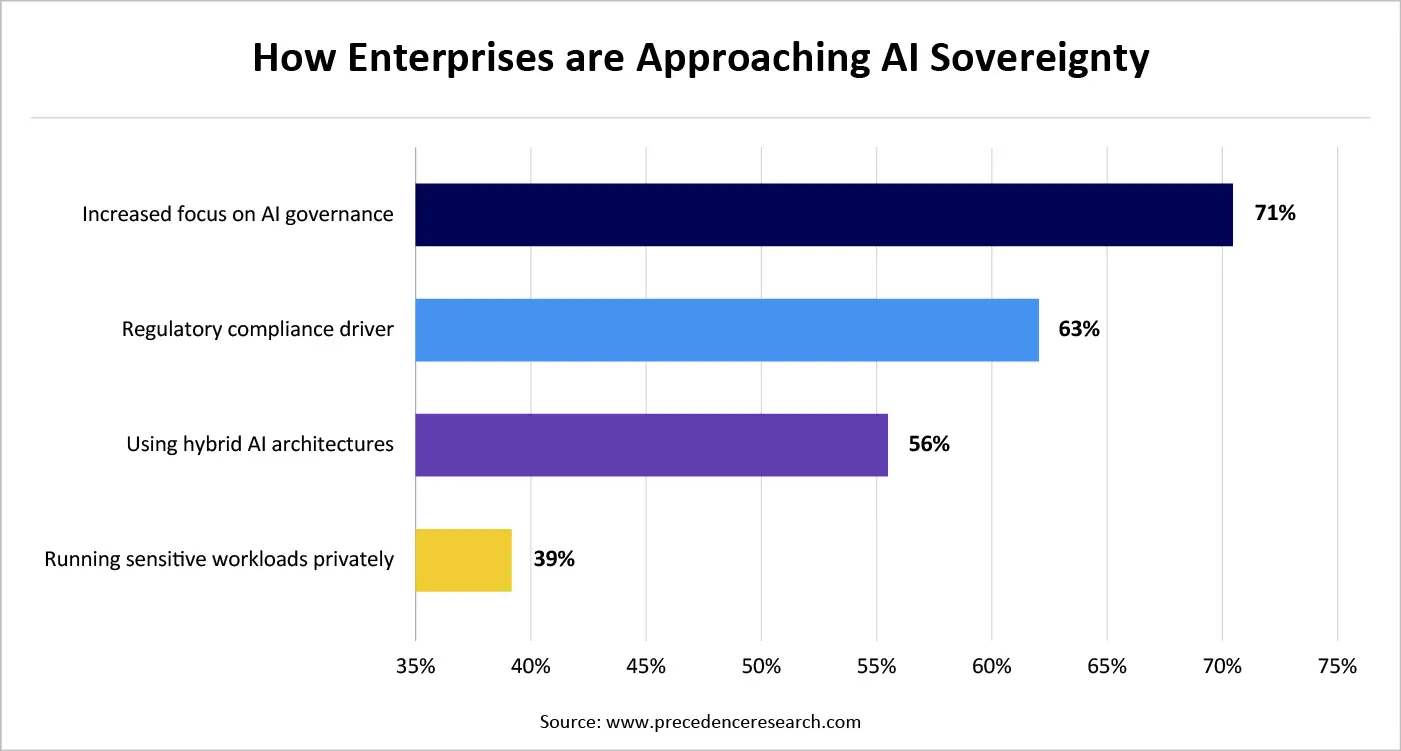
Many enterprises are adopting hybrid approaches that combine public cloud capabilities with private or sovereign environments. This allows them to leverage scalability while retaining control over sensitive workloads.
Federated and Distributed Learning
Federated learning enables AI models to be trained across decentralized data sources without transferring raw data. This approach supports collaboration while preserving data sovereignty.
Vendor Diversification
Rather than relying on a single AI provider, organizations are diversifying their technology stack to reduce dependency risks and increase negotiation leverage.
Governance-First Design
Leading organizations embed governance into AI system design from the outset. This includes ethics committees, model review processes, and clear accountability structures.
AI Sovereignty as a Boardroom Governance Issue
For enterprise leaders, AI sovereignty is no longer a technology discussion delegated to IT teams. It is increasingly a governance and risk issue that requires direct board oversight. As AI systems influence revenue forecasting, customer eligibility decisions, supply chain optimization, and workforce management, the consequences of limited control are amplified. Boards are now asking where AI models are hosted, who has access to training data, and whether decision logic can be explained under regulatory or legal scrutiny. In this context, AI sovereignty becomes a mechanism for enterprise accountability, ensuring that strategic intelligence assets are governed with the same rigor as financial or operational systems.
Enterprise Adoption of Sovereign AI
Economic and Competitive Implications
AI sovereignty is increasingly viewed as a competitive differentiator. Organizations that demonstrate strong governance and control are better positioned to win customer trust, secure partnerships, and enter regulated markets.
From an economic standpoint, sovereign AI strategies are driving investment in local infrastructure, talent development, and innovation ecosystems. This has long-term implications for workforce skills and regional competitiveness.
Executives note that AI sovereignty investments often pay dividends beyond compliance, improving system reliability, resilience, and strategic clarity.
Key Investment Priorities Supporting AI Sovereignty
| Investment Area | Strategic Objective | Business Outcome |
| AI Governance Frameworks | Oversight and accountability | Reduced regulatory and reputational risk |
| Secure Data Platforms | Data localization and protection | Increased trust and compliance readiness |
| Explainable AI Tools | Model transparency | Improved decision confidence |
| Sovereign Infrastructure | Control over deployment | Operational resilience |
Challenges Organizations Must Address
Despite its benefits, AI sovereignty is not without obstacles.
Cost remains a significant barrier, particularly for smaller organizations. Talent shortages also pose challenges, as sovereign AI requires expertise in security, compliance, and advanced engineering. There is also a risk of fragmentation if sovereignty initiatives are pursued without interoperability in mind. Industry leaders caution that isolation can slow innovation and reduce the benefits of global collaboration.
Looking forward, AI sovereignty will continue to shape how AI ecosystems evolve. Standards bodies, industry consortia, and regulators will play a critical role in defining shared frameworks that enable trust without stifling innovation. Enterprises that act early will be better positioned to adapt as regulations mature and expectations increase.
As one senior executive put it, AI sovereignty is not about building walls. It is about building foundations that allow innovation to scale responsibly.
About the Authors

Aditi Shivarkar
Aditi, Vice President at Precedence Research, brings over 15 years of expertise at the intersection of technology, innovation, and strategic market intelligence. A visionary leader, she excels in transforming complex data into actionable insights that empower businesses to thrive in dynamic markets. Her leadership combines analytical precision with forward-thinking strategy, driving measurable growth, competitive advantage, and lasting impact across industries.



Aman Singh
Aman Singh with over 13 years of progressive expertise at the intersection of technology, innovation, and strategic market intelligence, Aman Singh stands as a leading authority in global research and consulting. Renowned for his ability to decode complex technological transformations, he provides forward-looking insights that drive strategic decision-making. At Precedence Research, Aman leads a global team of analysts, fostering a culture of research excellence, analytical precision, and visionary thinking.

Piyush Pawar
Piyush Pawar brings over a decade of experience as Senior Manager, Sales & Business Growth, acting as the essential liaison between clients and our research authors. He translates sophisticated insights into practical strategies, ensuring client objectives are met with precision. Piyush’s expertise in market dynamics, relationship management, and strategic execution enables organizations to leverage intelligence effectively, achieving operational excellence, innovation, and sustained growth.