






 Request Consultation
Technology trends signal deep, connected shifts in how value is created, combining intelligence, automation, and human collaboration to drive adaptable, resilient, and future-ready organizations.
Technology trends represent more than emerging tools or transient innovations; they signal deeper structural shifts in how organizations create value, society’s function, and economies evolve. In contemporary discourse, technology trends are increasingly viewed as interconnected forces shaping strategic choices, organizational capabilities, and long-term competitiveness. This article presents an analytical examination of major technology trends through a strategic and conceptual lens, emphasizing their systemic nature, drivers of convergence, and implications for organizations and policymakers. Rather than cataloging technologies, the discussion focuses on how trends redefine decision-making, operating models, and the future of work.
Introduction
The pace, scale, and scope of technological change have accelerated to a point where traditional forecasting models struggle to remain relevant. Organizations no longer face isolated technological innovations but rather clusters of interdependent trends that evolve simultaneously. In this environment, understanding technology trends requires interpretive capability, distinguishing signal from noise, and translating innovation into strategic relevance. Technology trends today are not solely technical phenomena; they are socio-economic forces that reshape power structures, labor markets, and institutional norms. As a result, leaders must engage with technology trends not as optional experiments but as foundational elements of long-term strategy.
Inviting Tomorrow: The Technologies Shaping the Future Horizon
The future is no longer a distant concept; it is actively being constructed through a convergence of emerging technologies that are redefining how societies function, businesses compete, and individuals experience the world. Rather than advancing in isolation, the latest technologies are evolving as interconnected systems, collectively shaping a new era of intelligence, automation, and human technologies are evolving as interconnected systems, collectively shaping a new era of intelligence, automation, and human technology collaboration. This article explores the most influential technological directions poised to define the future, emphasizing their strategic and societal significance.
- Intelligent Systems and Augmented Decision Making: The evolution of intelligent systems marks a shift from technology as a passive tool to technology as a collaborator. Future-facing systems are designed to sense, learn, and adapt in real time, supporting complex decision-making across domains. These systems enhance human judgement rather than replace it, enabling faster insights, predictive foresight, and context-aware responses. The strategic value lies in their ability to transform uncertainty into informed action.
- Autonomous and self-optimizing technologies: Autonomy represents a defining feature of next-generation technologies. Systems are increasingly capable of operating with minimal human intervention, constantly optimizing performance through feedback loops. From adaptive manufacturing environments to self-regulating digital operations, autonomy enhances efficiency, resilience, and scalability. These technologies redefine operational models by shifting focus from control to supervision and orchestration.
- Immersive Digital Environments: Future technologies are expanding digital interaction beyond screens into immersive environments. These experiences integrate physical and virtual dimensions, enabling deeper engagement, realistic simulation, and experimental learning. Immersive environments hold transformative potential for education, training, and design, and collaboration by enabling users to interact with information spatially and intuitively. They represent a move toward experience-centric digital ecosystems.
- Next-Generation Connectivity and Distributed Intelligence: Connectivity is evolving from simple data transmission to intelligent, distributed networks. Future communication technologies enable seamless interaction between devices, systems, and environments, supporting real-time responsiveness at scale. The shift decentralizes intelligence, allowing decisions to occur closer to the point of action. As a result, systems become faster, more efficient, and more resilient to disruption.
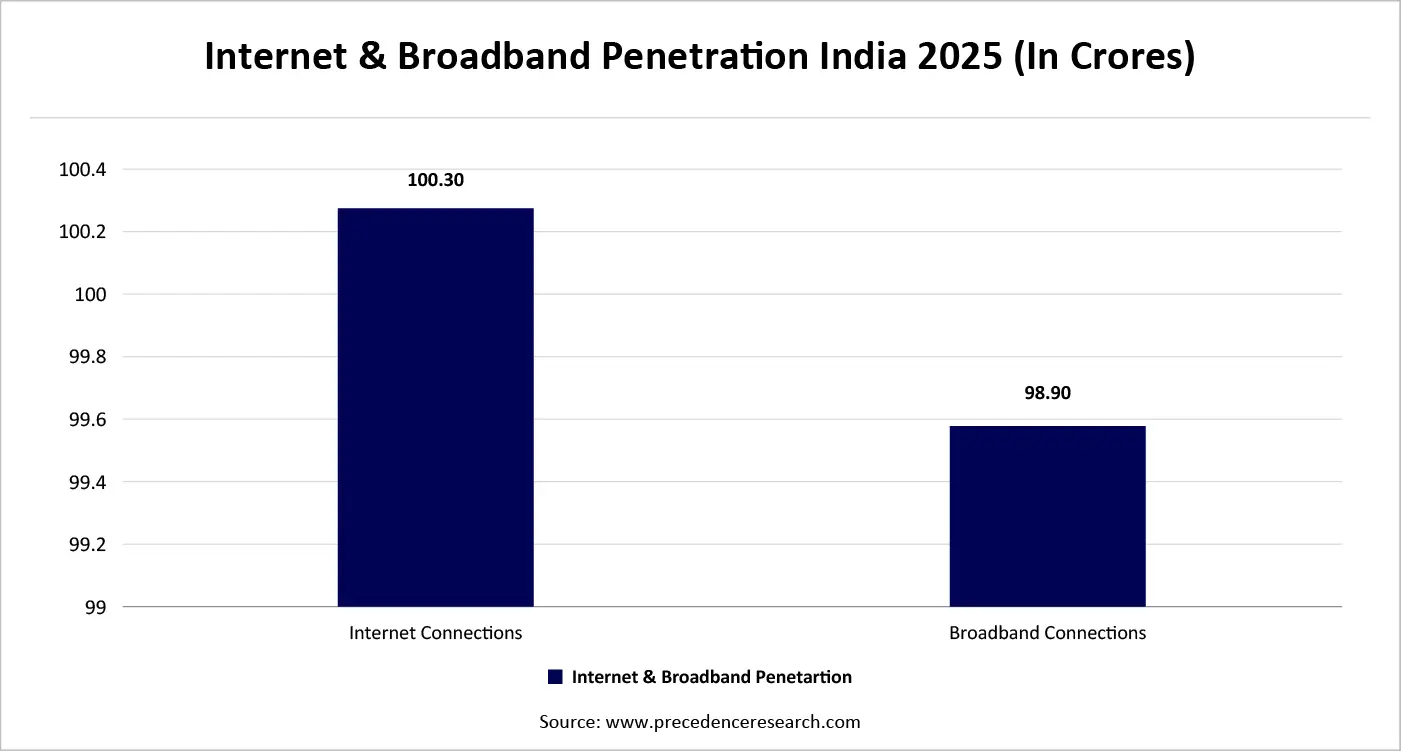
Internet & Broadband Penetration India 2025 (In Crores)
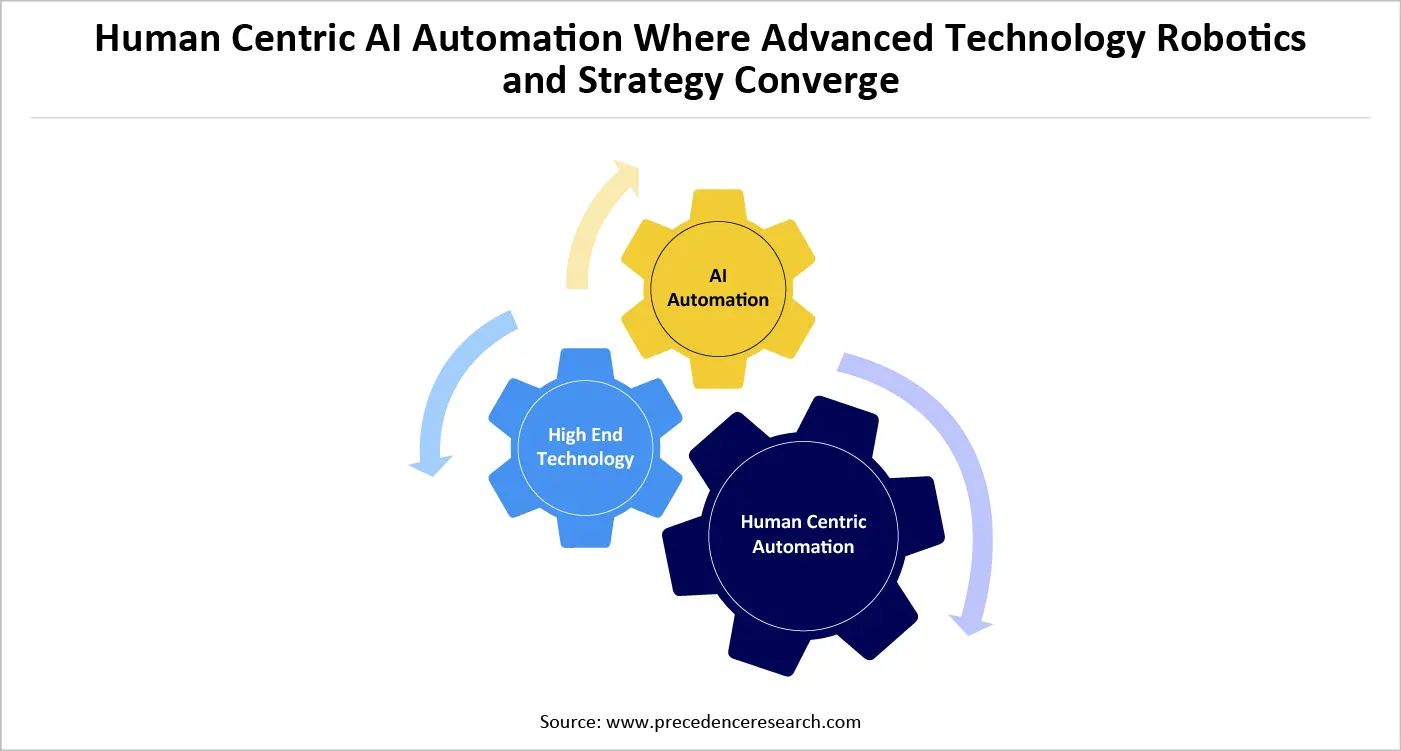
- Human-Centric Automation and Robotics: The future of automation emphasizes collaboration between humans and machines. Advanced robotic systems are being designed with adaptability, perception, and safety at their core, allowing them to work alongside humans in dynamic environments. These technologies augment physical and cognitive capabilities, transforming work by enhancing productivity while preserving human creativity and judgment.
Human Centric AI Automation Where Advanced Technology Robotics and Strategy Converge
Technology Trends as Strategy Indicators.
Technology trends are signals of a direction change and not forecasts of the future. They are produced when there is agreement between the scientific progress, economic feasibility, and social dispositions. However, in contrast to the old times when technologies developed separately, this is not the case with the current trends, which support each other and compound in their influence. Organizations that perceive trends as temporary experiments take the risk of being fragmented. Those who discern trends as structural changes develop resiliency and a long-lasting competitive edge.
Technological Trends Evolution: Discrete Tools to Built-in Systems.
The changing trends in technology are a manifestation of a paradigm change in the way organizations view, implement, and extract value from technology. What started as the incorporation of individualized tools to combat certain organizational demands has gradually evolved to be a combined, intelligent system, which determines organizational strategy and structure. Such a shift of tools to systems is not only a technology improvement, but also a change of mentality, a shift to efficiency-focused problem solving to holistic, ability-based value creation.
Phase 1: Technology as Individual tools.
In the initial phases of technology adoption, the organizations implemented technology as a single tool. These aids were meant to mechanize or assist in well-articulated processes like record keeping, calculations, or even the simple execution of processes. The technological solutions were isolated, and there was not much communication within the departments or functions. The main goal in this stage was operational efficiency. The investments in technologies were supported by the short-term benefits in the form of productivity improvement, cost savings, or reduction of errors. Decision-making continued to be a human-based activity, but technology was applied as a supportive tool and not a strategic resource. But the weaknesses of this method got more pronounced. Discrete tools tended to form data silos, redundant work, and limit scalability. Although useful where local problems needed to be met, they were unable to facilitate the cross-functional coordination or enterprise-wide visibility.
Phase 2: Financing and Operational Integration.
Digitalization became a binding force as organizations realized the inefficiencies in an isolated system. This stage was where individual tools were changed to built-in digital systems. There was an increased interconnection of technologies based on shared databases, standardized interfaces, and enterprise platforms. Integration facilitated the smooth flow of data among the functions like operations, finance, and customer management. There was increased transparency and coordination of processes, which minimized the occurrence of redundancy and increased consistency. Technology not only started to affect the way of performing tasks are performed, but it also started to affect the way of designing and managed.
Phase 3: Data-Driven and Platform-Based Systems.
From Discrete Tools to Data Driven Digital Platforms Shaping Intelligent Enterprise Systems
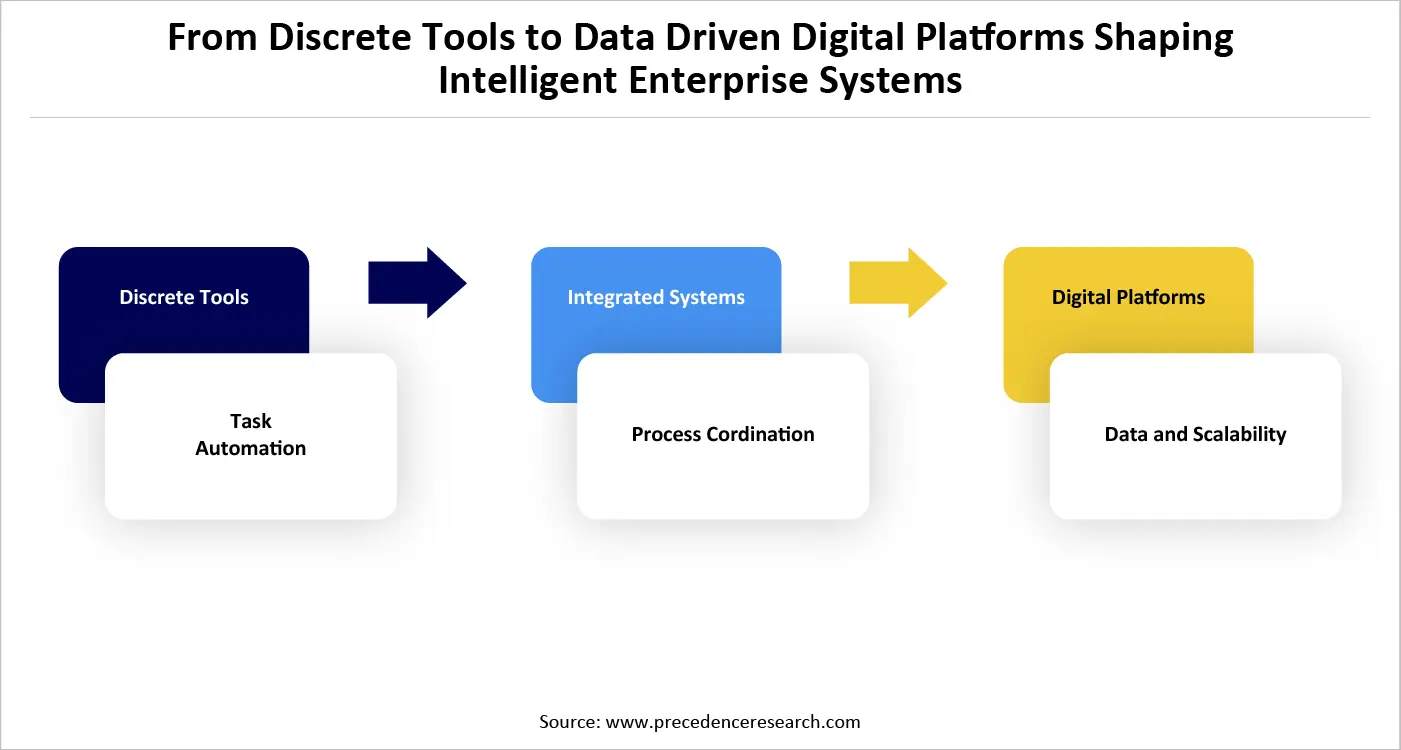
The subsequent stage of evolution offered platform-based frameworks and information-focused strategies. Technology systems became more than integration; they formed the building's infrastructure on which many applications and stakeholders run. Scalability, modularity, and extensibility were possible through platforms, and organizations could innovate faster. Data was identified as a strategic asset, which propelled insights, personalization, and anticipatory powers. Systems no longer just passed events through, but analyzed trends and made judgments. This was the start of the intelligent systems, where technology played a significant role in strategic results.
The progression from tools to systems signifies a shift in strategic thinking. Organizations must move from evaluating technology investments based on isolated returns to understanding their contribution to system-wide capability. Leadership focus shifts toward integration, orchestration, and continuous learning. This evolution also demands a balance between innovation and governance. As systems become more autonomous and interconnected, issues of trust, security, and accountability gain prominence.
As we can observe in the diagram, the evolution of technology trends from discrete tools to integrated systems reflects a broader transformation in how organizations create value. Early tool-based adoption delivered efficiency, but system-level transformation enables intelligence, adaptability, and sustained competitiveness. Understanding this evolution is essential for organizations seeking to navigate technological complexity and harness technology not merely as a resource, but as a strategic system shaping their future.
Data Centric Technologies and Intelligent Systems: From Information to Foresight
In the modern digital economy, data has ceased to be a by-product of the operations, but it is the most important strategic asset of modern organizations. Intelligent systems and data-centric technologies are a turning point in the generation of insights, the decisions made, and the sustainable value created by enterprises. This development exemplifies the move towards hindsight-oriented reporting, which is preoccupied with what has already occurred, to foresight-oriented intelligence, which is anticipatory, strategic, and formulates responses to change.
- The Emergence of Data as a Resource Base: The past data in organizations used to be disjointed, underutilized, and was mainly held back by compliance or record-keeping purposes. Information systems emphasized the transaction but not the extraction of meaning. With the rise in digitalization, the level of data has grown exponentially with the spread of interconnected systems, digital interactions, sensors, and platforms.
- Introduction to Descriptive Analytics to Intelligence Systems: Initial use of data was based on descriptive analytics, which responds to questions like what and when. Conventional reporting systems were based on past information, and they created fixed dashboards and periodic reports. As useful as they were, the methods were backward-looking and tactical in nature. The advent of sophisticated analytics was a change. Predictive/prescriptive methods allowed organizations to investigate the reasons for things that occurred and why things would occur, or occur, and what needs to be done. Smart systems are now able to take data, algorithms, and contextual awareness to provide actionable insights in real time.
- Data Acquisition and Integration: The information is gathered through a variety of internal and external sources such as operational systems, digital platforms, sensors, and partner ecosystems. Integration is used to provide consistency, interoperability, and quality of data throughout the organization.
- Data Governance and Management: Strong governance systems bring about set guidelines on the ownership, security, privacy, and ethical usage of data. This layer guarantees trust and reliability, which are crucial to intelligence-based decision-making. Raw data are converted into insights using advanced analytics, machine learning, and rule-based models. These features facilitate pattern recognition, prediction, and optimizing scale.
- Decision and Action Layer: Insights have been internalized in workflows, dashboards, and automated systems. Depending on risk profile and context, decisions can be human-guided, system-aided, or automated all the way.
- Decision Support to decision intelligence: Conventional systems assisted the decision-makers by providing facts. Intelligent systems, on the contrary, have a role in decision-making. They prescribe behaviour, role play, and trial. This change toward decision intelligence brings technology closer to the strategic goals. Instead of maximizing the isolated processes, organizations use intelligence systems to correlate decisions between functions to make them coherent and agile. What is produced is a more responsive organization that can survive in dynamic environments.
Data Centric Intelligence Driving Anticipatory Decision Making and Adaptive Organizational Systems
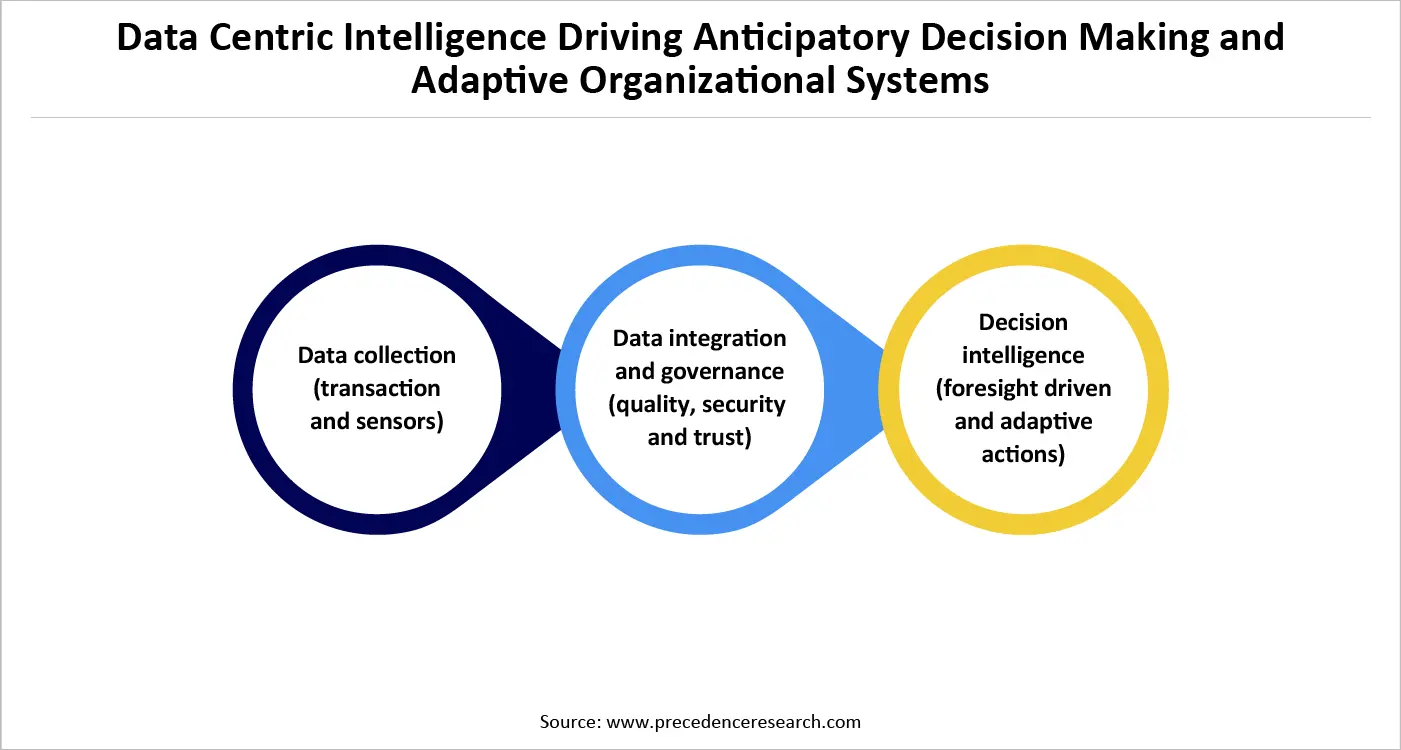
In the above diagram, the data-centric technologies and intelligent systems represent a paradigm shift in organizational capability. By moving beyond intelligence, organizations gain the ability to anticipate change, optimize decisions, and sustain long-term value creation. In an era defined by complexity and speed, intelligence powered by data has become the defining factor of organizational success.
Artificial Intelligence and Intelligent Automation: Digital Capability Redefined
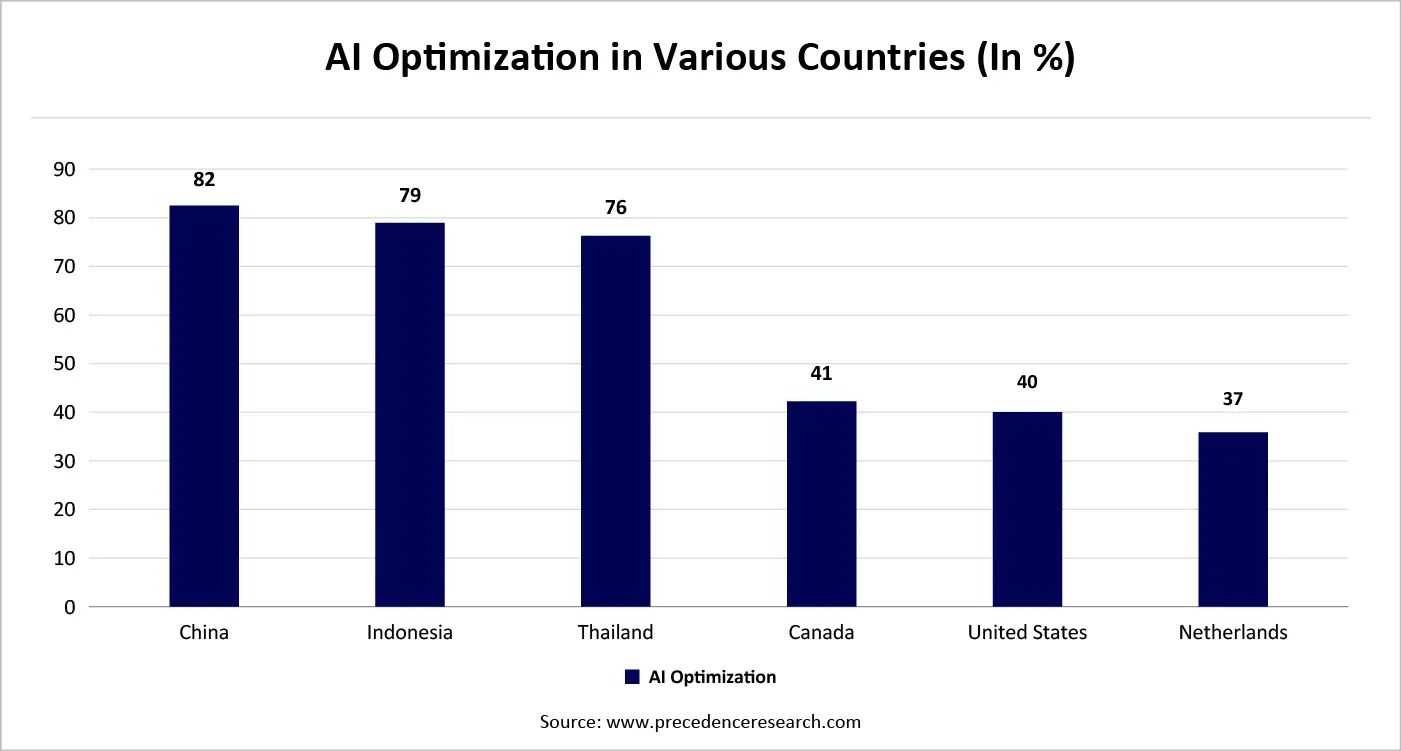
Artificial Intelligence (AI) and Intelligent Automation are the convergence of computational intelligence, data-driven decisions, and automated implementation. Collectively, they take technology more than merely aiding man to increase, or even, in certain instances, autonomously, performing complex thinking and functioning capabilities. This transformation alters the way companies plan workflows, distribute resources, and aim for scalable efficiency and innovation. Rule-based traditional automation automated structured tasks that were repetitive and had a fixed logic. It was faster and more regular, yet not as adaptive and contextual. When an input was not as expected, a human being was required to step in.
Artificial intelligence automation is a radical development. Intelligent automation can process unstructured data, learn and adapt to changing conditions, as machine learning, natural language processing, computer vision, and reasoning models combine to interpret data. Automation has not only ceased to exist as a deterministic process, but it also encompasses decision-making, pattern recognition, and predictive execution. Intelligent automation is an interplay between AI and automation technologies that are used to execute end-to-end processes. It can operate in both structured and unstructured environments, unlike conventional automation, which typically only works in structured environments.
Platforms, ecosystems, and network-based models: Redefining Value Creation
The current digital economy is characterized by phantomization, which transforms traditional linear value chains into dynamic, networked ecosystems. This shift necessitates a decrease in asset ownership and emphasizes interactions and participation among various actors to create value. Traditionally, companies operated in a linear model where they processed raw materials into quality products, leveraging efficiency and asset ownership for competitive advantage. However, platforms disrupt this model by forming multi-sided networks that connect producers, consumers, and partners within a shared digital environment.
These platforms enable participants to co-create value instead of following the linear push-down approach. They serve as fundamental infrastructures for scalable participation, equipped with standard interfaces, common rules, and governance tools that facilitate collaboration while reducing friction. As more users join a platform, network effects enhance its value, making it more robust. Platforms are designed to be open, extensible, and modular, allowing ecosystems to evolve naturally and fostering innovation that is not fully regulated by the platform owner. The key to a platform’s success lies in its openness combined with effective governance to uphold trust, quality, and sustainability.
Suppliers and Producers Converging Through Platforms to Transform Distribution Models
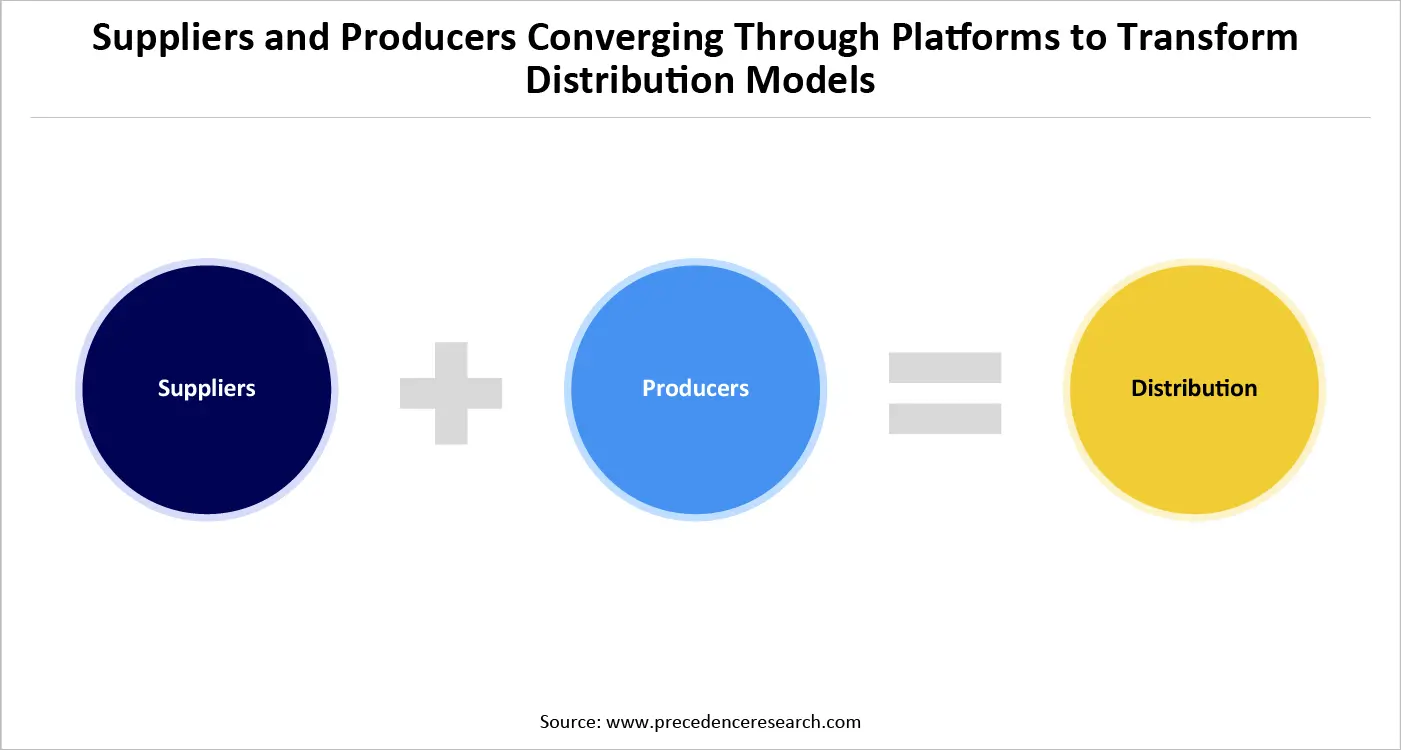
Platforms, ecosystems, and network-based models represent a fundamental redefinition of how value is created and sustained in the digital era. As linear value chains give way to dynamic ecosystems, competitive advantage increasingly rests on orchestration rather than ownership. Organizations that master this transition position themselves not merely as market participants but as architects of interconnected value systems capable of scaling innovation, resilience, and long-term growth.
Future Possibilities and Conclusion: Toward Intelligent, Orchestrated Digital Futures
As digital transformation matures, the convergence of platforms, data-centric intelligence, artificial intelligence, and ecosystem-based models signals a profound reconfiguration of how organizations create value and sustain relevance. The future will not be defined by individual technologies in isolation, but by how effectively these capabilities are integrated, governed, and orchestrated at a system level.
Future Possibilities: Emerging Directions of Transformation
Autonomous and Self-Evolving Systems
Future digital systems will increasingly possess self-learning and self-optimizing capabilities. Rather than being periodically reconfigured by humans, systems will adapt continuously based on environmental signals, performance outcomes, and strategic objectives. This will enable organizations to operate with greater speed, resilience, and precision in volatile contexts.
Decision Intelligence as a Core Organizational Capability
Decision-making will evolve from episodic executive judgment to continuous, intelligence-assisted processes embedded across the enterprise. Predictive and prescriptive intelligence will guide operational, tactical, and strategic decisions, reducing uncertainty while preserving human oversight for ethical and creative judgment.
Deepening of Platform Ecosystems
Ecosystems will expand beyond transactional interactions into deeply integrated value networks. Organizations will increasingly participate in multiple ecosystems simultaneously, requiring advanced orchestration skills to manage interdependencies, data sharing, and trust. Ecosystem leadership will hinge on the ability to design inclusive, adaptable participation models.
Human–Machine Symbiosis
Rather than replacing human capability, future technologies will amplify it. Intelligent automation will handle complexity, scale, and pattern recognition, while humans focus on sense-making, ethics, innovation, and relational leadership. New roles will emerge at the intersection of technology, governance, and strategy.
Responsible and Ethical Technology Architectures
As systems become more autonomous and interconnected, responsible design will become non-negotiable. Transparency, explainability, data stewardship, and ethical governance will be embedded into digital architectures. Trust will emerge as a central currency of digital ecosystems.
From Digital Transformation to Digital Continuity
Digital transformation will no longer be viewed as a finite initiative. Instead, organizations will adopt a model of digital continuity, an ongoing capability to evolve, reconfigure, and renew systems in alignment with shifting market and societal expectations.
Conclusion
The evolution of technology trends from discrete tools to intelligent systems and orchestrated ecosystems marks a decisive shift in the logic of value creation. In this emerging paradigm, competitive advantage is no longer derived from ownership of assets or isolated technological adoption, but from the ability to integrate intelligence, enable collaboration, and orchestrate complex networks. Future-ready organizations will be those that treat technology as a living system, continuously learning, ethically governed, and strategically aligned.
By embracing foresight-driven intelligence, platform-based ecosystems, and human–machine collaboration, enterprises can move beyond efficiency gains toward sustained innovation and resilience. Ultimately, the digital future belongs not to those who adopt the most advanced technologies, but to those who design the most adaptive, responsible, and intelligent systems.
About the Authors

Aditi Shivarkar
Aditi, Vice President at Precedence Research, brings over 15 years of expertise at the intersection of technology, innovation, and strategic market intelligence. A visionary leader, she excels in transforming complex data into actionable insights that empower businesses to thrive in dynamic markets. Her leadership combines analytical precision with forward-thinking strategy, driving measurable growth, competitive advantage, and lasting impact across industries.



Aman Singh
Aman Singh with over 13 years of progressive expertise at the intersection of technology, innovation, and strategic market intelligence, Aman Singh stands as a leading authority in global research and consulting. Renowned for his ability to decode complex technological transformations, he provides forward-looking insights that drive strategic decision-making. At Precedence Research, Aman leads a global team of analysts, fostering a culture of research excellence, analytical precision, and visionary thinking.

Piyush Pawar
Piyush Pawar brings over a decade of experience as Senior Manager, Sales & Business Growth, acting as the essential liaison between clients and our research authors. He translates sophisticated insights into practical strategies, ensuring client objectives are met with precision. Piyush’s expertise in market dynamics, relationship management, and strategic execution enables organizations to leverage intelligence effectively, achieving operational excellence, innovation, and sustained growth.